Allergy Symptoms Worse at Night? Bedroom Air Checklist

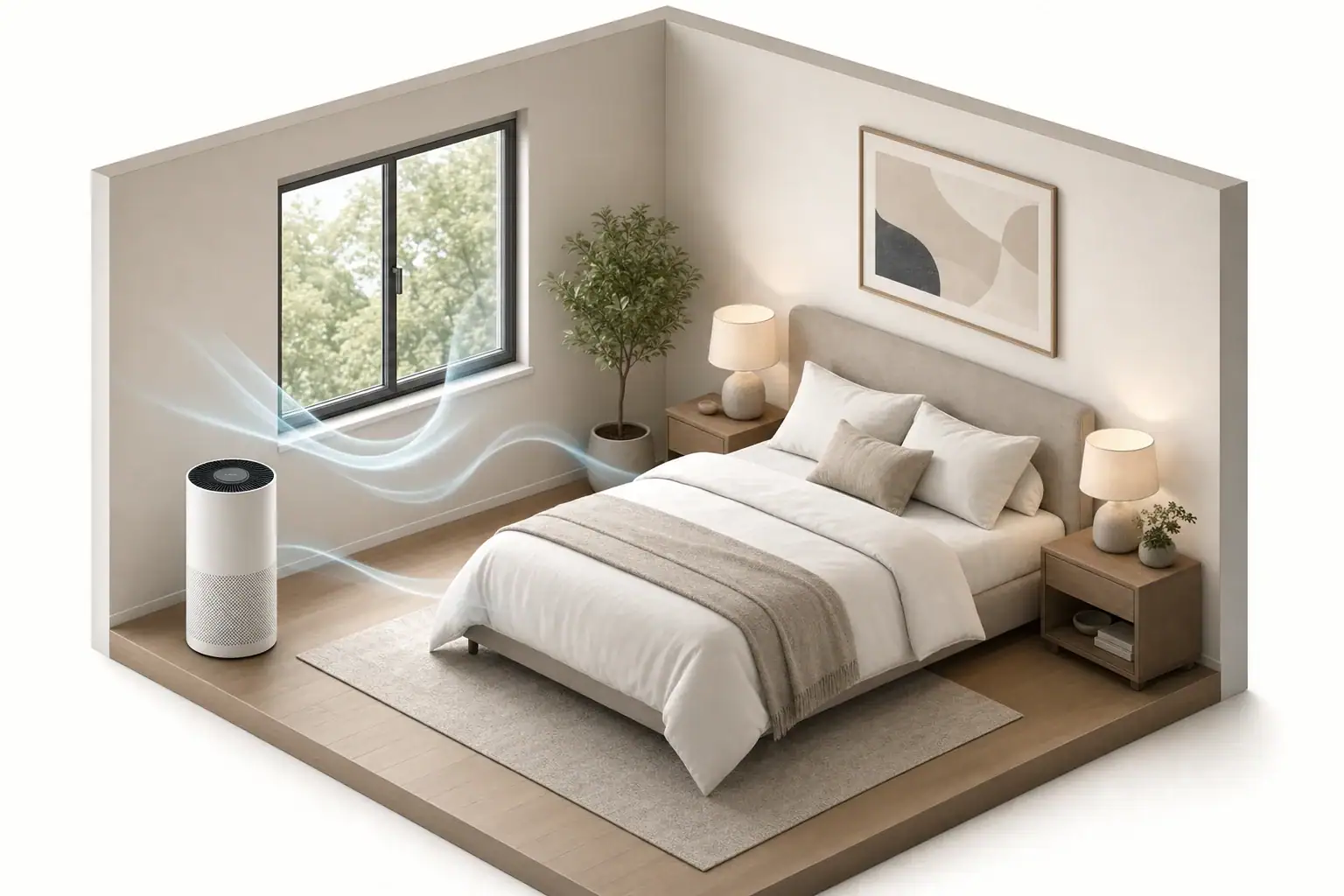
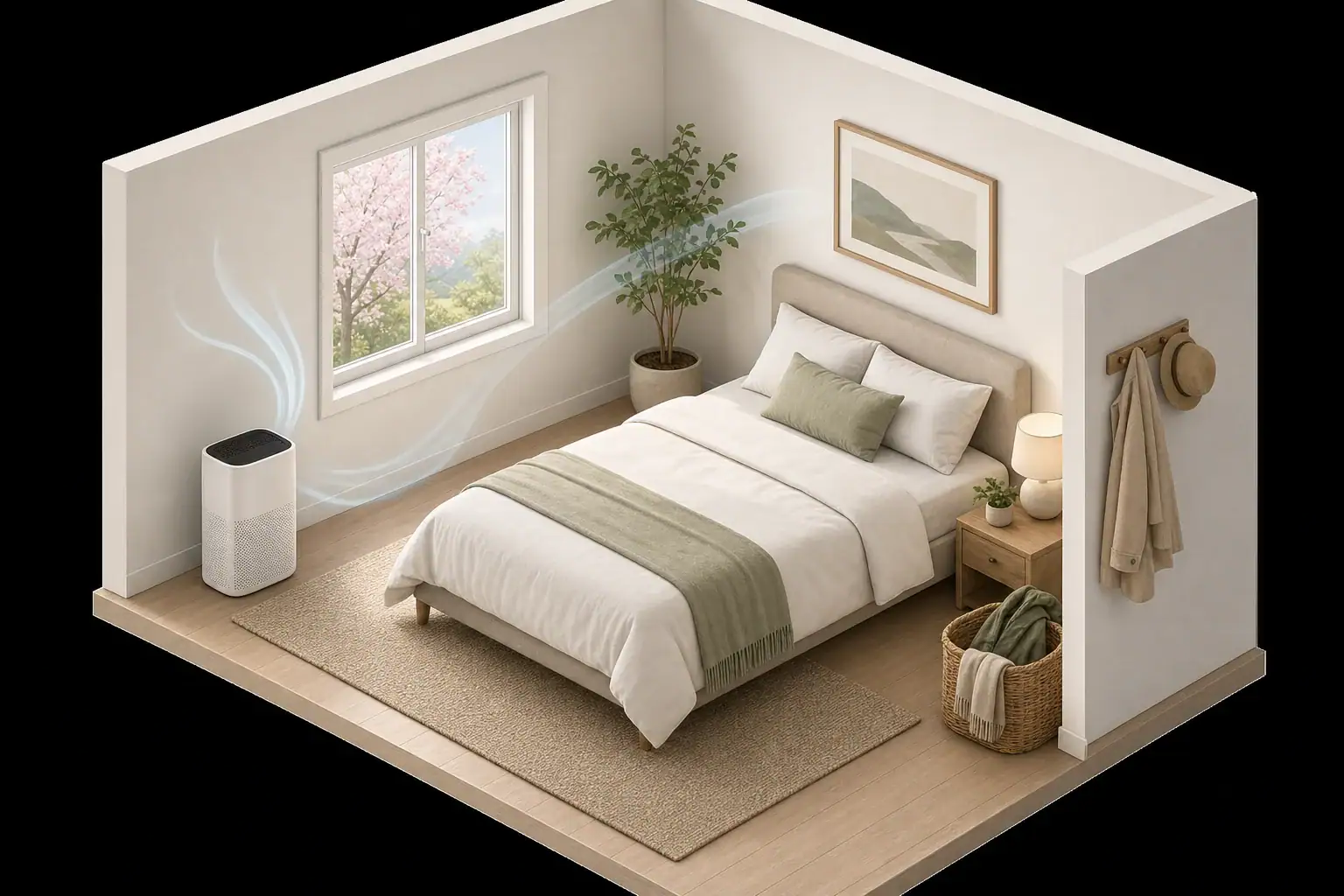
Calm bedroom with air purifier and clean linens

Allergy symptoms can feel worse at night when bedroom air contains pollen, dust mite debris, pet allergens, mold particles, or other irritants that accumulate around the sleeping area. Several hours of continuous exposure may make the difference more noticeable. Bedroom humidity, ventilation, bedding, pets, and air-cleaner placement can all affect conditions.

Quick answer

  • Keep indoor relative humidity around 30% to 50% as general guidance, and investigate prolonged readings above 60%.
  • For particle filtration, approximately 4 to 6 air changes per hour is a practical planning range for many bedrooms, not a medical standard.
  • Wash bedding about weekly when practical, follow fabric instructions, and dry everything thoroughly.
  • Keep purifier inlets and outlets unobstructed, with the clearance specified by the manufacturer.
  • During high-pollen or smoke periods, closing windows may help; ventilate when outdoor air is suitable.

Why Allergy Symptoms May Feel Worse at Night

The bedroom combines long exposure time with materials that can collect particles. Mattresses, pillows, rugs, curtains, upholstered furniture, and clutter provide surfaces where dust and allergens settle. Movement in bed can return some of those particles to the air.

Outdoor pollen can enter through windows or arrive on clothing, hair, shoes, and pets. Indoor sources may include dust mites, animal dander, damp materials, scented products, and particles distributed by heating or cooling equipment.

Nighttime discomfort is not always an air quality issue. Body position, respiratory infections, medication timing, or other conditions can also affect symptoms. Indoor air improvements can reduce exposure to some triggers, but they cannot identify the cause of a symptom or replace professional medical advice.

Bedroom Air Quality Targets and Sizing Basics

Start with humidity, particle filtration, ventilation, and source control. Relative humidity of roughly 30% to 50% is a commonly used indoor comfort range. Lower levels may feel dry, while sustained high humidity can support dust mites and dampness-related problems.

For a portable air cleaner, clean air delivery rate and air changes per hour are more useful than filter labels alone. Estimate the room volume by multiplying length, width, and ceiling height. Then use this planning formula:

Required clean airflow in cubic feet per minute = room volume × desired ACH ÷ 60

For example, a 12-by-12-foot bedroom with an 8-foot ceiling contains 1,152 cubic feet. A target of 5 ACH would require about 96 cubic feet per minute of effective clean airflow. This is an illustrative estimate; room layout, open doors, leakage, operating speed, and filter condition affect real performance.

Ventilation removes accumulated indoor pollutants but can introduce pollen, humidity, or smoke. Carbon dioxide can serve as a rough indicator of occupied-room ventilation, although it does not directly measure allergens. A reading around or below 1,000 parts per million is sometimes used as a practical ventilation cue, not a universal safety threshold.

Bedroom air quality decision matrix

Example values for illustration.

Match common bedroom observations with practical responses
Observation Primary response Important note
Visible dust or elevated particle readings Source cleaning plus particle filtration A monitor cannot identify specific allergens
Humidity frequently above 60% Reduce moisture and consider dehumidification Check for leaks or condensation
Humidity below about 30% Reduce over-drying or use cautious humidification Clean humidifiers consistently
Stuffy room with rising carbon dioxide Increase suitable outdoor-air ventilation Consider pollen, smoke, and outdoor humidity
Seasonal pollen entering through windows Close windows during higher-pollen periods Use filtered mechanical ventilation when available
Persistent odor or gaseous pollutants Remove the source and ventilate Particle filters alone do not remove gases
Damp spots or visible mold growth Correct the moisture source Filtration does not repair wet materials

Common Bedroom Air Quality Mistakes

A frequent mistake is relying on an air purifier while leaving the source unchanged. Filtration may capture airborne particles, but it does not clean bedding, prevent pets from entering, repair a leak, or stop pollen carried in on clothing.

Another issue is operating a purifier at a speed that is quiet but provides too little airflow. Published room coverage may be based on a low ACH target or maximum fan speed. Compare airflow with the actual room volume and choose a nighttime speed that remains both tolerable and useful.

  • Blocked airflow: Curtains, furniture, walls, or bedding can restrict an intake or outlet.
  • Open-plan assumptions: An open bedroom door increases the effective area the cleaner must serve.
  • Dirty filters: Loaded filters may reduce airflow and increase noise.
  • Excess humidification: Adding moisture without measuring humidity can create condensation or support dust mites.
  • Monitor overinterpretation: Consumer PM2.5 and TVOC readings indicate trends, not a diagnosis or identification of a specific allergen.

Bedroom Air Quality Checklist for Nighttime Comfort

Control particles at their sources

  • Wash sheets, pillowcases, and blankets about weekly when practical, following care labels.
  • Dry bedding completely before returning it to the bed.
  • Use washable or easily cleaned window coverings when possible.
  • Vacuum rugs and upholstered surfaces with equipment that limits dust leakage.
  • Damp-dust hard surfaces instead of redistributing dust with a dry cloth.
  • Keep outdoor shoes away from the sleeping area.
  • Change clothes and consider washing hair after substantial pollen exposure.

Manage the bed and pet areas

Allergen-resistant mattress and pillow encasements can create a washable barrier around materials that are difficult to clean. They still require routine exterior cleaning. If pets are a suspected trigger, keeping them out of the bedroom is a more direct source-control step than depending on filtration alone.

Set up airflow thoughtfully

Place a portable purifier where room air can reach it freely. Avoid pushing it against curtains, under furniture, or directly into a corner unless the instructions specifically allow that placement. Direct airflow away from the sleeper if drafts cause discomfort.

Keep windows closed when outdoor pollen or smoke is elevated. When outdoor conditions are favorable, brief ventilation or a mechanical ventilation system can reduce accumulated carbon dioxide and odors. Bathroom and kitchen exhaust fans should discharge outdoors and can help keep moisture from spreading through the home.

Track humidity rather than guessing

Use a basic hygrometer to observe patterns across several days. If humidity remains high, look first for damp laundry, bathroom moisture, window condensation, plumbing leaks, or an oversized cooling system that cycles briefly. If humidity is low, adjust gradually and avoid visible mist settling on nearby materials.

Real-World Bedroom Scenarios

Seasonal pollen in a small bedroom

A sleeper keeps windows open during spring and runs a purifier intermittently. A practical approach is to close windows during higher-pollen periods, remove outdoor clothing before entering the bedroom, clean bedding regularly, and operate appropriately sized filtration continuously at a sustainable speed.

Humid bedroom with morning condensation

Condensation and humidity readings above 60% suggest that moisture control deserves priority. Check ventilation, leaks, and indoor moisture sources before adding more filtration. A dehumidifier may help when the underlying moisture cannot be controlled through ventilation or air conditioning alone.

Closed bedroom that feels stuffy overnight

A purifier can reduce particles but does not remove carbon dioxide. If carbon dioxide rises while the room is occupied, consider suitable outdoor-air ventilation, an open interior door, or a balanced mechanical ventilation option. During smoke or high-pollen events, balance ventilation needs against outdoor conditions.

Air Cleaner Safety and Technology Considerations

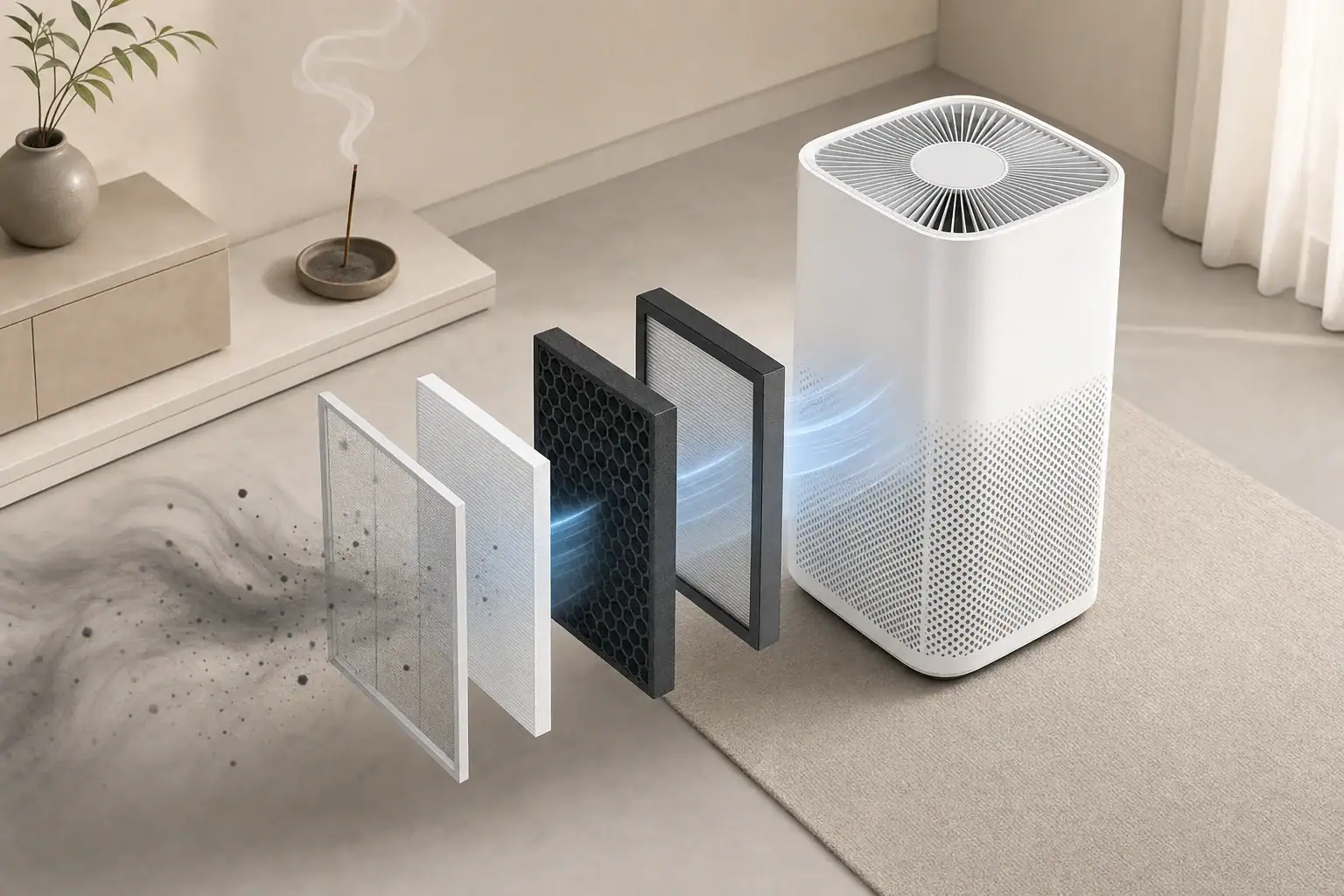
Mechanical filtration is generally the most direct approach for airborne bedroom particles. A well-sealed filter assembly matters because air that leaks around the filter bypasses the media. HEPA classifications describe filter performance under test conditions, but the complete device also needs sufficient airflow and good sealing.

Activated carbon can help with some odors and gases, but thin carbon sheets have limited capacity. Carbon does not replace particle filtration, ventilation, or removal of the odor source.

Use caution with ionizers, electrostatic features, and other electronic air-cleaning methods that may generate ozone as a byproduct. Ozone is a respiratory irritant and should not be intentionally produced in occupied bedrooms. If an electronic feature is optional, review independent safety certification information and determine whether it can remain off.

UV-C may be used inside some equipment, but effectiveness depends on dose, exposure time, design, and shielding. It does not remove dust, pollen, gases, or moisture and should not expose skin or eyes. Follow all manufacturer safety instructions rather than modifying the device.

Maintenance and Filter Replacement Planning

Air quality equipment works best when maintenance is routine. Check the prefilter for lint and hair, inspect the main filter, and clean exterior vents according to the instructions. Do not wash a filter unless it is specifically designed to be washable.

Replacement indicators are useful reminders, but actual filter life depends on operating hours, fan speed, particle load, pets, smoke, construction dust, and humidity. Reduced airflow, persistent odor, visible loading, or unusual noise may justify an earlier inspection.

Humidifiers require especially consistent cleaning because standing water and mineral deposits can affect what enters the room. Use the water type and cleaning method specified for the unit. Dehumidifier tanks, drains, coils, and intake screens also need periodic attention.

General bedroom filter and equipment maintenance planner

Example values for illustration.

Illustrative inspection and replacement planning ranges
Item Planning interval What may shorten the interval
Washable prefilter Inspect every 2 to 4 weeks Pets, lint, or continuous use
Disposable particle filter Inspect every 3 to 6 months Smoke, renovation dust, or high fan speed
Activated carbon filter Inspect every 3 to 6 months Strong or continuous odor sources
HVAC filter Inspect monthly at first Long run times, pets, or dusty conditions
Humidifier reservoir Empty and refresh frequently Warm rooms or visible residue
Dehumidifier intake and tank Check every few weeks Heavy moisture removal or dusty air

Related guides:
Bedroom Allergy Setup: The Fastest Changes That Reduce Symptoms
Pollen Season Indoor Plan: Filters, Ventilation Timing, and Cleaning
Dust Mites and Humidity: The RH Range That Helps Most
CO2 in Bedrooms: What Levels Mean and How to Improve Air Exchange

Summary of the Bedroom Air Quality Checklist

If allergy symptoms are worse at night, begin with the conditions closest to the bed. Clean bedding and nearby surfaces, control outdoor pollen entry, manage pet access, and keep relative humidity generally between 30% and 50%.

Size particle filtration by room volume and desired air changes rather than by filter terminology alone. Maintain clear airflow, use a tolerable continuous setting, and remember that ventilation, humidity control, and source removal solve different problems.

Track changes one at a time so patterns are easier to recognize. Indoor air steps may improve comfort and reduce exposure to some triggers, but persistent, severe, or unexplained symptoms should be discussed with a qualified health professional.

Frequently asked questions

Why are my allergy symptoms worse at night in the bedroom?

Bedroom symptoms may feel more noticeable because you spend several continuous hours near bedding, rugs, upholstered furniture, and other surfaces that collect allergens. Dust mites, pet dander, pollen brought indoors, and dampness-related particles can all contribute. Nasal congestion can also feel worse when lying down, so nighttime symptoms are not always caused only by bedroom air.

Should I keep bedroom windows closed when pollen is high?

Keeping windows closed during periods of elevated outdoor pollen can reduce the amount entering the bedroom. Pollen may still arrive on clothing, hair, shoes, and pets, so source-control steps such as changing clothes and washing bedding remain useful. When outdoor air is suitable, ventilation can still help with odors and stuffiness.

What humidity level is best for a bedroom with allergies?

A relative humidity range of about 30% to 50% is commonly used as general indoor guidance. Sustained humidity above 60% can support dust mites and moisture-related problems, while very dry air may feel irritating. Use a hygrometer to track conditions rather than adjusting humidity based only on comfort.

Can an air purifier remove dust mites from a bedroom?

An air purifier can capture some airborne particles, but it does not remove dust mites or their debris from mattresses, pillows, carpets, and other settled surfaces. Regular bedding washing, thorough drying, cleaning nearby surfaces, and using allergen-resistant encasements address those reservoirs more directly. Filtration works best as one part of a broader bedroom cleaning plan.

How often should bedding be washed if nighttime allergies are a problem?

Washing sheets, pillowcases, and blankets about weekly is a practical routine when possible, while following each fabric’s care instructions. Dry all bedding thoroughly before placing it back on the bed, since lingering moisture can contribute to dampness concerns. Mattress and pillow encasements should also be cleaned according to their instructions.
Spring Pollen Indoor Routine: What Matters and What to Do

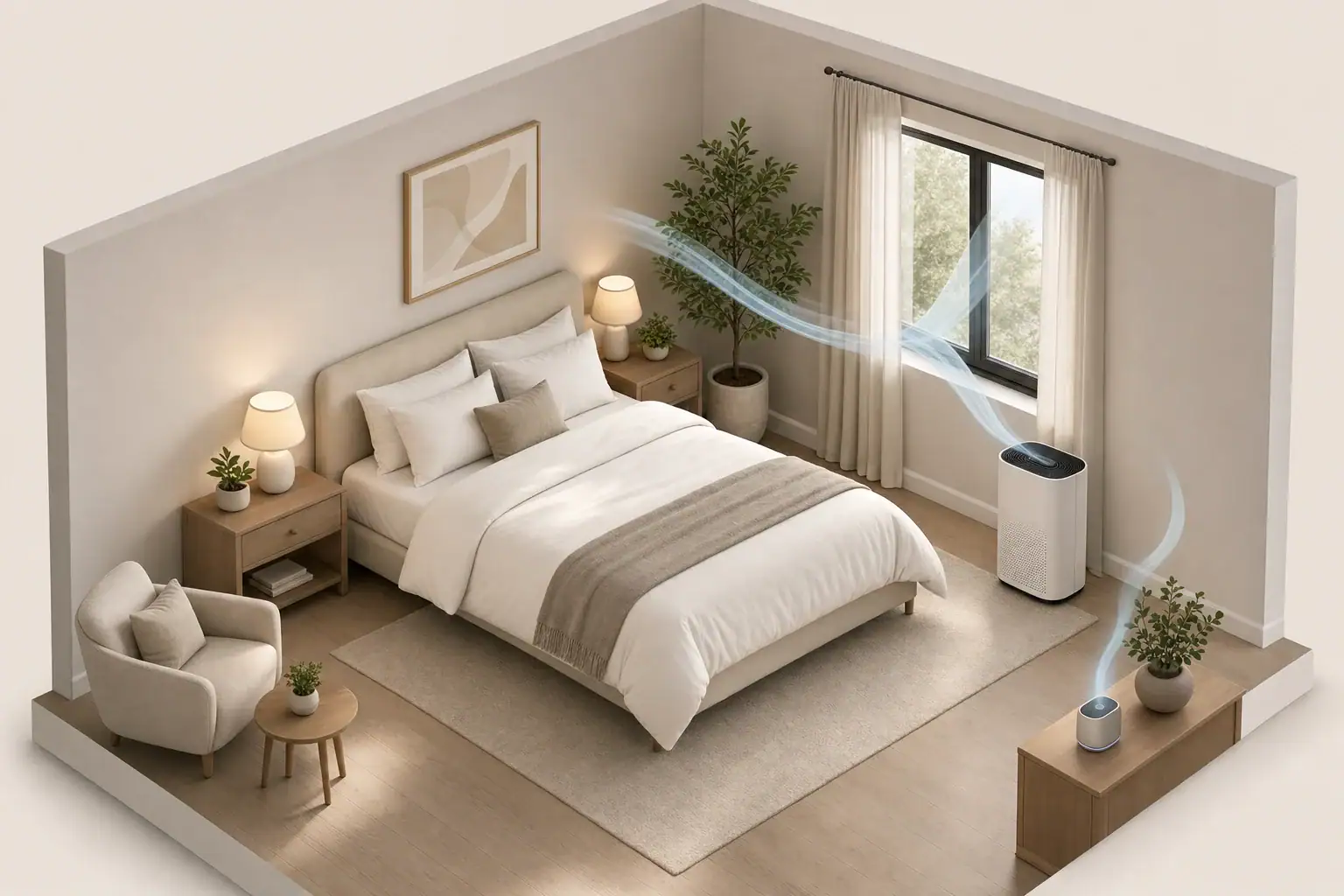
Calm bedroom with purifier and neatly contained outdoor pollen

A practical spring pollen indoor routine keeps windows closed during higher-pollen periods, contains pollen on clothes and hair, cleans floors regularly, and maintains effective particle filters. The goal is to reduce how much outdoor pollen enters, settles, and returns to the air. A consistent routine usually matters more than aggressive cleaning on a single day.

Quick answer

  • Keep windows closed when pollen levels are elevated or conditions are dry and windy; if ventilation is needed, consider a brief 5- to 10-minute opening when outdoor conditions are more favorable.
  • Leave outdoor shoes near the entrance and change pollen-exposed outer clothing before sitting on beds or upholstered furniture.
  • Vacuum high-use areas about 1–2 times per week and damp-mop hard floors about weekly, adjusting for pets, open windows, and visible debris.
  • Wash frequently used bedding about weekly and avoid drying it outdoors during active pollen periods.
  • For a portable purifier, an example planning target of about 4–5 air changes per hour can provide steady particle filtration in a closed room.

How Spring Pollen Gets Indoors

Pollen enters through open windows and doors, outdoor-air ventilation, gaps in the building envelope, and normal trips in and out. It also rides indoors on shoes, clothing, bags, hair, and pet fur. Window screens block insects and larger debris, but they are not fine-particle filters.

Once inside, pollen can settle on floors, beds, furniture, and other surfaces. Walking, vacuuming without suitable filtration, handling fabrics, or strong airflow can disturb settled material. Some pollen grains can also break into smaller fragments that remain airborne longer.

A useful routine therefore has three parts: limit entry when practical, remove settled material without spreading it, and filter recirculating indoor air. A completely pollen-free home is not a realistic target, and sealing a home continuously may conflict with ventilation needs.

Windows and Ventilation During Pollen Season

There is no single window schedule that works in every location. Pollen types, weather, landscaping, and local patterns vary. Check a local pollen forecast and consider current conditions rather than relying only on a fixed time of day.

Dry, breezy conditions can move more pollen through an open window. Rain may temporarily reduce airborne pollen, although local conditions can change quickly. If indoor air feels stale or carbon dioxide rises because people are present, brief ventilation may still be appropriate. Kitchen and bathroom exhaust fans also help remove moisture and indoor pollutants at their sources.

When outdoor pollen is elevated, use air conditioning or filtered mechanical ventilation when available and suitable. Keep exterior doors open only as long as needed. In homes with forced-air HVAC, a compatible particle filter can reduce recirculated particles, but it does not prevent pollen from entering through every opening.

Window and ventilation decisions for common spring conditions. Example values for illustration.
Spring pollen ventilation decision matrix
Condition Practical response Why
Elevated pollen and windy Keep windows closed when practical Wind can carry outdoor particles inside
Lower pollen and calm Use brief ventilation if needed Balances outdoor-air exchange with pollen control
Cooking or showering Run the appropriate exhaust fan Removes pollutants or moisture near the source
Stuffy occupied room Ventilate briefly or use mechanical ventilation Filtration alone does not remove carbon dioxide
Window air conditioner operating Check whether the outdoor-air vent is open Operating modes differ among units
Rain has recently passed Recheck current outdoor conditions Any temporary pollen reduction may not last
Windows must remain open Clean nearby surfaces more often More outdoor material may settle indoors

Clothes, Hair, Bedding, and Entry Habits

Create a simple transition area near the main entrance. A shoe tray, hooks, and a washable basket can keep outdoor items from moving through the home. Avoid shaking jackets or blankets indoors because that can release settled particles.

After extended time outdoors

  • Leave outdoor shoes at the entrance when practical.
  • Change an exposed outer layer before using the bed or upholstered furniture.
  • Place worn clothing in a hamper rather than on a chair or floor.
  • Rinse or wash hair before bed after substantial outdoor exposure, especially if hair has been uncovered.
  • Wipe a pet’s paws and coat gently with a damp, pet-appropriate cloth after outdoor activity.

Wash frequently used sheets and pillowcases about once a week during active pollen periods. Follow fabric care instructions and dry bedding indoors or in a dryer rather than on an outdoor line when pollen is circulating.

Common containment mistakes

Changing clothes helps less if exposed garments are left on the bed. Likewise, opening bedroom windows for hours can offset careful laundry habits. Focus first on the bedroom and the room used most often rather than trying to apply an elaborate routine throughout the entire home.

Floors and Surface Cleaning Checklist

Floors collect pollen because particles settle and are tracked in. Use a vacuum with effective particle filtration and a well-sealed airflow path when possible. A high-efficiency filter is less useful if air and dust leak around the filter or out of the vacuum body.

  • Vacuum entryways, bedrooms, and high-traffic areas about 1–2 times weekly as a starting point.
  • Increase frequency when windows have been open, pets spend time outdoors, or visible debris accumulates.
  • Move the vacuum slowly enough to pick up material rather than making repeated fast passes.
  • Damp-mop hard floors after vacuuming or sweeping with a particle-trapping tool.
  • Wipe smooth surfaces with a damp microfiber cloth instead of dry dusting.
  • Wash reusable cloths and mop pads after use and allow them to dry fully.

Do not saturate wood, laminate, or other moisture-sensitive flooring. Follow the floor manufacturer’s cleaning instructions. For rugs and upholstery, use suitable attachments and avoid beating or shaking items indoors.

If cleaning temporarily raises airborne dust, run a particle-filtering purifier during and after the task. Avoid pointing a purifier’s outlet directly across an uncleaned floor, which may disturb settled material.

Filters, Purifier Sizing, and Airflow

A particle filter is the relevant filter type for pollen. HEPA filters in portable purifiers are designed to capture airborne particles passing through the filter. Activated carbon has a different purpose: it can help with certain gases and odors but is not the primary pollen-control medium.

Filter grade alone does not describe whole-device performance. Airflow, clean air delivery rate, room size, fan speed, placement, and leakage around the filter all matter. A highly efficient filter with very low airflow may clean a room more slowly than a well-sealed unit moving more filtered air.

Use room volume for a simple estimate

Air changes per hour, or ACH, describes how many room volumes of cleaned air are supplied each hour. For an illustrative 12-by-15-foot bedroom with an 8-foot ceiling, room volume is 1,440 cubic feet. A target of 5 ACH would require about 120 cubic feet per minute of clean air because 1,440 × 5 ÷ 60 = 120.

This is a planning estimate, not a guarantee. Open doors, high ceilings, connected spaces, furniture, fan speed, and filter loading can affect real-world mixing. Select performance based on the fan setting you expect to tolerate, especially during sleep.

Placement and central HVAC filters

Place a portable purifier where intake and outlet grilles have open space. Keep it away from curtains, furniture, and tight corners. Closing the room door generally makes room-level cleaning more predictable, while open-plan areas require planning for the larger connected volume.

For central HVAC, use the filter efficiency recommended for the system. A MERV 13 filter is often considered for improved particle capture when the equipment and filter cabinet support it, but higher resistance can reduce airflow in an incompatible system. Do not force a thicker or more restrictive filter into a system not designed for it.

Real-World Spring Pollen Routines

Bedroom-focused routine

Keep the bedroom window closed during elevated pollen conditions, change exposed clothing before entering the bed, and wash bedding weekly. Run a correctly sized purifier continuously at a tolerable setting, using a higher setting during cleaning when practical. Keep the area around the purifier unobstructed.

Apartment with limited ventilation

Use kitchen and bathroom exhaust for source control, but remember that exhaust air must be replaced from somewhere. If windows are needed for ventilation, choose a shorter opening based on current outdoor conditions. Concentrate floor cleaning near the entrance and window area.

House with pets and a yard

Use one main entrance as the containment point when possible. Store yard shoes there, wipe pets after outdoor activity, and clean the route from the door to the main living area more frequently. Replace or clean HVAC filters based on condition and operating time rather than the calendar alone.

Open-plan living area

Calculate purifier needs using the connected air volume, not only the corner where the unit sits. One small purifier may not distribute cleaned air evenly across multiple connected rooms. Multiple appropriately sized units can sometimes provide more even coverage without requiring maximum fan speed.

Maintenance, Troubleshooting, and Safety

Inspect filters regularly during spring because higher particle loading can reduce airflow. Follow the appliance instructions for replacement and cleaning. Most HEPA-style filters should not be washed unless the manufacturer specifically identifies them as washable; moisture or handling can damage filter media.

Clean reusable prefilters carefully so accumulated lint and hair do not restrict airflow. Wipe the exterior and intake grille with the appliance unplugged, following its safety instructions. Never operate a purifier without required filters or modify it to fit an unsupported filter.

Signs the routine needs adjustment

  • Visible dust returns quickly near an open window or entryway.
  • Purifier airflow has weakened even at the same setting.
  • A filter is discolored, damaged, damp, or no longer seated correctly.
  • Cleaning consistently produces a noticeable cloud of dust.
  • A purifier is blocked by furniture or is undersized for the connected space.

Ionizers and other electronic air-cleaning features require caution because some designs can produce ozone. Choose equipment that does not intentionally generate ozone, and disable optional ionization when the instructions allow and the feature is not wanted. Ozone is not needed for pollen filtration.

UV-C is not a substitute for particle filtration and does not remove pollen from the air. Enclosed systems should be used only as designed because direct UV-C exposure can harm eyes and skin. Do not modify housings, defeat safety switches, or install unsupported lamps.

Illustrative maintenance intervals that should be adjusted to device instructions and actual filter condition. Example values for illustration.
Spring filter maintenance planner
Filter or component Example interval What may shorten it Reminder
Washable prefilter Inspect every 2–4 weeks Pets, lint, heavy use Dry completely before reinstalling
Portable purifier particle filter Often 6–12 months Continuous use, dust, smoke Follow condition indicators and instructions
Thin activated carbon filter Often 3–6 months Odors and gaseous pollutants Carbon life does not indicate HEPA condition
Central HVAC filter Inspect monthly; often 1–3 months Long run time, pets, renovations Use only a compatible size and resistance
Vacuum exhaust filter Inspect every 1–3 months Frequent floor cleaning Replace or clean only as directed
Window air conditioner filter Inspect about monthly in use Open windows, dust, long run time Clean only according to its manual

Related guides:
Pollen Season Indoor Plan: Filters, Ventilation Timing, and Cleaning
Bedroom Allergy Setup: The Fastest Changes That Reduce Symptoms
Ventilation vs Air Purifier: When You Need One, the Other, or Both
HEPA Vacuum vs Air Purifier: Which Helps More for Allergies?

Spring Pollen Routine Summary

Start with the pathways that matter most: windows, the main entrance, clothing, bedding, floors, and recirculated air. Keep windows closed during less favorable pollen conditions, but account for ventilation needs rather than treating filtration as a replacement for outdoor air.

  • Use local conditions to guide window timing.
  • Contain shoes and exposed outer clothing near the entrance.
  • Clean floors and surfaces with methods that capture rather than scatter particles.
  • Size particle filtration for the room volume and expected fan setting.
  • Inspect filters regularly and maintain seals, airflow, and safe placement.

A manageable weekly routine is generally more practical than attempting to eliminate every particle. Adjust cleaning and filter checks based on weather, pets, open-window use, room layout, and what you observe in the home.

Frequently asked questions

Should I keep windows closed all day during spring pollen season?

Keeping windows closed is generally practical when local pollen levels are elevated or conditions are dry and windy. However, homes still need appropriate ventilation, so use filtered mechanical ventilation when available or open windows briefly when current outdoor conditions are more favorable.

How often should I wash bedding during a spring pollen indoor routine?

Washing frequently used sheets and pillowcases about once a week is a reasonable starting point during active pollen periods. If someone spends substantial time outdoors, sleeps with long uncovered hair, or has pets on the bed, more frequent washing may be helpful.

Does showering or washing hair before bed help reduce indoor pollen?

Rinsing or washing hair before bed can reduce pollen transferred from hair to pillows and bedding after extended outdoor exposure. Changing pollen-exposed outer clothing and placing it directly in a hamper also helps limit transfer to furniture and sleeping areas.

What type of air purifier filter is most useful for pollen?

A particle filter, such as a HEPA filter in a portable purifier, is the primary filter type for airborne pollen. Choose a unit with sufficient clean-air delivery for the room volume at a fan setting that can be used consistently, and keep its intake and outlet unobstructed.

How often should floors be cleaned when pollen is high outside?

Vacuuming high-use areas about one to two times per week and damp-mopping hard floors about weekly is a practical baseline. Increase cleaning around entryways, open windows, and pet routes when visible debris builds up or more outdoor material is being tracked indoors.

Dust Mite Bedroom Setup: What Works and What Matters

Tidy bedroom with purifier and clean covered bedding

A practical dust mite bedroom setup combines controlled humidity, zippered bedding covers, regular cleaning, and correctly sized particle filtration. These measures address different parts of the problem, so no single device or cleaning task replaces the others. The goal is a manageable routine that limits moisture and reduces material accumulating in bedding and room dust.

Quick answer

  • Keep bedroom relative humidity around 30% to 50%, with a practical goal below 50% when conditions allow.
  • Use fully zippered, allergen-resistant covers on the mattress and pillows; consider covering the box spring as well.
  • Wash sheets and pillowcases about once a week using the warmest water permitted by their care labels, then dry them completely.
  • Damp-dust hard surfaces and vacuum floors regularly, preferably with a well-sealed vacuum using efficient particle filtration.
  • Use a properly sized air purifier for airborne particles, but do not expect it to remove mites living inside bedding.

Why a Dust Mite Bedroom Setup Uses Several Controls

Dust mites are microscopic organisms that commonly live in household dust, especially where skin flakes collect. Mattresses, pillows, upholstered furniture, carpets, and soft toys provide suitable reservoirs. The particles associated with mites can become airborne when bedding is disturbed, people move through the room, or cleaning stirs settled dust.

A bedroom plan works best when it addresses both the reservoir and the surrounding environment. Humidity control makes indoor conditions less favorable to mites. Encasements create a barrier around major bedding reservoirs, while washing and cleaning remove accumulated material. Filtration captures some particles after they enter the air.

These controls have different jobs. An air purifier cannot clean the interior of a mattress, and a mattress cover cannot control moisture in the room. Combining modest measures is generally more practical than relying on one aggressive intervention.

Humidity Targets and Moisture-Control Basics

Relative humidity is the amount of moisture in the air compared with the maximum the air can hold at the same temperature. Because warmer air can hold more moisture, the relative humidity reading may change as room temperature changes even when no water is added or removed.

A general indoor target of 30% to 50% relative humidity balances moisture control with everyday comfort. For a dust mite bedroom, keeping the level below 50% for sustained periods is a useful practical goal where the climate and building allow it. Levels consistently above 50% can also support condensation and dampness in cool areas.

Measure before adding equipment

Use a basic hygrometer to check the room rather than estimating humidity by feel. Place it away from windows, supply vents, exterior walls, humidifiers, and dehumidifier outlets. Check readings at different times for several days because outdoor weather, showering, cooking, air conditioning, and overnight occupancy can all affect the result.

If readings are already between 30% and 50%, extra moisture equipment may not be necessary. When humidity is high, start with source control: run bathroom exhaust fans, repair leaks, dry wet materials, avoid drying laundry in the bedroom, and use air conditioning or a dehumidifier as appropriate. If indoor air is below about 30%, avoid unnecessary dehumidification.

Humidity and bedroom control decision matrix

Example values for illustration.

Actions for common bedroom conditions
Observed condition Primary action Additional note
Humidity below 30% Stop unnecessary dehumidification Check the monitor location and room temperature
Humidity 30% to 50% Maintain current moisture controls Continue periodic checks as seasons change
Humidity repeatedly above 50% Improve moisture removal Consider air conditioning or dehumidification
Window condensation Reduce moisture and improve circulation Inspect nearby surfaces for persistent dampness
Localized damp area Find and correct the moisture source A room appliance does not repair a leak
Reading changes sharply Verify monitor placement Keep it away from direct equipment airflow

Mattress and Pillow Covers That Address Reservoirs

Use covers designed to fully encase the mattress and pillows rather than pads that protect only the top surface. A complete encasement has a zipper and tightly woven or otherwise allergen-resistant material. A protected zipper end or flap can help limit gaps around the closure.

Covering the box spring is also reasonable because its fabric and internal structure can collect dust. A bed frame without an upholstered headboard or fabric surround is easier to wipe down, although replacing existing furniture is not essential if it can be cleaned adequately.

Fit and fabric considerations

  • Measure the mattress length, width, and depth so the cover is not excessively loose or strained at the seams.
  • Choose a surface that can tolerate the expected cleaning routine and remains comfortable beneath normal sheets.
  • Check whether the cover is machine washable and follow its temperature and drying limits.
  • Inspect the zipper and seams after laundering or moving the mattress.
  • Do not assume that waterproof and allergen-resistant mean the same thing; verify the cover’s intended function.

After installation, leave the encasement in place as the regular mattress barrier. Wash it according to its care instructions rather than removing it with every weekly sheet change. Rough handling, excessive heat, or an incorrect size can damage its barrier or zipper.

Cleaning Bedding, Floors, and Dust-Holding Surfaces

Wash sheets, pillowcases, and washable blankets about weekly. Use the warmest water permitted by the textile’s care label and dry each item completely. Hot water around 130°F is often discussed for mite control, but washer settings vary, high temperatures can create a scald risk, and some fabrics cannot tolerate that heat. Following appliance and textile instructions is the safer general approach.

Bulky comforters that are difficult to wash can be placed inside a washable duvet cover. Keep decorative pillows and extra throws to a manageable number. Washable soft toys can be cleaned according to their labels; items that cannot be cleaned may be stored outside the sleeping area.

Use a low-dust cleaning sequence

  1. Remove and bag or carry bedding carefully instead of shaking it in the room.
  2. Damp-wipe shelves, the headboard, window sills, and other hard surfaces.
  3. Vacuum the floor, rugs, and accessible edges around the bed.
  4. Allow disturbed particles to settle or run particle filtration during and after cleaning.
  5. Install fully dried bedding.

A damp microfiber cloth generally captures dust more effectively than a dry feather duster. If vacuuming noticeably releases dust or odor, inspect the vacuum’s bag, bin, seals, hoses, and filters. Empty or service it as directed, preferably away from the bedroom.

Hard flooring is usually easier to damp-clean than thick carpet, but flooring replacement is not always practical. Existing carpet can be vacuumed methodically with overlapping passes. Cleaning frequency matters more than repeatedly using fragrances or harsh chemicals.

Air Filtration, Room Airflow, and Ventilation

A portable air purifier with efficient particle filtration can capture airborne mite-related particles and other household dust. It does not kill or remove mites embedded in a mattress, so it should supplement humidity control, covers, and cleaning.

Choose a unit using its smoke clean air delivery rate, or CADR, and the bedroom’s volume. Room volume equals floor area multiplied by ceiling height. Air changes per hour can be estimated as CADR multiplied by 60 and divided by room volume, using cubic feet and cubic feet per minute.

For example, a 150-square-foot room with an 8-foot ceiling has a volume of 1,200 cubic feet. A CADR of 100 cubic feet per minute would provide about five theoretical air changes per hour: 100 × 60 ÷ 1,200. Actual mixing varies with placement, furniture, door position, filter condition, and fan speed.

Placement for useful airflow

  • Leave clearance around the intake and outlet according to the equipment instructions.
  • Do not hide the purifier behind curtains, under furniture, or inside a closet.
  • Place it where airflow can circulate through the occupied part of the room without blowing directly at the sleeper.
  • Select a nighttime speed that is quiet enough to run consistently.
  • Keep the bedroom door position reasonably consistent when evaluating performance.

Outdoor ventilation can dilute indoor pollutants when outdoor conditions are suitable, but it does not directly control bedding reservoirs. Opening windows during humid weather may increase indoor moisture. Also consider outdoor particles, smoke, security, and noise before relying on window ventilation.

Common Mistakes and Real-World Bedroom Examples

One common mistake is adding a humidifier automatically because the room feels dry. Measure first: excessive humidification can move the room away from the preferred range. Another is running a dehumidifier continuously without checking humidity, which may create unnecessary noise, heat, and energy use.

Purifier placement is another frequent issue. A large unit on its lowest setting may move less clean air than expected, while a smaller unit on a tolerable medium setting may be used more consistently. CADR should be considered at the fan speed that will actually run.

Example: Humid summer bedroom

A bedroom repeatedly measuring 58% to 65% relative humidity may benefit from closed windows during muggy weather, bathroom exhaust use, air conditioning, or dehumidification. Bedding covers and weekly laundering remain useful because lowering humidity does not remove existing dust.

Example: Dry winter bedroom

If the room stays near 30% to 40%, dehumidification is unnecessary. Focus on encasements, bedding care, surface cleaning, and particle filtration. If a humidifier is used for comfort, monitor the room and avoid raising humidity above the intended range.

Example: Carpeted rental bedroom

When replacing carpet is not an option, reduce movable dust collectors, damp-dust hard surfaces, and vacuum on a consistent schedule. A purifier can capture particles suspended during normal activity, while washable bedding and full encasements address the bed.

Safety, Maintenance, and Ongoing Upkeep

Follow the instructions for every purifier, dehumidifier, humidifier, vacuum, and bedding cover. Do not modify equipment, block ventilation openings, defeat safety switches, or use an extension cord unless the manufacturer permits it. Keep water-containing equipment away from outlets and electrical devices.

Particle filters need inspection and periodic replacement. Timing depends on operating hours, fan speed, dust loading, pets, smoke exposure, and filter area. A clogged filter can reduce airflow. Wash only filters specifically identified as washable, and reinstall washable components only after they are completely dry.

Empty dehumidifier tanks regularly or maintain an approved drain arrangement. Clean accessible coils, grilles, and water-contact surfaces according to the manual. Humidifiers require especially consistent water and reservoir care because standing water and residue can accumulate.

Ionizers and some electronic air cleaners can produce ozone as a byproduct. Ozone is not needed for a dust mite bedroom plan, so favor mechanical particle filtration that does not intentionally generate it. UV-C may be included in some equipment, but performance depends on dose, exposure time, and enclosure design; it does not replace filtration, cleaning, or moisture control. Never operate exposed UV-C devices around people or animals.

Humidity and moisture quick plan

Example values for illustration.

Routine actions for bedroom moisture conditions
Goal Simple actions Tool or check Reminder
Verify current humidity Record morning and evening readings Room hygrometer Check for several days
Stay near 30% to 50% Adjust moisture equipment gradually Hygrometer and controls Seasonal changes are normal
Reduce high humidity Use exhaust, cooling, or dehumidification Fan, air conditioner, or dehumidifier Correct leaks separately
Avoid over-drying Pause dehumidification below target Humidity trend Confirm monitor accuracy and placement
Prevent condensation Improve circulation near cool surfaces Visual inspection Dry damp surfaces promptly
Maintain equipment Clean grilles, tanks, and approved components Calendar reminder Follow equipment instructions

Related guides:
Dust Mite Allergy: Humidity Targets, Bedding, and Filtration
Bedroom Allergy Setup: The Fastest Changes That Reduce Symptoms
HEPA Vacuum vs Air Purifier: Which Helps More for Allergies?

Dust Mite Bedroom Setup Summary

Start by measuring humidity and aim for a stable indoor range of about 30% to 50%, generally staying below 50% when practical. Correct leaks and moisture sources before relying on portable equipment.

Fully encase the mattress and pillows, manage bedding with a consistent weekly routine, and reduce dust using damp wiping and regular vacuuming. Use a correctly sized particle air purifier for airborne material, with enough clearance and a fan speed that can run consistently.

Recheck humidity as seasons change, inspect covers and equipment, and replace filters when indicated by their condition or maintenance schedule. A simple routine carried out regularly is more useful than adding multiple devices without measuring the room or maintaining them.

Frequently asked questions

What humidity level is best for a dust mite bedroom setup?

A practical bedroom target is about 30% to 50% relative humidity, with sustained levels below 50% when practical. Use a hygrometer to check conditions over several days, since readings can change with weather, temperature, and daily activities. If humidity is consistently high, address leaks and moisture sources before relying only on portable equipment.

Do mattress encasements prevent dust mites in a bed?

Fully zippered, allergen-resistant mattress and pillow encasements create a barrier around major bedding reservoirs. They do not replace laundering or room cleaning, but they can limit exposure to material inside the mattress and pillows. Choose covers that fit correctly and inspect the zipper and seams periodically.

How often should bedding be washed to reduce dust mite allergens?

Sheets, pillowcases, and washable blankets are commonly washed about once a week. Use the warmest water allowed by each item’s care label, then dry the bedding completely. For bulky items that are difficult to wash, a washable duvet cover can make regular care easier.

Will an air purifier get rid of dust mites in a mattress?

No. An air purifier can capture some airborne particles, including dust that becomes suspended during normal activity or cleaning, but it cannot remove mites living inside bedding. Use it as a supplement to encasements, humidity management, regular laundering, and dust removal.

Is carpet a problem in a dust mite bedroom setup?

Carpet can hold dust and may require more regular cleaning than hard flooring, but replacing it is not always necessary or practical. Vacuum carpet methodically with overlapping passes and damp-dust other room surfaces to reduce settled material. Reducing unnecessary soft furnishings can also simplify the cleaning routine.

3D Printer Fumes at Home: What Matters and What Works

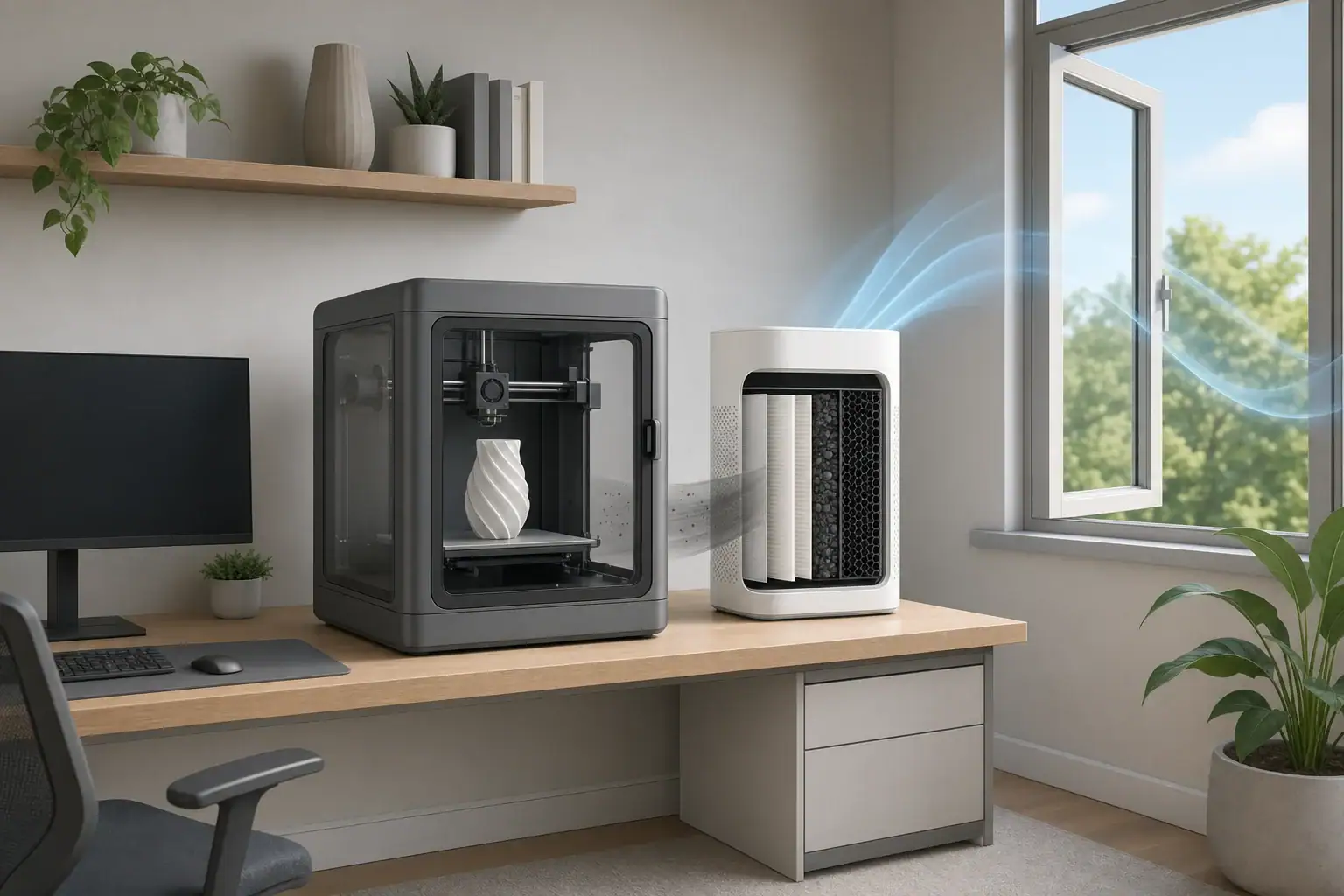
Enclosed 3D printer with ventilation and carbon filtration

3D printer fumes at home are best managed with source control, outdoor ventilation, and filtration selected for both airborne particles and volatile organic compounds.

Desktop 3D printers can release very small particles and gases, although the amount varies by printing process, material, temperature, and operating conditions. A practical room setup limits how far emissions spread and keeps air moving away from occupied areas.

Quick answer

  • Place the printer in a separate, ventilated room rather than a bedroom or frequently occupied living area.
  • Use an enclosure, ideally exhausted outdoors, to capture emissions near the source.
  • As general planning guidance, consider about 3–6 air changes per hour during printing when outdoor exhaust is not available.
  • Choose HEPA filtration for particles and a substantial activated carbon stage for gases and odors; neither replaces ventilation.
  • Continue ventilation for roughly 30–60 minutes after printing as a practical starting point, adjusting for the process and room.

What 3D Printer Fumes Contain

The word fumes is commonly used for a mixture of particles and gases released during printing. The exact mixture depends on whether the machine melts filament, cures liquid resin, or uses another process.

Particles from filament printing

Fused-filament fabrication heats plastic and pushes it through a nozzle. This process can release ultrafine particles, many of which are smaller than the particle sizes measured reliably by typical consumer PM2.5 monitors. A low PM2.5 reading therefore does not prove that no printer-related particles are present.

Particle emissions can change with filament formulation, nozzle temperature, print speed, printer condition, and additives such as pigments. Material names alone do not provide a complete emissions profile.

VOCs from filament and resin

Heating filament can release volatile organic compounds, or VOCs. Resin printers and their cleaning supplies can also release vapors during printing, washing, curing, pouring, and waste handling. An odor may indicate that a gas is present, but odor strength does not measure concentration or establish a safety threshold.

Safety data sheets and handling instructions for the specific filament, resin, cleaner, or additive remain important. Different formulations sold under the same broad material category may have different handling requirements.

How Emissions Behave in a Home Room

Emissions are usually most concentrated near the printer before room air currents dilute and distribute them. Open doors, central HVAC returns, fans, and movement through the room can carry contaminants beyond the printing area.

An enclosure reduces this spread only when it is reasonably sealed and managed correctly. A loose enclosure can delay release rather than eliminate it, while an enclosure exhausted outdoors maintains airflow toward the printer and removes captured air from the home.

Room volume affects dilution and filtration planning. Multiply floor area by ceiling height to estimate volume. For example, a 120-square-foot room with an 8-foot ceiling contains about 960 cubic feet of air. A general 5-ACH target in that room corresponds to approximately 80 cubic feet per minute because CADR equals room volume multiplied by ACH, divided by 60.

This calculation is useful for particle filtration. Gas removal is harder to predict because carbon quantity, gas type, contact time, humidity, airflow, and media saturation all affect performance.

Example values for illustration.
3D printer emission control decision matrix
Situation Primary concern Practical control
Enclosed filament printer Particles and VOCs Exhaust enclosure outdoors when feasible
Open-frame filament printer Emissions spreading into the room Add an enclosure or relocate the printer
Resin printing Vapors and liquid handling Use a dedicated ventilated work area
Resin washing or curing Vapors during post-processing Keep containers closed and ventilate outdoors
No outdoor exhaust option Accumulation in room air Combine enclosure, HEPA, carbon, and room ventilation
Printer in a shared living area Long occupant exposure time Move it to a separate low-occupancy room

How to Set Up the Printing Room

A separate room with a closable door is generally easier to manage than an open-plan living space. Garages and workshops may be options when temperatures stay within the printer and material operating ranges, but attached garages should be isolated from living areas.

Create airflow toward the outdoors

Outdoor exhaust is most effective when it captures air at or around the enclosure rather than trying to clear the entire room after contaminants have dispersed. The exhausted air should terminate outdoors away from operable windows, doors, and air intakes.

A window fan can help create negative pressure in a printing room. Place the fan to exhaust outward and provide replacement air from a cleaner part of the home through a door undercut or controlled opening. Avoid aiming a strong fan directly across an open printer because drafts may affect print quality and spread emissions before capture.

Keep emissions out of the HVAC system

Do not place an open printer beside a central return vent. A return can distribute room air through other parts of the home, and ordinary HVAC filters are not designed to provide source capture or broad VOC removal.

Keep the room door closed during printing when practical. Children, pets, food preparation, and sleeping areas should be separated from printing and resin-handling activities.

Choosing HEPA and Carbon Filtration

Particle and gas filtration perform different jobs. HEPA media captures airborne particles when air passes through the filter. Activated carbon adsorbs certain gases onto its internal surface, but performance varies substantially by the type and amount of carbon.

Size particle filtration with CADR

Use smoke CADR or a comparable particle CADR when available. The basic planning formula is:

Required CADR in cfm = room volume in cubic feet × target ACH ÷ 60

For the 960-cubic-foot example room, 3 ACH requires about 48 cfm, while 6 ACH requires about 96 cfm. These are planning examples rather than official limits. Enclosure exhaust may reduce the burden on a room purifier because it captures emissions before they mix throughout the space.

Higher filter grades do not automatically produce better room cleaning. Airflow, filter fit, cabinet sealing, and bypass leakage all matter. A well-sealed HEPA system with adequate airflow can be more useful than denser media installed in a leaky or underpowered device.

Evaluate carbon by media quantity

Thin carbon-coated sheets may help with some odors but generally have limited gas capacity. Deeper beds containing granular or pelletized carbon provide more media, although no simple room-size rating predicts removal of every VOC. Carbon eventually becomes saturated and should be replaced according to condition, use, and manufacturer instructions.

Place a portable purifier near the enclosure without blocking printer cooling or exhaust paths. Leave clearance around the purifier intake and outlet, and run it at a sustainable speed throughout the print and post-print ventilation period.

Monitoring and Common Setup Mistakes

Consumer monitors are most useful for observing trends, not certifying that a room is safe. PM2.5 sensors may respond to larger printer-generated particles but can miss ultrafine particles. TVOC sensors often provide a broad relative signal rather than identifying individual compounds.

Carbon dioxide is not a printer-fume measurement. It can, however, indicate whether occupied-room ventilation is limited. Opening a window may lower CO2 while still failing to capture emissions efficiently if airflow carries printer exhaust across the room first.

Common setup mistakes include:

  • Assuming an enclosure removes contaminants when it has no exhaust or filtration.
  • Using a particle-only purifier to address VOCs and odors.
  • Relying on odor alone to decide when ventilation is adequate.
  • Placing the printer in a bedroom, kitchen, or continuously occupied office.
  • Undersizing a purifier by using floor area without accounting for ceiling height.
  • Allowing filters, fans, vents, or enclosure seals to become obstructed.

If monitor readings rise during every print, odors linger, or air escapes visibly from enclosure gaps, review capture airflow, door position, filter condition, and exhaust routing. Changes should be evaluated one at a time so their effects are easier to observe.

Room Setup Examples for Common Homes

Small spare room

In a small room, use an enclosed printer near a window with controlled exhaust outdoors. Keep the door closed and provide a modest replacement-air path. A HEPA-and-carbon purifier can supplement source capture, especially while opening the enclosure or removing a finished print.

Apartment without a dedicated exhaust duct

A removable window-panel exhaust may be practical if building rules allow it and the outlet does not affect nearby units. If outdoor exhaust is unavailable, choose a low-occupancy room, keep the printer enclosed, use both particle and gas filtration, and increase general ventilation. Avoid exhausting into a hallway, ceiling cavity, or another interior area.

Open-plan home

An open-plan room is difficult to isolate because emissions can spread before reaching a purifier. Relocating the printer to a closable room is usually more effective than adding multiple fans to the open area.

Resin workstation

Keep printing, washing, curing, and temporary waste storage together in a dedicated ventilated zone. Use closed containers, suitable protective equipment, and the material instructions. Do not pour uncured resin or contaminated cleaning liquid into household drains; follow applicable local disposal requirements.

Safety, Maintenance, and Filter Planning

Inspect enclosure seals, exhaust ducts, fan grilles, and filter housings regularly. Dust or residue can reduce airflow, while a displaced filter can allow air to bypass the media. Clean equipment only when it is powered down and according to its instructions.

Track filter installation dates and printing hours. HEPA replacement depends on particle loading and airflow resistance. Carbon replacement depends on media quantity, VOC load, humidity, and use patterns; a return of odor can be a maintenance cue but should not be the only one.

Keep replacement costs in the room plan. Running a purifier at a lower, quieter setting may provide less airflow than its maximum rating, so size equipment using the speed likely to be used consistently.

Ionizers, electrostatic features, and some air-cleaning technologies may generate ozone as a byproduct. For occupied homes, choose equipment designed and verified not to produce meaningful ozone. UV-C does not replace particle filtration, carbon media, or outdoor exhaust, and exposed UV-C can present safety concerns.

For resin systems, keep liquid materials in closed original containers away from heat and direct sunlight. Clean spills using the material instructions, keep uncured materials away from children and pets, and maintain ventilation during post-processing as well as printing.

Example values for illustration.
Home air monitor metrics for 3D printing rooms
Metric What it can indicate Important limitation Practical use
PM2.5 Changes in measurable fine particles May miss ultrafine emissions Compare printing and non-printing trends
TVOC Relative changes in mixed gases Does not identify specific VOCs Check ventilation and carbon trends
CO2 Ventilation in occupied rooms Does not measure printer fumes Assess general air exchange
Temperature Room and enclosure conditions Not an emissions measurement Keep equipment within operating guidance
Relative humidity Moisture conditions affecting comfort and media Does not show pollutant levels Generally maintain about 30–50 percent
Odor observations Changes noticed during operation Not quantitative or compound-specific Use as a maintenance cue only

Related guides:
Air Purifier for Printer and Craft Rooms: Particles, VOCs, and Placement
Ventilation vs Air Purifier: When You Need One, the Other, or Both
How to Choose the Right Air Purifier for Your Room Size
When to Replace Carbon Filters (And How to Tell They’re Spent)

Key Takeaways for Managing 3D Printer Fumes

The most effective room setup starts by controlling emissions at the printer. Use an enclosure, direct captured air outdoors when feasible, and prevent air from spreading into bedrooms or shared living areas.

HEPA filtration addresses particles, while substantial activated carbon media can supplement VOC control. Size particle filtration with room volume and a practical ACH target, but treat purification as a backup to source capture and ventilation rather than a complete substitute.

Monitor trends, maintain airflow paths, replace loaded filters, and follow the handling instructions for each filament, resin, cleaner, and printer process. These steps create a more predictable and manageable home printing environment.

Frequently asked questions

Are 3D printer fumes safe to breathe at home?

Desktop 3D printers can release particles and volatile organic compounds, so it is sensible to reduce exposure rather than treat emissions as harmless. The amount and type of emissions vary with the printing process, material, temperature, enclosure, and room conditions. Source capture and outdoor exhaust are generally more effective than relying on room dilution alone.

Do I need to ventilate a 3D printer enclosure outdoors?

Outdoor exhaust is the preferred option when it can be installed safely and practically because it removes captured air from the home. An enclosure without exhaust or effective filtration can reduce initial spread but may release accumulated emissions when opened. Exhaust outlets should be located away from windows, doors, and outdoor air intakes.

Is a HEPA air purifier enough for 3D printer fumes?

A HEPA purifier can help remove airborne particles, including many particles generated during filament printing, but it does not provide broad removal of VOCs. For gases and odors, a purifier needs a substantial activated carbon stage, and even that has limited capacity. Filtration should supplement enclosure capture and ventilation rather than replace them.

How long should I ventilate a room after 3D printing?

Continuing ventilation for about 30 to 60 minutes after a print is a practical starting point, particularly before opening an enclosure or spending time in the room. The appropriate duration depends on the room size, airflow, material, print duration, and whether the printer is enclosed and exhausted outdoors. Resin printing and post-processing may require ventilation throughout handling activities as well.

Can I run a 3D printer in a bedroom or home office?

A bedroom or continuously occupied home office is generally not an ideal location because people may spend long periods there, including while sleeping. A separate room with a closable door, source capture, and ventilation is easier to manage. If relocation is not possible, reduce time in the area during printing and improve enclosure, filtration, and outdoor ventilation controls.

MDF and Particle Board VOCs: What Works to Reduce Them

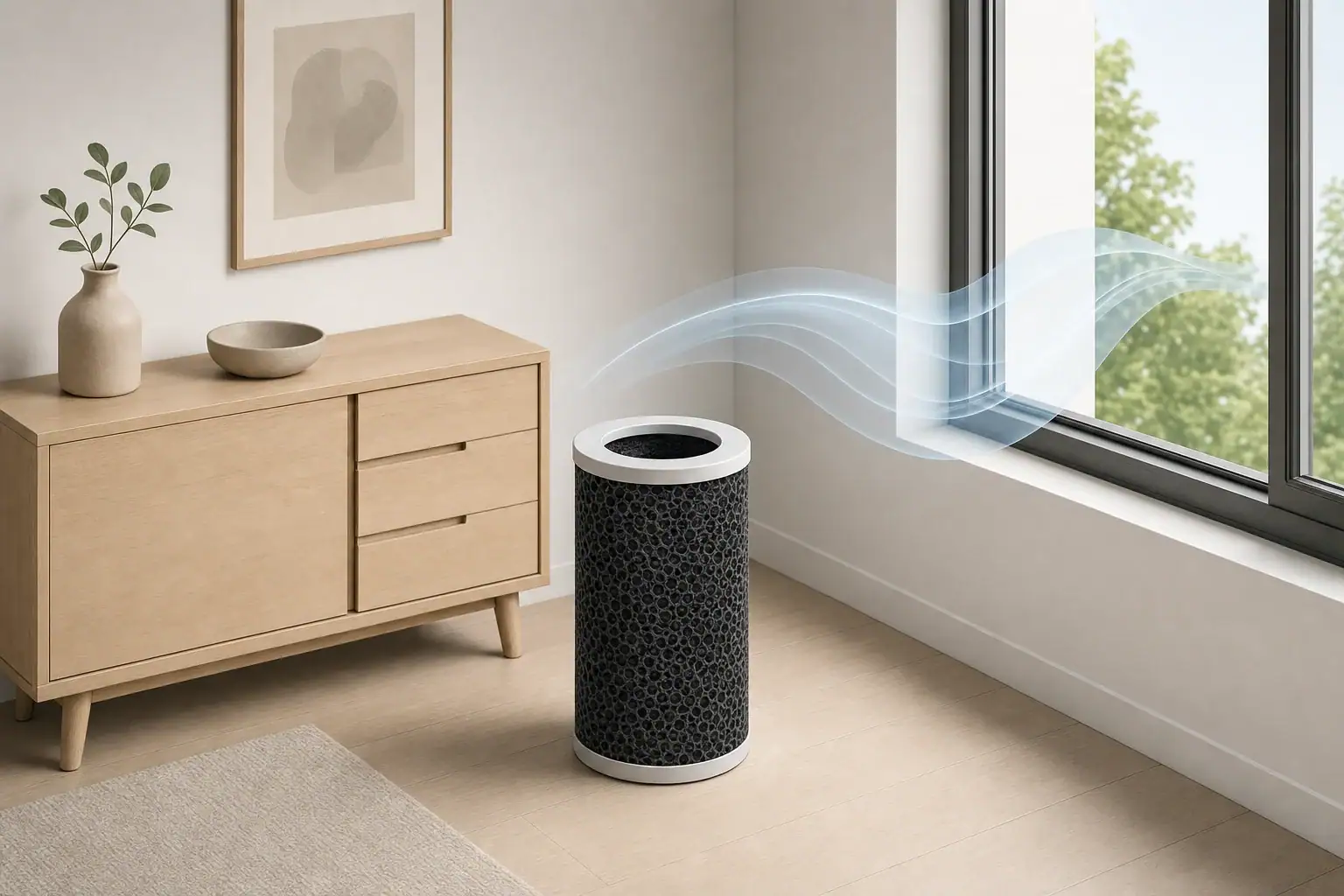
Carbon filter near composite wood furniture and open window

Furniture VOCs from MDF and particle board can usually be reduced through source control, steady ventilation, moderate temperature and humidity, and properly selected activated carbon filtration.

Composite wood can release volatile organic compounds from resins, adhesives, finishes, and surface treatments. Emissions are often strongest when furniture is new and generally decline over time, although the rate varies by construction, coatings, room conditions, and ventilation.

Quick answer

  • Ventilate the room for about 15–30 minutes several times a day when outdoor air quality and weather permit.
  • As general guidance, keep indoor relative humidity around 30%–50% and avoid unnecessarily high room temperatures.
  • If possible, unpack and air new furniture in a garage, spare room, or other well-ventilated area for several days before regular use.
  • Use an air purifier with a meaningful amount of activated carbon or other gas-phase media; HEPA alone does not capture VOC gases.
  • Choose low-emitting, compliant composite wood products and keep factory-applied laminates or edge sealing intact.

What Furniture VOCs From MDF and Particle Board Mean

MDF, or medium-density fiberboard, is made from wood fibers bonded under heat and pressure. Particle board uses larger wood particles in a similar resin-bonded structure. Both are common in cabinets, shelving, desks, bed frames, and ready-to-assemble furniture.

The wood, bonding resin, paint, laminate, veneer, edge banding, and other finishes can release VOCs into room air. Formaldehyde is one recognized compound associated with some composite wood resins, but it is not the only possible emission. A general VOC odor does not reveal which compounds are present or their concentrations.

Odor and VOC exposure are also not interchangeable. Some compounds are noticeable at low concentrations, while others have little odor. A piece of furniture that no longer smells new may still release small amounts, and a strong smell may come partly from packaging, paint, or surface finishes rather than the wood core.

Emission rates commonly decrease as a product ages. However, airflow, exposed unfinished edges, heat, humidity, product thickness, and the type of adhesive or coating can affect how quickly that happens.

What Controls the VOC Level in a Room

Indoor concentration reflects a balance between the rate at which furniture releases gases and the rate at which those gases are removed or diluted. A large cabinet in a small closed bedroom can have a greater effect than the same cabinet in a large, well-ventilated living area.

Temperature matters because warmer materials often release VOCs faster. Deliberately heating furniture to accelerate off-gassing is not a controlled home-air-quality strategy and may create unnecessarily high short-term concentrations. A stable, comfortable indoor temperature—often roughly 68°F–75°F—is a more practical general range.

Humidity can also influence composite wood emissions and material condition. A general indoor target of about 30%–50% relative humidity balances comfort and moisture control in many homes. Local climate, season, and building conditions may require adjustments.

Ventilation removes indoor air and replaces it with outdoor air. Filtration can supplement this process, but the filter must contain gas-sorbing material such as activated carbon. Particle filters, including HEPA filters, are designed primarily for airborne particles rather than VOC gases.

Choosing a response to furniture-related VOC concerns
Practical source and room-condition decision matrix
Situation Primary step Supporting step
New furniture still packaged Unpack in a ventilated area Remove cardboard and plastic promptly
Noticeable odor in one room Increase outdoor-air ventilation Open interior doors to improve dilution
Outdoor air is smoky or polluted Keep windows closed temporarily Use gas-phase and particle filtration
Exposed MDF or particle board edges Ask the manufacturer about compatible sealing Avoid sanding or damaging the surface
Room is unusually warm Return it to a moderate temperature Keep furniture away from heat sources
Humidity remains above 50%–60% Identify and control the moisture source Consider dehumidification if appropriate
Odor persists despite ventilation Isolate or remove the suspected source Evaluate other finishes, fabrics, and cleaners

Example values for illustration.

Common Mistakes When Addressing Composite Wood VOCs

Relying on a HEPA filter alone

HEPA filters capture particles such as dust, pollen, and smoke particles. VOC molecules are gases and pass through particle media. A purifier needs activated carbon or another appropriate gas-phase medium to address them.

Assuming all carbon filters perform the same

A thin carbon-coated sheet may help with light, intermittent odors but has limited gas-holding capacity. A deeper bed containing more sorbent generally offers more capacity, although actual performance depends on the compound, airflow, contact time, humidity, and filter condition.

Masking odor instead of removing the source

Fragrances, sprays, candles, and scented plug-ins add compounds to indoor air. They may cover a furniture odor without lowering the underlying emissions. Source control and ventilation are more direct approaches.

Using heat as a shortcut

Heating a room or placing furniture near a heater can raise the short-term emission rate and may damage finishes or adhesives. Keep the product within the temperature and humidity conditions specified by its manufacturer.

Treating a consumer TVOC reading as a laboratory result

Consumer VOC sensors typically respond to a mixture of gases and may also react to cleaners, alcohol, cooking, fragrances, and changes in humidity. They are more useful for observing trends than identifying a specific chemical or proving that a room is safe.

Practical Steps to Reduce MDF and Particle Board VOCs

1. Control the source first

Remove packaging and inspect the furniture for damaged laminate, missing edge banding, or exposed core material. If an item has an unusually persistent odor, contact the seller or manufacturer for material information and handling instructions. Returning or relocating the source can be more effective than trying to filter a continuously high emission rate.

2. Ventilate according to outdoor conditions

Cross-ventilation is most effective when air can enter through one opening and leave through another. When conditions permit, open windows on different sides of the room and use existing exhaust fans that vent outdoors. Short ventilation periods of about 15–30 minutes can be repeated during the day.

Check outdoor smoke, pollution, heat, cold, and humidity before opening windows. During poor outdoor-air conditions, use the home’s mechanical ventilation as designed and keep windows closed until conditions improve.

3. Improve room airflow

Do not press large composite wood panels directly against supply vents or block return grilles. Leave some space around wardrobes, bookcases, and desks so room air can circulate. A portable fan may help mix air toward an open window, but it does not remove VOCs by itself.

4. Add suitable gas-phase filtration

Place an activated carbon air purifier where room air can reach it without being trapped behind furniture or curtains. Run it long enough to process room air consistently. CADR ratings primarily describe particle removal and do not provide a direct measure of VOC-removal capacity.

Carbon eventually becomes saturated. A returning odor or a gradual loss of odor control can indicate that replacement is due, but odor alone is not a precise capacity test.

5. Avoid unnecessary indoor VOC sources

Temporarily limit fragranced cleaners, aerosol products, solvent-based projects, and indoor smoking. This makes it easier to assess whether the furniture-related trend is improving and reduces the total gas load placed on ventilation and carbon filters.

How the Steps Change in Different Rooms

New dresser in a small bedroom

If practical, assemble and air the dresser in a ventilated spare area before moving it into the bedroom. Once installed, ventilate during the day, keep drawers open for limited airing periods, and close them before sleeping if odor remains noticeable. Do not block the room’s supply or return vents.

Particle board cabinets in a kitchen

Kitchen cabinetry has extensive surface area, but finished faces and edge banding can reduce exposed core material. Use the kitchen exhaust fan during cooking if it vents outdoors, manage indoor humidity, and repair plumbing leaks promptly. Avoid drilling, sanding, or refinishing composite panels without appropriate instructions and dust controls.

Large bookcase in an apartment

An apartment may have fewer cross-ventilation options. Open a window and the interior door when outdoor conditions are suitable, and use bathroom or kitchen exhaust only as intended. Check whether exhaust operation causes outdoor air to enter from undesirable locations, such as an attached garage or smoky neighboring area.

Home office with several composite wood items

Multiple desks, shelves, and cabinets can create a larger total source. Introduce new pieces in stages when possible. This makes odor changes easier to interpret and avoids placing several new emitting products into a closed room at once.

Product Standards, Air Cleaners, and Safety Considerations

In the United States, composite wood products may be labeled as compliant with federal formaldehyde emission requirements under TSCA Title VI. California Air Resources Board Phase 2 terminology may also appear on products. Compliance indicates that regulated composite wood panels meet specified formaldehyde emission requirements; it does not mean a product emits no VOCs.

When shopping, look for clear information about the panel material, compliant composite wood, finishes, adhesives, and edge sealing. Solid wood can also emit naturally occurring VOCs or compounds from coatings, so material type alone does not determine total room emissions.

For air cleaning, activated carbon or other sorbent media is the relevant component for gases. HEPA media remains useful when the room also has dust or fine-particle concerns. The purifier should be appropriately sized for the room’s particle-cleaning needs, but a high particle CADR does not guarantee strong VOC performance.

Avoid devices that intentionally generate ozone. Ozone is a reactive gas and is not appropriate as an occupied-space solution for furniture VOCs. Ionizers and some electronic air cleaners may produce ozone as a byproduct, so review independent safety certification and the manufacturer’s operating information. UV-C can be used in some air-handling equipment for microbial control, but it does not replace ventilation or adequate gas-phase media for furniture emissions.

Monitoring, Filter Replacement, and Ongoing Upkeep

Keep the room clean without using heavily fragranced products. Dust furniture with a damp microfiber cloth, vacuum surrounding floors as appropriate, and avoid soaking exposed composite wood. Excess water can damage panels and edge seams.

Inspect carbon filters according to the purifier’s instructions. Replacement timing may range from a few months to longer, but there is no universal interval. Heavy VOC loads, smoke, frequent cooking, high humidity, and a small amount of carbon can shorten useful life.

Particle prefilters should also be cleaned or replaced as directed. A clogged prefilter reduces airflow through both the particle and carbon stages. When replacing filters, keep the purifier unplugged and follow its normal safety instructions rather than altering the filter housing or bypassing sensors.

If using an indoor air monitor, compare patterns over time under similar conditions. Note when windows are open, cleaning occurs, furniture is added, or humidity changes. This context is usually more useful than reacting to a single reading.

Indoor monitor metrics that can support troubleshooting
Monitor metrics and practical interpretation
Metric What it indicates Practical use Important limitation
TVOC General sensor response to mixed gases Compare trends before and after ventilation Does not identify individual VOCs
Formaldehyde estimate Possible response associated with formaldehyde Observe repeated patterns Consumer sensors may have cross-sensitivity
CO2 How occupied-room ventilation is performing Compare closed-room and ventilated periods Does not directly measure furniture VOCs
PM2.5 Fine airborne particle concentration Check outdoor smoke and particle filtration Does not measure gases
Relative humidity Moisture level in room air Use 30%–50% as general home guidance Sensor placement affects readings
Temperature Room thermal conditions Maintain a stable range near 68°F–75°F Local heat near furniture may differ

Example values for illustration.


Related guides:
Ventilation vs Air Purifier: When You Need One, the Other, or Both
New Furniture Smell: Ventilation vs Carbon Filters—What Works Faster?
VOC Sensors vs Real VOCs: How to Interpret “TVOC” Readings

Summary of the Most Effective Reduction Steps

Begin with the source: unpack furniture in a ventilated area, preserve finished surfaces and edge sealing, and relocate an item if emissions remain difficult to manage. Ventilate for short, repeated periods when outdoor conditions are favorable, and maintain moderate temperature and humidity.

Use activated carbon or another appropriate gas-phase medium when filtration is needed, recognizing that HEPA filtration alone does not remove VOC gases. Replace filters as their effectiveness declines, and use monitor readings as trend information rather than definitive chemical analysis.

For future purchases, look for compliant composite wood, clear material disclosures, durable surface coverage, and intact edge banding. These practical controls can lower indoor concentrations without relying on fragrances, excessive heat, or ozone-generating equipment.

Frequently asked questions

How long do MDF and particle board VOCs usually last?

Emissions are often highest when composite wood furniture is new and generally decrease over time. The timeline varies with the product’s resin, coatings, exposed edges, room temperature, humidity, and ventilation. Airing the item in a well-ventilated area can help reduce indoor concentrations during the initial period.

Will a HEPA air purifier reduce VOCs from MDF furniture?

HEPA media is designed to capture airborne particles, not VOC gases. To reduce gases, an air purifier needs a meaningful amount of activated carbon or other suitable gas-phase sorbent media. HEPA can still be useful for dust and fine-particle concerns in the same room.

Should I seal exposed MDF or particle board edges to reduce emissions?

Intact laminate, veneer, paint, and edge banding can limit exposed composite wood surfaces. If edges are damaged or unfinished, ask the furniture manufacturer about a compatible low-emitting sealing method before applying a product. Avoid sanding or damaging panels, as this can expose more core material and create dust.

Does opening windows always help reduce furniture VOCs?

Opening windows can dilute and remove indoor VOCs when outdoor air quality and weather conditions are suitable. Cross-ventilation, with air entering through one opening and leaving through another, is generally more effective than opening only one window. Keep windows closed temporarily during smoke, high pollution, or other poor outdoor-air conditions.

Can high humidity make MDF and particle board emissions worse?

Humidity can influence composite wood emissions and may also affect the condition of the material and its edge seams. Maintaining indoor relative humidity around 30%–50% is a practical general target for many homes. Persistent humidity above about 50%–60% should prompt attention to moisture sources, ventilation, or dehumidification where appropriate.

New Mattress Off-Gassing: Ventilation and Carbon Explained

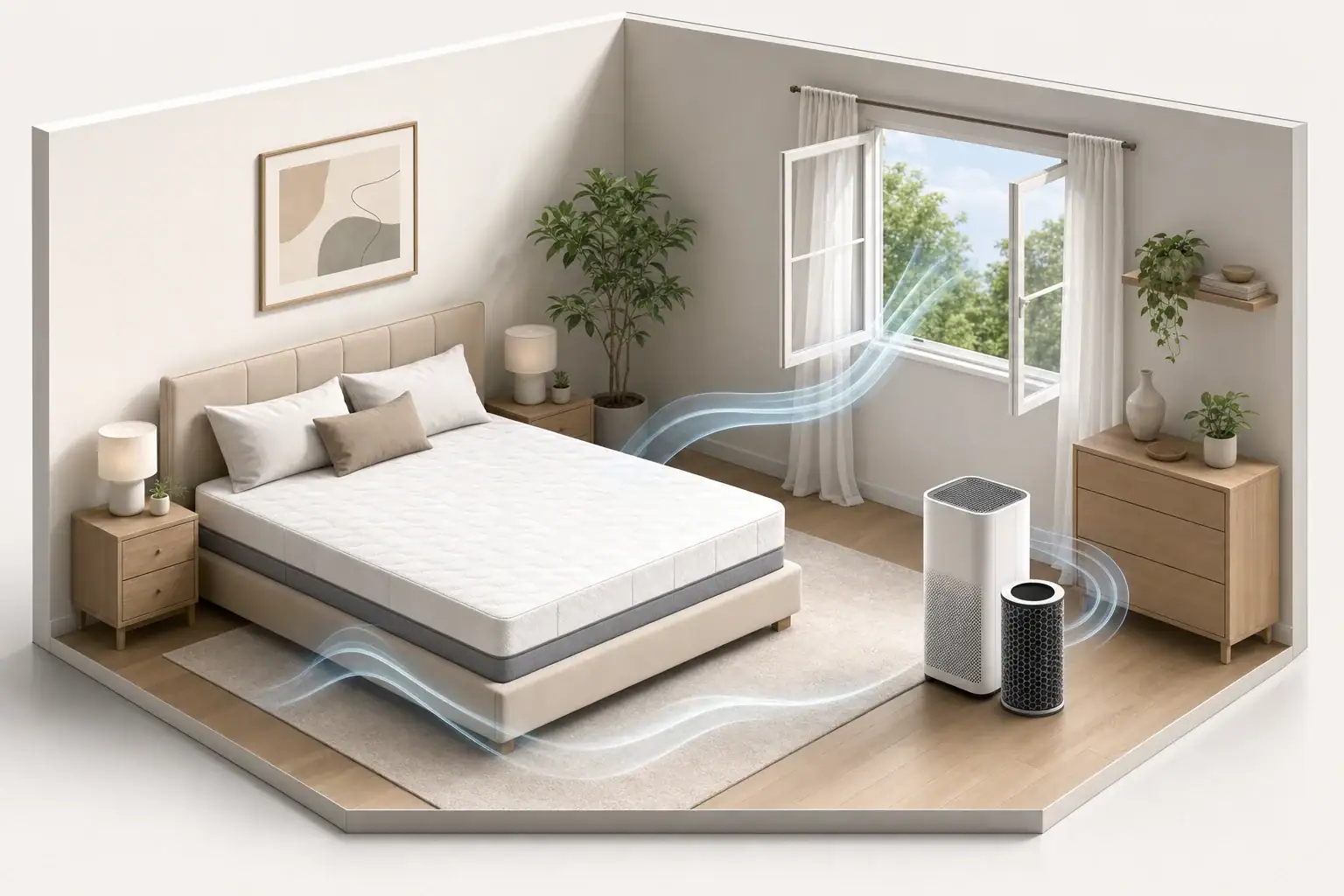
New mattress airing beside a carbon filter purifier

Ventilate the room continuously when practical, and use a purifier with a substantial activated-carbon filter for supplemental control of new mattress odors and volatile organic compounds.

New mattress off-gassing usually becomes less noticeable as materials air out, although the timing varies by mattress construction, packaging, room temperature, and airflow. Ventilation removes indoor gases, while activated carbon can capture some compounds that pass through the purifier.

Quick answer

  • If conditions allow, air out the mattress in a well-ventilated room for about 24–72 hours before regular use.
  • Aim for continuous airflow or several 15–30 minute window-opening periods during the day when outdoor air is suitable.
  • For active airing, roughly 3–5 air changes per hour is a useful planning range, not an official safety threshold.
  • Choose activated carbon for gases and odors; a HEPA filter alone mainly captures particles.
  • Keep room temperature and humidity moderate rather than using heat to accelerate off-gassing.

What New Mattress Off-Gassing Means

Off-gassing is the release of volatile compounds from materials into the surrounding air. Mattresses may contain foams, adhesives, fabric treatments, fire-barrier materials, or packaging-related odors. Some compounds have a detectable smell, while others do not.

Odor strength is not a reliable measurement of total VOC concentration or risk. A strong smell can come from a compound detectable at a low concentration, and a room can contain gases that have little or no odor. Treat smell as a practical comfort cue rather than a precise air-quality reading.

Emissions are often most noticeable shortly after a compressed or sealed mattress is opened. They commonly decline as the mattress airs out, but there is no universal schedule. Material composition, product age, ventilation, temperature, humidity, and the volume of the room all affect the process.

How Ventilation and Carbon Filters Work

Ventilation dilutes and removes indoor gases

Ventilation replaces indoor air with outdoor air. Cross-ventilation—opening windows or doors on opposite sides of a space—can be more effective than opening one window because it creates a clearer airflow path. A window fan exhausting outward may also help, provided it is used safely and outdoor conditions are acceptable.

Air changes per hour, or ACH, describes how many times an amount of air equal to the room’s volume is replaced in one hour. As general planning guidance, approximately 3–5 ACH can provide purposeful airing. This is not a health limit, and actual natural ventilation can vary greatly with wind, window area, and temperature differences.

To estimate airflow for a specific ACH target, multiply room volume in cubic feet by the desired ACH and divide by 60. A 12-by-12-foot bedroom with an 8-foot ceiling has 1,152 cubic feet of air. Reaching 4 ACH would require about 77 cubic feet per minute of effective outdoor-air exchange: 1,152 × 4 ÷ 60.

Activated carbon adsorbs some gases

Activated carbon has a porous surface that adsorbs certain gases and odor compounds. Performance depends on the amount of carbon, its formulation, contact time, airflow, humidity, and the specific compounds present. A thin carbon-coated sheet generally has less capacity than a deeper bed containing more carbon.

Carbon filtration recirculates and treats room air, but it does not bring in outdoor air. It is best considered a supplement when windows cannot remain open or when some residual odor continues after initial airing. HEPA media can be useful for dust and particles, but it does not replace activated carbon for gas control.

Decision matrix for managing mattress off-gassing

Example values for illustration.

Choosing ventilation, filtration, or related room controls
Situation Primary action Supporting action
Good outdoor air and mild weather Open windows for cross-ventilation Use a fan to direct air outdoors
Outdoor smoke or high particle levels Keep windows closed temporarily Use recirculating carbon and particle filtration
Cold or hot outdoor conditions Use several 15–30 minute airing periods Close the room between ventilation periods
Persistent odor after initial airing Continue moderate ventilation Inspect carbon filter capacity and placement
Dust released during setup Use particle filtration or careful cleaning Use carbon separately for gases
High indoor humidity Control moisture to a moderate range Avoid directing humidifier mist at the mattress

Common Ventilation and Filter Mistakes

One common mistake is assuming that any air purifier removes VOCs. A unit labeled only for particle filtration may reduce packaging dust but provide little gas control. Look for a meaningful amount of activated carbon or another clearly identified gas-phase medium rather than relying on a very thin deodorizing layer.

Placement also matters. A purifier squeezed between furniture, placed behind curtains, or pushed against a wall may have restricted intake or exhaust airflow. Follow the appliance’s required clearances and position it in the mattress room, with unobstructed airflow around the unit. Review common air purifier placement considerations when choosing a location.

Other mistakes include:

  • Running only the central HVAC fan: Many residential systems recirculate indoor air and do not automatically add outdoor air.
  • Using heat to speed the process: Higher temperatures can increase emissions and may affect mattress materials. Keep the room in a normal occupied temperature range.
  • Masking odor with fragrances: Scented sprays, candles, or plug-ins add other airborne compounds rather than removing the original source.
  • Trusting odor alone: A weaker smell can indicate improvement, but it does not quantify individual VOCs.
  • Ignoring outdoor conditions: Opening windows during wildfire smoke, heavy traffic pollution, or very high humidity can create a different indoor air-quality problem.

A Practical Mattress Airing Checklist

Before opening the packaging

  • Choose a room where windows can be opened or mechanical exhaust can operate.
  • Check current outdoor smoke, particle, weather, and humidity conditions.
  • Make enough space around the mattress and purifier for airflow.
  • Review the mattress instructions, including expansion time and foundation requirements.

During the first 24–72 hours

  • Remove packaging promptly and move plastic materials out of the room.
  • Open windows continuously when practical, or use several shorter airing periods.
  • If using a fan, direct room air toward an open window rather than blowing outdoor contaminants inward.
  • Run a carbon-equipped purifier at a setting that maintains steady airflow without blocking its intake.
  • Keep interior doors positioned to support the intended airflow path and prevent odor from spreading unnecessarily.

The 24–72 hour range is general planning guidance, not a guarantee that odor will disappear within that period. Continue airing as needed, and follow manufacturer instructions if the mattress requires a specific expansion period.

After the initial airing period

Return the room to normal use when the mattress has expanded as directed and the odor is acceptable for the occupants. Continue lower-level ventilation or carbon filtration if the smell remains noticeable. If an odor is unusual, intensifies, or resembles burning or overheating, stop using nearby electrical equipment and inspect for a separate source.

Ventilation Examples for Different Homes

Bedroom with windows on one wall

Open the window and bedroom door to establish an airflow route through the home, provided doing so will not spread the odor into occupied rooms. An exhaust fan in a nearby bathroom may help draw air along that route if it vents outdoors. Avoid relying on a recirculating range hood, which may not exhaust outside.

Apartment with limited window access

Use the available window in short, purposeful intervals when outdoor conditions are favorable. Keep the mattress-room door closed between airing periods if odor migration is a concern. A purifier with substantial activated carbon can provide supplemental treatment while the windows are closed.

Open-plan home

Open-plan spaces have more air volume, which can dilute odors, but they can also allow gases to spread farther. Place the mattress in a room that can be isolated during the strongest initial period when possible. If it must remain in an open area, ventilate the larger connected space and size recirculating filtration for that full area rather than the mattress footprint alone.

Home near traffic or seasonal smoke

Time window ventilation for periods with better outdoor conditions. When outdoor particle pollution is elevated, closed-window operation with both particle and carbon filtration may be the more practical temporary approach. Resume outdoor-air ventilation after conditions improve because recirculation does not replace fresh-air exchange.

Purifier Safety and Air-Cleaning Technologies

Select equipment that operates without intentionally producing ozone. Ozone is a reactive gas and is not needed for routine mattress odor management. Avoid ozone generators in occupied homes, and do not use them to treat a mattress or bedroom. Learn more about air purifier vs ozone generator considerations.

Some purifiers include ionizers, electrostatic features, plasma systems, or similar electronic technologies. These are different from passive HEPA and activated-carbon filtration. If considering an electronic feature, check whether it can be switched off and look for applicable independent limits on ozone emissions. Passive mechanical and carbon filtration offers a straightforward option without intentional ion production.

UV-C may be included in some air-cleaning devices, but it is not a substitute for ventilation or activated carbon. Its role is generally related to exposing microorganisms to sufficient ultraviolet energy under controlled conditions, not removing VOC gases. Enclosed designs should prevent direct exposure to eyes and skin.

Do not heat the mattress, apply solvents, spray fragrances on it, or alter its cover to address odor. Protect the mattress from open flames and follow its care, fire-safety, and warranty instructions.

Carbon Filter Maintenance and Monitoring

Carbon media becomes less effective as adsorption sites fill. Unlike a particle filter, a saturated carbon filter may not show a clear visual change. Returning odor, reduced odor control, elapsed operating time, and the manufacturer’s replacement guidance are more useful cues.

High gas concentrations, continuous operation, humid conditions, and a small amount of carbon can shorten useful life. Store unopened replacement filters in sealed packaging so they do not adsorb gases from the surrounding storage area.

Inspect washable prefilters and exterior grilles regularly. Dust accumulation can reduce airflow through the carbon and HEPA stages. Clean only as directed; carbon and HEPA filters are often not washable unless explicitly identified otherwise.

Using air-quality monitors carefully

A consumer TVOC monitor can help show broad trends, such as whether readings rise after unwrapping and decline during ventilation. It generally cannot identify individual chemicals or establish that a room meets a health standard. Readings can also respond to cleaning products, fragrances, cooking, alcohol vapors, and humidity changes. Understand VOC monitor limitations and TVOC readings before using the results to make decisions.

A carbon dioxide monitor does not measure mattress emissions. In an occupied room, however, rising CO2 can suggest that outdoor-air exchange is limited. PM2.5 readings track fine particles rather than VOC gases, so they are particularly useful when deciding whether outdoor smoke makes window ventilation unsuitable.

General filter inspection and replacement planner

Example values for illustration.

Illustrative maintenance intervals for common filter types
Filter type Example interval What may shorten it Maintenance cue
Thin carbon pad About 1–3 months Strong odors and continuous use Odor control declines
Deeper carbon filter About 3–12 months High VOC load and humidity Follow condition and maker guidance
HEPA-style particle filter About 6–18 months Dust, smoke, pets, and high runtime Reduced airflow or filter indicator
Disposable particle prefilter About 1–3 months Visible dust and pet hair Surface appears loaded
Washable prefilter Inspect every 2–4 weeks Dusty rooms and frequent use Clean and dry as instructed
Central HVAC filter About 1–3 months System runtime and particle load Check fit, condition, and airflow

Related guides:
Ventilation vs Air Purifier: When You Need One, the Other, or Both
Carbon Filter vs HEPA: What Each One Removes (And What It Doesn’t)
Wildfire Smoke Indoors: Step-by-Step Plan to Lower PM2.5 Fast
Air Exchange Basics: ACH, Infiltration, and Why “Stuffy” Happens

Summary of Ventilation and Carbon Filter Tips

Outdoor-air ventilation is the primary way to dilute and remove new mattress off-gassing. When conditions allow, provide steady airflow or several focused ventilation periods during the first 24–72 hours, then continue as needed.

Activated carbon can supplement ventilation by adsorbing some gases and odors. Carbon amount, filter depth, airflow, compound type, and replacement timing matter more than the presence of a minimal carbon coating. HEPA filtration addresses particles but should not be treated as VOC control by itself.

Use normal room temperatures, keep humidity moderate, avoid fragrance masking and ozone-generating devices, and maintain unobstructed airflow through filters. Consider monitor readings as trends rather than chemical identification, and adjust the plan for outdoor smoke, weather, room layout, and occupant comfort.

Frequently asked questions

How long should I ventilate a new mattress after opening it?

Airing a new mattress for about 24–72 hours is a practical general guideline when outdoor conditions allow. The needed time varies with the mattress materials, packaging, room size, temperature, and airflow, so continue ventilation if the odor remains noticeable or bothers occupants.

Is opening one window enough for new mattress off-gassing ventilation?

One open window can provide some air exchange, but cross-ventilation is usually more effective because it creates a clearer path for indoor air to leave. Opening a door or another window, or using a fan to exhaust room air outward, may improve airflow when it is safe to do so.

Does a HEPA air purifier remove new mattress odors and VOCs?

HEPA filtration is designed primarily to capture airborne particles such as dust and does not by itself provide meaningful control of most gases or odors. For mattress off-gassing, look for a purifier with a substantial activated-carbon or other gas-phase filter in addition to any particle filter.

What should I do if outdoor smoke makes it unsafe to open windows?

When smoke or other outdoor pollution is elevated, it can be reasonable to keep windows closed temporarily to avoid bringing in polluted air. Use recirculating filtration with both particle media and activated carbon, then resume outdoor-air ventilation when conditions improve.

Should I use heat or a space heater to make a new mattress off-gas faster?

Using extra heat is not recommended because higher temperatures can increase emissions and may affect mattress materials. Keep the room at a normal occupied temperature and rely on ventilation and, where useful, carbon filtration instead.

Incense Smoke Indoors: What Air Cleaning Can and Cannot Do

Air purifier filtering particles and odors from incense smoke

Incense smoke indoors contains fine particles and gases, so reducing it requires source control and ventilation, while particle filters and activated carbon address different parts of the pollution.

No single air-cleaning method removes everything incense releases. The practical approach is to burn less, keep smoke away from occupied areas, exhaust it outdoors when conditions allow, and use correctly sized filtration for what remains.

What incense smoke adds to indoor air

Burning incense is a combustion process. It produces a mixture of visible and invisible particles, water vapor, carbon dioxide, carbon monoxide, and various gaseous compounds. The exact mixture varies with the material, binders, fragrance ingredients, burn rate, and available ventilation.

Much of the airborne particle mass can fall within the fine-particle range measured as PM2.5. These particles may remain suspended after the visible plume disappears, especially in rooms with limited air exchange. Some settle onto furniture, walls, fabrics, and filters, where they may contribute to lingering odors.

Odor is a separate issue from particle concentration. A room can smell strongly even when a particle monitor shows that PM2.5 has declined, and a room may contain elevated particles even if occupants have become accustomed to the scent.

Smoke can also move beyond the room where incense is burned. Open doors, central air systems, return vents, ceiling fans, and pressure differences can carry particles and odors into bedrooms, hallways, or adjacent apartments.

Particles and odors require different air-cleaning methods

Particle filtration

A well-sealed particle filter can capture airborne smoke particles as room air passes through it. HEPA filtration is designed for particles, but overall performance also depends on airflow, cabinet sealing, filter fit, and operating time. A high-grade filter provides limited benefit if much of the air bypasses it or the purifier runs only at a very low speed.

Clean air delivery rate, or CADR, is more useful for room planning than filter efficiency alone. CADR represents filtered airflow and can be related to air changes per hour with a simple calculation:

Required CADR in cubic feet per minute = room volume × target ACH ÷ 60.

For example, a 150-square-foot room with an 8-foot ceiling has a volume of 1,200 cubic feet. A 5 ACH planning target would require about 100 cubic feet per minute of clean air delivery. This is an illustrative cleanup target, not a health or safety threshold.

Gas and odor control

Activated carbon and other sorbent media can capture some gaseous compounds associated with incense odor. Results vary because different gases interact with media differently. Thin carbon sheets may help with mild background odors but generally have less capacity than deeper beds containing more sorbent material.

Carbon eventually becomes saturated. It may stop reducing odors even when the particle filter still looks usable. Particle CADR also does not describe gas-removal performance, so a high smoke CADR should not be interpreted as a guarantee of odor control.

Example values for illustration.
Choosing a response for common incense smoke conditions
Condition Primary response Supporting action
Incense is actively burning Limit or stop the source Exhaust air outdoors when practical
Visible haze is present Increase particle filtration Keep the purifier intake unobstructed
Particles decline but odor remains Use ventilation or substantial carbon media Clean odor-holding surfaces
Smoke enters other rooms Close interior doors where appropriate Avoid airflow that spreads the plume
Outdoor air is smoky or polluted Avoid unnecessary window ventilation Rely on source control and filtration
A small room fills with smoke quickly Do not burn incense there Use a larger, better-ventilated space if needed

Common mistakes when managing incense smoke indoors

Relying on fragrance to cover the odor: Air fresheners may change how a room smells, but they do not remove smoke particles. They can also add more volatile compounds to the air.

Choosing a purifier by room-size marketing alone: Room claims may be based on a low number of air changes per hour. Calculate room volume and compare particle CADR with a practical ACH target instead.

Running the purifier only while incense burns: Particles and gases remain after the visible smoke is gone. Continued operation for at least several air-change cycles can improve cleanup. At 5 ACH, one theoretical air change takes 12 minutes, but mixing and ongoing release from surfaces make real cleanup slower.

Expecting HEPA filtration to remove odor: HEPA media captures particles rather than most gases. Odor control requires source reduction, outdoor ventilation, suitable sorbent media, or a combination of these methods.

Blocking airflow: A purifier squeezed behind furniture or placed directly against a wall may recirculate less room air. Follow the required clearances and keep both intake and outlet paths open.

Trusting automatic mode for every pollutant: Some onboard sensors respond mainly to particles. Others may not react strongly to a nearby odor, so manual higher-speed operation may be needed during cleanup.

A practical incense smoke cleanup checklist

Before burning incense

  • Consider whether incense is necessary, especially in a bedroom or other small enclosed room.
  • Check outdoor air conditions before opening windows or using an exhaust fan.
  • Place incense on a stable, noncombustible holder away from curtains, paper, bedding, children, and pets.
  • Position a purifier where it can circulate room air without blowing directly across the burning material.
  • Close doors if doing so will keep smoke from reaching other occupied areas.

While incense is burning

  • Use the smallest amount and shortest burn time that meets the intended purpose.
  • Use local exhaust to the outdoors if available and appropriate.
  • Run particle filtration at the highest tolerable airflow rather than prioritizing quiet operation.
  • Do not leave burning incense unattended.

After extinguishing it

  • Confirm that the ember is fully out and handle ash according to the holder’s safety instructions.
  • Continue ventilation or filtration until particle readings and odor return toward the room’s normal baseline.
  • Wipe nearby hard surfaces with an appropriate damp-cleaning method rather than dry dusting.
  • Launder washable fabrics if they retain odor, and vacuum settled material with suitable filtration.

In an apartment, avoid using a fan that pushes smoke into a shared corridor, neighboring window, or common ventilation shaft. In an open-plan home, size filtration for the connected air volume rather than only the immediate area around the incense.

How incense smoke control works in real rooms

Small bedroom

A 120-square-foot bedroom with an 8-foot ceiling contains about 960 cubic feet of air. Five ACH corresponds to roughly 80 cfm of particle CADR. Even with adequate filtration, burning incense close to bedding and curtains can create persistent odor because fabrics collect particles and gases. Avoiding combustion in the bedroom is the simplest control.

Open living and dining area

A connected 400-square-foot area with a 9-foot ceiling contains about 3,600 cubic feet. Reaching 5 ACH would require about 300 cfm of combined clean air delivery. One small purifier may mix air locally without cleaning the entire connected space effectively. Multiple units can be added together by CADR when they serve the same open area and are positioned to support circulation.

Apartment with limited window access

When outdoor exhaust is unavailable, source reduction becomes especially important. A portable particle purifier can lower airborne particle levels, while a unit with meaningful carbon capacity may help with odor. Neither method supplies fresh outdoor air or removes all combustion gases.

Home with poor outdoor air conditions

Opening windows during a wildfire smoke event, high outdoor particle episode, or heavy nearby traffic may increase indoor particles. In that situation, keep windows closed as needed, stop indoor combustion, run particle filtration, and ventilate later when outdoor conditions improve.

Safety limits of purifiers, ionizers, and UV-C

An air purifier is not a substitute for fire safety, functioning smoke alarms, or carbon monoxide alarms. Incense should remain on a stable holder with adequate clearance, and the area should be supervised until the ember is completely extinguished.

Carbon monoxide is a combustion gas that particle filters and ordinary activated carbon filters are not designed to control reliably. A listed carbon monoxide alarm should be used where required or recommended; a general air quality monitor does not replace it.

Ionizers and electrostatic technologies may charge particles so they settle or are collected. Some devices can produce ozone as a byproduct. Ozone is itself an indoor air contaminant, so intentionally generating it is not an appropriate method for controlling incense odor in occupied spaces. Look for clear documentation of low or no ozone emissions when evaluating devices with electronic air-cleaning features.

UV-C may be used in enclosed equipment for microbial control, but it does not remove smoke particles or most odor gases. Its value for incense smoke is therefore limited, and poorly enclosed ultraviolet sources can create avoidable exposure or material-damage concerns.

Filter maintenance and useful monitor readings

Smoke can load filters faster than ordinary household dust. Inspect accessible prefilters about monthly during frequent use and clean them only as directed. A dirty prefilter reduces airflow, which lowers effective clean air delivery.

Do not wash a HEPA or other fine-particle filter unless it is specifically described as washable. Water, compressed air, or aggressive vacuuming can damage fine filter media or seals. Replace the filter when indicated by the instructions, when airflow remains reduced after prefilter cleaning, or when physical damage is visible.

Carbon replacement is less predictable because saturation depends on the amount and type of gases, humidity, airflow, and carbon mass. A return of odor downstream from the purifier can be a practical cue, although odor perception varies and is not a precise measurement.

PM2.5 monitors can help show the rise during burning and the decline during cleanup. Place a monitor away from the direct smoke plume and purifier outlet; otherwise, the reading may represent a concentrated stream or freshly filtered air rather than average room conditions.

Consumer TVOC sensors can show relative changes but usually cannot identify individual compounds or determine whether air is safe. Use them for trends against the room’s normal baseline, not as a precise measure of incense emissions.

Example values for illustration.
Monitor metrics relevant to incense smoke management
Metric What it can indicate Common limitation Practical response
PM2.5 Change in fine-particle concentration Placement can distort readings Increase filtration and stop the source
PM10 Broader particle changes Less specific to fine smoke Compare with the normal room baseline
TVOC Relative change in mixed gases Does not identify individual compounds Ventilate when outdoor air is suitable
Carbon dioxide General ventilation trends when people are present Does not measure smoke cleanup directly Use as a ventilation clue, not a smoke metric
Carbon monoxide Presence of a combustion gas General monitors may not be safety alarms Use a listed alarm and follow its instructions
Relative humidity Moisture conditions affecting comfort and sorbents Does not measure smoke Keep humidity in a generally comfortable range

Related guides:
Do Air Purifiers Help With Smoke and Odors?
Ventilation vs Air Purifier: When You Need One, the Other, or Both
CADR Calculator: Room Size + Ceiling Height + ACH Target
Indoor Air Quality Monitors: What to Measure (PM2.5, CO2, VOCs, Humidity)

Key takeaways for incense smoke indoors

Incense smoke air cleaning works best as a layered process. Reduce or eliminate the source first, exhaust polluted air outdoors when conditions allow, and use a purifier with enough particle CADR for the full room volume.

Plan around roughly 4–6 ACH when faster particle cleanup is desired, while recognizing that this is general sizing guidance rather than a safety threshold. Use activated carbon for gases and odors, but expect capacity and replacement needs to vary.

Keep filters maintained, place equipment where air can circulate, and treat monitor readings as trends rather than guarantees. Most importantly, recognize the limits: filtration can reduce airborne particles and some odors, but it does not make indoor combustion emission-free.

Frequently asked questions

Can an air purifier remove incense smoke from a room?

A particle purifier with a well-sealed HEPA-type filter can reduce airborne incense smoke particles as air passes through the unit. It cannot instantly clear the room, and its effectiveness depends on its clean air delivery rate, room volume, placement, and operating speed. It also does not reliably remove combustion gases or all odor-causing compounds.

What size air purifier is needed for incense smoke?

Use the room’s full air volume rather than floor area alone, then compare the purifier’s particle CADR with the desired air changes per hour. A planning range of about 4–6 ACH can support faster particle cleanup, but it is not an exposure limit or safety guarantee. For an open-plan space, include all connected areas that share air.

Will activated carbon remove incense odor?

Activated carbon can reduce some gases that contribute to incense odor, but results depend on the amount and type of carbon, airflow, humidity, and the compounds present. Thin carbon filters may provide limited odor reduction, while larger sorbent beds generally have more capacity. Carbon must be replaced when it becomes saturated.

How long should a purifier run after incense is extinguished?

Run filtration until particle readings and odor move back toward the room’s usual baseline. Several air-change cycles may be needed because room air does not mix perfectly and smoke residues can continue to release from surfaces and fabrics. Ventilation can help when outdoor air quality is acceptable.

Is it safe to burn incense in a bedroom with an air purifier running?

An air purifier can reduce airborne particles but does not make indoor incense burning emission-free or replace source control. Bedrooms are often small and contain fabrics that can retain smoke residues and odor, so avoiding combustion there is the simpler option. Never leave incense unattended, and maintain appropriate fire and carbon monoxide safety measures.

Air Purifier for Candle Smoke: What Actually Works

Generic purifier with carbon filter in neutral room

An air purifier can reduce candle soot particles and some odors, but it needs both particle filtration and enough activated carbon, and it works best with sensible ventilation.

Candle smoke is a mix of tiny particles, visible soot, vapor-phase compounds from fragrance and wax, and normal combustion byproducts. A purifier can help clean the room air after or during candle use, but it does not make poor burning habits or inadequate ventilation irrelevant.

Quick answer

  • For soot and smoke particles, use a purifier with a high-efficiency particle filter and a CADR sized for the room.
  • For fragrance VOCs and lingering odor, look for a meaningful activated carbon or sorbent filter, not just a thin deodorizing sheet.
  • As general guidance, plan around 4–6 air changes per hour for noticeable particle reduction in the room where candles are used.
  • Ventilate briefly when outdoor conditions are reasonable, especially after extinguishing candles or when odors build up.
  • Trim wicks to about 1/4 inch and avoid drafts to reduce visible soot at the source.

What Candle Smoke Adds to Indoor Air

Candles can affect indoor air in several ways. The most visible issue is soot, which may show up as gray or black film near the candle, on nearby glass, or around air currents. Soot is made of fine particles produced by incomplete combustion.

Many candles also release fragrance compounds. These are not captured the same way as soot particles because many are gases or vapors. A particle filter can remove smoke particles, but vapor-phase compounds need adsorption media such as activated carbon filters or other sorbents.

Burning any flame indoors also uses oxygen and produces combustion byproducts. In normal household candle use, the practical response is not to panic, but to combine source control, ventilation, and filtration. The purifier is one part of that plan, not the entire plan.

How An Air Purifier Handles Soot, Smoke, And Fragrance VOCs

Different parts of candle emissions require different control methods. A high-efficiency particle filter is the main tool for smoke particles and soot. Activated carbon is the main tool for many odor and VOC concerns, although performance depends heavily on the amount and type of carbon, airflow design, and how saturated the filter becomes.

Particle filtration for soot

For candle soot and fine smoke, the most relevant purifier number is CADR, or clean air delivery rate. CADR estimates how much filtered air the unit can deliver for particles. A higher particle CADR generally means faster reduction of airborne particle levels in an appropriately sized room.

HEPA-type terms can be confusing. A well-sealed purifier with a true high-efficiency particle filter is usually more important than chasing a higher filter label alone. Air that leaks around the filter or through a poor seal can reduce real-world performance.

Activated carbon for fragrance and odor

Activated carbon works by adsorption, meaning gas molecules stick to internal surfaces in the carbon. More usable carbon generally provides more capacity than a very thin layer. However, consumer specifications often do not provide enough detail to predict exact VOC performance from the label alone.

Carbon also saturates over time. A filter that once handled candle odor well may become less effective before the particle filter looks dirty. If fragrance smells return quickly, carbon capacity may be used up or the purifier may not have enough gas-phase media for the candle load.

Candle smoke control options compared. Example values for illustration.
Situation Most useful tool Why it helps Practical note
Visible soot or haze Particle filtration Captures airborne smoke particles Size by CADR and room volume
Lingering fragrance Activated carbon Adsorbs some vapor-phase odor compounds Thin carbon layers may have limited capacity
Stuffy room after burning Ventilation Dilutes indoor generated pollutants Use when outdoor air is acceptable
Black marks near candle Source control Reduces soot before it spreads Trim wick and limit drafts
Smoke spike after blowing out candle Extinguishing method and filtration Reduces immediate smoke release Use a snuffer or ventilate briefly
Open-plan living area Higher CADR or multiple units Improves mixing across a larger zone Do not size only by a small corner area

Sizing an Air Purifier for Candle Smoke Without Guessing

Room size matters because a small purifier cannot clean a large space quickly. A useful way to think about sizing is air changes per hour, or ACH. ACH estimates how many times per hour the air volume of a room passes through the purifier.

A simple planning formula is: CADR needed equals room volume multiplied by target ACH, divided by 60. Room volume is floor area multiplied by ceiling height. For example, a 200-square-foot room with an 8-foot ceiling has about 1,600 cubic feet of air. At 5 ACH, the rough CADR target would be about 133 cubic feet per minute.

This is only planning math. Real rooms have furniture, doorways, heat sources, drafts, and imperfect air mixing. Still, it is a practical way to avoid undersizing, especially when candles are used in a living room rather than a small bedroom.

For candle smoke particles, a general target of 4–6 air changes per hour in the active room is reasonable for noticeable reduction. If candles are burned frequently, in an open floor plan, or near cooking areas, a higher CADR or more than one purifier may be more practical than running a small unit at its loudest setting.

Ventilation Still Matters for Candle Fragrance and Combustion Byproducts

Filtration and ventilation solve different problems. A particle filter recirculates room air and removes particles. Carbon can reduce some gases and odors. Ventilation brings in outdoor air and lets indoor air leave, diluting pollutants that filters may not fully capture.

When outdoor air quality is reasonable, short, controlled ventilation can be useful after candle use. This may mean opening a window for a few minutes, using a bathroom or kitchen exhaust fan briefly when appropriate, or creating cross-ventilation between two openings. In apartments, ventilation choices may be more limited, so source control and purifier sizing become more important. For broader context, see Ventilation vs Air Purifier.

When to ventilate

  • After extinguishing a candle, especially if the wick smokes.
  • When fragrance remains strong after the candle is out.
  • When several candles were burned in one room.
  • When a room feels stale or heavy despite filtration.

Ventilation should be balanced with outdoor conditions. If outdoor smoke, heavy traffic pollution, or very high humidity is present, it may be better to keep windows closed and rely more on filtration until conditions improve.

Placement and Source Control Checklist

Good placement helps the purifier process room air instead of just cleaning a small pocket. Put the purifier in the same room where the candle is used, with open space around the intake and outlet. Avoid pushing it tightly into a corner, hiding it behind furniture, or placing it where curtains block airflow. See also Air Purifier Placement: Where to Put It for Best Results.

For candle use, do not place the purifier so close that it blows directly on the flame. Drafts can make a candle flicker and soot more. A few feet of separation is often better, with the purifier set up to circulate room air rather than disturb the candle.

Reduce soot at the source

  • Trim the wick to about 1/4 inch before lighting, unless the candle maker gives different safety instructions.
  • Keep the candle away from strong drafts, vents, and fans.
  • Extinguish the candle if the flame becomes very tall, unstable, or visibly smoky.
  • Limit burn time to the candle’s instructions and avoid burning to the very bottom of the container.
  • Use fewer candles at once in enclosed rooms.

These actions can reduce the load before the purifier has to handle it. Source control is often the simplest way to keep soot from becoming a cleaning problem.

Common Mistakes and Troubleshooting Clues

One common mistake is buying a purifier based only on the room-size claim on the box. Room-size claims may be based on different assumptions, such as lower ACH targets. For smoke and soot, CADR-based planning is more reliable.

Another mistake is expecting a basic particle-only purifier to remove fragrance. If the smell is the main issue, activated carbon capacity matters. If the purifier has only a mesh prefilter and a small deodorizing insert, it may reduce some odor but should not be expected to perform like a unit with a substantial sorbent filter.

If soot settles on walls, jars, or nearby surfaces, the candle may be producing more soot than the purifier can reasonably capture. Check for a long wick, drafts, poor flame stability, or too many candles in a small room.

If a room monitor shows particle spikes during candle use, that is expected. The practical question is how quickly levels fall after the candle is extinguished and the purifier is running. Slow recovery can point to undersizing, poor placement, low fan speed, or ongoing sources.

Real-World Examples for Different Rooms

In a small bedroom, one scented candle may create a noticeable fragrance and a short particle spike. A properly sized purifier on a medium or high setting can help reduce particles, while opening the door or window briefly afterward may reduce lingering scent.

In a living room with an open connection to a kitchen or hallway, the effective air volume is larger than the seating area. A purifier sized only for the rug area may underperform. In this case, a higher CADR unit or two smaller units placed apart can improve air mixing.

In a bathroom, candles are often used in a small space with limited airflow. A purifier may not be practical in a damp location, and electrical safety should come first. Brief use of an exhaust fan after candle use may be a better ventilation step, depending on the room layout and fan condition.

In a home office, fragrance may be the main complaint rather than visible smoke. Here, a purifier with meaningful carbon and low enough noise for work may be more useful than a particle-only unit with a very high fan speed.

Safety, Ozone, Ionizers, and UV-C Considerations

For candle smoke, the core technologies to prioritize are mechanical particle filtration and activated carbon or other sorbent media. Ozone generation is not needed for normal home candle odor control, and intentionally generating ozone indoors is not a practical air-cleaning strategy for occupied spaces.

Some purifiers include ionizers, plasma features, or UV-C lights. These features vary widely in design, and their benefit for candle soot and fragrance is not as straightforward as particle filtration plus carbon. If a unit has optional ionization, many households prefer to leave it off unless they have verified that the device is designed not to add ozone under normal operation. For more detail, see Air Purifier vs Ozone Generator.

UV-C is mainly discussed for certain biological concerns inside devices, not for removing candle soot or fragrance VOCs from room air. It should not be treated as a substitute for CADR, filtration, carbon capacity, ventilation, or safe candle handling.

Maintenance, Filter Life, and Cost Planning

Candle smoke can load filters faster than normal dust alone. Particle filters may darken as they collect soot, while carbon can lose odor-control capacity even when the filter looks acceptable. Follow the purifier’s replacement guidance, but also pay attention to performance changes.

Do not wash a filter unless the manufacturer specifically says it is washable. Washing non-washable particle or carbon filters can damage the media, reduce performance, or create drying problems. Washable prefilters, if present, should be fully dry before reinstalling.

Cleaning around the purifier also matters. Dust around the intake, soot film on nearby surfaces, and blocked grilles can reduce airflow. Keep the purifier on a stable surface, allow clearance, and vacuum exterior vents gently as part of routine cleaning.

Filter replacement planning for homes that use candles. Example values for illustration.
Filter or part Typical interval range What can shorten it Reminder
Washable prefilter Every 2–4 weeks for cleaning Dust, lint, pet hair, visible soot Dry fully before reinstalling
Disposable prefilter About 1–3 months Frequent candle use or dusty rooms Replace if clogged or darkened
Particle filter About 6–12 months Smoke, soot, high fan use Check airflow and indicator lights
Activated carbon filter About 3–6 months Strong fragrance, cooking odors, smoke Odor return can signal saturation
Exterior grille Monthly cleaning check Dust buildup near the purifier Vacuum gently with power off
Room placement Review seasonally Furniture changes, closed doors Keep intake and outlet clear

Related guides:
Do Air Purifiers Help With Smoke and Odors?
How to Choose the Right Air Purifier for Your Room Size
Air Purifier Placement: Where to Put It for Best Results

Summary: The Practical Answer

An air purifier can help with candle smoke when it is sized for the room and designed for both particles and some gas-phase odors. For soot, focus on particle CADR, room volume, and good airflow. For fragrance VOCs and lingering smells, activated carbon capacity matters more than filter marketing terms alone.

Ventilation remains useful because it dilutes compounds that recirculating filters may not fully capture. The best overall approach is simple: burn fewer candles at once, keep wicks trimmed, avoid drafts, run a properly sized purifier in the same room, and ventilate briefly when outdoor conditions are suitable.

If candle use is frequent, plan for faster filter replacement and keep an eye on odor return, visible soot, and slower particle recovery. These cues are more useful than assuming one purifier setting or filter schedule will fit every home.

Frequently asked questions

Does an air purifier help with candle smoke?

Yes, an air purifier can reduce candle smoke particles and some of the odor, provided it has strong particle filtration and enough airflow for the room. It works best when the unit is sized properly and used along with reasonable ventilation.

What type of filter is best for candle soot?

A high-efficiency particle filter is the most important part for soot and visible smoke. A good seal and enough CADR matter as much as the filter label, because leaked air reduces real-world performance.

Will a HEPA air purifier remove candle smell?

HEPA or HEPA-type filtration is good for particles, but candle smell is often caused by gases and vapors. For odor control, you also need a meaningful amount of activated carbon or another sorbent media.

How big of an air purifier do I need for candle smoke?

For noticeable smoke reduction, a practical target is around 4–6 air changes per hour in the room where the candle is used. That usually means choosing a unit based on CADR and room volume, not just the manufacturer’s room-size claim.

Should I run the purifier while the candle is burning or after?

Either can help, but it is useful during and after candle use because it can reduce airborne particles as they are produced and help clear lingering smoke afterward. Short ventilation after extinguishing the candle can also help when outdoor air conditions are reasonable.

Why does my purifier still leave candle odor behind?

The carbon or sorbent media may be too small for the amount of fragrance being released, or it may already be saturated. If odors return quickly, the purifier may need more gas-phase media, better placement, or more frequent filter replacement.

Activated Carbon Weight Explained: Why More Carbon Often Matters

Activated carbon filter cartridge beside a purifier

Activated carbon weight matters because a heavier, well-designed carbon filter usually contains more adsorbent material and can hold odors and many gaseous pollutants longer than a thin carbon sheet.

Weight is not the only detail, but it is one of the easiest clues to compare when shopping for odor and VOC filtration. The type of carbon, airflow path, filter thickness, sealing, and replacement schedule also affect real-world performance.

Quick answer

  • For light, occasional odors, a thin carbon layer may help, but it is often measured in ounces rather than pounds.
  • For routine odor control in a room, look for meaningful carbon mass, often roughly 1 to 5 pounds in a dedicated carbon filter or cartridge.
  • For stronger or recurring odor sources, several pounds of carbon, good sealing, and lower fan speeds can be more useful than a very thin deodorizing pad.
  • Activated carbon is for gases and odors; it does not replace a HEPA filter for dust, pollen, smoke particles, or PM2.5.
  • Use source control and ventilation first when possible, then use carbon filtration as a supporting tool.

What Activated Carbon Weight Means

Activated carbon weight refers to the amount of activated carbon media inside a filter. It is usually expressed in ounces or pounds. In home air purifiers, carbon may appear as a thin bonded sheet, a pleated layer with carbon coating, loose granules, pellets, or a thicker carbon bed inside a cartridge.

Activated carbon is porous. Its internal surface area can adsorb many odor molecules and some volatile organic compounds, often called VOCs. Adsorption means molecules attach to the surface of the carbon rather than being mechanically trapped like dust in a particle filter.

More carbon can matter because adsorption capacity is finite. Once many sites on the carbon surface are occupied, the filter becomes less effective for the gas mixture it is exposed to. A small carbon pad can become saturated faster than a larger carbon bed, especially in environments where odors are frequent, such as a cooking odors carbon filters range hoods situation, wildfire smoke, hobby materials, new furnishings, or attached-garage smells.

However, weight alone does not guarantee performance. A heavy filter with poor airflow contact or bypass leakage may underperform. A lighter filter with better engineering may handle mild odors acceptably. Carbon weight should be read as one important clue, not a complete rating.

How Carbon Weight Fits Into Filter Sizing

Carbon filters work best when air has enough contact with the carbon surface. This is sometimes called dwell time or residence time. In practical home terms, air should pass through the carbon media rather than around it, and it should not move so quickly that contact is minimal.

There is no single household standard that says every room needs a specific number of pounds of carbon. The right amount depends on room volume, odor source strength, ventilation, fan speed, and how long you expect the filter to last. Still, general ranges can help set expectations.

Simple sizing logic

Think of carbon capacity in three parts:

  • Source strength: Occasional cooking odor is different from ongoing solvent, smoke, or garage odor intrusion.
  • Air contact: A thick, sealed carbon bed usually gives air more contact than a dust filter with a sprayed-on carbon coating.
  • Replacement interval: More carbon often lasts longer, but saturation can happen faster in high-odor environments.

For many homes, carbon is best used as part of a layered approach. Remove or reduce the source, ventilate when outdoor conditions allow, and use a purifier sized for both particles and gases if both concerns are present, especially when comparing options like carbon filter vs HEPA systems.

Table 1. Comparing common carbon filter formats. Example values for illustration.
Carbon filter format comparison
Filter format Typical carbon amount Best fit Key limitation
Carbon-coated prefilter Often ounces Light household odors Limited capacity
Thin bonded carbon sheet Often ounces Mild odor polishing Can saturate quickly
Pleated filter with carbon Varies widely Mixed dust and mild odor needs Carbon depth may be modest
Loose granular cartridge Often pounds More persistent odors Needs good sealing
Pellet carbon bed Often pounds Higher gas adsorption capacity May reduce airflow if dense
Specialty impregnated carbon Varies Specific gas concerns Not universal for all VOCs

Why More Carbon Often Helps but Is Not the Only Factor

More carbon often helps because it increases available adsorption sites. If two filters have similar carbon type, airflow design, sealing, and room use, the heavier carbon filter generally has more capacity. That can mean better odor holding and a longer useful life before replacement.

The word “often” is important. Carbon performance depends on the actual gas mixture. Some compounds are adsorbed more readily than others. Humidity can compete for adsorption sites in some situations. High airflow can reduce contact time. A filter that allows air to leak around the media can lose much of the advantage of added carbon.

Carbon weight versus CADR

Clean air delivery rate, or CADR, is mainly used for particles such as smoke particles, dust, and pollen. It does not fully describe VOC or odor removal. A purifier may have a strong particulate CADR and only a small carbon layer. Another unit may have more carbon but lower particle airflow.

For homes with both particle and odor concerns, compare both sides of the design. For particles, look for efficient mechanical filtration and enough airflow for the room. For odors and gases, look for carbon mass, media depth, and a clear replacement plan.

Common Mistakes When Comparing Carbon Filters

A common mistake is assuming that any mention of “carbon” means strong odor control. Many filters include only a very thin carbon layer intended for light odor reduction. This can be useful, but it should not be confused with a dedicated carbon cartridge containing pounds of media.

Another mistake is focusing only on room size claims. A room-size statement may be based on particle filtration, not VOC adsorption capacity. When odor control is the main goal, check whether the product information clearly states carbon weight or at least describes a substantial carbon bed.

  • Ignoring the source: A purifier cannot fix an ongoing source as efficiently as removing, sealing, storing, or ventilating it properly.
  • Running only on high speed: Higher speed moves more air, but it may reduce contact time through carbon media.
  • Overlooking bypass: Gaps, poor filter fit, or damaged gaskets let air avoid the carbon.
  • Waiting for a calendar date only: Strong odors can use up carbon faster than a standard replacement interval suggests.
  • Expecting particle filters to handle gases: HEPA-type filters capture particles, not most gases or odors.

Practical Checklist for Choosing Carbon Capacity

Start by identifying the problem you are trying to solve. Occasional food odors, pet smells, wildfire smoke odor after particles are filtered, and new-product smells are not the same challenge. The more persistent the source, the more you should prioritize carbon mass and source control. If the odor source is something like formaldehyde in homes, the carbon type and capacity matter even more.

What to look for

  • Carbon weight listed in ounces or pounds, especially for odor-focused devices.
  • A dedicated carbon cartridge or bed rather than only a coated prefilter, when odors are a main concern.
  • A tight filter fit with gaskets, latches, or a design that discourages bypass.
  • A fan range that allows continuous operation at a comfortable noise level.
  • Separate replacement information for carbon and particle filters, if they are different parts.
  • Clear instructions for filter disposal and replacement without needing to modify the device.

As a practical rule, if odor or VOC reduction is a high priority, do not rely on marketing terms alone. Look for the physical design. A thicker and heavier carbon section is generally more meaningful than a thin black layer attached to a dust filter.

Real-World Examples for Homes and Apartments

In a small apartment kitchen, brief cooking odors may improve with a range hood, window ventilation when appropriate, and a purifier that includes both particle filtration and a modest carbon layer. If odors are occasional, a very large carbon bed may not be necessary.

In a bedroom near an attached garage, the first step is reducing the pathway for odors to enter the living space. Weatherstripping, pressure differences, and storage practices may matter. A purifier with several pounds of carbon can help reduce remaining odors in the room, but it should not be treated as the only control.

In a hobby room using paints, adhesives, or solvents, source control is especially important. Follow product labels, use appropriate ventilation, and store materials tightly closed. Carbon filtration may support comfort, but it is not a substitute for safe product use or occupational-level controls when stronger chemicals are involved.

For wildfire smoke events, a HEPA or high-efficiency particle filter is the main tool for smoke particles and PM2.5. Activated carbon can help with some smoke odors and gases, but the amount of carbon affects how long that benefit may last. After a major smoke exposure, when to replace carbon filters becomes a practical question if odors remain.

Safety, Standards, and Maintenance Considerations

For home use, choose air-cleaning approaches that do not intentionally generate ozone. Ozone can react with indoor materials and is not needed for routine residential air cleaning. If a purifier includes ionization, plasma, or UV-C features, review the safety information carefully and understand whether those features can be turned off.

Activated carbon itself does not add oxygen, remove carbon dioxide in a normal home ventilation sense, or solve moisture problems. If a room feels stale, ventilation may be needed. If a room is damp, humidity control and moisture repair are more direct tools.

Maintaining carbon filters

Carbon filters are usually replaced, not washed. Washing can damage media, remove coatings, or leave moisture that affects performance. Vacuuming the exterior prefilter may help airflow if the manufacturer allows it, but it does not restore saturated carbon.

Signs that a carbon filter may need replacement include returning odors, a noticeable odor from the filter itself, reduced airflow from dust loading, or a known heavy exposure such as smoke or solvent use. Replacement timing varies widely, so use both the schedule and room conditions, and remember that carbon filter saturation signs can appear before the calendar says it is time.

Table 2. General carbon filter replacement planning. Example values for illustration.
Filter replacement planner
Filter type Typical interval range What changes it Reminder
Thin carbon prefilter About 1 to 3 months Cooking, pets, smoke odor Check odor return
Carbon-coated sheet About 2 to 6 months Airflow and odor load Do not wash unless allowed
Pleated filter with carbon About 3 to 12 months Dust loading and gas exposure Follow the filter schedule
Granular carbon cartridge About 6 to 18 months Carbon weight and source strength Replace sooner after heavy odors
Large pellet carbon bed About 6 to 24 months Humidity, VOC mix, airflow Monitor odor breakthrough
Separate HEPA filter Varies by dust load Particles, pets, fan hours Needed for particles, not gases

Related guides:
Activated Carbon Filters Explained: VOCs, Odors, and What They Can’t Do
How Much Activated Carbon Do You Need to Remove Odors?
Activated Carbon Types: Pellet vs Granular vs Impregnated Carbon
When to Replace Carbon Filters (And How to Tell They’re Spent)

Summary: Practical Takeaways

Activated carbon weight is a useful clue because more carbon generally means more adsorption capacity, assuming the filter is well sealed and air passes through the media. Thin carbon layers can help with mild odors, while heavier carbon cartridges are usually more appropriate for persistent odor concerns.

Do not evaluate carbon weight in isolation. Consider the type of carbon, filter depth, airflow, bypass control, room conditions, and replacement cost. For particles such as dust, pollen, smoke particles, and PM2.5, use a suitable mechanical filter; for odors and many gases, look for meaningful carbon capacity.

The most practical approach is simple: reduce the source first, ventilate when suitable, choose enough carbon for the odor load, and replace the filter when performance declines. More carbon often matters, but good design and realistic expectations matter too.

Frequently asked questions

How much activated carbon is enough for home odor control?

There is no universal amount that works for every room, because odor strength, room size, and airflow all matter. As a rough guide, thin carbon pads may help with light odors, while dedicated cartridges with roughly 1 to 5 pounds of carbon are often more useful for routine odor control. Strong or recurring sources may need even more carbon plus source reduction and ventilation.

Is a heavier carbon filter always better?

Not always, because carbon weight is only one part of performance. A heavier filter usually has more adsorption capacity, but it still needs good sealing, enough air contact time, and the right carbon type for the gases present. A poorly designed heavy filter can underperform a lighter but better-built one.

Does activated carbon remove smoke particles?

No, activated carbon is mainly for odors and gaseous pollutants, not particles. Smoke particles, dust, pollen, and PM2.5 are better handled by a HEPA or other high-efficiency particle filter. Carbon can still help with some smoke odors and gases after the particles are captured.

How can I tell if a filter has enough carbon to matter?

Look for a stated carbon weight, a dedicated carbon cartridge or bed, or a clearly thick carbon section rather than a thin black coating. Product descriptions that only say “carbon filter” may still mean a very small amount of media. If the product does not provide meaningful carbon details, its odor control may be limited.

How often should activated carbon be replaced?

Replacement timing depends on odor load, humidity, runtime, and the amount of carbon in the filter. Thin carbon layers may need replacement in a few months, while larger carbon beds can last much longer. If odors return before the scheduled date, the carbon may be saturated and need earlier replacement.

HEPA Filter Storage: How to Keep Spares Clean and Dry

Layered HEPA filter media beside a generic purifier

Spare HEPA filters stay clean and dry when they remain sealed, upright, and off the floor in a cool indoor space with moderate humidity.

Good HEPA filter storage is mostly about preventing dust, moisture, compression, and chemical odors from reaching the filter media before installation. A spare filter does not need special treatment, but it should be protected from garages, damp basements, laundry moisture, pests, and heavy items stacked on top.

Quick answer

  • Keep spare HEPA filters in the original sealed plastic bag or box until use.
  • Store indoors where relative humidity is generally below 60%, with about 30% to 50% often comfortable for homes.
  • Choose a closet, cabinet, or utility shelf away from water heaters, sinks, open windows, and laundry areas.
  • Keep filters off the floor and avoid crushing pleats, frames, or gaskets.
  • Label the purchase date and rotate older unopened filters first.
  • Do not spray filters with fragrances, disinfectants, oils, or cleaning products.

Why HEPA Filter Storage Matters

A HEPA filter works by forcing air through a dense web of fibers that traps small particles. That fiber structure is the useful part of the filter, so the main storage goal is to keep it intact, dry, and uncontaminated before the filter goes into the purifier.

Storage conditions can affect fit as well as cleanliness. If a filter frame warps, a gasket compresses unevenly, or the pleats are crushed, air may not move through the filter as intended. In a purifier, that can contribute to bypass, where some air finds an easier path around the filter instead of through it.

Moisture is another concern. A damp filter can develop odors, lose structural stiffness, or become unsuitable for installation. Keeping the filter dry is a practical step for maintaining normal performance expectations without making health promises.

What Clean and Dry Storage Means

Keep the filter sealed

The simplest rule is to keep the filter in its original inner bag until the day you install it. The box protects against bumps and light handling damage, while the bag helps keep dust and household debris away from the media.

If the original bag is missing, use a clean, dry, unscented plastic bag or storage bin. Avoid scented trash bags, fragranced liners, or containers that previously held chemicals, because filter media and carbon layers can pick up odors.

Use moderate indoor conditions

Most spare filters are best stored in normal indoor living conditions. As general guidance, aim for a dry indoor area below about 60% relative humidity. Many homes target roughly 30% to 50% relative humidity for comfort and moisture control, although local climate and season matter.

Avoid places with large temperature swings, condensation risk, or direct moisture exposure. A bedroom closet, hallway closet, or clean utility cabinet is usually better than an unfinished basement, shed, attic, or garage.

Protect shape and sealing surfaces

HEPA filters often include pleats, a rigid or semi-rigid frame, and a sealing surface. Store the filter upright or flat according to what protects the shape best, and do not place heavy items on top. If the gasket is visibly crushed or torn later, the filter may not seal well in the purifier.

Storage checklist for spare HEPA filters. Example values for illustration.
Practical storage checklist
Storage task Why it matters General note
Keep inner packaging sealed Limits dust and handling debris Open only when ready to install
Store below about 60% relative humidity Reduces dampness risk Use indoor living spaces when possible
Keep off the floor Avoids spills, pests, and cleaning moisture Use a shelf, cabinet, or bin
Avoid heavy stacking Protects pleats, frames, and gaskets Do not compress the filter box
Keep away from chemicals Helps prevent odor absorption Avoid paint, solvents, fuels, and scented products
Label purchase date Supports first-in, first-out rotation Use older unopened filters first

Common Storage Mistakes and Warning Signs

One common mistake is storing filters in a garage because it seems convenient. Garages can expose filters to humidity swings, dust, vehicle-related odors, lawn products, paint, and temperature extremes. Even if the filter remains boxed, these conditions are less predictable than an indoor closet.

Another mistake is opening a spare filter early to check the fit and then leaving it unbagged. Once opened, the filter can collect household dust before it is ever used. If you need to confirm size, compare the outside dimensions on the box or briefly inspect and reseal it in a clean bag.

Watch for these warning signs before installation:

  • Water stains, damp cardboard, or a musty odor
  • Crushed pleats or a bent frame
  • Torn gasket material or loose seals
  • Visible dust, debris, insect activity, or residue inside the bag
  • Strong chemical or fragrance odor from storage nearby

A filter with minor box wear may still be fine if the sealed inner packaging and filter frame are intact. A filter that is wet, moldy smelling, visibly contaminated, or distorted should not be installed in a purifier.

Practical Checklist for Storing Spare HEPA Filters

Set up a simple storage place before buying multiple replacements. The best spot is dry, clean, easy to access, and separated from cleaning chemicals or moisture-producing appliances.

Step-by-step storage routine

  • Check that the replacement filter matches the purifier model or required dimensions before storing it.
  • Leave the filter in its inner bag and outer box.
  • Write the purchase month and year on the box.
  • Place the box on a shelf, not directly on concrete or carpet near an exterior wall.
  • Keep one filter type per area or label boxes clearly if your home uses multiple purifier sizes.
  • Inspect the box during seasonal cleaning, especially after leaks, flooding, pest activity, or high humidity events.

If you use a storage bin, choose one that is clean and dry. Do not seal a damp filter or damp cardboard in an airtight bin, because trapped moisture can linger. If a box becomes wet, inspect the inner packaging carefully and replace the filter if moisture reached the filter itself.

Real-World Storage Examples

Apartment closet

In an apartment, a hallway or bedroom closet is often a good storage location. Keep the filter on an upper shelf, away from shoes, mops, and scented products. If space is tight, store the box vertically as long as the frame is supported and not bent.

Basement with humidity control

A finished basement can work if it stays dry and the humidity is managed. A basement dehumidifier guide can help if the space often smells damp or a dehumidifier runs frequently. Keep the filter well above the floor, and avoid placing it near floor drains, sump areas, or foundation walls that may get condensation.

House with multiple purifier sizes

Homes with several purifiers can easily mix up filters. Store replacements by room or size, and label boxes with the purifier location. A simple first-in, first-out approach helps prevent older filters from being buried behind newer purchases.

Seasonal smoke or pollen planning

Some households keep an extra filter before seasons when outdoor particles may be more noticeable indoors. This can be practical, but bulk storage only makes sense if you have a clean, dry place for the extras. Buying more filters than you can store properly can create clutter and increase the chance of damage.

Safety and Standards Considerations

HEPA filter storage should not involve sprays, oils, fragrances, disinfectants, or homemade treatments. Adding substances to a filter can affect air flow, leave residues, create odors, or interfere with the way the filter was designed to fit and function.

Do not attempt to wash a disposable HEPA filter unless the filter instructions specifically state that it is washable. Many HEPA filters are made from materials that can be damaged by water, pressure, or scrubbing. A filter that looks dry on the surface may still hold moisture in deeper layers.

Be cautious with devices or treatments that intentionally produce ozone. Ozone is not needed for storing filters, and it can react with materials and indoor air chemistry. If a purifier includes optional ionizer, UV-C, or similar features, follow the manufacturer instructions and use general indoor air quality guidance that avoids intentional ozone generation.

When handling used filters, avoid shaking them indoors. Place the used filter in a bag for disposal and wash your hands afterward. This is a housekeeping step, not a medical precaution.

Maintenance Planning and Filter Rotation

Filter storage is easier when it is tied to a replacement plan. Most air purifiers use a main particle filter, and some also use a prefilter, activated carbon layer, or combined cartridge. The replacement interval depends on run time, fan setting, room dust, pets, cooking particles, smoke exposure, and the specific filter design.

Use the purifier manual as the primary reference for replacement timing. General interval ranges can help with planning, but they are not official limits. A filter indicator light may be useful, yet it should be considered alongside visual checks, airflow changes, odor changes, and how the purifier is used.

Keep one spare on hand if the filter is a less common size or if shipping delays would be inconvenient. For common filters, avoid overstocking unless your storage area is reliable. A small, well-labeled supply is usually easier to keep clean and dry than a large stack in a poor location.

Filter replacement planning ranges for common home air purifier parts. Example values for illustration.
Filter replacement planner
Filter type Typical planning interval What can shorten it Reminder
Main HEPA-style particle filter About 6 to 12 months High run time, pets, smoke, heavy dust Check fit, gasket, and airflow
Washable prefilter About 2 to 4 weeks for cleaning Pet hair, lint, visible dust Dry fully before reinstalling
Disposable prefilter About 1 to 3 months Dusty rooms or frequent use Keep spares sealed
Activated carbon filter About 3 to 6 months Odors, cooking, smoke, VOC sources Store away from strong smells
Combined HEPA and carbon cartridge About 6 to 12 months Particle load or odor load Replace as one unit if designed that way
Whole-home HVAC filter About 1 to 3 months System use, dust, pets, filter depth Use the correct size and airflow rating

Related guides:
How Often Should You Replace a HEPA Filter?
Air Purifier Maintenance Checklist: Filters, Sensors, and Cleaning
Best Indoor Humidity Level to Prevent Mold (With Seasonal Targets)

Frequently asked questions

Where should I store spare HEPA filters at home?

The best place is a clean, dry indoor location such as a closet, cabinet, or utility shelf. Avoid garages, attics, unfinished basements, and laundry areas because temperature swings and moisture can damage the filter or its packaging.

Do spare HEPA filters need to stay in the original packaging?

Yes, keeping them sealed in the original bag and box is the simplest way to protect them from dust, odors, and handling damage. If the original packaging is unavailable, use a clean, dry, unscented bag or bin.

Can I store a HEPA filter in a basement?

A basement can work if it stays dry and humidity is controlled, but a damp or musty basement is not ideal. Keep the filter on a shelf or in a sealed bin above the floor, away from condensation, leaks, and sump areas.

How do I know if a stored HEPA filter is still usable?

Check for water stains, musty odors, crushed pleats, torn gaskets, or visible contamination before installing it. If the filter is dry, clean, and structurally intact, it is generally suitable for use according to the purifier instructions.

Should I rotate spare HEPA filters by date?

Yes, first-in, first-out rotation is a practical way to avoid older filters sitting unused for too long. Label the purchase date on the box so you can install the oldest unopened filter first.

Can odors from cleaning products affect stored filters?

Yes, filters can absorb strong odors from solvents, fragrances, fuels, and some household chemicals. For best spare HEPA filter storage, keep replacements away from cleaning supplies and other strong-smelling materials.

Summary: Simple Takeaways for Spare Filter Storage

Store spare HEPA filters sealed, dry, clean, and protected from crushing. A normal indoor closet or cabinet is usually a better choice than a garage, attic, unfinished basement, or laundry area.

Use below about 60% relative humidity as a practical moisture-control target, and keep filters away from spills, chemicals, fragrances, and temperature swings. Leave packaging intact until installation, label the purchase date, and rotate older unopened filters first.

Before installing a stored filter, check for dampness, odor, visible contamination, bent frames, and damaged gaskets. If the filter looks clean, dry, and structurally sound, it is generally ready to use according to the purifier instructions.