
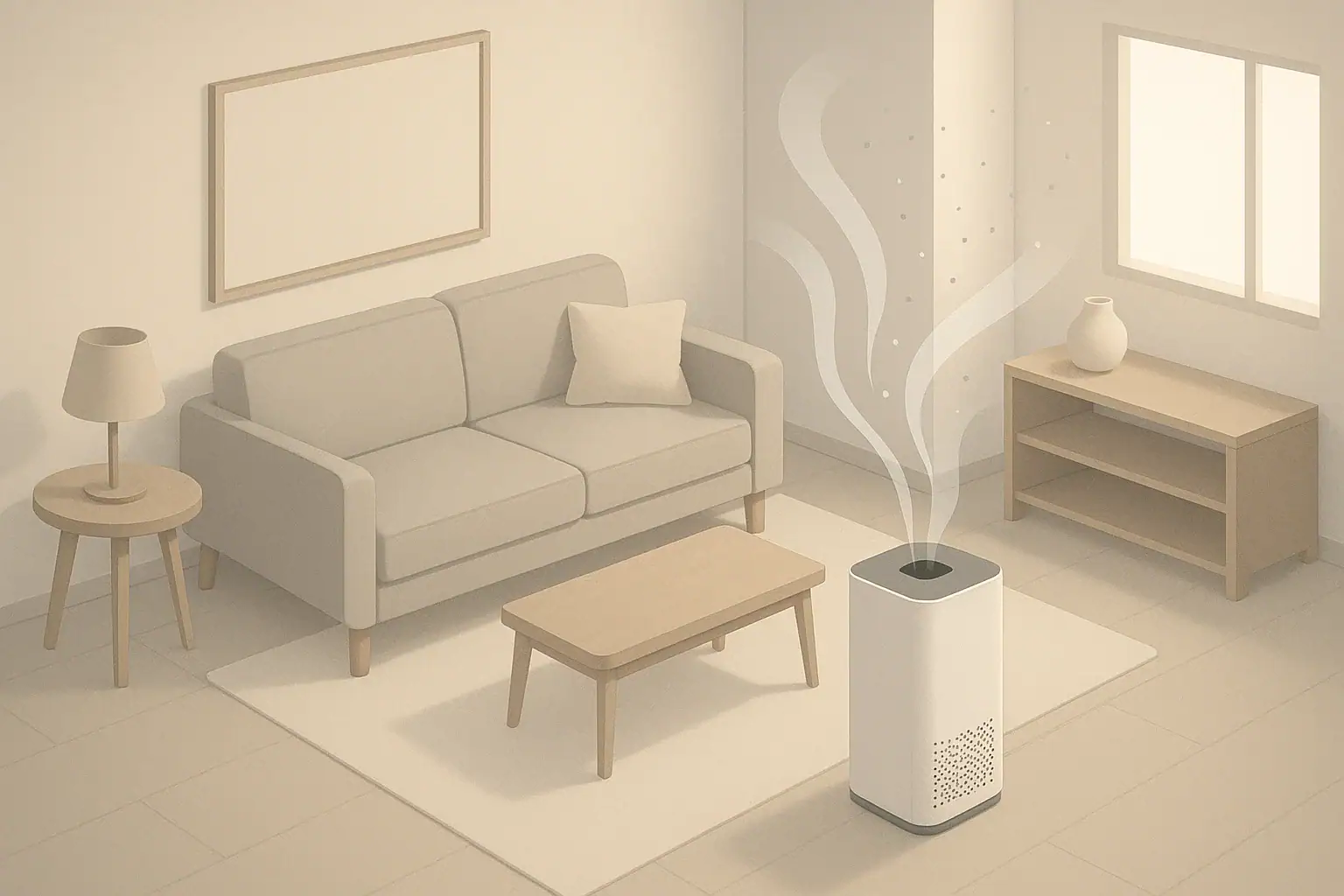
A practical way to lower wildfire smoke indoors is to close windows and doors, set up one cleaner-air room, and run appropriately sized particle filtration there continuously at the highest practical fan setting. You can then check for smoke entry points, adjust compatible HVAC settings, and air out the home when outdoor air quality improves.
Wildfire smoke, haze, and drifting ash can raise indoor PM2.5 even when the fire is far away. Fine smoke particles can remain airborne and enter through gaps, open windows, doors, and ventilation systems. A clear plan helps you reduce exposure without treating any particular monitor reading as a guarantee that the air is safe.
This guide covers practical actions you can take at home: how to create a cleaner-air room, choose sufficient smoke CADR, operate portable filtration, adjust central HVAC settings, and avoid actions that bring more smoke inside. The recommendations follow current U.S. Environmental Protection Agency guidance for wildfire smoke.
What Wildfire Smoke Indoors Really Means and Why PM2.5 Matters
When outdoor wildfire smoke gets inside, an important concern is fine particulate matter called PM2.5. PM2.5 generally refers to particles with aerodynamic diameters of 2.5 micrometers or smaller. These particles can be inhaled, and particle filtration is one of the main ways to reduce their concentration indoors.
Wildfire smoke indoors can include:
- Fine particles, including PM2.5, produced by burning materials
- Gases and volatile organic compounds released during combustion
- Coarser ash and dust that may settle onto surfaces
You can track PM2.5 trends with a consumer air-quality sensor. A falling reading after windows are closed and filtration begins is useful evidence that the setup is reducing measured particles. However, the EPA cautions that consumer sensors have more uncertainty than regulatory monitors, may be affected by humidity and temperature, and do not measure smoke gases or settled ash. Short-term indoor readings should not be directly compared with 24-hour Air Quality Index values or regulatory limits. See the EPA’s Air Quality Sensors for Wildfire Smoke fact sheet.
Most household smoke plans use three measures:
- Limit smoke entry by closing windows and doors when safe.
- Filter indoor air continuously in at least one occupied room.
- Air out the home when outdoor air quality improves, even if the improvement is temporary.
If whole-home filtration is insufficient, concentrating portable filtration in one appropriately sized room can create a more manageable cleaner-air space.
Key Concepts: Cleaner-Air Rooms, CADR, and Air Changes per Hour
Indoor particle levels reflect both the rate at which smoke enters and the rate at which particles are removed. Room size, air-cleaner performance, filter condition, airflow, and continuing infiltration all affect the result.
Cleaner-air room basics
- Choose a room large enough for the people who will use it and suitable for keeping cool.
- Close windows and doors without blocking an emergency exit.
- Use temporary weatherstripping only where it will not interfere with egress, required ventilation, or combustion-appliance air supplies.
- Avoid activities that create particles indoors, including smoking, burning candles, frying food, and unnecessary fireplace use.
- If the room has a window air conditioner or HVAC controls, use recirculation mode when available and close any outdoor-air intake unless the manufacturer or a qualified professional says it must remain open.
The EPA’s June 2026 Cleaner-Air Room fact sheet recommends closing windows and doors, using recirculation, avoiding indoor particle sources, and operating an appropriately sized air cleaner continuously. It also says not to obstruct emergency exits.
Smoke CADR and room size
Clean Air Delivery Rate, or CADR, describes how much particle-free air an air cleaner delivers. CADR is usually listed in cubic feet per minute in the United States, and separate ratings may be given for smoke, dust, and pollen.
For wildfire smoke, the EPA recommends a smoke CADR of at least two-thirds of the room’s area in square feet. For example, a 180-square-foot room calls for a smoke CADR of at least 120 cfm under this sizing rule. This is a minimum equipment-sizing recommendation, not a guaranteed cleanup time or a declaration that a resulting PM2.5 level is safe.
| Room area | Minimum smoke CADR under EPA’s rule | Practical approach |
|---|---|---|
| 120 ft² | 80 cfm | Choose a unit rated at or above this smoke CADR. |
| 180 ft² | 120 cfm | Use one suitable unit or combine units whose smoke CADRs total at least 120 cfm. |
| 250 ft² | About 167 cfm | Round up when comparing available ratings. |
| 400 ft² | About 267 cfm | One larger unit or multiple well-placed units may be needed. |
| 500 ft² | About 333 cfm | Confirm that the rating shown is specifically the smoke CADR. |
If you prefer to compare equipment using air changes per hour, ACH can be calculated from CADR and room volume. Treat the result as an airflow calculation rather than a universal health or safety threshold.
How to run portable air cleaners during smoke
- Operate the air cleaner continuously at the highest fan setting that is practical.
- Keep doors and windows closed while filtration runs, provided the room remains safe and cool.
- Leave the intake and outlet unobstructed, and follow the manufacturer’s placement clearances.
- For additional capacity, you may use more than one air cleaner and add their smoke CADRs when applying the room-sizing rule.
- Avoid units that intentionally produce ozone. EPA guidance also recommends checking for California Air Resources Board certification when selecting a portable air cleaner.
These specifications and operating instructions are detailed in the EPA’s Indoor Air Filtration fact sheet.
Examples of Managing Wildfire Smoke Indoors
The following examples show how the same principles can be adapted to different homes. They are planning examples, not measured performance results.
Example 1: Small apartment
- Choose a bedroom that can be kept cool and has enough space for its occupants.
- Close the window and door without obstructing the room’s emergency exit.
- Calculate the minimum smoke CADR by multiplying the room’s square footage by two-thirds.
- Place the air cleaner with its airflow unobstructed and operate it continuously on high.
- Limit unnecessary use of bathroom and kitchen exhaust fans while outdoor smoke is high.
Example 2: Home with central HVAC
- Choose a daytime cleaner-air room and, if needed, a bedroom for overnight use.
- Use a MERV 13 or higher filter only if the HVAC system can accommodate it, and make sure the filter fits snugly without gaps.
- Close any outdoor-air intake or set the system to recirculation when that is compatible with the system and building requirements.
- Run the HVAC fan as often as practical to move air through the filter.
- Use appropriately sized portable air cleaners in the most occupied rooms for additional particle removal.
Example 3: Older or drafty home
- Prioritize a manageable room that can remain cool and has fewer obvious smoke entry points.
- Use removable weatherstripping on nonessential gaps only when it will not impede emergency egress or appliance safety.
- Increase total smoke CADR by using a larger unit or multiple units with unobstructed airflow.
- Check outdoor conditions rather than assuming a particular time of day is cleaner. Air out the home only when local outdoor air quality improves.
| Situation | Primary action | What to check |
|---|---|---|
| Smoke odor or elevated indoor PM2.5 | Close windows and doors and operate cleaner-air-room filtration continuously. | Openings, indoor particle sources, airflow obstructions, and filter condition. |
| Indoor PM2.5 continues to rise | Check smoke entry points and confirm that total smoke CADR is sufficient. | Outdoor-air intakes, frequently opened doors, filter fit, and purifier settings. |
| Outdoor air temporarily improves | Air out the home, then close it again if smoke returns. | Current AirNow or local agency readings rather than a presumed time of day. |
| Filter is dirty or begins to smell | Clean or replace it as directed by the manufacturer. | Reduced airflow, visible loading, odor, and the device’s filter indicator. |
| The home cannot remain cool or too much smoke enters | Consider moving to another location with cleaner, cooler air if possible. | Heat, power availability, symptoms, and local emergency instructions. |
Common Mistakes and Troubleshooting When Smoke Gets Inside
Even with suitable equipment, airflow restrictions, continuing infiltration, and indoor particle sources can limit the improvement.
Common mistakes that keep PM2.5 high
- Using too little smoke CADR for the room. Check the smoke rating rather than relying only on a general room-size label.
- Blocking the intake or outlet. Furniture, walls, and curtains can restrict airflow; follow the manufacturer’s clearance instructions.
- Leaving windows open while outdoor smoke is high. This allows more smoke to enter.
- Running exhaust fans longer than necessary. Exhaust can encourage outdoor air to enter through other openings.
- Creating particles indoors. Smoking, candles, fireplaces, frying, and some cleaning activities can add particles while the home is closed.
- Ignoring filter condition. A dirty or odorous filter may need cleaning or replacement according to the manufacturer’s instructions.
Troubleshooting cues and simple checks
- PM2.5 does not trend downward: Check windows, exterior doors, outdoor-air intakes, fireplace openings, indoor particle sources, purifier settings, and filter fit.
- The cleaner-air room improves but other rooms do not: Keep the priority room closed when practical or add sufficient filtration where additional coverage is needed.
- Airflow seems weak: Inspect prefilters and replaceable filters, remove any obstruction, and confirm that packaging was removed from a newly installed filter.
- Smoke odor remains after PM2.5 falls: Particle filters do not remove all smoke gases. Activated carbon or another gas-phase medium may reduce some odors, but performance varies and odor is not a reliable measure of PM2.5.
- The room becomes too hot: Heat safety takes priority. Use compatible cooling in recirculation mode or move to a cooler location with cleaner air if possible.
When to reconsider your setup
- If smoke events recur, designate a room that can be kept cool and equip it with enough smoke CADR for its area.
- If particles appear to enter around a particular opening, address that opening without blocking an emergency exit or required appliance ventilation.
- If you rely on central HVAC, ask a qualified professional whether the system can support MERV 13 or higher filtration without unacceptable airflow restriction.
Safety Basics When Dealing With Wildfire Smoke Indoors
Reducing indoor smoke exposure is not the same as treating symptoms, and no consumer PM2.5 reading establishes that a room is medically safe. Heat, power loss, appliance requirements, and emergency egress also affect whether a closed room remains suitable.
Ventilation and combustion safety
- Do not block or modify furnace, water-heater, boiler, or other combustion-air inlets.
- Do not seal appliance exhaust vents or fireplace components in a way that conflicts with their operating instructions.
- Do not block a required emergency exit while closing windows, doors, or gaps.
- Reduce avoidable use of gas stoves, fireplaces, candles, and other indoor combustion sources.
- Keep smoke alarms and carbon monoxide alarms installed and working as required for the home.
Electrical and equipment safety
- Follow the air cleaner manufacturer’s electrical, placement, and filter instructions.
- Do not use a damaged cord or overload an outlet or power strip.
- Keep equipment stable, dry, and positioned so cords do not create a tripping hazard.
Symptoms and escalation
- Contact a healthcare provider for persistent trouble breathing, shortness of breath, or a cough that will not stop.
- Call 911 or go immediately to an emergency department for severe trouble breathing, chest pain, or signs of a possible heart attack or stroke.
- Follow evacuation orders and local emergency instructions. Exposure-reduction steps inside the home are not a substitute for evacuation.
- If the home cannot remain cool, power fails, or too much smoke continues to enter, consider relocating to a cleaner-air location if it is safe to do so.
These escalation steps reflect current CDC guidance for wildfire smoke and people with chronic conditions. People with heart or lung disease should also follow an existing treatment or action plan provided by their healthcare professional.
Maintenance, Filter Care, and Readiness
Filter condition and equipment readiness affect how well a smoke-response plan works. There is no single replacement interval that applies to every smoke event, because loading depends on use, smoke concentration, filter area, and the equipment.
Filter care during and after smoke events
- Inspect portable-air-cleaner and HVAC filters frequently during active smoke.
- Clean reusable prefilters only as directed by the manufacturer.
- Clean or replace filters when they are dirty, begin to smell, trigger a filter indicator, or reach the manufacturer’s service limit.
- Check that replacement filters are installed in the correct direction and fit without bypass gaps.
Humidity and comfort management
- Closed homes can become warm or humid. Use compatible cooling and moisture control without opening the home to smoky air.
- Use bathroom and kitchen exhaust only as needed while outdoor smoke is elevated.
- Do not use a humidifier merely to treat smoke particles; if one is needed for comfort, clean and operate it according to its instructions.
Storage and readiness between events
- Inspect equipment and filters before smoke season or when wildfire risk rises.
- Store portable air cleaners in a clean, dry location.
- Keep compatible replacement filters available if supply interruptions are common in your area.
- Record the room area and required smoke CADR for the space you plan to use.
Practical Takeaways and Specs to Look For
The core plan is to limit smoke entry, create a room that can remain safe and cool, run sufficient particle filtration continuously, and air out the home when outdoor conditions improve.
Specs to look for in portable air cleaners
- Smoke CADR of at least two-thirds of the room area, using square feet for area and cfm for CADR.
- Mechanical particle filtration, such as HEPA filtration, with a published smoke CADR.
- No intentional ozone generation.
- CARB certification, as recommended in EPA wildfire-smoke guidance.
- Accessible replacement filters and clear maintenance instructions.
- An optional gas-phase filter if odor reduction is also desired, recognizing that performance depends on the amount and type of sorbent.
For more detail on comparing equipment, see which air-purifier specifications matter for wildfire smoke.
Central HVAC checks
- Use MERV 13 or higher filtration only when the system supports it.
- Make sure the filter is the correct size, oriented properly, and seated snugly.
- Use recirculation and close outdoor-air intakes when compatible with the system and building requirements.
- Run the fan as often as practical during smoke events and inspect the filter frequently.
No setup guarantees a particular indoor PM2.5 concentration or cleanup time. Use monitor trends, current outdoor conditions, equipment condition, room temperature, and occupants’ symptoms together when deciding whether the space remains suitable.
Frequently asked questions
What specifications matter most when choosing an air purifier for wildfire smoke indoors?
Start with the unit’s smoke CADR. EPA recommends at least two-thirds of the room area in square feet, so a 300-square-foot room calls for at least 200 cfm of smoke CADR. Also look for mechanical particle filtration, no intentional ozone generation, CARB certification, unobstructed airflow, and readily available replacement filters.
How long should I run an air purifier to reduce indoor smoke?
Do not rely on a fixed 30- or 60-minute cleanup time. Run the air cleaner continuously on its highest practical setting while outdoor smoke remains a concern, and use indoor PM2.5 trends to evaluate progress. Room size, smoke CADR, infiltration, starting concentration, airflow, and filter condition all affect the result.
What is one common mistake that makes indoor smoke worse?
Leaving windows open while outdoor air is smoky allows more particles to enter. Other common problems include insufficient smoke CADR, blocked purifier airflow, dirty filters, open outdoor-air intakes, and particle-producing activities indoors.
Is it safe to seal my home completely during a wildfire smoke event?
Do not treat complete sealing as universally safe. Never block emergency exits, combustion-air inlets, or appliance exhausts. The home must also remain cool enough to occupy. If excessive smoke still enters, the room becomes dangerously hot, or power fails, consider moving to a cleaner and cooler location when it is safe to do so.
How often should I check or replace filters during an active smoke event?
Inspect them frequently rather than relying on a fixed number of days. Clean or replace a filter when it is dirty, begins to smell, triggers the device’s indicator, restricts airflow, or reaches the manufacturer’s service limit.
Should I run my central HVAC fan continuously when wildfire smoke is outside?
EPA advises running the HVAC fan as often as practical so air passes through the filter. Use MERV 13 or higher only if the system can accommodate it, seat the filter snugly, and use recirculation when compatible with the system. A qualified HVAC professional can assess filter and airflow compatibility.
- Clear sizing logic (room size → CADR/ACH)
- HEPA vs carbon explained for real use-cases
- Humidity + ventilation basics to reduce mold risk