
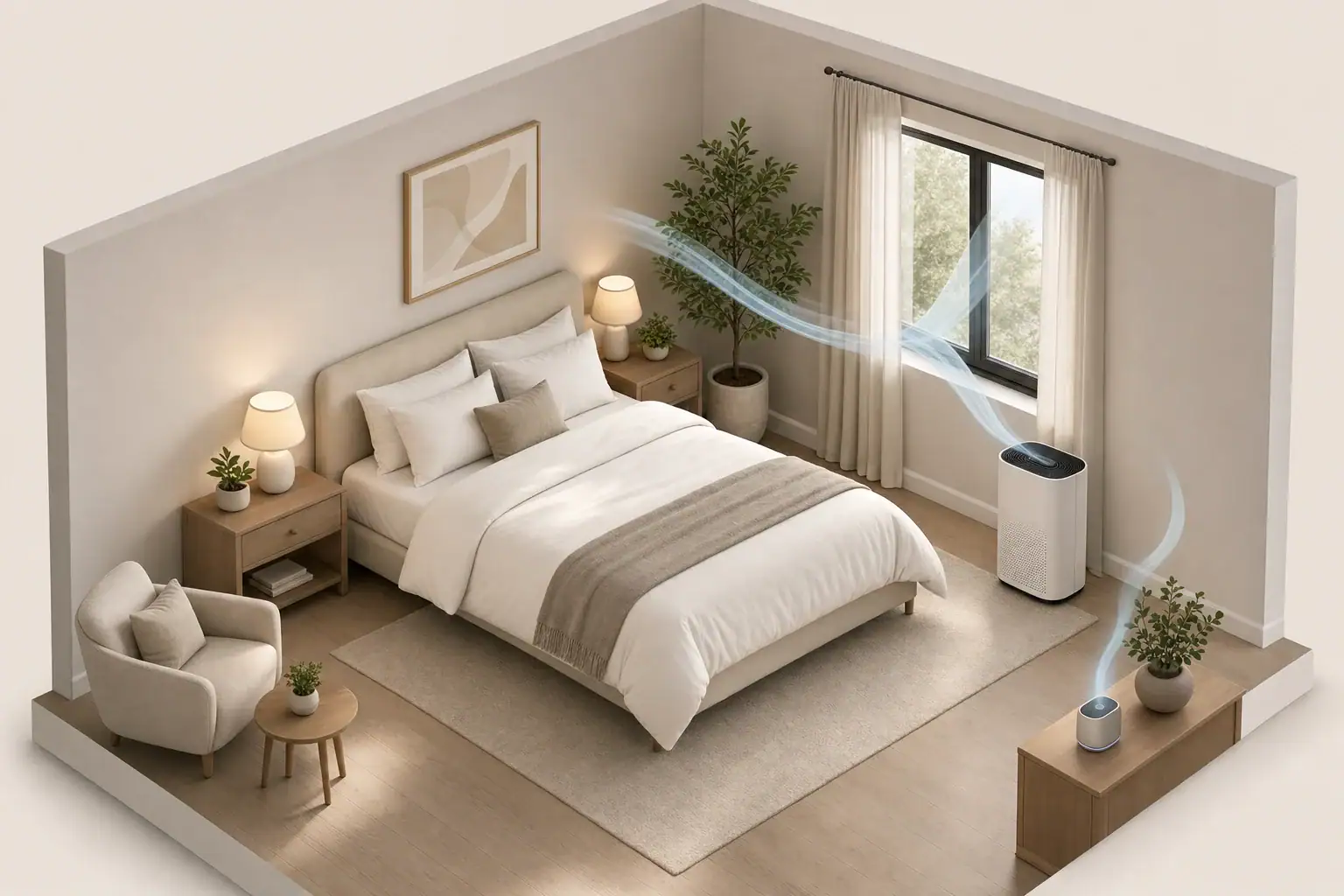
A practical dust mite bedroom setup combines controlled humidity, zippered bedding covers, regular cleaning, and correctly sized particle filtration. These measures address different parts of the problem, so no single device or cleaning task replaces the others. The goal is a manageable routine that limits moisture and reduces material accumulating in bedding and room dust.
- Keep bedroom relative humidity around 30% to 50%, with a practical goal below 50% when conditions allow.
- Use fully zippered, allergen-resistant covers on the mattress and pillows; consider covering the box spring as well.
- Wash sheets and pillowcases about once a week using the warmest water permitted by their care labels, then dry them completely.
- Damp-dust hard surfaces and vacuum floors regularly, preferably with a well-sealed vacuum using efficient particle filtration.
- Use a properly sized air purifier for airborne particles, but do not expect it to remove mites living inside bedding.
Why a Dust Mite Bedroom Setup Uses Several Controls
Dust mites are microscopic organisms that commonly live in household dust, especially where skin flakes collect. Mattresses, pillows, upholstered furniture, carpets, and soft toys provide suitable reservoirs. The particles associated with mites can become airborne when bedding is disturbed, people move through the room, or cleaning stirs settled dust.
A bedroom plan works best when it addresses both the reservoir and the surrounding environment. Humidity control makes indoor conditions less favorable to mites. Encasements create a barrier around major bedding reservoirs, while washing and cleaning remove accumulated material. Filtration captures some particles after they enter the air.
These controls have different jobs. An air purifier cannot clean the interior of a mattress, and a mattress cover cannot control moisture in the room. Combining modest measures is generally more practical than relying on one aggressive intervention.
Humidity Targets and Moisture-Control Basics
Relative humidity is the amount of moisture in the air compared with the maximum the air can hold at the same temperature. Because warmer air can hold more moisture, the relative humidity reading may change as room temperature changes even when no water is added or removed.
A general indoor target of 30% to 50% relative humidity balances moisture control with everyday comfort. For a dust mite bedroom, keeping the level below 50% for sustained periods is a useful practical goal where the climate and building allow it. Levels consistently above 50% can also support condensation and dampness in cool areas.
Measure before adding equipment
Use a basic hygrometer to check the room rather than estimating humidity by feel. Place it away from windows, supply vents, exterior walls, humidifiers, and dehumidifier outlets. Check readings at different times for several days because outdoor weather, showering, cooking, air conditioning, and overnight occupancy can all affect the result.
If readings are already between 30% and 50%, extra moisture equipment may not be necessary. When humidity is high, start with source control: run bathroom exhaust fans, repair leaks, dry wet materials, avoid drying laundry in the bedroom, and use air conditioning or a dehumidifier as appropriate. If indoor air is below about 30%, avoid unnecessary dehumidification.
Example values for illustration.
| Observed condition | Primary action | Additional note |
|---|---|---|
| Humidity below 30% | Stop unnecessary dehumidification | Check the monitor location and room temperature |
| Humidity 30% to 50% | Maintain current moisture controls | Continue periodic checks as seasons change |
| Humidity repeatedly above 50% | Improve moisture removal | Consider air conditioning or dehumidification |
| Window condensation | Reduce moisture and improve circulation | Inspect nearby surfaces for persistent dampness |
| Localized damp area | Find and correct the moisture source | A room appliance does not repair a leak |
| Reading changes sharply | Verify monitor placement | Keep it away from direct equipment airflow |
Mattress and Pillow Covers That Address Reservoirs
Use covers designed to fully encase the mattress and pillows rather than pads that protect only the top surface. A complete encasement has a zipper and tightly woven or otherwise allergen-resistant material. A protected zipper end or flap can help limit gaps around the closure.
Covering the box spring is also reasonable because its fabric and internal structure can collect dust. A bed frame without an upholstered headboard or fabric surround is easier to wipe down, although replacing existing furniture is not essential if it can be cleaned adequately.
Fit and fabric considerations
- Measure the mattress length, width, and depth so the cover is not excessively loose or strained at the seams.
- Choose a surface that can tolerate the expected cleaning routine and remains comfortable beneath normal sheets.
- Check whether the cover is machine washable and follow its temperature and drying limits.
- Inspect the zipper and seams after laundering or moving the mattress.
- Do not assume that waterproof and allergen-resistant mean the same thing; verify the cover’s intended function.
After installation, leave the encasement in place as the regular mattress barrier. Wash it according to its care instructions rather than removing it with every weekly sheet change. Rough handling, excessive heat, or an incorrect size can damage its barrier or zipper.
Cleaning Bedding, Floors, and Dust-Holding Surfaces
Wash sheets, pillowcases, and washable blankets about weekly. Use the warmest water permitted by the textile’s care label and dry each item completely. Hot water around 130°F is often discussed for mite control, but washer settings vary, high temperatures can create a scald risk, and some fabrics cannot tolerate that heat. Following appliance and textile instructions is the safer general approach.
Bulky comforters that are difficult to wash can be placed inside a washable duvet cover. Keep decorative pillows and extra throws to a manageable number. Washable soft toys can be cleaned according to their labels; items that cannot be cleaned may be stored outside the sleeping area.
Use a low-dust cleaning sequence
- Remove and bag or carry bedding carefully instead of shaking it in the room.
- Damp-wipe shelves, the headboard, window sills, and other hard surfaces.
- Vacuum the floor, rugs, and accessible edges around the bed.
- Allow disturbed particles to settle or run particle filtration during and after cleaning.
- Install fully dried bedding.
A damp microfiber cloth generally captures dust more effectively than a dry feather duster. If vacuuming noticeably releases dust or odor, inspect the vacuum’s bag, bin, seals, hoses, and filters. Empty or service it as directed, preferably away from the bedroom.
Hard flooring is usually easier to damp-clean than thick carpet, but flooring replacement is not always practical. Existing carpet can be vacuumed methodically with overlapping passes. Cleaning frequency matters more than repeatedly using fragrances or harsh chemicals.
Air Filtration, Room Airflow, and Ventilation
A portable air purifier with efficient particle filtration can capture airborne mite-related particles and other household dust. It does not kill or remove mites embedded in a mattress, so it should supplement humidity control, covers, and cleaning.
Choose a unit using its smoke clean air delivery rate, or CADR, and the bedroom’s volume. Room volume equals floor area multiplied by ceiling height. Air changes per hour can be estimated as CADR multiplied by 60 and divided by room volume, using cubic feet and cubic feet per minute.
For example, a 150-square-foot room with an 8-foot ceiling has a volume of 1,200 cubic feet. A CADR of 100 cubic feet per minute would provide about five theoretical air changes per hour: 100 × 60 ÷ 1,200. Actual mixing varies with placement, furniture, door position, filter condition, and fan speed.
Placement for useful airflow
- Leave clearance around the intake and outlet according to the equipment instructions.
- Do not hide the purifier behind curtains, under furniture, or inside a closet.
- Place it where airflow can circulate through the occupied part of the room without blowing directly at the sleeper.
- Select a nighttime speed that is quiet enough to run consistently.
- Keep the bedroom door position reasonably consistent when evaluating performance.
Outdoor ventilation can dilute indoor pollutants when outdoor conditions are suitable, but it does not directly control bedding reservoirs. Opening windows during humid weather may increase indoor moisture. Also consider outdoor particles, smoke, security, and noise before relying on window ventilation.
Common Mistakes and Real-World Bedroom Examples
One common mistake is adding a humidifier automatically because the room feels dry. Measure first: excessive humidification can move the room away from the preferred range. Another is running a dehumidifier continuously without checking humidity, which may create unnecessary noise, heat, and energy use.
Purifier placement is another frequent issue. A large unit on its lowest setting may move less clean air than expected, while a smaller unit on a tolerable medium setting may be used more consistently. CADR should be considered at the fan speed that will actually run.
Example: Humid summer bedroom
A bedroom repeatedly measuring 58% to 65% relative humidity may benefit from closed windows during muggy weather, bathroom exhaust use, air conditioning, or dehumidification. Bedding covers and weekly laundering remain useful because lowering humidity does not remove existing dust.
Example: Dry winter bedroom
If the room stays near 30% to 40%, dehumidification is unnecessary. Focus on encasements, bedding care, surface cleaning, and particle filtration. If a humidifier is used for comfort, monitor the room and avoid raising humidity above the intended range.
Example: Carpeted rental bedroom
When replacing carpet is not an option, reduce movable dust collectors, damp-dust hard surfaces, and vacuum on a consistent schedule. A purifier can capture particles suspended during normal activity, while washable bedding and full encasements address the bed.
Safety, Maintenance, and Ongoing Upkeep
Follow the instructions for every purifier, dehumidifier, humidifier, vacuum, and bedding cover. Do not modify equipment, block ventilation openings, defeat safety switches, or use an extension cord unless the manufacturer permits it. Keep water-containing equipment away from outlets and electrical devices.
Particle filters need inspection and periodic replacement. Timing depends on operating hours, fan speed, dust loading, pets, smoke exposure, and filter area. A clogged filter can reduce airflow. Wash only filters specifically identified as washable, and reinstall washable components only after they are completely dry.
Empty dehumidifier tanks regularly or maintain an approved drain arrangement. Clean accessible coils, grilles, and water-contact surfaces according to the manual. Humidifiers require especially consistent water and reservoir care because standing water and residue can accumulate.
Ionizers and some electronic air cleaners can produce ozone as a byproduct. Ozone is not needed for a dust mite bedroom plan, so favor mechanical particle filtration that does not intentionally generate it. UV-C may be included in some equipment, but performance depends on dose, exposure time, and enclosure design; it does not replace filtration, cleaning, or moisture control. Never operate exposed UV-C devices around people or animals.
Example values for illustration.
| Goal | Simple actions | Tool or check | Reminder |
|---|---|---|---|
| Verify current humidity | Record morning and evening readings | Room hygrometer | Check for several days |
| Stay near 30% to 50% | Adjust moisture equipment gradually | Hygrometer and controls | Seasonal changes are normal |
| Reduce high humidity | Use exhaust, cooling, or dehumidification | Fan, air conditioner, or dehumidifier | Correct leaks separately |
| Avoid over-drying | Pause dehumidification below target | Humidity trend | Confirm monitor accuracy and placement |
| Prevent condensation | Improve circulation near cool surfaces | Visual inspection | Dry damp surfaces promptly |
| Maintain equipment | Clean grilles, tanks, and approved components | Calendar reminder | Follow equipment instructions |
Related guides: Dust Mite Allergy: Humidity Targets, Bedding, and Filtration • Bedroom Allergy Setup: The Fastest Changes That Reduce Symptoms • HEPA Vacuum vs Air Purifier: Which Helps More for Allergies?
Dust Mite Bedroom Setup Summary
Start by measuring humidity and aim for a stable indoor range of about 30% to 50%, generally staying below 50% when practical. Correct leaks and moisture sources before relying on portable equipment.
Fully encase the mattress and pillows, manage bedding with a consistent weekly routine, and reduce dust using damp wiping and regular vacuuming. Use a correctly sized particle air purifier for airborne material, with enough clearance and a fan speed that can run consistently.
Recheck humidity as seasons change, inspect covers and equipment, and replace filters when indicated by their condition or maintenance schedule. A simple routine carried out regularly is more useful than adding multiple devices without measuring the room or maintaining them.
Frequently asked questions
What humidity level is best for a dust mite bedroom setup?
A practical bedroom target is about 30% to 50% relative humidity, with sustained levels below 50% when practical. Use a hygrometer to check conditions over several days, since readings can change with weather, temperature, and daily activities. If humidity is consistently high, address leaks and moisture sources before relying only on portable equipment.
Do mattress encasements prevent dust mites in a bed?
Fully zippered, allergen-resistant mattress and pillow encasements create a barrier around major bedding reservoirs. They do not replace laundering or room cleaning, but they can limit exposure to material inside the mattress and pillows. Choose covers that fit correctly and inspect the zipper and seams periodically.
How often should bedding be washed to reduce dust mite allergens?
Sheets, pillowcases, and washable blankets are commonly washed about once a week. Use the warmest water allowed by each item’s care label, then dry the bedding completely. For bulky items that are difficult to wash, a washable duvet cover can make regular care easier.
Will an air purifier get rid of dust mites in a mattress?
No. An air purifier can capture some airborne particles, including dust that becomes suspended during normal activity or cleaning, but it cannot remove mites living inside bedding. Use it as a supplement to encasements, humidity management, regular laundering, and dust removal.
Is carpet a problem in a dust mite bedroom setup?
Carpet can hold dust and may require more regular cleaning than hard flooring, but replacing it is not always necessary or practical. Vacuum carpet methodically with overlapping passes and damp-dust other room surfaces to reduce settled material. Reducing unnecessary soft furnishings can also simplify the cleaning routine.
Recommended next:
- Pet Dander Allergy: Best Air Cleaner Setup and Habits That Help
- Dust Mite Allergy: Humidity Targets, Bedding, and Filtration
- Asthma Triggers Indoors: A Practical Checklist to Improve Air Quality
- Bedroom Allergy Setup: The Fastest Changes That Reduce Symptoms
- Pollen Season Indoor Plan: Filters, Ventilation Timing, and Cleaning
- Dust Mites and Humidity: The RH Range That Helps Most
- Clear sizing logic (room size → CADR/ACH)
- HEPA vs carbon explained for real use-cases
- Humidity + ventilation basics to reduce mold risk