
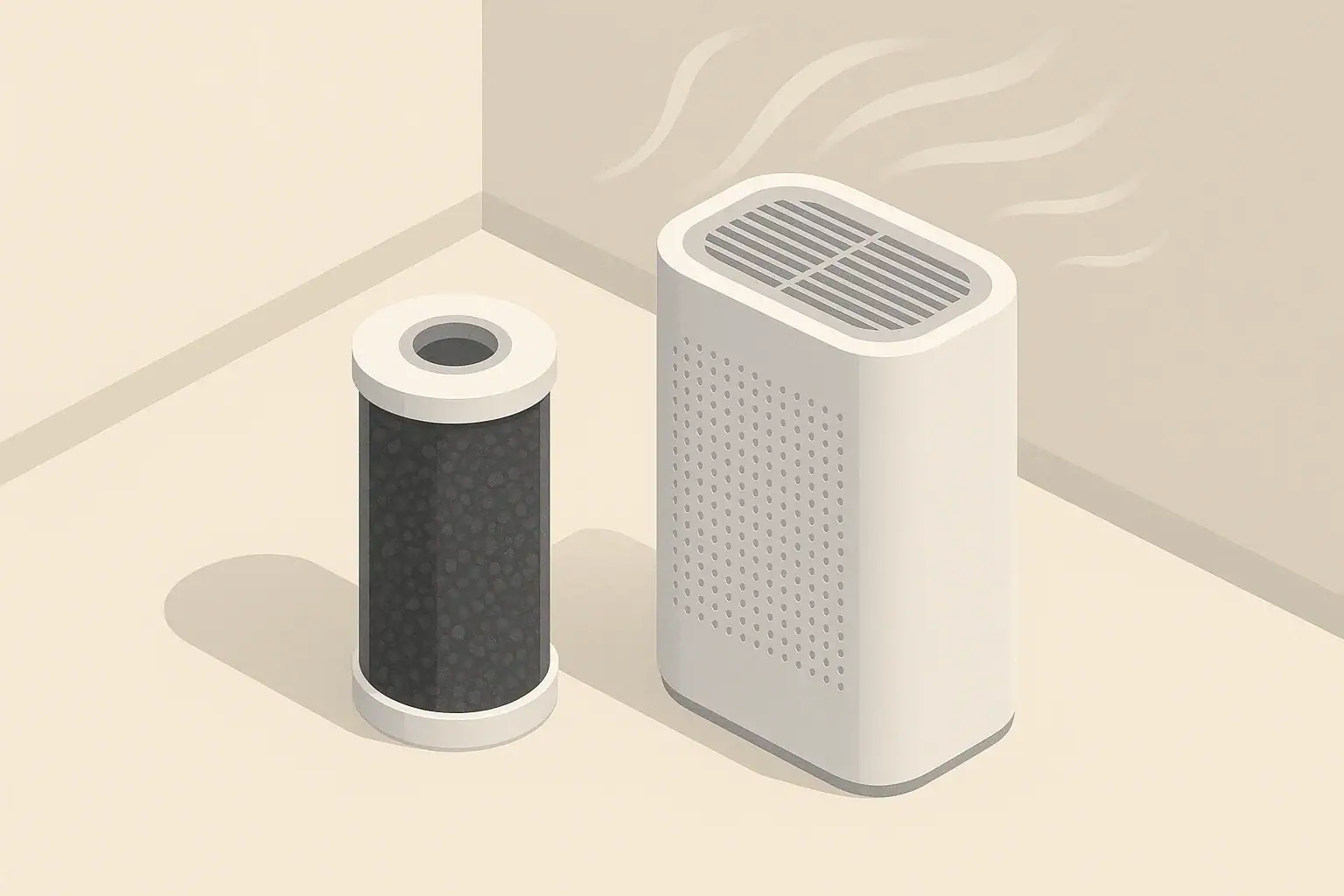
Activated carbon weight matters because a heavier, well-designed carbon filter usually contains more adsorbent material and can hold odors and many gaseous pollutants longer than a thin carbon sheet.
Weight is not the only detail, but it is one of the easiest clues to compare when shopping for odor and VOC filtration. The type of carbon, airflow path, filter thickness, sealing, and replacement schedule also affect real-world performance.
- For light, occasional odors, a thin carbon layer may help, but it is often measured in ounces rather than pounds.
- For routine odor control in a room, look for meaningful carbon mass, often roughly 1 to 5 pounds in a dedicated carbon filter or cartridge.
- For stronger or recurring odor sources, several pounds of carbon, good sealing, and lower fan speeds can be more useful than a very thin deodorizing pad.
- Activated carbon is for gases and odors; it does not replace a HEPA filter for dust, pollen, smoke particles, or PM2.5.
- Use source control and ventilation first when possible, then use carbon filtration as a supporting tool.
What Activated Carbon Weight Means
Activated carbon weight refers to the amount of activated carbon media inside a filter. It is usually expressed in ounces or pounds. In home air purifiers, carbon may appear as a thin bonded sheet, a pleated layer with carbon coating, loose granules, pellets, or a thicker carbon bed inside a cartridge.
Activated carbon is porous. Its internal surface area can adsorb many odor molecules and some volatile organic compounds, often called VOCs. Adsorption means molecules attach to the surface of the carbon rather than being mechanically trapped like dust in a particle filter.
More carbon can matter because adsorption capacity is finite. Once many sites on the carbon surface are occupied, the filter becomes less effective for the gas mixture it is exposed to. A small carbon pad can become saturated faster than a larger carbon bed, especially in environments where odors are frequent, such as a cooking odors carbon filters range hoods situation, wildfire smoke, hobby materials, new furnishings, or attached-garage smells.
However, weight alone does not guarantee performance. A heavy filter with poor airflow contact or bypass leakage may underperform. A lighter filter with better engineering may handle mild odors acceptably. Carbon weight should be read as one important clue, not a complete rating.
How Carbon Weight Fits Into Filter Sizing
Carbon filters work best when air has enough contact with the carbon surface. This is sometimes called dwell time or residence time. In practical home terms, air should pass through the carbon media rather than around it, and it should not move so quickly that contact is minimal.
There is no single household standard that says every room needs a specific number of pounds of carbon. The right amount depends on room volume, odor source strength, ventilation, fan speed, and how long you expect the filter to last. Still, general ranges can help set expectations.
Simple sizing logic
Think of carbon capacity in three parts:
- Source strength: Occasional cooking odor is different from ongoing solvent, smoke, or garage odor intrusion.
- Air contact: A thick, sealed carbon bed usually gives air more contact than a dust filter with a sprayed-on carbon coating.
- Replacement interval: More carbon often lasts longer, but saturation can happen faster in high-odor environments.
For many homes, carbon is best used as part of a layered approach. Remove or reduce the source, ventilate when outdoor conditions allow, and use a purifier sized for both particles and gases if both concerns are present, especially when comparing options like carbon filter vs HEPA systems.
| Filter format | Typical carbon amount | Best fit | Key limitation |
|---|---|---|---|
| Carbon-coated prefilter | Often ounces | Light household odors | Limited capacity |
| Thin bonded carbon sheet | Often ounces | Mild odor polishing | Can saturate quickly |
| Pleated filter with carbon | Varies widely | Mixed dust and mild odor needs | Carbon depth may be modest |
| Loose granular cartridge | Often pounds | More persistent odors | Needs good sealing |
| Pellet carbon bed | Often pounds | Higher gas adsorption capacity | May reduce airflow if dense |
| Specialty impregnated carbon | Varies | Specific gas concerns | Not universal for all VOCs |
Why More Carbon Often Helps but Is Not the Only Factor
More carbon often helps because it increases available adsorption sites. If two filters have similar carbon type, airflow design, sealing, and room use, the heavier carbon filter generally has more capacity. That can mean better odor holding and a longer useful life before replacement.
The word “often” is important. Carbon performance depends on the actual gas mixture. Some compounds are adsorbed more readily than others. Humidity can compete for adsorption sites in some situations. High airflow can reduce contact time. A filter that allows air to leak around the media can lose much of the advantage of added carbon.
Carbon weight versus CADR
Clean air delivery rate, or CADR, is mainly used for particles such as smoke particles, dust, and pollen. It does not fully describe VOC or odor removal. A purifier may have a strong particulate CADR and only a small carbon layer. Another unit may have more carbon but lower particle airflow.
For homes with both particle and odor concerns, compare both sides of the design. For particles, look for efficient mechanical filtration and enough airflow for the room. For odors and gases, look for carbon mass, media depth, and a clear replacement plan.
Common Mistakes When Comparing Carbon Filters
A common mistake is assuming that any mention of “carbon” means strong odor control. Many filters include only a very thin carbon layer intended for light odor reduction. This can be useful, but it should not be confused with a dedicated carbon cartridge containing pounds of media.
Another mistake is focusing only on room size claims. A room-size statement may be based on particle filtration, not VOC adsorption capacity. When odor control is the main goal, check whether the product information clearly states carbon weight or at least describes a substantial carbon bed.
- Ignoring the source: A purifier cannot fix an ongoing source as efficiently as removing, sealing, storing, or ventilating it properly.
- Running only on high speed: Higher speed moves more air, but it may reduce contact time through carbon media.
- Overlooking bypass: Gaps, poor filter fit, or damaged gaskets let air avoid the carbon.
- Waiting for a calendar date only: Strong odors can use up carbon faster than a standard replacement interval suggests.
- Expecting particle filters to handle gases: HEPA-type filters capture particles, not most gases or odors.
Practical Checklist for Choosing Carbon Capacity
Start by identifying the problem you are trying to solve. Occasional food odors, pet smells, wildfire smoke odor after particles are filtered, and new-product smells are not the same challenge. The more persistent the source, the more you should prioritize carbon mass and source control. If the odor source is something like formaldehyde in homes, the carbon type and capacity matter even more.
What to look for
- Carbon weight listed in ounces or pounds, especially for odor-focused devices.
- A dedicated carbon cartridge or bed rather than only a coated prefilter, when odors are a main concern.
- A tight filter fit with gaskets, latches, or a design that discourages bypass.
- A fan range that allows continuous operation at a comfortable noise level.
- Separate replacement information for carbon and particle filters, if they are different parts.
- Clear instructions for filter disposal and replacement without needing to modify the device.
As a practical rule, if odor or VOC reduction is a high priority, do not rely on marketing terms alone. Look for the physical design. A thicker and heavier carbon section is generally more meaningful than a thin black layer attached to a dust filter.
Real-World Examples for Homes and Apartments
In a small apartment kitchen, brief cooking odors may improve with a range hood, window ventilation when appropriate, and a purifier that includes both particle filtration and a modest carbon layer. If odors are occasional, a very large carbon bed may not be necessary.
In a bedroom near an attached garage, the first step is reducing the pathway for odors to enter the living space. Weatherstripping, pressure differences, and storage practices may matter. A purifier with several pounds of carbon can help reduce remaining odors in the room, but it should not be treated as the only control.
In a hobby room using paints, adhesives, or solvents, source control is especially important. Follow product labels, use appropriate ventilation, and store materials tightly closed. Carbon filtration may support comfort, but it is not a substitute for safe product use or occupational-level controls when stronger chemicals are involved.
For wildfire smoke events, a HEPA or high-efficiency particle filter is the main tool for smoke particles and PM2.5. Activated carbon can help with some smoke odors and gases, but the amount of carbon affects how long that benefit may last. After a major smoke exposure, when to replace carbon filters becomes a practical question if odors remain.
Safety, Standards, and Maintenance Considerations
For home use, choose air-cleaning approaches that do not intentionally generate ozone. Ozone can react with indoor materials and is not needed for routine residential air cleaning. If a purifier includes ionization, plasma, or UV-C features, review the safety information carefully and understand whether those features can be turned off.
Activated carbon itself does not add oxygen, remove carbon dioxide in a normal home ventilation sense, or solve moisture problems. If a room feels stale, ventilation may be needed. If a room is damp, humidity control and moisture repair are more direct tools.
Maintaining carbon filters
Carbon filters are usually replaced, not washed. Washing can damage media, remove coatings, or leave moisture that affects performance. Vacuuming the exterior prefilter may help airflow if the manufacturer allows it, but it does not restore saturated carbon.
Signs that a carbon filter may need replacement include returning odors, a noticeable odor from the filter itself, reduced airflow from dust loading, or a known heavy exposure such as smoke or solvent use. Replacement timing varies widely, so use both the schedule and room conditions, and remember that carbon filter saturation signs can appear before the calendar says it is time.
| Filter type | Typical interval range | What changes it | Reminder |
|---|---|---|---|
| Thin carbon prefilter | About 1 to 3 months | Cooking, pets, smoke odor | Check odor return |
| Carbon-coated sheet | About 2 to 6 months | Airflow and odor load | Do not wash unless allowed |
| Pleated filter with carbon | About 3 to 12 months | Dust loading and gas exposure | Follow the filter schedule |
| Granular carbon cartridge | About 6 to 18 months | Carbon weight and source strength | Replace sooner after heavy odors |
| Large pellet carbon bed | About 6 to 24 months | Humidity, VOC mix, airflow | Monitor odor breakthrough |
| Separate HEPA filter | Varies by dust load | Particles, pets, fan hours | Needed for particles, not gases |
Related guides: Activated Carbon Filters Explained: VOCs, Odors, and What They Can’t Do • How Much Activated Carbon Do You Need to Remove Odors? • Activated Carbon Types: Pellet vs Granular vs Impregnated Carbon • When to Replace Carbon Filters (And How to Tell They’re Spent)
Summary: Practical Takeaways
Activated carbon weight is a useful clue because more carbon generally means more adsorption capacity, assuming the filter is well sealed and air passes through the media. Thin carbon layers can help with mild odors, while heavier carbon cartridges are usually more appropriate for persistent odor concerns.
Do not evaluate carbon weight in isolation. Consider the type of carbon, filter depth, airflow, bypass control, room conditions, and replacement cost. For particles such as dust, pollen, smoke particles, and PM2.5, use a suitable mechanical filter; for odors and many gases, look for meaningful carbon capacity.
The most practical approach is simple: reduce the source first, ventilate when suitable, choose enough carbon for the odor load, and replace the filter when performance declines. More carbon often matters, but good design and realistic expectations matter too.
Frequently asked questions
How much activated carbon is enough for home odor control?
There is no universal amount that works for every room, because odor strength, room size, and airflow all matter. As a rough guide, thin carbon pads may help with light odors, while dedicated cartridges with roughly 1 to 5 pounds of carbon are often more useful for routine odor control. Strong or recurring sources may need even more carbon plus source reduction and ventilation.
Is a heavier carbon filter always better?
Not always, because carbon weight is only one part of performance. A heavier filter usually has more adsorption capacity, but it still needs good sealing, enough air contact time, and the right carbon type for the gases present. A poorly designed heavy filter can underperform a lighter but better-built one.
Does activated carbon remove smoke particles?
No, activated carbon is mainly for odors and gaseous pollutants, not particles. Smoke particles, dust, pollen, and PM2.5 are better handled by a HEPA or other high-efficiency particle filter. Carbon can still help with some smoke odors and gases after the particles are captured.
How can I tell if a filter has enough carbon to matter?
Look for a stated carbon weight, a dedicated carbon cartridge or bed, or a clearly thick carbon section rather than a thin black coating. Product descriptions that only say “carbon filter” may still mean a very small amount of media. If the product does not provide meaningful carbon details, its odor control may be limited.
How often should activated carbon be replaced?
Replacement timing depends on odor load, humidity, runtime, and the amount of carbon in the filter. Thin carbon layers may need replacement in a few months, while larger carbon beds can last much longer. If odors return before the scheduled date, the carbon may be saturated and need earlier replacement.
Recommended next:
- Activated Carbon Filters Explained: VOCs, Odors, and What They Can’t Do
- How Much Activated Carbon Do You Need to Remove Odors?
- Carbon Filter vs HEPA: What Each One Removes (And What It Doesn’t)
- Formaldehyde in Homes: Sources, Risks, and How to Reduce It
- Activated Carbon Types: Pellet vs Granular vs Impregnated Carbon
- How Much Carbon Do You Need for Odors? Weight, Depth, and Contact Time
- More in Carbon Filters & VOCs →
- Clear sizing logic (room size → CADR/ACH)
- HEPA vs carbon explained for real use-cases
- Humidity + ventilation basics to reduce mold risk