
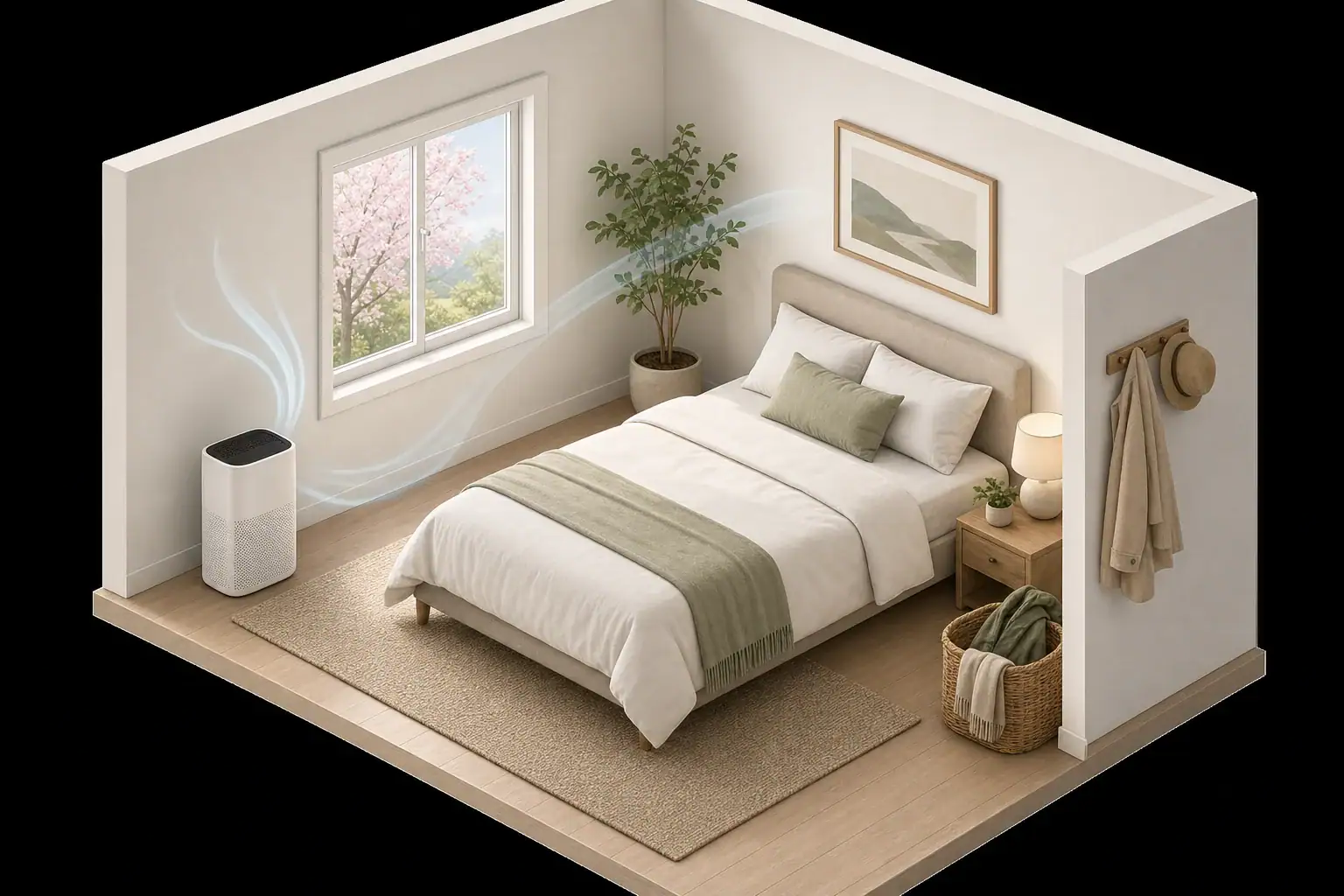
A practical spring pollen indoor routine keeps windows closed during higher-pollen periods, contains pollen on clothes and hair, cleans floors regularly, and maintains effective particle filters. The goal is to reduce how much outdoor pollen enters, settles, and returns to the air. A consistent routine usually matters more than aggressive cleaning on a single day.
Quick answer
- Keep windows closed when pollen levels are elevated or conditions are dry and windy; if ventilation is needed, consider a brief 5- to 10-minute opening when outdoor conditions are more favorable.
- Leave outdoor shoes near the entrance and change pollen-exposed outer clothing before sitting on beds or upholstered furniture.
- Vacuum high-use areas about 1–2 times per week and damp-mop hard floors about weekly, adjusting for pets, open windows, and visible debris.
- Wash frequently used bedding about weekly and avoid drying it outdoors during active pollen periods.
- For a portable purifier, an example planning target of about 4–5 air changes per hour can provide steady particle filtration in a closed room.
How Spring Pollen Gets Indoors
Pollen enters through open windows and doors, outdoor-air ventilation, gaps in the building envelope, and normal trips in and out. It also rides indoors on shoes, clothing, bags, hair, and pet fur. Window screens block insects and larger debris, but they are not fine-particle filters.
Once inside, pollen can settle on floors, beds, furniture, and other surfaces. Walking, vacuuming without suitable filtration, handling fabrics, or strong airflow can disturb settled material. Some pollen grains can also break into smaller fragments that remain airborne longer.
A useful routine therefore has three parts: limit entry when practical, remove settled material without spreading it, and filter recirculating indoor air. A completely pollen-free home is not a realistic target, and sealing a home continuously may conflict with ventilation needs.
Windows and Ventilation During Pollen Season
There is no single window schedule that works in every location. Pollen types, weather, landscaping, and local patterns vary. Check a local pollen forecast and consider current conditions rather than relying only on a fixed time of day.
Dry, breezy conditions can move more pollen through an open window. Rain may temporarily reduce airborne pollen, although local conditions can change quickly. If indoor air feels stale or carbon dioxide rises because people are present, brief ventilation may still be appropriate. Kitchen and bathroom exhaust fans also help remove moisture and indoor pollutants at their sources.
When outdoor pollen is elevated, use air conditioning or filtered mechanical ventilation when available and suitable. Keep exterior doors open only as long as needed. In homes with forced-air HVAC, a compatible particle filter can reduce recirculated particles, but it does not prevent pollen from entering through every opening.
| Condition | Practical response | Why |
|---|---|---|
| Elevated pollen and windy | Keep windows closed when practical | Wind can carry outdoor particles inside |
| Lower pollen and calm | Use brief ventilation if needed | Balances outdoor-air exchange with pollen control |
| Cooking or showering | Run the appropriate exhaust fan | Removes pollutants or moisture near the source |
| Stuffy occupied room | Ventilate briefly or use mechanical ventilation | Filtration alone does not remove carbon dioxide |
| Window air conditioner operating | Check whether the outdoor-air vent is open | Operating modes differ among units |
| Rain has recently passed | Recheck current outdoor conditions | Any temporary pollen reduction may not last |
| Windows must remain open | Clean nearby surfaces more often | More outdoor material may settle indoors |
Clothes, Hair, Bedding, and Entry Habits
Create a simple transition area near the main entrance. A shoe tray, hooks, and a washable basket can keep outdoor items from moving through the home. Avoid shaking jackets or blankets indoors because that can release settled particles.
After extended time outdoors
- Leave outdoor shoes at the entrance when practical.
- Change an exposed outer layer before using the bed or upholstered furniture.
- Place worn clothing in a hamper rather than on a chair or floor.
- Rinse or wash hair before bed after substantial outdoor exposure, especially if hair has been uncovered.
- Wipe a pet’s paws and coat gently with a damp, pet-appropriate cloth after outdoor activity.
Wash frequently used sheets and pillowcases about once a week during active pollen periods. Follow fabric care instructions and dry bedding indoors or in a dryer rather than on an outdoor line when pollen is circulating.
Common containment mistakes
Changing clothes helps less if exposed garments are left on the bed. Likewise, opening bedroom windows for hours can offset careful laundry habits. Focus first on the bedroom and the room used most often rather than trying to apply an elaborate routine throughout the entire home.
Floors and Surface Cleaning Checklist
Floors collect pollen because particles settle and are tracked in. Use a vacuum with effective particle filtration and a well-sealed airflow path when possible. A high-efficiency filter is less useful if air and dust leak around the filter or out of the vacuum body.
- Vacuum entryways, bedrooms, and high-traffic areas about 1–2 times weekly as a starting point.
- Increase frequency when windows have been open, pets spend time outdoors, or visible debris accumulates.
- Move the vacuum slowly enough to pick up material rather than making repeated fast passes.
- Damp-mop hard floors after vacuuming or sweeping with a particle-trapping tool.
- Wipe smooth surfaces with a damp microfiber cloth instead of dry dusting.
- Wash reusable cloths and mop pads after use and allow them to dry fully.
Do not saturate wood, laminate, or other moisture-sensitive flooring. Follow the floor manufacturer’s cleaning instructions. For rugs and upholstery, use suitable attachments and avoid beating or shaking items indoors.
If cleaning temporarily raises airborne dust, run a particle-filtering purifier during and after the task. Avoid pointing a purifier’s outlet directly across an uncleaned floor, which may disturb settled material.
Filters, Purifier Sizing, and Airflow
A particle filter is the relevant filter type for pollen. HEPA filters in portable purifiers are designed to capture airborne particles passing through the filter. Activated carbon has a different purpose: it can help with certain gases and odors but is not the primary pollen-control medium.
Filter grade alone does not describe whole-device performance. Airflow, clean air delivery rate, room size, fan speed, placement, and leakage around the filter all matter. A highly efficient filter with very low airflow may clean a room more slowly than a well-sealed unit moving more filtered air.
Use room volume for a simple estimate
Air changes per hour, or ACH, describes how many room volumes of cleaned air are supplied each hour. For an illustrative 12-by-15-foot bedroom with an 8-foot ceiling, room volume is 1,440 cubic feet. A target of 5 ACH would require about 120 cubic feet per minute of clean air because 1,440 × 5 ÷ 60 = 120.
This is a planning estimate, not a guarantee. Open doors, high ceilings, connected spaces, furniture, fan speed, and filter loading can affect real-world mixing. Select performance based on the fan setting you expect to tolerate, especially during sleep.
Placement and central HVAC filters
Place a portable purifier where intake and outlet grilles have open space. Keep it away from curtains, furniture, and tight corners. Closing the room door generally makes room-level cleaning more predictable, while open-plan areas require planning for the larger connected volume.
For central HVAC, use the filter efficiency recommended for the system. A MERV 13 filter is often considered for improved particle capture when the equipment and filter cabinet support it, but higher resistance can reduce airflow in an incompatible system. Do not force a thicker or more restrictive filter into a system not designed for it.
Real-World Spring Pollen Routines
Bedroom-focused routine
Keep the bedroom window closed during elevated pollen conditions, change exposed clothing before entering the bed, and wash bedding weekly. Run a correctly sized purifier continuously at a tolerable setting, using a higher setting during cleaning when practical. Keep the area around the purifier unobstructed.
Apartment with limited ventilation
Use kitchen and bathroom exhaust for source control, but remember that exhaust air must be replaced from somewhere. If windows are needed for ventilation, choose a shorter opening based on current outdoor conditions. Concentrate floor cleaning near the entrance and window area.
House with pets and a yard
Use one main entrance as the containment point when possible. Store yard shoes there, wipe pets after outdoor activity, and clean the route from the door to the main living area more frequently. Replace or clean HVAC filters based on condition and operating time rather than the calendar alone.
Open-plan living area
Calculate purifier needs using the connected air volume, not only the corner where the unit sits. One small purifier may not distribute cleaned air evenly across multiple connected rooms. Multiple appropriately sized units can sometimes provide more even coverage without requiring maximum fan speed.
Maintenance, Troubleshooting, and Safety
Inspect filters regularly during spring because higher particle loading can reduce airflow. Follow the appliance instructions for replacement and cleaning. Most HEPA-style filters should not be washed unless the manufacturer specifically identifies them as washable; moisture or handling can damage filter media.
Clean reusable prefilters carefully so accumulated lint and hair do not restrict airflow. Wipe the exterior and intake grille with the appliance unplugged, following its safety instructions. Never operate a purifier without required filters or modify it to fit an unsupported filter.
Signs the routine needs adjustment
- Visible dust returns quickly near an open window or entryway.
- Purifier airflow has weakened even at the same setting.
- A filter is discolored, damaged, damp, or no longer seated correctly.
- Cleaning consistently produces a noticeable cloud of dust.
- A purifier is blocked by furniture or is undersized for the connected space.
Ionizers and other electronic air-cleaning features require caution because some designs can produce ozone. Choose equipment that does not intentionally generate ozone, and disable optional ionization when the instructions allow and the feature is not wanted. Ozone is not needed for pollen filtration.
UV-C is not a substitute for particle filtration and does not remove pollen from the air. Enclosed systems should be used only as designed because direct UV-C exposure can harm eyes and skin. Do not modify housings, defeat safety switches, or install unsupported lamps.
| Filter or component | Example interval | What may shorten it | Reminder |
|---|---|---|---|
| Washable prefilter | Inspect every 2–4 weeks | Pets, lint, heavy use | Dry completely before reinstalling |
| Portable purifier particle filter | Often 6–12 months | Continuous use, dust, smoke | Follow condition indicators and instructions |
| Thin activated carbon filter | Often 3–6 months | Odors and gaseous pollutants | Carbon life does not indicate HEPA condition |
| Central HVAC filter | Inspect monthly; often 1–3 months | Long run time, pets, renovations | Use only a compatible size and resistance |
| Vacuum exhaust filter | Inspect every 1–3 months | Frequent floor cleaning | Replace or clean only as directed |
| Window air conditioner filter | Inspect about monthly in use | Open windows, dust, long run time | Clean only according to its manual |
Related guides: Pollen Season Indoor Plan: Filters, Ventilation Timing, and Cleaning • Bedroom Allergy Setup: The Fastest Changes That Reduce Symptoms • Ventilation vs Air Purifier: When You Need One, the Other, or Both • HEPA Vacuum vs Air Purifier: Which Helps More for Allergies?
Spring Pollen Routine Summary
Start with the pathways that matter most: windows, the main entrance, clothing, bedding, floors, and recirculated air. Keep windows closed during less favorable pollen conditions, but account for ventilation needs rather than treating filtration as a replacement for outdoor air.
- Use local conditions to guide window timing.
- Contain shoes and exposed outer clothing near the entrance.
- Clean floors and surfaces with methods that capture rather than scatter particles.
- Size particle filtration for the room volume and expected fan setting.
- Inspect filters regularly and maintain seals, airflow, and safe placement.
A manageable weekly routine is generally more practical than attempting to eliminate every particle. Adjust cleaning and filter checks based on weather, pets, open-window use, room layout, and what you observe in the home.
Frequently asked questions
Should I keep windows closed all day during spring pollen season?
Keeping windows closed is generally practical when local pollen levels are elevated or conditions are dry and windy. However, homes still need appropriate ventilation, so use filtered mechanical ventilation when available or open windows briefly when current outdoor conditions are more favorable.
How often should I wash bedding during a spring pollen indoor routine?
Washing frequently used sheets and pillowcases about once a week is a reasonable starting point during active pollen periods. If someone spends substantial time outdoors, sleeps with long uncovered hair, or has pets on the bed, more frequent washing may be helpful.
Does showering or washing hair before bed help reduce indoor pollen?
Rinsing or washing hair before bed can reduce pollen transferred from hair to pillows and bedding after extended outdoor exposure. Changing pollen-exposed outer clothing and placing it directly in a hamper also helps limit transfer to furniture and sleeping areas.
What type of air purifier filter is most useful for pollen?
A particle filter, such as a HEPA filter in a portable purifier, is the primary filter type for airborne pollen. Choose a unit with sufficient clean-air delivery for the room volume at a fan setting that can be used consistently, and keep its intake and outlet unobstructed.
How often should floors be cleaned when pollen is high outside?
Vacuuming high-use areas about one to two times per week and damp-mopping hard floors about weekly is a practical baseline. Increase cleaning around entryways, open windows, and pet routes when visible debris builds up or more outdoor material is being tracked indoors.
Recommended next:
- Pet Dander Allergy: Best Air Cleaner Setup and Habits That Help
- Dust Mite Allergy: Humidity Targets, Bedding, and Filtration
- Asthma Triggers Indoors: A Practical Checklist to Improve Air Quality
- Bedroom Allergy Setup: The Fastest Changes That Reduce Symptoms
- Pollen Season Indoor Plan: Filters, Ventilation Timing, and Cleaning
- Dust Mites and Humidity: The RH Range That Helps Most
- Clear sizing logic (room size → CADR/ACH)
- HEPA vs carbon explained for real use-cases
- Humidity + ventilation basics to reduce mold risk