
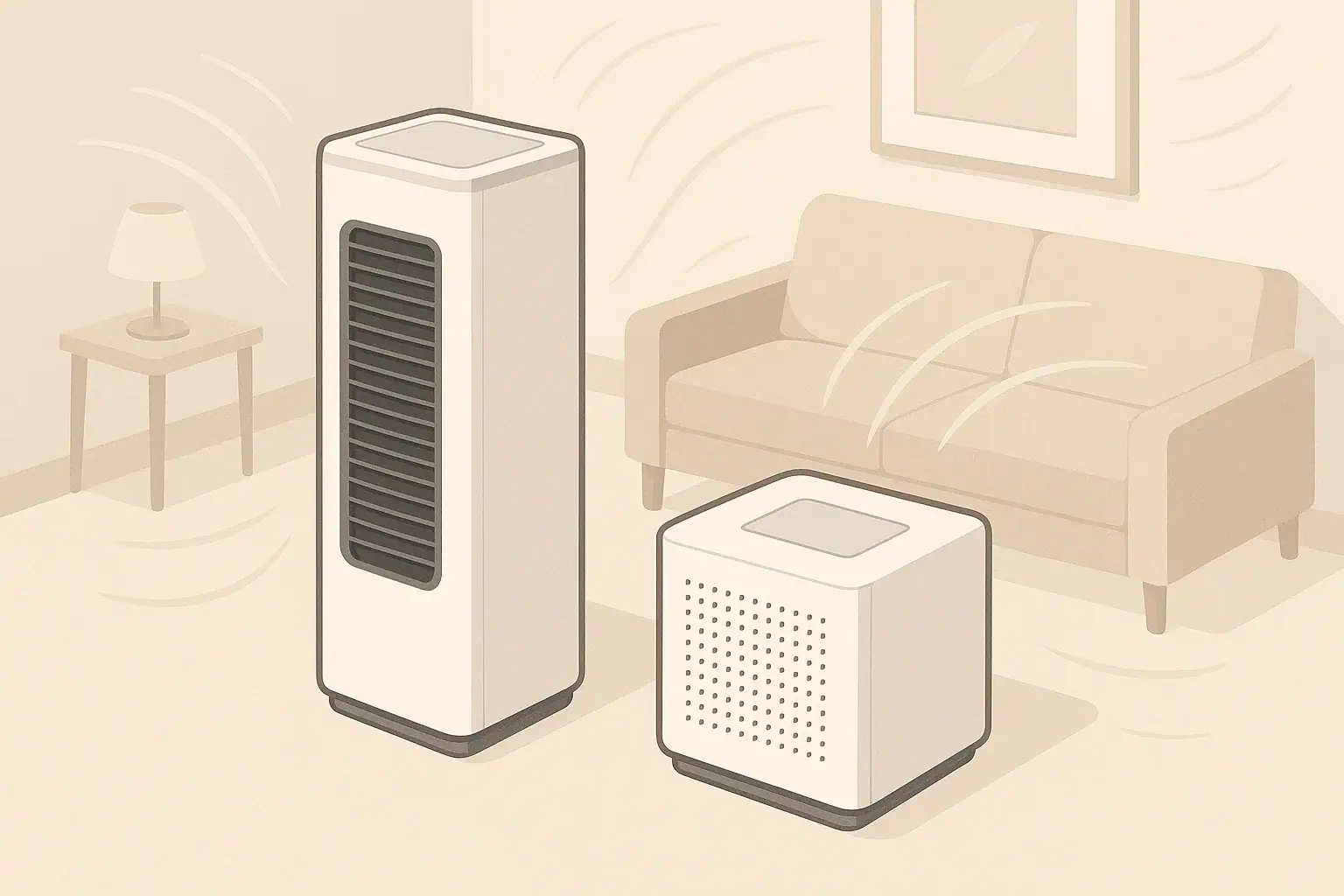
Air purifiers and ozone generators are often discussed together, but they work in very different ways. Understanding those differences is essential before bringing either device into a home, especially where children, older adults, or people with breathing sensitivities live.
Air purifiers for home use typically rely on physical filtration and, sometimes, adsorptive media. Their goal is to capture or reduce indoor pollutants without generating harmful byproducts.
Ozone generators intentionally produce ozone gas. Ozone is a reactive form of oxygen that can change the chemistry of some pollutants but also interacts with the air you breathe. At levels high enough to noticeably change odors, ozone can be irritating and is generally not recommended for occupied spaces.
This article looks at how each technology works, what it can and cannot do, safety considerations, and how to make practical choices for common indoor air quality concerns at home.
Overview: How Air Purifiers and Ozone Generators Differ
Air purifiers and ozone generators are often discussed together, but they work in very different ways. Understanding those differences is essential before bringing either device into a home, especially where children, older adults, or people with breathing sensitivities live.
Air purifiers for home use typically rely on physical filtration and, sometimes, adsorptive media. Their goal is to capture or reduce indoor pollutants without generating harmful byproducts.
Ozone generators intentionally produce ozone gas. Ozone is a reactive form of oxygen that can change the chemistry of some pollutants but also interacts with the air you breathe. At levels high enough to noticeably change odors, ozone can be irritating and is generally not recommended for occupied spaces.
This article looks at how each technology works, what it can and cannot do, safety considerations, and how to make practical choices for common indoor air quality concerns at home.
How Air Purifiers Work: Filters, Airflow, and Practical Use
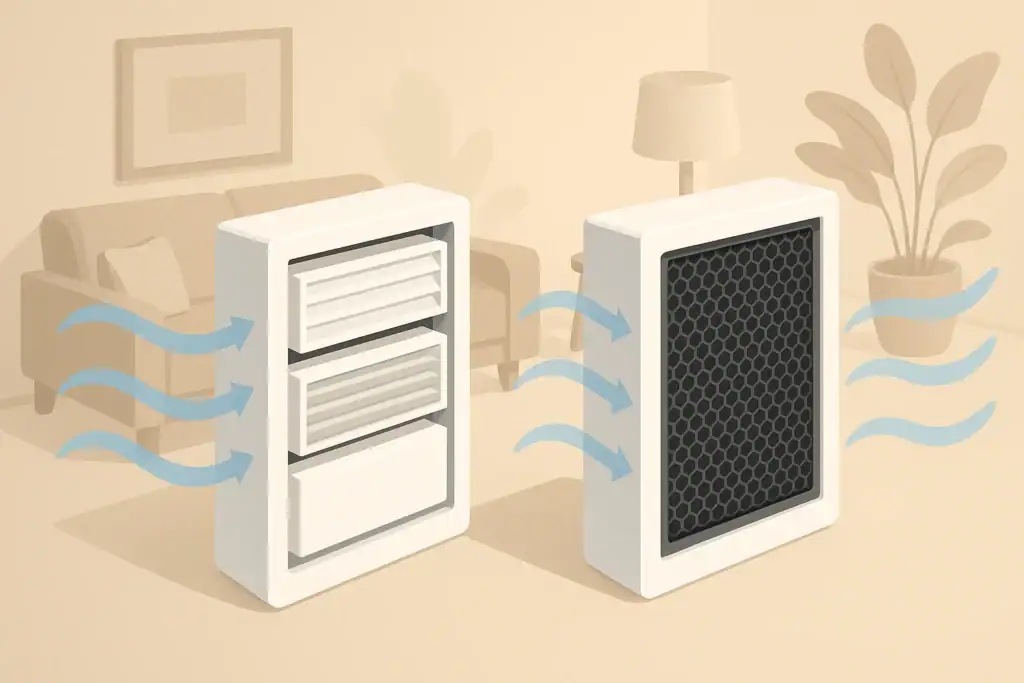
Most residential air purifiers rely on a fan that pulls air through one or more filters and then returns that air to the room. The details of those filters matter a lot more than the outer shape of the machine.
Common Filter Types
Typical home air purifiers may use several layers:
- Prefilter: Captures larger dust, hair, and lint to protect the main filter and keep airflow steady.
- HEPA or HEPA-style filter: A dense fiber filter designed to capture fine particles such as dust, pet dander, and smoke particles.
- Activated carbon filter: Uses porous carbon material to reduce some odors and some volatile organic compounds (VOCs) by adsorption.
When looking at HEPA claims, you may see terms like “true HEPA” or “H13/H14.” In general, higher-grade filters are designed to capture a greater fraction of small particles, but they may also add resistance to airflow. For household use, overall design, room sizing, and sealing around the filter are just as important as filter grade labels.
Performance Concepts: CADR, ACH, and Room Size
Two practical ideas help translate purifier specs into real-room performance:
- Clean Air Delivery Rate (CADR): A measure that combines airflow and filtration efficiency. Higher CADR usually means a purifier can reduce particle levels more quickly in a given room.
- Air Changes per Hour (ACH): How many times per hour the purifier moves a room’s volume of air through its filters, in theory. A higher ACH generally means faster cleaning, but it depends on where the purifier is placed and how air circulates.
For typical bedrooms and living rooms, many people aim for multiple air changes per hour when sizing a purifier, especially for particle concerns such as dust and smoke. That usually means selecting a unit with a CADR aligned to the room’s floor area and ceiling height, while keeping noise and energy use in mind.
Placement and Airflow
Even a well-sized purifier can underperform if placed poorly. Common tips include:
- Keeping the intake and outlet areas unobstructed.
- Avoiding tight corners where airflow is blocked.
- Allowing some distance from walls and large furniture so air can circulate.
Air purifiers work best as part of an overall strategy that also considers ventilation, source control, and humidity management.
| Aspect | Typical Air Purifier (HEPA + Carbon) | Ozone Generator |
|---|---|---|
| Primary function | Capture particles and reduce some odors/VOCs via filters | Produce ozone gas to react with odors or pollutants |
| Main removal method | Filtration and adsorption | Chemical reactions in the air and on surfaces |
| Use in occupied rooms | Commonly used continuously when designed to be ozone-free | Often recommended only in unoccupied spaces, if used at all |
| Effect on particles | Directly captures dust, pollen, smoke particles | Does not filter particles; may change their chemistry |
| Odor handling | Carbon filters can reduce many everyday odors | May mask or change odors; results can be inconsistent |
| Byproduct considerations | Well-designed units aim to be essentially ozone-free | Ozone itself is the output and must be managed cautiously |
| Maintenance focus | Filter replacement and cleaning | Careful control, room vacancy, and ventilation after use |
Example values for illustration.
How Ozone Generators Work: Chemistry and Intended Use
Ozone generators create ozone by exposing air to an electrical discharge or ultraviolet (UV) light inside the device. The ozone then diffuses into the room and reacts with gases and surfaces.
What Ozone Does in Indoor Air
Ozone is highly reactive. When released into a room, it can:
- React with odor-causing compounds, sometimes reducing or converting them.
- React with indoor materials such as carpets, paints, rubber, and upholstery.
- Interact with other indoor pollutants and form new chemicals, some of which may be irritating.
Because ozone is a gas, it spreads throughout a space rather than flowing through a filter. It does not selectively remove particles in the way a HEPA filter does. Instead, it changes the chemistry of certain compounds, often in ways that are complex to predict.
Ozone and “Shock” Treatments
Some ozone generators are promoted for short-term “shock” treatments of unoccupied spaces, for example after strong odors or water damage. This type of use typically involves:
- Running the ozone generator while people and pets are out of the room or building.
- Allowing time after treatment for ozone to dissipate.
- Ventilating the space thoroughly before re-entry.
Even in those scenarios, ozone does not guarantee full removal of contaminants, and it may leave behind reaction products on surfaces and in the air. For routine improvement of everyday indoor air quality where people are present, ozone-generating devices are generally not favored compared with filtration and ventilation-based approaches.
Safety: Ozone Exposure vs Filter-Based Purification
Safety is the central difference between using an air purifier and using an ozone generator in occupied homes. It helps to think about what each device adds to or removes from your indoor air.
Ozone Exposure Considerations
Ozone at ground level is widely recognized as a respiratory irritant. At concentrations high enough to aggressively mask odors, it can be uncomfortable for many people, especially in smaller or poorly ventilated spaces.
Key points for residential settings include:
- People vary in sensitivity to ozone; some may notice irritation at lower levels than others.
- Children, older adults, and individuals with breathing sensitivities may be more affected by ozone.
- Closed windows and low ventilation can allow ozone to build up indoors more easily.
Because of these issues, many indoor air quality guidelines encourage avoiding devices that intentionally generate ozone in occupied spaces.
Ozone-Free Purification Approaches
Mechanical filter-based air purifiers are designed to reduce particles and, with carbon filters, some odors and gases without adding reactive gases to the room. When considering a purifier:
- Look for clear statements that the unit does not intentionally generate ozone.
- Approach ionizers and UV-C add-ons cautiously, as they can sometimes produce small amounts of ozone as a side effect if not carefully designed.
- Remember that a well-sized, well-placed filter-only purifier, combined with ventilation and source control, can be effective without additional reactive technologies.
Regular maintenance—such as replacing filters on schedule and keeping intakes clean—also supports safety by preventing dust buildup and preserving airflow.
Effectiveness: What Each Device Can and Cannot Handle
Both air purifiers and ozone generators are often marketed as solutions for a wide range of indoor air problems. In practice, their strengths and limits differ significantly.
Particles: Dust, Pollen, and Smoke
For solid and liquid particles floating in the air—such as dust, pet dander, and smoke—filter-based purifiers are the more direct tool. HEPA-type filters are designed specifically to capture fine particles as air passes through.
Ozone generators do not filter particles. While ozone can react with some components of smoke or organic particles, the particles themselves remain unless removed by ventilation or filtration.
Odors and VOCs
Odors and volatile organic compounds are gases, not particles. No single device can remove all VOCs, but:
- Activated carbon filters can adsorb a variety of everyday odors (such as cooking smells) and some VOCs. They saturate over time and need replacement to remain effective.
- Ozone can chemically alter certain VOCs, sometimes reducing noticeable odor, but it may create new compounds. The overall effect can be hard to predict and does not necessarily mean the air is “cleaner.”
For persistent VOC sources, such as fresh paint or new furnishings, increasing ventilation and, when possible, selecting lower-emission materials are often more reliable strategies than relying solely on any device.
Mold and Moisture-Related Concerns
Mold growth indoors is mainly a moisture problem. Ozone does not solve underlying dampness, leaks, or condensation. While high ozone levels may affect mold on exposed surfaces, they do not address moisture in walls, carpets, or subfloors.
For mold prevention and control, focus on:
- Managing humidity with ventilation, dehumidifiers, or repairs to leaks.
- Drying wet materials quickly after spills or water events.
- Using filtration and ventilation to reduce airborne spores and odors associated with dampness.
Air purifiers with HEPA filters can help reduce airborne mold spores, but they are not a substitute for fixing moisture sources.
Common Myths About Ozone Generators and Air Purifiers
Marketing language and online discussions can blur the line between evidence-based information and speculation. Several myths come up repeatedly.
Myth 1: “Ozone Turns Any Room Into Mountain Air”
Outdoor air in natural settings feels fresher largely because of:
- Continuous dilution of pollutants by wind and large air volumes.
- Sunlight-driven chemical reactions in the open atmosphere.
- Vegetation and soil processes.
Indoor ozone generators cannot recreate this large-scale environment. Adding ozone to a closed room mainly changes the chemical mix inside that limited space and can make the air more irritating rather than “fresh.”
Myth 2: “If You Can’t Smell Ozone, It Must Be Safe”
Odor perception is not a precise safety gauge. People vary widely in how and when they notice ozone’s smell, and some may become less aware of it with continued exposure. A room can contain potentially concerning amounts of ozone even if the odor seems faint or goes unnoticed.
Myth 3: “Ozone Eliminates All Germs and Makes Surfaces Sterile”
Ozone can inactivate some microorganisms under controlled conditions, but real homes are complex spaces with varied materials, hidden surfaces, and constantly changing air. Achieving thorough, uniform exposure in every crevice is difficult.
Routine cleaning, moisture control, ventilation, and, when appropriate, targeted disinfection in line with product directions are more practical for household hygiene than relying on ozone to make a home “sterile.”
Myth 4: “Any Device Labeled ‘Ionizer’ Is the Same as an Ozone Generator”
Some devices marketed as ionizers or plasma systems produce charged particles intended to cause airborne particles to clump and settle or stick to surfaces. Depending on design, some may also create small amounts of ozone as a byproduct.
However, not all ionizers are designed to produce significant ozone. The challenge for consumers is that marketing terms are not always consistent. When in doubt, look for clear information on ozone emissions and independent testing where available, and consider choosing devices explicitly described as ozone-free for everyday use in occupied rooms.
Choosing for Home Use: Practical Scenarios
Deciding between an air purifier and an ozone generator—or whether you need either—starts with clarifying what problem you want to address and how the space is used.
Everyday Living Areas
For bedrooms, living rooms, and home offices where people spend many hours each day, filter-based air purifiers and good ventilation are usually the first tools to consider. Typical goals include:
- Reducing dust and pet dander that accumulate on surfaces.
- Lowering indoor smoke particles from cooking or nearby outdoor sources.
- Improving comfort for people bothered by airborne particles.
An ozone generator is generally not an appropriate choice for these continuously occupied spaces.
Short-Term Odor Incidents
For strong but temporary odors such as burnt food, hobby materials, or light renovation smells, practical steps include:
- Source control: Stop or reduce the odor source as soon as possible.
- Ventilation: Open windows when outdoor conditions allow, or use exhaust fans.
- Filtration: Run an air purifier with a carbon filter at a higher setting temporarily.
These actions usually help without adding reactive gases to your indoor air.
Damp Basements and Mold-Prone Areas
For areas that feel damp or smell musty, the priority is moisture management. Dehumidifiers, drainage fixes, and better air circulation address root causes. A HEPA purifier may help reduce airborne spores and dust, but it will not dry out the space.
Ozone does not replace dehumidification or repairs and can make the air more irritating in tight, poorly ventilated basements.
| Home scenario | ACH range example | What it generally implies | Planning note |
|---|---|---|---|
| Small bedroom, typical use | 3–5 ACH | Moderate particle reduction with manageable noise | Choose a purifier with CADR suited to room volume |
| Bedroom for particle-sensitive occupant | 5–8 ACH | Faster reduction of dust and fine particles | Higher fan speeds may be needed; consider noise level |
| Open-plan living/dining area | 2–4 ACH | Helps manage everyday dust and cooking particles | Large spaces may need more than one unit or zoning |
| Home office with equipment and paper dust | 3–6 ACH | Supports steady background particle control | Place purifier so intake faces main work area |
| Temporary smoke event from outdoors | 5–10 ACH | More aggressive particle reduction during events | Run purifier on higher setting while event lasts |
| Damp basement with dehumidifier in use | 3–6 ACH | Helps reduce airborne spores alongside moisture control | Combine with humidity management and source repairs |
Example values for illustration.
Key Takeaways for Safer, More Effective Indoor Air Strategies
Air purifiers and ozone generators are not interchangeable. Filter-based purifiers are designed to capture particles and reduce some gases without adding reactive chemicals to your breathing zone, making them more suitable for routine use in occupied homes.
Ozone generators, by contrast, intentionally release a gas that can be irritating at levels high enough to noticeably change odors. Their effects on complex indoor environments are difficult to predict and do not replace the fundamentals: source control, ventilation, moisture management, and well-sized filtration.
When planning improvements to indoor air quality, start with the problem you are trying to solve, consider how often people occupy the space, and prioritize methods that are transparent in how they work, straightforward to maintain, and aligned with established indoor air quality guidance.
Frequently asked questions
Is it safe to use an ozone generator in an occupied home?
Ozone is a respiratory irritant and can be uncomfortable or harmful at concentrations that noticeably change odors. Because of that, ozone generators are generally not recommended for use in occupied spaces; many indoor air quality guidelines advise avoiding devices that intentionally produce ozone indoors.
How should I size an air purifier for smoke from outdoors?
Choose a unit with a Clean Air Delivery Rate (CADR) appropriate for your room volume and aim for a higher ACH (air changes per hour) during smoke events. HEPA filtration captures fine particles from smoke, and running the purifier at higher settings while the event lasts improves removal speed, balanced against noise and energy use.
Can activated carbon filters remove all VOCs and paint fumes?
Activated carbon adsorbs many common odors and a range of VOCs, but it has limited capacity and does not remove every chemical or very high emissions. For persistent sources like fresh paint or new furnishings, increasing ventilation and using lower-emission products are more reliable than relying solely on filtration.
Will ozone treatments get rid of mold in a damp basement?
Ozone does not address the underlying moisture that fosters mold growth and is not a substitute for dehumidification, repairs, and drying wet materials. HEPA filtration can reduce airborne spores, but controlling humidity and fixing leaks are the primary actions for mold control.
Are ionizers the same as ozone generators, and how can I be sure a device is safe?
Not all ionizers are designed to produce significant ozone, but some technologies can generate ozone as a byproduct depending on design. Look for explicit manufacturer statements and independent testing on ozone emissions, and prefer units marketed as ozone-free for routine use in occupied rooms.
Recommended next:
- Clear sizing logic (room size → CADR/ACH)
- HEPA vs carbon explained for real use-cases
- Humidity + ventilation basics to reduce mold risk
About this site
Home Air Quality Lab publishes practical, independent guides about indoor air quality—clear sizing, safer use, and real-world expectations.
Affiliate disclosure
Some links on this site may be affiliate links. If you buy through these links, we may earn a small commission at no extra cost to you. This helps support our content. Learn more.