
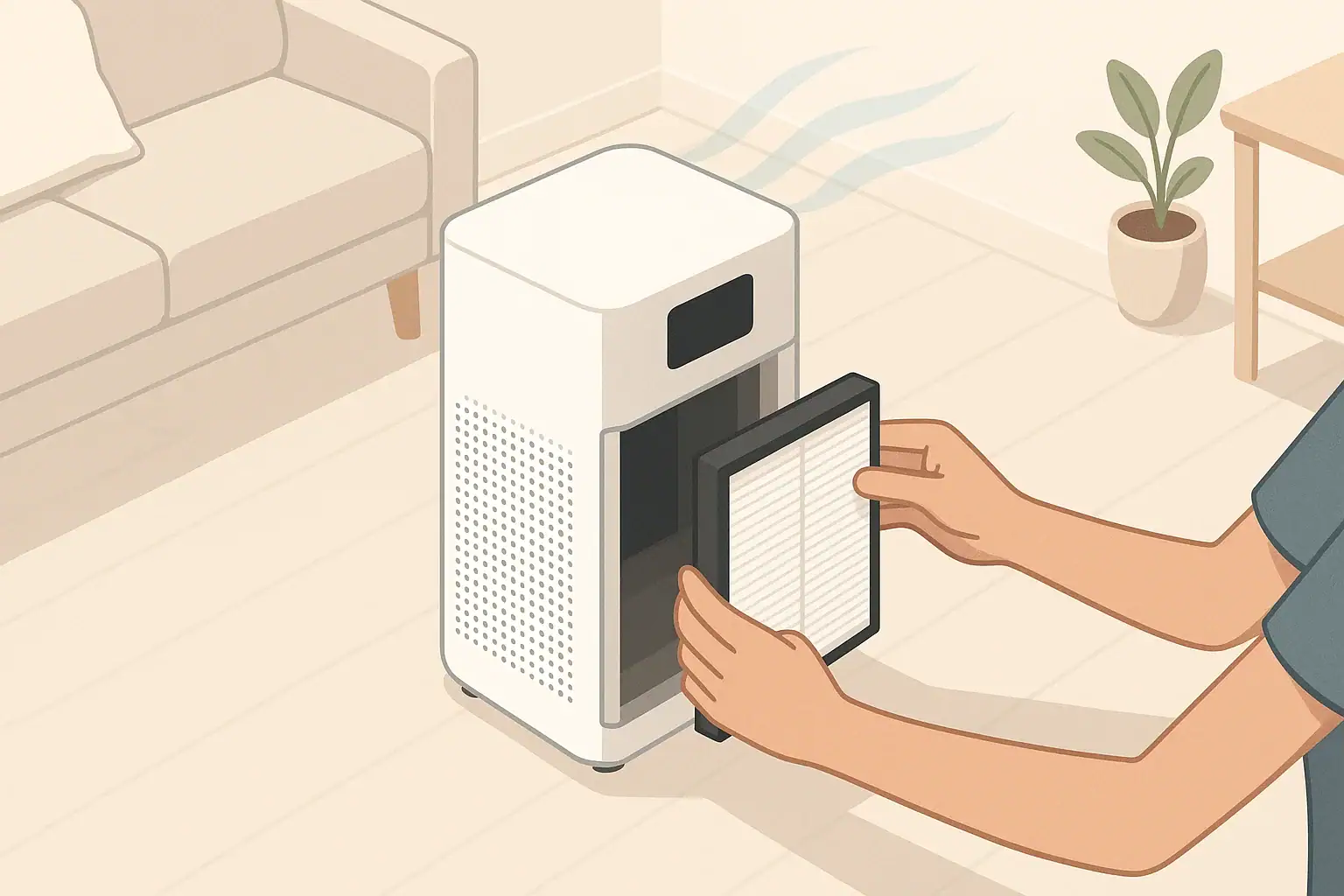
Why HEPA Filter Replacement Matters
HEPA filters play a central role in indoor air quality because they physically trap very small particles. When they are new and properly installed, they can capture a high percentage of:
- Dust and fine particulate (including PM2.5)
- Pollen and plant debris
- Pet dander and hair fragments
- Dust mite debris
- Some bacteria and other biological particles
- Smoke particles from cooking or tobacco
Over time, those particles build up inside the filter fibers. The filter gradually becomes harder to push air through and its performance changes. Replacing the HEPA filter at the right time helps maintain:
- Consistent filtration efficiency
- Adequate airflow and clean air delivery
- Reasonable noise levels from fans
- Energy-efficient operation
The challenge is that there is no single replacement interval that works for every home, device, and environment. Instead, you can use a combination of general timelines, manufacturer guidance, and real-world signs from your own space.
Typical Replacement Intervals for HEPA Filters
Most HEPA filters fall into a few common replacement ranges, depending on how and where they are used.
Air Purifiers (Portable Room Units)
For portable air purifiers that use true HEPA filters, a typical replacement interval is:
- Every 6–12 months under average home conditions
- Every 3–6 months in demanding conditions (heavy smoke, multiple pets, or very dusty environments)
These ranges assume the purifier runs many hours per day. If you only use an air purifier occasionally (for example, during allergy season or wildfire events), the calendar interval can stretch longer, but total run time and air quality still matter more than simple months on the calendar.
HVAC Systems With HEPA-Level Filters
Some central HVAC systems or add-on filtration boxes use HEPA or near-HEPA filters. These filters are larger, with more surface area, and are designed for longer service life. Typical guidance:
- Every 6–12 months for many residential applications
- Every 3–6 months if the system runs almost continuously or serves occupants with high sensitivity (such as severe allergies)
Central HEPA filters often have higher resistance to airflow than standard furnace filters, so replacing them on time is important to avoid overloading the blower and reducing airflow to the home.
Vehicles and Specialty Uses
Some vehicles, vacuum cleaners, and specialty devices also use HEPA filters. These typically have shorter lifespans because of their smaller size and frequent exposure to dirt:
- Vacuum HEPA filters: often every 6–12 months, depending on use frequency and vacuum capacity
- Vehicle cabin HEPA or high-efficiency filters: often every 12 months or a certain mileage, depending on driving conditions
Always check the documentation provided with the device, as the design and filter size strongly influence how often replacement is needed.
Key Factors That Change How Often You Should Replace
Because filter life is highly situational, it helps to consider the main factors that either shorten or extend the replacement interval.
1. Air Quality in and Around Your Home
The more particles the filter has to capture, the faster it clogs. Important contributors include:
- Outdoor pollution: Living near busy roads, industrial areas, or during a long wildfire season stresses filters.
- Indoor sources: Frequent cooking without strong ventilation, burning candles, or indoor smoking all add fine particles.
- Renovation and construction: Home projects that create dust or debris can rapidly load a filter.
In homes with generally clean air and good ventilation, HEPA filters may last toward the upper end of typical ranges. In homes with ongoing particle sources, shorter intervals are often appropriate.
2. Presence of Pets
Pets increase airborne particles, especially if they shed fur or dander. Additional effects include:
- More hair and larger particles trapped by pre-filters
- Fine dander and skin flakes that load the HEPA layer
- Extra tracked-in dust from outdoors
In multi-pet households, HEPA filters for air purifiers may need changing closer to every 3–6 months, especially if the device runs continuously in shared living areas.
3. Allergies, Asthma, and Sensitivities
If anyone in the home has allergies, asthma, or other respiratory conditions, it often makes sense to replace HEPA filters a bit more proactively. Reasons include:
- Consistent performance is more important when symptoms are triggered by small changes in air quality.
- Filters partially loaded with dust may still capture well, but reduced airflow can lower the effective clean air delivery rate.
- Visible dirt on filters can be concerning for people managing chronic conditions. Replacing on a conservative schedule provides peace of mind.
In these situations, many households choose the shorter end of the recommended range even if the manufacturer allows longer intervals.
4. Operating Time and Fan Speed
A HEPA filter that runs nonstop at high fan speed will need replacing sooner than one that runs at low speed a few hours per day. Consider:
- Daily hours: A purifier running 24/7 processes about four times more air in a day than one running six hours.
- Fan setting: Higher fan speeds move more air and capture more pollutants, but also fill the filter faster.
- Auto modes: Some purifiers automatically adjust speed based on particle sensors, which can extend filter life in generally clean environments.
Many users find that running a purifier on a moderate setting for much of the day balances air cleaning and filter longevity.
5. Filter Size, Design, and Quality
Filters with larger surface area tend to last longer because dust is spread across more media. Other design aspects include:
- Pleat depth and density: Deep, densely pleated filters hold more dust before airflow drops significantly.
- True HEPA media: High-efficiency fibers can stay effective even as they load with particles, but resistance also increases.
- Combination filters: Units that combine HEPA layers with other media (such as a dense pre-filter) may distribute loading differently.
These differences mean that two filters used in similar conditions may have different recommended lifespans. Manufacturer timelines are a useful starting point because they reflect the specific filter geometry and media.
6. Pre-Filters and Other Stages
Many air purifiers and HVAC filter housings use a pre-filter. Pre-filters trap larger particles such as hair, lint, and coarse dust before they reach the HEPA layer. This can significantly extend HEPA filter life, provided the pre-filter is regularly cleaned or replaced. In practice:
- Washable pre-filters: Often rinsed or vacuumed every 2–4 weeks, then reused.
- Disposable pre-filters: Replaced more frequently than the HEPA main filter.
If pre-filter maintenance is neglected, the HEPA filter will load more quickly and may need to be replaced sooner.
Signs Your HEPA Filter Needs Replacement
Instead of relying only on calendar time, it helps to watch for practical signs that your HEPA filter is nearing the end of its useful life.
1. Visible Dirt and Discoloration
Over time, HEPA filters change color as they capture dust and smoke. Indicators include:
- Noticeable gray or brown zones across most of the surface
- Deep, uniform darkening rather than a few local spots
- Layers that look matted or heavily compacted
Some darkening is normal and indicates the filter is doing its job, but a thoroughly coated surface often means the filter is approaching the end of its effective lifespan.
2. Reduced Airflow From the Device
As the filter clogs, it becomes harder for the fan to push air through. You might notice:
- Weaker airflow coming from the purifier outlet at the same fan setting
- Rooms taking longer to smell or feel fresh after the purifier starts
- HVAC registers delivering less air volume than usual
If you replace the HEPA filter and airflow improves noticeably, it is a strong sign the old filter was overdue.
3. Increased Noise or Fan Effort
Clogged filters can cause fans to work harder. Signs include:
- A higher-pitched or strained sound from the air purifier or HVAC blower
- Fans ramping up more often when an auto mode is engaged
- Unexpected cycling or longer run times for central systems
Noise alone is not a perfect indicator, but combined with visible dust and decreased airflow it suggests the filter is loaded.
4. Increased Dust or Allergy Symptoms
If you notice more dust settling on surfaces despite regular cleaning, or if allergy and asthma symptoms worsen while your purifier or system is operating as usual, it may be time to:
- Inspect the HEPA filter for dirt buildup
- Check that it is seated correctly with no gaps or bypass paths
- Replace the filter if it is near or past its recommended interval
Other factors can affect symptoms, such as humidity and seasonal pollen, but an aging HEPA filter is often part of the picture.
5. Filter Change Indicators and Timers
Some devices include:
- Simple hour-based timers that estimate filter life
- Sensor-based systems that track fan speed and airflow resistance
- Visual indicators that remind you to check the filter
These features are helpful guidelines, but they may not reflect your exact air conditions. Treat indicators as prompts to inspect the filter and decide rather than automatic proof that the filter is either fine or finished.
Can You Clean and Reuse HEPA Filters?
Many people wonder if they can extend filter life by washing, blowing out, or vacuuming a HEPA filter. For most consumer HEPA filters, the answer is:
- Do not wash: Water and detergents can damage the fine fibers, alter the structure, and reduce efficiency.
- Do not blow out with compressed air: Strong air jets can tear or stretch the media and may drive embedded particles deeper instead of removing them.
- Vacuum only if explicitly allowed: Some filters are labeled as vacuum-safe on the surface to remove loose debris, but this usually does not restore full performance and can still risk damage if done aggressively.
HEPA filters are generally designed as disposable components. While light surface cleaning of a compatible pre-filter can reduce dust load, the core HEPA media is intended to be replaced rather than rejuvenated.
How to Create a Practical Replacement Schedule
Instead of following a single fixed rule, it is useful to build a simple replacement strategy tailored to your home.
Step 1: Start With Manufacturer Guidance
Begin with the recommended replacement interval in the user manual. This baseline reflects the filter’s size, media, and expected operating conditions. If you have multiple devices, list them with their suggested intervals.
Step 2: Adjust for Your Environment
Next, consider how your conditions differ from the manufacturer’s assumed “average” case. You might shorten the interval if you have:
- Multiple pets or heavy shedding
- Frequent indoor smoke or cooking without strong ventilation
- Ongoing renovation or regular use of wood-burning appliances
- High sensitivity to dust, pollen, or smoke
Conversely, you may be able to extend the interval slightly if you live in a clean environment, use good ventilation, and run the purifier fewer hours per day.
Step 3: Use Seasonal Checkpoints
Many people find it helpful to tie filter checks to seasonal changes. For example:
- Early spring: Check before peak pollen season.
- Mid-summer: Check during high use of air conditioning and potential wildfire smoke.
- Early fall: Check after high outdoor dust and pollen levels subside.
- Mid-winter: Check during heavy indoor occupancy and closed windows.
At each checkpoint, visually inspect the HEPA filter, feel the airflow, and note any changes in noise or air quality. Decide whether to keep, clean the pre-filter, or replace.
Step 4: Track Replacement Dates and Conditions
Keeping simple notes can make maintenance easier. You can:
- Write the installation date on the filter frame (if safe and allowed)
- Record replacements in a notebook or digital calendar
- Note special events (wildfire season, renovations, nearby roadwork) that could shorten filter life
Over time, these records help you refine a realistic schedule for your devices and environment.
Cost, Energy, and Performance Trade-Offs
Replacing HEPA filters involves a balance between cost, energy use, and air quality performance.
Replacing Too Late
Waiting too long to replace a HEPA filter can lead to:
- Reduced clean air delivery because of restricted airflow
- Fans working harder, using more electricity, and making more noise
- Potential strain on HVAC blowers and components
Heavily loaded filters may still capture particles efficiently, but the overall amount of cleaned air delivered to the room or home declines.
Replacing Too Early
On the other hand, replacing filters far earlier than needed can:
- Increase ongoing operating costs
- Raise waste volume from discarded filters
- Offer only marginal improvement in air quality compared with a moderately used filter
The goal is to replace often enough to maintain good airflow and filtration without discarding filters that still have substantial useful life.
Finding a Reasonable Middle Ground
A practical approach is to aim for the midpoint of the manufacturer’s recommended range at first. Then adjust based on:
- How dirty the filter looks at that time
- Whether airflow and noise improved after replacing
- Any feedback from household members about air quality or symptoms
This method typically yields a balanced schedule that controls long-term costs while keeping performance consistent.
Safe Handling and Disposal of Used HEPA Filters
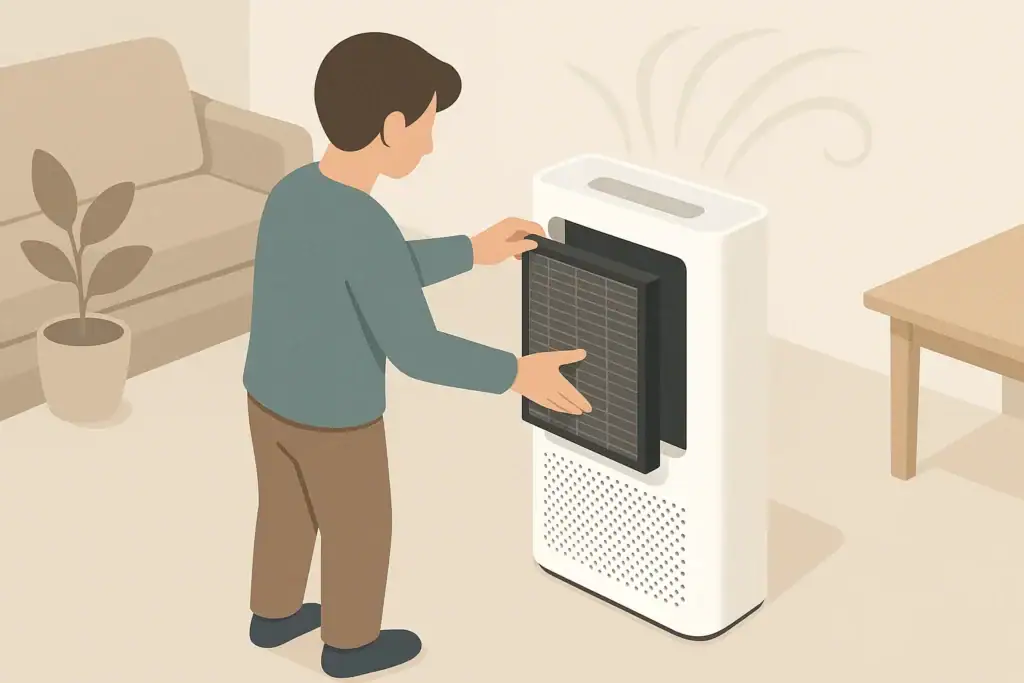
When it is time to replace a HEPA filter, basic handling steps help avoid releasing trapped dust back into the air.
Before Removing the Filter
- Turn off and unplug the air purifier or shut down the HVAC system.
- Let the device sit for a few minutes so particles settle inside.
- If you are sensitive, consider wearing a simple mask and gloves.
During Removal
- Open the access panel slowly to prevent sudden air movement.
- Lift the filter gently, trying not to bump or bend it.
- Avoid tapping or shaking the filter, which can release dust.
Bagging and Disposing
- Place the used HEPA filter directly into a sturdy trash bag.
- Seal the bag before carrying it through living spaces.
- Follow local guidelines for regular household waste disposal.
Some regions have specific rules for mixed-material waste, but in many homes used HEPA filters are disposed of with general trash because they are too contaminated for most recycling streams.
Installing the New Filter
- Confirm you have the correct size and type for your device.
- Check the airflow arrows or orientation marks and align accordingly.
- Ensure the filter seats firmly with no gaps along the edges.
- Close panels securely so air cannot bypass the media.
Proper sealing is as important as timely replacement. Even a high-quality HEPA filter cannot perform well if air slips around its edges instead of passing through it.
Summary: How Often Should You Replace a HEPA Filter?
There is no single answer that fits every situation, but most households can use these guidelines as a starting point:
- Portable air purifiers: replace HEPA filters roughly every 6–12 months, or every 3–6 months in demanding conditions.
- Central HVAC HEPA filters: check at least twice a year and replace approximately every 6–12 months, depending on use.
- Homes with pets, smoke, or high pollution: expect more frequent changes.
- Homes with sensitive occupants: lean toward the early side of the recommended range.
By combining manufacturer guidance with observation of air quality, airflow, noise, and visible filter condition, you can develop a replacement schedule that maintains healthy indoor air while managing cost and energy use effectively.
Frequently asked questions
How can I tell if my HEPA filter still performs well even if it doesn’t look very dirty?
Visible cleanliness is not the only indicator of performance. Check for reduced airflow at the outlet, increased fan noise or effort, and any rise in dust or allergy symptoms while the device is running; sensor or hour-timer indicators can also prompt inspection. If airflow or symptoms have worsened, consider replacing the filter even if it appears only lightly soiled.
Will using a pre-filter or lowering fan speed meaningfully extend HEPA filter life?
Yes. A pre-filter that captures larger particles can significantly slow HEPA media loading if it is cleaned or replaced regularly. Lowering fan speed reduces the volume of air processed and therefore the rate of particle capture, but it also lowers the clean air delivery rate, so balance longevity with needed air cleaning performance.
Are washable or permanent filters equivalent to true HEPA and can they be washed safely?
Some products use washable or permanent high-efficiency filters, but many labeled as “true HEPA” are not designed to be washed. Washing can damage fine fibers and reduce filtration efficiency unless the manufacturer explicitly states the filter is washable. Always follow the device instructions to avoid degrading performance.
What safety steps should I take when replacing a HEPA filter in a home with allergic occupants?
Turn off and unplug the device, wear a simple mask and gloves if sensitivity is high, and avoid shaking the used filter to limit particle release. Immediately seal the removed filter in a sturdy trash bag and carry it out of living spaces; then install the new filter ensuring correct orientation and a tight seal.
How do run time and room placement affect how often I need to change a HEPA filter?
Longer daily runtime and placement in areas with high particle loads (near kitchens, pet areas, or entryways) will load the filter faster and shorten its service life. Positioning purifiers to cover primary living spaces and using moderate fan speeds can optimize both air cleaning and filter longevity, while inspections tied to seasons or events help adjust replacement timing.
Recommended next:
- Clear sizing logic (room size → CADR/ACH)
- HEPA vs carbon explained for real use-cases
- Humidity + ventilation basics to reduce mold risk
About this site
Home Air Quality Lab publishes practical, independent guides about indoor air quality—clear sizing, safer use, and real-world expectations.
Affiliate disclosure
Some links on this site may be affiliate links. If you buy through these links, we may earn a small commission at no extra cost to you. This helps support our content. Learn more.