
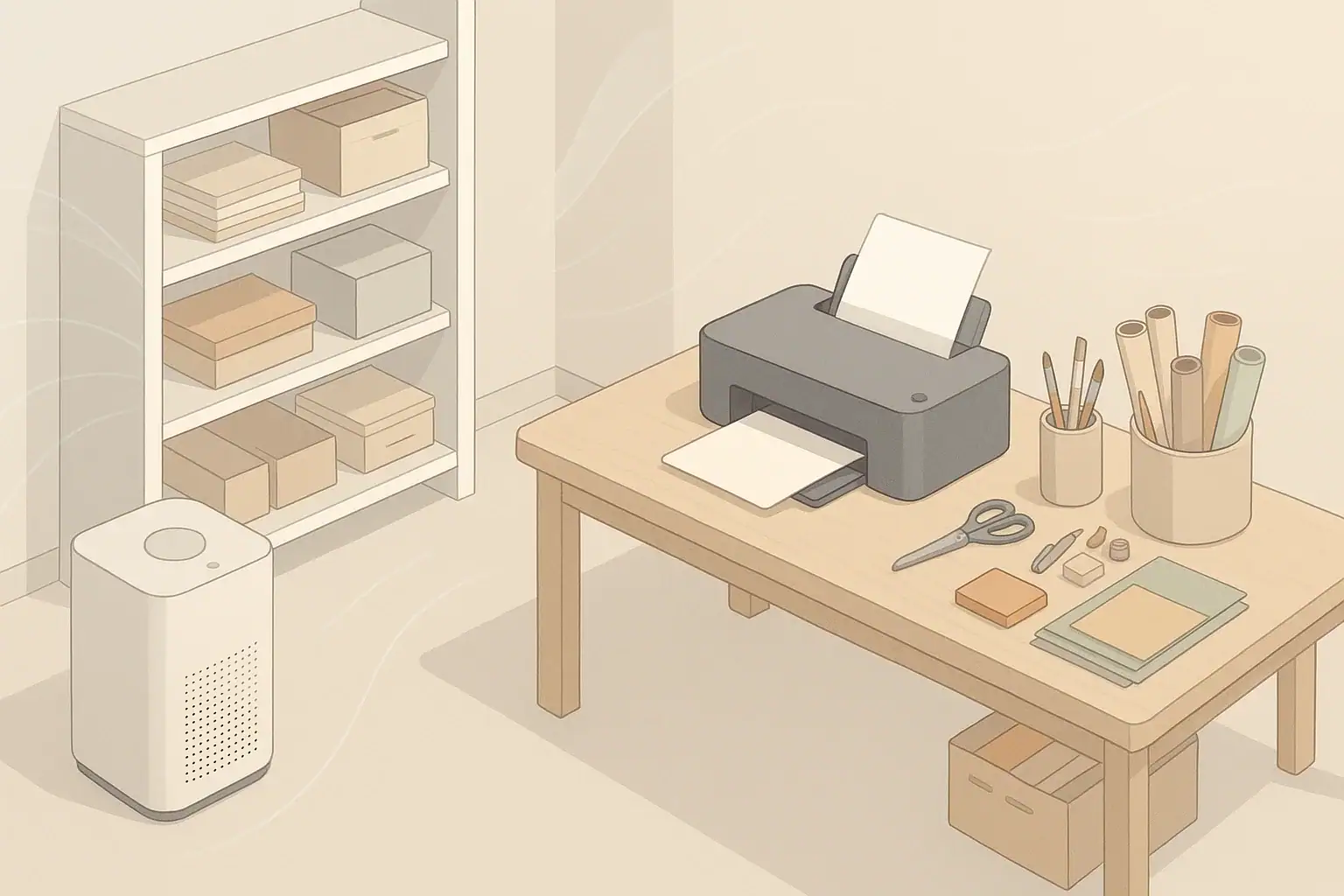
An air purifier for printer and craft rooms should combine strong particle filtration, meaningful activated carbon, and placement that keeps airflow near the source without blocking intake or exhaust.
Printer and craft rooms can release a mix of airborne particles, odors, and vapors depending on what you do in the space. A portable air purifier can help reduce recirculating particles and some odors, but it works best alongside source control, careful material handling, and ventilation when needed.
- For active printing or craft sessions, plan around 4 to 6 air changes per hour as general guidance; use higher airflow if dust or fine particles build up quickly.
- Use a particle filter such as true HEPA for paper dust, toner traces, sanding dust, and fine particles; add substantial activated carbon for odors and many VOCs.
- Estimate CADR with this simple formula: room volume in cubic feet × target ACH ÷ 60 = CADR in cfm.
- Place the purifier in the same room, usually 3 to 8 feet from the printer or work area, with open space around the intake and outlet.
- Do not rely on a purifier alone for strong solvent fumes, resin work, aerosol sprays, or flammable vapors; follow product labels and use ventilation.
Why printer and craft rooms need different air planning
A home office with an occasional inkjet print job is not the same as a room used for laser printing, paper cutting, model making, painting, adhesives, heat tools, or resin crafts. The air concerns can change from minute to minute based on the task.
Particles are one part of the picture. Laser printers can contribute fine particles during operation, and any printer area can collect paper dust. Crafting can add visible dust from cutting, sanding, powders, fibers, glitter, or clay. These are primarily particle issues, so true HEPA filtration matters.
VOCs, or volatile organic compounds, are the other major category. They can come from some inks, paints, markers, adhesives, solvents, coatings, and craft resins. VOCs are gases, not particles, so a HEPA filter alone is not designed to capture them. Activated carbon and ventilation are the main practical tools for odors and many gaseous compounds.
The goal is not to make the room sterile or to create a lab-grade environment. The practical goal is to reduce buildup, improve room air turnover during projects, and avoid sending dust or odors into nearby living spaces.
Particles, VOCs, and sizing basics
Match the filter to the pollutant type
A particle filter and a gas-phase filter do different jobs. A true HEPA-style filter is intended for airborne particles, including dust and fine particulate matter. It does not remove gases in a meaningful way. Activated carbon and related sorbent media can help with many odors and some VOCs, but capacity varies by the amount of media, contact time, and the specific chemical.
For printer and craft rooms, the preferred setup is often a sealed portable purifier with both a high-efficiency particle filter and a separate carbon stage. Thin deodorizing sheets may reduce mild odors briefly, but they usually have limited capacity for frequent projects.
Use CADR and ACH for room planning
CADR, or clean air delivery rate, estimates how much filtered air a purifier supplies in cubic feet per minute. ACH, or air changes per hour, translates that airflow into a room-size target.
Use this general formula for planning: room volume × desired ACH ÷ 60 = CADR in cfm. For example, a 120 square foot room with an 8 foot ceiling has about 960 cubic feet of air. At 5 ACH, the planning CADR is about 80 cfm. This is an illustration, not a product guarantee.
In printer and craft rooms, 4 to 6 ACH is a useful starting range for active use. If the room is open to a hallway, has tall ceilings, or includes dusty craft work, plan for more airflow or use source control such as dust collection, covered storage, and cleaning between tasks.
| Concern | Primary control | Purifier feature to look for | Practical note |
|---|---|---|---|
| Paper dust | Housekeeping and filtration | High-efficiency particle filter | Clean shelves and printer areas so dust is not repeatedly stirred up. |
| Fine printer particles | Airflow and filtration | CADR sized for the room | Run the unit during and after larger print jobs. |
| Toner handling dust | Careful cartridge handling | Sealed particle filter path | Avoid shaking cartridges or brushing loose toner into the air. |
| Adhesive odors | Ventilation and source reduction | Activated carbon stage | Cap containers promptly and use the least amount needed. |
| Paint or marker smells | Material choice and ventilation | Carbon with adequate media | Low-odor materials can reduce the load on the purifier. |
| Sanding or cutting dust | Capture at the source | Particle filtration plus strong airflow | Use wet methods or local collection when appropriate for the material. |
| Resin or solvent work | Ventilation and label directions | Carbon as a supplement only | A purifier should not be treated as the main safety control. |
Placement that works with room airflow
Placement affects how quickly a purifier can draw in room air and return filtered air without short-circuiting. The simplest rule is to keep the purifier in the same room as the source and give it open space to breathe.
For a printer station, place the purifier close enough to influence the immediate area, often about 3 to 8 feet away, but not so close that paper, exhaust heat, or cords become a problem. Keep the purifier away from loose craft materials that could block the intake.
For a craft table, place the unit where air can move across the work zone and toward the purifier without blowing directly onto powders, glitter, wet paint, or delicate materials. Direct airflow can scatter lightweight supplies, so angle the outlet away from the table if needed.
Clearance and door position
Many portable purifiers need at least several inches of clearance on all intake and exhaust sides. More open space is usually better. Avoid squeezing the unit under a desk, inside a cabinet, behind a printer stand, or between storage bins.
If the room has a door, closing it during a short project can help the purifier cycle the same room air more efficiently. If VOC odors are present, however, ventilation to the outdoors may be more important than isolating the room. Use the approach that fits the material and task.
Practical checklist for printing, crafting, and cleanup
A good air plan starts before the purifier is turned on. Small habits can reduce the amount of material released into the room and extend filter life.
Before the project
- Choose low-odor or water-based materials when they meet the project requirements.
- Open and prepare only the materials needed for the session.
- Set the purifier on a higher speed before printing, sanding, cutting, painting, or gluing.
- Check that intakes and outlets are not blocked by paper stacks, fabric, or storage bins.
- Use outdoor-venting exhaust when product labels call for ventilation.
During and after the project
- Keep lids and caps closed between uses.
- Do not aim purifier airflow at loose powders, toner, glitter, or wet coatings.
- Run the purifier for 30 to 60 minutes after active work as a general cleanup period.
- Wipe hard surfaces with a damp cloth instead of dry dusting when fine dust is present.
- Dispose of used wipes, scraps, and packaging according to the material label.
These steps are general home practices, not a substitute for safety data sheets or product instructions. Materials such as strong solvents, spray coatings, and two-part resins can require more specific ventilation and handling.
Common mistakes and troubleshooting cues
One common mistake is buying for floor area only. Ceiling height, open doors, connected rooms, and fan speed all affect real-world performance. If a purifier is rated for a large room only on its highest setting, check whether you are willing to use that louder setting during projects.
Another mistake is expecting carbon to last indefinitely. Activated carbon fills up over time. If odors return quickly even with clean airflow and correct placement, the carbon stage may be saturated or too small for the task.
Placement can also cause disappointing results. A purifier behind a printer cabinet may clean the air immediately around the cabinet but fail to mix with the rest of the room. A purifier across the room may still help, but it may take longer to affect the source area.
Signs to review your setup
- Visible dust settles soon after cleaning.
- Odors linger into the next day after normal projects.
- A PM2.5 monitor rises during printing or cutting and takes a long time to settle.
- The purifier filter loads quickly with powder, paper dust, or fibers.
- The room feels stuffy because ventilation is limited, even when particles are controlled.
These cues do not diagnose a problem. They simply suggest that size, placement, filtration type, cleaning habits, or ventilation may need adjustment.
Real-world room examples
Small home office with occasional printing
For a small enclosed office with an inkjet printer and light paper handling, a particle-focused purifier sized for 4 to 5 ACH may be enough for general dust control. A modest carbon stage can help with mild odors, but ventilation and material choices still matter.
Laser printer plus paper storage
A room with a laser printer, reams of paper, and frequent print runs benefits from stronger airflow and careful placement. Set the purifier near the printer area, keep paper dust under control, and run the device during and after larger jobs. Avoid placing the purifier where warm printer exhaust blows directly into an intake unless the purifier manual allows that spacing.
Craft room with cutting, sanding, and adhesives
This is a mixed-pollutant room. Use particle filtration for dust and fibers, carbon for odors, and local capture or damp cleanup for dust-producing work. For adhesives, paints, and coatings, limit open containers and ventilate according to label directions.
Shared open-plan craft corner
Open-plan spaces are harder because the effective room volume is larger than the craft corner. A purifier near the work area can still reduce local particle buildup, but whole-space control may require higher CADR, more than one unit, or better source control.
Safety standards and technology cautions
For occupied home spaces, choose air-cleaning methods that do not intentionally generate ozone. Ozone generators are not appropriate as a daily air-cleaning strategy in occupied rooms. If a purifier includes an ionizer, plasma feature, or similar electronic function, review whether it can be turned off and whether the product is listed for low ozone emissions under applicable safety standards.
UV-C features, when enclosed inside an appliance, are usually marketed for treating surfaces inside the unit. They do not replace particle filtration, activated carbon, or ventilation for printer and craft room pollutants. Do not modify a purifier, remove safety shields, or operate lamps outside their intended enclosure.
Also consider ordinary electrical and material safety. Keep purifiers away from heat tools, wet work areas, overspray, and flammable vapor sources. A portable purifier is not an explosion-control device and should not be used as the main control for concentrated solvent vapors.
Maintenance is part of safety and performance. A clogged prefilter reduces airflow. A poorly seated filter can allow bypass, where air leaks around the media instead of going through it. Check that filters fit firmly and that access panels close correctly after replacement.
| Metric | What it can indicate | Common pitfall | Practical action idea |
|---|---|---|---|
| PM2.5 | Fine particle changes during printing, cutting, or sanding | Low-cost sensors can vary by dust type and humidity | Watch trends before, during, and after projects. |
| PM10 | Larger dust from paper, fibers, powders, and cutting | Not all monitors measure it accurately | Use with visual dust checks and cleaning habits. |
| TVOC | General change in mixed gases or odors | Readings are broad and not chemical-specific | Use as a prompt to ventilate and cap materials. |
| CO2 | Ventilation proxy when people occupy the room | It does not measure printer particles or VOCs directly | Increase outdoor air when levels climb during long sessions. |
| Relative humidity | Moisture conditions that affect comfort, paper, and dust | Very dry or damp air can affect materials | Many homes aim roughly for 30 to 50 percent indoors. |
| Odor notes | Human sense of lingering smells | Nose fatigue can make odors seem to disappear | Record which materials cause lingering odors and adjust use. |
Related guides: How to Choose the Right Air Purifier for Your Room Size • Air Purifier Placement: Where to Put It for Best Results • Activated Carbon Filters Explained: VOCs, Odors, and What They Can’t Do • Ventilation vs Air Purifier: When You Need One, the Other, or Both
Frequently asked questions
How strong should an air purifier be for an air purifier for printer and craft rooms?
A practical starting point is about 4 to 6 air changes per hour for active use, then adjust for room size, ceiling height, and how much dust or odor the space produces. If the room is open to other areas or you do heavier sanding, cutting, or frequent printing, you may need more airflow.
Do I need HEPA, activated carbon, or both for printer and craft rooms?
HEPA-style filtration is useful for paper dust, toner traces, sanding dust, and other fine particles. Activated carbon helps with odors and many VOCs, but it does not replace particle filtration. For mixed-use rooms, a purifier with both stages is usually the most practical choice.
Where should I place an air purifier in a printer or craft room?
Place it in the same room as the source and keep the intake and outlet unobstructed. In many rooms, 3 to 8 feet from the printer or work area is a reasonable starting point, as long as the airflow is not aimed at loose materials or blocked by furniture.
Will an air purifier remove toner fumes, paint smells, or solvent odors?
It can help reduce some odors if it has enough activated carbon, but performance depends on the chemical and the amount of carbon in the unit. Strong solvent fumes, spray coatings, resin work, and flammable vapors usually need ventilation and source control, not filtration alone.
How long should I run the purifier after printing or crafting?
A general cleanup period of 30 to 60 minutes after active work is a reasonable starting point. Longer run times may be useful if odors linger, dust is heavy, or the room is open to other spaces.
Can I rely on an air purifier instead of ventilation in a craft room?
No, not for every material or task. A purifier is helpful for recirculating particles and some odors, but ventilation is still important for many VOCs, strong solvents, aerosols, and any material whose label says to use outdoor ventilation.
Summary takeaways
An air purifier for printer and craft rooms works best when it is planned for both particles and gases. Use true HEPA-style particle filtration for dust and fine particles, and use a meaningful activated carbon stage when odors or VOCs are part of the project.
Size the unit with CADR and ACH rather than floor area alone. A general target of 4 to 6 ACH is a practical starting point for many active rooms, with adjustments for ceiling height, room openings, dust-producing tasks, and acceptable noise level.
Place the purifier in the same room, near but not directly interfering with the printer or workspace. Keep the intake and outlet clear, run the purifier during and after projects, and pair it with source control, damp cleanup, and ventilation when materials call for it.
A purifier is a useful support tool, not a substitute for safe material handling. For strong solvents, sprays, resin work, or flammable vapors, follow the product instructions and use appropriate ventilation rather than relying on filtration alone.
Recommended next:
- Best Air Purifiers for Allergies: What to Look For (CADR, HEPA, Carbon)
- How to Choose the Right Air Purifier for Your Room Size
- Air Purifier Placement: Where to Put It for Best Results
- Do Air Purifiers Help With Smoke and Odors?
- Air Purifier Noise: What dB Levels Are Quiet Enough for Sleep?
- Best Air Purifiers for Pets: Dander, Odors, and Filter Costs
- More in Air Purifiers →
- Clear sizing logic (room size → CADR/ACH)
- HEPA vs carbon explained for real use-cases
- Humidity + ventilation basics to reduce mold risk