
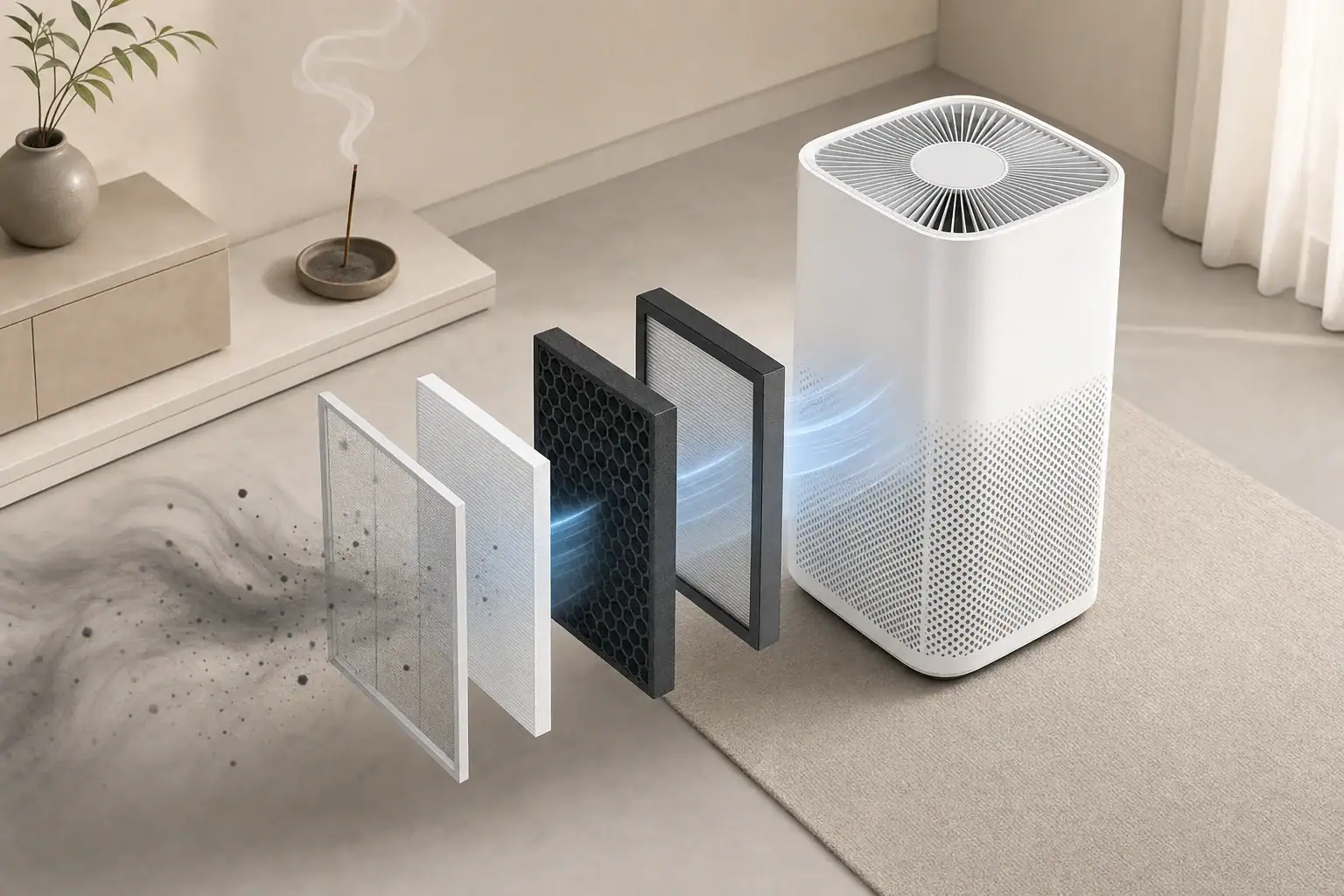
Incense smoke indoors contains fine particles and gases, so reducing it requires source control and ventilation, while particle filters and activated carbon address different parts of the pollution.
No single air-cleaning method removes everything incense releases. The practical approach is to burn less, keep smoke away from occupied areas, exhaust it outdoors when conditions allow, and use correctly sized filtration for what remains.
What incense smoke adds to indoor air
Burning incense is a combustion process. It produces a mixture of visible and invisible particles, water vapor, carbon dioxide, carbon monoxide, and various gaseous compounds. The exact mixture varies with the material, binders, fragrance ingredients, burn rate, and available ventilation.
Much of the airborne particle mass can fall within the fine-particle range measured as PM2.5. These particles may remain suspended after the visible plume disappears, especially in rooms with limited air exchange. Some settle onto furniture, walls, fabrics, and filters, where they may contribute to lingering odors.
Odor is a separate issue from particle concentration. A room can smell strongly even when a particle monitor shows that PM2.5 has declined, and a room may contain elevated particles even if occupants have become accustomed to the scent.
Smoke can also move beyond the room where incense is burned. Open doors, central air systems, return vents, ceiling fans, and pressure differences can carry particles and odors into bedrooms, hallways, or adjacent apartments.
Particles and odors require different air-cleaning methods
Particle filtration
A well-sealed particle filter can capture airborne smoke particles as room air passes through it. HEPA filtration is designed for particles, but overall performance also depends on airflow, cabinet sealing, filter fit, and operating time. A high-grade filter provides limited benefit if much of the air bypasses it or the purifier runs only at a very low speed.
Clean air delivery rate, or CADR, is more useful for room planning than filter efficiency alone. CADR represents filtered airflow and can be related to air changes per hour with a simple calculation:
Required CADR in cubic feet per minute = room volume × target ACH ÷ 60.
For example, a 150-square-foot room with an 8-foot ceiling has a volume of 1,200 cubic feet. A 5 ACH planning target would require about 100 cubic feet per minute of clean air delivery. This is an illustrative cleanup target, not a health or safety threshold.
Gas and odor control
Activated carbon and other sorbent media can capture some gaseous compounds associated with incense odor. Results vary because different gases interact with media differently. Thin carbon sheets may help with mild background odors but generally have less capacity than deeper beds containing more sorbent material.
Carbon eventually becomes saturated. It may stop reducing odors even when the particle filter still looks usable. Particle CADR also does not describe gas-removal performance, so a high smoke CADR should not be interpreted as a guarantee of odor control.
| Condition | Primary response | Supporting action |
|---|---|---|
| Incense is actively burning | Limit or stop the source | Exhaust air outdoors when practical |
| Visible haze is present | Increase particle filtration | Keep the purifier intake unobstructed |
| Particles decline but odor remains | Use ventilation or substantial carbon media | Clean odor-holding surfaces |
| Smoke enters other rooms | Close interior doors where appropriate | Avoid airflow that spreads the plume |
| Outdoor air is smoky or polluted | Avoid unnecessary window ventilation | Rely on source control and filtration |
| A small room fills with smoke quickly | Do not burn incense there | Use a larger, better-ventilated space if needed |
Common mistakes when managing incense smoke indoors
Relying on fragrance to cover the odor: Air fresheners may change how a room smells, but they do not remove smoke particles. They can also add more volatile compounds to the air.
Choosing a purifier by room-size marketing alone: Room claims may be based on a low number of air changes per hour. Calculate room volume and compare particle CADR with a practical ACH target instead.
Running the purifier only while incense burns: Particles and gases remain after the visible smoke is gone. Continued operation for at least several air-change cycles can improve cleanup. At 5 ACH, one theoretical air change takes 12 minutes, but mixing and ongoing release from surfaces make real cleanup slower.
Expecting HEPA filtration to remove odor: HEPA media captures particles rather than most gases. Odor control requires source reduction, outdoor ventilation, suitable sorbent media, or a combination of these methods.
Blocking airflow: A purifier squeezed behind furniture or placed directly against a wall may recirculate less room air. Follow the required clearances and keep both intake and outlet paths open.
Trusting automatic mode for every pollutant: Some onboard sensors respond mainly to particles. Others may not react strongly to a nearby odor, so manual higher-speed operation may be needed during cleanup.
A practical incense smoke cleanup checklist
Before burning incense
- Consider whether incense is necessary, especially in a bedroom or other small enclosed room.
- Check outdoor air conditions before opening windows or using an exhaust fan.
- Place incense on a stable, noncombustible holder away from curtains, paper, bedding, children, and pets.
- Position a purifier where it can circulate room air without blowing directly across the burning material.
- Close doors if doing so will keep smoke from reaching other occupied areas.
While incense is burning
- Use the smallest amount and shortest burn time that meets the intended purpose.
- Use local exhaust to the outdoors if available and appropriate.
- Run particle filtration at the highest tolerable airflow rather than prioritizing quiet operation.
- Do not leave burning incense unattended.
After extinguishing it
- Confirm that the ember is fully out and handle ash according to the holder’s safety instructions.
- Continue ventilation or filtration until particle readings and odor return toward the room’s normal baseline.
- Wipe nearby hard surfaces with an appropriate damp-cleaning method rather than dry dusting.
- Launder washable fabrics if they retain odor, and vacuum settled material with suitable filtration.
In an apartment, avoid using a fan that pushes smoke into a shared corridor, neighboring window, or common ventilation shaft. In an open-plan home, size filtration for the connected air volume rather than only the immediate area around the incense.
How incense smoke control works in real rooms
Small bedroom
A 120-square-foot bedroom with an 8-foot ceiling contains about 960 cubic feet of air. Five ACH corresponds to roughly 80 cfm of particle CADR. Even with adequate filtration, burning incense close to bedding and curtains can create persistent odor because fabrics collect particles and gases. Avoiding combustion in the bedroom is the simplest control.
Open living and dining area
A connected 400-square-foot area with a 9-foot ceiling contains about 3,600 cubic feet. Reaching 5 ACH would require about 300 cfm of combined clean air delivery. One small purifier may mix air locally without cleaning the entire connected space effectively. Multiple units can be added together by CADR when they serve the same open area and are positioned to support circulation.
Apartment with limited window access
When outdoor exhaust is unavailable, source reduction becomes especially important. A portable particle purifier can lower airborne particle levels, while a unit with meaningful carbon capacity may help with odor. Neither method supplies fresh outdoor air or removes all combustion gases.
Home with poor outdoor air conditions
Opening windows during a wildfire smoke event, high outdoor particle episode, or heavy nearby traffic may increase indoor particles. In that situation, keep windows closed as needed, stop indoor combustion, run particle filtration, and ventilate later when outdoor conditions improve.
Safety limits of purifiers, ionizers, and UV-C
An air purifier is not a substitute for fire safety, functioning smoke alarms, or carbon monoxide alarms. Incense should remain on a stable holder with adequate clearance, and the area should be supervised until the ember is completely extinguished.
Carbon monoxide is a combustion gas that particle filters and ordinary activated carbon filters are not designed to control reliably. A listed carbon monoxide alarm should be used where required or recommended; a general air quality monitor does not replace it.
Ionizers and electrostatic technologies may charge particles so they settle or are collected. Some devices can produce ozone as a byproduct. Ozone is itself an indoor air contaminant, so intentionally generating it is not an appropriate method for controlling incense odor in occupied spaces. Look for clear documentation of low or no ozone emissions when evaluating devices with electronic air-cleaning features.
UV-C may be used in enclosed equipment for microbial control, but it does not remove smoke particles or most odor gases. Its value for incense smoke is therefore limited, and poorly enclosed ultraviolet sources can create avoidable exposure or material-damage concerns.
Filter maintenance and useful monitor readings
Smoke can load filters faster than ordinary household dust. Inspect accessible prefilters about monthly during frequent use and clean them only as directed. A dirty prefilter reduces airflow, which lowers effective clean air delivery.
Do not wash a HEPA or other fine-particle filter unless it is specifically described as washable. Water, compressed air, or aggressive vacuuming can damage fine filter media or seals. Replace the filter when indicated by the instructions, when airflow remains reduced after prefilter cleaning, or when physical damage is visible.
Carbon replacement is less predictable because saturation depends on the amount and type of gases, humidity, airflow, and carbon mass. A return of odor downstream from the purifier can be a practical cue, although odor perception varies and is not a precise measurement.
PM2.5 monitors can help show the rise during burning and the decline during cleanup. Place a monitor away from the direct smoke plume and purifier outlet; otherwise, the reading may represent a concentrated stream or freshly filtered air rather than average room conditions.
Consumer TVOC sensors can show relative changes but usually cannot identify individual compounds or determine whether air is safe. Use them for trends against the room’s normal baseline, not as a precise measure of incense emissions.
| Metric | What it can indicate | Common limitation | Practical response |
|---|---|---|---|
| PM2.5 | Change in fine-particle concentration | Placement can distort readings | Increase filtration and stop the source |
| PM10 | Broader particle changes | Less specific to fine smoke | Compare with the normal room baseline |
| TVOC | Relative change in mixed gases | Does not identify individual compounds | Ventilate when outdoor air is suitable |
| Carbon dioxide | General ventilation trends when people are present | Does not measure smoke cleanup directly | Use as a ventilation clue, not a smoke metric |
| Carbon monoxide | Presence of a combustion gas | General monitors may not be safety alarms | Use a listed alarm and follow its instructions |
| Relative humidity | Moisture conditions affecting comfort and sorbents | Does not measure smoke | Keep humidity in a generally comfortable range |
Related guides: Do Air Purifiers Help With Smoke and Odors? • Ventilation vs Air Purifier: When You Need One, the Other, or Both • CADR Calculator: Room Size + Ceiling Height + ACH Target • Indoor Air Quality Monitors: What to Measure (PM2.5, CO2, VOCs, Humidity)
Key takeaways for incense smoke indoors
Incense smoke air cleaning works best as a layered process. Reduce or eliminate the source first, exhaust polluted air outdoors when conditions allow, and use a purifier with enough particle CADR for the full room volume.
Plan around roughly 4–6 ACH when faster particle cleanup is desired, while recognizing that this is general sizing guidance rather than a safety threshold. Use activated carbon for gases and odors, but expect capacity and replacement needs to vary.
Keep filters maintained, place equipment where air can circulate, and treat monitor readings as trends rather than guarantees. Most importantly, recognize the limits: filtration can reduce airborne particles and some odors, but it does not make indoor combustion emission-free.
Frequently asked questions
Can an air purifier remove incense smoke from a room?
A particle purifier with a well-sealed HEPA-type filter can reduce airborne incense smoke particles as air passes through the unit. It cannot instantly clear the room, and its effectiveness depends on its clean air delivery rate, room volume, placement, and operating speed. It also does not reliably remove combustion gases or all odor-causing compounds.
What size air purifier is needed for incense smoke?
Use the room’s full air volume rather than floor area alone, then compare the purifier’s particle CADR with the desired air changes per hour. A planning range of about 4–6 ACH can support faster particle cleanup, but it is not an exposure limit or safety guarantee. For an open-plan space, include all connected areas that share air.
Will activated carbon remove incense odor?
Activated carbon can reduce some gases that contribute to incense odor, but results depend on the amount and type of carbon, airflow, humidity, and the compounds present. Thin carbon filters may provide limited odor reduction, while larger sorbent beds generally have more capacity. Carbon must be replaced when it becomes saturated.
How long should a purifier run after incense is extinguished?
Run filtration until particle readings and odor move back toward the room’s usual baseline. Several air-change cycles may be needed because room air does not mix perfectly and smoke residues can continue to release from surfaces and fabrics. Ventilation can help when outdoor air quality is acceptable.
Is it safe to burn incense in a bedroom with an air purifier running?
An air purifier can reduce airborne particles but does not make indoor incense burning emission-free or replace source control. Bedrooms are often small and contain fabrics that can retain smoke residues and odor, so avoiding combustion there is the simpler option. Never leave incense unattended, and maintain appropriate fire and carbon monoxide safety measures.
Recommended next:
- Activated Carbon Filters Explained: VOCs, Odors, and What They Can’t Do
- How Much Activated Carbon Do You Need to Remove Odors?
- Carbon Filter vs HEPA: What Each One Removes (And What It Doesn’t)
- Formaldehyde in Homes: Sources, Risks, and How to Reduce It
- Activated Carbon Types: Pellet vs Granular vs Impregnated Carbon
- How Much Carbon Do You Need for Odors? Weight, Depth, and Contact Time
- More in Carbon Filters & VOCs →
- Clear sizing logic (room size → CADR/ACH)
- HEPA vs carbon explained for real use-cases
- Humidity + ventilation basics to reduce mold risk