
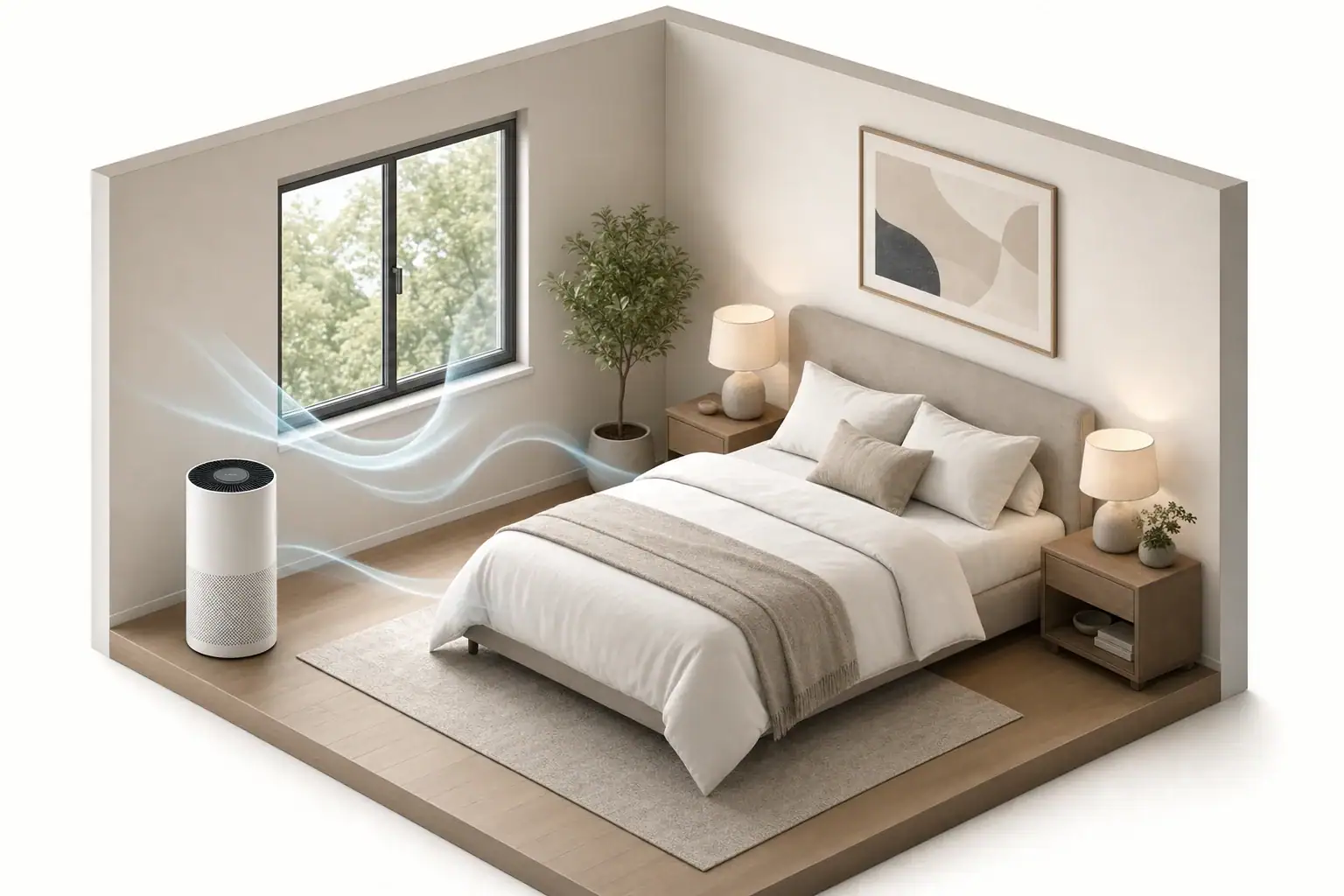
Allergy symptoms can feel worse at night when bedroom air contains pollen, dust mite debris, pet allergens, mold particles, or other irritants that accumulate around the sleeping area. Several hours of continuous exposure may make the difference more noticeable. Bedroom humidity, ventilation, bedding, pets, and air-cleaner placement can all affect conditions.
- Keep indoor relative humidity around 30% to 50% as general guidance, and investigate prolonged readings above 60%.
- For particle filtration, approximately 4 to 6 air changes per hour is a practical planning range for many bedrooms, not a medical standard.
- Wash bedding about weekly when practical, follow fabric instructions, and dry everything thoroughly.
- Keep purifier inlets and outlets unobstructed, with the clearance specified by the manufacturer.
- During high-pollen or smoke periods, closing windows may help; ventilate when outdoor air is suitable.
Why Allergy Symptoms May Feel Worse at Night
The bedroom combines long exposure time with materials that can collect particles. Mattresses, pillows, rugs, curtains, upholstered furniture, and clutter provide surfaces where dust and allergens settle. Movement in bed can return some of those particles to the air.
Outdoor pollen can enter through windows or arrive on clothing, hair, shoes, and pets. Indoor sources may include dust mites, animal dander, damp materials, scented products, and particles distributed by heating or cooling equipment.
Nighttime discomfort is not always an air quality issue. Body position, respiratory infections, medication timing, or other conditions can also affect symptoms. Indoor air improvements can reduce exposure to some triggers, but they cannot identify the cause of a symptom or replace professional medical advice.
Bedroom Air Quality Targets and Sizing Basics
Start with humidity, particle filtration, ventilation, and source control. Relative humidity of roughly 30% to 50% is a commonly used indoor comfort range. Lower levels may feel dry, while sustained high humidity can support dust mites and dampness-related problems.
For a portable air cleaner, clean air delivery rate and air changes per hour are more useful than filter labels alone. Estimate the room volume by multiplying length, width, and ceiling height. Then use this planning formula:
Required clean airflow in cubic feet per minute = room volume × desired ACH ÷ 60
For example, a 12-by-12-foot bedroom with an 8-foot ceiling contains 1,152 cubic feet. A target of 5 ACH would require about 96 cubic feet per minute of effective clean airflow. This is an illustrative estimate; room layout, open doors, leakage, operating speed, and filter condition affect real performance.
Ventilation removes accumulated indoor pollutants but can introduce pollen, humidity, or smoke. Carbon dioxide can serve as a rough indicator of occupied-room ventilation, although it does not directly measure allergens. A reading around or below 1,000 parts per million is sometimes used as a practical ventilation cue, not a universal safety threshold.
Example values for illustration.
| Observation | Primary response | Important note |
|---|---|---|
| Visible dust or elevated particle readings | Source cleaning plus particle filtration | A monitor cannot identify specific allergens |
| Humidity frequently above 60% | Reduce moisture and consider dehumidification | Check for leaks or condensation |
| Humidity below about 30% | Reduce over-drying or use cautious humidification | Clean humidifiers consistently |
| Stuffy room with rising carbon dioxide | Increase suitable outdoor-air ventilation | Consider pollen, smoke, and outdoor humidity |
| Seasonal pollen entering through windows | Close windows during higher-pollen periods | Use filtered mechanical ventilation when available |
| Persistent odor or gaseous pollutants | Remove the source and ventilate | Particle filters alone do not remove gases |
| Damp spots or visible mold growth | Correct the moisture source | Filtration does not repair wet materials |
Common Bedroom Air Quality Mistakes
A frequent mistake is relying on an air purifier while leaving the source unchanged. Filtration may capture airborne particles, but it does not clean bedding, prevent pets from entering, repair a leak, or stop pollen carried in on clothing.
Another issue is operating a purifier at a speed that is quiet but provides too little airflow. Published room coverage may be based on a low ACH target or maximum fan speed. Compare airflow with the actual room volume and choose a nighttime speed that remains both tolerable and useful.
- Blocked airflow: Curtains, furniture, walls, or bedding can restrict an intake or outlet.
- Open-plan assumptions: An open bedroom door increases the effective area the cleaner must serve.
- Dirty filters: Loaded filters may reduce airflow and increase noise.
- Excess humidification: Adding moisture without measuring humidity can create condensation or support dust mites.
- Monitor overinterpretation: Consumer PM2.5 and TVOC readings indicate trends, not a diagnosis or identification of a specific allergen.
Bedroom Air Quality Checklist for Nighttime Comfort
Control particles at their sources
- Wash sheets, pillowcases, and blankets about weekly when practical, following care labels.
- Dry bedding completely before returning it to the bed.
- Use washable or easily cleaned window coverings when possible.
- Vacuum rugs and upholstered surfaces with equipment that limits dust leakage.
- Damp-dust hard surfaces instead of redistributing dust with a dry cloth.
- Keep outdoor shoes away from the sleeping area.
- Change clothes and consider washing hair after substantial pollen exposure.
Manage the bed and pet areas
Allergen-resistant mattress and pillow encasements can create a washable barrier around materials that are difficult to clean. They still require routine exterior cleaning. If pets are a suspected trigger, keeping them out of the bedroom is a more direct source-control step than depending on filtration alone.
Set up airflow thoughtfully
Place a portable purifier where room air can reach it freely. Avoid pushing it against curtains, under furniture, or directly into a corner unless the instructions specifically allow that placement. Direct airflow away from the sleeper if drafts cause discomfort.
Keep windows closed when outdoor pollen or smoke is elevated. When outdoor conditions are favorable, brief ventilation or a mechanical ventilation system can reduce accumulated carbon dioxide and odors. Bathroom and kitchen exhaust fans should discharge outdoors and can help keep moisture from spreading through the home.
Track humidity rather than guessing
Use a basic hygrometer to observe patterns across several days. If humidity remains high, look first for damp laundry, bathroom moisture, window condensation, plumbing leaks, or an oversized cooling system that cycles briefly. If humidity is low, adjust gradually and avoid visible mist settling on nearby materials.
Real-World Bedroom Scenarios
Seasonal pollen in a small bedroom
A sleeper keeps windows open during spring and runs a purifier intermittently. A practical approach is to close windows during higher-pollen periods, remove outdoor clothing before entering the bedroom, clean bedding regularly, and operate appropriately sized filtration continuously at a sustainable speed.
Humid bedroom with morning condensation
Condensation and humidity readings above 60% suggest that moisture control deserves priority. Check ventilation, leaks, and indoor moisture sources before adding more filtration. A dehumidifier may help when the underlying moisture cannot be controlled through ventilation or air conditioning alone.
Closed bedroom that feels stuffy overnight
A purifier can reduce particles but does not remove carbon dioxide. If carbon dioxide rises while the room is occupied, consider suitable outdoor-air ventilation, an open interior door, or a balanced mechanical ventilation option. During smoke or high-pollen events, balance ventilation needs against outdoor conditions.
Air Cleaner Safety and Technology Considerations
Mechanical filtration is generally the most direct approach for airborne bedroom particles. A well-sealed filter assembly matters because air that leaks around the filter bypasses the media. HEPA classifications describe filter performance under test conditions, but the complete device also needs sufficient airflow and good sealing.
Activated carbon can help with some odors and gases, but thin carbon sheets have limited capacity. Carbon does not replace particle filtration, ventilation, or removal of the odor source.
Use caution with ionizers, electrostatic features, and other electronic air-cleaning methods that may generate ozone as a byproduct. Ozone is a respiratory irritant and should not be intentionally produced in occupied bedrooms. If an electronic feature is optional, review independent safety certification information and determine whether it can remain off.
UV-C may be used inside some equipment, but effectiveness depends on dose, exposure time, design, and shielding. It does not remove dust, pollen, gases, or moisture and should not expose skin or eyes. Follow all manufacturer safety instructions rather than modifying the device.
Maintenance and Filter Replacement Planning
Air quality equipment works best when maintenance is routine. Check the prefilter for lint and hair, inspect the main filter, and clean exterior vents according to the instructions. Do not wash a filter unless it is specifically designed to be washable.
Replacement indicators are useful reminders, but actual filter life depends on operating hours, fan speed, particle load, pets, smoke, construction dust, and humidity. Reduced airflow, persistent odor, visible loading, or unusual noise may justify an earlier inspection.
Humidifiers require especially consistent cleaning because standing water and mineral deposits can affect what enters the room. Use the water type and cleaning method specified for the unit. Dehumidifier tanks, drains, coils, and intake screens also need periodic attention.
Example values for illustration.
| Item | Planning interval | What may shorten the interval |
|---|---|---|
| Washable prefilter | Inspect every 2 to 4 weeks | Pets, lint, or continuous use |
| Disposable particle filter | Inspect every 3 to 6 months | Smoke, renovation dust, or high fan speed |
| Activated carbon filter | Inspect every 3 to 6 months | Strong or continuous odor sources |
| HVAC filter | Inspect monthly at first | Long run times, pets, or dusty conditions |
| Humidifier reservoir | Empty and refresh frequently | Warm rooms or visible residue |
| Dehumidifier intake and tank | Check every few weeks | Heavy moisture removal or dusty air |
Related guides: Bedroom Allergy Setup: The Fastest Changes That Reduce Symptoms • Pollen Season Indoor Plan: Filters, Ventilation Timing, and Cleaning • Dust Mites and Humidity: The RH Range That Helps Most • CO2 in Bedrooms: What Levels Mean and How to Improve Air Exchange
Summary of the Bedroom Air Quality Checklist
If allergy symptoms are worse at night, begin with the conditions closest to the bed. Clean bedding and nearby surfaces, control outdoor pollen entry, manage pet access, and keep relative humidity generally between 30% and 50%.
Size particle filtration by room volume and desired air changes rather than by filter terminology alone. Maintain clear airflow, use a tolerable continuous setting, and remember that ventilation, humidity control, and source removal solve different problems.
Track changes one at a time so patterns are easier to recognize. Indoor air steps may improve comfort and reduce exposure to some triggers, but persistent, severe, or unexplained symptoms should be discussed with a qualified health professional.
Frequently asked questions
Why are my allergy symptoms worse at night in the bedroom?
Bedroom symptoms may feel more noticeable because you spend several continuous hours near bedding, rugs, upholstered furniture, and other surfaces that collect allergens. Dust mites, pet dander, pollen brought indoors, and dampness-related particles can all contribute. Nasal congestion can also feel worse when lying down, so nighttime symptoms are not always caused only by bedroom air.
Should I keep bedroom windows closed when pollen is high?
Keeping windows closed during periods of elevated outdoor pollen can reduce the amount entering the bedroom. Pollen may still arrive on clothing, hair, shoes, and pets, so source-control steps such as changing clothes and washing bedding remain useful. When outdoor air is suitable, ventilation can still help with odors and stuffiness.
What humidity level is best for a bedroom with allergies?
A relative humidity range of about 30% to 50% is commonly used as general indoor guidance. Sustained humidity above 60% can support dust mites and moisture-related problems, while very dry air may feel irritating. Use a hygrometer to track conditions rather than adjusting humidity based only on comfort.
Can an air purifier remove dust mites from a bedroom?
An air purifier can capture some airborne particles, but it does not remove dust mites or their debris from mattresses, pillows, carpets, and other settled surfaces. Regular bedding washing, thorough drying, cleaning nearby surfaces, and using allergen-resistant encasements address those reservoirs more directly. Filtration works best as one part of a broader bedroom cleaning plan.
How often should bedding be washed if nighttime allergies are a problem?
Washing sheets, pillowcases, and blankets about weekly is a practical routine when possible, while following each fabric’s care instructions. Dry all bedding thoroughly before placing it back on the bed, since lingering moisture can contribute to dampness concerns. Mattress and pillow encasements should also be cleaned according to their instructions.
Recommended next:
- Pet Dander Allergy: Best Air Cleaner Setup and Habits That Help
- Dust Mite Allergy: Humidity Targets, Bedding, and Filtration
- Asthma Triggers Indoors: A Practical Checklist to Improve Air Quality
- Bedroom Allergy Setup: The Fastest Changes That Reduce Symptoms
- Pollen Season Indoor Plan: Filters, Ventilation Timing, and Cleaning
- Dust Mites and Humidity: The RH Range That Helps Most
- Clear sizing logic (room size → CADR/ACH)
- HEPA vs carbon explained for real use-cases
- Humidity + ventilation basics to reduce mold risk