
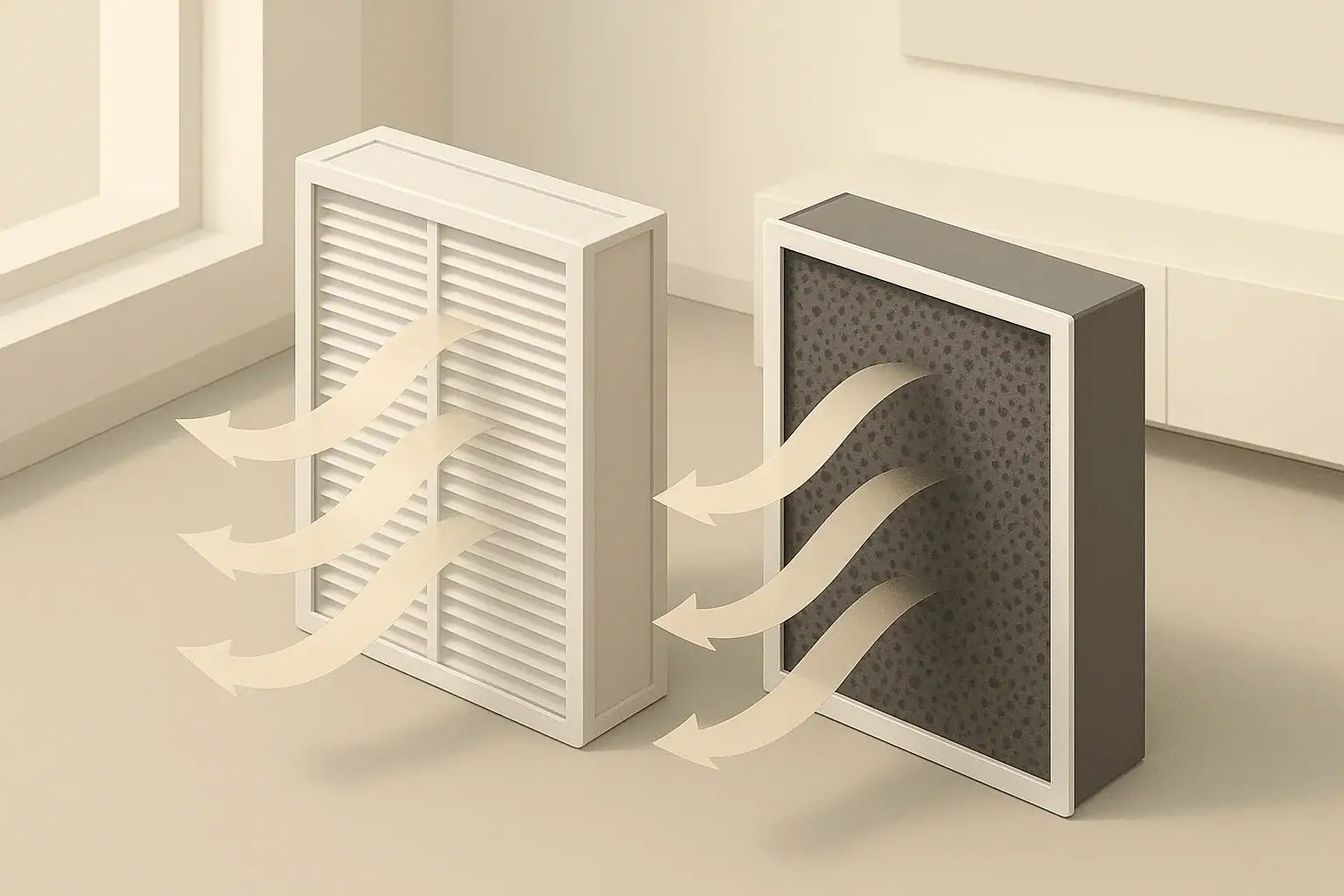
The short answer is that HEPA filters capture airborne particles such as dust, pollen, smoke particles, and spores. Activated carbon is used for selected gases and odors, but its effectiveness depends on the chemical, sorbent type, amount of media, airflow, humidity, and remaining capacity. Neither filter is a universal indoor-air solution.
People often search for “carbon filter vs HEPA” hoping to learn which is better. In reality, they address different parts of indoor air pollution: HEPA is particle filtration, while activated carbon is gas-phase media. Choosing between them starts with identifying the pollutant and reducing its source.
A useful order of operations is: remove or reduce the source, ventilate or exhaust it when outdoor air is suitable, and then use correctly sized filtration for the remaining particles or identified gases. The U.S. Environmental Protection Agency (EPA) describes source control as usually the most effective approach and air cleaning as a supplement rather than a substitute for source control and ventilation in its technical summary of residential air cleaners.
Carbon Filter vs HEPA: What They Are and Why It Matters
HEPA and activated carbon are complementary media, not interchangeable competitors:
- HEPA filters target solid and liquid particles suspended in air.
- Activated carbon and other sorbents target gases for which the selected media has an affinity.
If the concern is pollen, airborne dust, smoke particles, or mold spores, particle filtration is the relevant tool. If the concern is an odor or vapor, HEPA alone is not designed to remove it; gas-phase media must be selected for the actual compound. Many situations, including smoke and cooking emissions, involve both particles and gases.
Smell is not a complete pollutant test. Some hazardous gases may not have a useful warning odor, while an unpleasant smell does not reveal which sorbent will work. Identify and control the source whenever possible rather than selecting a filter by smell alone.
How HEPA and Carbon Filters Work (and What They Miss)
How HEPA Filters Work
HEPA filters are fibrous media through which a fan moves air. Particles can be captured through mechanisms including interception, impaction, and diffusion. The efficiency classification describes performance of the filter under specified test conditions; it does not by itself state how quickly a complete purifier will clean a particular room.
HEPA filtration is intended to capture particles such as:
- Airborne household dust and dust-mite debris
- Pollen
- Pet dander and other airborne animal-derived particles
- Fine particles in wildfire, tobacco, candle, and cooking smoke
- Airborne mold spores
- Other fine particulate matter, including PM2.5
HEPA filtration is not designed to remove:
- Individual gas molecules and vapors
- Gaseous odor compounds
- Most volatile organic compounds (VOCs)
- Carbon monoxide or radon gas
How Activated Carbon Filters Work
Activated carbon is processed to provide a large internal surface area. Gas molecules can adhere to that surface through adsorption. Carbon may be supplied as granules or pellets, or incorporated into a foam or nonwoven sheet.
Carbon performance depends on more than whether the words “activated carbon” appear on the package. Important variables include:
- The named gas: Sorbents preferentially capture compounds for which they have an affinity.
- Sorbent chemistry: Untreated carbon and chemically treated or impregnated media do not have identical targets.
- Media amount and available surface: A larger amount can provide more capacity when the sorbent is suitable for the gas.
- Contact time and airflow: Gas must contact the media long enough to be adsorbed.
- Concentration and source strength: A continuing source can exhaust finite sorbent capacity.
- Humidity: Water vapor can compete for adsorption sites and change performance.
The EPA reports that ordinary activated carbon is not especially effective against every gas; examples of difficult targets include carbon monoxide, nitrogen oxides, ammonia, sulfur oxides, hydrogen sulfide, and low-molecular-weight aldehydes such as formaldehyde. The same EPA technical review notes that thin sorbent layers can have limited capacity and may reach breakthrough quickly.
Therefore, a thin carbon-coated sheet is best treated as limited-capacity odor media unless the manufacturer provides compound-specific test results. Do not assume that a carbon layer removes all VOCs, all smoke gases, or “traffic pollution” as a single category.
Side by Side: What Each Filter Type Handles
| Indoor-air concern | HEPA | Activated carbon or another sorbent |
|---|---|---|
| Airborne dust and dust-mite debris | Designed to capture particles | Not a substitute for particle filtration |
| Pollen | Designed to capture particles | No direct gas-phase role |
| Pet dander | Captures airborne dander passing through the unit | May address selected odor compounds, depending on the media |
| Airborne mold spores | Captures spores passing through the unit | Does not correct mold growth or moisture |
| Wildfire or tobacco smoke particles | Relevant for the particle fraction | Requires suitable media and evidence for named gases |
| Cooking emissions | Relevant for airborne particles and droplets | May reduce selected odor compounds; kitchen exhaust remains important |
| VOCs from paint, cleaners, or materials | Not designed for gases | Performance varies by compound, media, capacity, and test conditions |
| Traffic-related gases | Not designed for gases | Do not assume removal; require evidence for the named gas |
| Carbon monoxide or radon | Not a safety solution | Standard consumer carbon media is not a reliable safety solution |
Filter Rating vs Whole-Device Performance
A filter’s efficiency and a purifier’s room-cleaning performance are not the same measurement. A highly efficient filter cannot clean much room air if the fan moves little air through it, air bypasses the media, or the unit is too small for the space.
For portable particle air cleaners, Clean Air Delivery Rate (CADR) combines particle-removal efficiency with airflow for the complete tested appliance. The Association of Home Appliance Manufacturers (AHAM) identifies ANSI/AHAM AC-1-2020 as its standard for measuring particle CADR. Its directory of verified air cleaners lists model-specific smoke, dust, and pollen CADRs for participating products.
When checking performance evidence:
- Match the exact purifier model number to the listing or test report.
- Confirm that the tested filter configuration is the one you will install. A replacement filter is not automatically interchangeable merely because it fits.
- Use particle CADR as evidence for particle cleaning, not as proof of VOC or odor removal.
- Do not treat “HEPA-like,” “HEPA-style,” or an unsupported H13/H14 label as whole-device performance evidence.
- Check the fan setting associated with any performance claim. Cleaning rate and noise can change with fan speed.
AHAM also lists a separate chemical-reduction standard, ANSI/AHAM AC-4-2022. The existence of that standard does not mean a particular product was tested under it. Look for a report that names the exact appliance, filter configuration, target compound, method, and test conditions.
For a central HVAC system, verify filter dimensions, fit, sealing, pressure drop, and compatibility with the fan and filter slot. The EPA cautions that installing higher-efficiency media does not guarantee intended performance if the system cannot accommodate it or air bypasses the filter. Ask an HVAC professional about system compatibility rather than selecting only by the filter label.
Real-World Scenarios: When You Need HEPA, Carbon, or Both
Seasonal Pollen and Airborne Dust
Relevant media: HEPA or another particle filter with documented whole-device performance.
A properly sized bedroom air purifier selected for particle CADR can reduce particles that pass through it. It does not remove dust already settled on bedding, floors, and furnishings, so cleaning and source control still matter. Carbon is only relevant if there is also a specific gas or odor concern.
Wildfire Smoke or Indoor Smoking
Smoke contains particles and gases. HEPA addresses the particle fraction; suitable gas-phase media may reduce selected gases until its finite capacity is reached. Particle CADR does not establish gas removal.
During wildfire smoke, follow local public-health advice and limit outdoor-air entry when outdoor air is hazardous. A correctly sized particle purifier with suitable carbon media may reduce pollutants that pass through it, but performance depends on the unit, room, building leakage, runtime, and source strength. For tobacco smoke, not smoking indoors is more effective than trying to clean continuously generated smoke.
Cooking Odors and Particles
First step: Use a range hood exhausted outdoors when available and safe to operate. Cooking produces both particles and gases, so HEPA and suitable sorbent media can be supplemental where emissions remain. A recirculating purifier does not replace capture at the stove, and no generic carbon layer can be assumed to remove every cooking gas.
New Furniture, Flooring, or Paint
Reduce or isolate the emitting source and ventilate with suitable outdoor air. HEPA does not remove gaseous VOCs. Carbon or another sorbent may reduce a named compound only if the media is suitable and has adequate capacity. Ask for compound-specific test evidence rather than relying on a general “VOC filter” claim.
Moldy or Musty Basement
Fix water entry, condensation, or excessive humidity and address contaminated materials. HEPA can capture airborne spores that reach the filter, but it cannot dry a wall or remove mold growing inside materials. A sorbent may reduce some odor compounds temporarily, but masking or filtering the odor does not establish that the moisture problem is resolved.
Common Mistakes and Troubleshooting Cues
| What you notice | Possible explanation | What to check |
|---|---|---|
| Particle readings improve, but an odor remains | The unit may lack suitable gas media, or the source may still be active | Remove the source; identify the gas; check sorbent type, amount, test data, and replacement condition |
| Odor changes, but airborne particles remain high | Insufficient particle filtration, airflow, runtime, or room sizing | Check model-specific particle CADR, placement, fan setting, room volume, and filter fit |
| An odor returns after initial improvement | The source may be continuing or stronger, or the sorbent may have reached breakthrough | Investigate the source and follow model-specific media replacement guidance |
| Little improvement despite a high filter-efficiency label | Low airflow, bypass leakage, an undersized unit, or a mismatched pollutant | Check whole-device CADR, exact filter compatibility, seals, obstructions, runtime, and pollutant type |
| Musty odor quickly returns | Ongoing dampness or microbial growth | Inspect for leaks, condensation, humidity, and contaminated materials rather than relying on filtration alone |
Other Common Missteps
- Buying by a media label alone. A HEPA or H13/H14 claim does not reveal the complete appliance’s clean-air delivery, leakage, noise, or performance at the setting you will use.
- Using particle CADR as proof of gas removal. Particle and chemical performance require different evidence.
- Treating all gases as one category. Ask which named substances the sorbent targets and how performance was tested.
- Assuming a thin carbon sheet has unlimited capacity. Sorbents are finite, and thin layers may reach breakthrough quickly.
- Ignoring the treated space. Opening the purifier to additional rooms increases the volume it must serve; size and airflow should be evaluated for the actual connected space.
- Ignoring source control and ventilation. Air cleaning cannot ensure adequate air quality while a strong source continues.
Safety Basics: What Filters Cannot Protect You From
Serious Gas Hazards
- Carbon monoxide: Do not rely on HEPA or ordinary consumer activated carbon. Use properly installed and maintained CO alarms and address combustion or venting problems.
- Radon: A portable HEPA or standard carbon purifier is not a radon-mitigation system. Radon requires testing and, when indicated, a purpose-designed mitigation approach.
- Major chemical releases: A household purifier is not emergency protective equipment. Follow emergency-services, poison-control, product-label, or public-health instructions as applicable.
Biological Contaminants
- Mold growth: Capturing airborne spores does not remove growth from building materials or correct the moisture that supports it.
- Microbe-containing particles: A particle filter can capture particles that reach the media, but this does not mean that a room has been sterilized.
Placement and Operation
- Follow the appliance manufacturer’s clearance, placement, electrical, and filter-installation instructions.
- Keep air inlets and outlets unobstructed so the tested airflow path is not restricted.
- Do not use an incompatible replacement filter merely because its dimensions appear similar.
Maintenance and Long-Term Use
There is no universal six-month or annual replacement interval that applies to every HEPA or carbon filter. Service life varies with the device, airflow, operating time, particle loading, gas concentration, humidity, media capacity, and source strength. Start with the exact manufacturer schedule for the installed model, then use any documented loading, pressure-drop, airflow, sensor, or gas-breakthrough guidance supplied for that system.
HEPA Filter Care
- Use the exact compatible filter and install it in the specified orientation.
- Check gaskets, frames, and access panels for gaps that could allow bypass.
- Maintain a washable or replaceable prefilter only as directed; do not wash HEPA media unless the manufacturer explicitly says it is washable.
- Do not judge remaining particle-filter capacity from color alone. Follow the device’s replacement indicator and instructions while also watching for reduced airflow or abnormal operation.
Activated Carbon and Sorbent Care
- Follow model-specific replacement conditions; sorbent life cannot be inferred reliably from appearance.
- A returning odor can indicate exhausted media, but it can also indicate a continuing or stronger source.
- Keep unused replacement media in its sealed packaging until installation.
- For consequential gas concerns, seek capacity or breakthrough data for the named chemical rather than using odor alone as the replacement signal.
Whole-Home vs Room-by-Room Strategies
- Portable units can target occupied rooms, but their model-specific CADR must suit the space they actually serve.
- Central HVAC filters can filter recirculated air while the system fan operates, but filter fit, pressure drop, fan compatibility, and duct leakage affect results.
- Meaningful gas control requires suitable sorbent media and enough contact and capacity; a token carbon coating in either format should not be assumed to control a specific gas.
Practical Takeaways and Specs to Look For
Key Takeaways
- Choose HEPA or documented particle filtration for dust, pollen, smoke particles, pet dander, and airborne spores.
- Choose activated carbon or another sorbent only after identifying the gas or odor compounds it is intended and documented to capture.
- Use both when particles and gases are present, but evaluate particle and gas performance separately.
- Reduce the source first, ventilate or exhaust when appropriate, and use filtration for the remaining pollutant load.
Specs and Evidence to Look For
- Exact model identification: Match the purifier and installed filter to the certification directory or test report.
- Model-specific particle CADR: Check smoke, dust, and pollen values for the complete device rather than relying only on the media label.
- Intended fan setting: Confirm cleaning rate and noise at a speed you can realistically operate.
- Gas target and test method: Look for named compounds, sorbent type or impregnation, test conditions, initial efficiency, capacity or breakthrough data, and replacement conditions.
- Sorbent quantity: Ask for carbon or other sorbent mass. Thickness alone is an incomplete measure, but an unspecified thin sheet provides little evidence of substantial capacity.
- Filter compatibility and sealing: Confirm part numbers, dimensions, gaskets, and installation requirements.
- HVAC compatibility: Check pressure drop, filter-slot fit, and fan capability before upgrading central media.
- Operating and replacement cost: Compare energy use and the price and availability of all required filters without assuming a universal replacement interval.
The most defensible comparison is not simply “carbon filter vs HEPA.” It is whether a complete device, with the correct installed media and adequate airflow, has evidence for the particular particles or gases you need to address.
Frequently Asked Questions
Is HEPA better than activated carbon?
Neither is universally better. HEPA is intended for particles. Activated carbon is gas-phase media whose performance depends on the named chemical, media formulation, quantity, airflow, humidity, and remaining capacity.
Does an H13 or H14 label prove that a purifier will clean a room well?
No. A filter classification is not a whole-device cleaning-rate measurement. Check the exact purifier’s particle CADR, installed filter, fan setting, sealing, and suitability for the room.
Does particle CADR prove that a purifier removes odors or VOCs?
No. Particle CADR applies to particle cleaning. Gas or chemical performance needs separate evidence naming the appliance, filter configuration, target compound, method, and test conditions.
Can a thin carbon sheet remove all household VOCs?
No such universal conclusion is justified. Sorbents have finite capacity and different affinities. Thin media may reach breakthrough quickly, so ask for the sorbent mass and compound-specific test and capacity data.
Can a combined HEPA and carbon purifier replace ventilation or moisture control?
No. It can treat only air that passes through the device. It does not supply outdoor air, repair leaks, dry damp materials, or eliminate a continuing pollution source.
How often should HEPA and carbon filters be replaced?
There is no universal interval. Follow the schedule and condition indicators for the exact device and filter. Particle loading, airflow, runtime, gas concentration, humidity, sorbent capacity, and source strength can all change service life.
- Clear sizing logic (room size → CADR/ACH)
- HEPA vs carbon explained for real use-cases
- Humidity + ventilation basics to reduce mold risk