
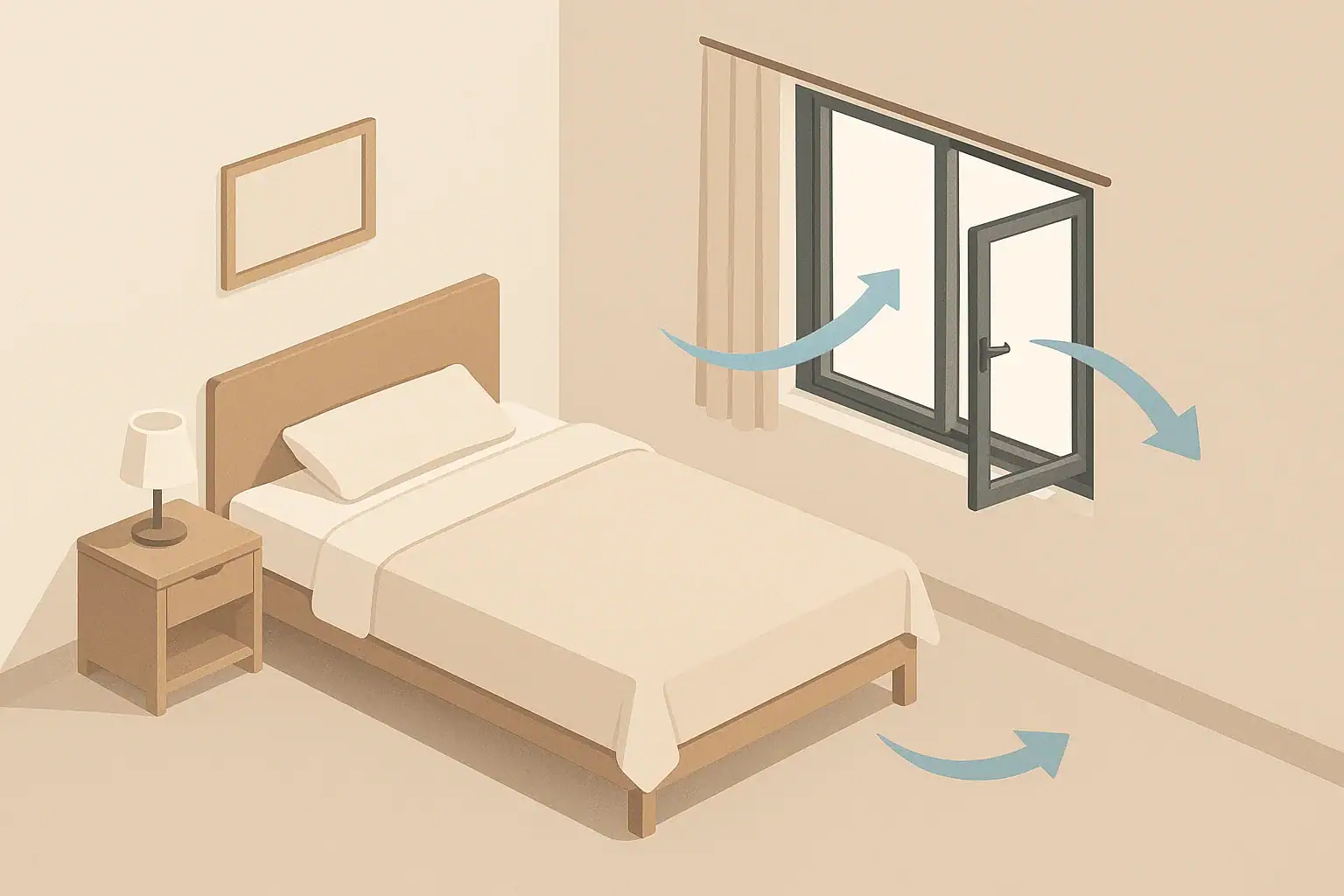
In bedrooms, carbon dioxide (CO2) levels below about 800–1000 ppm are generally considered good for comfort, while higher values suggest limited air exchange and a buildup of exhaled air.
Bedroom CO2 is mainly a sign of how well fresh air is replacing stale air while people sleep. It does not tell you everything about air quality, but it is a useful marker of ventilation and can help you decide when to open windows, adjust HVAC settings, or add simple ventilation strategies. Understanding typical ranges and how room size, occupancy, and doors/windows affect CO2 can make your bedroom more comfortable and easier to ventilate.
- Aim for bedroom CO2 roughly below 800–1000 ppm for typical comfort.
- Over ~1200–1500 ppm usually indicates not enough fresh air exchange.
- High CO2 in bedrooms is common when doors/windows are closed and vents are weak.
- Improve air exchange with window airing, HVAC fan use, and under-door gaps.
- Air purifiers do not remove CO2; you need ventilation or fresh air supply.
- Use a CO2 monitor as a ventilation guide, not a medical device.
What Bedroom CO2 Means and Why It Matters
CO2 in a bedroom mostly comes from people breathing. When you close doors and windows at night, the same air is recirculated, and CO2 gradually rises. The higher it climbs, the clearer the signal that fresh outdoor air is not entering fast enough.
CO2 is measured in parts per million (ppm). Outdoor air in most locations typically sits around 400 ppm, sometimes higher in cities. Indoor levels are usually higher than outdoor because of human activity and limited ventilation.
In bedrooms, elevated CO2 is mainly a comfort and ventilation issue. People often notice stuffy or stale air, mild headaches, or grogginess when air is poorly exchanged, but reactions vary widely. CO2 is helpful because it gives you a simple number to work with when you want to improve air movement, even though it does not directly track dust, particles, or volatile organic compounds (VOCs).
Key Concepts: CO2 Ranges, Air Changes, and Room Factors
To use CO2 readings effectively in a bedroom, it helps to understand a few basic concepts: typical ranges, air changes per hour (ACH), and how room characteristics affect buildup.
Typical CO2 Ranges in Bedrooms
These ranges are general comfort-oriented guidelines, not strict health limits:
- Outdoor air: around 400 ppm (varies by location).
- Well-ventilated indoor space: commonly 500–800 ppm.
- Typical bedroom with door closed: 800–1500+ ppm overnight, depending on size and leaks.
- Very poorly ventilated bedroom: 2000+ ppm by early morning is possible with multiple people and tight construction.
The exact numbers depend on how many people are in the room, how long they stay, and how easily air can move in and out.
Air Changes Per Hour (ACH) in Simple Terms
ACH describes how many times the air in a room is effectively replaced in one hour. Higher ACH means better ventilation and slower CO2 buildup. For bedrooms focused on comfort, an air change rate on the order of a few changes per hour is often used as a planning idea, but actual rates vary widely between homes.
CO2 level trends can act as a rough indicator of ventilation:
- If CO2 rises quickly and remains high, ACH is likely low (little fresh air).
- If CO2 rises slowly and levels off at a moderate value, ACH is higher.
- If CO2 drops rapidly when you open a window, you are briefly reaching very high effective ACH.
Room Size, Occupancy, and Door/Window Position
Several practical factors strongly influence bedroom CO2:
- Room volume: Larger rooms with higher ceilings dilute CO2 more, so levels rise more slowly.
- Number of people: Each person exhales CO2, so two adults in a small room will drive levels up faster than one person in a large room.
- Door position: A fully closed, well-sealed door can significantly limit airflow, especially in tight homes without dedicated supply and return vents in the bedroom.
- Windows: Open windows, even slightly, can dramatically lower CO2 by boosting natural ventilation when outdoor conditions allow.
- Mechanical supply/return: Bedrooms with active supply and return ducts connected to central HVAC often maintain lower CO2 than isolated rooms without good ducting.
| Observation | Why it matters | Practical note |
|---|---|---|
| CO2 over ~1500 ppm by morning | Signals limited fresh air exchange overnight | Check door gaps, vents, and window options |
| CO2 stays near outdoor level | Indicates strong ventilation or large leaks | Air exchange already high; focus on filtration if needed |
| CO2 drops quickly when window opens | Window airing is very effective in that room | Use short airing periods before bed or in early morning |
| CO2 high only when door fully closed | Door is restricting airflow to rest of home | Consider under-cut door or small transfer grille (if feasible) |
| CO2 high despite HVAC running | Bedroom may lack return path or supply air | Discuss balancing or duct adjustments with a professional |
| CO2 lower on mild days | Natural ventilation improves when windows are comfortable to open | Use these times to flush the room fully |
Common CO2 and Ventilation Mistakes in Bedrooms
Many bedrooms have elevated CO2 simply because of everyday habits and building quirks. Recognizing frequent issues makes it easier to choose realistic improvements.
Relying on Air Purifiers for CO2 Removal
Mechanical air purifiers with HEPA or activated carbon filters are designed to remove particles and some gases, but typical home units do not remove CO2 in a meaningful way. They recirculate indoor air within the room. As a result, CO2 will still rise if there is no source of outdoor air, even if the air purifier is running on high.
Closing Doors and Windows Completely All Night
Sleeping with both door and windows closed is common for privacy, temperature control, or noise reduction. In tight, modern homes, this can leave the bedroom almost isolated from the rest of the house, especially if there is no return duct. CO2 may rise from a few hundred ppm to well over 1500 ppm overnight.
Blocking Supply or Return Vents
Furniture, curtains, and rugs can partially block wall, floor, or ceiling registers. When supply air cannot enter or leave the room freely, both temperature control and air exchange suffer. Even if the central system is capable of good ventilation, the bedroom may not receive the full benefit.
Ignoring Under-Door Gaps
Some bedrooms have thick carpets or tight-fitting doors that nearly seal the gap at the bottom. Without enough space under the door, air cannot move easily when the HVAC fan runs, reducing effective air changes. A small visible gap can make a noticeable difference in CO2 trends.
Misreading CO2 Monitors
CO2 monitors vary in sensor type and accuracy. Many consumer units estimate CO2 (“eCO2”) indirectly from VOC readings. These can be useful for general trends but may not match absolute values precisely. Treat them as directional tools rather than instruments that must match a specific numerical target.
Practical Ways to Improve Bedroom Air Exchange
You do not need complex systems to improve CO2 in many bedrooms. A few simple changes to air pathways and timing can have a large effect on overnight levels.
Use Window Ventilation Strategically
When outdoor air quality and weather are acceptable, windows are one of the most powerful tools for reducing CO2:
- Short, intensive airing: Open windows wide for 5–15 minutes before bedtime or first thing in the morning. This can quickly bring CO2 close to outdoor levels.
- Cracked windows overnight: A small opening can meaningfully increase air changes, especially if the door is also slightly open to allow crossflow.
- Opposite-side openings: If possible, open windows or vents on opposite sides of the home or at different heights to create a mild cross-breeze.
Always consider outdoor temperature, humidity, pollen, and pollution when deciding how much to open windows.
Leverage Central HVAC for Ventilation Support
If your home has a central HVAC system:
- Fan “on” or circulation mode: Running the system fan continuously or on a schedule (not just during heating/cooling) can increase mixing and help distribute whatever outdoor air your system introduces.
- Keep vents unblocked: Ensure supply and return registers in and near the bedroom are not hidden by furniture or heavy drapes.
- Check return paths: If the bedroom has only a supply vent and no obvious return, air must escape under the door or through transfer paths. Keeping the door slightly open or ensuring a gap under the door supports this.
Not all residential systems bring in dedicated outdoor air; many mostly recirculate indoor air. In those cases, HVAC still helps with distribution, but CO2 ultimately declines only when outdoor air is admitted via cracks, windows, or dedicated ventilation inlets.
Improve Door and Transfer Airflow
If you prefer to sleep with the door mostly closed, consider:
- Under-cut doors: A modest gap under the door allows air to move between the bedroom and hallway when the HVAC fan runs or when windows are open elsewhere.
- Door position: Even opening the door a few inches can reduce peak CO2 overnight compared to a fully closed door.
- Passive transfer grilles: In some homes, small wall or door grilles are used to allow air to pass between rooms while maintaining privacy; adding these should be planned and installed by someone familiar with building codes and sound/privacy expectations.
Use Fans to Support, Not Replace, Ventilation
Portable fans and ceiling fans help mix air within the room and can move indoor air toward open doors or windows, but they do not create fresh air on their own. Combine them with a source of outdoor air (like a cracked window), or use them to help pull air to and from the hallway where other vents are located.
Combine CO2 Monitoring With Other Air Quality Tools
Because CO2 does not track particles or many gases, you may also want to manage other aspects of bedroom air:
- Air purifiers: Useful for dust, smoke, and other particles, especially when outdoor air is not ideal for open windows.
- Humidity control: Keeping indoor relative humidity in a moderate range (often discussed in the ~30–50% area as a general comfort example) can help with comfort and mold prevention; humidifiers or dehumidifiers can support this when used carefully.
- Source control: Limiting candles, incense, and strong chemical products in the bedroom can reduce pollutants that are not reflected in CO2 readings.
Example Bedroom Scenarios and CO2 Patterns
Looking at typical setups can help you interpret what your own readings might mean and which changes are likely to help.
Small Apartment Bedroom, One Person, Door Closed
In a compact room with a tight-fitting door and no window use, CO2 might start near 600–800 ppm in the evening and climb to 1500–2000 ppm by morning. Opening the door slightly or running the HVAC fan continuously can often bring peak levels down significantly.
Medium Bedroom, Two People, Window Cracked
With two people sleeping and a window open slightly, CO2 may rise from outdoor levels to somewhere in the 700–1100 ppm range overnight, depending on wind and temperature differences. Short, regular airing plus partial window opening can maintain moderate values with minimal effort.
Large Bedroom With Good Supply and Return Vents
In a large, well-ducted bedroom where the HVAC system runs regularly, CO2 may remain between roughly 600 and 900 ppm, even with the door closed. Here, the main focus might be filters and humidity, since air exchange is already relatively strong.
Safety, Devices, and Technology Considerations
When working on bedroom CO2 and air exchange, it is important to think about safety and the limitations of various devices.
CO2 vs CO: Different Gases, Different Devices
Carbon dioxide (CO2) and carbon monoxide (CO) are different. CO is a safety hazard at relatively low concentrations and requires dedicated CO alarms that meet local codes. CO2 monitors do not replace CO detectors or smoke alarms.
Choosing and Using CO2 Monitors Carefully
Consumer CO2 monitors vary widely. Some points to keep in mind:
- Sensor type: Non-dispersive infrared (NDIR) sensors are typically used for more direct CO2 readings. Some low-cost devices instead estimate “equivalent CO2” based on VOCs.
- Placement: Place monitors away from open windows, vents, and direct exhaled breath to get more representative readings of room air.
- Calibration: Many devices benefit from regular exposure to outdoor air to maintain reasonable baseline readings (following the manufacturer’s instructions).
- Use trends, not single numbers: Watching how CO2 changes overnight, and how it responds to opening a window or door, is often more useful than focusing on a precise value at one moment.
Neutral View on Ionizers and UV-C Devices
Some air cleaners use ionization or UV-C lamps to address particles or microorganisms. These technologies can have trade-offs and should be used with care. For CO2, they do not provide a benefit, because they work on particles or microbes, not on the main gas composition. If considering such devices, check for independent testing, potential byproducts, and how they fit with existing filters and ventilation.
Maintenance, Filters, and Long-Term Bedroom Air Quality
Keeping CO2 at comfortable levels is part of overall bedroom air quality. Ongoing maintenance helps keep ventilation and filtration working as intended.
HVAC Filters and Airflow
A clogged central HVAC filter can reduce airflow through the system, which may indirectly affect bedroom air exchange. Replacing filters on a reasonable schedule (following equipment guidance) helps maintain designed airflows. Filters with higher particle efficiency can capture smaller particles but may require correct sizing and fan capacity to avoid airflow issues.
Window and Door Seals
Weatherstripping and tight construction improve energy efficiency but also reduce natural air leakage. If your home is very tight, planned ventilation methods (such as controlled window airing or dedicated outdoor air systems) become more important to manage CO2 and other indoor pollutants.
Purifier Filters and Bedroom Particles
While purifiers do not reduce CO2, they can keep particle levels lower in a bedroom with limited ability to open windows (for example, during wildfire smoke events or high-pollen seasons). Replacing HEPA and carbon filters according to recommended intervals helps maintain clean airflow and avoid reduced performance from clogged or saturated media.
| Metric | What it indicates | Common pitfall | Simple action idea |
|---|---|---|---|
| CO2 (ppm) | Ventilation and buildup of exhaled air | Treating purifier use as a CO2 fix | Open windows or improve airflow when levels rise |
| PM2.5 (µg/m³) | Fine particles from dust, smoke, and outdoor air | Ignoring outdoor sources like traffic or wildfires | Use filtration and close windows during high outdoor pollution |
| TVOC (ppb or index) | Mixed volatile organic compounds | Assuming it directly measures all chemical risks | Increase ventilation and reduce strong chemical products |
| Temperature (°F) | Thermal comfort and HVAC performance | Not linking temperature swings to HVAC cycling | Adjust thermostat and fan settings for steadier sleep comfort |
| Relative humidity (%) | Moisture level affecting comfort and mold risk | Letting humidity stay very high or very low for long periods | Use humidifiers or dehumidifiers to stay in a moderate range |
| Indoor/outdoor comparison | How much indoor air differs from outside | Not checking outdoor air before airing out | Plan window opening when outdoor air is relatively clean |
Related guides: CO2 Ventilation Calculator: Fresh-Air Needs for Bedrooms • Bedroom Air Change Targets: How Many ACH for Sleep? • Air Purifier vs Ventilation: Which Fixes Stuffy Bedrooms Better?
Key Takeaways on Bedroom CO2 and Air Exchange
CO2 in bedrooms is a practical indicator of how well fresh air is replacing exhaled air overnight. Values below about 800–1000 ppm are often associated with good ventilation for comfort, while higher levels suggest it may be time to adjust windows, doors, or HVAC settings.
Because CO2 does not capture particles or many gases, it should be viewed as one part of an overall indoor air quality picture. Combining simple CO2 monitoring with window airing, appropriate HVAC use, unobstructed vents, and, when needed, separate filtration and humidity control gives you a balanced approach to making bedroom air fresher and more comfortable over the long term.
Frequently asked questions
What CO2 concentration in a bedroom typically indicates inadequate air exchange?
As a practical rule for comfort, sustained bedroom CO2 above about 1200–1500 ppm usually indicates limited fresh-air exchange overnight. Levels between roughly 800 and 1000 ppm are commonly associated with comfortable ventilation; anything much higher suggests you should consider opening windows, running the HVAC fan, or improving door/transfer airflow.
How can I reduce CO2 overnight without making the room too cold or noisy?
Try short, intensive airing before bed (5–15 minutes) and then leaving a window cracked slightly, or run the central HVAC fan continuously to increase mixing. If you prefer the door mostly closed, a small under-door gap or opening the door a few inches helps; pair these steps with a fan to support airflow while minimizing temperature and noise impacts.
Will running an air purifier lower CO2 levels in my bedroom?
No. Typical HEPA or activated-carbon air purifiers remove particles and some gases but do not remove CO2; they mainly recirculate indoor air. To reduce CO2 you need ventilation or an engineered outdoor-air supply rather than a standard room purifier.
Where is the best place to put a CO2 monitor in a bedroom for reliable readings?
Place the monitor away from open windows, supply vents, and direct exhalation zones (avoid putting it right next to the bed’s head). A representative location is near the breathing zone height (about 1–1.5 m above the floor) and roughly in the room’s center or on a nightstand a little way from the occupant to capture typical room air rather than short-term spikes.
How often should I check or recalibrate a consumer CO2 monitor?
Follow the manufacturer’s guidance, but in practice it’s helpful to expose the device to outdoor air occasionally to reset its baseline and to check long-term trends rather than isolated values. Many consumer units benefit from periodic outdoor-air exposure and occasional calibration checks; if readings seem inconsistent, consult the device documentation or consider a sensor with NDIR technology for greater accuracy.
Recommended next:
- Clear sizing logic (room size → CADR/ACH)
- HEPA vs carbon explained for real use-cases
- Humidity + ventilation basics to reduce mold risk