
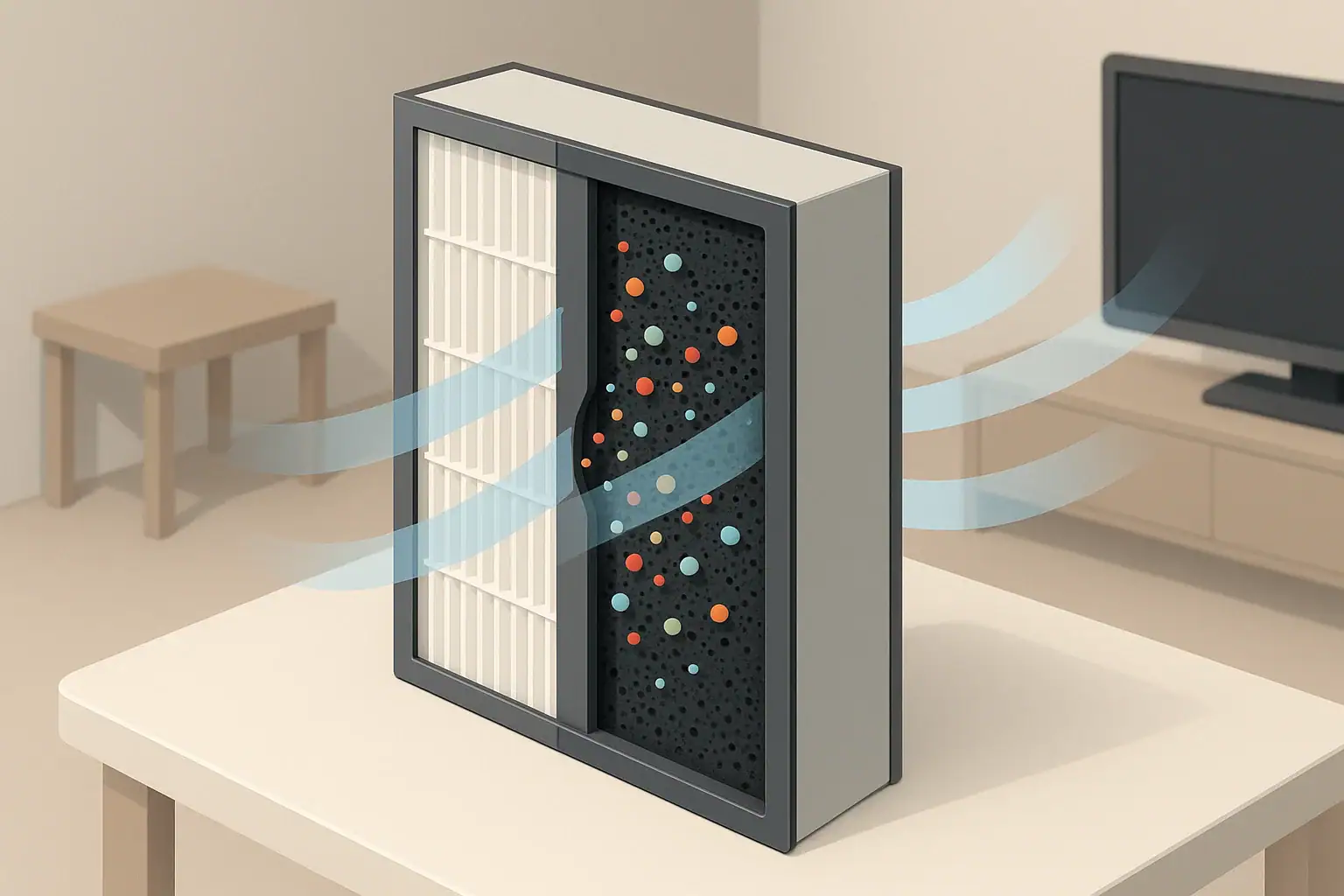
Activated carbon filters remove many household odors and a portion of VOCs, but they do not catch dust, pollen, or every gas in your indoor air. They are best used alongside particle filters like HEPA plus good ventilation and source control, not as a stand‑alone solution. Understanding what these carbon filters can and cannot do helps you avoid disappointment, wasted money, and a false sense of safety.
This guide explains how activated charcoal filters work, which odors and chemical fumes they are good at capturing, where they fall short, and how to choose and maintain them for real-world home use. You will see concrete examples, common mistakes to avoid, and simple specs to check before you buy or replace a filter so you can match your air cleaning strategy to your actual indoor air quality problems.
What Activated Carbon Filters Are and Why They Matter
Activated carbon filters (also called activated charcoal filters or gas-phase filters) use highly porous carbon to capture gas molecules and odor compounds from the air. Instead of trapping particles like dust or pollen, they target chemicals in the gas phase, especially many volatile organic compounds (VOCs) and nuisance smells.
In homes, activated carbon is commonly added to portable air purifiers, whole-house filtration cabinets, and some ventilation or recirculation systems. People usually turn to carbon when they notice:
- Persistent cooking or pet odors that linger even after cleaning.
- New paint, flooring, or furniture smells from renovation or remodeling.
- Smoke odors from wildfires, neighbors, or past smoking indoors.
- Musty smells that remain after fixing a moisture problem.
These filters matter because many VOCs are too small and too light to be captured efficiently by particle filters, even very good ones. Without a gas-phase medium like activated carbon, an air cleaner can remove visible haze while leaving much of the odor and some chemical exposure behind.
At the same time, carbon filters are often oversold. Very thin, lightweight carbon pads may only offer modest odor reduction, and no amount of carbon will fix an active source like a gas leak, ongoing mold growth, or heavy smoking indoors. The goal is to use carbon where it is effective and pair it with other measures where it is not.
Key Concepts: How Activated Carbon Filters Work
Activated carbon works by providing a huge internal surface area where gas molecules can stick. Several key ideas explain how and why this happens.
What “Activated” Carbon Means
Regular carbon materials (such as charcoal) are processed at high temperatures and with specific treatments to create millions of microscopic pores. This activation step turns a relatively dense material into a sponge-like network of internal tunnels and cavities.
Because of this structure, a small amount of activated carbon can have the internal surface area of a large house. That surface is where gas molecules are held when air passes through the filter.
Adsorption vs. Absorption
Activated carbon filters rely on adsorption, not absorption:
- Adsorption means molecules cling to the surface of the carbon due to physical forces and sometimes chemical interactions.
- Absorption means a substance is drawn into the bulk of a material, like water soaking into a sponge.
In a carbon filter, air flows across or through the carbon bed. As the air moves, some odor and VOC molecules stick to the carbon surface and are removed from the airstream. The more contact time and surface area available, the more can be captured on each pass.
Why Surface Area, Depth, and Airflow Matter
Three design factors largely determine how well a carbon filter performs:
- Carbon mass: More grams of carbon usually mean more total capacity to hold VOCs and odors.
- Bed depth: A deeper carbon layer gives air more time in contact with the media.
- Airflow speed: Slower airflow through the carbon bed increases contact time per pass, improving removal efficiency, but reduces total air volume treated per minute.
There is always a tradeoff between airflow and gas removal per pass. Very thin carbon sheets in a high-speed purifier may move a lot of air but remove only a small fraction of VOCs with each pass, while a deep, dense carbon bed at moderate airflow can remove a higher fraction of gas pollutants but may move less air overall.
| Filter type | Main target | Examples of what it removes well | What it does not handle |
|---|---|---|---|
| Pre-filter | Large particles | Hair, lint, large dust | Fine particles, gases, VOCs |
| HEPA or high-efficiency particle filter | Fine particles | Pollen, dust, smoke particles, spores | Gases, most odors |
| Activated carbon filter | Gases and odors | Many VOCs, cooking smells, pet odors, some smoke odors | Dust, pollen, most microbes |
In practice, the most effective home systems combine these media so each type of pollutant is handled by the filter that is best suited to it.
Real-World Examples: What Carbon Filters Can and Cannot Remove
Seeing how activated carbon behaves in everyday situations makes its strengths and limits clearer.
Common VOC and Odor Sources in Homes
Indoor air often contains a mix of VOCs and odor-causing compounds from sources such as:
- Building and renovation materials: Fresh paint, varnish, sealants, flooring adhesives, new cabinets and furniture.
- Daily activities: Cooking, cleaning sprays, air fresheners, candles, personal care products.
- Combustion: Gas stoves, fireplaces, candles, and tobacco or other smoke.
- Stored products: Solvents, glues, fuels, and hobby chemicals kept in living areas.
Many of these emit organic vapors that are reasonably well-suited to removal by a substantial activated carbon filter, especially when the source is intermittent rather than constant.
Situations Where Activated Carbon Helps
Examples where a well-designed carbon filter can make a noticeable difference include:
- Post-renovation bedroom: After repainting and installing new flooring, a carbon-equipped purifier can help reduce the paint and adhesive smell while the room continues to off-gas.
- Open-plan kitchen: For frequent pan-frying or strongly seasoned cooking, carbon can reduce lingering food odors that drift into nearby living spaces.
- Pet area: In a room where litter boxes or pet bedding are already kept clean, carbon helps trim down residual pet smells.
- Smoke-affected room: After addressing the source, carbon can lessen remaining smoke odors from wildfires or occasional indoor smoke exposure.
- Craft or hobby room: When glues, resins, or solvents are used occasionally, a carbon filter can reduce the short-term VOC peaks in the room air.
In these cases, performance is best when the carbon filter has enough mass, the room is reasonably well sealed from new sources, and ventilation and source control are also used.
What Activated Carbon Filters Cannot Do
There are clear limits to what activated carbon can handle:
- Particles: Carbon does not reliably remove dust, pollen, pet dander, mold spores, or fine smoke particles. A separate particle filter is needed.
- Very small or reactive gases: Some gases, including certain acidic or very small polar molecules, are poorly captured by standard carbon and may require specialized media.
- Strong, continuous sources: Heavy indoor smoking, an unvented gas appliance problem, or an active mold growth area will quickly overwhelm carbon and may saturate it in a short time.
- Underlying building issues: Carbon cannot fix moisture intrusion, structural mold, or ventilation design problems. It can only reduce some of the odors that result.
Recognizing these boundaries prevents over-reliance on carbon filters when other interventions are more appropriate or urgent.
Common Mistakes and Troubleshooting Carbon Filter Performance
When people say their activated carbon filter “does nothing,” it is often due to avoidable setup or expectation issues rather than a completely ineffective product. Watching for these patterns can help you troubleshoot.
Frequent User Mistakes
- Choosing a filter with too little carbon: Thin, feather-light carbon pads may have very limited capacity, especially in rooms with strong or frequent odor sources.
- Running at the lowest fan speed only: Very low airflow may be quiet but can treat too little room air to make a noticeable difference, even if per-pass removal is decent.
- Placing the unit poorly: Hiding a purifier behind furniture or in a corner with blocked intake or exhaust reduces how much room air actually passes through the carbon.
- Ignoring saturation: Carbon that has been in place for many months in a high-VOC environment may be effectively full, even if it looks clean.
- Expecting particle removal from carbon alone: Using carbon to solve dust or pollen problems leads to disappointment because it is the wrong tool for that job.
Simple Troubleshooting Cues
If your carbon filter does not seem to be working well, consider these quick checks:
- Confirm the unit is actually pulling air (feel for airflow at the outlet).
- Check that the carbon filter is installed in the right orientation and fully seated.
- Try a higher fan speed for several hours to increase the volume of air treated.
- Move the unit closer to the odor source or more central in the room.
- Review how long the same carbon filter has been in use and whether odor problems have intensified recently.
| Observed issue | Likely cause | Practical next step |
|---|---|---|
| Odors never improve, even when new | Filter has very little carbon or source is too strong | Reduce source, improve ventilation, or use a unit with more carbon mass |
| Odors improved at first, then returned | Carbon saturated over time | Replace the carbon filter and shorten future replacement intervals |
| Smell near the purifier is musty or stale | Old carbon holding a mix of captured vapors | Replace filter; check for moisture or mold issues nearby |
| Dust and allergies remain bad | No effective particle filter in the system | Add or upgrade a HEPA or similar particle filter |
| Unit is loud but room still smells | Poor placement or air short-circuiting around the unit | Reposition so intake and outlet are unobstructed and away from walls |
When to Suspect a Source Problem Instead of a Filter Problem
Sometimes the issue is not the filter at all but an unresolved source. Warning signs include:
- Odor intensity that spikes when a particular appliance or activity starts.
- Musty smell that increases after rain or when humidity rises.
- Chemical or fuel odors strongest in a specific closet, basement area, or attached garage.
In these cases, tracking down and addressing the source, and improving ventilation, will usually have a much larger impact than changing filter models or running more carbon.
Safety Basics When Using Activated Carbon Filters
Activated carbon filters are generally safe for home use, but there are some safety-related points to keep in mind so they support, rather than replace, critical protections.
Do Not Use Carbon as a Substitute for Hazard Detection
Carbon filters should never be relied on to manage or hide serious hazards. Specifically, they do not replace:
- Smoke alarms or carbon monoxide detectors.
- Proper venting and servicing of fuel-burning appliances.
- Professional remediation for significant mold growth or chemical spills.
If you suspect a gas leak, combustion problem, or major chemical release, the correct response is to leave the area safely and contact appropriate help, not to run an air purifier harder.
Ventilation and Combustion Safety
When using combustion devices indoors, such as gas stoves or fireplaces, ventilation is the primary safety control. Activated carbon may reduce some odors from these sources but does not remove all harmful gases. Ensuring exhaust hoods, flues, and make-up air are working properly is more important than any filter for safety.
Handling and Disposal of Used Carbon Filters
Over time, used carbon filters can hold a mixture of adsorbed chemicals. For typical home use, basic precautions are usually enough:
- Turn off the unit and allow it to sit briefly before opening, so dust settles.
- Handle the filter by its frame where possible, and avoid crushing or cutting it.
- Place the spent filter in a bag before discarding to help contain odors and dust.
- Wash your hands after handling used filters, especially from smoke- or solvent-heavy environments.
Local rules may differ for disposal in specialized settings, but for ordinary household exposures, used filters are typically discarded with regular trash.
Maintenance, Replacement, and Long-Term Use
Because activated carbon works by filling up its available sites with gas molecules, it has a finite life. Good maintenance habits keep performance closer to what you expect.
How Long Carbon Filters Tend to Last
Filter life depends on several factors:
- The amount of carbon in the filter (heavier, deeper filters usually last longer).
- How many hours per day the system runs and at what fan speed.
- The strength and frequency of VOC and odor sources in the space.
- Humidity levels, which can compete with VOCs for adsorption sites.
In a typical home with moderate odor levels and a reasonable amount of carbon, replacement intervals are often on the order of a few months of regular use. In spaces with frequent smoke, strong cooking odors, or regular solvent use, saturation can occur much faster, and shorter replacement intervals are appropriate.
Signs Your Activated Carbon Filter Is Spent
Because carbon does not usually change appearance, you have to infer its condition from performance:
- Odors that used to clear within an hour now linger for several hours or more.
- A faint stale or musty smell near the purifier even when the room air seems otherwise clean.
- Noticeable improvement right after installing a new filter, compared to the old one.
Tracking approximate installation dates and household conditions (for example, a period of wildfire smoke or recent remodeling) can help you anticipate when capacity is likely to be used up.
Why “Recharging” Carbon at Home Does Not Work Well
Once VOCs and odor molecules are adsorbed into the pores of activated carbon, they are held tightly. Industrial regeneration processes use high temperatures, controlled atmospheres, or chemical treatments to drive those molecules off and restore capacity. These processes are not practical or safe in a home setting.
Common home ideas such as washing the filter, leaving it in the sun, or heating it in an oven usually fail to restore meaningful capacity and can instead:
- Damage the filter structure or supporting materials.
- Release captured pollutants back into indoor air in an uncontrolled way.
- Increase fire risk if heating is involved.
For typical consumer products, activated carbon filters are designed as consumables: once saturated, they should be replaced rather than regenerated at home.
Practical Takeaways and Specs to Look For
Putting all of this together, activated carbon filters are best seen as one tool in a broader indoor air quality plan. They are very useful for trimming down many household odors and some VOCs, but they cannot do everything and they eventually fill up.
Key Takeaways for Using Activated Carbon Filters
- Use carbon alongside a good particle filter when you care about both odors/VOCs and dust, pollen, or smoke particles.
- Address sources first: ventilate well during painting or cooking, store chemicals outside main living areas, and fix moisture issues promptly.
- Expect to replace carbon regularly, especially after heavy odor events or in high-use rooms like kitchens.
- Do not rely on carbon for safety-critical hazards such as gas leaks, carbon monoxide, or structural mold problems.
Specs and Features to Look For
When comparing air cleaners or replacement filters that use activated carbon, pay attention to:
- Carbon mass or weight: More grams of carbon generally mean more capacity and longer life. Filters that feel substantially heavier for the same size often contain more carbon.
- Bed depth: A visibly thicker carbon layer usually provides better gas contact than a thin coating or sprayed-on layer.
- Airflow and room size rating: The system should be capable of circulating the air in your room several times per hour at a fan speed you can tolerate for noise.
- Separate particle filtration: Look for a clearly defined particle filter stage (such as HEPA or another high-efficiency media) in addition to carbon if you also need dust and allergen control.
- Replacement filter availability and cost: Check how often the manufacturer expects the carbon to be replaced and what that will cost over a year of typical use.
- Operating environment: Consider humidity and temperature in the room; very damp areas may shorten effective carbon life.
- Access and installation: Filters that are easy to access, orient correctly, and seal well inside the unit are more likely to perform as intended.
By focusing on these practical details and pairing activated carbon with source control, ventilation, and particle filtration, you can set realistic expectations and get the most value from gas and odor filtration in your home.
Frequently asked questions
What specifications should I check when choosing an activated carbon filter?
Look for the carbon mass or weight and the apparent bed depth first: heavier and thicker beds generally offer more capacity and better per-pass removal. Also check the unit’s airflow/room size rating and whether a separate particle filter (such as HEPA) is included, plus replacement frequency and cost.
Why won’t my activated carbon filter remove dust and allergens?
Activated carbon targets gases and odors, not particles; it does not capture dust, pollen, or pet dander effectively. If you need particle removal, use a purifier or system that includes a HEPA or equivalent particle filter in addition to carbon.
Can activated carbon filters protect against dangerous gases like carbon monoxide?
No. Carbon filters are not a substitute for hazard detection and do not reliably remove or neutralize life‑threatening gases such as carbon monoxide. Always use proper detectors and follow evacuation and service procedures for suspected leaks.
How long does an activated carbon filter typically last in a home?
Lifetime varies widely: in a moderate-use home a carbon filter may last a few months, while heavy odor or smoke exposure can saturate it much faster. Track install dates and performance (odor reduction) and replace sooner if effectiveness declines.
Is it effective to try to “recharge” or wash a spent carbon filter at home?
No. Industrial regeneration requires high heat or chemical treatment; common home methods like washing, sunning, or oven heating generally won’t restore capacity and may release trapped pollutants or damage the filter. For safety and performance, replace spent carbon filters.
Where should I place a purifier with an activated carbon filter for best odor removal?
Place the unit centrally or nearer the odor source (for short-term events) with intake and outlet unobstructed, and avoid hiding it behind furniture or in corners. Increasing fan speed during strong odor events also helps treat more room air quickly.
- Clear sizing logic (room size → CADR/ACH)
- HEPA vs carbon explained for real use-cases
- Humidity + ventilation basics to reduce mold risk