Washable vs Disposable Pre-Filters: What Matters

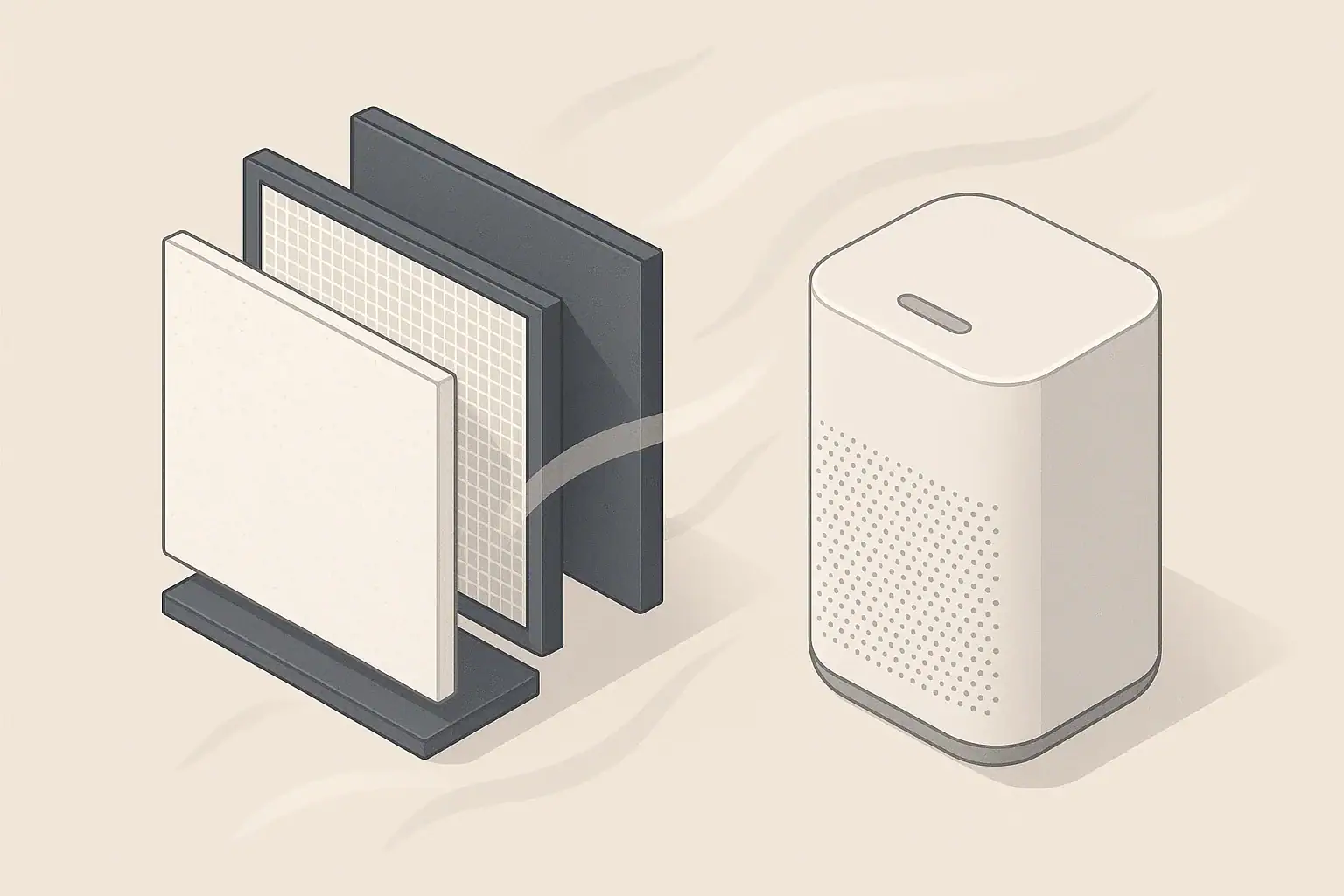
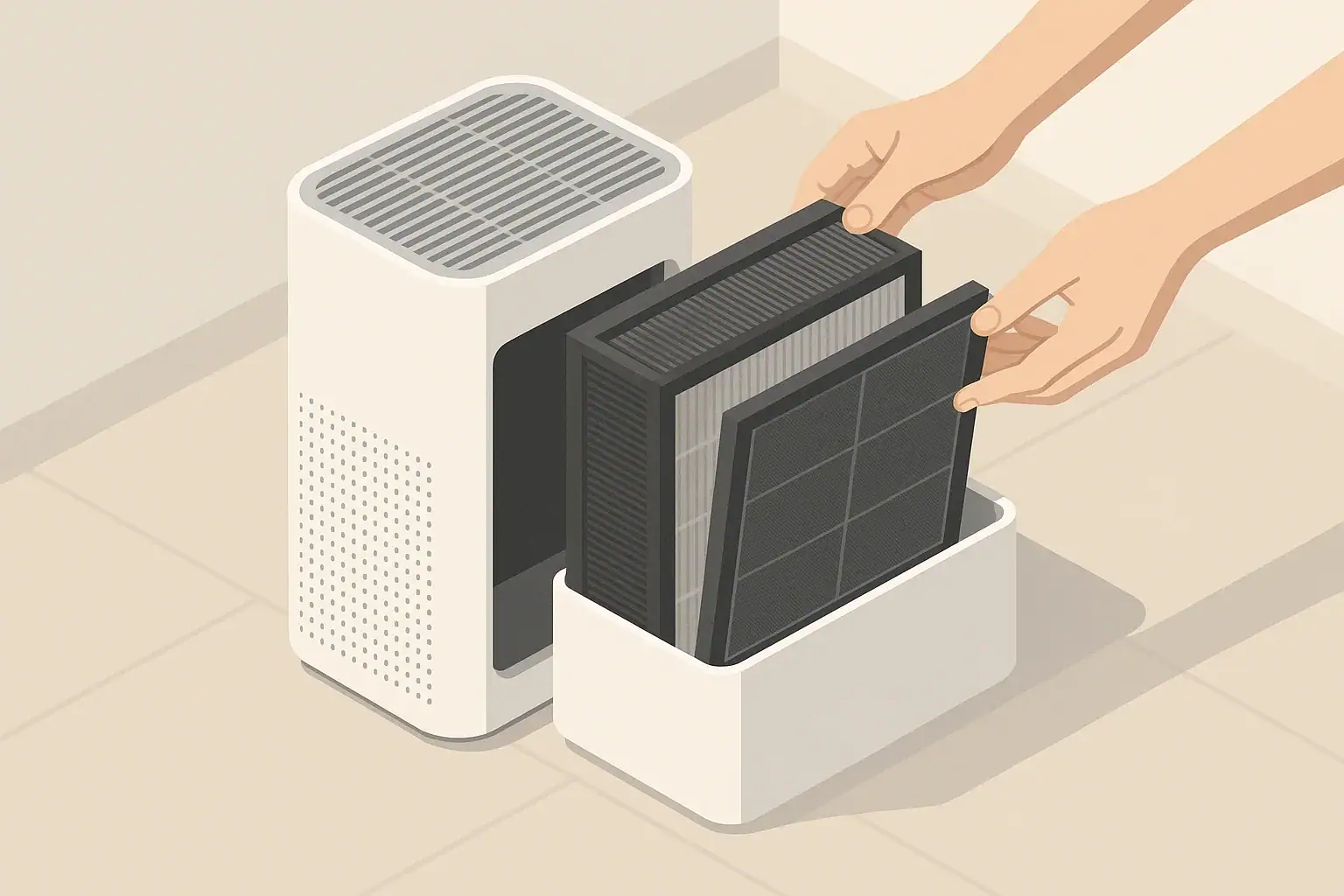
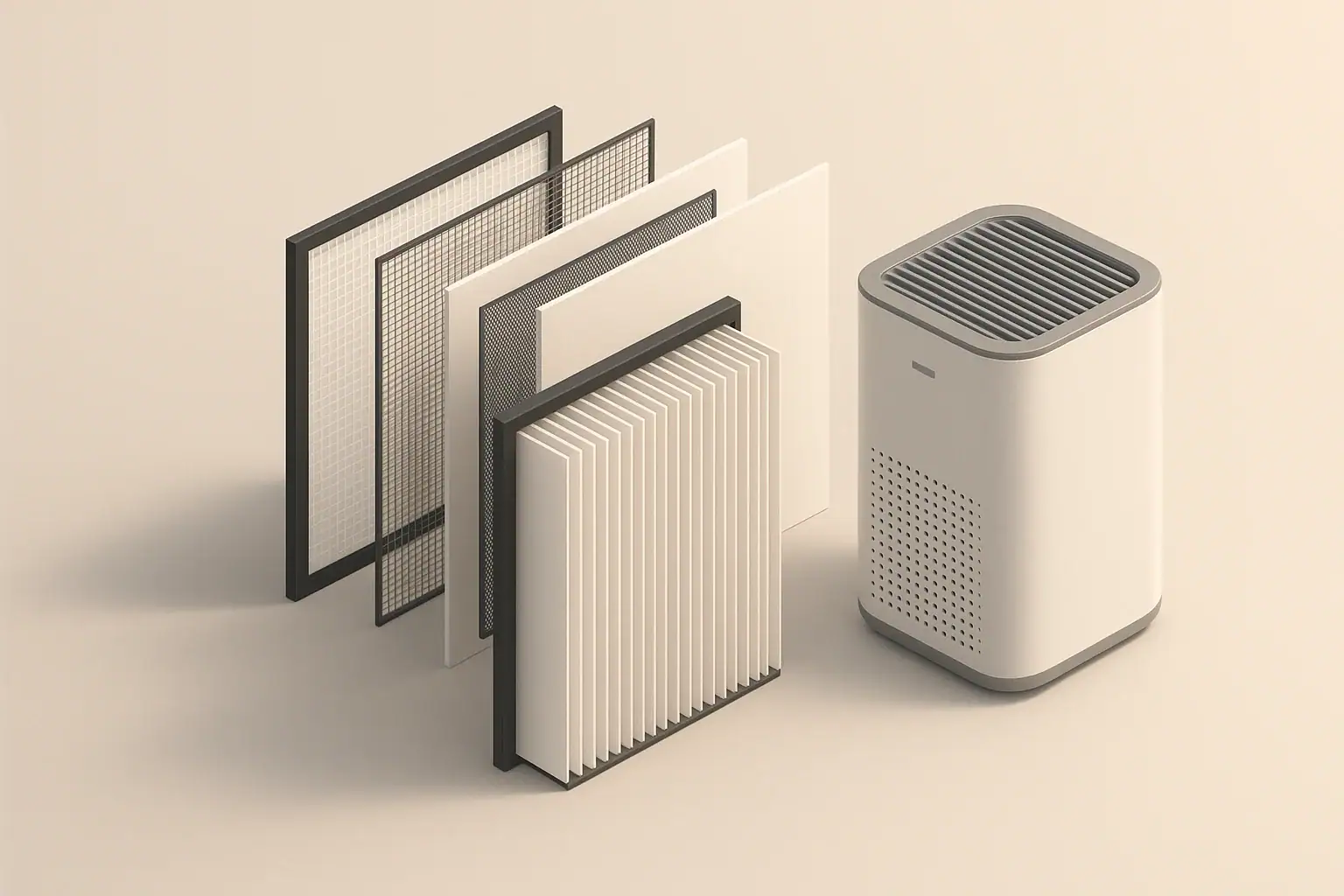
Layered pre-filter media beside a generic purifier

Washable pre-filters usually cost less over time but require regular cleaning, while disposable pre-filters are simpler to replace and may be more consistent when changed on schedule; either type can reduce airflow if it becomes loaded or is installed incorrectly. A pre-filter is the first layer that catches larger lint, hair, pet fur, and visible dust before air reaches a HEPA or carbon filter. The better choice depends on your dust load, tolerance for cleaning, replacement budget, and whether the purifier or HVAC unit is designed for that filter type.

What Pre-Filters Do in Home Air Cleaning

A pre-filter is a coarse first-stage filter. In a portable air purifier, it usually sits before the HEPA-grade particle filter and, when present, before activated carbon. In an HVAC return, a filter may act as the main system filter rather than a separate pre-filter, but the basic job is similar: capture larger debris before it reaches more sensitive parts.

Pre-filters are not usually the layer responsible for capturing the smallest particles. Fine particle performance depends more on the main particle filter, the seal around the filter, fan airflow, room size, and run time. Still, the pre-filter matters because a clogged first layer can restrict the entire system.

For home indoor air quality, pre-filters are most useful for practical maintenance. They can reduce how quickly hair and lint build up on the main filter surface. That may help keep airflow steadier between main filter changes, especially in homes with pets, carpets, fabric furniture, or frequent window opening.

Washable vs Disposable Pre-Filters: Main Tradeoffs

The core difference is maintenance style. A washable pre-filter is cleaned and reused. A disposable pre-filter is removed and replaced. Both can work well when they are the correct size, installed in the right orientation, and maintained before they become heavily loaded.

Washable pre-filters often appeal to households that want fewer recurring purchases and do not mind rinsing, vacuuming, or drying a filter panel. Disposable pre-filters appeal to households that want predictable replacement and less mess. Neither option is automatically better for airflow; the cleaner, correctly fitted filter is usually the better-performing one in day-to-day use.

Airflow depends on resistance across all filter layers. A thicker or denser pre-filter may capture more visible debris, but it can also add resistance if the purifier was not designed for it. Avoid adding extra filter material or substituting a different type unless the appliance instructions allow it.

Comparison of washable and disposable pre-filter considerations. Example values for illustration.
Washable vs disposable pre-filter comparison
FactorWashable pre-filterDisposable pre-filter
Routine taskVacuum, rinse, or wash if approvedRemove and replace
Typical attention neededEvery 2 to 4 weeks for inspectionEvery 1 to 3 months for replacement checks
Upfront costOften included with the unitMay require multi-packs or cut-to-fit sheets
Ongoing costLower material cost, more timeHigher material cost, less cleaning effort
Airflow riskCan restrict airflow if dirty, wet, warped, or reinstalled poorlyCan restrict airflow if overdue, too dense, or incorrectly sized
Mess factorDust can be stirred up during cleaningDust is contained if removed carefully
Best fitPeople comfortable with regular upkeepPeople who prefer scheduled replacement

How Airflow Changes When a Pre-Filter Gets Dirty

Air purifiers and HVAC blowers move air through resistance. As dust, lint, and hair collect on a pre-filter, that resistance can increase. The system may still run, but the amount of air moving through the filter path can drop.

Reduced airflow matters because clean air delivery depends on both filtration and the volume of air moved. A very efficient filter with weak airflow may not mix and recirculate room air as effectively as expected. In a room purifier, this may show up as less noticeable air movement at the outlet or slower particle readings after cooking, cleaning, or smoke intrusion events.

During heavy pollution periods, smoke events can load a pre-filter faster than normal, so it is worth checking the intake more often than you would in a low-dust season.

Common airflow warning signs

  • The outlet airflow feels weaker than normal at the same fan setting.
  • The fan sounds strained, louder, or higher pitched.
  • Dust is visibly matted on the intake side.
  • The filter does not sit flat, leaving gaps or bypass paths.
  • The purifier indicates maintenance sooner than expected.

Do not assume higher fan noise means better cleaning. It can also mean the fan is working against a loaded filter. When in doubt, turn the unit off, inspect the pre-filter, and follow the cleaning or replacement instructions.

Maintenance Checklist for Washable and Disposable Pre-Filters

A simple maintenance routine is usually enough. The goal is not to keep the filter looking new; it is to prevent heavy loading, poor fit, odors from damp material, and airflow restriction.

For washable pre-filters

  • Check the intake side every 2 to 4 weeks in normal use.
  • Vacuum loose dust gently if the material allows it.
  • Rinse or wash only when the instructions say the filter is washable.
  • Use mild cleaning methods and avoid harsh chemicals unless specified.
  • Let the filter dry completely before reinstalling; overnight may not always be enough in humid conditions.
  • Replace the pre-filter if it is torn, stretched, warped, or no longer seals properly.

For disposable pre-filters

  • Keep a simple calendar reminder for inspection and replacement.
  • Replace sooner if the pre-filter is visibly clogged or airflow drops.
  • Use the correct dimensions and thickness for the appliance.
  • Do not stack extra layers unless the manufacturer allows it.
  • Seal the used filter in a bag before disposal if it is dusty.

For either type, turn the appliance off before removing filters. Reinstall filters in the intended order, with the intake-facing side oriented correctly when the filter has a direction.

Cost Planning: Time, Replacement Packs, and Main Filter Life

The cost comparison is not only the price of the pre-filter. It also includes cleaning time, replacement frequency, shipping or store trips, and whether poor maintenance causes the main filter to load faster.

A washable pre-filter may have a lower material cost over several years. However, it requires a place to clean it, time to dry it, and enough consistency to prevent clogging. If it is reinstalled damp, it can create odor issues and may affect nearby filter media.

A disposable pre-filter has a clearer material cost. If a package costs a modest amount and lasts several months, the annual expense is easy to estimate. The tradeoff is that skipping replacements can reduce airflow and may allow larger debris to reach the main filter surface.

A simple cost estimate

For disposable pre-filters, multiply the replacement cost by the number of changes per year. For example, a pre-filter changed every two months requires about six replacements per year. For washable pre-filters, estimate the time spent cleaning and drying, plus occasional replacement if the material wears out.

Main filters should be considered separately. A clean pre-filter can help keep lint off the main filter, but it does not make the main filter permanent. HEPA-grade and carbon filters still need replacement based on use, loading, odor saturation, and manufacturer guidance.

Real-World Examples: Which Option Fits Different Homes

Different homes place different demands on pre-filters. The best choice is often the one that the household will maintain consistently.

Pet household with visible hair

A washable pre-filter can be convenient if hair builds up quickly and the owner is willing to vacuum or rinse it often. The key is frequent attention. A disposable option can also work, but replacement intervals may be shorter than in a low-dust home.

Apartment with limited cleaning space

A disposable pre-filter may be simpler where there is no utility sink, outdoor area, or good drying space. It reduces the chance of reinstalling a damp washable filter and can make maintenance less messy.

Bedroom purifier used at night

Airflow and noise are both important in bedrooms. A clogged pre-filter may make the fan sound more noticeable. Inspecting the pre-filter before increasing fan speed can help maintain airflow without unnecessary noise.

Home near seasonal smoke or outdoor dust

During periods with more outdoor particles, either type may load faster. A practical approach is to check the pre-filter weekly during high-use periods, then return to a longer interval when conditions are calmer.

Safety, Compatibility, and Standards Considerations

Pre-filters are mechanical components. They do not intentionally generate ozone, and they should not require any chemical treatment to work. If a device also includes ionization, UV-C, or other electronic features, review those features separately and use them only as directed.

Compatibility matters. A pre-filter that looks similar may not fit correctly, may be too dense, or may interfere with the designed airflow path. Gaps around the edge can allow bypass, where air goes around the filter instead of through it. A filter that is too restrictive can reduce clean air delivery and may strain the appliance.

Do not wash a HEPA filter, carbon filter, or combined filter unless the instructions specifically say it is washable. Many fine filters are damaged by water, and wet carbon can be messy or ineffective for odor adsorption until fully dry if it is designed to be reused at all.

For HVAC systems, use filters that match the system design and avoid increasing filter resistance beyond what the system can handle. If airflow problems occur across multiple rooms, a qualified HVAC professional can evaluate the system without guessing or modifying safety controls.

General maintenance intervals for common home air filter layers. Example values for illustration.
Filter maintenance and replacement planner
Filter layerTypical interval rangeWhat changes itReminder
Washable pre-filterInspect every 2 to 4 weeksPets, lint, open windows, heavy dustDry completely before reinstalling
Disposable pre-filterReplace about every 1 to 3 monthsVisible loading, reduced airflow, high useUse the correct size and thickness
Foam or mesh pre-filterClean about monthlyHair, fabric dust, kitchen proximityReplace if stretched or crumbling
Main particle filterOften 6 to 12 monthsRuntime, room dust, smoke eventsFollow the device indicator or manual
Activated carbon layerOften 3 to 6 monthsOdors, cooking, VOC sourcesParticle pre-filters do not refresh carbon
HVAC return filterOften 1 to 3 monthsSystem use, filter depth, household dustCheck airflow and fit at the return
Stored spare filtersCheck before useMoisture, packaging damage, ageKeep sealed in a dry location

Related guides: Do You Need a Pre-Filter? Extending HEPA Life and Reducing CostsAir Purifier Maintenance Checklist: Filters, Sensors, and CleaningHow Often Should You Replace a HEPA Filter?

Frequently asked questions

Which lasts longer: washable or disposable pre-filters?

Washable pre-filters usually last longer in terms of the filter media itself because they are reused after cleaning. Disposable pre-filters are replaced more often, so their lifespan is shorter by design. The better option depends on whether you want to trade cleaning time for lower ongoing material cost.

Do washable pre-filters reduce airflow more than disposable ones?

Not necessarily. Airflow depends more on how loaded, wet, dirty, or poorly fitted the filter is than on whether it is washable or disposable. A clean, correct-fit pre-filter of either type should generally support better airflow than an overdue one.

How often should I clean or replace a pre-filter?

Many washable pre-filters should be inspected every 2 to 4 weeks, while disposable pre-filters are often checked and replaced about every 1 to 3 months. Homes with pets, heavy lint, smoke, or open windows may need shorter intervals. Always follow the appliance manual if it gives a specific schedule.

Can I use a washable pre-filter in a device made for disposable ones?

Only if the manufacturer says it is compatible. A filter that fits physically may still be too dense, too thin, or shaped in a way that causes bypass or airflow problems. Using an unapproved filter can reduce performance and may affect the appliance warranty or safety guidance.

What happens if a pre-filter gets too dirty?

A loaded pre-filter can reduce airflow, make the fan sound strained, and allow less air to pass through the rest of the filtration system. Over time, that can also make the main filter load faster. Cleaning or replacing the pre-filter usually helps restore normal performance.

Are disposable pre-filters better for hygiene than washable ones?

Disposable pre-filters can be less messy because the dust stays contained during removal and disposal. Washable pre-filters can still be sanitary if they are cleaned properly and dried completely before reuse. The more important factor is consistent maintenance, not the material alone.

Summary: Practical Takeaways

Washable and disposable pre-filters can both support good airflow and easier maintenance when they are used as intended. Washable pre-filters reduce recurring material cost but require consistent cleaning and complete drying. Disposable pre-filters are easier to schedule and replace, but they create an ongoing supply cost.

The most important airflow rule is simple: keep the pre-filter clean enough that the fan can move air freely, and keep it fitted well enough that air does not bypass the filter. Inspect every few weeks, shorten the interval when dust or pet hair increases, and avoid adding unapproved layers.

If you prefer lower waste and do not mind upkeep, a washable pre-filter may fit your routine. If you prefer predictable, low-mess maintenance, disposable pre-filters may be the better practical choice. In either case, the main filter, carbon layer, room size, fan setting, and placement still matter for overall indoor air quality performance.

HEPA Filter Direction and Sealing Explained Clearly

Layered HEPA filter beside a generic purifier

Air bypass reduces HEPA performance because some air travels around the filter instead of through the dense filter media, so fewer particles are captured per pass.

HEPA filter direction and sealing are simple details, but they affect how well a purifier or filter cabinet works as a whole system. The filter media may be efficient, but the installed fit determines how much room air actually uses that media.

Quick answer
  • Install the filter with the airflow arrow pointing in the direction air moves through the unit, usually toward the fan or blower.
  • A good seal means no obvious gaps, rocking, bent frame edges, or loose access panels around the filter.
  • As general guidance, check filter fit at installation, after moving the unit, and during each filter change.
  • Expect replacement intervals to vary widely; many home HEPA filters fall around 6 to 12 months, depending on use and dust load.
  • Do not tape over vents, block intakes, or modify electrical appliances unless the manufacturer instructions specifically allow it.

What HEPA Filter Direction and Sealing Mean

HEPA filter direction refers to the orientation of the filter inside an air purifier, vacuum, or HVAC-style filter holder. Many filters have an airflow arrow on the frame. That arrow should point the same way the air moves through the device.

Sealing refers to how tightly the filter frame sits against the housing. A sealed fit encourages air to pass through the filter media, not around the edges. In portable air purifiers, this usually depends on the factory gasket, filter frame, access panel, and how the filter locks or slides into place.

HEPA media is designed to capture fine particles as air passes through it. However, the media rating is not the same as the installed performance of the whole appliance. A high-efficiency filter that is loose in its housing can underperform because part of the airflow takes the easier path around it.

Why Bypass Changes Real-World Performance

A HEPA filter creates resistance to airflow because the media is dense. If there is a gap around the filter, air follows the path of least resistance. Even a small edge gap can let some unfiltered air mix with the cleaned air coming out of the device.

For home use, performance is often discussed using CADR, or clean air delivery rate, and ACH, or air changes per hour. CADR is a system-level measure: it reflects fan airflow, filtration efficiency, and how the device is assembled and tested. ACH estimates how many times per hour the air in a room could be processed, based on clean air delivery and room volume.

A simple way to think about bypass is this: clean air delivery depends on both how much air moves and how well that air is filtered. If 100% of the air goes through a well-seated filter, the system can work as intended. If a meaningful portion slips around the filter, the effective clean air delivery rate drops even if the fan still sounds normal.

Filter direction matters because the frame, gasket, pleat support, and prefilter layers may be designed for one airflow direction. A reversed filter may not seat correctly, may expose the wrong surface first, or may create noise and leakage at the frame.

Common fit checks for HEPA filter direction and sealing. Example values for illustration.
HEPA filter direction and sealing checklist
CheckWhy it mattersPractical note
Airflow arrowAligns the filter with the intended air pathPoint the arrow toward the fan or blower side
Frame fitLimits edge gaps where air can bypassThe filter should sit flat without rocking
Gasket contactHelps seal the filter perimeterLook for even contact around all sides
Access panelCompletes the seal in many portable unitsClose panels fully before running the device
Prefilter positionCaptures larger dust before the HEPA mediaKeep washable or removable prefilters seated correctly
Filter damageBent frames and torn media can leakReplace damaged filters rather than reshaping them aggressively
Correct sizePrevents loose installationUse the size and style specified for the appliance

Common Mistakes That Create Air Bypass

Air bypass is not always obvious. A purifier may still turn on, move air, and sound normal while some air is not being filtered as intended. The most common causes are installation errors, filter wear, or a mismatch between the filter and the housing.

Installing the filter backward

Some filters can physically slide in either way, but that does not mean both orientations work the same. The airflow arrow, gasket side, pull tab position, and prefilter layer can all indicate the intended direction. If the filter does not sit flush when installed, check the orientation before forcing it.

Using a slightly wrong filter size

A filter that is close to the right size may seem acceptable, but even a small perimeter gap can reduce installed performance. In a portable purifier, a nonmatching filter may also interfere with the access panel or sensor pathway. In an HVAC filter slot, a loose filter can shift when the blower starts.

Running the unit with a loose door or panel

Many portable purifiers use the filter door as part of the air path. If the door is not fully latched, air can be drawn from unintended openings. A rattling or whistling sound after a filter change is a useful cue to recheck the panel and filter seating.

Letting dust prevent a good seal

Dust, pet hair, and lint can build up on filter tracks, grille edges, and gasket surfaces. This can keep the filter from sitting flat. A gentle cleaning during filter changes can help restore normal contact without modifying the appliance.

Practical Steps to Improve Filter Fit Without Guessing

The safest first step is to follow the appliance manual and use the specified filter format. HEPA purifiers are designed as complete systems, and the filter housing often has little tolerance for improvisation. Avoid adding thick foam, tape, or improvised seal material inside a device unless the instructions explicitly allow it.

Use this practical sequence when installing or replacing a filter:

  • Turn the unit off and unplug it before opening the filter compartment.
  • Remove packaging from the new filter, including any plastic wrap around the media.
  • Find the airflow arrow, pull tab, gasket, or prefilter side before inserting it.
  • Slide or place the filter without bending the frame.
  • Check that the filter sits evenly against its stop or gasket surface.
  • Close the access panel fully and confirm that latches or magnets engage normally.
  • Run the unit briefly and listen for new rattling, fluttering, or whistling.

For HVAC filter slots, the same principle applies: use the correct size and point the arrow toward the blower. If the filter slot has a cover, reinstall it properly. If you see major gaps, poor rack fit, or return-air leakage, consider asking a qualified HVAC professional rather than altering the system yourself.

Real-World Examples of Bypass and Direction Problems

Example scenarios can make the concept easier to apply. These are general situations, not product-specific performance claims.

Bedroom purifier after a filter change

A small bedroom purifier sounds louder than usual after a new filter is installed. The filter door closes, but one corner sticks out slightly. In this case, the filter may be reversed, not fully seated, or the packaging may not have been completely removed. Reopening the unit and checking direction, frame position, and panel closure is the right first step.

Open-plan living area with visible dust at the filter edge

A purifier in a larger living area collects dust mainly along one edge of the filter frame. Some edge dust is normal, but heavy streaking near a gap can suggest uneven airflow or poor gasket contact. Cleaning the track and checking for a warped frame can help identify whether the filter is sealing evenly.

HVAC return filter that shifts when the blower starts

A return grille filter or filter cabinet may pull the filter toward one side when the blower turns on. If the filter is undersized or the grille does not close tightly, air may slip around it. The practical fix is usually correct sizing or proper rack repair, not stacking extra filters or blocking the return.

Safety and Standards Considerations

HEPA describes high-efficiency particle filtration, but standards and labels can vary by product category and market. In consumer air purifiers, terms such as True HEPA, H13, or H14 are often used to describe filter media performance. The installed device still depends on airflow design, housing seal, and filter maintenance.

Be cautious when comparing only filter labels. A very dense filter media can also increase resistance, and the fan must be able to move air through it. A filter that does not match the device may reduce airflow, create noise, or leave gaps that defeat the purpose of the upgrade.

Some air-cleaning devices include ionizers, UV-C lamps, or other add-on technologies. These features should be evaluated separately from HEPA filtration. For general home use, many people prefer mechanical filtration that does not intentionally generate ozone. Do not disable safety switches, expose UV-C lamps, or modify appliances to change how they operate.

For homes with combustion appliances, avoid blocking air intakes, returns, or vents. Airflow changes can affect comfort and equipment operation. When in doubt, use the filter type specified for the equipment and consult a qualified professional for duct or cabinet issues.

Maintenance and Replacement Planning

Good sealing is not a one-time task. Filters load with dust over time, gaskets compress, and removable panels can loosen if they are opened frequently. Regular, light maintenance helps the purifier keep working as designed.

Typical replacement timing depends on filter area, fan speed, dust levels, smoke exposure, pets, renovation dust, and hours of use. Many home HEPA filters are replaced somewhere around 6 to 12 months, but the appliance indicator or manual should take priority. Washable prefilters, if provided, often need more frequent attention because they catch larger lint and hair before the HEPA layer.

Do not wash a HEPA filter unless the instructions clearly say it is washable. Many HEPA filters are made from materials that can be damaged by water, brushing, or compressed air. Damaged media, bent frames, or collapsed pleats can create new leakage paths.

General filter replacement planning for home air purifiers. Example values for illustration.
Filter replacement planner
Filter typeTypical interval rangeWhat changes itReminder
Washable prefilterEvery 2 to 4 weeksPets, lint, visible dustDry fully before reinstalling
Disposable prefilter1 to 3 monthsDust load and runtimeReplace if clogged or torn
HEPA filter6 to 12 monthsFan speed, room dust, smoke eventsUse the appliance indicator or manual
Carbon filter layer3 to 6 monthsOdors, cooking, VOC sourcesParticle capture and odor capture are different
HVAC pleated filter1 to 3 monthsSystem runtime and household dustUse the specified size and airflow direction
Gasket or seal surfaceCheck at each changeCompression, dust, handlingLook for gaps, cracking, or uneven contact

Related guides: HEPA Filter Bypass Leakage: Why Seals Matter as Much as the FilterHow Often Should You Replace a HEPA Filter?Air Purifier Maintenance Checklist: Filters, Sensors, and Cleaning

Frequently asked questions

Which way should the HEPA filter arrow point?

The airflow arrow should point in the direction the air moves through the device, usually toward the fan or blower. If you are unsure, check the appliance manual or follow the airflow path from the intake side to the discharge side.

What happens if a HEPA filter is installed backward?

A backward installation can prevent the filter from seating correctly and may increase leakage around the frame. In some units, it can also reduce airflow or create noise because the filter was designed for one direction of flow.

How can I tell if my HEPA filter is sealed well?

A well-sealed filter sits flat, does not rock, and has even contact around the perimeter. After the panel is closed, there should be no obvious gaps, loose edges, or air whistling from the housing.

Does a small gap around a HEPA filter matter?

Yes, even a small gap can let some air bypass the filter media. That reduces the amount of room air that is actually cleaned, which can lower real-world performance even if the fan still runs normally.

How often should I check HEPA filter fit and sealing?

Check the fit when you install a new filter, after moving the unit, and during each filter change. It is also worth rechecking any time the device becomes noisier, rattles, or starts to show dust streaks around the frame.

Summary: Key Takeaways on HEPA Bypass

HEPA filter media can only capture particles from air that passes through it. Direction and sealing matter because they help route airflow through the intended filter path instead of around the edges.

For most homes, the practical approach is straightforward: use the correct filter, follow the airflow arrow, close panels fully, and check for gaps or damage during each replacement. If a device becomes unusually noisy, shows dust streaks around the frame, or no longer closes correctly, recheck the installation before assuming the filter itself is the problem.

Air bypass is a performance issue, not a reason for alarm. Careful fit, routine cleaning, and manufacturer-approved replacement parts are usually enough to keep a purifier or filter cabinet operating as intended.

Air Purifier for Laundry Rooms Lint VOCs and Humidity Explained

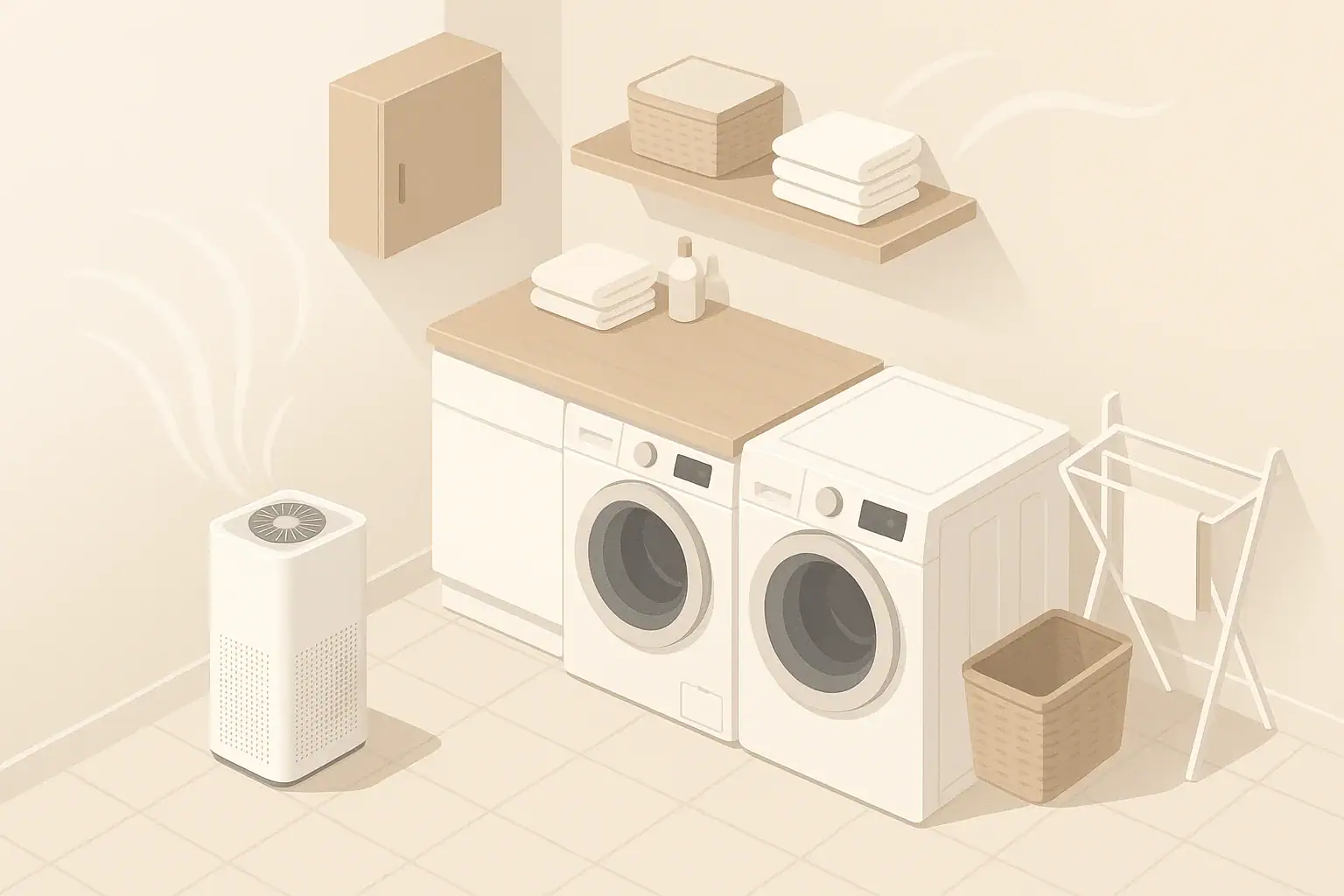
Generic purifier in a tidy laundry room

An air purifier can help in a laundry room by capturing airborne lint and fine particles, while activated carbon can reduce some fragrance odors and VOCs; it does not control humidity.

Laundry rooms combine several indoor air quality issues in a small space: fabric lint, detergent fragrance, dryer heat, and occasional dampness. A purifier can be useful, but it works best as one part of a plan that also includes ventilation, source control, and moisture management.

Quick answer

  • For lint and dust, choose a sealed purifier with a true HEPA or high-efficiency particle filter and a washable or replaceable prefilter.
  • For fragrance odors and some VOCs, look for a substantial activated carbon filter; HEPA alone does not remove gases.
  • For sizing, a general target is about 4 to 6 air changes per hour for routine particle control in a closed laundry room.
  • Keep indoor relative humidity generally around 30% to 50%; investigate or dehumidify if the room often stays above 60%.
  • Place the purifier with several inches of clearance, away from direct heat, water splashes, and the dryer exhaust outlet.

Why laundry room air is different

Laundry rooms are often smaller than bedrooms or living rooms, but they can have concentrated sources of particles, odors, and moisture. Dry towels, fleece, bedding, pet blankets, and cotton fabrics can shed lint. A dryer also moves large amounts of air, which can stir settled dust even when the appliance is working normally.

Fragranced detergents, scent boosters, dryer sheets, and fabric softeners can release odor compounds into the room. These may be noticed as a strong scent rather than measured as a specific pollutant. People vary in fragrance preferences and sensitivities, so the practical goal is usually comfort and odor management rather than a medical outcome.

Humidity is the third issue. Washing machines, utility sinks, damp laundry, and dryer heat can raise moisture levels. An air purifier filters air, but it does not remove water vapor. If the room is humid, a fan, exhaust, dehumidifier, or Ventilation vs Air Purifier: When You Need One, the Other, or Both may be needed.

How to size and choose filters for lint, VOCs, and humidity

Start with the room volume. Multiply floor area by ceiling height. A 100-square-foot laundry room with an 8-foot ceiling has about 800 cubic feet of air.

Clean air delivery rate, or CADR, is commonly expressed in cubic feet per minute. A simple planning formula is: room volume multiplied by target air changes per hour, divided by 60. Using the 800-cubic-foot example, a 5 ACH target would call for about 67 cfm of CADR for particles. This is only a planning estimate, and real performance depends on placement, filter condition, room layout, and fan speed.

Particle filters for lint

A HEPA-type particle filter is the main tool for airborne lint, dust, and fine particles. A prefilter is especially useful in a laundry room because larger lint can load the first layer quickly. A prefilter that can be vacuumed, rinsed if the manual allows, or replaced separately may reduce how fast the main filter clogs.

Carbon for fragrance VOCs and odors

Activated carbon is used for odors and some gases, including certain fragrance-related VOCs. The amount and design of the carbon matter. Thin carbon sheets may help with light odors, while larger carbon beds generally have more capacity. Carbon also saturates over time, so odor return can be a sign that replacement is due.

Humidity needs a separate control

A purifier does not lower relative humidity. If the laundry room often smells musty, has condensation, or stays above about 60% relative humidity, focus on moisture sources. Common steps include using exhaust ventilation, drying spills promptly, avoiding long-term storage of damp clothing, and considering a Dehumidifier for Laundry Rooms: Drying Faster Without Mold Smell where appropriate.

Decision matrix for laundry room air quality choices. Example values for illustration.
Laundry room issue and practical response
Issue noticedMost relevant toolWhy it mattersPractical note
Visible lint or dusty surfacesParticle filter with prefilterCaptures airborne fabric fibers and dustCheck the prefilter often during heavy laundry weeks
Strong detergent or dryer sheet scentActivated carbon plus source reductionCarbon can adsorb some odor compoundsUse less fragrance or fragrance-free products if scent is unwanted
Room feels damp after laundryVentilation or dehumidifierPurifiers do not remove water vaporTrack relative humidity with a basic hygrometer
Musty odor or condensationMoisture investigationDamp materials can support odor and surface growthLook for leaks, poor drying, or restricted airflow
Dryer exhaust smell or heat indoorsAppliance vent inspection by a qualified personExhaust should be directed safely outdoors where requiredDo not modify appliance safety systems
Small closet laundry areaCompact purifier and door-airflow planTight spaces can restrict purifier intakeLeave clearance around the unit and avoid blocking vents

Placement and airflow in a laundry room

Placement can make a small purifier perform noticeably better. Put the unit where air can circulate through the intake and outlet without being blocked by baskets, hanging clothes, doors, or appliances. Many purifiers need at least several inches of clearance, and some need more depending on intake location.

Avoid placing the purifier directly behind the dryer, next to a hot exhaust area, or under a shelf where warm air is trapped. Also keep it away from water splashes from a utility sink or washer hookups. Laundry rooms can be tight, so a side wall, open corner, or nearby hallway-facing position may work better than the floor space between machines.

If the laundry room door is usually closed, size for that smaller room. If the door stays open to a hallway or kitchen, the effective space is larger, and the same purifier may deliver fewer air changes per hour. In an open-plan area, a single small purifier may reduce local particles near the laundry area but is unlikely to manage the entire connected space at the same rate.

Common mistakes and troubleshooting cues

The most common mistake is expecting one device to solve all three issues: lint, fragrance VOCs, and humidity. Air Purifier vs Dehumidifier: Which One Solves Musty Air? is useful context here because air purifiers are strongest for airborne particles, can help with some odors when they include carbon, and do not dehumidify.

  • Odor returns quickly: The carbon filter may be saturated, the fan may be too low, or the odor source may be continuous.
  • Lint builds up fast on the grille: The prefilter may need more frequent cleaning, or the purifier may be too close to a lint source.
  • Room still feels damp: Check humidity, ventilation, damp laundry storage, and plumbing or appliance moisture issues.
  • Purifier gets noisy: Filters may be loaded, airflow may be blocked, or the unit may be undersized for the preferred lower fan setting.
  • Dust settles nearby: Airflow may be short-circuiting, meaning clean air exits and returns to the intake without mixing through the room.

A basic particle monitor can show whether PM2.5 rises during laundry activity, while a hygrometer can show humidity trends. TVOC readings from consumer monitors can be useful for observing changes, but they are broad indicators and should not be treated as precise chemical analysis.

Practical setup checklist

A calm setup begins with reducing the source load where practical. Cleaning the dryer lint screen before each load is an appliance maintenance step and can also reduce loose lint around the laundry area. Keep the floor and machine tops free of lint piles, and avoid storing damp towels or clothing in a closed room for long periods.

  • Measure the room and estimate volume before choosing a purifier size.
  • Use a particle filter for lint and dust, and carbon if fragrance odor is a concern.
  • Run the purifier on a higher setting during active laundry, then lower it after the room clears.
  • Keep baskets, curtains, and hanging garments away from purifier intake and outlet areas.
  • Ventilate when outdoor conditions and the room layout allow, especially during strong fragrance use.
  • Use a hygrometer and aim for a general indoor range near 30% to 50% relative humidity.
  • Address moisture problems directly instead of relying on filtration.

If you prefer very low scent indoors, product choice matters. Fragrance-free detergents and avoiding scent boosters can reduce the odor load before filtration is needed. This is often more effective than trying to remove strong fragrance after it has filled the room.

Real-world laundry room examples

Small enclosed laundry closet

A laundry closet may be only 30 to 60 square feet, but airflow is restricted. A compact purifier can work if it has open intake space and the door is not sealed so tightly that air cannot circulate. In this setup, prefilter maintenance is usually more important than very high CADR.

Utility room with a sink and storage

A larger utility room may have cleaning products, damp mops, pet supplies, and stored textiles. The purifier can help with particles and some odors, but it should not be placed next to chemicals or where splashes are likely. Good storage practices, closed containers, and moisture control reduce the load on the filter.

Basement laundry area

Basement laundry rooms often have cooler surfaces and higher humidity. In this case, a purifier may reduce dust and lint, but humidity control may be the main priority. A Basement Dehumidifier Guide: Targets, Drainage, and Energy Use, drainage plan, and routine humidity checks may be more important than adding more purifier capacity.

Safety, standards, and feature cautions

For a laundry room, prioritize mechanical filtration and adequate carbon over features that intentionally add reactive byproducts to the air. Avoid ozone generators in occupied indoor spaces. If a purifier includes ionization, plasma, or similar electronic features, look for the ability to turn them off and for clear low-ozone safety information from recognized testing programs.

UV-C features are sometimes included in air purifiers, but they are not a substitute for proper particle filtration, carbon capacity, or moisture control. Their effectiveness depends on exposure time, lamp output, and internal design. For most laundry room concerns, filter quality, fit, and airflow are more practical selection factors.

Electrical placement matters because laundry rooms may have water, heat, and vibration. Keep cords away from walkways, sinks, and moving appliances. Do not place a purifier where it could block access to shutoff valves, appliance doors, or service panels.

Maintenance and cost planning

Laundry rooms can load filters faster than cleaner living spaces because lint is a constant source. A visible prefilter is helpful because it shows when maintenance is needed. If airflow drops, the purifier becomes louder, or odors return, check the filters before assuming the unit is too small.

Plan for separate particle and carbon replacement if the purifier uses both. Particle filters may still look usable while carbon is already spent, especially in a heavily fragranced room. Conversely, a low-fragrance laundry room may load the particle filter with lint long before carbon capacity is a concern.

Cleaning around the purifier is part of maintenance. Vacuum or wipe the floor, baseboards, and appliance tops so settled lint does not become airborne again. Follow the appliance and purifier manuals for cleaning steps, and avoid spraying cleaners into the purifier intake.

Filter and upkeep planning for laundry rooms. Example values for illustration.
Typical maintenance intervals and reminders
ItemTypical interval rangeWhat changes itReminder
PrefilterEvery 2 to 4 weeksHeavy towel loads, pets, fleece, visible lintClean sooner if airflow drops
Main particle filterAbout 6 to 12 monthsRun time, fan speed, room dust, filter sizeUse the manual and visual condition together
Activated carbon filterAbout 3 to 6 monthsFragrance use, cleaning products, odor loadOdor return can signal reduced capacity
Outer grille and intakeMonthlyLint accumulation and tight placementVacuum gently with the unit unplugged
Room surfaces near machinesWeekly to monthlyLaundry volume and fabric typeRemove settled lint before it recirculates
Humidity checkSeveral times per week if dampness is suspectedBasement location, drying habits, ventilationInvestigate frequent readings above 60%

Related guides: Best Air Purifiers for Allergies: What to Look For (CADR, HEPA, Carbon)How to Choose the Right Air Purifier for Your Room SizeAir Purifier Placement: Where to Put It for Best Results

Frequently asked questions

Can an air purifier for laundry rooms remove lint from the air?

Yes. A sealed purifier with a true HEPA or similar high-efficiency particle filter can capture airborne lint, dust, and fabric fibers. A washable or replaceable prefilter is especially helpful because laundry-room lint can load filters quickly.

Will an air purifier get rid of detergent and dryer sheet odors?

It can help, but only if it includes enough activated carbon to adsorb odor compounds and some VOCs. Thin carbon layers may reduce light odors, while stronger or persistent fragrance often needs source reduction as well. HEPA filtration alone does not remove gases or odors well.

Does an air purifier lower humidity in a laundry room?

No. Air purifiers filter particles and sometimes gases, but they do not remove water vapor. If the room often feels damp or stays above about 60% relative humidity, use ventilation, leak repairs, better drying habits, or a dehumidifier.

How powerful should a laundry room purifier be?

A practical target is about 4 to 6 air changes per hour for routine particle control in a closed laundry room. To estimate this, multiply room volume by the target air changes and divide by 60 to get a rough CADR goal in cubic feet per minute. Door position, placement, and filter loading can change real-world performance.

Where is the best place to put a purifier in a laundry room?

Place it where air can move freely around the intake and outlet, with several inches of clearance on all sides. Keep it away from the dryer exhaust outlet, hot surfaces, and water splashes from the washer or sink. A side wall or open corner often works better than the narrow space between appliances.

What is the most common mistake people make with laundry-room air quality?

The biggest mistake is expecting one device to solve lint, odor, and humidity all at once. Filtration is good for particles, carbon helps with some odors, and moisture needs its own control strategy. Matching the tool to the problem usually gives better results and lower long-term cost.

Summary takeaways

An air purifier for laundry rooms is most useful for airborne lint and dust when it has a good particle filter, a well-fitting prefilter, and enough CADR for the room volume. Activated carbon can help with some fragrance odors and VOCs, but source control and ventilation are still important.

Humidity is a separate issue. If relative humidity often rises above about 60%, use moisture-control steps such as ventilation, drying practices, leak checks, or a dehumidifier rather than expecting filtration to solve dampness. The most reliable approach is to match the tool to the problem: HEPA-style filtration for particles, carbon for some gases and odors, and humidity control for moisture.

Air Purifier for Small Offices: What Matters Most

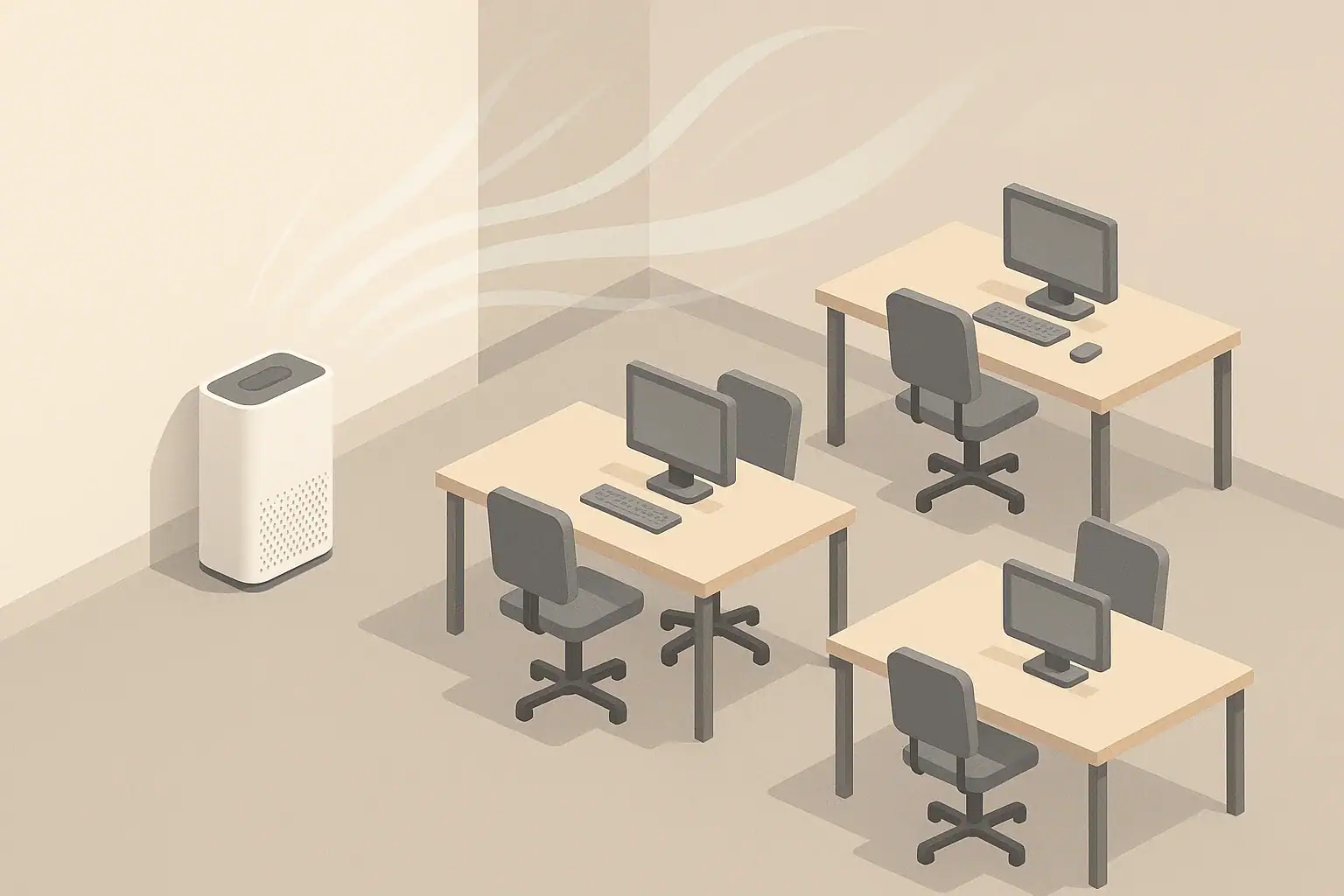
Generic air purifier in a tidy small office

An air purifier for a small office can reduce airborne dust and some odors when it is properly sized, uses the right filters, and is placed where shared air can circulate. It should be viewed as one part of an indoor air quality plan, not a replacement for cleaning, source control, or ventilation. The practical goal is steady air mixing, reasonable noise, and maintenance that staff can actually keep up with.

Quick answer

  • For many small offices, plan around roughly 3 to 5 air changes per hour as a general comfort-oriented target.
  • Use CADR, not just stated room size, to compare units; CADR in cfm equals room volume times target ACH divided by 60.
  • Choose a particulate filter for dust and fine particles, and meaningful activated carbon if odors are a frequent concern.
  • Place the purifier where air can enter and leave freely, usually at least 12 to 24 inches from walls or large furniture when possible.
  • An air purifier does not remove carbon dioxide from shared air; ventilation is still needed for CO2 and general freshness.

What an Air Purifier Can and Cannot Do in a Small Office

A small office often has a mix of particle sources, odor sources, and shared-air expectations. Dust can come from paper, carpet, clothing fibers, nearby roads, and normal foot traffic. Odors may come from food, cleaning products, furnishings, printers, or restrooms near the workspace.

A portable air purifier is mainly an air-cleaning device for recirculated indoor air. With a good particle filter, it can capture dust, pollen, lint, smoke particles, and other fine particles that pass through the unit. With a suitable activated carbon or other sorbent filter, it can help reduce some odor-causing gases, though odor results vary more than dust results.

What it cannot do is bring in outdoor air. That matters in offices because people exhale carbon dioxide, and CO2 is a useful indicator of ventilation adequacy. If the room feels stale during meetings, a purifier may help with particles, but ventilation or outdoor air exchange is the tool that addresses CO2 buildup. For a broader comparison, see ventilation vs air purifier.

How to Size an Air Purifier for Office Dust and Shared Air

The most useful sizing term is CADR, or clean air delivery rate. CADR is commonly expressed in cubic feet per minute and estimates how much filtered air a purifier delivers for a given particle category. Higher CADR generally means faster particle reduction in the same room, assuming good placement and reasonable filter condition.

Use ACH as the Planning Target

ACH means air changes per hour. For a portable purifier, this refers to equivalent clean air changes from filtered recirculated air, not outdoor ventilation. A common planning range for general small-office use is about 3 to 5 equivalent ACH, with higher targets sometimes preferred for dusty rooms or high-traffic shared spaces.

The simple formula is: required CADR in cfm equals room square footage times ceiling height times target ACH, divided by 60. For example, a 200 square foot office with an 8 foot ceiling has a volume of 1,600 cubic feet. At 4 ACH, the planning CADR would be about 107 cfm.

Match Filter Type to the Problem

For dust and fine particles, look for a well-sealed particulate filter, often described as HEPA or true HEPA. Labels such as H13 and H14 refer to high-efficiency filtration classes, but real-world performance also depends on airflow, filter fit, and leakage around the filter. If you are comparing labels, True HEPA vs HEPA-Type is worth a look.

For odors, activated carbon matters more than HEPA. Thin carbon sheets may help lightly, while deeper carbon beds or heavier sorbent filters are generally more relevant when odor control is a regular need. Even then, the best first step for odors is source control, such as removing old trash, improving food storage, or choosing low-odor products. For more detail, see Activated Carbon Filters Explained.

Table 1: Small office air quality choices by concern. Example values for illustration.

Decision matrix for purifier, ventilation, and source control
Office concernMost relevant actionWhy it mattersPractical note
Visible dust on desksParticle filtration plus cleaningFilters capture airborne dust, not settled dustVacuum and wipe surfaces regularly
Fine particles from nearby trafficHigher CADR particle filtrationMore clean air delivery can reduce particle levels fasterKeep windows closed during poor outdoor air periods
Food odorsSource control plus carbonOdors are gases and vapors, not just particlesEmpty trash and store food promptly
Stale meeting room airVentilation checkPurifiers do not remove CO2Use outdoor air or HVAC ventilation when available
Printer or product smellsSource separation and carbonMoving sources away lowers exposure in the work areaFollow equipment ventilation guidance
Damp or musty smellMoisture control firstFilters do not fix leaks or damp materialsInvestigate humidity and water sources

Dust, Odors, and Shared Air Expectations

Office air quality expectations are often social as much as technical. One person may notice lunch odors, another may focus on dust, and another may be bothered by fan noise. A good plan sets realistic expectations before the purifier is installed.

For dust, improvement is usually easiest to observe when the unit is appropriately sized and runs during occupied hours. However, a purifier will not stop all dust from settling because much of the larger dust in a room falls out of the air quickly. Cleaning routines, footwear habits, paper storage, and HVAC filter condition all affect results.

For odors, the outcome depends on the source and the amount of sorbent media in the purifier. Carbon becomes used up over time, and odors may return even when the particle filter still looks clean. Strong or persistent odors should be handled by removing or isolating the source rather than relying only on filtration.

For shared air, think in layers. Use ventilation to dilute indoor-generated gases, filtration to reduce airborne particles, cleaning to remove settled dust, and moisture control to avoid dampness-related issues. No single device handles every layer equally well.

Placement and Airflow Checklist for Small Offices

Placement can make a properly sized purifier work better or worse. The unit needs access to room air, and people need to tolerate its sound. In a small office, the best location is often visible, central enough for airflow, and out of the main walking path.

  • Keep the air intake and outlet unblocked.
  • Avoid squeezing the unit tightly under a desk or behind a cabinet.
  • Leave at least 12 to 24 inches of clearance when the layout allows.
  • Point the clean-air outlet toward the room, not directly into a wall.
  • Do not place the purifier where papers can be pulled against the intake.
  • Run it continuously during occupied periods instead of only after odors appear.
  • Use a moderate fan speed if the high setting is too distracting for calls or focused work.

Open-plan offices may need more than one unit. A single purifier in a corner may not mix air evenly across cubicles, partitions, or conference areas. Several smaller units can sometimes provide better distribution than one large unit, especially when airflow paths are blocked by furniture.

Small Office Scenarios and Practical Sizing Examples

Consider a two-person office of 120 square feet with an 8 foot ceiling. The room volume is about 960 cubic feet. At 4 ACH, the planning CADR is about 64 cfm, which is relatively modest, but noise and placement still matter. If you need a sharper rule of thumb, a Room Size Calculator for Air Purifiers can help translate room volume into CADR.

A 250 square foot shared office with several desks has a volume of about 2,000 cubic feet with an 8 foot ceiling. At 4 ACH, the planning CADR is about 133 cfm. If the room has partitions or a printer alcove, one purifier may not clean all areas evenly. In those cases, One Big Purifier vs Two Small Ones is a useful comparison.

A small conference room can be different from a daily office because occupancy changes quickly. Six people in a compact room can make the air feel stale even when particle levels are not high. In that case, filtration may help with particles, but ventilation scheduling, open-door periods, or HVAC outdoor air settings may be more important for comfort.

A reception area near an entrance may have more dust from foot traffic and outdoor air. A purifier can help capture airborne particles, but mats, regular vacuuming, and keeping outdoor debris from entering the workspace are also part of the solution.

Safety and Standards to Consider Before Buying

For routine office use, choose a purifier intended to clean air without intentionally producing ozone. Ozone can irritate materials and occupants and is not needed for standard particle filtration. Be cautious with devices that emphasize ozone generation as an air-cleaning method.

Ionizers and other electronic add-ons are common in some air cleaners. They may affect particle behavior, but performance and byproducts can vary by design. If an ionizer is optional, many offices prefer to keep it off unless there is a clear reason to use it and documentation that supports low emissions.

UV-C features are also sometimes included. UV-C effectiveness depends on exposure time, intensity, and design, and it should be fully enclosed so people are not exposed to the light. For most small offices, filter performance, airflow, noise, and maintenance are more important buying criteria than extra technologies.

Also look for practical safety basics: a stable base, a power cord that does not create a trip hazard, and a location away from water sources. Follow the manufacturer instructions for filter installation and do not modify the unit or bypass safety features.

Maintenance, Noise, and Operating Expectations

A purifier only works as expected when air can move through clean, properly seated filters. Offices often forget maintenance because no one clearly owns the task. Assigning responsibility prevents filters from staying in place long after they are loaded with dust or spent carbon. An air purifier maintenance checklist can make that routine easier to manage.

Particle filter replacement intervals vary with dust levels, runtime, and filter size. Carbon filters may need replacement sooner when odor sources are frequent. Washable prefilters, if included, should be cleaned according to instructions so they do not restrict airflow.

Noise planning matters in small offices. A purifier that is tolerable at high speed in a hallway may be distracting beside a desk. Many offices choose a unit large enough to run at a medium setting during calls and focused work, with a higher setting used after cleaning, during low-occupancy periods, or when outdoor particle levels are temporarily elevated.

Energy use is usually modest for a single small-office purifier, but continuous operation still adds cost. To estimate electricity use, multiply wattage by hours of operation, then convert to kilowatt-hours. The more important ownership cost is often filter replacement, especially if both HEPA-style and carbon filters are used.

Table 2: CADR planning examples for small offices. Example values for illustration.

Room size and CADR planning ideas
Room sizeCeiling height noteCADR planning ideaNotes
100 sq ft8 ft ceilingAbout 40 to 67 cfm for 3 to 5 ACHTypical private office or small enclosed room
150 sq ft8 ft ceilingAbout 60 to 100 cfm for 3 to 5 ACHConsider noise at desk distance
200 sq ft8 ft ceilingAbout 80 to 133 cfm for 3 to 5 ACHCommon shared office planning range
300 sq ft8 ft ceilingAbout 120 to 200 cfm for 3 to 5 ACHAir mixing and furniture layout matter more
400 sq ft8 ft ceilingAbout 160 to 267 cfm for 3 to 5 ACHMay need more than one unit for distribution
Any room with tall ceilingsUse actual heightIncrease CADR with room volumeSquare footage alone can understate the need

Related guides: How to Choose the Right Air Purifier for Your Room SizeAir Purifier Placement: Where to Put It for Best ResultsDo Air Purifiers Help With Smoke and Odors?

Frequently asked questions

How big should an air purifier for a small office be?

Size it by CADR and room volume rather than by the marketing room-size claim alone. A practical planning range for many small offices is about 3 to 5 equivalent air changes per hour. Higher CADR is usually better if the room is dusty, crowded, or has a layout that blocks airflow.

Will an air purifier remove stale air or carbon dioxide from a small office?

No, a portable purifier does not remove carbon dioxide because it recirculates indoor air instead of bringing in outdoor air. It can help reduce particles and some odors, but ventilation is still needed for freshness and CO2 control. If a meeting room feels stuffy, improving outdoor air exchange is usually the right fix.

What filter is best for dust in a small office?

A well-sealed particle filter, often described as HEPA or true HEPA, is the most relevant choice for dust and fine airborne particles. The filter fit and overall airflow matter as much as the label. Settled dust still needs regular cleaning because a purifier mainly captures particles that are already suspended in the air.

Do I need activated carbon for office odors?

Activated carbon is the more useful feature when odors are part of the problem. Thin carbon layers may help only a little, while more carbon media is generally better for repeated odors from food, trash, or equipment. For strong or persistent odors, source control is still the first step.

Where should I place a purifier in a small office?

Place it where air can move freely, with the intake and outlet unobstructed. In many rooms, that means keeping it at least 12 to 24 inches from walls or large furniture when possible. Avoid hiding it under a desk or behind a cabinet, since that can reduce performance and increase noise annoyance.

Should a small office purifier run all day?

For occupied spaces, continuous operation is usually more effective than turning it on only after odors appear. Running it during work hours helps keep particle levels steadier and reduces the chance of short-term buildup. If noise or energy use is a concern, a medium setting is often a good compromise.

Summary: Practical Takeaways for Small Offices

An air purifier for small offices is most useful when it is sized by CADR, matched to the main concern, and placed for unobstructed airflow. Particle filtration is the key feature for dust and fine particles, while activated carbon is the more relevant feature for many odors.

Use ventilation for CO2 and stale shared air, cleaning for settled dust, and source control for persistent smells. Plan around realistic ACH targets, acceptable noise, and a simple filter replacement routine. The best small-office setup is usually not the most complicated one; it is the one that runs consistently, fits the room, and supports everyday comfort without overstating what a purifier can do.

Air Purifier for Basement Odor: What Works and Why

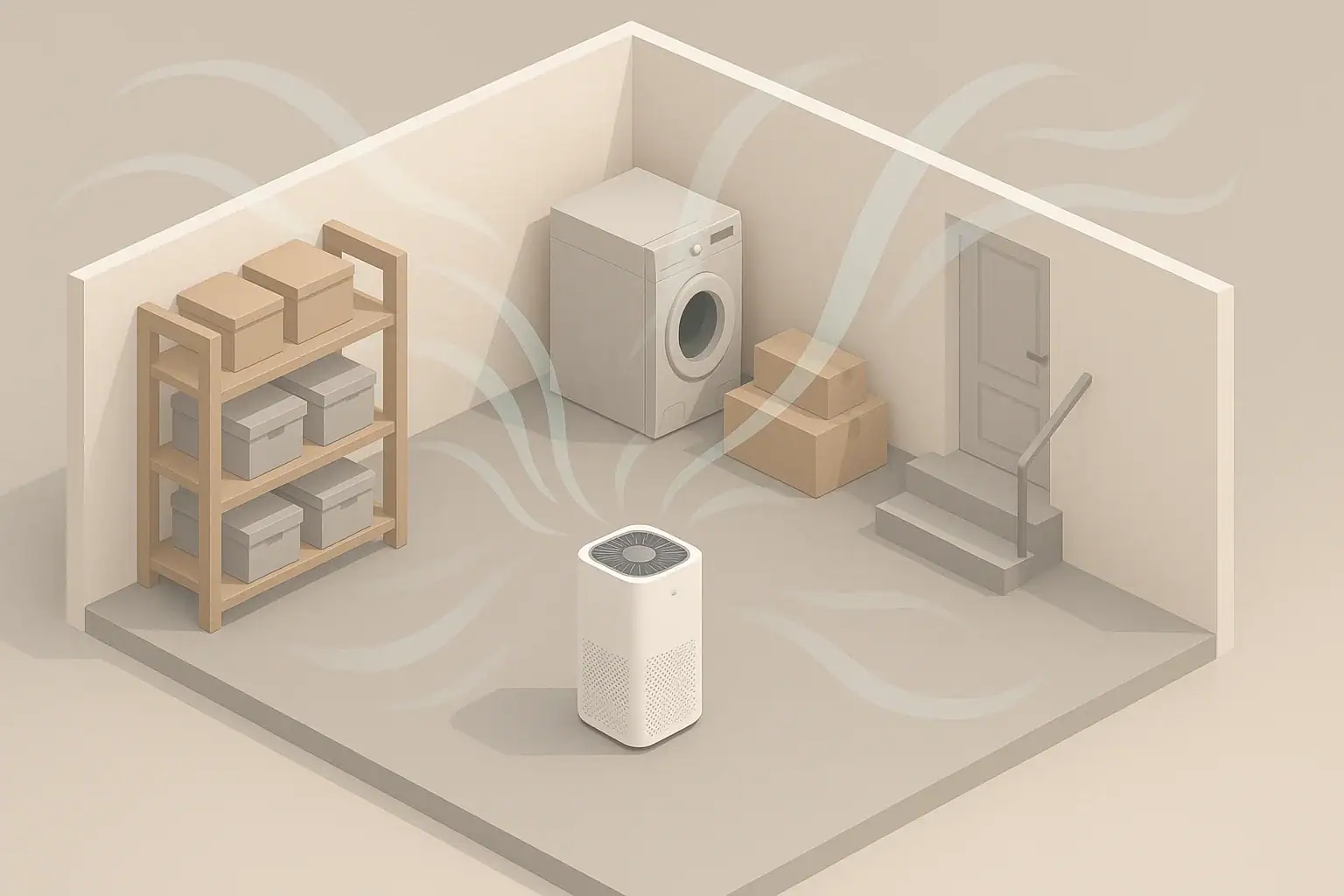
Generic basement air purifier with subtle airflow

An air purifier can reduce airborne musty particles and some basement odors when it has a well-sealed HEPA filter plus enough activated carbon, but it will not fix moisture or hidden odor sources by itself.

Basement odor usually comes from a mix of damp materials, settled dust, limited air exchange, stored items, floor drains, or unfinished surfaces. The most practical setup combines source control, humidity management, ventilation when conditions allow, and a suitably sized purifier.

Quick answer
  • Use a purifier with a true HEPA-style particle filter and a meaningful activated carbon stage for odor control.
  • Aim for about 4 to 5 air changes per hour for general basement air cleaning; more may be useful for heavy dust or open areas.
  • Keep basement relative humidity roughly in the 30% to 50% range when practical to reduce damp, musty conditions.
  • Place the purifier in open air, usually 6 to 12 inches or more from walls and furniture, with intake and outlet unobstructed.
  • If odor returns quickly when the purifier is off, look for a moisture, drain, storage, or ventilation source instead of only adding filtration.

Why Basement Odor Needs More Than One Fix

Basements often have cooler surfaces, less sunlight, lower airflow, and more contact with soil-facing walls or floors. Those conditions can make odors linger longer than they do upstairs.

A purifier helps with what is in the air. It can capture dust, lint, some mold fragments, pet dander, and other fine particles. A carbon filter can adsorb some odor-causing gases and vapors, depending on the amount of carbon, contact time, and how quickly the air passes through it.

However, a musty smell is a clue, not a diagnosis. If the odor comes from wet drywall, a damp carpet pad, stored cardboard, a dry plumbing trap, or water intrusion, filtration alone will only reduce what reaches the machine. The source still needs attention.

Sizing and Filter Setup for a Basement Air Purifier

The two most useful planning ideas are CADR and ACH. CADR, or clean air delivery rate, estimates how much filtered air a purifier can deliver per minute for a given particle type. ACH, or air changes per hour, describes how many times the room’s air volume is processed in one hour.

For a simple estimate, calculate room volume by multiplying length by width by ceiling height. Then choose a target ACH. A practical formula is: required CADR in cubic feet per minute equals room volume times target ACH, divided by 60.

For example, a 500-square-foot basement with an 8-foot ceiling has about 4,000 cubic feet of air. At 4 ACH, the planning target is about 267 cfm of clean air delivery. This is an estimate, not a guarantee, because real rooms have furniture, partitions, leakage, stairwells, and door openings.

Filter setup matters as much as size. A particle filter handles dust and fine particles. Activated carbon handles some odors. A thin deodorizing sheet may help a little, but basement odor control usually benefits from a deeper carbon bed or a larger carbon cartridge because more carbon provides more adsorption capacity.

Basement odor setup decision matrix. Example values for illustration.
What to prioritize by basement condition
Basement cueMost useful first stepWhy it matters
Musty smell after rainCheck moisture entry and humidityFiltration cannot stop a continuing damp source
Dust on shelves and floorsUse HEPA-style filtration and clean surfacesAir cleaning works better when settled dust is reduced
General stale airImprove air exchange when outdoor conditions are suitableVentilation can dilute indoor-generated odors
Odor from stored boxesRemove or seal odor-holding materialsCardboard and fabrics can hold moisture and smells
Occasional drain smellCheck plumbing traps and floor drainsSome odors are source problems, not filter problems
Persistent light odorRun purifier continuously with carbonSteady airflow gives filters more chances to capture and adsorb contaminants

HEPA, Carbon, and Musty Air: What Each Filter Does

Particle filtration

A true HEPA or HEPA-type filter is intended for airborne particles, not gases. In a basement, that can include dust, lint, fine debris, and particles disturbed by foot traffic, storage movement, laundry, or workshops.

Look for a design that seals the filter well inside the unit. Poor fit, gaps, or air bypass around the filter can reduce real-world performance even if the filter media itself is efficient.

Activated carbon

Activated carbon is the main purifier component for odor adsorption. It can help with some musty smells and household VOCs, but it has a limited capacity. Once the carbon is saturated, odor performance drops even if the particle filter still looks acceptable.

For basement odor, carbon quantity and airflow contact time matter. A heavier carbon filter generally has more capacity than a very thin carbon-coated pad, although replacement cost and airflow resistance may also be higher.

Common Mistakes When Using a Purifier for Basement Odor

One common mistake is buying only for square footage without checking ceiling height or layout. A large open basement, a finished room with doorways, and a storage area separated by shelving may all behave differently.

Another mistake is placing the purifier in a corner behind furniture. If intake air is blocked or clean air immediately hits a wall, the unit may clean a small pocket of air while the rest of the basement stays stale.

It is also easy to confuse odor masking with odor removal. Fragrances, sprays, and scented products can add more airborne compounds without addressing dampness, dust, or stale air. A neutral approach is to reduce sources, control humidity, and filter continuously.

  • If odor improves only while the unit runs on high, check whether the CADR is too low for the space.
  • If dust improves but smell remains, carbon capacity may be too small or the source may still be active.
  • If the smell is strongest near a drain, wall, carpet, or stored items, investigate that area before upsizing the purifier.
  • If the basement feels clammy, prioritize humidity control along with filtration.

Practical Basement Purifier Setup Checklist

Start by walking through the basement without turning on scented products or fans. Note where the odor is strongest, whether it changes after rain, and whether surfaces feel damp or dusty.

Placement basics

  • Set the purifier on a stable surface or floor location with open space around it.
  • Keep intake and outlet grilles clear of walls, curtains, boxes, and furniture.
  • Place it near the odor zone, but not directly against a wet wall or in a utility area where it may be exposed to water.
  • For a divided basement, consider whether one larger unit or two smaller units will provide better airflow coverage.

Operating routine

Continuous low or medium operation is often more useful than short bursts, because basements tend to have ongoing air mixing and odor sources. Use higher speeds after cleaning, moving storage, or opening dusty areas, then return to a tolerable daily setting.

If you also use a dehumidifier, give both appliances enough clearance. A purifier cleans air; a dehumidifier removes moisture. They solve different parts of the same basement comfort problem.

Real-World Basement Examples

Finished basement family room

A finished basement with carpet, furniture, and a TV area may need quiet operation as much as high airflow. In this case, size the purifier so it can reach the target ACH on a medium setting rather than only on its loudest setting. Choose a unit with both particle filtration and replaceable carbon.

Laundry and storage basement

Laundry areas can have lint, detergent scents, damp towels, and stored cardboard. A purifier can help with airborne particles and some odors, but source control is important. Store items in sealed plastic bins where appropriate, remove damp fabrics promptly, and avoid blocking airflow with stacked boxes.

Unfinished basement with seasonal dampness

An unfinished basement may have concrete surfaces, exposed framing, and variable humidity. The first priority is keeping the area dry and clean. A purifier can support general air cleaning, but a dehumidifier and basic moisture checks may make a larger difference in the musty character of the space.

Safety and Standards Considerations

Choose air cleaning approaches that do not intentionally generate ozone. Ozone can react with indoor materials and is not needed for routine basement odor control. If a purifier includes optional ionizing or similar features, review the documentation carefully and consider running the unit in a mechanical filtration mode when available.

UV-C features are sometimes included in air purifiers. They should be fully enclosed and used only as designed by the manufacturer. UV-C does not replace HEPA filtration, carbon adsorption, or humidity control.

Also consider practical safety. Do not place a purifier where it can be splashed, tipped over, or blocked by stored items. Keep cords out of walking paths and away from wet areas. Follow the appliance manual for clearances, filter installation, and replacement.

Maintenance, Humidity, and Monitoring

Basement purifier performance depends on upkeep. A clogged prefilter reduces airflow. A saturated carbon filter stops doing much for odor. A particle filter loaded with dust can make the fan work harder and may reduce clean air delivery. For routine care, see our air purifier maintenance checklist monthly and seasonal.

Check filters on a schedule, but adjust based on use. A basement workshop, pet area, laundry space, or renovation zone can load filters faster than a lightly used guest room.

A simple humidity monitor can be useful because musty odor often tracks damp conditions. General indoor comfort guidance commonly aims for about 30% to 50% relative humidity. If humidity frequently stays above that range, air cleaning alone is unlikely to solve the basement smell. A basement dampness RH targets dehumidifiers guide can help you compare options.

Air quality monitors can provide trend information, especially for PM2.5 or particle changes after cleaning and moving boxes. Treat TVOC readings as broad indicators rather than exact odor measurements. CO2 is more about ventilation and occupancy than basement mustiness, but it can show whether air exchange is limited in occupied finished spaces. If you want a broader overview, review indoor air quality monitors.

CADR planning examples for basement spaces. Example values for illustration.
Room size and clean air delivery planning
Basement areaCeiling noteCADR planning ideaNotes
150 square feet8 feet assumedAbout 80 cfm for 4 ACHUseful for a small finished room
250 square feet8 feet assumedAbout 135 cfm for 4 ACHConsider noise at daily fan speed
400 square feet8 feet assumedAbout 215 cfm for 4 ACHOpen layout helps distribution
600 square feet8 feet assumedAbout 320 cfm for 4 ACHTwo units may cover divided areas better
800 square feet8 feet assumedAbout 425 cfm for 4 ACHCheck stairs, doors, and partitions
Any sizeHigher ceilings increase volumeRecalculate using actual heightVolume matters more than floor area alone

Related guides: Air Purifier Placement: Where to Put It for Best ResultsHow to Choose the Right Air Purifier for Your Room SizeActivated Carbon Filters Explained: VOCs, Odors, and What They Can’t Do

Frequently asked questions

Can an air purifier remove basement odor completely?

An air purifier can reduce airborne musty particles and some odor-causing compounds, but it usually cannot remove basement odor completely if a moisture or source problem is still present. If the smell returns quickly when the unit is off, the basement likely has an ongoing source such as damp materials, drains, or poor ventilation.

What filter type works best for basement odor?

A sealed particle filter such as HEPA helps with dust and fine particles, while activated carbon is the main filter material for odor reduction. For basement odor, a purifier with a meaningful amount of carbon generally performs better than one with only a thin carbon layer.

How many air changes per hour should a basement purifier provide?

About 4 to 5 air changes per hour is a practical target for general basement air cleaning. Larger open basements, dusty storage areas, or spaces with stronger odor may benefit from more airflow, especially if the purifier will usually run on a lower setting.

Where should I place an air purifier in a basement?

Place the purifier in open air with clear space around the intake and outlet, usually several inches away from walls, furniture, and boxes. It should be close enough to affect the odor zone, but not so close to a wet wall, drain, or storage stack that airflow is blocked.

Will a dehumidifier or air purifier work better for musty basement smell?

They do different jobs, so neither one fully replaces the other. A dehumidifier addresses moisture, which is often the root cause of musty odor, while an air purifier helps clean the airborne particles and some gases associated with that smell.

How do I know if the basement odor is coming from the purifier not being strong enough?

If the air smells better only while the purifier is on high and the odor returns quickly at lower speeds, the unit may be undersized for the room. If smell is strongest in one area, though, it is more likely that there is a source problem in that location rather than a filtration problem alone.

Summary: A Practical Basement Odor Setup

The most useful air purifier for basement odor is not just a particle filter or just a deodorizing pad. It is a properly sized unit with good airflow, a sealed particle filter, and enough activated carbon to help with odors.

Use the purifier as part of a broader setup: keep humidity in a reasonable range, remove damp or odor-holding materials, clean settled dust, check drains and moisture-prone areas, and improve ventilation when outdoor conditions support it.

If the smell comes back quickly or stays strongest in one location, treat that as a source clue. Air cleaning can make basement air more comfortable, but the best results usually come from combining filtration with moisture control and simple source reduction.

Air Purifier for Fireplace Smell: What Works Indoors

Generic air purifier near a clean fireplace

An air purifier can reduce ash dust and smoky fireplace smell, but it works best on airborne particles and only helps odors when it has enough activated carbon.

Fireplace smell is usually a mix of fine smoke particles, settled ash, soot film, and gases from combustion residues. A purifier can be useful after a normal fire or a brief smoky event, but it cannot fix draft problems, remove carbon monoxide, or clean soot from surfaces.

Quick answer

  • For smoke particles and ash dust, look for a sealed HEPA-style particle filter and plan for about 4–6 air changes per hour in the main room as general guidance.
  • Estimate CADR with this rough formula: room cubic feet × target ACH ÷ 60. Higher targets may be useful during short cleanup periods.
  • For odor, activated carbon matters. Thin carbon sheets may reduce mild smells, while heavier carbon beds generally last longer for odor control.
  • Ventilate briefly when outdoor air is acceptable, then run the purifier on a higher setting until the room smells normal again.
  • If smoke spills into the room repeatedly, treat that as a fireplace draft or maintenance issue, not just an air purifier problem.

Why smoky fireplace smell lingers indoors

A smoky fireplace smell can remain after the fire is out because smoke does not behave like a single pollutant. It includes fine particles, larger ash dust, semi-volatile compounds, and odor-causing gases that can settle on walls, rugs, curtains, furniture, and the inside of the fireplace opening.

Fine smoke particles can stay suspended in air for a while, especially in a closed room. Larger ash dust tends to settle faster, then becomes airborne again when people walk, sweep, or move nearby objects. Odors may also reappear when the room warms up or when airflow pulls air from the firebox into the living space.

This is why an air purifier may make the room feel cleaner but still not fully remove the smell. Air cleaning handles what passes through the purifier. It does not scrub the brick, mantel, upholstery, carpet, damper area, or chimney liner.

What an air purifier can and cannot remove

For fireplace-related air quality, the two main filter functions are particle removal and gas adsorption. A HEPA-type particle filter captures airborne ash, soot, dust, and fine smoke particles. Activated carbon adsorbs some odor-causing gases and vapor-phase compounds. Both functions are useful, but they solve different parts of the problem.

HEPA filters for ash dust and smoke particles

A true HEPA-style filter is designed for very small particles. In practical home use, it can reduce airborne smoke particles and fine ash dust if the room air reaches the filter often enough. The purifier also needs a reasonably sealed filter path so air does not bypass the filter around loose edges.

H13 and H14 labels are sometimes used for higher-efficiency filters, but efficiency alone is not the whole story. Airflow matters. A very restrictive filter in a small unit may clean less air per minute than a well-sized unit with balanced airflow and filtration.

Activated carbon for smoky odor

Smell control depends on the amount and quality of carbon, contact time, and how much odor is being produced. A thin deodorizing prefilter may help with light background odor, but it can saturate quickly after a smoky fireplace event. A larger carbon section generally has more capacity, but even that is a consumable filter, not a permanent odor remover.

Odor also clings to surfaces. If soot or ash residue remains in the fireplace area, the purifier may reduce airborne smell but the room can continue to pick up odor from those surfaces.

What a purifier cannot do

  • It cannot remove carbon monoxide or make combustion problems safe.
  • It cannot correct a blocked flue, poor draft, negative house pressure, or improper fireplace operation.
  • It cannot remove settled soot from walls, fabrics, rugs, or the firebox.
  • It cannot replace source control, ventilation, and basic cleaning.
How air cleaning options relate to common fireplace smell causes. Example values for illustration.
Fireplace smoke issue and practical response
IssueWhat helps mostFilter roleImportant limit
Fine smoke particlesHEPA-style filtration plus adequate airflowCaptures airborne particles passing through the unitDoes not clean surfaces
Light ash dustCareful cleanup and particle filtrationReduces dust that becomes airborneSweeping can resuspend dust
Smoky odorActivated carbon and source cleanupAdsorbs some odor compoundsCarbon becomes saturated
Soot film on surfacesSurface cleaning with appropriate methodsLimited indirect helpAirflow cannot remove stuck residue
Repeated smoke spillDraft, flue, and ventilation troubleshootingMay reduce remaining particlesDoes not fix the cause
Combustion gasesProper fireplace operation and safety devicesNot a reliable controlPurifiers do not remove carbon monoxide

Sizing and placement for a smoky fireplace smell

Air purifier sizing is usually based on clean air delivery rate, often called CADR, and the room volume. For smoke cleanup, a practical target is often around 4–6 air changes per hour for the room where the smell is strongest. This is general planning guidance, not a guarantee of odor removal.

Use this simple estimate: multiply the room length, width, and ceiling height to get cubic feet. Then multiply by the target air changes per hour and divide by 60. For example, a 15 by 20 foot room with an 8 foot ceiling is 2,400 cubic feet. At 5 air changes per hour, the planning CADR is about 200 cubic feet per minute.

Open floor plans need extra care. If the living room, dining area, and kitchen are connected, size for the connected area or use more than one unit. A purifier in a corner of a large open space may clean the air near itself but leave stagnant zones elsewhere.

Placement tips

  • Place the purifier in the room where smoke smell is strongest, not hidden behind furniture.
  • Keep air intake and outlet areas clear by at least a foot or two when possible.
  • Avoid placing the purifier inside the fireplace alcove or where ash can directly fall into it.
  • Run the unit on a higher setting during and after a smoky event, then reduce speed for normal use.
  • If using two units, place them to support circulation across the room rather than side by side.

Noise matters because a purifier only works while it is running. A unit that is tolerable on medium speed often performs better in real life than one that is sized only for a loud maximum setting people rarely use.

Common mistakes and troubleshooting cues

The most common mistake is expecting a purifier to solve an active fireplace problem. If smoke regularly rolls into the room when starting a fire, opening the door, or when the furnace turns on, the cause may involve chimney draft, damper position, house pressure, or exhaust fans. In that case, air cleaning is secondary.

Another mistake is using particle filtration alone for an odor complaint. A particle filter can reduce smoke haze and ash dust, but odor molecules are much smaller than filter pores and need adsorption media such as activated carbon. Even then, carbon is limited by capacity.

Watch for these practical cues:

  • Smell improves, then returns: odor source may be in the firebox, chimney area, fabric, carpet, or settled dust.
  • Dust appears near the purifier quickly: ash may be getting resuspended during cleanup or from a leaky fireplace area.
  • Filter darkens faster than usual: the unit is capturing soot and smoke particles, which may shorten filter life.
  • Odor is strongest on damp days: humidity and chimney airflow can change how smells move indoors.
  • Smoke spills when exhaust fans run: the house may be under negative pressure and pulling air down the chimney.

Basic monitoring can help with particles, but it has limits. A PM2.5 monitor can show whether fine particle levels rise during a smoky event and fall after ventilation and filtration. A typical TVOC reading may respond to odors, cleaners, and many other vapors, so it should be treated as a trend indicator rather than a precise fireplace odor meter.

Practical cleanup checklist for ash dust and odors

Start with source control. Allow ashes to cool fully and follow fireplace safety guidance for ash handling. Avoid dry sweeping fine ash in a way that sends particles into the room. Gentle cleaning habits matter because resuspended ash can make the air purifier work harder.

After a normal fire

  • Make sure the fire is completely out and ashes are handled safely before cleaning.
  • Remove ash using appropriate fireplace tools and a suitable ash container.
  • Use a damp wipe on nearby hard surfaces if a light residue is present.
  • Vacuum rugs and upholstery with a well-filtered vacuum if soot or ash dust has settled.
  • Run the purifier in the room on a higher setting for several hours, then reassess odor.

For lingering smell

  • Check whether the damper is fully closed only after the fire is out and safe, and follow normal fireplace operation guidance.
  • Ventilate briefly when outdoor air quality and weather are reasonable.
  • Wash washable fabrics that absorbed smoke odor.
  • Replace or refresh carbon filters if odor reduction has noticeably weakened.
  • Consider whether the chimney, firebox, or hearth needs professional cleaning.

Humidity can influence comfort and odor perception. A common indoor comfort range is roughly 30–50 percent relative humidity. Very damp conditions can make many household odors seem more noticeable, while very dry air can make dust easier to stir up. A purifier is not a humidifier or dehumidifier, so humidity problems need separate tools.

Real-world fireplace smell scenarios

Scenario 1: One smoky startup

A brief smoky startup can leave a noticeable smell even after the fire burns normally. In this case, open a window briefly if outdoor air is acceptable, then run a properly sized purifier on high. A HEPA-style filter should help reduce particles, while carbon may reduce remaining odor. If the smell fades and does not return, this is usually a cleanup event rather than an ongoing air problem.

Scenario 2: Ash dust after cleaning

If the room smells dusty and gray residue appears after fireplace cleaning, the issue may be resuspended ash. Wet wiping nearby hard surfaces, careful vacuuming, and running the purifier can help. Check the prefilter sooner than usual because ash can load the first filter layer quickly.

Scenario 3: Odor returns when the fireplace is not in use

If a smoky smell appears on windy days, damp days, or when exhaust fans run, airflow may be moving through the chimney in the wrong direction. An air purifier can reduce what enters the room, but it cannot stop the pathway. This is a cue to check draft conditions, damper operation, and fireplace maintenance.

Scenario 4: Open-plan living area

In a connected living room and kitchen, one small purifier may not move enough air through the whole space. Use the full connected volume for CADR planning, or consider multiple units placed for better circulation. Odor control may still depend on carbon capacity and surface cleaning.

Safety, ozone, and filter maintenance limits

Fireplaces involve combustion, so safety comes before air cleaning. A purifier is not a carbon monoxide alarm and should not be treated as a protection device for combustion gases. Use properly installed alarms as recommended by local code and the alarm manufacturer, and have fireplaces and chimneys inspected or cleaned when needed by qualified professionals.

Be cautious with ozone-generating devices marketed for odor removal. Ozone should not be intentionally generated in occupied indoor spaces for routine home air cleaning. Ionizers and UV-C features may be presented as add-ons, but they are not substitutes for adequate particle filtration, carbon for odor, ventilation, and source control. If a device has optional ionization, review whether it can operate with that feature off.

Filter upkeep is especially important around smoke and ash. Smoke particles can darken filters, and activated carbon can reach odor capacity before the particle filter looks dirty. A filter that is overloaded, poorly seated, or surrounded by leakage will reduce real-world performance.

General maintenance ranges vary by use, but fireplace smoke usually counts as heavier service. Check filters more often during heating season, keep intake grilles clean, and avoid washing filters unless the product instructions specifically say they are washable. Many HEPA-style filters are not washable and can be damaged by water.

General filter upkeep planning for rooms with fireplace smoke exposure. Example values for illustration.
Filter replacement planner
Filter or partTypical interval rangeWhat may shorten itReminder
Pre-filter screenEvery 2–4 weeks to check or cleanAsh dust, pet hair, lintKeep airflow openings clear
Disposable prefilter1–3 monthsFrequent fires or visible dust loadingReplace if coated or clogged
HEPA-style particle filter6–12 monthsSmoke events, heavy dust, high fan useDo not wash unless allowed
Activated carbon filter3–6 monthsPersistent smoky odor or cooking odorsReplace when odor control weakens
Air intake grilleMonthly during fireplace seasonDusty rooms or nearby ash handlingVacuum or wipe gently
Room surfacesAs needed after smoke spillSoot film and settled ashCleaning reduces odor sources

Frequently asked questions

Will an air purifier remove the smoky smell from a fireplace?

It can reduce smoky smell, but results depend on the filter design and the size of the carbon layer. A HEPA-style filter removes airborne smoke particles, while activated carbon helps with odor compounds. If the smell is coming from soot on surfaces or from an ongoing draft problem, a purifier will only help partially.

What filter is best for fireplace smell?

For fireplace smell, a sealed particle filter and a meaningful amount of activated carbon are the most useful combination. The particle filter handles ash, soot, and smoke particles, while carbon helps with odor. Thin carbon sheets may help with mild smells, but heavier carbon beds usually perform better for lingering odor.

How long should I run the purifier after a smoky fire?

Run it on a higher setting for several hours after the fire, then keep it going until the room odor and visible haze have improved. The exact time depends on room size, airflow, and how much smoke entered the space. If the smell returns quickly, the issue may be a recurring source rather than leftover air pollution.

Can an air purifier fix smoke coming in from the fireplace?

No, it cannot fix the cause of smoke entering the room. Repeated smoke spill usually points to draft, damper, chimney, or house pressure issues. In that situation, the purifier may reduce lingering particles, but the fireplace system itself needs attention.

Do I need a HEPA purifier for ash dust?

A HEPA-style filter is a good choice for airborne ash dust because it captures fine particles effectively. The unit should also move enough air for the room size, or the cleanup will be slow. Avoid sweeping ash dry if you can, since that can put more dust back into the air.

Summary: what matters most

An air purifier for fireplace smell is most useful when it is sized for the room, has strong particle filtration, includes enough activated carbon for odor, and runs long enough for room air to circulate through it several times.

The main limit is source control. If smoke or odor keeps entering from the fireplace, chimney, or settled soot, the purifier will only manage part of the problem. Combine filtration with careful ash cleanup, brief ventilation when conditions allow, surface cleaning, and proper fireplace maintenance.

For practical planning, aim for about 4–6 air changes per hour in the affected room, place the purifier where airflow is unobstructed, check filters more often during fireplace season, and treat repeated smoke spill as a draft or safety issue rather than an odor problem alone.


Related guides: Do Air Purifiers Help With Smoke and Odors?Air Purifier Placement: Where to Put It for Best ResultsHow to Choose the Right Air Purifier for Your Room SizeActivated Carbon Filters Explained: VOCs, Odors, and What They Can’t Do

Essential Oil Diffusers and Indoor Air Quality Explained

Generic purifier in a calm tidy room

Essential oil diffusers can affect indoor air quality by adding fragrance chemicals, volatile organic compounds, and in some cases fine particles to the air.

For many households, occasional use with good ventilation is a comfort choice rather than a major air quality project. The practical question is not whether a scent is natural, but how much material is being added to the room, how long it remains, who shares the space, and how well the room is ventilated.

Quick answer
  • Use short sessions as a general starting point: about 15 to 60 minutes, then pause and let the room air out.
  • Keep indoor relative humidity roughly in the 30% to 50% range when possible, especially if using water-based ultrasonic diffusers often.
  • Ventilate during or after use, such as 5 to 15 minutes of window opening when outdoor air is acceptable, or steady mechanical ventilation if available.
  • Keep diffusers away from pet areas, food bowls, cages, litter boxes, and bedding; avoid use around birds unless a veterinarian has advised otherwise.
  • HEPA filtration can help with droplets and particles, while activated carbon and ventilation are more relevant for odors and VOCs.

What essential oil diffusers add to indoor air

Essential oil diffusers disperse a mixture of fragrance compounds into the room. These compounds are often plant-derived, but natural origin does not mean the air impact is zero. Once released, they become part of the indoor air mixture along with cooking emissions, cleaning product vapors, outdoor air pollutants, dust, and moisture.

Different diffusers release oils in different ways. Ultrasonic diffusers use water and vibration to create a mist. Nebulizing diffusers typically disperse undiluted oil as a fine aerosol. Evaporative and heat-based designs rely more on evaporation, though some particles or residues may still be produced depending on the design and use.

Indoor air quality depends on the balance between sources and removal. Sources include the diffuser, candles, cooking, cleaning sprays, furnishings, and outdoor air. Removal comes from ventilation, deposition on surfaces, filtration for particles, sorption by activated carbon for some gases, and ordinary air exchange.

Particles, VOCs, and scent chemistry basics

Particles from mist and oil droplets

Ultrasonic and nebulizing diffusers can add small droplets or particles to the air. These may contain water, oil components, minerals from tap water, or room dust that becomes part of the mist pathway. The amount varies widely with run time, oil quantity, water quality, room size, and ventilation.

If a PM2.5 monitor rises during diffuser use, it may be detecting droplets rather than combustion smoke. That still means material is suspended in the air. It does not automatically mean the situation is dangerous, but it is a useful cue to reduce run time, improve ventilation, or change the setup.

VOCs from fragrance compounds

Essential oils contain volatile organic compounds, often including terpenes. VOCs are gases that can evaporate into indoor air. Some VOCs are noticeable by smell at very low levels, while others may be present even after the scent seems weaker.

Indoor chemistry also matters. Terpenes can react with ozone that is already present in indoor air from outdoor sources or from some devices. These reactions can form secondary particles and other byproducts. The most practical response is simple: avoid ozone-generating devices, use fragrances lightly, and ventilate.

How common diffuser types can influence indoor air. Example values for illustration.
Diffuser type comparison for indoor air quality planning
Diffuser typeMain release pathwayIndoor air considerationPractical note
UltrasonicWater mist plus oil dropletsCan raise particle readings and humidityUse distilled water if mineral dust is a concern
NebulizingFine oil aerosolCan be more concentrated per minuteShorter sessions are often more appropriate
EvaporativeOil evaporates from a pad or wickMore VOC-focused than mist-focusedReplace pads or wicks as directed
Heat-basedWarming increases evaporationCan change scent intensity and residuesAvoid overheating oils or leaving unattended
Passive reed or stoneSlow evaporationLower output but continuous VOC sourceUse in well-ventilated spaces, not pet zones
No fragranceNo intentional scent sourceLowest added VOC load from scentUseful baseline when troubleshooting air quality

Common mistakes and troubleshooting cues

A common mistake is treating essential oils like clean air treatment. A diffuser may make a room smell fresher, but it does not remove particles, carbon dioxide, cooking emissions, moisture problems, or combustion byproducts. Scent can mask odors without correcting the source.

Another mistake is running a diffuser continuously in a small room. A bedroom, nursery, office, or bathroom can accumulate fragrance compounds quickly, especially when doors are closed. If the scent is strong at the doorway, the room is probably receiving more fragrance than needed for comfort.

Useful troubleshooting cues include:

  • A PM2.5 monitor rises soon after mist starts.
  • A TVOC reading rises and stays elevated after the diffuser turns off.
  • Surfaces near the diffuser feel slightly oily or sticky.
  • The room feels humid or windows show condensation.
  • Pets avoid the room, cough, drool, paw at the face, seem lethargic, or show unusual behavior.
  • Odors return quickly after the scent fades, suggesting the original source still needs attention.

Consumer monitors are not laboratory instruments, and TVOC sensors respond differently to different chemicals. Still, changes before, during, and after diffuser use can help you spot patterns.

Practical ways to use a diffuser with less air quality impact

The simplest approach is source control: use less oil, run the device for less time, and avoid using it in every room. A mild scent close to the diffuser is usually enough; a strong scent throughout the home suggests higher emissions. For lower exposure, planning around indoor air quality monitors can help you notice when the setup is adding too much material to the room.

Room setup

  • Place the diffuser on a stable surface away from fabrics, electronics, papers, and HVAC returns.
  • Keep it several feet from pillows, cribs, pet beds, cages, and places where people or animals spend long periods.
  • Avoid aiming mist directly at walls, furniture, filters, or air quality monitors.
  • Do not run a diffuser in a closed closet, small bathroom, or other tight space for long periods.

Ventilation habits

Ventilation dilutes VOCs and helps remove excess moisture. When outdoor air quality and weather are reasonable, a short window-opening period can be useful. In homes with mechanical ventilation, consistent low-level air exchange may be preferable to long, stagnant periods followed by heavy fragrance use. If you are trying to understand how that exchange affects the room, air exchange basics are a helpful reference.

If outdoor smoke, high pollen, or heavy traffic pollution is present, window ventilation may not be the best option at that moment. In that case, reduce diffuser use and rely on existing mechanical ventilation or recirculating filtration for particles.

Pet safety considerations for diffusers

Pets can be more sensitive to airborne fragrances than people, and species differences matter. Birds are especially vulnerable to airborne irritants because of their respiratory anatomy. Cats, dogs, rabbits, reptiles, and small mammals may also react differently based on species, age, health status, and exposure level.

Keep essential oils and diffuser reservoirs out of reach. Do not allow pets to lick oils, walk through spills, or groom oil from fur. Concentrated oils can be a contact and ingestion issue as well as an airborne issue. In households with animals, it can also help to compare diffuser use with broader guidance like Pets and Allergies: Air Purifier + Cleaning Routine That Works.

Some oils are commonly flagged by veterinary sources as higher concern, including tea tree, eucalyptus, peppermint, citrus, pine, wintergreen, and cinnamon oils. This is not a complete list, and safe use cannot be assumed from the oil name alone. If a pet has a known respiratory condition, is very young or old, or lives in an enclosed habitat, ask a veterinarian before using scented products nearby.

Good pet-centered practices include:

  • Use diffusers only in rooms pets can leave freely.
  • Do not diffuse near bird cages, aquariums, terrariums, or small animal enclosures.
  • Stop use and ventilate if a pet avoids the space or shows unusual behavior.
  • Store oils in closed containers inside a cabinet.
  • Clean spills promptly and keep used pads or wicks out of trash that pets can access.

Real-world examples for common home situations

Small bedroom at night

A small bedroom with the door closed has limited dilution. If a diffuser runs for hours, both scent compounds and humidity can build up. A better pattern is a short session before bedtime, then turning the device off and allowing some air exchange before sleeping. If you want a quieter bedtime setup overall, Quiet Air Purifiers for Bedrooms: What “Sleep Mode” Really Means may also be useful.

Open-plan living room

An open-plan space provides more air volume, but it can also spread scent farther than intended. If a diffuser is placed near an HVAC return, fragrance may move through multiple rooms. Put it where it serves the immediate seating area rather than the whole air system.

Apartment with limited window access

In an apartment, ventilation may depend on bathroom fans, kitchen exhaust, and building air exchange. If opening windows is limited, use diffusers more sparingly and avoid continuous passive fragrance sources. A portable air purifier may help with particles, but it is not a substitute for controlling fragrance emissions.

Home with pets

A pet household needs more caution. Choose a pet-free room with a door, run the diffuser briefly, and ventilate before allowing pets back in. For birds and animals in small enclosures, the safer practical default is to avoid airborne fragrance use near them.

Safety, ozone, and device features to approach carefully

Essential oil diffusion should not be combined with ozone generation. Ozone is a lung irritant and can also react with fragrance compounds, forming additional byproducts. For home air cleaning, avoid devices intended to generate ozone in occupied spaces.

Some air purifiers include ionizers, plasma features, or UV-C lamps. These technologies vary by design, construction, and certification. If your goal is low-emission indoor air, choose settings and devices that do not intentionally add ozone, and follow the manufacturer safety instructions without modifying the appliance.

UV-C systems should be enclosed and designed so people and pets are not exposed to the light. Do not bypass covers, defeat interlocks, or alter electrical devices. For most household diffuser concerns, practical ventilation, source control, HEPA filtration for particles, and sufficient activated carbon for odors are simpler topics to manage.

Maintenance, cleaning, and filter planning

Diffusers can accumulate oil residue, biofilm, mineral scale, and dust. Regular cleaning reduces odors from old oil and helps the device operate as intended. Follow the device instructions, empty standing water after use, and let parts dry before storage.

Water choice matters for ultrasonic diffusers. Tap water can leave mineral dust, especially in areas with hard water. Distilled or demineralized water can reduce mineral particles, although it does not remove VOC emissions from the oil itself.

Air purifier maintenance also matters. HEPA filters capture particles but do not meaningfully remove most gases. Activated carbon filters explained can adsorb some odor compounds and VOCs, but capacity is finite. Heavy fragrance use may saturate carbon faster than expected.

Planning intervals for diffuser and filter upkeep. Example values for illustration.
Filter and diffuser maintenance planner
ItemTypical interval rangeWhat changes itReminder
Diffuser reservoirAfter each use to weeklyStanding water, oil type, visible residueEmpty, wipe, and dry as directed
Ultrasonic plate or nozzleWeekly to monthlyHard water, frequent use, weak mistClean gently; do not scrape delicate parts
Diffuser pad or wickMonthly or when scent changesOil buildup and mixed fragrancesReplace if odor becomes stale
Air purifier prefilterEvery 2 to 4 weeksDust, pets, cooking, open windowsVacuum or wash only if allowed
HEPA-style particle filter6 to 12 monthsDust load, smoke, runtime, seal fitFollow the indicator and inspect fit
Activated carbon filter3 to 6 monthsOdors, VOC sources, fragrance useReplace when odors break through

Related guides: Do Air Purifiers Help With Smoke and Odors?Ventilation vs Air Purifier: When You Need One, the Other, or BothActivated Carbon Filters Explained: VOCs, Odors, and What They Can’t Do

Frequently asked questions

Do essential oil diffusers improve indoor air quality?

No. Essential oil diffusers add fragrance compounds and sometimes fine droplets or particles to indoor air, so they are scent sources rather than air cleaners. They may make a room smell better, but they do not remove dust, smoke, carbon dioxide, or other pollutants.

How long should I run an essential oil diffuser in a room?

A short session is usually the most practical starting point, often around 15 to 60 minutes. After that, it is helpful to turn it off and let the room air out, especially in small or closed spaces.

Do ultrasonic diffusers add humidity or particles to the air?

Yes, ultrasonic diffusers can increase both humidity and airborne droplets, depending on the amount of water used and the room size. If tap water is hard, they can also contribute mineral dust that shows up on nearby surfaces or monitors.

Are essential oil diffusers safe to use around pets?

Not always. Pets can be more sensitive than people to airborne fragrance compounds, and birds are especially vulnerable. It is best to avoid using diffusers near pet beds, cages, bowls, and enclosed habitats, and to stop use if an animal shows signs of discomfort.

Can an air purifier remove diffuser smells?

An air purifier with activated carbon can help reduce some odors and VOCs, while a HEPA filter helps with particles and droplets. However, filter capacity is limited, so heavy or continuous fragrance use can overwhelm the system.

What is the best way to reduce the air quality impact of a diffuser?

Use less oil, run the diffuser for less time, and ventilate the room when conditions allow. Keeping the device away from closed small rooms, sensitive occupants, and pet areas also lowers the impact.

Summary takeaways

Essential oil diffusers are scent sources, not air cleaners. They can add VOCs, fragrance compounds, humidity, and sometimes fine droplets or particles to indoor air. The amount depends on diffuser type, oil quantity, run time, room size, ventilation, and nearby surfaces.

For practical home use, keep sessions short, use modest oil amounts, ventilate when conditions allow, and avoid running diffusers continuously in small closed rooms. Watch for monitor changes, visible residue, strong lingering scents, or pet avoidance as cues to adjust use.

Pet safety deserves extra attention. Keep oils out of reach, avoid fragrance near enclosures and bird cages, and give animals a clear way to leave the area. If indoor air quality is the priority, reducing fragrance sources is usually the first step, followed by ventilation, particle filtration, and appropriate carbon filtration for odors.

Air Purifier Extension Cord Safety Explained Simply

Generic air purifier connected safely near wall outlet
An air purifier can usually be used with a properly rated extension cord temporarily, but the safer everyday setup is a wall outlet with the total circuit load kept within its rating and the cord placed where it cannot overheat, pinch, or trip someone.

Most home air purifiers use far less electricity than high-heat appliances, but they may run for many hours at a time. That makes the outlet, cord rating, shared loads, and placement more important than the purifier alone.

Quick answer

  • Use a wall outlet when possible; if an extension cord is needed, choose one rated for at least the purifier load and in good condition.
  • For planning, estimate amps as watts divided by 120 volts; a 120-watt purifier is about 1 amp.
  • As general guidance for long run times, keep continuous load around 80% or less of the circuit rating, such as about 12 amps on a 15-amp circuit.
  • Avoid sharing the same circuit with space heaters, portable air conditioners, irons, or other high-wattage devices.
  • Keep cords uncoiled, uncovered, dry, and out from under rugs, doors, furniture legs, and walkways.

What Air Purifier Extension Cord Safety Means

Air purifier extension cord safety is about matching the purifier, cord, outlet, and room layout so the device can run without overloading the circuit or creating a physical hazard. It does not mean every extension cord use is automatically unsafe. It means the cord should be the right type, used in the right location, and treated as part of the electrical setup rather than an afterthought.

Many air purifiers are designed for long operating periods. Some run overnight, during wildfire smoke events, while cooking odors clear, or as part of a general indoor air quality routine. A device that runs continuously should not rely on a thin, damaged, hidden, or loosely connected cord.

The main concerns are straightforward: load on the outlet and circuit, heat buildup in cords or plugs, nuisance trips or repeated breaker trips, and placement that blocks airflow or creates a trip hazard. Addressing these issues usually requires simple checks, not complicated electrical work.

Outlet Load Basics for Air Purifiers

In the United States, standard household outlets are typically on 15-amp or 20-amp, 120-volt circuits. The outlet face is not always enough to tell what else is on the circuit. One breaker may serve multiple receptacles and lights in the same room or nearby rooms.

The basic estimate is:

  • Amps = watts divided by volts
  • Using 120 volts as a planning number, a 60-watt purifier is about 0.5 amps.
  • A 120-watt purifier is about 1 amp.
  • An 180-watt purifier is about 1.5 amps.

These examples are modest compared with high-heat appliances, but the total circuit load matters. A purifier plugged into the same circuit as a space heater, hair dryer, microwave, or portable air conditioner can contribute to an overload even if the purifier itself is not the main load.

For devices that may run for many hours, a practical planning target is to keep continuous loads at roughly 80% or less of the circuit rating. That means about 12 amps on a 15-amp circuit or about 16 amps on a 20-amp circuit. This is a general planning approach, not a substitute for local code requirements or an electrician’s review.

Outlet load and cord safety checks. Example values for illustration.
Checklist for deciding whether an extension cord setup is reasonable
CheckWhy it mattersPractical note
Purifier wattageHelps estimate amp drawWatts divided by 120 volts gives an approximate amp load
Circuit sharingOther devices add to the same circuit loadBe cautious with heaters, kitchen appliances, and portable AC units
Cord ratingThe cord must handle the electrical loadUse a cord rated at least for the connected load
Grounding matchPlug design should not be alteredDo not remove a ground pin or force a plug to fit
Cord conditionDamage can raise risk of heat or fault tripsDo not use cracked, frayed, loose, or warm cords
Run timeLong operation magnifies small problemsWall outlet use is preferred for everyday continuous operation
PlacementHeat and trip hazards are preventableKeep cords visible, uncoiled, dry, and uncovered

Why Breakers, GFCIs, or Power Strips May Trip

A trip is a signal that something in the electrical system needs attention. It may be a simple overload, a worn cord, a loose connection, or a protective device responding as intended. Repeatedly resetting a breaker or power strip without identifying the cause is not a good long-term practice.

Overloaded breaker

A standard breaker trips when circuit current exceeds its rating for long enough. If a purifier trips a breaker only when a heater, vacuum, or window air conditioner is also running, the combined load is likely the issue. Move one device to a different circuit or reduce simultaneous use.

GFCI trip

A GFCI outlet or breaker is designed to respond to current imbalance, often used in kitchens, bathrooms, laundry areas, garages, basements, and outdoor locations. An air purifier used near moisture, a damp floor, or a damaged cord may trip a GFCI. Keep purifiers and cords dry, and do not use indoor-only cords in damp locations.

AFCI trip

An air purifier maintenance checklist can help you spot the loose plug, damaged cord, or failing switch issues that sometimes contribute to AFCI trips. AFCI protection responds to certain arcing conditions. A loose plug, damaged cord, failing switch, or internal electrical problem can contribute. If trips repeat with the same purifier or cord, unplug it and stop using that setup until the cause is corrected.

Power strip or extension cord reset trips

Some power strips include overload protection. If the reset trips, the connected devices may exceed the strip rating, or the strip may be worn or damaged. Avoid daisy chaining power strips and extension cords. A purifier should not be part of a crowded outlet cluster with chargers, lamps, fans, and high-wattage devices all sharing one strip.

Placement Rules for Cords and Air Purifiers

Good purifier placement is usually about airflow, but electrical placement matters too. A purifier needs enough open space for air intake and exhaust while staying close enough to a safe outlet that the cord does not cross traffic paths.

Use these placement guidelines as a practical starting point:

  • Place the purifier on a stable, level surface unless the manual allows another setup.
  • Keep air intakes and outlets open, with several inches of clearance at minimum or more if the manual states it.
  • Route the cord along a wall where it remains visible and is not stretched tight.
  • Do not run a cord under rugs, mats, bedding, or furniture.
  • Do not pinch cords through doors, windows, recliners, or bed frames.
  • Keep the cord away from heat sources, water bowls, humidifier mist, sinks, tubs, and wet floors.
  • Leave the plug accessible so the purifier can be unplugged easily if needed.

If the only workable location requires a cord across a walkway, the room layout may need adjustment. Moving a small table, selecting a different outlet on the same wall, or repositioning the purifier can reduce both airflow obstruction and trip risk.

Practical Checklist Before Using an Extension Cord

If an extension cord is unavoidable, treat it as a temporary or carefully managed setup. The goal is to avoid hidden heat buildup, loose connections, and unnecessary circuit loading.

  • Check the purifier label. Look for watts or amps on the nameplate, power adapter, or manual.
  • Select the right cord type. Use an indoor cord for dry indoor spaces and an outdoor-rated cord only where appropriate. Do not use a cord that feels flimsy for long-running equipment.
  • Match the plug. If the purifier has a three-prong plug, use a grounded three-prong cord and grounded receptacle. Do not modify the plug.
  • Keep it short. Use the shortest cord that reaches safely without tension. Longer cords add more resistance and more opportunities for damage.
  • Uncoil the cord. Coiled cords can retain heat. Lay the cord out in a visible, open path.
  • Feel for warmth. After the purifier has run for a while, the plug and cord should not feel hot. Slight warmth can occur with some electrical connections, but noticeable heat is a warning sign to stop using that setup.
  • Do not stack adapters. Avoid plug adapters, multi-tap cubes, and daisy-chained power strips for a continuously running purifier.

When in doubt, use a different outlet, reduce other loads on the circuit, or ask a qualified electrician to evaluate the receptacle and circuit.

Real-World Examples of Safer Setups

Different homes create different constraints. These examples show how to think through common situations without relying on a specific product or brand.

Bedroom purifier near the bed

A small or medium purifier may draw well under 2 amps, but the cord can still be a problem if it crosses the path from the bed to the door. A better setup is usually a wall outlet near the purifier with the cord routed behind furniture without being pinched. Avoid placing the purifier where bedding can cover the cord or block the intake.

Living room with shared electronics

A purifier near a media console may be competing for outlets with a television, speakers, chargers, a lamp, and game equipment. The total load may still be modest, but crowded power strips can loosen plugs and trap heat. If the purifier will run daily, give it a dedicated wall outlet when possible.

Apartment with limited outlets

Older apartments may have fewer receptacles. A properly rated extension cord may be a practical bridge, but it should remain visible and not pass under rugs or across doorways. If a breaker trips regularly, note which devices were running at the time and contact building maintenance rather than repeatedly resetting it.

Basement, laundry, or damp area

Air purifiers are not dehumidifiers and should not be placed where water can reach the cord or plug. In damp spaces, keep the purifier elevated if allowed by the manual, away from laundry sinks and floor drains, and plugged into a properly protected outlet. If moisture is the problem, address humidity and water sources separately.

Safety Standards and Features to Treat Neutrally

Electrical safety depends on the whole setup, not just one mark or feature. Still, recognized safety listings can provide useful assurance that a cord, power strip, or appliance was evaluated to applicable product safety standards. Look for a listing mark from a nationally recognized testing laboratory, and use the product only as intended.

Surge protectors and power strips are not the same as adding circuit capacity. A surge protector may help with voltage spikes, but it does not make an overloaded circuit safe. A air purifier placement setup that avoids crowding also helps reduce the temptation to add too many devices to one receptacle.

Some air purifiers include ionizers, UV-C lamps, or other add-on technologies. From an extension cord safety standpoint, the main issue is still electrical load, plug condition, and placement. From an indoor air quality standpoint, ozone-producing settings should be approached cautiously, and users who prefer ozone-free operation can choose units or settings that do not intentionally generate ozone.

Do not open, modify, bypass, or rewire an air purifier, power cord, plug, breaker, GFCI, AFCI, or safety interlock. If a device repeatedly trips protection, smells unusual, sparks, shuts off unexpectedly, or has a damaged cord, stop using it and seek repair or replacement through appropriate channels.

Maintenance and Upkeep That Affect Safe Operation

Filter maintenance is mainly an air performance issue, but it can also affect how the purifier runs. A heavily loaded filter may reduce airflow and cause the fan to work less efficiently. Some units may become noisier, run at higher settings longer, or show a filter alert sooner in dusty or smoky conditions.

Keep the outside of the purifier free of dust buildup, especially around vents. Unplug the unit before routine cleaning when the manual instructs it. Avoid spraying cleaners directly into vents, controls, or electrical openings. If the plug or receptacle appears discolored, cracked, loose, or heat-damaged, do not continue using that outlet for the purifier.

Also check the extension cord periodically if one is being used. Look for flattened insulation, cuts, fraying, bent blades, loose plug fit, or areas that feel warm during operation. Replace damaged cords rather than repairing them with tape.

Filter and cleaning upkeep planner. Example values for illustration.
General maintenance intervals that can support steady purifier operation
ItemTypical interval rangeWhat changes itReminder
Washable prefilterEvery 2 to 4 weeksDust, pet hair, cooking particlesClean only as the manual allows
Disposable prefilterEvery 1 to 3 monthsVisible loading or reduced airflowDo not vacuum if the manual says replace only
HEPA-type main filterAbout 6 to 12 monthsSmoke, dust, run time, room conditionsFollow the unit indicator and manual
Activated carbon filterAbout 3 to 6 monthsOdors, VOC sources, cooking, smokeCarbon can saturate before it looks dirty
Exterior ventsMonthly checkDusty rooms and pet hairUnplug before cleaning if directed
Power cord and plugMonthly visual checkMovement, furniture pressure, ageStop use if damaged or unusually warm

Frequently asked questions

Can I use an extension cord with an air purifier every day?

A wall outlet is the safer everyday choice, especially for a purifier that runs for many hours at a time. If an extension cord must be used, it should be properly rated, in good condition, and kept visible and uncoiled. If the setup feels warm, looks damaged, or trips protection repeatedly, stop using it.

How do I know what extension cord size I need for an air purifier?

Check the purifier’s watts or amps, then compare that with the cord’s rating. As a planning step, watts divided by 120 volts gives approximate amps, and the cord should be rated for at least that load. For longer run times, shorter and heavier-duty cords are generally safer than thin, long ones.

Is it okay to plug an air purifier into a power strip?

It can be acceptable if the strip is properly rated and the total load stays within its limit, but a direct wall outlet is often better for continuous use. Power strips do not add circuit capacity, and crowded strips can loosen plugs or trap heat. Avoid daisy chaining strips or combining a purifier with high-wattage appliances on the same strip.

Why does my air purifier trip the breaker or GFCI outlet?

A breaker trip usually points to too much total load on the circuit, while a GFCI trip often points to moisture, a damaged cord, or a grounding or leakage issue. An AFCI trip can happen if there is arcing from a loose plug or failing cord. Repeated trips mean the setup should be checked before being used again.

Where should I place the cord so it is safer?

Run the cord along a wall where it stays visible and away from walkways, doors, rugs, furniture legs, bedding, and moisture. The cord should not be pinched, tightly bent, or covered. Keeping the plug accessible also makes it easier to disconnect the purifier quickly if needed.

What are warning signs that I should stop using the cord?

Stop using it if you notice fraying, cracks, loose plugs, discoloration, melted spots, or unusual warmth at the plug or cord. Repeated breaker trips, sparks, burning smells, or intermittent power are also warning signs. Replace the cord or move the purifier to a safer outlet rather than trying to patch the problem.


Related guides: Air Purifier Placement: Where to Put It for Best ResultsAir Purifier Safety for Kids and Pets: Tipping, Cords, and PlacementAir Purifier Maintenance Checklist: Monthly and Seasonal Tasks

Summary Takeaways for Everyday Use

For most homes, the safest everyday choice is to plug an air purifier directly into a suitable wall outlet. If an extension cord is needed, use a properly rated, undamaged cord, keep it short and visible, and avoid covering, pinching, coiling, or daisy chaining it.

Estimate load with watts divided by 120 volts, then consider what else shares the circuit. Breaker, GFCI, AFCI, or power strip trips should be treated as useful clues, not annoyances to ignore. A calm check of load, cord condition, moisture, and placement will solve many common issues.

Good purifier safety is practical: maintain the filters, keep airflow clear, keep cords dry and accessible, and stop using any setup that produces repeated trips, unusual heat, sparking, or damaged electrical parts.

CARB-Certified Air Purifiers Explained for Ozone Safety

Generic purifier in tidy room with soft airflow

CARB-certified air purifiers are units that meet California’s air cleaner rule, including an ozone emissions requirement, so the label is a practical screening tool for ozone safety.

For home use, CARB certification is not the same thing as a performance rating for dust, smoke, pollen, or odors. It means the device has met specific regulatory requirements for sale in California, including ozone testing and electrical safety-related documentation. Shoppers in any U.S. state can use the same concept as a calm way to compare air cleaners.

Quick answer
  • Look for CARB certification when comparing portable air purifiers, especially models with ionizer, plasma, electrostatic, or UV-C features.
  • CARB’s ozone emissions limit for covered indoor air cleaning devices is 0.050 parts per million under the required test conditions.
  • For routine occupied rooms, choose mechanical filtration first, such as a sealed particle filter, and treat optional ionizing features as features to verify carefully.
  • Ozone safety is separate from room sizing. Also check CADR, airflow, noise, filter cost, and whether the unit can run continuously at a comfortable setting.
  • Avoid devices marketed to intentionally generate ozone for occupied home spaces.

What CARB certification means for air purifiers

CARB stands for the California Air Resources Board. Its indoor air cleaner regulation applies to many indoor air cleaning devices sold in California, including portable room air purifiers and some electronic air cleaners. The rule is widely referenced because California is a large market, and many manufacturers make one compliant product line for broader U.S. sale.

In practical terms, a CARB-certified air purifier has been submitted for review and must meet the applicable ozone emissions requirement. The commonly cited limit is 0.050 parts per million, measured under the regulatory test. That number should be understood as a compliance standard under test conditions, not as a guarantee about every possible room, placement, or operating situation.

Certification does not mean a purifier removes particles well. It does not confirm that the unit has enough clean air delivery rate, or CADR, for your room. It also does not prove that carbon filters will control odors or volatile organic compounds for a specific household. It is best viewed as one safety-related checkpoint in a larger selection process.

Why ozone safety matters in home air cleaning

Ozone is a reactive gas. Outdoors in the upper atmosphere it has a different context, but indoors it is generally not something most households want to add. Some devices create ozone intentionally, while others may produce small amounts as a byproduct of certain technologies.

The main home air purifier features to review are ionizers, plasma generators, electrostatic precipitators, and some UV-C designs. These technologies vary widely. Some are engineered to meet low-ozone requirements, while others are not appropriate for routine occupied spaces. CARB certification helps separate regulatory compliance from vague marketing language.

Mechanical filtration is different. A particle filter moves air through physical filter media and does not need to generate ozone to capture particles. Activated carbon is also not an ozone-generating technology; it is used to adsorb some gases and odors, although its capacity depends on the amount and type of carbon, airflow, and pollutant mix.

For most homes, the practical approach is simple: choose a properly sized purifier that uses mechanical filtration as its core cleaning method, verify CARB certification, and be cautious with add-on electronic features.

Ozone-related air cleaner features compared

Example values for illustration.

General comparison of purifier features and ozone-safety checks
Feature or claimOzone relevancePractical check
Mechanical particle filterDoes not rely on ozone generationCheck CADR, seal quality, and filter replacement cost
Activated carbon filterDoes not generate ozoneLook for meaningful carbon depth or weight, not just a thin coating
Ionizer or plasma featureMay produce ozone depending on designVerify CARB certification and whether the feature can be turned off
Electrostatic collectionCan vary by designCheck certification and cleaning instructions before use
UV-C chamberSome lamp designs can create ozoneVerify certification and use only as directed by the manual
Ozone generator claimIntentionally produces ozoneAvoid for routine occupied room air cleaning
CARB-certified listingIndicates compliance with the ruleMatch the exact model number, not just the product family

How to check whether an air purifier is CARB certified

The most reliable check is the exact model number. Air purifier model names can be similar, and one suffix can indicate a different feature set, market version, or technology package. When verifying certification, compare the full model number shown on the product label, manual, or packaging.

Where to look

  • Product specifications or compliance section
  • The physical label on the unit or packaging
  • The owner’s manual or safety documentation
  • CARB’s public certified air cleaner listing

If a seller uses broad wording such as compliant, safe, ozone free, or low ozone without a model-specific reference, treat that as a prompt to verify. A legitimate listing should point back to the exact device, not just a general product line.

What the label does not tell you

A CARB certification mark or listing does not tell you whether the purifier is quiet enough for sleep, efficient enough for your electricity budget, or large enough for an open-plan living area. It also does not replace normal air purifier sizing based on room size and CADR. Think of certification as the ozone-safety gate, then evaluate performance separately.

Air purifier marketing often uses broad terms for electronic air cleaning. The same words may describe very different engineering designs. A calm, feature-by-feature review is more useful than assuming every electronic feature is the same.

Ionizers

Ionizers charge particles so they may attach to surfaces, collection plates, or filter media. Some designs may emit ozone as a byproduct. If the unit includes an ionizer, check CARB certification and whether the ionizer can stay off while the fan and filter still operate.

UV-C

UV-C components are sometimes placed inside air purifiers. In enclosed designs, the lamp is intended to act within the device rather than shine into the room. Ozone generation depends on the lamp type and system design, so the practical step is to verify certification and follow the manual. Do not modify lamps, covers, interlocks, or other safety parts.

Electrostatic and washable filter systems

Some devices use electrostatic collection or washable plates. These systems may require careful cleaning to work as intended. If plates are dirty, misaligned, or not maintained, performance may change. For ozone safety, certification and proper maintenance both matter.

Activated oxygen and fresh air claims

Terms such as activated oxygen can be used to describe ozone. Avoid air cleaners that intentionally generate ozone for use in occupied rooms. If odor control is the goal, focus first on source control, ventilation when outdoor conditions allow, and a purifier with a meaningful activated carbon stage.

Practical checklist for choosing a low-ozone air purifier

Ozone safety is important, but it is only one part of choosing a purifier that works well in a real room. A unit can be low-ozone and still be undersized, too loud, poorly sealed, or expensive to maintain.

  • Start with the room. Measure floor area and note ceiling height. Larger rooms, tall ceilings, and open layouts generally need more airflow.
  • Use CADR for particle performance. CADR helps compare how quickly a unit can clean particles such as dust and smoke under standardized conditions.
  • Check CARB certification. Match the exact model number and review any electronic features.
  • Prefer a clear filter path. A sealed mechanical filter helps reduce bypass, where air leaks around the filter instead of passing through it.
  • Review carbon honestly. Thin carbon sheets may help with light odors, but stronger odor or VOC concerns usually need more carbon capacity and source control.
  • Look at noise on usable settings. Many people run purifiers below maximum speed, so usable airflow at comfortable noise levels matters.
  • Plan for maintenance. Replacement filters, cleaning steps, and electricity use affect long-term ownership.

A simple sizing shortcut sometimes used for many standard 8-foot rooms is to compare smoke CADR to room area, with higher CADR needed for faster air exchange or more challenging particle sources. This is not an ozone rule. It is a performance planning step after the safety screen.

Real-world examples of using the rule

Bedroom with a mechanical filter purifier

A household wants a purifier for a bedroom and is looking at a basic fan-and-filter design. The ozone question is usually straightforward: verify CARB certification, then focus on room size, CADR, noise, placement, and filter cost. If the unit has no ionizer or UV-C feature, the review is simpler.

Living room model with an ionizer button

Another household is comparing a larger purifier for a living room. The model includes an ionizer that can be turned on separately. In this case, the buyer should confirm the exact model is CARB certified and check whether the purifier can run with the fan and filter while the ionizer remains off.

Open-plan area with cooking odors

For an open-plan kitchen and living area, ozone certification still matters, but it will not solve odor control by itself. Cooking odors are usually best addressed with source control, range hood use when available, ventilation when practical, and a carbon stage sized for the task. A particle-focused purifier may reduce fine particles from some cooking events, but carbon capacity and airflow affect odor performance.

Older electronic air cleaner

If a home has an older electronic air cleaner, the cautious approach is to identify the model and review its documentation. If it is part of an HVAC system, maintenance or replacement decisions should involve a qualified professional. Do not bypass safety systems or alter internal electrical parts.

Maintenance and ownership habits that support ozone safety

Certification is based on the device as designed and tested. Home use still depends on keeping the purifier in normal working condition. Good maintenance also helps airflow, noise, and filter performance.

Replace filters on schedule, and shorten the interval if the purifier runs continuously, handles frequent smoke or dust events, or shows visibly loaded filters. Clean pre-filters when the manual says they are washable or vacuumable. Avoid spraying cleaners, fragrances, or oils into the unit, because added chemicals can affect materials and air quality in unpredictable ways.

Placement matters as well. Keep airflow paths open, avoid crowding the purifier against curtains or furniture, and leave enough clearance for intake and outlet vents. For electronic features, use the device only as directed and keep covers, lamps, plates, or interlocks in their original configuration.

Filter and upkeep planning for home air purifiers

Example values for illustration.

General maintenance intervals and reminders
Filter or taskTypical interval rangeWhat changes itReminder
Washable or vacuumable pre-filterEvery 2 to 4 weeksPets, dust, lint, and continuous useClean only if the manual allows it
Particle filterAbout 6 to 12 monthsSmoke, heavy dust, fan speed, and hours usedReplace rather than wash unless labeled washable
Activated carbon filterAbout 3 to 6 monthsOdor load, gas exposure, and carbon amountOdor return can be a practical cue
Combination filterOften 6 to 12 monthsWhichever layer loads firstFollow the combined filter schedule
Air inlets and outletsMonthly visual checkDust buildup and blocked airflowUnplug before basic exterior cleaning
Room sizing reviewSeasonally or after layout changesNew furniture, open doors, or room use changesRecheck airflow paths and operating speed

Related guides: Do Air Purifiers Produce Ozone? What to Avoid and What to Buy InsteadUL 2998 ‘Zero Ozone’ Explained (What It Certifies and What It Doesn’t)Air Purifier vs Ozone Generator: Safety, Effectiveness, and Myths

Summary: what to take away

CARB-certified air purifiers matter because they give shoppers a specific ozone-safety checkpoint. The rule is especially useful when a purifier includes ionizing, plasma, electrostatic, or UV-C features.

  • CARB certification indicates compliance with California’s indoor air cleaner rule, including an ozone emissions limit under test conditions.
  • The certification is not a particle-removal rating, a room-size rating, or an odor-control guarantee.
  • Mechanical filtration is the simplest core technology for most home particle concerns because it does not need to generate ozone.
  • Optional electronic features should be verified carefully, and ozone-generating devices should not be used for routine occupied room air cleaning.
  • After checking certification, compare CADR, room size, noise, filter replacement needs, and placement requirements.

A practical buying process is to screen for CARB certification first, choose adequate airflow second, and maintain the purifier according to the manual throughout its service life.

Frequently asked questions

Are CARB certified air purifiers always ozone free?

No. CARB certification means the purifier met California’s ozone emissions requirement under the required test conditions, not that it can never emit any ozone in any situation. It is best understood as a low-ozone compliance screen rather than an absolute zero-ozone promise.

How do I verify that a purifier is truly CARB certified?

Check the exact model number on the unit, packaging, manual, or product specifications, then confirm it against CARB’s public certified air cleaner listing. Similar product names can hide different feature sets, so the full model number matters. Broad claims like safe or ozone free are not enough on their own.

Do CARB certified air purifiers clean air better than non-certified models?

Not necessarily. CARB certification addresses ozone-related compliance, not particle removal performance, room coverage, or noise. To judge cleaning effectiveness, compare CADR, airflow, seal quality, and filter capacity separately.

Should I avoid air purifiers with ionizers or UV-C?

Not automatically, but those features deserve closer review because some designs may produce ozone. If you are using the purifier in an occupied room, look for CARB certification and check whether the feature can be turned off. Mechanical filtration remains the simplest option when you want to minimize ozone-related uncertainty.

Is the CARB rule enough to choose the right air purifier for my home?

No. It is only one part of the buying decision because ozone safety and air-cleaning performance are different things. After confirming CARB certification, also check room size, CADR, noise, maintenance needs, and whether the unit fits your use case.

Air Purifier Filter Subscription: When It Actually Pays

Generic air purifier filter being removed for replacement

An air purifier filter subscription saves money when it matches your real replacement pace, reduces shipping or bulk costs, and prevents missed changes without sending filters you do not need.

It does not automatically lower costs for every home. The right choice depends on the filter price, discount, shipping, return policy, indoor conditions, and how many purifiers you maintain.

Quick answer
  • A subscription is usually worth considering if it gives a real 10% to 20% discount or free shipping and the schedule matches your use.
  • Many particle filters are replaced about every 6 to 12 months, while carbon filters may need replacement about every 3 to 6 months, depending on use and conditions.
  • If your purifier runs 12 to 24 hours per day, filter use is more predictable than if it runs only occasionally.
  • For multiple purifiers, auto-delivery can reduce planning time, but only if you track the right size and filter type for each unit.
  • If filters are easy to buy, prices do not change much, or you often delay replacement based on actual loading, buying as needed may cost less.

What an Air Purifier Filter Subscription Means

An air purifier filter subscription is an automatic delivery plan for replacement filters. The plan may ship on a fixed schedule, such as every three, six, or twelve months, or it may allow you to adjust the timing before each shipment.

Most subscriptions are built around consumable parts, not the purifier itself. These may include a activated carbon filter, a combined filter cartridge, or a washable prefilter replacement if the design uses one.

The main benefit is convenience. You do not need to remember the exact filter model, compare prices every time, or wait until the purifier shows a replacement alert. The main risk is overbuying. A filter sent too early is not a savings if it sits unused or does not match your current device.

Subscriptions can also become confusing when a home has several purifiers, different room conditions, or filters with different lifespans. A bedroom unit used at low speed may not load at the same pace as a living room unit used during cooking, pet activity, or wildfire smoke days.

The Cost Math: When Auto-Delivery Can Save Money

The basic calculation is simple: compare the annual subscription cost with the annual cost of buying the same compatible filters as needed. Include shipping, sales tax, minimum order requirements, and any wasted filters from shipments that arrive too often.

A practical formula is: annual filter cost equals the number of filters used per year multiplied by the delivered cost per filter. If a subscription sends filters twice a year but you normally need only one replacement, the lower per-filter price may still produce a higher annual cost.

For example, suppose a main filter costs $50 plus $8 shipping when purchased as needed. If you replace it once per year, the estimated annual cost is $58 before tax. A subscription that sends the same type every six months at $45 per shipment costs $90 before tax. In that case, the subscription does not save money, even though each shipment is discounted.

Now consider a purifier that truly needs two replacements per year. If the as-needed delivered cost is $58 each, the annual cost is $116. If the subscription ships two compatible filters at $45 each with no shipping, the annual cost is $90. In that situation, the subscription saves money and reduces the chance of a delayed replacement.

Subscription decision matrix. Example values for illustration.
When an air purifier filter subscription may or may not pay off
SituationLikely resultWhy it matters
Filter schedule matches actual useMore likely to savePaid shipments turn into used filters instead of storage.
Discount is 10% to 20% plus free shippingMay saveShipping often changes the real delivered cost.
Purifier runs daily in a busy roomMore predictableRegular loading makes automatic timing easier to estimate.
Purifier is used seasonally or occasionallyLess likely to saveFixed shipments may arrive before the filter is ready.
Multiple filter types have different lifespansNeeds careful setupCarbon and particle filters may not need the same interval.
Filter availability is uncertainMay add valueConvenience and continuity may matter even if savings are modest.
Cancellation or changes are difficultHigher riskA low price is less useful if the plan is hard to adjust.

When a Subscription Usually Does Not Save Money

A subscription is less useful when the delivery interval is shorter than the real replacement interval. Filter status lights and calendar reminders are helpful, but they are not always measuring actual filter loading. Some are based mainly on runtime, not particle buildup, odor performance, or pressure change.

Buying as needed may also cost less when compatible filters are widely available and shipping is inexpensive. If you can order one filter at a fair delivered price without meeting a high minimum order, a subscription discount may be small.

Subscriptions can also lose value after changes in the home. Examples include moving to a smaller room, running the purifier at a lower speed, adding a second purifier that shares the workload, or improving ventilation and source control. In these cases, the old interval may be too aggressive.

Another concern is filter mismatch. Air purifiers are designed around specific filter dimensions, seals, airflow resistance, and housing fit. A subscription only helps if it reliably sends the correct replacement. An incorrect filter may not seal well, may trigger airflow problems, or may not fit the unit at all.

How to Estimate Your Real Replacement Schedule

Start with the purifier manual, then adjust expectations based on actual use. Manufacturer intervals are general guidance, not a guarantee that every home will need the same schedule.

Runtime matters

A purifier running continuously at medium speed will move more air through the filter than one used a few hours per week. More airflow usually means faster particle loading, especially in rooms with pets, dust, smoke, or frequent activity.

Room conditions matter

Filters in kitchens, open-plan living areas, workshops, or rooms with nearby outdoor particle sources may load faster than filters in a closed bedroom. Activated carbon may also lose odor-control usefulness sooner in spaces with regular cooking odors or gas-phase pollutants, even when the particle filter still looks usable.

Visual checks help, but they are limited

A dark or dusty prefilter is a clear sign that cleaning is needed, but the main filter can load internally before the surface looks dramatic. On the other hand, discoloration alone does not always mean the filter is fully spent. Use visual checks along with runtime, airflow, noise changes, and the purifier reminder system.

Good signs that your interval may need review include reduced airflow at the same fan setting, an unusual increase in noise, frequent filter alerts soon after replacement, or visible dust buildup on the prefilter. These cues do not diagnose indoor air quality, but they can help you plan maintenance more realistically.

Checklist Before You Sign Up

Before starting an air purifier filter subscription, compare the total annual cost and the amount of flexibility. A plan that is easy to pause, skip, or change is usually safer than one that locks you into a fixed interval.

  • Confirm the exact filter type, size, and compatibility for your purifier.
  • Check whether the plan includes the main particle filter, carbon filter, prefilter, or a combined cartridge.
  • Calculate delivered cost, including shipping and expected sales tax.
  • Compare the subscription interval with your actual replacement history.
  • Look for pause, skip, cancellation, and return options before the first shipment.
  • Avoid storing more spare filters than you can use in a reasonable time.
  • Keep spare filters sealed and dry until installation.
  • Recheck the plan after moving, adding pets, changing room use, or buying another purifier.

If you have more than one purifier, label your storage area by room or unit type. This helps prevent installing the wrong filter and makes it easier to see whether subscriptions are creating extra inventory.

Safety and Compatibility Considerations

Replacement filters should fit the purifier housing as intended. Gaps, crushed edges, missing gaskets, or poor seating can allow air to bypass the filter media. Bypass reduces the value of any replacement plan because some air may move around the filter instead of through it.

Do not modify a purifier, force an incompatible filter into place, tape over vents, or bypass safety switches. These changes can affect airflow, heat management, and normal operation. If a filter does not fit easily, verify the model number and replacement part type.

Some air cleaners include optional technologies such as ionizers, UV-C lamps, or other electronic features. For home use, many people prefer purifier settings that do not intentionally produce ozone. If a device has optional electronic features, read the manual and use them only as directed. A filter subscription does not change the need to follow the purifier’s safety instructions.

For activated carbon filters, remember that carbon is mainly used for certain odors and gas-phase compounds. It is not the same function as a particle filter. A subscription that replaces only the particle filter may not refresh odor-control media, and a subscription that replaces carbon often may still need to match your actual odor and source-control needs.

Maintenance Planning Beyond the Subscription

A subscription can deliver filters, but it does not complete the maintenance routine. Airflow depends on a clean intake area, unobstructed outlet, and a prefilter that is cleaned or replaced as designed.

Place the purifier where air can enter and leave freely. Avoid pushing it tightly against walls, curtains, bedding, or furniture. A well-placed purifier may operate more effectively at a given fan speed, which can make filter loading more predictable.

Track replacement dates on a simple calendar or note inside a household maintenance list. Include the room, filter type, and whether the change was based on time, alert light, odor performance, or visible loading. After one year, this record is more useful than guessing.

Also check energy and noise habits. If a subscription assumes continuous use but you often turn the purifier off because it is too loud, the plan may overdeliver. If you run the unit continuously during smoke season or high-dust periods, the plan may underdeliver. Your actual use pattern should guide the schedule.

Filter replacement planning ranges. Example values for illustration.
Common filter maintenance planning ideas
Filter or taskTypical interval rangeWhat can change itReminder
Washable or vacuumable prefilterAbout every 2 to 4 weeksPets, dust, lint, heavy room useFollow the manual and let washable parts dry fully.
Main particle filterAbout every 6 to 12 monthsRuntime, smoke, dust, room activityUse alerts and airflow cues together.
Activated carbon filterAbout every 3 to 6 monthsCooking odors, VOC sources, ventilationOdor return may occur before particle loading is obvious.
Combined filter cartridgeAbout every 6 to 12 monthsWhichever media reaches its useful point firstOne cartridge may replace both particle and carbon media.
Intake and outlet cleaningAbout monthlyDusty rooms, floor placement, pet hairUnplug before routine exterior cleaning.
Subscription reviewEvery 6 to 12 monthsRoom changes, new purifier, seasonal usePause or adjust if filters are accumulating.

Related guides: Air Purifier Maintenance Checklist: Filters, Sensors, and CleaningWhen to Replace Carbon Filters (And How to Tell They’re Spent)Filter Replacement Schedules: HEPA, Carbon, and Pre-Filters

Summary: When to Subscribe and When to Buy as Needed

An air purifier filter subscription is most likely to make sense when the filter is replaced on a predictable schedule, the delivered price is clearly lower, and the plan is easy to pause or adjust. It can be especially practical for daily-use purifiers or homes with several units using the same replacement filter.

Buying as needed is often better when use is seasonal, replacement intervals vary, filters are easy to find, or a subscription would send replacements before you need them. The lowest advertised filter price is not the key number; the useful number is the annual delivered cost for filters you actually install.

For most homes, the practical approach is to track one year of filter changes, review the real cost, and then decide. A subscription should support your maintenance routine, not replace basic checks for fit, airflow, prefilter cleaning, and safe operation.

Frequently asked questions

How do I know if an air purifier filter subscription will actually save me money?

Compare the annual delivered cost of the subscription with the annual cost of buying the same filter as needed, including shipping and tax. The subscription only tends to save money if the replacement timing matches your actual use and the discount is large enough to outweigh any extra shipments.

How often should air purifier filters be replaced?

Replacement timing depends on the filter type and how hard the purifier works. Particle filters are often changed about every 6 to 12 months, while activated carbon filters may need replacement about every 3 to 6 months, but heavy use, smoke, pets, or dust can shorten those ranges.

Is an air purifier filter subscription a good idea for a purifier that runs all day?

It can be, because daily or continuous use makes filter wear more predictable. If the subscription schedule is close to your real replacement pace and the delivered price is lower than buying later, auto-delivery may be convenient and cost-effective.

When is it better to buy replacement filters as needed instead of subscribing?

Buying as needed often makes more sense when your purifier use is seasonal, your home conditions change often, or filters are easy to find at a fair delivered price. It can also be better if you prefer to wait until airflow, odor control, or the manual’s guidance shows that a replacement is truly needed.

What should I check before signing up for a filter subscription?

Confirm the exact filter model, what parts are included, and whether the plan is easy to pause, skip, or cancel. It also helps to compare the total delivered cost, review your past replacement history, and make sure the delivery interval matches how you actually use the purifier.