
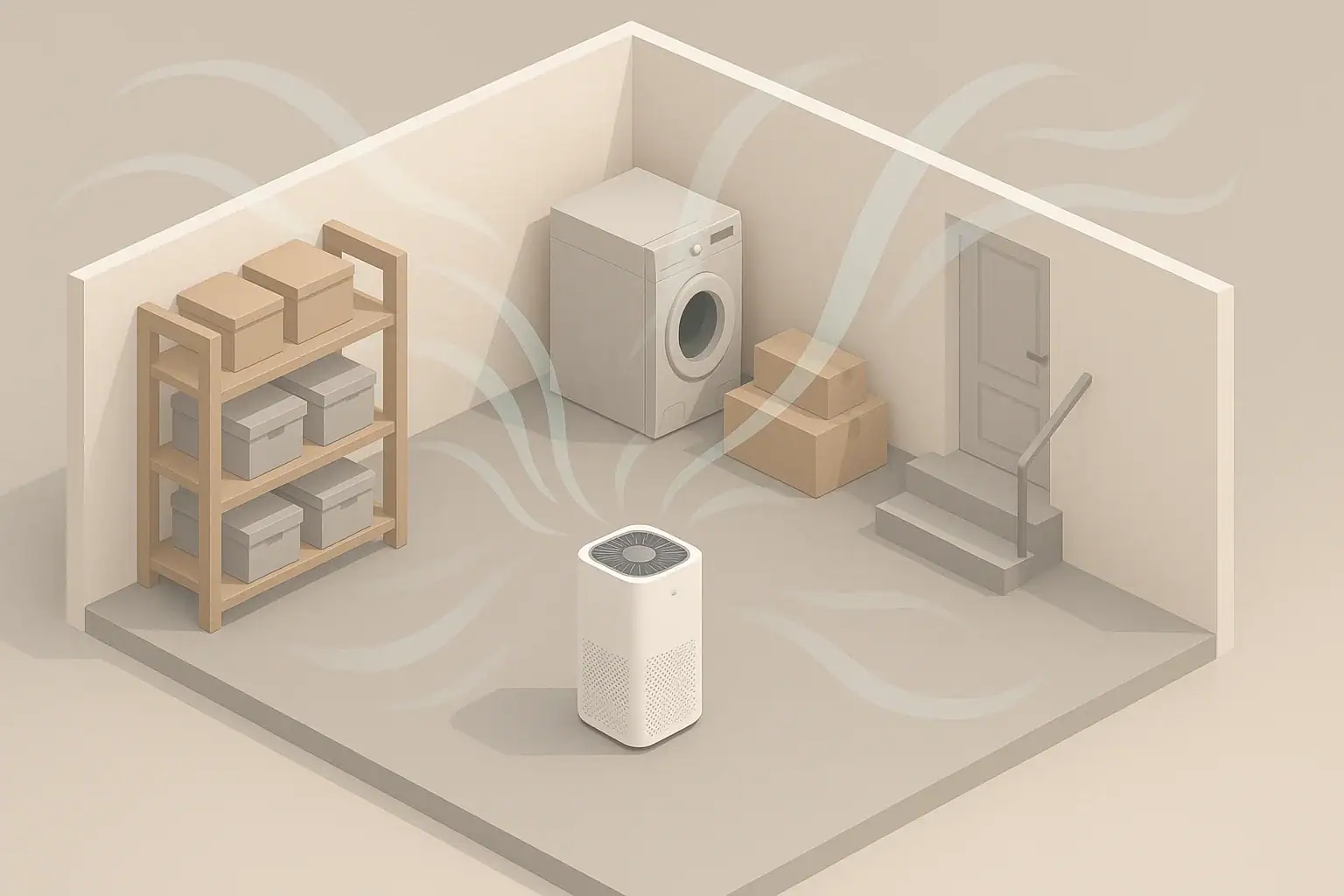
An air purifier can reduce airborne musty particles and some basement odors when it has a well-sealed HEPA filter plus enough activated carbon, but it will not fix moisture or hidden odor sources by itself.
Basement odor usually comes from a mix of damp materials, settled dust, limited air exchange, stored items, floor drains, or unfinished surfaces. The most practical setup combines source control, humidity management, ventilation when conditions allow, and a suitably sized purifier.
- Use a purifier with a true HEPA-style particle filter and a meaningful activated carbon stage for odor control.
- Aim for about 4 to 5 air changes per hour for general basement air cleaning; more may be useful for heavy dust or open areas.
- Keep basement relative humidity roughly in the 30% to 50% range when practical to reduce damp, musty conditions.
- Place the purifier in open air, usually 6 to 12 inches or more from walls and furniture, with intake and outlet unobstructed.
- If odor returns quickly when the purifier is off, look for a moisture, drain, storage, or ventilation source instead of only adding filtration.
Why Basement Odor Needs More Than One Fix
Basements often have cooler surfaces, less sunlight, lower airflow, and more contact with soil-facing walls or floors. Those conditions can make odors linger longer than they do upstairs.
A purifier helps with what is in the air. It can capture dust, lint, some mold fragments, pet dander, and other fine particles. A carbon filter can adsorb some odor-causing gases and vapors, depending on the amount of carbon, contact time, and how quickly the air passes through it.
However, a musty smell is a clue, not a diagnosis. If the odor comes from wet drywall, a damp carpet pad, stored cardboard, a dry plumbing trap, or water intrusion, filtration alone will only reduce what reaches the machine. The source still needs attention.
Sizing and Filter Setup for a Basement Air Purifier
The two most useful planning ideas are CADR and ACH. CADR, or clean air delivery rate, estimates how much filtered air a purifier can deliver per minute for a given particle type. ACH, or air changes per hour, describes how many times the room’s air volume is processed in one hour.
For a simple estimate, calculate room volume by multiplying length by width by ceiling height. Then choose a target ACH. A practical formula is: required CADR in cubic feet per minute equals room volume times target ACH, divided by 60.
For example, a 500-square-foot basement with an 8-foot ceiling has about 4,000 cubic feet of air. At 4 ACH, the planning target is about 267 cfm of clean air delivery. This is an estimate, not a guarantee, because real rooms have furniture, partitions, leakage, stairwells, and door openings.
Filter setup matters as much as size. A particle filter handles dust and fine particles. Activated carbon handles some odors. A thin deodorizing sheet may help a little, but basement odor control usually benefits from a deeper carbon bed or a larger carbon cartridge because more carbon provides more adsorption capacity.
| Basement cue | Most useful first step | Why it matters |
|---|---|---|
| Musty smell after rain | Check moisture entry and humidity | Filtration cannot stop a continuing damp source |
| Dust on shelves and floors | Use HEPA-style filtration and clean surfaces | Air cleaning works better when settled dust is reduced |
| General stale air | Improve air exchange when outdoor conditions are suitable | Ventilation can dilute indoor-generated odors |
| Odor from stored boxes | Remove or seal odor-holding materials | Cardboard and fabrics can hold moisture and smells |
| Occasional drain smell | Check plumbing traps and floor drains | Some odors are source problems, not filter problems |
| Persistent light odor | Run purifier continuously with carbon | Steady airflow gives filters more chances to capture and adsorb contaminants |
HEPA, Carbon, and Musty Air: What Each Filter Does
Particle filtration
A true HEPA or HEPA-type filter is intended for airborne particles, not gases. In a basement, that can include dust, lint, fine debris, and particles disturbed by foot traffic, storage movement, laundry, or workshops.
Look for a design that seals the filter well inside the unit. Poor fit, gaps, or air bypass around the filter can reduce real-world performance even if the filter media itself is efficient.
Activated carbon
Activated carbon is the main purifier component for odor adsorption. It can help with some musty smells and household VOCs, but it has a limited capacity. Once the carbon is saturated, odor performance drops even if the particle filter still looks acceptable.
For basement odor, carbon quantity and airflow contact time matter. A heavier carbon filter generally has more capacity than a very thin carbon-coated pad, although replacement cost and airflow resistance may also be higher.
Common Mistakes When Using a Purifier for Basement Odor
One common mistake is buying only for square footage without checking ceiling height or layout. A large open basement, a finished room with doorways, and a storage area separated by shelving may all behave differently.
Another mistake is placing the purifier in a corner behind furniture. If intake air is blocked or clean air immediately hits a wall, the unit may clean a small pocket of air while the rest of the basement stays stale.
It is also easy to confuse odor masking with odor removal. Fragrances, sprays, and scented products can add more airborne compounds without addressing dampness, dust, or stale air. A neutral approach is to reduce sources, control humidity, and filter continuously.
- If odor improves only while the unit runs on high, check whether the CADR is too low for the space.
- If dust improves but smell remains, carbon capacity may be too small or the source may still be active.
- If the smell is strongest near a drain, wall, carpet, or stored items, investigate that area before upsizing the purifier.
- If the basement feels clammy, prioritize humidity control along with filtration.
Practical Basement Purifier Setup Checklist
Start by walking through the basement without turning on scented products or fans. Note where the odor is strongest, whether it changes after rain, and whether surfaces feel damp or dusty.
Placement basics
- Set the purifier on a stable surface or floor location with open space around it.
- Keep intake and outlet grilles clear of walls, curtains, boxes, and furniture.
- Place it near the odor zone, but not directly against a wet wall or in a utility area where it may be exposed to water.
- For a divided basement, consider whether one larger unit or two smaller units will provide better airflow coverage.
Operating routine
Continuous low or medium operation is often more useful than short bursts, because basements tend to have ongoing air mixing and odor sources. Use higher speeds after cleaning, moving storage, or opening dusty areas, then return to a tolerable daily setting.
If you also use a dehumidifier, give both appliances enough clearance. A purifier cleans air; a dehumidifier removes moisture. They solve different parts of the same basement comfort problem.
Real-World Basement Examples
Finished basement family room
A finished basement with carpet, furniture, and a TV area may need quiet operation as much as high airflow. In this case, size the purifier so it can reach the target ACH on a medium setting rather than only on its loudest setting. Choose a unit with both particle filtration and replaceable carbon.
Laundry and storage basement
Laundry areas can have lint, detergent scents, damp towels, and stored cardboard. A purifier can help with airborne particles and some odors, but source control is important. Store items in sealed plastic bins where appropriate, remove damp fabrics promptly, and avoid blocking airflow with stacked boxes.
Unfinished basement with seasonal dampness
An unfinished basement may have concrete surfaces, exposed framing, and variable humidity. The first priority is keeping the area dry and clean. A purifier can support general air cleaning, but a dehumidifier and basic moisture checks may make a larger difference in the musty character of the space.
Safety and Standards Considerations
Choose air cleaning approaches that do not intentionally generate ozone. Ozone can react with indoor materials and is not needed for routine basement odor control. If a purifier includes optional ionizing or similar features, review the documentation carefully and consider running the unit in a mechanical filtration mode when available.
UV-C features are sometimes included in air purifiers. They should be fully enclosed and used only as designed by the manufacturer. UV-C does not replace HEPA filtration, carbon adsorption, or humidity control.
Also consider practical safety. Do not place a purifier where it can be splashed, tipped over, or blocked by stored items. Keep cords out of walking paths and away from wet areas. Follow the appliance manual for clearances, filter installation, and replacement.
Maintenance, Humidity, and Monitoring
Basement purifier performance depends on upkeep. A clogged prefilter reduces airflow. A saturated carbon filter stops doing much for odor. A particle filter loaded with dust can make the fan work harder and may reduce clean air delivery. For routine care, see our air purifier maintenance checklist monthly and seasonal.
Check filters on a schedule, but adjust based on use. A basement workshop, pet area, laundry space, or renovation zone can load filters faster than a lightly used guest room.
A simple humidity monitor can be useful because musty odor often tracks damp conditions. General indoor comfort guidance commonly aims for about 30% to 50% relative humidity. If humidity frequently stays above that range, air cleaning alone is unlikely to solve the basement smell. A basement dampness RH targets dehumidifiers guide can help you compare options.
Air quality monitors can provide trend information, especially for PM2.5 or particle changes after cleaning and moving boxes. Treat TVOC readings as broad indicators rather than exact odor measurements. CO2 is more about ventilation and occupancy than basement mustiness, but it can show whether air exchange is limited in occupied finished spaces. If you want a broader overview, review indoor air quality monitors.
| Basement area | Ceiling note | CADR planning idea | Notes |
|---|---|---|---|
| 150 square feet | 8 feet assumed | About 80 cfm for 4 ACH | Useful for a small finished room |
| 250 square feet | 8 feet assumed | About 135 cfm for 4 ACH | Consider noise at daily fan speed |
| 400 square feet | 8 feet assumed | About 215 cfm for 4 ACH | Open layout helps distribution |
| 600 square feet | 8 feet assumed | About 320 cfm for 4 ACH | Two units may cover divided areas better |
| 800 square feet | 8 feet assumed | About 425 cfm for 4 ACH | Check stairs, doors, and partitions |
| Any size | Higher ceilings increase volume | Recalculate using actual height | Volume matters more than floor area alone |
Related guides: Air Purifier Placement: Where to Put It for Best Results • How to Choose the Right Air Purifier for Your Room Size • Activated Carbon Filters Explained: VOCs, Odors, and What They Can’t Do
Frequently asked questions
Can an air purifier remove basement odor completely?
An air purifier can reduce airborne musty particles and some odor-causing compounds, but it usually cannot remove basement odor completely if a moisture or source problem is still present. If the smell returns quickly when the unit is off, the basement likely has an ongoing source such as damp materials, drains, or poor ventilation.
What filter type works best for basement odor?
A sealed particle filter such as HEPA helps with dust and fine particles, while activated carbon is the main filter material for odor reduction. For basement odor, a purifier with a meaningful amount of carbon generally performs better than one with only a thin carbon layer.
How many air changes per hour should a basement purifier provide?
About 4 to 5 air changes per hour is a practical target for general basement air cleaning. Larger open basements, dusty storage areas, or spaces with stronger odor may benefit from more airflow, especially if the purifier will usually run on a lower setting.
Where should I place an air purifier in a basement?
Place the purifier in open air with clear space around the intake and outlet, usually several inches away from walls, furniture, and boxes. It should be close enough to affect the odor zone, but not so close to a wet wall, drain, or storage stack that airflow is blocked.
Will a dehumidifier or air purifier work better for musty basement smell?
They do different jobs, so neither one fully replaces the other. A dehumidifier addresses moisture, which is often the root cause of musty odor, while an air purifier helps clean the airborne particles and some gases associated with that smell.
How do I know if the basement odor is coming from the purifier not being strong enough?
If the air smells better only while the purifier is on high and the odor returns quickly at lower speeds, the unit may be undersized for the room. If smell is strongest in one area, though, it is more likely that there is a source problem in that location rather than a filtration problem alone.
Summary: A Practical Basement Odor Setup
The most useful air purifier for basement odor is not just a particle filter or just a deodorizing pad. It is a properly sized unit with good airflow, a sealed particle filter, and enough activated carbon to help with odors.
Use the purifier as part of a broader setup: keep humidity in a reasonable range, remove damp or odor-holding materials, clean settled dust, check drains and moisture-prone areas, and improve ventilation when outdoor conditions support it.
If the smell comes back quickly or stays strongest in one location, treat that as a source clue. Air cleaning can make basement air more comfortable, but the best results usually come from combining filtration with moisture control and simple source reduction.
Recommended next:
- Best Air Purifiers for Allergies: What to Look For (CADR, HEPA, Carbon)
- How to Choose the Right Air Purifier for Your Room Size
- Air Purifier Placement: Where to Put It for Best Results
- Do Air Purifiers Help With Smoke and Odors?
- Air Purifier Noise: What dB Levels Are Quiet Enough for Sleep?
- Best Air Purifiers for Pets: Dander, Odors, and Filter Costs
- More in Air Purifiers →
- Clear sizing logic (room size → CADR/ACH)
- HEPA vs carbon explained for real use-cases
- Humidity + ventilation basics to reduce mold risk