
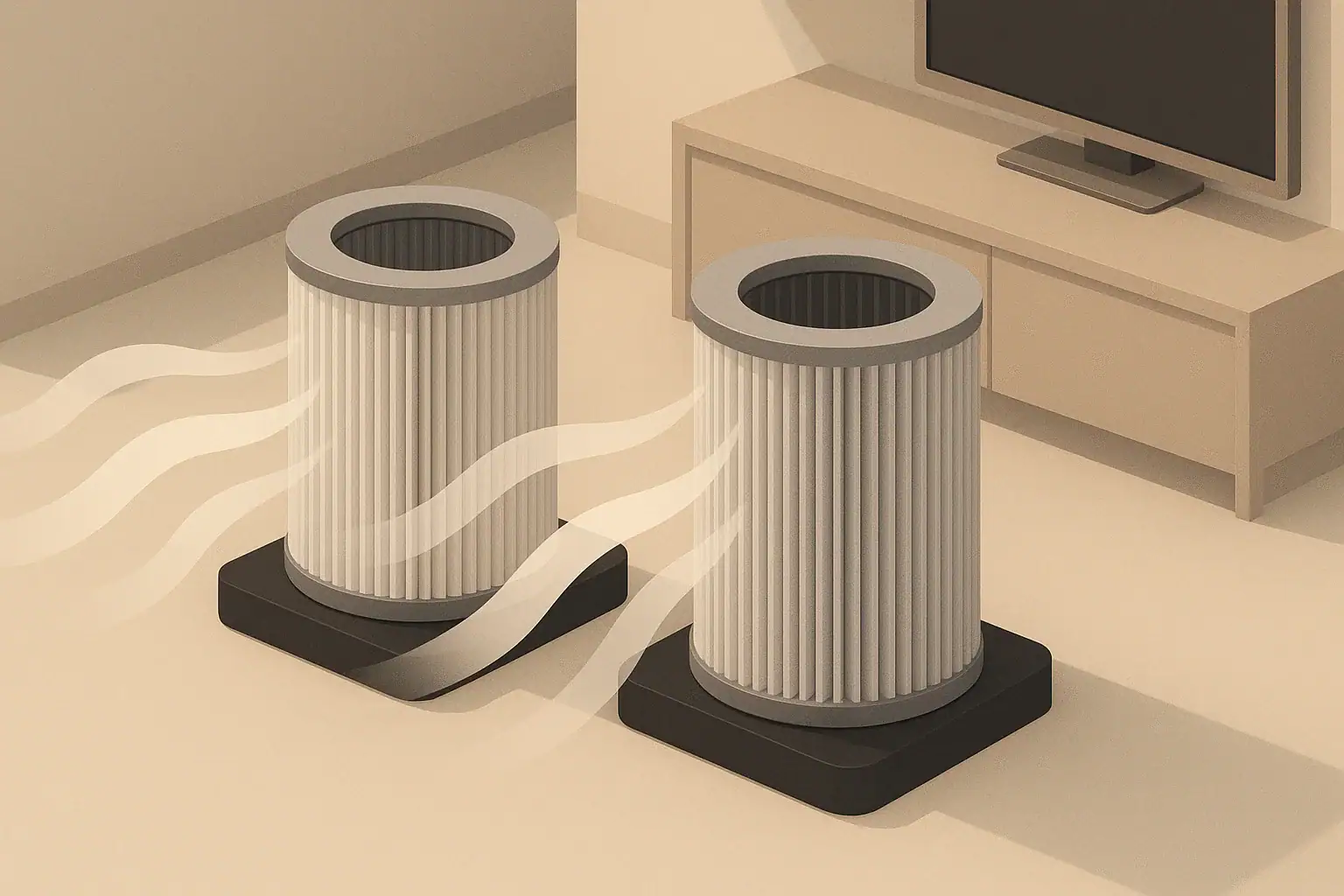
HEPA H13 is enough for most homes and offices, while HEPA H14 mainly matters in critical or high‑risk spaces that need extremely clean air. Both are very high‑efficiency HEPA filters, but H14 captures a bit more of the hardest‑to‑filter ultrafine particles in a single pass. In real rooms, airflow, run time, and proper installation often matter more than choosing H13 vs H14 on the label.
This guide explains what HEPA H13 and H14 ratings really mean, how they affect clean air delivery, and how to decide which level makes sense for your situation. You will see practical examples, typical use cases, and the trade‑offs in cost, noise, and energy use. By the end, you should be able to look at any “medical‑grade HEPA” or “H13/H14” claim and quickly judge whether it fits your air quality goals.
What HEPA H13 and H14 Mean (and Why It Matters)
HEPA H13 and H14 are high‑grade classifications defined in standards such as EN 1822 and ISO 29463. They describe how efficiently a filter removes particles at its most penetrating particle size (MPPS), typically around 0.1–0.3 microns. This is the size range that is hardest for filters to capture.
In simple terms:
- H13: At least about 99.95% efficient at MPPS
- H14: At least about 99.995% efficient at MPPS
The numerical difference looks tiny, but it represents roughly a tenfold reduction in the small fraction of particles that slip through. That extra “9” of efficiency is why H14 is used in cleanrooms, some hospital zones, and other high‑risk environments.
For typical indoor air quality needs—such as allergies, smoke, or general fine dust—H13 already removes the vast majority of particles when paired with adequate airflow and run time. The key question is not only “How efficient is the filter media?” but “How much clean air does the whole system actually deliver into the room?”
Key Concepts: How HEPA H13 and H14 Filters Work
HEPA filters are made from a dense mat of fibers, not a rigid screen with uniform holes. Air weaves through the fibers, and particles are captured in several ways:
- Inertial impaction: Larger, heavier particles (like coarse dust) cannot follow the air stream around fibers and crash into them.
- Interception: Mid‑sized particles follow the air flow lines but pass close enough to fibers to touch and stick.
- Diffusion: Very small particles move randomly (Brownian motion) and bounce into fibers more often.
The “most penetrating” size range sits between these mechanisms, where none of them is especially strong. H14 filters use denser fiber packing or different construction to reduce how many of these “slippery” particles get through.
However, denser media usually means more resistance to airflow (pressure drop). To maintain the same clean air delivery rate:
- The fan must be stronger, or
- The device must run at higher speed (often louder), or
- The actual airflow will drop, reducing room‑level cleaning.
This is why a well‑designed H13 system can outperform a poorly designed H14 system in real‑world use, even though H14 media is technically more efficient.
| Filter class | Single‑pass MPPS efficiency | Particles allowed through (out of 10,000) | Typical use case |
|---|---|---|---|
| H13 | ≈ 99.95% | Up to about 5 | Homes, offices, clinics, general clean air needs |
| H14 | ≈ 99.995% | Up to about 0.5 | Cleanrooms, some hospital areas, high‑risk labs |
Both H13 and H14 are extremely effective across a wide range of particle sizes:
- Larger particles (>0.3 microns): dust, pollen, many mold spores, pet dander fragments
- Fine particles (PM2.5 range): smoke, traffic pollution, combustion particles
- Submicron particles: some bacteria and fragments, many virus‑carrying droplets and droplet nuclei
In practice, both grades can dramatically reduce indoor particle levels as long as the system moves enough air and is sealed properly.
Real‑World Examples: When H13 Is Enough and When H14 Helps
Deciding between HEPA H13 vs H14 is easier when you map the rating to a specific problem and room type. Below are common scenarios and how each class fits.
Example 1: Allergies in a bedroom
- Goal: Reduce pollen, pet dander, and dust mite debris.
- Room: 150 ft² bedroom with average ceiling height.
- Best fit: H13 with enough clean air delivery to reach roughly 4–5 air changes per hour.
In this case, the limiting factor is usually air changes per hour and keeping the unit running, not the difference between H13 and H14. An H13 unit that quietly runs overnight on a medium speed will often provide excellent symptom relief.
Example 2: Urban apartment near a busy road
- Goal: Lower fine particulate pollution (PM2.5) from traffic and outdoor air.
- Room: Open‑plan living room and kitchen.
- Best fit: H13 or H14, but priority is high airflow and long runtime.
Both H13 and H14 capture fine pollution effectively. The bigger impact comes from choosing a unit that can turn over the air in the space several times per hour and running it whenever outdoor pollution is elevated.
Example 3: Home workshop or hobby room
- Goal: Reduce fine dust, fumes, or particles from sensitive work.
- Room: Small workshop or studio.
- Best fit: H13 for general control, H14 only if extremely low background particle counts are needed.
Here, source control (local exhaust, masks, wet methods) and ventilation should come first. A HEPA system is a useful second layer. H14 may be justified if the work demands near‑cleanroom conditions and the system is sized and sealed correctly.
Example 4: High‑risk medical or lab space
- Goal: Maintain very low particle concentrations for infection control or sensitive processes.
- Room: Isolation area, procedure room, or lab.
- Best fit: H14 or higher, within a professionally designed system.
In such spaces, the incremental step from H13 to H14 can be important because even a small number of residual particles may matter. These systems are usually engineered with strong fans, carefully sealed housings, and measured air changes per hour, not just upgraded filters dropped into consumer devices.
| Scenario | Typical goal | Practical HEPA choice | What usually matters most |
|---|---|---|---|
| Bedroom allergies | Reduce pollen and dander | H13 | Quiet operation, steady runtime, proper room sizing |
| Traffic pollution | Lower PM2.5 | H13 or H14 | High CADR, long daily runtime, sealed windows when needed |
| Light home workshop | Reduce fine dust | H13 | Source control, ventilation, pre‑filters for coarse dust |
| Critical lab or isolation room | Very low particle counts | H14 or higher | Engineered airflow, pressure control, professional design |
Common Mistakes and Troubleshooting HEPA Performance
Many people upgrade to a higher HEPA rating but see little improvement because other parts of the system are limiting performance. These are frequent issues to watch for and how to spot them.
Mistake 1: Focusing only on filter grade, not airflow
- Symptom: Unit has an H14 filter but the room still looks hazy or measured particle levels stay high.
- Likely cause: Airflow is too low for the room size, or the unit runs only a few hours per day.
- Fix: Increase fan speed, extend runtime, or choose a system with higher clean air delivery for the same room.
Mistake 2: Poor placement and blocked airflow
- Symptom: Clean air seems localized near the device; far corners of the room stay dusty.
- Likely cause: Unit is placed in a corner, behind furniture, or under a desk.
- Fix: Move it to a more open location, away from walls and obstacles, to encourage mixing of room air.
Mistake 3: Bypass leaks around the filter
- Symptom: Visible dust streaks or discoloration around the filter frame; strong air stream from the device but modest air quality improvement.
- Likely cause: Gaps between the filter and housing allow unfiltered air to bypass the media.
- Fix: Reseat the filter carefully, check gaskets, and ensure the access panel is fully closed and latched.
Mistake 4: Overused or clogged filters
- Symptom: Airflow drops, fan noise changes, or the unit feels weak on settings that used to move a lot of air.
- Likely cause: HEPA media is heavily loaded with particles, increasing resistance.
- Fix: Replace the HEPA filter and clean or replace pre‑filters as recommended.
Mistake 5: Expecting HEPA to solve every air problem
- Symptom: Odors, gases, or humidity‑related issues persist even though particles are reduced.
- Likely cause: HEPA targets particles, not gases or moisture.
- Fix: Combine HEPA with ventilation, humidity control, and other filtration media when needed.
| Observed issue | Probable cause | Simple check |
|---|---|---|
| High readings on an air quality monitor despite HEPA | Insufficient airflow or runtime | Increase fan speed for 30–60 minutes and recheck levels |
| Strong airflow, but little improvement in dust | Bypass leaks or open windows introducing new dust | Inspect seals and close nearby windows or doors |
| Unit suddenly louder and moving less air | Filter heavily loaded with particles | Check and replace HEPA and pre‑filters if visibly dirty |
| Odors remain even when particles drop | Gaseous pollutants not captured by HEPA | Consider additional filtration or increased ventilation |
Safety Basics for Using H13 and H14 HEPA Systems
High‑efficiency filters are generally safe to use in homes and workplaces, but there are a few safety‑related points to keep in mind, especially as filter density and fan power increase.
- Electrical load and heat: Systems designed for H14 may use more powerful motors. Ensure the outlet and circuit can handle the rated power draw, and keep vents clear so heat can dissipate.
- Filter integrity: Do not cut, wash, or modify HEPA filters unless the manufacturer explicitly allows it. Damaged media or disturbed fibers can reduce efficiency and release captured dust.
- Handling used filters: Treat old HEPA filters as dusty items. Handle them gently, avoid shaking, and place them in a bag or container before disposal to limit re‑release of particles.
- Noise exposure: Running a high‑powered unit on maximum speed in small rooms for long periods can be noisy. If you need higher fan settings, consider limiting time spent very close to the device or relocating it to reduce direct noise exposure.
- Ventilation balance: HEPA recirculates and cleans indoor air but does not add fresh air. In tight spaces, balance filtration with periodic ventilation to control carbon dioxide and indoor pollutants that HEPA does not capture.
- Moisture and mold: Avoid placing HEPA units where they will pull in large amounts of moist air from bathrooms or damp basements without addressing the moisture source. HEPA captures mold spores but does not correct underlying humidity problems.
Used correctly, both H13 and H14 systems are a safe part of a layered strategy that also considers ventilation, humidity control, and source reduction.
Maintenance and Lifespan: Getting Full Value from H13 and H14
Both H13 and H14 filters gradually load with particles, increasing resistance and reducing airflow. Keeping up with maintenance is essential if you want the high rated efficiency to translate into real‑world performance.
How often to replace HEPA filters
Replacement intervals depend on several factors:
- Outdoor air quality and local pollution events
- Indoor activities such as cooking, candles, or smoking
- Daily runtime and fan speed
- Whether pre‑filters are used and cleaned regularly
In relatively clean environments with moderate use, HEPA filters may last many months. In dusty or high‑pollution areas, or when running at high speeds for long hours, they may need replacement sooner. H14 media, being denser, can reach higher resistance more quickly at the same load.
Practical signs a filter is nearing end of life
- Noticeable drop in airflow at familiar fan settings.
- Fan noise changes as the motor works harder.
- Visible darkening or patchy discoloration on the intake side of the HEPA (if viewable).
- Air quality monitor shows slower improvement after you switch the unit on.
Role of pre‑filters
A washable or replaceable pre‑filter that captures hair, lint, and coarse dust can greatly extend HEPA life. Cleaning or swapping the pre‑filter on schedule keeps the HEPA layer focused on the fine particles it is designed to capture.
Storage and seasonal use
- If you store a unit for a season, remove heavily used filters rather than leaving them in a damp or unconditioned area.
- Store replacement filters in a dry, sealed bag or box to protect them from dust and humidity before use.
- When restarting after storage, visually inspect the HEPA and pre‑filters and consider starting with a lower fan speed for the first run to check for abnormal noise or vibration.
Practical Takeaways and Specs to Look For
Choosing between HEPA H13 vs H14 is easier when you focus on your air quality goal and the performance of the whole system, not just the filter label.
- For most homes and typical offices, H13 with good airflow and long runtime is usually the best balance of performance, noise, and cost.
- H14 becomes more relevant in high‑risk or critical environments where even a small number of remaining particles can matter.
- Real‑world results depend heavily on room size, placement, sealing, and maintenance.
Specs to look for when comparing HEPA systems
- Filter class: Confirm H13 or H14, and avoid vague terms like “HEPA‑type” for serious particle control.
- Clean air delivery (or equivalent airflow data): Check that the system can provide enough clean air for your room volume and target air changes per hour.
- Fan speeds and noise levels: Look for a setting you can tolerate continuously, especially for bedrooms or offices.
- Seal quality and construction: Gaskets, tight‑fitting filter frames, and solid housings reduce bypass leakage.
- Pre‑filter design: Washable or easily replaceable pre‑filters help protect the HEPA and reduce long‑term costs.
- Filter replacement access: Filters that are easy to access and swap encourage you to maintain them on time.
- Power consumption: Compare wattage at the fan speeds you will actually use, especially for 24/7 operation.
- Room integration: Consider size, weight, and how easily you can place the unit where airflow will not be blocked.
If you are unsure whether to choose H13 or H14, start by sizing the system correctly for your room and usage pattern. In many cases, a well‑sealed H13 unit that you run consistently will deliver cleaner air than an undersized or poorly maintained H14 system.
Frequently asked questions
Which specs and features should I check when comparing H13 and H14 air purifiers?
Look beyond the filter class to the system’s clean air delivery rate (CADR) or equivalent airflow data for your room size, fan speed options and noise levels, seal quality to prevent bypass, and the presence of a pre‑filter. Also check filter access and expected replacement costs plus power consumption for the fan speeds you will use regularly.
Why doesn’t upgrading to H14 always improve my room’s air quality?
H14 media is more efficient per pass but also more restrictive to airflow; if the fan and housing aren’t designed for it, overall clean air delivery can be lower. Common real‑world limits include low airflow, poor placement, bypass leaks, and insufficient runtime, all of which can negate the benefit of a higher filter class.
Are H13 and H14 filters safe to use in homes?
Yes; both are safe when used as intended, but pay attention to electrical load and ventilation balance, avoid modifying filters, and handle used filters carefully to limit dust release. High‑powered systems can be louder and draw more current, so follow the manufacturer’s safety guidance and ensure proper installation.
How often should I replace H13 or H14 filters in typical home use?
Replacement intervals vary with outdoor pollution, indoor activities, daily runtime, and whether you use a pre‑filter; many home units run months to a year before replacement. Replace sooner if you notice reduced airflow, changed fan noise, visible darkening of the media, or slower improvements on an air quality monitor.
Can HEPA H13 or H14 filters remove odors and gases?
No; HEPA media captures particles but does not remove most gases or odors. To address odors, look for systems that add activated carbon or other gas‑phase sorbents and combine filtration with ventilation.
Is it worth choosing H14 for allergy relief or infection prevention at home?
For most allergy or everyday infection‑risk scenarios, a correctly sized and well‑maintained H13 system with good airflow and runtime is sufficient; H14 is generally reserved for high‑risk or professionally engineered spaces. H14 may be justified for immunocompromised occupants or specialized home settings, but the overall system design and operation matter more than the label alone.
- Clear sizing logic (room size → CADR/ACH)
- HEPA vs carbon explained for real use-cases
- Humidity + ventilation basics to reduce mold risk