
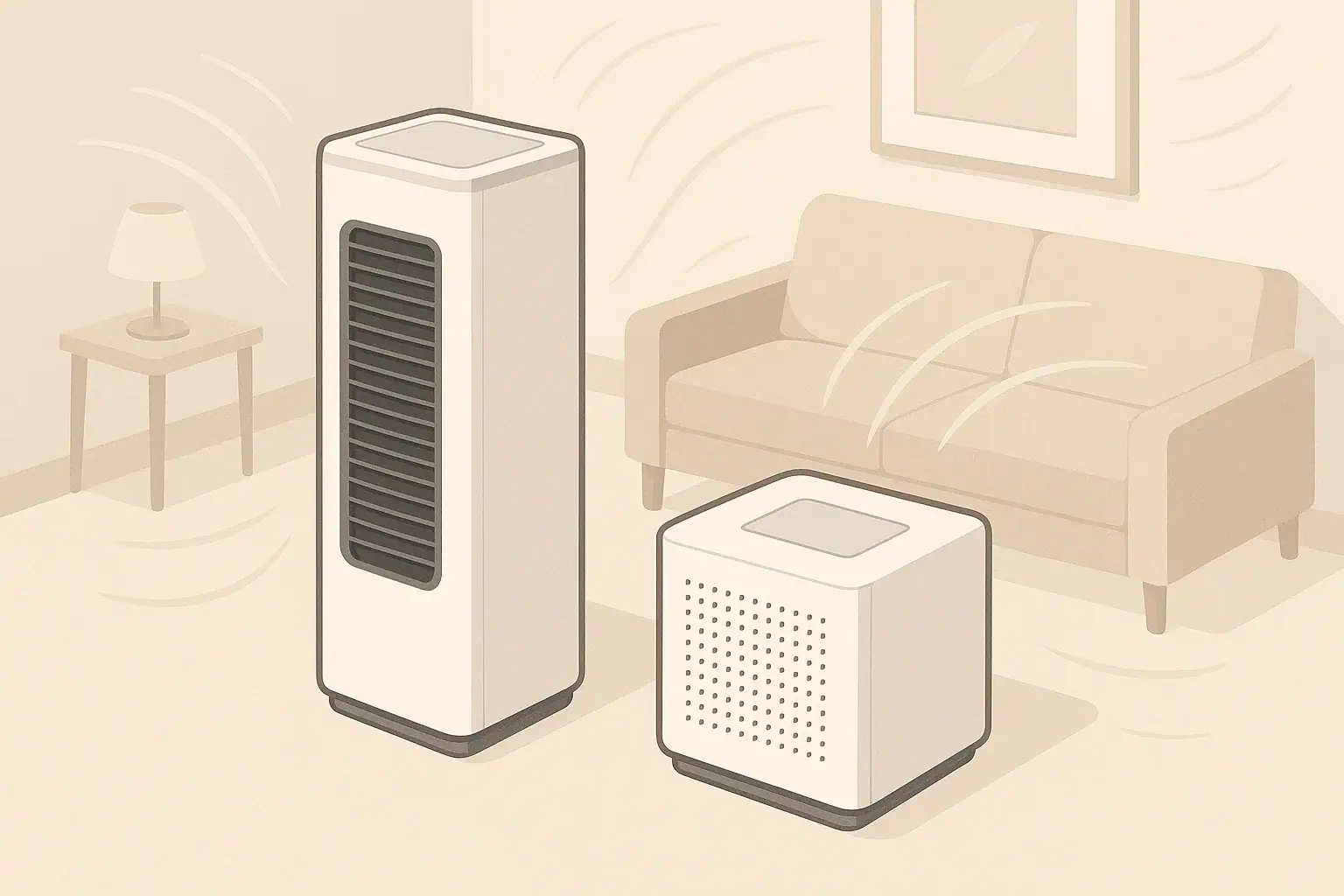
An air purifier is usually the safer and more effective choice for everyday home use, while an ozone generator is generally not recommended in occupied rooms. Both are marketed for cleaner air, but they work very differently and carry very different risks.
Understanding the difference between an air purifier and an ozone generator helps you match the right tool to common home air quality problems like dust, smoke, odors, and musty basements. It also helps you avoid choices that can make air quality worse, especially for children, older adults, or anyone with asthma or allergies.
This guide walks through how each technology works, what you can realistically expect from them, where they fit (and do not fit) in a home, and how to read key specs before you buy or plug anything in.
What Air Purifiers and Ozone Generators Are, and Why the Difference Matters
When people search for ways to “clean the air” at home, they often see both air purifiers and ozone generators in the same category. In reality, they belong in very different buckets.
Air purifiers for home use are usually fan-and-filter machines. They pull room air through filters that trap particles and, sometimes, adsorb gases and odors. Their goal is to remove pollutants from the air without adding new ones.
Ozone generators intentionally make ozone gas. Ozone is a reactive form of oxygen that can change the chemistry of some pollutants and odors, but it is also a lung irritant. At levels high enough to noticeably change smells in a room, ozone can bother the eyes, throat, and lungs.
This difference matters because:
- Most people want something safe to run for hours in bedrooms and living areas.
- Many advertisements blur the line between “fresh” and “safe” air.
- Some devices marketed as air cleaners are actually ozone generators or include ozone-producing features.
For routine, occupied spaces, filter-based air purifiers are usually the primary option to consider. Ozone generators, if used at all, belong in very controlled, unoccupied situations.
How Each Device Works: Key Concepts That Affect Real Performance
To compare an air purifier vs an ozone generator in a realistic way, it helps to understand the basics of how each one works and how that translates into cleaner (or not-so-clean) air.
How Air Purifiers Clean the Air
Most residential air purifiers use a simple sequence:
- Fan draws air in through an intake grille.
- Air passes through multiple filters, often in layers.
- Filtered air returns to the room through an outlet.
Common filter layers include:
- Prefilter to catch hair, lint, and larger dust so the main filter does not clog quickly.
- HEPA or HEPA-style filter (dense fibers) to capture fine particles such as pollen, pet dander, and smoke particles.
- Activated carbon filter (porous carbon) to adsorb some odors and volatile organic compounds (VOCs).
Performance is driven by two main ideas:
- Clean Air Delivery Rate (CADR): How much clean air the purifier produces per minute. Higher CADR usually means faster reduction of particle levels.
- Air changes per hour (ACH): How many times per hour the purifier can theoretically move a room’s volume of air through its filters. Higher ACH generally means more aggressive cleaning.
Room size, ceiling height, and where you place the purifier all affect whether the theoretical numbers match what you experience.
How Ozone Generators Work
Ozone generators use high voltage or ultraviolet light to convert some of the oxygen in the air (O2) into ozone (O3). That ozone then spreads through the room and reacts with substances in the air and on surfaces.
Once released, ozone can:
- React with odor-causing gases, sometimes reducing the smell.
- React with materials such as carpets, rubber, paints, and upholstery.
- Form new chemicals when it reacts with indoor pollutants, some of which may be irritating.
Unlike a HEPA filter, ozone does not physically remove particles from the air. It changes chemistry instead of capturing contaminants in a filter.
Side-by-Side Comparison of Typical Home Use
| Home air goal | Filter-based air purifier | Ozone generator |
|---|---|---|
| Reduce dust, pollen, pet dander | Directly captures particles with HEPA-type filter; can run continuously in occupied rooms. | Does not filter particles; may change chemistry of some components but leaves particles present. |
| Handle everyday cooking and household odors | Activated carbon can reduce many common odors when sized and replaced properly. | May temporarily change or mask odors; results can be uneven and create new byproducts. |
| Help during outdoor smoke or wildfire events | Higher CADR and ACH can significantly lower indoor smoke particle levels. | Does not remove smoke particles; ozone can add respiratory irritation. |
| Use in bedrooms and living rooms | Designed for occupied spaces when ozone-free; often run for many hours per day. | Generally not recommended in occupied rooms because ozone is a lung irritant. |
| Address musty or moldy smells | Can reduce airborne spores and some odors, but root moisture issues must be fixed separately. | May change odor for a short time but does not correct moisture; can be harsh in tight spaces. |
| Ease of use for non-technical users | Set fan speed, replace filters as scheduled, and keep vents unblocked. | Requires strict control of exposure time, vacancy, and post-treatment ventilation. |
Real-World Home Scenarios: What Actually Works Where
Marketing claims can make almost any device sound like a cure-all. Looking at specific home situations makes the difference between an air purifier and an ozone generator much clearer.
Bedroom for an Allergy or Asthma-Prone Occupant
Goal: Reduce pollen, pet dander, and fine dust to help with nighttime symptoms.
- More appropriate: A filter-based air purifier sized for the room, running on a steady setting to achieve multiple air changes per hour.
- Why: HEPA-type filtration directly removes airborne allergens. The device can run safely for long stretches in an occupied room when it does not intentionally produce ozone.
- Supporting steps: Regular vacuuming with good filtration, washing bedding, and keeping pets out of the bedroom if possible.
An ozone generator does not remove allergen particles and may irritate sensitive lungs, so it does not fit this scenario.
Kitchen and Open Living Area with Cooking Odors
Goal: Keep lingering cooking smells and light smoke from building up in the main living space.
- More appropriate: A purifier with a particle filter and a meaningful activated carbon layer, used along with range hoods or exhaust fans.
- Why: The purifier can reduce grease particles and some cooking odors as air circulates, especially when run on higher speed during and shortly after cooking.
- Supporting steps: Use lids on pans, run exhaust fans that vent outdoors, and wipe surfaces where grease can settle.
Ozone is not needed to manage everyday cooking smells and adds unnecessary risk if used where people are present.
Damp Basement with Musty Smell
Goal: Reduce musty odor and mold-related concerns in a cool, damp basement.
- Core solution: Moisture control using dehumidification, drainage fixes, and sealing obvious leaks or seepage.
- Helpful add-on: A HEPA-type purifier to reduce airborne spores and dust while moisture issues are being addressed.
- Why: Mold problems are driven by moisture, not just what is in the air. Filtration helps with what you breathe but does not dry the space.
Ozone might temporarily change the smell, but it does not dry walls or carpets. In a tight, poorly ventilated basement, ozone can build up and make the air more irritating.
Short-Term Odor Incident (Burnt Food, Hobby Chemicals)
Goal: Clear out a one-time strong odor from burnt food, craft glues, or paints.
- First step: Stop the source and ventilate by opening windows or running exhaust fans when outdoor conditions allow.
- Second step: Run an air purifier with carbon filtration on higher speed to help reduce residual odors and particles.
- Optional step: Temporarily avoid the room until the strongest odor dissipates.
Ozone is not required for these common situations and can be an unnecessary complication compared with simple ventilation plus filtration.
Common Mistakes and Troubleshooting Cues
Many people buy an air cleaner, plug it in, and assume it is working as advertised. Several common mistakes can limit effectiveness or increase risk, depending on the device.
Air Purifier Mistakes
- Undersizing the purifier: A small unit in a large open-plan area may only clean the air close to it. If you still see dust buildup or smell smoke far from the purifier, it may not be moving enough air for the space.
- Running only on the lowest fan speed: Quiet modes are comfortable but may not deliver enough clean air during high-pollution events like cooking or wildfire smoke. If the air looks hazy or smells smoky, temporarily use a higher speed.
- Ignoring filter replacement: Overloaded filters restrict airflow and reduce cleaning. Signs include reduced air coming from the outlet, more noise at the same setting, or dust visible on the filter surface.
- Blocking intake or outlet: Placing the purifier behind furniture or too close to walls can short-circuit airflow. If you feel only a weak air stream from the outlet, check that nothing is blocking vents.
Ozone Generator Mistakes
- Using ozone in occupied rooms: Running an ozone generator where people or pets are present increases the chance of irritation, especially for those with respiratory issues.
- Confusing “no smell” with “no ozone”: Not smelling ozone does not guarantee safe levels. People vary widely in sensitivity, and odor fatigue can occur.
- Relying on ozone for mold removal: Treating a moldy room with ozone without fixing leaks or humidity leads to recurring problems once moisture returns.
- Skipping post-treatment ventilation: After using ozone in an unoccupied space, failing to air out the area can leave higher ozone levels and reaction products indoors.
Troubleshooting Cues to Watch For
| What you notice | Likely cause | Practical next step |
|---|---|---|
| Dust still settles quickly on surfaces near a purifier. | Purifier is undersized, on too low a setting, or filters are clogged. | Check room size vs specs, increase fan speed, and inspect or replace filters. |
| Strong cooking or pet odors linger even with a purifier running. | Carbon filter is saturated or too small for the odor load. | Replace carbon filter and improve source control and ventilation. |
| Purifier becomes louder over time at the same fan speed. | Dust buildup restricting airflow through filters or grille. | Clean prefilters and grilles; replace main filters if past their service life. |
| Eyes or throat feel irritated when an ozone-producing device runs. | Ozone concentration is high enough to cause discomfort. | Turn the device off, ventilate the area, and avoid using ozone in occupied spaces. |
| Musty odor returns soon after a “treatment” session. | Moisture problem remains; odor source was never removed. | Investigate leaks, humidity, and drainage; use dehumidification and drying. |
Safety Basics: Ozone Exposure vs Filter-Based Purification
Safety is the most important difference between an air purifier and an ozone generator in everyday homes.
Why Ozone Exposure Is a Concern
Ozone at ground level is a known respiratory irritant. At concentrations high enough to aggressively change or mask odors indoors, it can:
- Cause coughing, throat irritation, or chest tightness in some people.
- Aggravate asthma or other lung conditions.
- Affect children, older adults, and people with breathing sensitivities more strongly.
In closed or poorly ventilated rooms, ozone from generators can build up more easily, especially if the device is left running for long periods.
Safer Approaches to Everyday Air Cleaning
Mechanical filter-based air purifiers are designed to remove particles and some gases without adding reactive chemicals to the air. For routine use in bedrooms, living rooms, and home offices:
- Favor devices that clearly rely on filters and do not intentionally produce ozone.
- Be cautious with add-on features labeled as ionizers, plasma, or UV that may produce small amounts of ozone as a byproduct if not carefully engineered.
- Combine filtration with ventilation, source control, and moisture management for a complete indoor air strategy.
In most homes, there is no need to introduce ozone to achieve meaningful improvements in indoor air quality.
Long-Term Use, Maintenance, and Storage
Whether you choose a filter-based air purifier or are evaluating an existing ozone-producing device, long-term performance depends on maintenance and how the device is stored and operated over time.
Keeping Air Purifiers Effective
- Follow filter schedules: Replace HEPA and carbon filters according to hours of use and local air conditions. Heavy smoke or dust may shorten the useful life of filters.
- Clean prefilters and grilles: Many prefilters can be vacuumed or gently washed. Keeping them clean protects the main filter and maintains airflow.
- Check placement periodically: As furniture moves or clutter builds, make sure intakes and outlets remain unblocked.
- Seasonal adjustments: During pollen or wildfire seasons, you may run the purifier more hours per day and on higher settings than in milder months.
Storing Devices Between Seasons
- Dry environment: Store purifiers in a dry, clean area to prevent mold growth on filters or internal parts.
- Cover against dust: A simple cover or bag (with the power cord outside) helps keep dust off while stored.
- Inspect before reuse: At the start of a new season, check filters for odor, discoloration, or visible buildup and replace if needed.
Ozone Generators and Long-Term Considerations
If you already own an ozone generator:
- Review how often it is actually needed versus safer alternatives like ventilation and filtration.
- Store it unplugged, labeled clearly, and out of reach of children to prevent accidental use.
- Reconsider using ozone in any regularly occupied space, even for short “freshening” runs.
Practical Takeaways and Specs to Look For
Choosing between an air purifier and an ozone generator becomes much simpler when you focus on your actual goal and who is breathing the air.
- For everyday particle reduction (dust, pollen, smoke), choose a filter-based air purifier sized correctly for the room.
- For odors and VOCs, use source control and ventilation first, then support with a purifier that includes meaningful activated carbon.
- For mold and musty smells, prioritize moisture control; use HEPA filtration as a support, not a substitute.
- Reserve ozone, if used at all, for carefully controlled, unoccupied situations and recognize that it does not fix underlying moisture or contamination sources.
Specs to Look For on an Air Purifier Label
When evaluating a filter-based air purifier for home use, focus on these practical details:
- Room size match: Look for a recommended room size or calculate whether the CADR can provide multiple air changes per hour in your actual room dimensions.
- Particle filtration: Confirm the presence of a HEPA or HEPA-type main filter designed to capture fine particles such as smoke and pollen.
- Gas and odor reduction: If odors are a concern, check that there is a dedicated activated carbon or other gas-phase filter, not just a thin scented pad.
- Noise levels: Review sound levels at different fan speeds, especially for bedrooms and home offices where you may run the device for many hours.
- Filter replacement indicators: A clear indicator or hour counter helps you replace filters based on actual use rather than guesswork.
- Energy use: Consider power consumption at the fan speeds you are likely to use most often, since purifiers may run many hours per day.
- Ozone-related claims: Prefer products that state they do not intentionally generate ozone and that rely on mechanical filtration as the primary cleaning method.
By focusing on these specs and on the real conditions in your home, you can choose equipment that improves indoor air quality without introducing avoidable risks.
Frequently asked questions
Which technical specs and features matter most when choosing an air purifier?
Prioritize CADR and recommended room size to ensure the unit can handle your space, and confirm it has a true HEPA (or HEPA-type) filter for particles. If odors or VOCs are a concern, look for a substantial activated carbon or gas-phase filter, and consider noise levels and filter-replacement indicators for practical long-term use.
How can I avoid common mistakes that make air purifiers less effective?
Match the purifier size to the room, run it at higher fan speeds during high-pollution events, and replace or clean filters on schedule. Also avoid blocking intake or outlet vents by placing the unit where air can circulate freely.
Are ozone generators safe to use around people and pets?
Ozone generators are not recommended for occupied spaces because ozone is a lung irritant that can cause coughing, throat irritation, and worsen asthma. If they are used at all, it should be only in controlled, unoccupied situations with thorough post-treatment ventilation.
Can an air purifier help during wildfire smoke events?
A purifier with a high CADR and a true HEPA filter can substantially reduce indoor smoke particle levels when run continuously and used in a closed room. Keep doors and windows closed and avoid relying on ozone generators, which do not remove particles and can add respiratory risk.
Will an air purifier eliminate mold smells in a damp basement?
An air purifier can reduce airborne spores and some odors, but it will not fix underlying moisture or mold in walls and carpets. Address humidity, leaks, and drying first, and use filtration as a supplemental measure while remediation is underway.
How long should I run a purifier after a short-term odor incident like burnt food?
Ventilate the room first if possible, then run a purifier with activated carbon on a higher setting for several hours until the smell subsides. The exact time depends on odor strength and room size, but continuous operation until air changes reduce the concentration is a practical approach.
- Clear sizing logic (room size → CADR/ACH)
- HEPA vs carbon explained for real use-cases
- Humidity + ventilation basics to reduce mold risk