
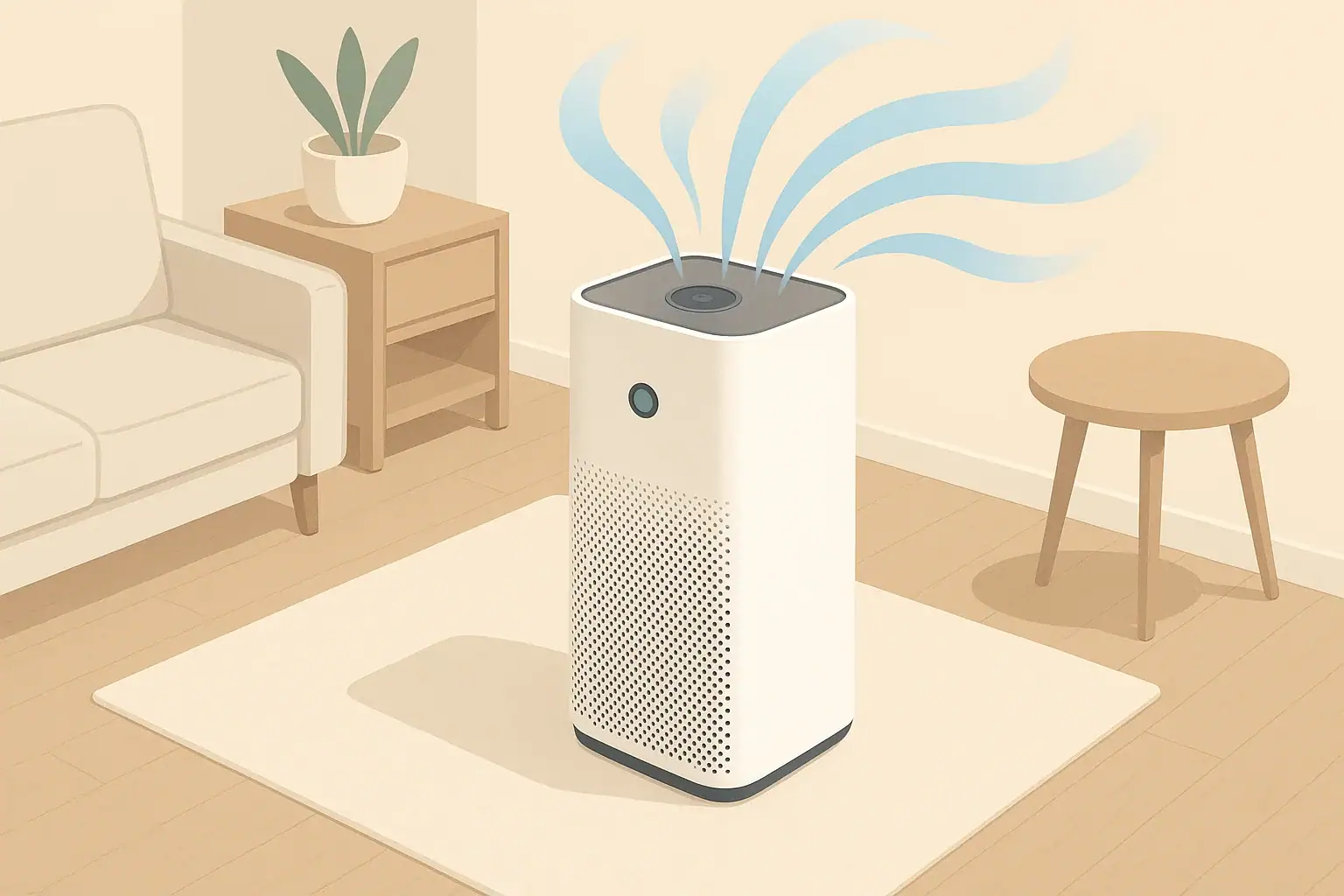
Some air purifiers do produce ozone, but many well-designed models do not and are considered ozone-free for home use. Whether an air cleaner emits ozone depends on the technology inside it, not on the fact that it is called an “air purifier.”
If you are sensitive to air quality, have asthma or allergies, or simply want healthier indoor air, it is important to understand which purification methods can create ozone and which ones rely on safer mechanical filtration. This helps you avoid devices that add a lung irritant while you are trying to solve dust, smoke, or odor problems.
This guide explains how ozone from air purifiers is created, which technologies to treat with caution, and how to pick an effective ozone-free purifier. You will see concrete examples, comparison tables, and a practical checklist of specs to look for so you can match a purifier to your room size, indoor air concerns, and comfort level.
What It Means When an Air Purifier Produces Ozone (and Why It Matters)
Ozone is a highly reactive gas made of three oxygen atoms (O3). Outdoors, it is a major part of smog. Indoors, even relatively low concentrations can irritate the lungs, throat, and eyes, especially during long exposure. People with asthma, COPD, or allergies are often more sensitive, but anyone can be affected.
When an air purifier produces ozone, it usually happens in one of two ways:
- The device is intentionally designed as an ozone generator and marketed as an “air cleaner.”
- The device uses high-voltage or reactive technologies (such as ionizers or some UV systems) that create ozone as a byproduct.
By contrast, a purifier that relies on mechanical filtration (a fan pulling air through particle and gas filters) does not need ozone to work. These ozone-free air purifiers are generally preferred for everyday home use because they physically remove particles and many odors without adding reactive gases.
Understanding this difference matters because it changes both safety and effectiveness. A unit that deliberately releases ozone can reduce some odors, but it does not reliably remove fine particles like smoke, and it can make indoor air more irritating. A filter-based purifier may look less “high-tech,” yet it often delivers more predictable results with fewer side effects.
Key Technologies: How Different Air Purifiers Can Create or Avoid Ozone
Most home air purifiers fall into two broad categories: mechanical filtration and electronic or reactive technologies. The second group is where ozone is more likely to appear.
Mechanical filtration (typically ozone-free)
- Particle filters (HEPA or similar) capture dust, pollen, pet dander, and smoke particles by forcing air through a dense fiber mat.
- Activated carbon or other sorbent filters adsorb many odors and some gases on a porous surface.
- Pre-filters catch hair and larger dust so the main filters last longer.
These components are passive. They do not rely on high voltage or deliberate chemical reactions, so they are considered ozone-free when used without extra ionizing or UV features.
Electronic and reactive technologies (ozone possible or likely)
- Ozone generators intentionally create ozone and release it into the room to “oxidize” odors or microorganisms.
- Ionizers and electrostatic precipitators use high voltage to charge particles so they stick to plates or surfaces; ozone can form as a side effect.
- UV-C and photocatalytic oxidation (PCO) use ultraviolet light, sometimes combined with a catalyst surface, to inactivate microbes or break down gases. Certain UV wavelengths and designs can generate ozone.
- Plasma, bipolar ionization, hydroxyl, and “advanced oxidation” systems rely on reactive chemistry that can also produce ozone or other byproducts.
Because marketing language can be confusing, it helps to compare these approaches side by side.
| Technology type | Main target pollutants | Typical ozone risk | Notes for everyday home use |
|---|---|---|---|
| HEPA-style mechanical filtration | Fine particles (dust, PM2.5, pollen, smoke) | Very low when no ionizer or UV is added | Preferred for general particle reduction; simple and predictable. |
| Activated carbon or other sorbent media | Many odors and some gases (VOCs) | Very low (passive media) | Best paired with a particle filter; capacity is finite and must be replaced. |
| Ozone generator marketed as purifier | Odors, some microbes via oxidation | High by design (intentional ozone) | Not recommended for occupied rooms; does not filter particles effectively. |
| Ionizer or electrostatic precipitator | Airborne particles | Low to moderate, depends on design | May deposit particles on surfaces; can add ozone and other byproducts. |
| UV-C / PCO / plasma systems | Microbes, some gases | Variable; some designs can create ozone | Performance and byproducts depend on wavelength, shielding, and room conditions. |
Example values for illustration.
For most households, a purifier built around mechanical filtration, with no ozone-generating features, is the simplest way to reduce particles and many odors while keeping risk low.
Real-World Scenarios: When Ozone From Purifiers Shows Up at Home
Seeing how this plays out in everyday situations makes it easier to recognize potential ozone issues before they become a problem.
Scenario 1: Strong “fresh” smell after turning on a new purifier
A homeowner buys a small purifier advertised as using “activated oxygen” to remove pet odors. Within minutes of turning it on, the room smells sharply “fresh” or similar to chlorine. Family members start to notice throat scratchiness after an hour.
What is likely happening: The device is acting as an ozone generator. The sharp, chemical-like smell is a common sign that ozone or other reactive compounds are present. Even if the odor fades over time, the unit may still be producing ozone at a lower, less noticeable level.
Scenario 2: Built-in ionizer on a filter-based purifier
Another household owns a purifier with a HEPA filter and a small indicator light labeled “ion.” They use it mainly on fan-only mode. One day they press the ion button out of curiosity. Over the next week, they notice a faint metallic or electrical smell near the unit and a fine dark film building up on nearby walls.
What is likely happening: The purifier’s ionizer is charging particles, which then stick to surfaces instead of being captured in the filter. The film on the wall is deposited dust. Depending on the design, the ionizer may also be creating small amounts of ozone.
Scenario 3: UV add-on in a duct or portable system
A homeowner installs a UV-C lamp in their ductwork or buys a portable purifier with a UV mode to reduce germs. The device is older, and the lamp housing becomes discolored or brittle over time. When the UV feature is on, some occupants report headaches or chest tightness.
What is likely happening: Aging components or poor shielding may allow UV at wavelengths that generate ozone. The lamp may also be interacting with dust and other materials inside the unit, creating byproducts that leak into the airstream.
Scenario 4: Trying to handle wildfire smoke or heavy cooking odors
During a wildfire event or after frequent high-heat cooking, someone buys an “advanced oxidation” purifier promising to break down smoke and VOCs. The air still looks hazy, and smoke odor lingers, even though the device runs on its highest setting.
What is likely happening: The purifier is not moving enough air through effective filters. Reactive technologies can alter some gases but do not physically remove fine smoke particles the way a high-efficiency filter does. The homeowner would likely see better results from a correctly sized, ozone-free, filter-based purifier combined with improved ventilation when outdoor air is acceptable.
Scenario 5: Sensitive occupants or chronic conditions
In a home with a child who has asthma or an adult with chronic bronchitis, even mild ozone levels can trigger coughing or chest tightness. A purifier that quietly emits ozone might not bother other family members, but the sensitive person can feel worse when the unit is running.
What is likely happening: The reactive gas is irritating already inflamed airways. In these homes, sticking to strictly ozone-free purification and good source control is especially important.
Common Mistakes and Troubleshooting Signs With Ozone and Air Purifiers
Many ozone-related issues start with well-intentioned decisions. Recognizing common mistakes and early warning signs can help you correct course quickly.
Common selection and use mistakes
- Confusing “fresh smell” with clean air: A chemical or sharp scent is not proof that air is cleaner. It can be a sign of ozone or other byproducts.
- Relying on marketing buzzwords: Terms like “plasma,” “activated oxygen,” “triple oxidation,” or “mountain-fresh air” often signal reactive technologies rather than straightforward filtration.
- Ignoring room size: A small ozone-free purifier undersized for the room will not keep up with smoke or dust, leading some users to turn to stronger but riskier devices.
- Leaving ion or UV modes on by default: Many units power up with all features active, even when the filters alone would be sufficient.
- Using ozone-generating devices in occupied spaces: Some products are intended for unoccupied shock treatments but are mistakenly run in bedrooms or living rooms.
Warning signs your purifier may be creating ozone or unwanted byproducts
- Noticeable sharp, metallic, or chlorine-like odor when the unit runs, especially near the outlet.
- New or worsening coughing, throat irritation, or chest tightness that improves when the purifier is turned off or removed.
- Unusual headaches or eye irritation associated with time spent near the device.
- Dark or sticky films accumulating on nearby walls or furniture, suggesting particle deposition from ionization.
Simple troubleshooting steps
- Turn off extra modes: Disable ion, plasma, UV, or “boost” features and run only the fan and filters for several days. Note any changes in odor or symptoms.
- Change location: Move the unit to a different room and see whether any irritation follows it.
- Inspect labels and manual: Look for any mention of ozone generation, ionization, or advanced oxidation. If the core technology is ozone-based, consider discontinuing use in occupied rooms.
- Compare with a simple fan-plus-filter unit: If a basic, clearly filter-based purifier improves comfort without the same side effects, the original device may be producing ozone or other byproducts.
| Observation | What it may indicate | Suggested action |
|---|---|---|
| Sharp, chemical “fresh” smell near the outlet | Possible ozone or reactive byproducts | Turn off ion/UV modes, ventilate room, and reassess comfort. |
| Increased coughing or throat irritation when purifier runs | Ozone or other irritants affecting airways | Stop using suspected unit; switch to a clearly ozone-free, filter-based model. |
| Dark film or dust streaks on nearby walls | Ionizer depositing particles on surfaces | Disable ion mode or replace with a purely mechanical purifier. |
| Marketing mentions “activated oxygen” or “ozone power” | Intentional ozone generator | Avoid using in occupied rooms; consider other options for odor control. |
| Little improvement in visible haze or dust levels | Device not moving enough air through effective filters | Choose a higher-CADR, properly sized, ozone-free purifier. |
Example values for illustration.
Safety Basics: Reducing Ozone Risk From Air Purifiers
A few high-level safety principles go a long way toward keeping indoor air healthier while you use air cleaners.
Prioritize ozone-free purification methods
- Favor purifiers that rely on mechanical filtration (HEPA or similar plus optional carbon) as the primary cleaning method.
- Avoid devices whose main function is generating ozone, even if they are labeled as “air purifiers” or “sanitizers.”
- Be cautious of products that emphasize ionization, plasma, or advanced oxidation without clear, independent testing for low ozone emissions.
Use reactive technologies, if at all, with clear boundaries
- If you must use an ozone generator for a specific odor or mold remediation task, do so only in unoccupied spaces and follow strict time, ventilation, and re-entry guidelines.
- Do not run ozone-generating devices in bedrooms, nurseries, or spaces used by people with respiratory conditions.
- With UV or PCO systems, ensure that components are intact, housings are not cracked, and any recommended shields or baffles are in place.
Consider sensitive groups and building conditions
- People with asthma, COPD, heart disease, or chronic respiratory infections are more vulnerable to ozone and should avoid exposure whenever possible.
- Tight, energy-efficient homes can trap both pollutants and ozone indoors, making ozone-generating devices a higher risk.
- Children and older adults may notice symptoms later or describe them less clearly, so monitor comfort and breathing when new devices are introduced.
Integrate purification with overall indoor air strategy
- Combine ozone-free filtration with source control (for example, using exhaust when cooking, storing chemicals properly, and avoiding indoor smoking).
- Use ventilation thoughtfully: bring in outdoor air when outdoor pollution is low, and close windows plus run filtration when outdoor smoke or smog is high.
- Manage humidity with dehumidifiers or humidifiers as needed to reduce mold growth and dust mite levels, which also improves overall respiratory comfort.
Long-Term Use, Maintenance, and Storage of Ozone-Free Purifiers
Once you choose an ozone-free air purifier, proper maintenance keeps it effective and prevents you from feeling tempted by “stronger” but riskier devices later.
Filter care over the life of the purifier
- Pre-filters: Clean or replace regularly to capture larger dust and hair. This protects the main filter and maintains airflow.
- HEPA or high-efficiency filters: Replace on schedule or sooner if airflow drops or noise increases at the same fan setting.
- Carbon or gas filters: Expect odor control to fade before the filter looks dirty; plan periodic replacement if you rely on smell reduction.
Operating patterns that keep air cleaner
- Run the purifier for long stretches, often continuously, at a moderate fan speed in rooms you use most.
- Increase fan speed during high-pollution events such as wildfire smoke, sanding, vacuuming, or heavy cooking.
- Keep doors at least partially open if you want one purifier to influence nearby rooms, but remember that each doorway adds resistance to airflow.
Safe storage and seasonal use
- If you store the purifier between seasons, remove used filters if recommended and keep the unit in a dry, dust-free area.
- Before restarting after storage, inspect the cord, housing, and seals, then install fresh filters if needed.
- Do not retrofit older purifiers with aftermarket ion or UV kits that could introduce ozone or compromise safety features.
When to consider replacement
- The housing is cracked, warped, or no longer seals tightly around the filters.
- Replacement filters are no longer available or have become extremely costly relative to the unit’s performance.
- The purifier lacks clear specifications (such as clean air delivery rate) and you cannot verify that it is both effective and ozone-free.
Practical Takeaways and Specs to Look For in an Ozone-Free Air Purifier
Choosing the right air purifier comes down to matching safe technology with solid performance numbers and realistic expectations for your space.
Key takeaways
- Ozone is not needed to clean indoor air and can make breathing more difficult, especially for sensitive people.
- Mechanical filtration (HEPA or similar plus optional carbon) is the preferred everyday method because it removes particles and many odors without adding reactive gases.
- Be cautious with devices that rely on ionization, plasma, UV, or “activated oxygen” as their main selling point; many can create ozone or other byproducts.
- Correct room sizing, placement, and filter maintenance are just as important as choosing an ozone-free technology.
Specs and features to look for
- Core technology: A clear description of mechanical filtration (particle filter plus optional carbon) as the main cleaning method.
- Ozone information: Explicit statements that the unit does not intentionally generate ozone and does not rely on ozone-based technologies.
- Particle filter type: HEPA or equivalent high-efficiency filter with good seals around the edges to reduce bypass.
- Gas/odor filter: A meaningful amount of activated carbon or other sorbent media if you care about cooking smells, mild chemical odors, or smoke odor.
- Clean Air Delivery Rate (CADR): Ratings high enough for your room size so the purifier can provide multiple air changes per hour at a tolerable noise level.
- Room size guidance: Clear recommendations based on typical ceiling heights, with realistic assumptions about fan speed.
- Fan speed options: Multiple speeds so you can run higher during pollution events and lower for quiet, continuous background use.
- Filter replacement indicators: Timers or sensors that remind you when particle and carbon filters are due for replacement.
- Optional modes control: If ion or UV features exist, they should be clearly labeled and easily switched off so you can rely on filtration alone.
- Noise and power use: Published noise levels and wattage at different fan speeds so you can balance comfort and operating cost.
By focusing on these specifications and avoiding technologies that intentionally or incidentally produce ozone, you can select an air purifier that genuinely improves indoor air quality and fits well into a broader plan that includes ventilation, humidity control, and source reduction.
Frequently asked questions
What specifications and features should I check to make sure an air purifier won’t produce ozone?
Look for a clear statement that the unit uses mechanical filtration (HEPA or equivalent) as the primary method and that it does not intentionally generate ozone. Important specs include CADR appropriate for your room size, a genuine HEPA particle filter, adequate activated carbon for odors, good seals around filters, multiple fan speeds, and filter replacement indicators. If the manual mentions ionization, plasma, or “activated oxygen,” treat it with caution and verify independent testing for ozone emissions.
Is a strong “fresh” or chemical smell a sign the purifier is working properly?
No. A sharp, metallic, or chlorine-like odor often indicates ozone or other reactive byproducts rather than cleaner air. If you notice such a smell, turn off ion/UV features, ventilate the room, and monitor symptoms; consider switching to a purely mechanical filter-based unit if the smell persists.
Are ionizers, UV, or plasma purifiers safe for people with asthma or other respiratory conditions?
People with asthma, COPD, or other respiratory issues are more sensitive to ozone and should avoid devices that produce it or other reactive byproducts. For households with vulnerable occupants, stick to filter-based purifiers (HEPA plus carbon) and avoid ionizers, ozone generators, and poorly shielded UV systems unless independent testing shows very low emissions.
Can ozone generators effectively remove smoke and fine particles?
Ozone generators are not a reliable method for removing fine particles such as smoke; they work by oxidizing some gases and odors but do not filter particulate matter. For smoke, a properly sized HEPA-equipped purifier with sufficient CADR is far more effective and avoids the health risks associated with ozone.
What should I do if I suspect my air purifier is causing respiratory irritation?
Stop using the suspected unit and ventilate the room if outdoor air quality allows. Run a clearly ozone-free, HEPA-based purifier if available, and check the device manual for mentions of ionization or ozone; disable any reactive modes and consult a healthcare provider if symptoms persist or are severe.
- Clear sizing logic (room size → CADR/ACH)
- HEPA vs carbon explained for real use-cases
- Humidity + ventilation basics to reduce mold risk