
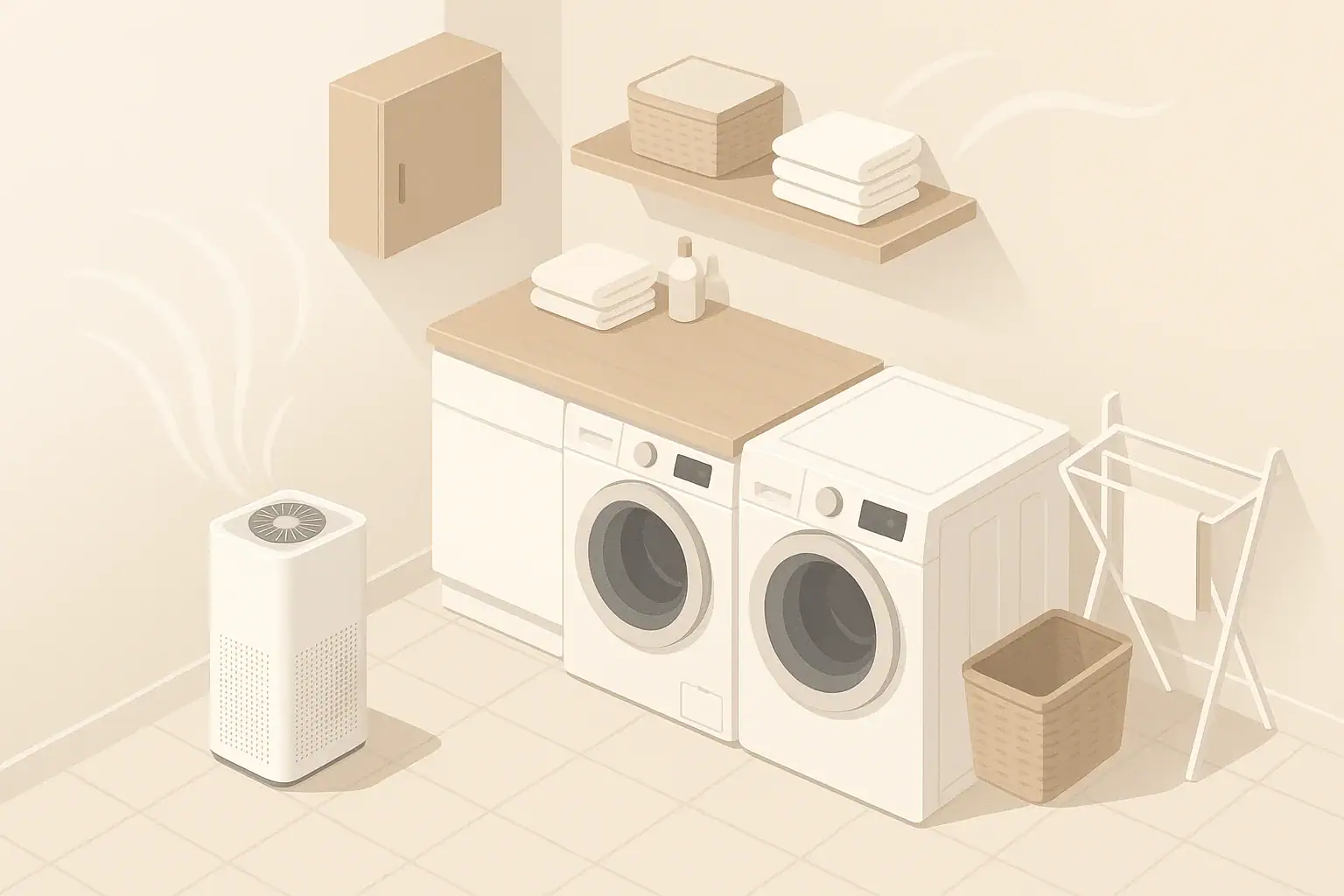
An air purifier can help in a laundry room by capturing airborne lint and fine particles, while activated carbon can reduce some fragrance odors and VOCs; it does not control humidity.
Laundry rooms combine several indoor air quality issues in a small space: fabric lint, detergent fragrance, dryer heat, and occasional dampness. A purifier can be useful, but it works best as one part of a plan that also includes ventilation, source control, and moisture management.
Quick answer
- For lint and dust, choose a sealed purifier with a true HEPA or high-efficiency particle filter and a washable or replaceable prefilter.
- For fragrance odors and some VOCs, look for a substantial activated carbon filter; HEPA alone does not remove gases.
- For sizing, a general target is about 4 to 6 air changes per hour for routine particle control in a closed laundry room.
- Keep indoor relative humidity generally around 30% to 50%; investigate or dehumidify if the room often stays above 60%.
- Place the purifier with several inches of clearance, away from direct heat, water splashes, and the dryer exhaust outlet.
Why laundry room air is different
Laundry rooms are often smaller than bedrooms or living rooms, but they can have concentrated sources of particles, odors, and moisture. Dry towels, fleece, bedding, pet blankets, and cotton fabrics can shed lint. A dryer also moves large amounts of air, which can stir settled dust even when the appliance is working normally.
Fragranced detergents, scent boosters, dryer sheets, and fabric softeners can release odor compounds into the room. These may be noticed as a strong scent rather than measured as a specific pollutant. People vary in fragrance preferences and sensitivities, so the practical goal is usually comfort and odor management rather than a medical outcome.
Humidity is the third issue. Washing machines, utility sinks, damp laundry, and dryer heat can raise moisture levels. An air purifier filters air, but it does not remove water vapor. If the room is humid, a fan, exhaust, dehumidifier, or Ventilation vs Air Purifier: When You Need One, the Other, or Both may be needed.
How to size and choose filters for lint, VOCs, and humidity
Start with the room volume. Multiply floor area by ceiling height. A 100-square-foot laundry room with an 8-foot ceiling has about 800 cubic feet of air.
Clean air delivery rate, or CADR, is commonly expressed in cubic feet per minute. A simple planning formula is: room volume multiplied by target air changes per hour, divided by 60. Using the 800-cubic-foot example, a 5 ACH target would call for about 67 cfm of CADR for particles. This is only a planning estimate, and real performance depends on placement, filter condition, room layout, and fan speed.
Particle filters for lint
A HEPA-type particle filter is the main tool for airborne lint, dust, and fine particles. A prefilter is especially useful in a laundry room because larger lint can load the first layer quickly. A prefilter that can be vacuumed, rinsed if the manual allows, or replaced separately may reduce how fast the main filter clogs.
Carbon for fragrance VOCs and odors
Activated carbon is used for odors and some gases, including certain fragrance-related VOCs. The amount and design of the carbon matter. Thin carbon sheets may help with light odors, while larger carbon beds generally have more capacity. Carbon also saturates over time, so odor return can be a sign that replacement is due.
Humidity needs a separate control
A purifier does not lower relative humidity. If the laundry room often smells musty, has condensation, or stays above about 60% relative humidity, focus on moisture sources. Common steps include using exhaust ventilation, drying spills promptly, avoiding long-term storage of damp clothing, and considering a Dehumidifier for Laundry Rooms: Drying Faster Without Mold Smell where appropriate.
| Issue noticed | Most relevant tool | Why it matters | Practical note |
|---|---|---|---|
| Visible lint or dusty surfaces | Particle filter with prefilter | Captures airborne fabric fibers and dust | Check the prefilter often during heavy laundry weeks |
| Strong detergent or dryer sheet scent | Activated carbon plus source reduction | Carbon can adsorb some odor compounds | Use less fragrance or fragrance-free products if scent is unwanted |
| Room feels damp after laundry | Ventilation or dehumidifier | Purifiers do not remove water vapor | Track relative humidity with a basic hygrometer |
| Musty odor or condensation | Moisture investigation | Damp materials can support odor and surface growth | Look for leaks, poor drying, or restricted airflow |
| Dryer exhaust smell or heat indoors | Appliance vent inspection by a qualified person | Exhaust should be directed safely outdoors where required | Do not modify appliance safety systems |
| Small closet laundry area | Compact purifier and door-airflow plan | Tight spaces can restrict purifier intake | Leave clearance around the unit and avoid blocking vents |
Placement and airflow in a laundry room
Placement can make a small purifier perform noticeably better. Put the unit where air can circulate through the intake and outlet without being blocked by baskets, hanging clothes, doors, or appliances. Many purifiers need at least several inches of clearance, and some need more depending on intake location.
Avoid placing the purifier directly behind the dryer, next to a hot exhaust area, or under a shelf where warm air is trapped. Also keep it away from water splashes from a utility sink or washer hookups. Laundry rooms can be tight, so a side wall, open corner, or nearby hallway-facing position may work better than the floor space between machines.
If the laundry room door is usually closed, size for that smaller room. If the door stays open to a hallway or kitchen, the effective space is larger, and the same purifier may deliver fewer air changes per hour. In an open-plan area, a single small purifier may reduce local particles near the laundry area but is unlikely to manage the entire connected space at the same rate.
Common mistakes and troubleshooting cues
The most common mistake is expecting one device to solve all three issues: lint, fragrance VOCs, and humidity. Air Purifier vs Dehumidifier: Which One Solves Musty Air? is useful context here because air purifiers are strongest for airborne particles, can help with some odors when they include carbon, and do not dehumidify.
- Odor returns quickly: The carbon filter may be saturated, the fan may be too low, or the odor source may be continuous.
- Lint builds up fast on the grille: The prefilter may need more frequent cleaning, or the purifier may be too close to a lint source.
- Room still feels damp: Check humidity, ventilation, damp laundry storage, and plumbing or appliance moisture issues.
- Purifier gets noisy: Filters may be loaded, airflow may be blocked, or the unit may be undersized for the preferred lower fan setting.
- Dust settles nearby: Airflow may be short-circuiting, meaning clean air exits and returns to the intake without mixing through the room.
A basic particle monitor can show whether PM2.5 rises during laundry activity, while a hygrometer can show humidity trends. TVOC readings from consumer monitors can be useful for observing changes, but they are broad indicators and should not be treated as precise chemical analysis.
Practical setup checklist
A calm setup begins with reducing the source load where practical. Cleaning the dryer lint screen before each load is an appliance maintenance step and can also reduce loose lint around the laundry area. Keep the floor and machine tops free of lint piles, and avoid storing damp towels or clothing in a closed room for long periods.
- Measure the room and estimate volume before choosing a purifier size.
- Use a particle filter for lint and dust, and carbon if fragrance odor is a concern.
- Run the purifier on a higher setting during active laundry, then lower it after the room clears.
- Keep baskets, curtains, and hanging garments away from purifier intake and outlet areas.
- Ventilate when outdoor conditions and the room layout allow, especially during strong fragrance use.
- Use a hygrometer and aim for a general indoor range near 30% to 50% relative humidity.
- Address moisture problems directly instead of relying on filtration.
If you prefer very low scent indoors, product choice matters. Fragrance-free detergents and avoiding scent boosters can reduce the odor load before filtration is needed. This is often more effective than trying to remove strong fragrance after it has filled the room.
Real-world laundry room examples
Small enclosed laundry closet
A laundry closet may be only 30 to 60 square feet, but airflow is restricted. A compact purifier can work if it has open intake space and the door is not sealed so tightly that air cannot circulate. In this setup, prefilter maintenance is usually more important than very high CADR.
Utility room with a sink and storage
A larger utility room may have cleaning products, damp mops, pet supplies, and stored textiles. The purifier can help with particles and some odors, but it should not be placed next to chemicals or where splashes are likely. Good storage practices, closed containers, and moisture control reduce the load on the filter.
Basement laundry area
Basement laundry rooms often have cooler surfaces and higher humidity. In this case, a purifier may reduce dust and lint, but humidity control may be the main priority. A Basement Dehumidifier Guide: Targets, Drainage, and Energy Use, drainage plan, and routine humidity checks may be more important than adding more purifier capacity.
Safety, standards, and feature cautions
For a laundry room, prioritize mechanical filtration and adequate carbon over features that intentionally add reactive byproducts to the air. Avoid ozone generators in occupied indoor spaces. If a purifier includes ionization, plasma, or similar electronic features, look for the ability to turn them off and for clear low-ozone safety information from recognized testing programs.
UV-C features are sometimes included in air purifiers, but they are not a substitute for proper particle filtration, carbon capacity, or moisture control. Their effectiveness depends on exposure time, lamp output, and internal design. For most laundry room concerns, filter quality, fit, and airflow are more practical selection factors.
Electrical placement matters because laundry rooms may have water, heat, and vibration. Keep cords away from walkways, sinks, and moving appliances. Do not place a purifier where it could block access to shutoff valves, appliance doors, or service panels.
Maintenance and cost planning
Laundry rooms can load filters faster than cleaner living spaces because lint is a constant source. A visible prefilter is helpful because it shows when maintenance is needed. If airflow drops, the purifier becomes louder, or odors return, check the filters before assuming the unit is too small.
Plan for separate particle and carbon replacement if the purifier uses both. Particle filters may still look usable while carbon is already spent, especially in a heavily fragranced room. Conversely, a low-fragrance laundry room may load the particle filter with lint long before carbon capacity is a concern.
Cleaning around the purifier is part of maintenance. Vacuum or wipe the floor, baseboards, and appliance tops so settled lint does not become airborne again. Follow the appliance and purifier manuals for cleaning steps, and avoid spraying cleaners into the purifier intake.
| Item | Typical interval range | What changes it | Reminder |
|---|---|---|---|
| Prefilter | Every 2 to 4 weeks | Heavy towel loads, pets, fleece, visible lint | Clean sooner if airflow drops |
| Main particle filter | About 6 to 12 months | Run time, fan speed, room dust, filter size | Use the manual and visual condition together |
| Activated carbon filter | About 3 to 6 months | Fragrance use, cleaning products, odor load | Odor return can signal reduced capacity |
| Outer grille and intake | Monthly | Lint accumulation and tight placement | Vacuum gently with the unit unplugged |
| Room surfaces near machines | Weekly to monthly | Laundry volume and fabric type | Remove settled lint before it recirculates |
| Humidity check | Several times per week if dampness is suspected | Basement location, drying habits, ventilation | Investigate frequent readings above 60% |
Related guides: Best Air Purifiers for Allergies: What to Look For (CADR, HEPA, Carbon) • How to Choose the Right Air Purifier for Your Room Size • Air Purifier Placement: Where to Put It for Best Results
Frequently asked questions
Can an air purifier for laundry rooms remove lint from the air?
Yes. A sealed purifier with a true HEPA or similar high-efficiency particle filter can capture airborne lint, dust, and fabric fibers. A washable or replaceable prefilter is especially helpful because laundry-room lint can load filters quickly.
Will an air purifier get rid of detergent and dryer sheet odors?
It can help, but only if it includes enough activated carbon to adsorb odor compounds and some VOCs. Thin carbon layers may reduce light odors, while stronger or persistent fragrance often needs source reduction as well. HEPA filtration alone does not remove gases or odors well.
Does an air purifier lower humidity in a laundry room?
No. Air purifiers filter particles and sometimes gases, but they do not remove water vapor. If the room often feels damp or stays above about 60% relative humidity, use ventilation, leak repairs, better drying habits, or a dehumidifier.
How powerful should a laundry room purifier be?
A practical target is about 4 to 6 air changes per hour for routine particle control in a closed laundry room. To estimate this, multiply room volume by the target air changes and divide by 60 to get a rough CADR goal in cubic feet per minute. Door position, placement, and filter loading can change real-world performance.
Where is the best place to put a purifier in a laundry room?
Place it where air can move freely around the intake and outlet, with several inches of clearance on all sides. Keep it away from the dryer exhaust outlet, hot surfaces, and water splashes from the washer or sink. A side wall or open corner often works better than the narrow space between appliances.
What is the most common mistake people make with laundry-room air quality?
The biggest mistake is expecting one device to solve lint, odor, and humidity all at once. Filtration is good for particles, carbon helps with some odors, and moisture needs its own control strategy. Matching the tool to the problem usually gives better results and lower long-term cost.
Summary takeaways
An air purifier for laundry rooms is most useful for airborne lint and dust when it has a good particle filter, a well-fitting prefilter, and enough CADR for the room volume. Activated carbon can help with some fragrance odors and VOCs, but source control and ventilation are still important.
Humidity is a separate issue. If relative humidity often rises above about 60%, use moisture-control steps such as ventilation, drying practices, leak checks, or a dehumidifier rather than expecting filtration to solve dampness. The most reliable approach is to match the tool to the problem: HEPA-style filtration for particles, carbon for some gases and odors, and humidity control for moisture.
Recommended next:
- Best Air Purifiers for Allergies: What to Look For (CADR, HEPA, Carbon)
- How to Choose the Right Air Purifier for Your Room Size
- Air Purifier Placement: Where to Put It for Best Results
- Do Air Purifiers Help With Smoke and Odors?
- Air Purifier Noise: What dB Levels Are Quiet Enough for Sleep?
- Best Air Purifiers for Pets: Dander, Odors, and Filter Costs
- More in Air Purifiers →
- Clear sizing logic (room size → CADR/ACH)
- HEPA vs carbon explained for real use-cases
- Humidity + ventilation basics to reduce mold risk