
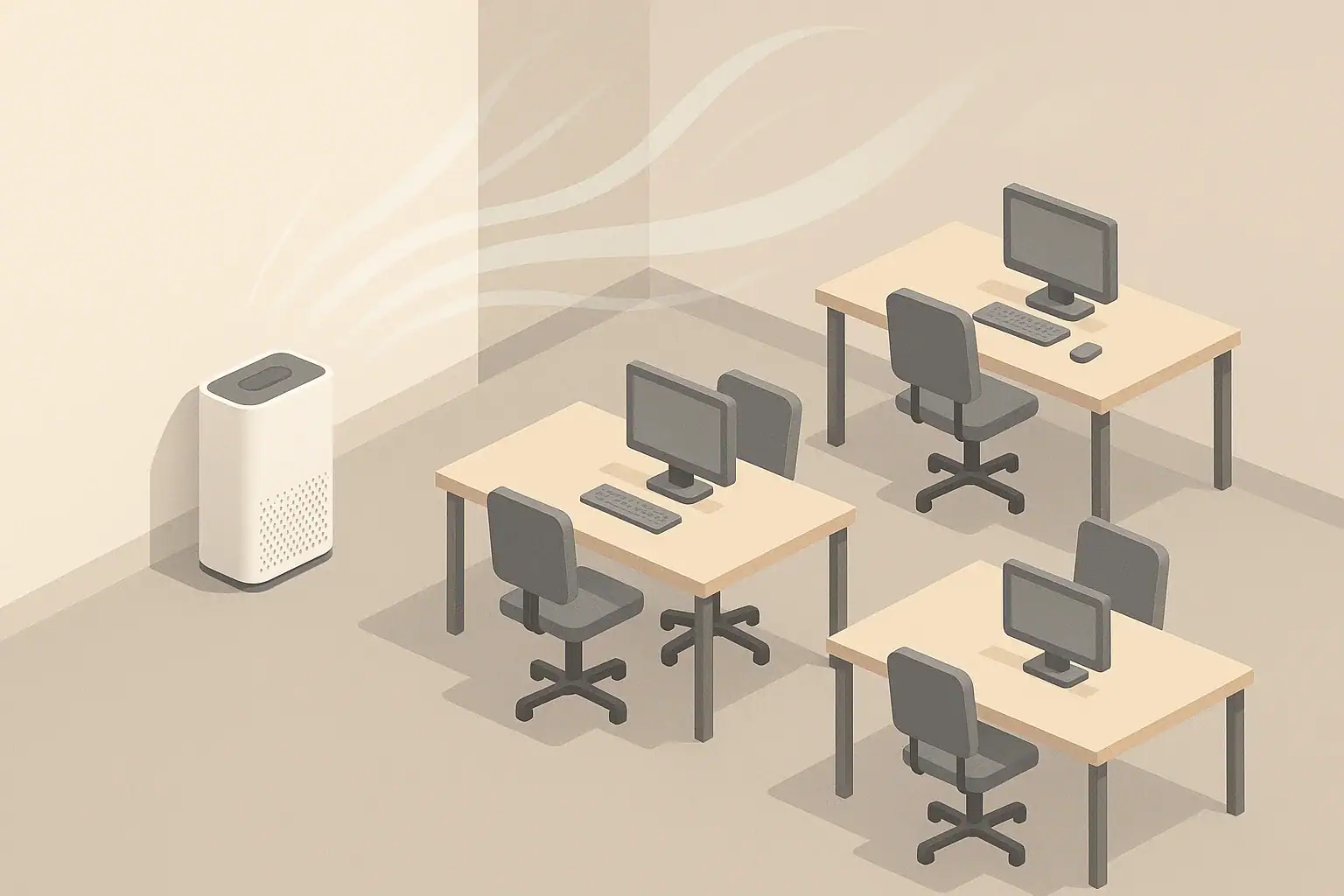
An air purifier for a small office can reduce airborne dust and some odors when it is properly sized, uses the right filters, and is placed where shared air can circulate. It should be viewed as one part of an indoor air quality plan, not a replacement for cleaning, source control, or ventilation. The practical goal is steady air mixing, reasonable noise, and maintenance that staff can actually keep up with.
Quick answer
- For many small offices, plan around roughly 3 to 5 air changes per hour as a general comfort-oriented target.
- Use CADR, not just stated room size, to compare units; CADR in cfm equals room volume times target ACH divided by 60.
- Choose a particulate filter for dust and fine particles, and meaningful activated carbon if odors are a frequent concern.
- Place the purifier where air can enter and leave freely, usually at least 12 to 24 inches from walls or large furniture when possible.
- An air purifier does not remove carbon dioxide from shared air; ventilation is still needed for CO2 and general freshness.
What an Air Purifier Can and Cannot Do in a Small Office
A small office often has a mix of particle sources, odor sources, and shared-air expectations. Dust can come from paper, carpet, clothing fibers, nearby roads, and normal foot traffic. Odors may come from food, cleaning products, furnishings, printers, or restrooms near the workspace.
A portable air purifier is mainly an air-cleaning device for recirculated indoor air. With a good particle filter, it can capture dust, pollen, lint, smoke particles, and other fine particles that pass through the unit. With a suitable activated carbon or other sorbent filter, it can help reduce some odor-causing gases, though odor results vary more than dust results.
What it cannot do is bring in outdoor air. That matters in offices because people exhale carbon dioxide, and CO2 is a useful indicator of ventilation adequacy. If the room feels stale during meetings, a purifier may help with particles, but ventilation or outdoor air exchange is the tool that addresses CO2 buildup. For a broader comparison, see ventilation vs air purifier.
How to Size an Air Purifier for Office Dust and Shared Air
The most useful sizing term is CADR, or clean air delivery rate. CADR is commonly expressed in cubic feet per minute and estimates how much filtered air a purifier delivers for a given particle category. Higher CADR generally means faster particle reduction in the same room, assuming good placement and reasonable filter condition.
Use ACH as the Planning Target
ACH means air changes per hour. For a portable purifier, this refers to equivalent clean air changes from filtered recirculated air, not outdoor ventilation. A common planning range for general small-office use is about 3 to 5 equivalent ACH, with higher targets sometimes preferred for dusty rooms or high-traffic shared spaces.
The simple formula is: required CADR in cfm equals room square footage times ceiling height times target ACH, divided by 60. For example, a 200 square foot office with an 8 foot ceiling has a volume of 1,600 cubic feet. At 4 ACH, the planning CADR would be about 107 cfm.
Match Filter Type to the Problem
For dust and fine particles, look for a well-sealed particulate filter, often described as HEPA or true HEPA. Labels such as H13 and H14 refer to high-efficiency filtration classes, but real-world performance also depends on airflow, filter fit, and leakage around the filter. If you are comparing labels, True HEPA vs HEPA-Type is worth a look.
For odors, activated carbon matters more than HEPA. Thin carbon sheets may help lightly, while deeper carbon beds or heavier sorbent filters are generally more relevant when odor control is a regular need. Even then, the best first step for odors is source control, such as removing old trash, improving food storage, or choosing low-odor products. For more detail, see Activated Carbon Filters Explained.
Table 1: Small office air quality choices by concern. Example values for illustration.
| Office concern | Most relevant action | Why it matters | Practical note |
|---|---|---|---|
| Visible dust on desks | Particle filtration plus cleaning | Filters capture airborne dust, not settled dust | Vacuum and wipe surfaces regularly |
| Fine particles from nearby traffic | Higher CADR particle filtration | More clean air delivery can reduce particle levels faster | Keep windows closed during poor outdoor air periods |
| Food odors | Source control plus carbon | Odors are gases and vapors, not just particles | Empty trash and store food promptly |
| Stale meeting room air | Ventilation check | Purifiers do not remove CO2 | Use outdoor air or HVAC ventilation when available |
| Printer or product smells | Source separation and carbon | Moving sources away lowers exposure in the work area | Follow equipment ventilation guidance |
| Damp or musty smell | Moisture control first | Filters do not fix leaks or damp materials | Investigate humidity and water sources |
Dust, Odors, and Shared Air Expectations
Office air quality expectations are often social as much as technical. One person may notice lunch odors, another may focus on dust, and another may be bothered by fan noise. A good plan sets realistic expectations before the purifier is installed.
For dust, improvement is usually easiest to observe when the unit is appropriately sized and runs during occupied hours. However, a purifier will not stop all dust from settling because much of the larger dust in a room falls out of the air quickly. Cleaning routines, footwear habits, paper storage, and HVAC filter condition all affect results.
For odors, the outcome depends on the source and the amount of sorbent media in the purifier. Carbon becomes used up over time, and odors may return even when the particle filter still looks clean. Strong or persistent odors should be handled by removing or isolating the source rather than relying only on filtration.
For shared air, think in layers. Use ventilation to dilute indoor-generated gases, filtration to reduce airborne particles, cleaning to remove settled dust, and moisture control to avoid dampness-related issues. No single device handles every layer equally well.
Placement and Airflow Checklist for Small Offices
Placement can make a properly sized purifier work better or worse. The unit needs access to room air, and people need to tolerate its sound. In a small office, the best location is often visible, central enough for airflow, and out of the main walking path.
- Keep the air intake and outlet unblocked.
- Avoid squeezing the unit tightly under a desk or behind a cabinet.
- Leave at least 12 to 24 inches of clearance when the layout allows.
- Point the clean-air outlet toward the room, not directly into a wall.
- Do not place the purifier where papers can be pulled against the intake.
- Run it continuously during occupied periods instead of only after odors appear.
- Use a moderate fan speed if the high setting is too distracting for calls or focused work.
Open-plan offices may need more than one unit. A single purifier in a corner may not mix air evenly across cubicles, partitions, or conference areas. Several smaller units can sometimes provide better distribution than one large unit, especially when airflow paths are blocked by furniture.
Small Office Scenarios and Practical Sizing Examples
Consider a two-person office of 120 square feet with an 8 foot ceiling. The room volume is about 960 cubic feet. At 4 ACH, the planning CADR is about 64 cfm, which is relatively modest, but noise and placement still matter. If you need a sharper rule of thumb, a Room Size Calculator for Air Purifiers can help translate room volume into CADR.
A 250 square foot shared office with several desks has a volume of about 2,000 cubic feet with an 8 foot ceiling. At 4 ACH, the planning CADR is about 133 cfm. If the room has partitions or a printer alcove, one purifier may not clean all areas evenly. In those cases, One Big Purifier vs Two Small Ones is a useful comparison.
A small conference room can be different from a daily office because occupancy changes quickly. Six people in a compact room can make the air feel stale even when particle levels are not high. In that case, filtration may help with particles, but ventilation scheduling, open-door periods, or HVAC outdoor air settings may be more important for comfort.
A reception area near an entrance may have more dust from foot traffic and outdoor air. A purifier can help capture airborne particles, but mats, regular vacuuming, and keeping outdoor debris from entering the workspace are also part of the solution.
Safety and Standards to Consider Before Buying
For routine office use, choose a purifier intended to clean air without intentionally producing ozone. Ozone can irritate materials and occupants and is not needed for standard particle filtration. Be cautious with devices that emphasize ozone generation as an air-cleaning method.
Ionizers and other electronic add-ons are common in some air cleaners. They may affect particle behavior, but performance and byproducts can vary by design. If an ionizer is optional, many offices prefer to keep it off unless there is a clear reason to use it and documentation that supports low emissions.
UV-C features are also sometimes included. UV-C effectiveness depends on exposure time, intensity, and design, and it should be fully enclosed so people are not exposed to the light. For most small offices, filter performance, airflow, noise, and maintenance are more important buying criteria than extra technologies.
Also look for practical safety basics: a stable base, a power cord that does not create a trip hazard, and a location away from water sources. Follow the manufacturer instructions for filter installation and do not modify the unit or bypass safety features.
Maintenance, Noise, and Operating Expectations
A purifier only works as expected when air can move through clean, properly seated filters. Offices often forget maintenance because no one clearly owns the task. Assigning responsibility prevents filters from staying in place long after they are loaded with dust or spent carbon. An air purifier maintenance checklist can make that routine easier to manage.
Particle filter replacement intervals vary with dust levels, runtime, and filter size. Carbon filters may need replacement sooner when odor sources are frequent. Washable prefilters, if included, should be cleaned according to instructions so they do not restrict airflow.
Noise planning matters in small offices. A purifier that is tolerable at high speed in a hallway may be distracting beside a desk. Many offices choose a unit large enough to run at a medium setting during calls and focused work, with a higher setting used after cleaning, during low-occupancy periods, or when outdoor particle levels are temporarily elevated.
Energy use is usually modest for a single small-office purifier, but continuous operation still adds cost. To estimate electricity use, multiply wattage by hours of operation, then convert to kilowatt-hours. The more important ownership cost is often filter replacement, especially if both HEPA-style and carbon filters are used.
Table 2: CADR planning examples for small offices. Example values for illustration.
| Room size | Ceiling height note | CADR planning idea | Notes |
|---|---|---|---|
| 100 sq ft | 8 ft ceiling | About 40 to 67 cfm for 3 to 5 ACH | Typical private office or small enclosed room |
| 150 sq ft | 8 ft ceiling | About 60 to 100 cfm for 3 to 5 ACH | Consider noise at desk distance |
| 200 sq ft | 8 ft ceiling | About 80 to 133 cfm for 3 to 5 ACH | Common shared office planning range |
| 300 sq ft | 8 ft ceiling | About 120 to 200 cfm for 3 to 5 ACH | Air mixing and furniture layout matter more |
| 400 sq ft | 8 ft ceiling | About 160 to 267 cfm for 3 to 5 ACH | May need more than one unit for distribution |
| Any room with tall ceilings | Use actual height | Increase CADR with room volume | Square footage alone can understate the need |
Related guides: How to Choose the Right Air Purifier for Your Room Size • Air Purifier Placement: Where to Put It for Best Results • Do Air Purifiers Help With Smoke and Odors?
Frequently asked questions
How big should an air purifier for a small office be?
Size it by CADR and room volume rather than by the marketing room-size claim alone. A practical planning range for many small offices is about 3 to 5 equivalent air changes per hour. Higher CADR is usually better if the room is dusty, crowded, or has a layout that blocks airflow.
Will an air purifier remove stale air or carbon dioxide from a small office?
No, a portable purifier does not remove carbon dioxide because it recirculates indoor air instead of bringing in outdoor air. It can help reduce particles and some odors, but ventilation is still needed for freshness and CO2 control. If a meeting room feels stuffy, improving outdoor air exchange is usually the right fix.
What filter is best for dust in a small office?
A well-sealed particle filter, often described as HEPA or true HEPA, is the most relevant choice for dust and fine airborne particles. The filter fit and overall airflow matter as much as the label. Settled dust still needs regular cleaning because a purifier mainly captures particles that are already suspended in the air.
Do I need activated carbon for office odors?
Activated carbon is the more useful feature when odors are part of the problem. Thin carbon layers may help only a little, while more carbon media is generally better for repeated odors from food, trash, or equipment. For strong or persistent odors, source control is still the first step.
Where should I place a purifier in a small office?
Place it where air can move freely, with the intake and outlet unobstructed. In many rooms, that means keeping it at least 12 to 24 inches from walls or large furniture when possible. Avoid hiding it under a desk or behind a cabinet, since that can reduce performance and increase noise annoyance.
Should a small office purifier run all day?
For occupied spaces, continuous operation is usually more effective than turning it on only after odors appear. Running it during work hours helps keep particle levels steadier and reduces the chance of short-term buildup. If noise or energy use is a concern, a medium setting is often a good compromise.
Summary: Practical Takeaways for Small Offices
An air purifier for small offices is most useful when it is sized by CADR, matched to the main concern, and placed for unobstructed airflow. Particle filtration is the key feature for dust and fine particles, while activated carbon is the more relevant feature for many odors.
Use ventilation for CO2 and stale shared air, cleaning for settled dust, and source control for persistent smells. Plan around realistic ACH targets, acceptable noise, and a simple filter replacement routine. The best small-office setup is usually not the most complicated one; it is the one that runs consistently, fits the room, and supports everyday comfort without overstating what a purifier can do.
Recommended next:
- Best Air Purifiers for Allergies: What to Look For (CADR, HEPA, Carbon)
- How to Choose the Right Air Purifier for Your Room Size
- Air Purifier Placement: Where to Put It for Best Results
- Do Air Purifiers Help With Smoke and Odors?
- Air Purifier Noise: What dB Levels Are Quiet Enough for Sleep?
- Best Air Purifiers for Pets: Dander, Odors, and Filter Costs
- More in Air Purifiers →
- Clear sizing logic (room size → CADR/ACH)
- HEPA vs carbon explained for real use-cases
- Humidity + ventilation basics to reduce mold risk