
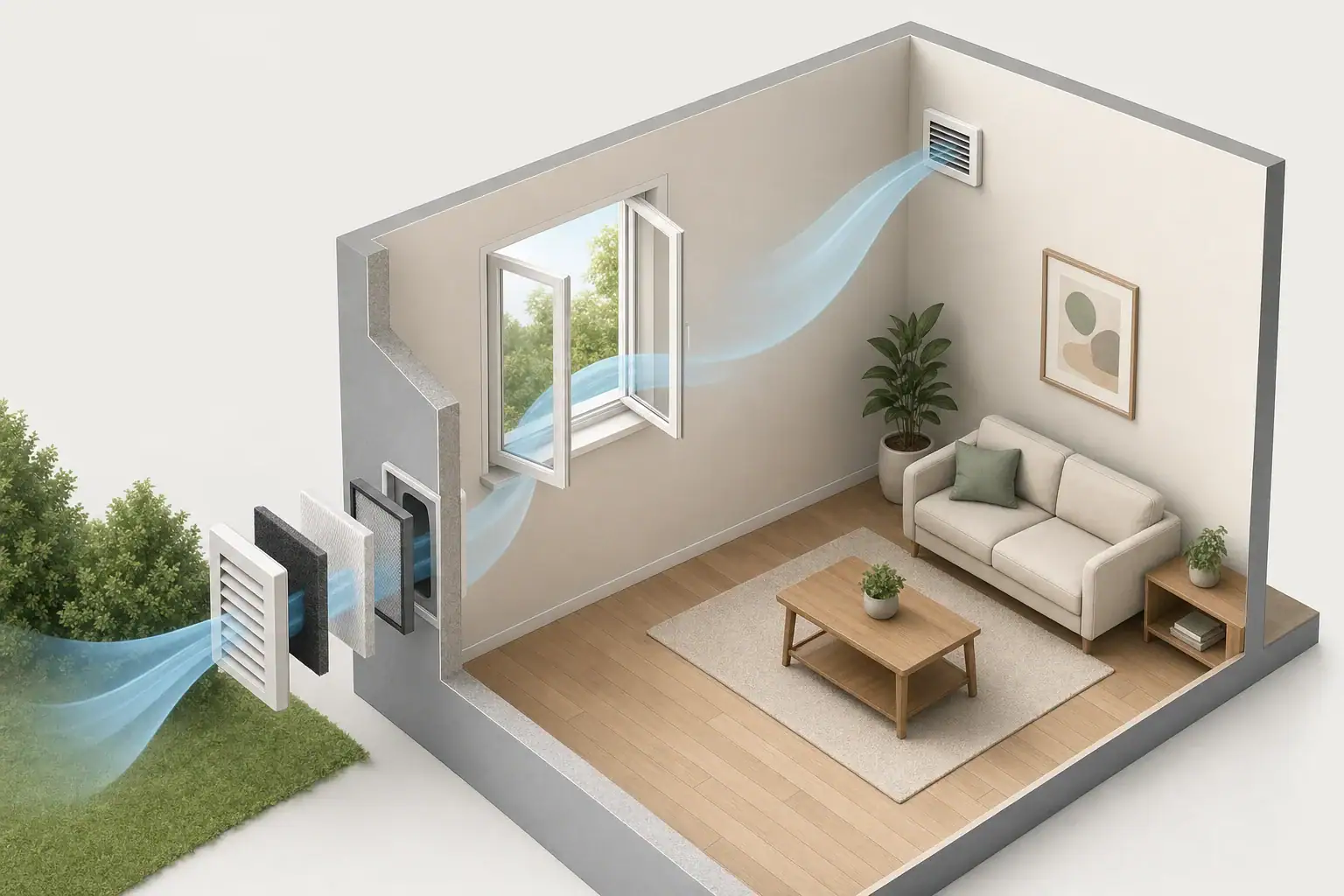
Outside air needs filtering at a fresh air intake when it regularly carries particles, smoke, pollen, insects, or debris into the home or ventilation equipment.
The right filter depends on the intake design, outdoor conditions, required airflow, and the equipment’s allowable resistance. Filtration should improve incoming air without restricting ventilation or unbalancing the system.
Quick answer
- Use the filter type and size specified for the intake, ventilator, or HVAC equipment.
- For many compatible residential systems, filters in the MERV 8–13 range provide a practical starting point for particle control.
- Inspect a new installation monthly at first; many intake filters need attention every 1–6 months, depending on conditions.
- Choose a filter with enough surface area to handle the intake airflow without excessive pressure drop.
- Particle filters do not reliably remove most gases or odors; substantial activated carbon media may be needed for those concerns.
What a Fresh Air Intake Filter Does
A fresh air intake is an opening or duct that deliberately brings outdoor air into a home. It may serve a heat-recovery ventilator, energy-recovery ventilator, central HVAC system, dedicated supply fan, or passive wall inlet.
The intake filter intercepts material before it reaches occupied rooms or internal equipment. Depending on its efficiency, it may capture insects, lint, larger dust, pollen, fine particles, and some smoke particles. This can also help keep ducts, fans, heat-exchange cores, and coils cleaner.
A filter does not make all outdoor air contaminants disappear. Standard particle filters have limited ability to remove gases from vehicle exhaust, wildfire odors, solvents, or other volatile organic compounds. Activated carbon can adsorb some gases, but performance depends on the amount of carbon, contact time, contaminant, humidity, and replacement schedule.
Fresh air filtration is different from running a portable air purifier. An intake filter treats outdoor air as it enters, while a portable purifier repeatedly filters air already inside a room. Some homes benefit from both approaches, especially where outdoor conditions vary.
How to Choose Filter Efficiency and Airflow Capacity
Filter selection involves a tradeoff between particle efficiency and airflow resistance. A filter that captures smaller particles generally creates more resistance than a coarse screen, although media area, depth, construction, loading, and airflow speed also matter.
Understand MERV and HEPA ratings
MERV is commonly used to describe the particle-removal efficiency of HVAC filters. A higher rating generally means better capture of smaller particles. MERV 8–13 is a common practical range for residential equipment that is designed to accept those filters, but compatibility matters more than choosing the highest number.
HEPA filters provide higher particle efficiency than typical residential HVAC filters, but they can also require a purpose-built housing, strong seals, and a fan selected for the associated pressure drop. A filter labeled H13 or H14 should not be placed in a standard intake unless the complete system was designed for it. Filter-media efficiency alone does not account for air leaking around the frame.
Match the filter to the airflow
Intake airflow is usually stated in cubic feet per minute, or cfm. The filter and housing must be rated to pass the required cfm while staying within the equipment’s pressure limits. A small filter pushed to a high airflow can become restrictive and may load quickly.
Increasing filter surface area can reduce face velocity and resistance. Deep pleats or a larger filter cabinet may offer more usable media area, but changes to a ventilation system should be designed or approved by a qualified HVAC professional.
Check seals and bypass
Air follows the easiest path. Gaps around a filter can allow incoming air to bypass the media, reducing real-world performance even if the filter itself has a high rating. The filter should fit its designated rack correctly, with intact gaskets and the airflow direction oriented as specified.
Example values for illustration.
| Outdoor concern | Practical starting point | Important limitation |
|---|---|---|
| Insects and large debris | Weather hood screen and coarse prefilter | Limited fine-particle capture |
| General dust | Compatible pleated particle filter | Check airflow resistance |
| Pollen | MERV 8–13 where supported | Seal gaps around the frame |
| Fine particles or smoke | Higher-efficiency compatible media | May load quickly during heavy events |
| Traffic or smoke odors | Particle filter plus substantial carbon media | Carbon does not remove every gas |
| High outdoor humidity | Ventilation with appropriate moisture control | A particle filter does not dehumidify |
| Mixed or changing conditions | Staged prefilter and final filter | Each stage requires maintenance |
Common Fresh Air Intake Filter Mistakes
Installing the highest-efficiency filter that physically fits is a common mistake. Filter thickness does not prove compatibility, and excessive resistance can reduce outdoor airflow, increase fan energy use, create noise, or unbalance a balanced ventilation system.
Another mistake is overlooking the outdoor intake location. An intake placed near a dryer vent, plumbing vent, garage opening, idling area, grill, or other exhaust source can draw pollutants toward the home. Required separation distances vary by system and local code, so intake placement should be evaluated before relying on filtration.
Other warning signs include:
- Whistling, fluttering, or unusual fan noise after changing filters
- Noticeably weaker airflow at ventilation supply grilles
- A filter that collapses, bends, or pulls away from its frame
- Dust tracks around the filter edge, suggesting bypass
- A filter that becomes wet or develops persistent musty odors
- Rapid loading caused by construction dust, wildfire smoke, or nearby landscaping
Do not solve low airflow by removing a filter that the equipment requires. Verify the correct filter, inspect for blockage, and have airflow or pressure measured if the cause is unclear.
Fresh Air Intake Filter Checklist
Begin by identifying the type of ventilation system. A passive wall inlet, central HVAC intake, and balanced heat-recovery ventilator have different airflow and filtration requirements. Review the equipment documentation before purchasing replacement media.
Before selecting a filter
- Confirm the exact length, width, and thickness required by the filter rack.
- Find the recommended filter class and maximum allowable pressure drop.
- Identify whether the system uses one filter or separate outdoor-air and return-air filters.
- Consider local sources such as pollen, road dust, seasonal smoke, or construction.
- Check whether odor control is actually needed in addition to particle control.
During installation
- Turn off the equipment using its normal controls when the manual requires it.
- Install the filter in the marked airflow direction.
- Make sure the frame sits squarely and the access panel closes fully.
- Do not cut, fold, stack, or force filters into an incompatible rack.
- Record the installation date in a maintenance log rather than on exposed equipment if markings are discouraged.
After installation
Confirm that the system runs normally and that supply airflow remains steady. If the filter creates new noise, pressure problems, or fault indications, return to the specified filter and arrange a professional assessment rather than modifying the fan or safety controls.
Real-World Home Ventilation Examples
House in a high-pollen area
A home with a balanced ventilator may use a coarse prefilter followed by a compatible pleated filter. The prefilter catches larger debris, while the final filter handles smaller particles. During peak pollen periods, monthly inspections can reveal whether the normal replacement schedule is adequate.
Home affected by seasonal wildfire smoke
Fine-particle filtration can reduce the amount of outdoor smoke particles entering through a mechanical intake. Filters may load faster during prolonged smoke events, so airflow and filter condition need closer attention. Odor may remain because particle media does not capture all smoke gases.
Apartment with passive wall vents
Small wall inlets often use simple pads or screens and may not support high-resistance filters. Blocking or overpacking these inlets can interfere with designed ventilation and building pressure. Renters should use approved replacement media and coordinate alterations with property management.
Urban home near traffic
A particle filter may reduce soot and road dust, while a properly designed carbon stage may help with some gaseous contaminants or odors. Thin carbon-coated pads have limited capacity and should not be treated as equivalent to a deep bed of carbon media.
Safety, Moisture, and Indoor Air Quality Considerations
Fresh air serves an important ventilation function. Restricting or closing an intake can allow carbon dioxide, moisture, odors, and indoor-generated pollutants to accumulate. A carbon dioxide monitor can help show broad ventilation patterns in occupied rooms, but it does not measure every pollutant or directly test filter performance.
Homes with fuel-burning appliances require additional care. Changing ventilation airflow or building pressure can affect combustion and exhaust behavior. A qualified professional should evaluate major intake changes, especially where natural-draft appliances, fireplaces, or powerful exhaust fans are present. Working carbon monoxide alarms should be maintained as required for the home.
Filters should remain dry. An intake hood must shed rain and snow, while the duct and cabinet should be installed to control condensation. Repeatedly wet filters can restrict airflow and support unwanted biological growth. Replacing the filter without correcting the moisture source is not a lasting solution.
Ionizers and ozone-generating devices are not substitutes for mechanical intake filtration. Ozone is a lung irritant and should not be intentionally generated in occupied residential spaces. UV-C may be used in purpose-designed HVAC applications for surface or coil management, but it does not replace particle filtration and requires safeguards against direct exposure and material damage.
Maintenance and Replacement Planning
There is no universal replacement interval for a fresh air intake filter. Outdoor particle levels, operating hours, filter area, efficiency, weather, nearby construction, and fan airflow all affect loading. The equipment manufacturer’s limit or a measured pressure-drop threshold is more useful than appearance alone.
For a new system or filter type, inspect monthly for the first season. That creates a local maintenance pattern. A lightly used intake in a clean setting may go several months between replacements, while smoke, pollen, or construction can shorten the interval substantially.
Clean reusable screens only as directed and let washable components dry completely before reinstalling them. Disposable media should not be vacuumed or washed unless it is specifically designed for that treatment, because cleaning can damage fibers without restoring full performance.
Maintenance costs should account for every filter stage, not just the final filter. Keeping one or two correctly sized replacements available can be practical during pollen or smoke seasons, provided they are stored sealed, flat, and dry.
Example values for illustration.
| Filter component | Starting interval | What can shorten it | Maintenance note |
|---|---|---|---|
| Exterior insect screen | Inspect every 1–3 months | Leaves, insects, snow, lint | Clear only by approved methods |
| Washable coarse prefilter | Inspect monthly; clean as needed | Dust, pollen, nearby vegetation | Dry fully before reinstalling |
| Basic disposable intake filter | About 1–3 months | Continuous operation, dusty conditions | Follow equipment instructions |
| Deep pleated particle filter | About 3–6 months | Smoke, high airflow, smaller filter area | Use pressure drop when available |
| Higher-efficiency final filter | About 3–12 months | Heavy particle loading, prefilter failure | Do not exceed the specified limit |
| Activated carbon stage | About 1–6 months | Strong odors, humidity, low carbon mass | Replace when performance declines |
Related guides: ERV vs HRV: What They Do for Indoor Air Quality • Wildfire Smoke Indoors: Step-by-Step Plan to Lower PM2.5 Fast • MERV 13 vs HEPA: What the Numbers Mean for Indoor Air
Fresh Air Intake Filter Takeaways
A fresh air intake filter is useful when outdoor air brings particles or debris into a mechanical or passive ventilation opening. The filter must match the equipment, required airflow, housing size, and contaminants of concern.
For many homes, a compatible pleated particle filter, secure edge seal, and regular inspection provide a practical foundation. Higher efficiency is helpful only when the fan and filter housing can support it without excessive resistance.
Particle filtration, gas control, ventilation, and humidity management are separate functions. Treating them as parts of one indoor air quality plan makes it easier to choose appropriate equipment, recognize limitations, and maintain dependable airflow.
Frequently asked questions
What MERV rating should I use for a fresh air intake filter?
Use the filter rating specified or permitted by the intake, ventilator, or HVAC equipment manufacturer. MERV 8–13 is often a practical residential range where the system can handle the associated pressure drop. A higher MERV rating is not automatically better if it reduces required outdoor airflow or causes noise and system imbalance.
How often should a fresh air intake filter be changed?
Replacement timing depends on outdoor conditions, operating hours, filter area, and the filter’s pressure drop rather than on a single universal schedule. Inspect a new filter setup monthly during the first season, then adjust the schedule based on loading and equipment guidance. Smoke, pollen, construction dust, and nearby vegetation can require more frequent service.
Can a fresh air intake filter remove wildfire smoke and odors?
A compatible higher-efficiency particle filter can reduce some smoke particles entering through a mechanical intake. It will not reliably remove all smoke odors or gases, which may require a properly designed activated-carbon stage with enough media capacity. During smoke events, filters can load quickly, so airflow and filter condition should be checked more often.
Is it safe to install a HEPA filter on a fresh air intake?
A HEPA filter should only be used when the complete intake system is designed for its resistance, sealing requirements, and airflow needs. Installing one in a standard filter rack can excessively restrict ventilation and allow air to bypass the media around the frame. Consult the equipment documentation or a qualified HVAC professional before making that change.
Why is my fresh air intake filter wet or musty?
A wet or musty filter can result from rain entry, snow, condensation, or another moisture problem at the intake hood, duct, or filter cabinet. Replace the affected filter and correct the moisture source, because repeated wetting can restrict airflow and encourage unwanted biological growth. Do not reinstall washable media until it is fully dry.
Recommended next:
- Ventilation vs Air Purifier: When You Need One, the Other, or Both
- CO2 in Bedrooms: What Levels Mean and How to Improve Air Exchange
- How to Ventilate in Winter Without Freezing: Practical Strategies
- Exhaust Fan Best Practices: Bathrooms and Kitchens That Actually Clear Air
- Air Exchange Basics: ACH, Infiltration, and Why “Stuffy” Happens
- ERV vs HRV: What They Do for Indoor Air Quality
- Clear sizing logic (room size → CADR/ACH)
- HEPA vs carbon explained for real use-cases
- Humidity + ventilation basics to reduce mold risk