
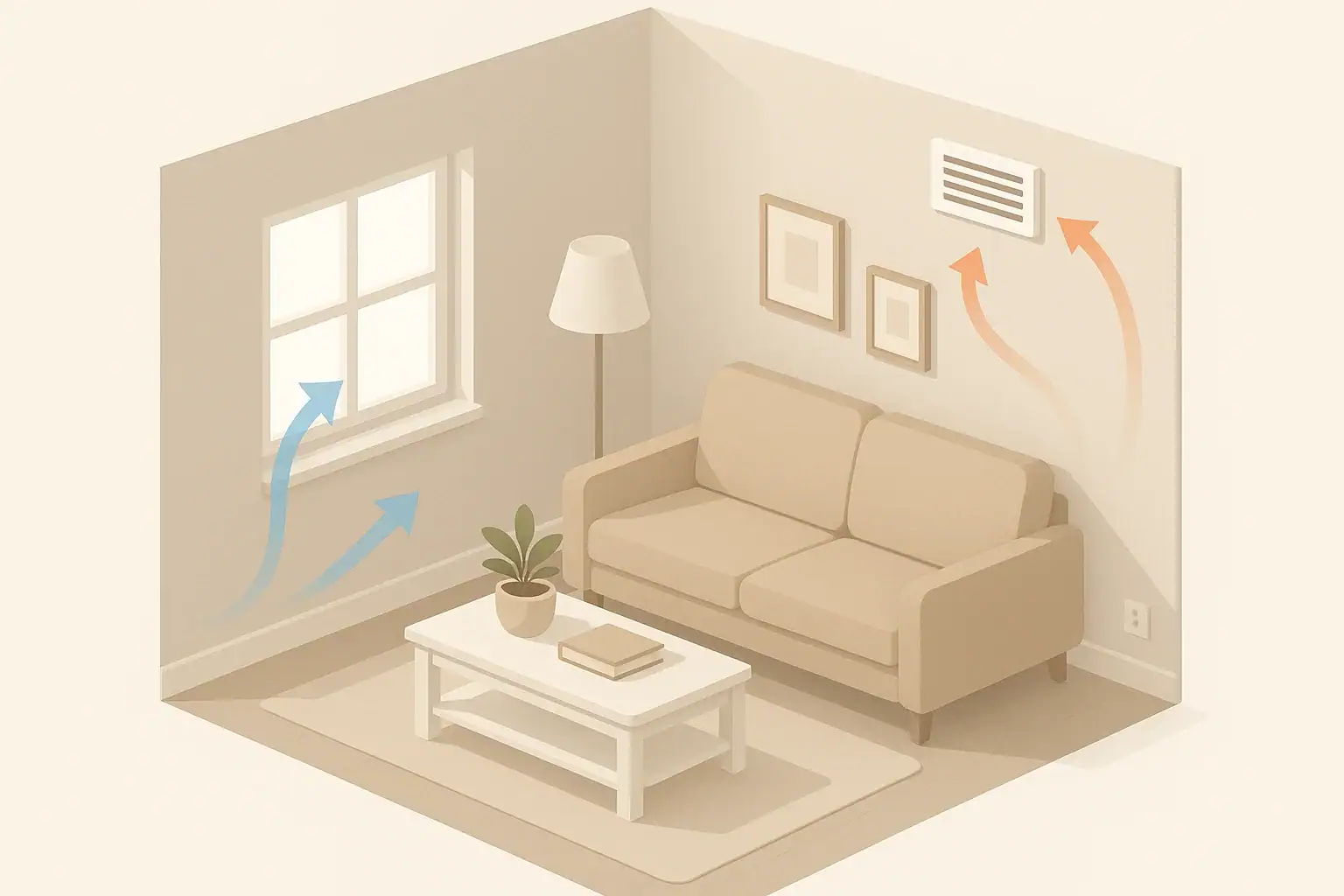
Energy recovery ventilators (ERVs) and heat recovery ventilators (HRVs) both bring in outdoor air and exhaust stale indoor air while transferring heat between the two air streams to support indoor air quality and comfort.
They are balanced mechanical ventilation systems designed to improve air exchange without wasting as much heating or cooling energy as simply opening windows. Understanding how each handles heat, moisture, and different climates helps you choose the option that fits your home and comfort needs.
- Both ERVs and HRVs improve indoor air quality by bringing in filtered outdoor air and exhausting stale indoor air.
- HRVs transfer heat only; ERVs transfer both heat and some moisture between incoming and outgoing air.
- HRVs are often favored in colder, drier winter climates; ERVs are often favored where indoor air tends to get too dry or summers are humid.
- Typical whole‑house systems aim for about 0.3–0.5 air changes per hour (ACH) as a general ventilation target.
- ERV/HRV systems support, but do not replace, good filtration (for particles), humidity control, and source control of pollutants.
What ERVs and HRVs Are and Why They Matter
Modern homes are often tightly built, which is good for energy efficiency but can trap indoor pollutants such as cooking emissions, cleaning product vapors, and general household odors. Mechanical ventilation with heat or energy recovery provides a predictable way to exchange indoor and outdoor air while reducing the energy penalty.
An HRV transfers heat from the warmer air stream to the cooler one. In winter, it pre-warms incoming cold air using heat from outgoing indoor air; in summer, it can help pre-cool incoming warm air. An ERV does the same but also transfers a portion of moisture (water vapor) between the air streams through a special core.
Both systems can help:
- Reduce buildup of indoor carbon dioxide (CO₂) from people breathing.
- Dilute indoor-generated pollutants and odors.
- Support more stable humidity when matched appropriately to climate and house conditions.
- Lower the need to open windows in extreme hot or cold weather.
Key Concepts: How ERVs and HRVs Work
ERVs and HRVs are typically ducted systems with two main air paths: outdoor air coming in and indoor air going out. The air streams pass through a core that allows heat (and in ERVs, some moisture) to transfer between them without mixing the actual air.
Basic airflow pattern
- Supply side: Outdoor air is pulled in, passes through filters and the core, and is delivered to living areas.
- Exhaust side: Stale air from bathrooms, kitchens (not usually the main cooking range hood), or central locations is pulled out and passed through the core before going outside.
- Balanced flow: ERVs/HRVs are generally designed so supply and exhaust airflow are similar, helping keep indoor pressure near neutral.
Heat transfer vs moisture transfer
- HRV: Transfers sensible heat (temperature). Moisture mostly stays where it is.
- ERV: Transfers sensible heat and some latent heat (moisture). Moisture migrates from the more humid air stream toward the drier one.
In winter, an ERV may help keep indoor humidity from dropping as quickly by transferring moisture from outgoing humid indoor air back into incoming dry outdoor air. In humid summers, it can reduce the amount of moisture brought into the house by transferring some of that moisture to the outgoing indoor air stream.
Ventilation and indoor air quality basics
Mechanical ventilation helps maintain indoor air quality by providing a reasonably steady air change rate. A commonly cited planning range for continuous residential ventilation is around 0.3–0.5 air changes per hour (ACH) as a general target, but actual needs depend on home size, occupancy, and local codes.
An ERV or HRV focuses on fresh air and dilution. It is not a direct substitute for:
- High-efficiency filtration for particles such as dust and smoke (HEPA or good furnace filters).
- Dedicated humidity control devices like dehumidifiers or humidifiers when conditions are extreme.
- Source-specific exhaust (e.g., kitchen range hoods and bathroom fans) for moisture and odors.
Example values for illustration.
| Aspect | HRV | ERV |
|---|---|---|
| What is transferred | Heat only | Heat and some moisture |
| Main ventilation goal | Fresh air with heat recovery | Fresh air with heat and moisture moderation |
| Typical climate fit (example) | Cold, relatively dry winters | Humid summers or very dry winters |
| Indoor humidity effect (winter) | Indoor air can dry out faster | Helps retain more indoor moisture |
| Indoor humidity effect (humid summer) | Brings in outdoor humidity | Can reduce humidity load on AC |
| Filter role | Protects core and fans, basic particle control | Same; may have similar filter needs |
| Common IAQ benefit | Dilutes indoor pollutants effectively | Dilutes pollutants and moderates dryness/humidity |
Choosing Between ERV and HRV: Key Sizing and Climate Logic
Choosing between an ERV and an HRV is largely about climate, how tight and insulated the home is, and how your household tends to operate. Sizing is about matching airflow to house volume and expected occupancy.
Climate and humidity considerations
- Cold, dry winter climates: HRVs are commonly used. Indoor air can get quite dry in winter; some homeowners prefer ERVs here to help retain moisture, but this can depend on how humid the indoor air already is from cooking, showers, and occupancy.
- Humid summer climates: ERVs are often favored because they can reduce the amount of moisture that enters the home with fresh air, helping air conditioning work more efficiently.
- Mixed climates: Either can work. The choice may come down to how often humidity is too high vs too low and whether comfort or energy considerations are prioritized.
Basic airflow sizing ideas
Ventilation rates are often set based on:
- Home floor area and ceiling height (total volume).
- Number of occupants or bedrooms as a proxy.
- Local code or standard references that provide minimum continuous ventilation rates (for example, a target cfm per square foot or per person).
A common planning approach is to target a whole-house ACH of roughly 0.3–0.5 for continuous mechanical ventilation, with higher rates in smaller, more heavily occupied homes. This is a general range, not a strict rule, and local codes or standards may differ.
How ERVs/HRVs interact with other systems
- With central heating/cooling: Systems can be ducted to supply air to main trunks or dedicated supply grilles. Coordination helps distribute fresh air evenly.
- With exhaust fans: Bathroom fans and range hoods are still useful for short bursts of higher exhaust when cooking or showering.
- With portable air purifiers: ERVs/HRVs manage fresh air; purifiers manage particles and some gases in specific rooms.
Common Mistakes and Troubleshooting Cues
Even a well-chosen ERV or HRV can underperform if installed or operated incorrectly. Many issues are related to airflow balance, duct design, and maintenance.
Frequent pitfalls
- Improper sizing: An undersized unit may not provide enough fresh air; an oversized unit may increase drafts and energy use if not controlled well.
- Poor duct layout: Long, restrictive ducts, sharp bends, or too many branches can reduce actual airflow compared to the unit’s rating.
- Imbalanced supply and exhaust: If exhaust is much higher than supply, the home can become slightly depressurized; if supply dominates, it can become slightly pressurized. Either condition can affect comfort and building envelope performance.
- Dirty or missing filters: Clogged filters reduce airflow and stress fans; missing filters allow dust and debris into the core.
- Incorrect control settings: Running on very low speed constantly may not provide enough ventilation during high-occupancy periods; running on high speed unnecessarily may waste energy.
Signs something may need attention
- Persistent odors in living areas despite the system running.
- Condensation on windows or walls in cold weather, suggesting high indoor humidity and insufficient air exchange.
- Very dry air (static shocks, dry throat) in winter when using an HRV at high rates in a dry climate.
- Unusual noises from the unit or ductwork, indicating airflow or mechanical issues.
- Noticeably dusty filters shortly after cleaning or replacement, indicating heavy dust load that might call for more pre-filtration or cleaning of ducts and intakes.
Practical Guidance: How to Decide and What to Ask For
Before choosing an ERV or HRV, it helps to clarify your main comfort concerns and how your home behaves through the seasons.
Questions to consider
- Does your home feel too dry in winter (nose, skin, static), or does it feel stuffy and humid with condensation on windows?
- Is your region known for long, humid summers with heavy air conditioning use?
- Is the house new and tight, or older and somewhat leaky?
- How many people usually occupy the home, and are they home most of the day?
- Are there specific indoor air quality goals, such as reducing cooking odors or supporting comfort for people with sensitivities to poor air quality?
Simple decision tendencies
These are general tendencies, not rigid rules:
- Leaning toward HRV: Cold climate, winter indoor humidity generally acceptable or high, main goal is steady fresh air with efficient heat recovery.
- Leaning toward ERV: Humid summers, house often feels muggy, or winters are so dry that some moisture recovery would be helpful.
- Either could work: Moderate climate, no extreme humidity issues, main goal is predictable fresh air and energy savings.
What to discuss with a professional
- Expected ventilation rate in cfm and corresponding ACH for your home size.
- Location of supply and exhaust grilles for good distribution.
- Filter types and sizes, and how easy they are to access.
- Drainage needs (if any) and service access for the core.
- Control strategy: continuous low-speed, intermittent high-speed, or demand-based control (for example, linked to occupancy or humidity sensors).
Real-World Examples: ERV vs HRV in Different Homes
Looking at typical scenarios can make the ERV vs HRV choice more concrete. These are simplified examples; actual decisions should reflect specific home details.
Example 1: Cold, dry winter region
A well-insulated house in a region with long, cold winters and low outdoor humidity uses a high-efficiency furnace. The homeowners notice winter air feels dry but manageable, and the main complaint is stuffy air with closed windows. An HRV might be selected to provide steady fresh air and heat recovery, with the option to add a humidifier if indoor air becomes uncomfortably dry.
Example 2: Humid summer, air-conditioned house
A tight, newer home in a warm, humid climate relies heavily on air conditioning in summer. Indoor air can feel muggy when windows are closed for long periods. An ERV may help by reducing the moisture that enters with outdoor air, supporting the air conditioner’s ability to control humidity and maintaining more comfortable indoor conditions.
Example 3: Mixed climate, concern about dryness
A family in a mixed climate region experiences both cold winters and humid summers. They run heat in winter and central air in summer. Winter air feels uncomfortably dry when the furnace runs often. In this case, an ERV might be chosen over an HRV to moderate winter dryness while still helping with humidity during humid periods.
Example 4: Older, somewhat leaky house
An older home with noticeable drafts may already have significant uncontrolled air exchange. Here, the first step may be to improve air sealing and basic exhaust ventilation. After tightening the house, adding an ERV or HRV can then provide controlled, balanced ventilation that is easier to size and manage.
Safety, Standards, and Indoor Air Quality Considerations
ERVs and HRVs are generally considered safe when properly installed and maintained, but there are important safety and standards-related points to keep in mind.
Combustion appliances and backdrafting
Homes with combustion appliances such as gas furnaces, boilers, or water heaters need to be evaluated for potential backdrafting risks. An imbalanced ventilation system that depressurizes the home could affect how combustion byproducts are exhausted. Building codes and best practices typically require attention to pressure balance and proper venting of combustion appliances.
Filtration and outdoor air quality
Because ERVs and HRVs bring in outdoor air, the quality of that air matters. When outdoor air is affected by wildfire smoke, heavy traffic, or other pollution events, filters on the intake become especially important. Many units use standard-sized filters that can be selected in different efficiency ratings, but very high-efficiency filters can add resistance and reduce airflow if the fan and duct design do not account for them.
Ozone, ionizers, and UV-C add-ons
Some ventilation or duct-related products may include optional features such as ionizers or UV-C lights. These technologies are separate from the core function of ERVs and HRVs.
- Ozone: Intentional ozone generators are generally not recommended for occupied spaces due to potential respiratory irritation.
- Ionizers: Ionization devices may affect particle behavior but can have byproducts; performance and safety can vary.
- UV-C: UV-C lamps are used in some systems for surface disinfection or coil cleanliness but need proper shielding, mounting, and maintenance to avoid direct exposure.
If such features are considered, it is reasonable to ask for data from recognized testing where available and to ensure they do not interfere with basic ventilation performance or maintenance.
Maintenance and Upkeep: Keeping ERVs and HRVs Effective
Regular maintenance supports both indoor air quality and equipment longevity. Most tasks are straightforward but need to be done consistently.
Routine tasks
- Filter cleaning/replacement: Inspect filters every 1–3 months at first, then adjust the schedule based on how quickly they load with dust. Replace or clean according to manufacturer instructions.
- Core inspection: The heat or energy recovery core should be checked periodically for dust buildup and cleaned as specified. Some cores are washable; others must be handled more carefully.
- Intake and exhaust grilles: Outdoor hoods and screens can accumulate leaves, insects, or dust. Clear obstructions to maintain airflow.
- Condensate management: Some systems produce condensate, especially in cold weather. Ensure any drain lines are clear.
- Controls and settings: Periodically verify that timers, speed settings, or any demand controls still match how the home is used.
Signs maintenance may be overdue
- Noticeable decrease in airflow from supply or exhaust grilles.
- Increased noise from the unit or ducts.
- Visible dust buildup on intake screens or around grilles.
- Musty odors from the unit or ducts when the system starts.
Building ERV/HRV checks into seasonal home maintenance (for example, spring and fall) can keep ventilation performance more consistent.
Example values for illustration.
| Component | Typical interval range | What changes it | Reminder |
|---|---|---|---|
| Intake/exhaust pre-filters | 1–3 months | Dusty area, pollen season, nearby traffic | Check monthly at first to set a pattern |
| Main ERV/HRV filters | 3–6 months | Filter efficiency, indoor dust sources | Mark change dates on a calendar |
| Heat/energy recovery core cleaning | 6–12 months | Outdoor air quality, filter performance | Inspect annually, clean as needed |
| Outdoor intake hood and screens | 2–4 times per year | Leaves, insects, wind-blown debris | Combine with seasonal yard cleanup |
| Fan and motor inspection | Every 1–2 years | Operating hours, dust loading | Listen for changes in sound or vibration |
| Professional system check | Every 1–3 years | Age of system, complexity of ducting | Verify airflow balance and overall function |
Related guides: Ventilation vs Air Purifier: When You Need One, the Other, or Both • CO2 Ventilation Calculator: Fresh-Air Needs for Bedrooms • Air Purifier vs Ventilation: Which Fixes Stuffy Bedrooms Better?
Summary: What ERVs and HRVs Do for Indoor Air Quality
ERVs and HRVs improve indoor air quality by providing balanced, controlled ventilation that exchanges indoor and outdoor air while recovering heat, and in the case of ERVs, some moisture. This helps dilute indoor pollutants, manage odors, and maintain more stable temperature and humidity compared with simple exhaust-only systems or opening windows in extreme weather.
Choosing between ERV and HRV mainly comes down to climate and comfort goals. HRVs focus on heat recovery and tend to fit cold, drier climates, while ERVs add moisture transfer that can be helpful in humid summers or very dry winters. In all cases, ventilation works best alongside good filtration, sensible humidity control, and regular maintenance, forming a practical foundation for cleaner, more comfortable indoor air.
Frequently asked questions
How does an ERV differ from an HRV in managing indoor humidity?
An ERV transfers both sensible heat and some moisture between incoming and outgoing air streams, which can help retain indoor humidity in dry winters or reduce incoming moisture in humid summers. An HRV transfers mainly sensible heat and does not actively move significant moisture, so it has less effect on indoor humidity levels.
Which should I choose for a house in a humid-summer climate: ERV or HRV?
In humid-summer climates an ERV is often preferred because it can reduce the moisture load brought in with outdoor air, easing the work of air conditioning. However, the best choice depends on the home’s tightness, existing humidity issues, and a professional assessment of ventilation needs.
Can ERVs or HRVs help when outdoor air has wildfire smoke or heavy pollution?
ERVs and HRVs bring in outdoor air through intake filters, so filter efficiency affects how much smoke or particles enter the home. Using higher-efficiency filters and adding portable HEPA air cleaners can substantially reduce indoor smoke particles; very high-efficiency filters can increase system resistance and should be evaluated against the unit’s fan capability.
Will installing an ERV or HRV create backdrafting problems with combustion appliances?
Properly designed and balanced ERV/HRV systems aim to keep supply and exhaust nearly equal, minimizing pressure shifts that can cause backdrafting. Homes with combustion appliances should be evaluated for venting and pressure interactions before installation, and professionals can perform pressure and combustion-safety checks.
How often should I change filters and clean the core on an ERV/HRV?
Inspect intake pre-filters every 1–3 months and main unit filters roughly every 3–6 months depending on dust loading; the recovery core is commonly inspected and cleaned every 6–12 months. Regular checks of intake hoods and a professional system check every 1–3 years help maintain performance.
Recommended next:
- Ventilation vs Air Purifier: When You Need One, the Other, or Both
- CO2 in Bedrooms: What Levels Mean and How to Improve Air Exchange
- How to Ventilate in Winter Without Freezing: Practical Strategies
- Exhaust Fan Best Practices: Bathrooms and Kitchens That Actually Clear Air
- Air Exchange Basics: ACH, Infiltration, and Why “Stuffy” Happens
- More in Ventilation & Air Exchange →
- Clear sizing logic (room size → CADR/ACH)
- HEPA vs carbon explained for real use-cases
- Humidity + ventilation basics to reduce mold risk