
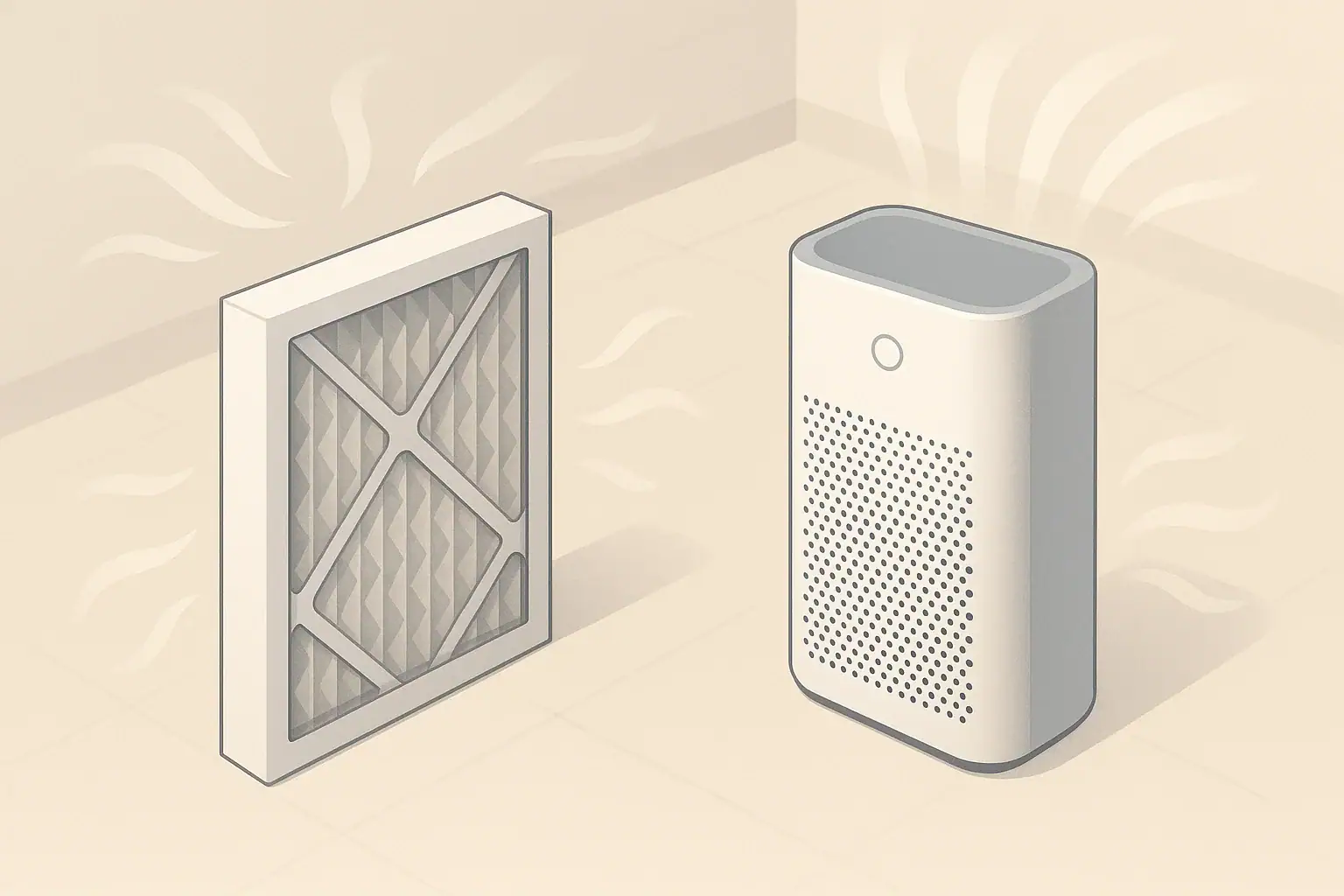
Understanding MERV 13 and HEPA in Plain Language
When you start comparing air filters, the numbers and acronyms can get confusing fast. Two of the most common terms you will see are MERV 13 and HEPA. Both relate to how well a filter can capture airborne particles, but they come from different rating systems and are usually used in different types of equipment.
This article explains what MERV 13 and HEPA actually mean, how they are tested, and what those numbers mean for everyday indoor air in a typical U.S. home. The goal is to help you decide when a high-MERV filter in your central system might be enough and when a HEPA air purifier could make more sense.
Because this is general guidance, always check the documentation for your specific HVAC system or air purifier before changing filters.
What MERV Ratings Measure
MERV stands for Minimum Efficiency Reporting Value. It is a scale used for many residential and commercial HVAC filters in the U.S. The scale typically runs from 1 to 16 for standard filters. Higher numbers generally mean the filter can capture smaller particles more efficiently during standardized testing.
How MERV Testing Works
MERV ratings come from a laboratory test that passes particles of different size ranges through the filter and measures how many are captured. The key size ranges go from larger dust and lint down to fine particles that are closer to the size of common indoor particulate matter.
A higher MERV rating means the filter keeps more of those test particles from passing through. However, the rating does not fully describe airflow resistance, how the filter performs once it starts to load with dust, or how well it is sealed inside your ductwork or filter slot.
What “MERV 13” Generally Means
Within the residential range, MERV 13 is often considered a high-performance filter. In many general summaries, a MERV 13 filter is described as being able to capture a significant share of:
- Common household dust
- Pet dander-sized particles
- Fine particles similar in size to many smoke and smog particles
These summaries are based on standardized test ranges, but real-world performance depends on:
- How well the filter fits and seals in the filter slot
- How often it is replaced
- Whether the HVAC fan runs often enough to move air through the filter
- Whether your system can handle the added resistance of a high-MERV filter
Using MERV 13 in many residential systems is possible, but not all equipment is designed for it. Higher resistance filters can reduce airflow if the system and ductwork were not sized for them. That can affect comfort and efficiency, so professional guidance is wise when moving up the MERV scale.
| Aspect | MERV 13 Filter | HEPA Filter |
|---|---|---|
| Typical location | Central HVAC return or furnace filter slot | Portable room air purifier or dedicated HEPA system |
| Rating system | MERV scale used for many HVAC filters | HEPA standard with efficiency target for very fine particles |
| Main focus | Broad indoor air cleaning with whole-home airflow | High-efficiency particle removal in specific rooms |
| Fine particle capture | High for many household and smoke-sized particles | Very high for very fine particles in test conditions |
| Airflow considerations | Must match HVAC blower capacity and duct design | Fan and filter are designed together in one unit |
| Installation | Replaces existing HVAC filter; sealing matters | Plug-in appliance; room placement matters |
| Coverage style | Whole home, depending on duct layout and runtime | Single room or limited area per device |
What HEPA Means and How It Differs
HEPA stands for High Efficiency Particulate Air. It is a standard used primarily for filters in dedicated air cleaning devices, not in most conventional residential HVAC systems.
Under common HEPA definitions, the filter must meet a very high efficiency requirement when tested with very small particles. In manufacturer literature, this is often described as capturing nearly all test particles at a specific particle size. While the exact test details can vary by region or standard, the key idea is that HEPA filters are engineered to be extremely effective on fine particles when properly installed and sealed in the device.
True HEPA vs Marketing Terms
Product packaging can use terms like “HEPA-type” or “HEPA-like.” These are marketing phrases and may not indicate that the filter meets a recognized HEPA standard. For consumers, this distinction matters:
- Filters that meet a HEPA standard usually have test data behind the claim.
- HEPA-type or HEPA-style filters may be improved over simple filters but are not necessarily tested to the same criteria.
If you are looking for the higher end of particle removal for a room purifier, check how the manufacturer describes the filter media and any efficiency testing that is referenced.
Why HEPA Is Usually in Room Purifiers, Not Furnaces
HEPA filters are dense compared to many typical HVAC filters. They can create a lot of resistance to airflow if placed in a duct system that was not designed for them. That is why, in most homes, you see HEPA filters in portable air purifiers or in specialized whole-house systems that are engineered for HEPA, not simply added into an existing furnace slot.
A portable HEPA air purifier combines:
- A fan sized for the HEPA filter’s resistance
- A housing that helps seal air so it passes through the filter media instead of around it
- Sometimes, additional pre-filters or carbon filters for coarse particles and odors
This “matched set” design helps maintain both good airflow (for better air changes per hour in the room) and high filtration efficiency.
Particle Sizes, PM2.5, and What These Filters Actually Catch
When comparing MERV 13 and HEPA, it helps to think about particle size. Many indoor air discussions now refer to PM2.5, which means fine particles with diameters generally smaller than 2.5 micrometers. These come from sources such as cooking, outdoor smoke that drifts indoors, and other combustion activities.
In very simple terms:
- MERV 13 is typically considered very capable at reducing many particles in the PM2.5 range and above.
- HEPA is designed to maintain very high capture efficiency even down to a small test particle size that is in the fine-particle range.
Laboratory test conditions do not perfectly match how filters behave in homes, but both technologies are relevant for reducing airborne particles that basic fiberglass filters barely touch.
Where Monitors Fit In
Affordable consumer air quality monitors often display PM2.5 estimates. They are not laboratory instruments, but they can still help you:
- See general trends when cooking or burning candles
- Compare indoor and outdoor conditions during a smoke event
- Observe how fast particles drop after you switch on an air purifier
Readings should be treated as approximate. Different devices may give different numbers even in the same room, but the direction and relative changes over time can still guide your use of filters and ventilation.
Whole-Home vs Room-by-Room: How MERV 13 and HEPA Work Together
You do not necessarily have to choose between MERV 13 and HEPA. In many homes, they play different roles and can complement each other.
Using MERV 13 in a Central System
When your HVAC system can handle a MERV 13 filter, it can help lower the baseline level of particles across the entire home. Key factors for effectiveness include:
- Runtime: The filter only cleans air when the fan is running. Some homeowners use the “fan on” setting during high particle events if the system allows.
- Filter fit: Gaps or bent frames can let air bypass the media, reducing performance.
- Replacement schedule: A clogged filter increases resistance and can reduce both airflow and cleaning effectiveness.
Even with an efficient filter, rooms far from return ducts, or spaces with closed doors for long periods, may not see strong circulation. That is where room-based solutions can help.
When a HEPA Air Purifier Makes Sense
A HEPA room purifier is most useful when you need focused particle reduction in a specific area, such as:
- A bedroom used for much of the day or where someone prefers cleaner-feeling air
- A home office where doors stay closed
- A living room during local wildfire smoke or other temporary events
For effective use, look at:
- Clean Air Delivery Rate (CADR): A measure that mixes airflow and filter efficiency; higher CADR generally means faster cleaning for a given room size.
- Air changes per hour (ACH): How many times per hour the purifier can theoretically process a room’s air volume. More air changes usually mean faster reduction of airborne particles.
- Placement: Ideally away from obstructions, with some open space around the intake and outlet so air can circulate.
Replacing or cleaning pre-filters on schedule helps the HEPA filter maintain airflow and performance over time.
Filter Efficiency vs Airflow: Why “Stronger” Is Not Always Better
It is tempting to assume that the highest-rated filter is always the best choice. In practice, air cleaning is a balance between how well the filter captures particles and how much air you can move through it without causing problems.
HVAC System Limits
Your furnace or air handler is designed for a certain pressure drop across the filter. If the filter is too restrictive, or if it clogs and is not replaced, you can end up with:
- Reduced airflow at supply vents
- Temperature imbalances between rooms
- Potential strain on the blower motor over time
This is why many manufacturers specify a maximum recommended MERV rating and type of filter for their equipment. If you want to move from a standard filter to MERV 13, it is wise to verify compatibility and possibly consult a professional.
Matching Purifier Settings to Room Needs
Portable HEPA purifiers face a similar trade-off between noise and airflow. Higher speeds provide more air changes per hour but are louder and may not be practical for sleeping or quiet work. Lower speeds are quieter but move less air.
One common approach is to run the purifier at a higher setting when the room is unoccupied or during the day, then use a lower setting at night if noise is a concern. The goal is to keep air turning over regularly while still fitting daily routines.
| Filter type | Typical interval range | What changes it | Reminder |
|---|---|---|---|
| Basic fiberglass HVAC filter | About 1 month | Heavy dust, pets, fan runtime | Check monthly and replace when visibly dirty |
| Pleated MERV 8–11 HVAC filter | About 1–3 months | Seasonal use, renovation dust | Inspect each month during peak use |
| MERV 13 HVAC filter | About 1–3 months | Fan set to “on”, local smoke events | Watch for reduced airflow or increased fan noise |
| HEPA filter in room purifier | Often 6–12 months | Speed setting, continuous use | Follow device indicator or manual guidelines |
| Pre-filter in purifier | Clean or replace every 1–3 months | Visible dust, pet hair | Keeping pre-filters clean supports HEPA lifespan |
| Activated carbon filter | Often 3–6 months | Odor sources, smoke exposure | Effectiveness may fade before it looks dirty |
Practical Steps to Decide Between MERV 13 and HEPA
When you are planning improvements to indoor air quality, it helps to think in layers: basic filtration, room-focused cleaning, ventilation, and moisture control. MERV 13 and HEPA are two tools within that bigger picture.
Questions to Ask About Your Home
To decide where to start, consider:
- How is your HVAC system set up? Single-story vs multi-story, number and location of return vents, and how often the system runs.
- Are there rooms that stay closed off? Closed doors reduce air mixing, which can limit the effect of a central filter alone.
- What are your main concerns? Everyday dust, seasonal pollen drift, nearby traffic, wildfire smoke events, or simply wanting air that feels cleaner.
- How much maintenance are you comfortable with? Central filters and room purifiers both require periodic attention.
Example Scenarios
Here are a few illustrative scenarios that show how MERV 13 and HEPA can fit into a broader plan:
- Typical suburban home, moderate concerns: Upgrading a compatible HVAC system from a basic filter to MERV 11 or MERV 13 (as allowed by the equipment) and replacing filters regularly may offer a noticeable reduction in dust and fine particles for the whole home.
- Apartment with limited control over central system: A portable HEPA air purifier sized correctly for the bedroom or main living area can provide room-level air cleaning even if the building filter is basic.
- Home in a wildfire-prone region: Combining a high-MERV central filter (if the system allows) with one or more HEPA purifiers in key rooms, and managing window opening during smoke events, can help reduce indoor particle buildup.
No single step solves every air quality issue, but understanding what MERV 13 and HEPA actually mean helps you choose the tools that fit your home, equipment, and comfort priorities.
Frequently asked questions
Can I install a MERV 13 filter in any home HVAC system?
Not always. Many HVAC systems can accept higher-MERV filters, but some were designed for lower pressure drop and may experience reduced airflow or blower strain with a MERV 13; check the equipment specifications or consult a professional before upgrading.
Will a MERV 13 filter remove wildfire smoke as effectively as a HEPA purifier?
MERV 13 filters are effective at capturing many PM2.5 particles found in smoke and can reduce whole-home exposure when the system runs, but HEPA filters generally have higher capture efficiency for the smallest particles and provide faster, room-level removal when used in a correctly sized purifier.
How often should I replace a MERV 13 filter compared to a HEPA filter in a room purifier?
MERV 13 HVAC filters typically need inspection and replacement around every 1–3 months depending on runtime and local conditions, while HEPA filters in portable purifiers often last 6–12 months; pre-filters and usage patterns will affect those intervals.
If I use MERV 13 in my furnace, do I still need a HEPA room purifier?
Possibly—merv 13 improves baseline whole-home air quality, but a HEPA room purifier is useful for focused cleaning in bedrooms, closed offices, or during acute events like heavy smoke, especially where occupants are vulnerable.
How can I verify a filter is actually improving indoor air quality?
Use a consumer PM2.5 monitor to track relative changes before and after running filters or purifiers, check CADR and ACH ratings for purifiers to confirm coverage for room size, and ensure proper filter fit and system airflow to avoid bypass or performance loss.
Recommended next:
- HEPA vs Activated Carbon: Best Setup for Allergies, Odors, and Smoke
- Air Purifier vs Dehumidifier: Which One Solves Musty Air?
- Humidifier vs Dehumidifier: When to Add Moisture vs Remove It
- Air Purifier vs Ozone Generator: Safety, Effectiveness, and Myths
- HEPA vs Carbon Filters: When Each One Matters Most
- Air Purifier vs Ventilation: Which Fixes Stuffy Bedrooms Better?
- More in Comparisons →
- Clear sizing logic (room size → CADR/ACH)
- HEPA vs carbon explained for real use-cases
- Humidity + ventilation basics to reduce mold risk