
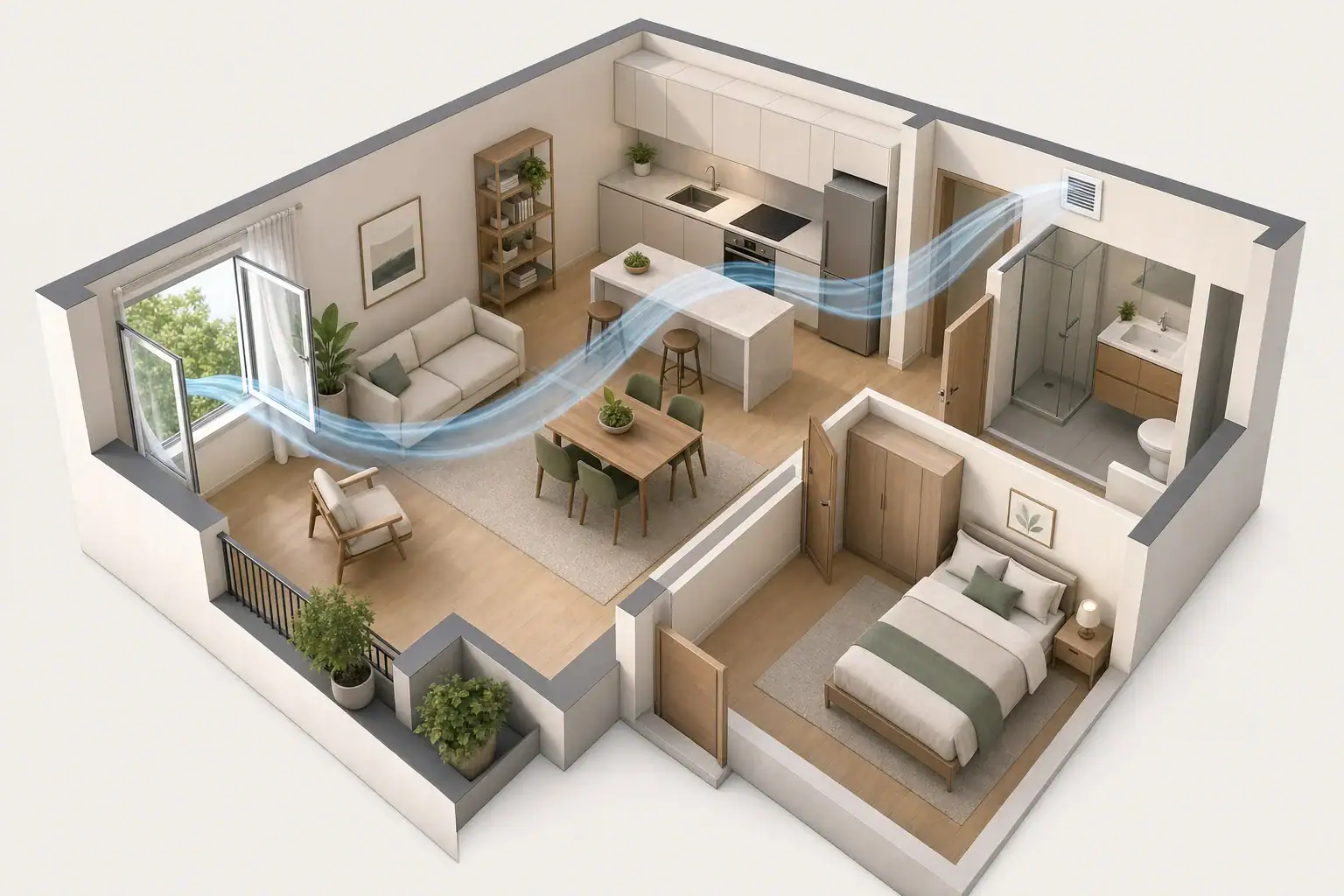
Air out a new apartment intensively for the first 24 to 72 hours, then use shorter daily ventilation sessions for several weeks while odors and source emissions decline. There is no universal airing-out time because ventilation, weather, furnishings, finishes, and building age all affect the process. Source control and outdoor air exchange generally matter more than trying to cover odors with fragrances.
Quick answer
- If outdoor conditions are suitable, create cross-ventilation for about 20 to 60 minutes at a time, two to four times during the first few days.
- Continue one or two shorter daily sessions for roughly two to six weeks, adjusting according to odors, indoor trends, weather, and security.
- Run kitchen and bathroom exhaust fans when appropriate, but confirm that they vent outdoors rather than merely recirculating air.
- Remove packaging, construction dust, scented products, and other avoidable sources before relying on an air purifier.
- Use particle filtration for dust and PM2.5; meaningful VOC and odor reduction requires substantial activated carbon or other suitable gas-phase media.
What airing out a new apartment actually does
New-apartment odors can come from paint, flooring, cabinets, adhesives, sealants, cleaning products, furniture, and packaging. Some of these materials release volatile organic compounds, or VOCs, into the air. Emission rates often decrease over time, although the pattern varies by material, temperature, humidity, and ventilation.
Ventilation replaces a portion of indoor air with outdoor air. This can dilute airborne VOCs and remove odors when outdoor air is cleaner and less odorous than indoor air. Opening one window may help, but opening windows or doors on opposite sides of the apartment usually produces faster air movement.
Odor is not a precise measure of VOC concentration or overall air quality. Some compounds are noticeable at low concentrations, while others have little odor. An apartment can also smell new because of materials that do not present a useful or measurable TVOC signal on a basic consumer monitor.
How to set a VOC and odor ventilation schedule
A practical schedule should account for the strength of the sources, the apartment layout, outdoor conditions, and how quickly air can move through the space. Treat time ranges as planning examples rather than official exposure limits.
Start with the highest-emission period
During the first 24 to 72 hours, ventilate as much as reasonably practical when outdoor conditions are favorable. Several 20- to 60-minute cross-ventilation sessions may be more manageable than leaving windows open continuously. Longer ventilation can be useful after fresh painting, flooring work, cabinet installation, or delivery of several new furnishings.
Reduce the schedule gradually
For the rest of the first two weeks, consider one or two ventilation sessions per day. From weeks three through six, ventilate as needed based on persistent odor, recent installation work, monitor trends, and comfort. Some materials decline quickly, while others release detectable odors intermittently for longer.
Estimate the effect of airflow
Air changes per hour, or ACH, describes how many room-equivalent volumes of air are replaced in one hour. Natural ventilation ACH varies widely because wind, temperature differences, window area, and apartment layout change constantly. A fully open cross-ventilation path may exchange air much faster than a slightly open window in a closed room, but neither setup guarantees a specific ACH without measurement.
Example values for illustration.
| Condition | Primary action | Planning note |
|---|---|---|
| Fresh paint or flooring odor | Use cross-ventilation | Begin with repeated 20- to 60-minute sessions |
| Visible packaging or protective film | Remove the source | Take cardboard, plastic, and foam outside promptly |
| Cooking or cleaning odor | Use outdoor-vented exhaust | Run during the activity and briefly afterward |
| Dust after construction | Clean surfaces and filter particles | VOC filtration alone will not remove settled dust |
| High outdoor smoke or PM2.5 | Close windows temporarily | Use particle filtration until outdoor air improves |
| Persistent cabinet or furniture odor | Ventilate the source area | Open empty drawers or doors when safe |
| Odor returns after windows close | Continue source control | Short-term dilution may not eliminate ongoing emissions |
Common airing-out mistakes and troubleshooting cues
One common mistake is assuming that the central HVAC fan always brings in outdoor air. Many apartment systems primarily recirculate indoor air. Building documentation or property management may clarify whether a system includes a dedicated outdoor-air supply.
Other common problems include:
- Opening only an interior door: Air needs a path to an outdoor opening or exhaust vent to leave the apartment.
- Blocking airflow: Closed bedroom doors, heavy curtains, and furniture in front of vents can create poorly ventilated zones.
- Using fragrance to mask an odor: Sprays, plug-ins, candles, and heavily scented cleaners introduce additional airborne compounds.
- Ignoring outdoor conditions: Outdoor smoke, traffic pollution, pollen, extreme humidity, or nearby construction may make open-window ventilation temporarily counterproductive.
- Expecting a thin carbon sheet to handle strong VOC sources: Small amounts of carbon may reduce some odors briefly but can saturate quickly.
- Relying on odor alone: Odor intensity can change with temperature and humidity, and occupants may become accustomed to a smell.
If an odor is concentrated in one cabinet, closet, room, or newly installed surface, focus on that area. If it resembles gas, burning material, sewage, or another building-system problem, leave the immediate area when appropriate and contact property management, emergency services, or the relevant utility rather than treating it as an ordinary new-apartment odor.
A practical move-in ventilation checklist
Before unpacking
- Inspect the apartment for active painting, damp materials, leaks, and unfinished work.
- Remove cardboard, plastic wrap, foam, adhesive liners, and empty cleaning containers.
- Vacuum with suitable particle filtration and damp-wipe hard surfaces to collect renovation dust.
- Check that supply vents, return grilles, and exhaust grilles are not blocked.
- Identify windows that can be opened safely and determine whether they create a cross-breeze.
During the first three days
- Open windows on different sides of the apartment when weather, security, and outdoor air permit.
- Use built-in bathroom and kitchen exhaust fans if they discharge outdoors.
- Open empty cabinet doors and drawers for limited periods so trapped air can mix with ventilated room air.
- Keep interior doors open when appropriate to prevent stagnant rooms.
- Avoid bringing in many new scented products or furnishings at the same time.
During the following weeks
Shift from intensive airing to a repeatable routine. Ventilate after cleaning, cooking, furniture assembly, or other activities that introduce odors. If outdoor air is unsuitable during the day, use shorter sessions when local conditions improve, provided doing so is safe and does not conflict with building rules.
Schedules for different apartment situations
Recently renovated studio
A studio may ventilate relatively evenly because it has few closed rooms, but a single exterior window can limit crossflow. Begin with several daily sessions during the first three days. A window fan may improve directional airflow if it is allowed, securely installed, and used according to its instructions.
Two-bedroom apartment with new cabinets
Open interior doors and ventilate the kitchen directly when possible. Empty cabinet doors and drawers can be left open during supervised ventilation periods, then closed when needed for safety. Continue daily sessions for two weeks and reassess whether the odor is becoming weaker and slower to return.
High-rise apartment with sealed windows
Do not attempt to modify sealed windows, vents, or building safety systems. Use the building-provided ventilation, run outdoor-vented exhaust where available, and ask property management about normal fresh-air operation. Source removal and low-emission purchasing decisions become especially important when occupants cannot control window ventilation.
Apartment near smoke or heavy traffic
Time open-window ventilation for periods when outdoor particle conditions are better. A particle monitor or local outdoor air information can help identify trends. During poor outdoor conditions, close windows and use appropriately sized particle filtration, recognizing that a HEPA filter is not a substitute for gas-phase VOC media.
Purifiers, monitors, humidity, and safety
Air purifiers can complement ventilation, but filter type matters. HEPA filtration captures airborne particles such as dust and fine particulate matter; it does not directly remove gases. Activated carbon or another gas-phase medium is needed for VOCs and odors, and performance depends on media quantity, airflow, compound type, and saturation.
For particle planning, clean air delivery rate and room size can be used to estimate equivalent air changes. A simple planning formula is CADR divided by room volume, multiplied by 60. For example, a 150 cubic-feet-per-minute CADR in a 1,500-cubic-foot room provides an illustrative six equivalent air changes per hour for particles under idealized conditions. This calculation does not predict VOC removal unless the stated airflow and performance apply to gas filtration.
Consumer TVOC monitors are most useful for observing patterns, such as a rise after cleaning or a decline when windows open. Their readings can be influenced by humidity, alcohols, fragrances, and sensor design. They should not be treated as compound-specific safety instruments.
Keep indoor humidity generally around 30% to 50% when practical, while accounting for climate and building conditions. High temperature and humidity can increase emissions from some materials, while excessive humidity can also contribute to condensation and dampness.
Avoid devices that intentionally produce ozone. Ionization and some electronic air-cleaning features may create ozone or other byproducts, so check independent safety certification and understand whether the feature can be disabled. Enclosed UV-C components are mainly intended for biological control within equipment; they do not replace ventilation, particle filtration, or gas-phase media.
Maintenance and signs that the schedule should change
Ventilation plans should respond to changing conditions rather than follow a fixed calendar indefinitely. Increase ventilation temporarily after painting, furniture delivery, deep cleaning, or other source-producing activities. Reduce open-window time when outdoor smoke, excessive humidity, or strong outdoor odors enter the apartment.
Check HVAC filters according to building guidance, especially after renovation dust. Clean prefilters and replace purifier filters according to their condition and the manufacturer’s schedule. Carbon media may need attention when odors begin passing through quickly, although odor return can also mean that the indoor source is still active.
Track simple observations at the same time each day:
- Whether the odor is weaker, unchanged, or stronger
- How quickly the odor returns after windows close
- Which room or object has the strongest odor
- Whether TVOC or PM2.5 trends respond to ventilation
- Whether outdoor air, humidity, or weather explains a temporary change
Document persistent problems with dates, locations, recent work, and photos of visible defects. Contact property management if odors remain intense, ventilation equipment does not operate, moisture is present, or building materials appear damaged. Specialized testing may be appropriate when a specific contaminant or building defect is suspected, but a general consumer TVOC reading cannot identify individual chemicals.
Example values for illustration.
| Metric | What it indicates | Practical use |
|---|---|---|
| TVOC | Broad sensor response to multiple gases | Compare trends before and after ventilation |
| PM2.5 | Fine airborne particle concentration | Check whether outdoor particles enter through windows |
| Carbon dioxide | Occupancy and ventilation trends | Observe whether occupied rooms need more fresh air |
| Relative humidity | Moisture level relative to temperature | Balance ventilation with condensation and dryness concerns |
| Temperature | Indoor thermal conditions | Note whether warmth corresponds with stronger emissions |
| Carbon monoxide | Combustion-related safety hazard | Use listed alarms; do not substitute a general air monitor |
Related guides: Cross-Ventilation Setup: How to Move Air Through a Home Faster • Ventilation vs Air Purifier: When You Need One, the Other, or Both • Indoor Air Quality Monitors: What to Measure (PM2.5, CO2, VOCs, Humidity) • Window Ventilation Schedule: Morning vs Evening Air Quality Trade-Offs
Summary of the VOC and odor schedule
Start with intensive ventilation during the first 24 to 72 hours when outdoor conditions are suitable. Continue shorter daily sessions for roughly two to six weeks, then adjust according to source activity, odor trends, monitor patterns, outdoor air, and apartment rules.
Remove avoidable sources, clean renovation dust, and use outdoor-vented exhaust before depending on filtration. Choose particle and gas-phase filtration according to the pollutant involved, and avoid ozone-producing devices. Persistent, unusual, or building-related odors should be documented and addressed with property management or an appropriately qualified professional.
Frequently asked questions
How long should I air out a new apartment before moving in?
If conditions allow, use intensive ventilation for the first 24 to 72 hours, with repeated cross-ventilation sessions of about 20 to 60 minutes. Continue shorter daily sessions for roughly two to six weeks, especially after recent painting, flooring installation, cabinet work, or furniture delivery. The appropriate duration depends on source strength, airflow, outdoor air quality, and whether odors are declining.
Is opening one window enough to remove new-apartment odors?
Opening one window can provide some dilution, but it may produce limited airflow in a closed apartment. Opening windows or exterior openings on opposite sides of the space, when safe and permitted, usually creates more effective cross-ventilation. Interior doors may also need to remain open so air can move through bedrooms and other enclosed areas.
Should I keep windows open if outdoor air is smoky or polluted?
When outdoor smoke, heavy traffic pollution, or other strong outdoor odors are present, open-window ventilation may temporarily worsen indoor particle levels. Close windows during poor conditions and use appropriately sized particle filtration if available. Resume shorter ventilation sessions when local outdoor air conditions improve and it is safe to do so.
Can an air purifier remove VOCs from paint, cabinets, and new furniture?
A particle filter can capture dust and fine particles but does not directly remove VOC gases. VOC and odor reduction requires a suitable gas-phase medium, such as a substantial amount of activated carbon, and its effectiveness varies with the pollutant, airflow, and filter saturation. Removing packaging and other avoidable sources, along with ventilation, is generally more important than relying on a purifier alone.
What should I do if the new-apartment smell returns after I close the windows?
An odor that returns quickly may indicate an ongoing source such as cabinets, flooring, paint, furniture, cleaning products, or materials stored in a closet. Focus ventilation and source control on the strongest-smelling room or object, and open empty drawers or cabinet doors during supervised ventilation periods. Document persistent intense odors, moisture, damaged materials, or ventilation problems and report them to property management.
Recommended next:
- Ventilation vs Air Purifier: When You Need One, the Other, or Both
- CO2 in Bedrooms: What Levels Mean and How to Improve Air Exchange
- How to Ventilate in Winter Without Freezing: Practical Strategies
- Exhaust Fan Best Practices: Bathrooms and Kitchens That Actually Clear Air
- Air Exchange Basics: ACH, Infiltration, and Why “Stuffy” Happens
- ERV vs HRV: What They Do for Indoor Air Quality
- Clear sizing logic (room size → CADR/ACH)
- HEPA vs carbon explained for real use-cases
- Humidity + ventilation basics to reduce mold risk