
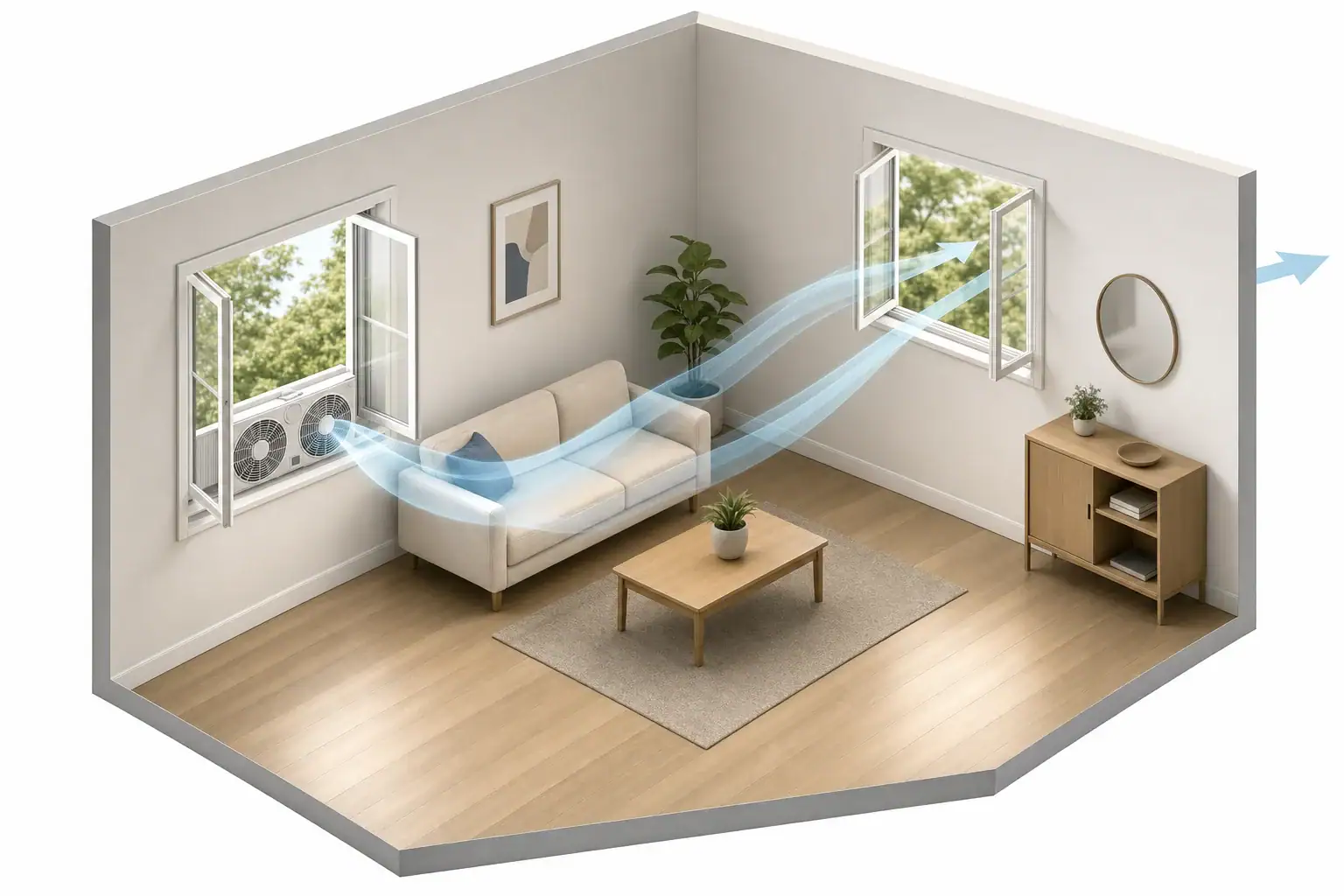
Use a window fan as exhaust to remove indoor heat, odors, or stale air, and use it as intake when the outdoor air is cleaner and more comfortable than the indoor air. In many homes, the most effective setup combines an exhaust fan on one side of the space with an open window or intake fan on the opposite side. Outdoor conditions, room layout, and fan placement all affect the result.
- Choose exhaust near an indoor heat, moisture, or odor source, provided the fan is suitable for that location.
- Choose intake on the cooler, cleaner, or quieter side of the home.
- For cross-ventilation, place intake and exhaust openings on opposite sides when possible.
- Estimate theoretical air changes per hour with ACH = fan CFM × 60 ÷ room volume; real airflow is usually lower.
- For a short air purge, run the setup for about 15–30 minutes, then reassess indoor and outdoor conditions.
How Window Fan Intake and Exhaust Setups Work
A window fan changes the pressure and airflow pattern inside a room. In exhaust mode, the fan pushes indoor air outside. Replacement air then enters through other open windows, doors, vents, and building leaks.
In intake mode, the fan pulls outdoor air inside. Indoor air must leave elsewhere, so an open interior door or another window is important. Without a clear exit path, airflow can fall and the fan may mainly circulate air near the window.
When exhaust is usually more useful
Exhaust is generally the practical starting point when the main goal is to remove something generated indoors. Examples include accumulated heat, cooking odors, cleaning odors, or stuffiness. Source-specific exhaust equipment, such as a properly vented range hood or bathroom fan, is often more effective for moisture and contaminants produced in those areas.
When intake is usually more useful
Intake can help cool or refresh a room when outdoor air is favorable. It often works well at a shaded window during cooler evening or early-morning hours. It is less suitable when outdoor smoke, pollution, high humidity, or strong odors are present.
Window Fan Sizing and Airflow Planning
Window fan airflow is commonly expressed in cubic feet per minute, or CFM. A larger airflow rating does not guarantee better ventilation because screens, partially closed windows, wind, curtains, and pressure differences can reduce actual airflow.
To estimate room volume, multiply floor area by ceiling height. A 120-square-foot room with an 8-foot ceiling has a volume of 960 cubic feet. A theoretical 150 CFM of airflow would equal about 9.4 air changes per hour: 150 × 60 ÷ 960. This is an illustrative free-air estimate, not a guaranteed result in an installed window.
More airflow is not always necessary. A lower speed may provide enough ventilation with less noise, less draft, and lower energy use. The clearest sign of an effective setup is a defined path from the outdoor air entry point, through the occupied space, and out through the exhaust opening.
Example values for illustration.
| Goal or condition | Suggested setup | Placement note |
|---|---|---|
| Remove accumulated indoor heat | Exhaust | Place high or on the warmer side when practical |
| Bring in cooler evening air | Intake | Use a shaded, cleaner outdoor side |
| Create cross-ventilation | Intake plus exhaust | Use separated or opposite windows |
| Remove a localized odor | Exhaust | Place near the source without disrupting dedicated exhaust |
| Ventilate one room from another | Exhaust at the destination window | Keep the connecting door open |
| Outdoor air is smoky or polluted | Keep fan off | Close windows and use appropriate particle filtration indoors |
| Outdoor humidity is high | Limit intake | Compare indoor and outdoor moisture conditions |
Common Setup Mistakes and Troubleshooting Cues
A common mistake is operating a fan without providing a return-air path. An exhaust fan needs a place for replacement air to enter, while an intake fan needs an opening through which indoor air can leave. Opening a second window several inches may make a noticeable difference.
Another mistake is placing intake and exhaust openings too close together. Air may take the shortest route between them and bypass much of the room. Greater separation usually creates a more useful sweep through the space.
Signs that airflow is restricted
- The fan sounds strained or changes pitch after installation.
- Curtains are pulled against the fan or block the opening.
- Only the area immediately around the window feels different.
- Indoor doors move or whistle because pressure differences are high.
- Odors or heat remain even after the fan has run for a reasonable period.
Window screens can also reduce flow, especially when loaded with dust or pollen. Do not remove a screen if doing so would create an insect, fall, pet, or child-safety concern. Instead, keep it clean and account for the added resistance.
How to Set Up a Window Fan Step by Step
- Check outdoor conditions. Avoid bringing in air during smoke events, poor local air quality, high outdoor humidity, or strong nearby odors.
- Define the goal. Decide whether you are removing indoor air, bringing outdoor air in, or establishing cross-ventilation.
- Select the window. For intake, favor the cleaner, cooler, and quieter side. For exhaust, choose a location near the area being ventilated.
- Create an airflow path. Open a second window or interior door away from the fan. Keep furniture, blinds, and curtains out of the path.
- Secure the fan. Follow its installation instructions and use the supplied panels or supports. The unit should not shift when the window or nearby doors move.
- Start at a moderate speed. Increase speed only if more airflow is needed. High speed can add noise and drafts without improving the path through the room.
- Test direction. A light strip of tissue held safely away from moving blades can show whether air is entering or leaving at an opening.
- Reassess after 15–30 minutes. Check temperature, odor, humidity, noise, and outdoor conditions rather than leaving the setup unchanged automatically.
In a multiroom home, keep interior doors open along the intended route. If privacy requires closed doors, gaps around the door may not provide enough airflow for a high-output fan.
Window Fan Layout Examples for Homes and Apartments
Single bedroom with one usable window
Use intake when outdoor air is cooler and clean enough to bring inside. Keep the bedroom door open so air can move into the hall and leave through another opening. If the room is warmer than the rest of the home, exhaust can instead pull conditioned or cooler air from the hall into the bedroom.
Apartment with windows on one side
True cross-ventilation may be limited when all windows face the same direction. One fan can exhaust through a window while another nearby window serves as a passive inlet, but the openings should be separated as much as the layout allows. Wind direction may have a large effect.
House with opposite-facing windows
Place an intake fan on the cooler or cleaner side and an exhaust fan on the opposite side. Keep the route between them open. Using both fans at similar low or medium settings can provide steadier airflow than running one fan at maximum speed.
Two-story home during cooler evenings
An upper-floor exhaust fan can remove warmer air while lower-floor windows admit cooler outdoor air. This uses both fan pressure and the natural tendency of warm air to rise. Stair gates, doors, and the locations of combustion equipment must still be considered.
Safety, Outdoor Air Quality, and Building Considerations
A window fan does not filter outdoor air. It can bring in particles, pollen, vehicle exhaust, humidity, and odors along with fresh outdoor air. Check current local conditions and close windows when outdoor air is unsuitable. During smoke episodes, keeping windows closed and using an appropriately sized particle-filtering air cleaner is generally more useful than window ventilation.
Strong exhaust can depressurize a home. In buildings with fuel-burning furnaces, water heaters, fireplaces, or other combustion appliances, negative pressure may interfere with proper venting. Follow appliance and building guidance, keep required vents unobstructed, and use working carbon monoxide alarms as required for the home. Stop using the exhaust setup if combustion gases may be entering the living space and seek qualified assistance.
Protect the fan from rain unless its instructions specifically permit that exposure. Keep cords dry, avoid overloaded extension arrangements, and plug the fan into an appropriate outlet. Do not place an unsecured fan where it creates a fall risk or compromises a window guard.
A window fan does not generate ozone as part of ordinary mechanical fan operation. Additional ionizing or ozone-generating features are not necessary for ventilation, and intentional ozone generation should not be used in occupied residential spaces.
Noise, Energy Use, and Window Fan Maintenance
Noise depends on fan speed, blade design, window vibration, outdoor sound, and distance from the sleeping or working area. Running a larger fan at a lower setting can sometimes be quieter than running a smaller fan at maximum output, but installed performance varies.
To limit vibration, confirm that the fan and window panels are stable and that no hard parts are rattling against the frame. Do not improvise modifications that interfere with blade guards, electrical components, or the window’s safe operation.
Inspect the fan regularly during its operating season. Unplug it before cleaning, and follow its instructions for accessing guards or removable parts. Dust on blades and grilles can reduce airflow and contribute to imbalance. Clean nearby screens and window tracks as well.
Energy use can be estimated by multiplying wattage by hours of operation and dividing by 1,000 to obtain kilowatt-hours. For example, a 50-watt fan running for eight hours uses about 0.4 kilowatt-hours. Actual wattage depends on the fan and speed setting.
Example values for illustration.
| Operating situation | Noise consideration | Placement or timing idea |
|---|---|---|
| Short air purge | Higher speed may be acceptable | Run about 15–30 minutes before quiet hours |
| Overnight intake | Outdoor sounds may enter | Use a quieter-facing window and low speed |
| Overnight exhaust | Motor and frame vibration may be noticeable | Secure panels and increase distance from the bed |
| Two-fan cross-ventilation | Two low-speed fans may sound steadier | Separate intake and exhaust across the home |
| Street-facing room | Traffic noise may outweigh cooling benefits | Ventilate before bedtime when practical |
| Home office | Air rush can affect calls or concentration | Use moderate speed and keep the fan off-axis |
Related guides: Window Ventilation Schedule: Morning vs Evening Air Quality Trade-Offs • Cross-Ventilation Setup: How to Move Air Through a Home Faster • Ventilating During Wildfire Smoke: When Keeping Windows Closed Is Better • Exhaust Fan Best Practices: Bathrooms and Kitchens That Actually Clear Air
Window Fan Intake vs Exhaust Takeaways
Exhaust is the usual choice for removing indoor heat, odors, and stale air, while intake is useful for bringing in cooler or cleaner outdoor air. The strongest general setup is a clear cross-ventilation path with separated intake and exhaust openings.
Fan ratings provide a planning estimate, but screens, wind, building leakage, and room layout determine real performance. Start at a moderate speed, provide a return-air path, and adjust based on indoor comfort and current outdoor conditions.
Keep the fan secured, clean, dry, and clear of curtains. Avoid window ventilation when outdoor smoke, pollution, or humidity would make indoor conditions less favorable, and use extra caution around combustion appliances and child-accessible windows.
Frequently asked questions
Is a window fan better on intake or exhaust for cooling a room?
Exhaust is often effective when the room contains built-up heat and there is a cooler place for replacement air to enter. Intake is usually better when outdoor air is cooler, cleaner, and comfortable enough to bring indoors. For the strongest whole-room cooling effect, use a separated intake opening and exhaust opening to create a clear airflow path.
Should a window fan blow in or out at night?
At night, use intake if the outdoor air is cooler and outdoor air quality is good. Use exhaust if the goal is to remove heat from an upper floor or warm room while cooler air enters through another open window. Keep windows closed when smoke, pollution, strong odors, or excessive humidity would worsen indoor conditions.
How far apart should intake and exhaust window fans be?
Place intake and exhaust openings as far apart as the home layout reasonably allows, ideally on opposite sides of the room or home. Greater separation helps air move through the occupied space instead of taking a short path between nearby windows. Keep interior doors open along the intended route to reduce airflow restriction.
Can one window fan provide cross-ventilation?
One window fan can support ventilation if another window, door, or opening provides a path for air to enter or leave. For example, an exhaust fan can pull air in through a separate open window. Two fans, with one set to intake and one to exhaust, can create a more defined and often stronger cross-ventilation path.
Why does my window fan not seem to move much air?
Restricted airflow often means there is no adequate return-air path, the screen is dirty, curtains are blocking the opening, or the intake and exhaust openings are too close together. Open a second window or interior door away from the fan and check that the fan panels and window opening are not obstructed. Wind direction and the fan’s installed airflow can also differ from its free-air CFM rating.
Is it safe to run a window fan in exhaust mode near a gas appliance?
Strong exhaust can lower indoor pressure and may interfere with the venting of fuel-burning appliances, such as some furnaces, water heaters, and fireplaces. Follow appliance and building guidance, keep required vents clear, and maintain working carbon monoxide alarms. Stop the exhaust setup and seek qualified help if combustion gases may be entering the living space.
Recommended next:
- Ventilation vs Air Purifier: When You Need One, the Other, or Both
- CO2 in Bedrooms: What Levels Mean and How to Improve Air Exchange
- How to Ventilate in Winter Without Freezing: Practical Strategies
- Exhaust Fan Best Practices: Bathrooms and Kitchens That Actually Clear Air
- Air Exchange Basics: ACH, Infiltration, and Why “Stuffy” Happens
- ERV vs HRV: What They Do for Indoor Air Quality
- Clear sizing logic (room size → CADR/ACH)
- HEPA vs carbon explained for real use-cases
- Humidity + ventilation basics to reduce mold risk