
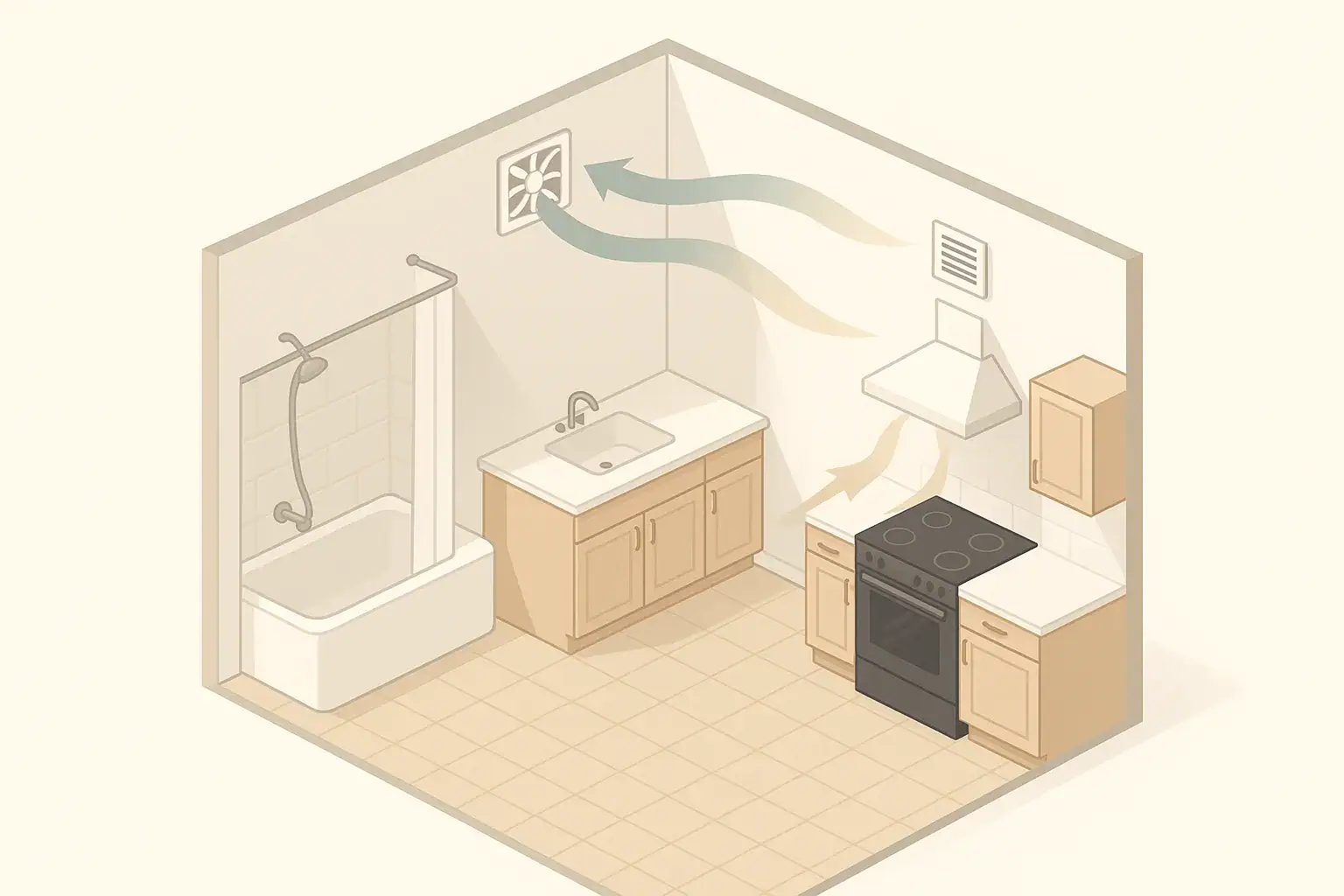
Exhaust fan best practices for bathrooms and kitchens focus on correct sizing, smart placement, adequate runtime, and regular cleaning so moisture and cooking pollutants are actually removed from indoor air.
In many homes, fans are either too small, too weakly ducted, or not run long enough to make a real difference. With a few simple rules of thumb and checks, you can turn a noisy, decorative fan into one that noticeably clears fog, steam, and cooking odors while supporting overall indoor air quality.
- Size bathroom exhaust fans around 1 CFM per square foot (minimum ~50 CFM), more for large or very humid spaces.
- Run bathroom fans during showers and for about 20–30 minutes afterward to clear moisture.
- Use kitchen exhaust on at least a medium setting whenever cooking, especially frying, searing, or boiling.
- Vent fans outdoors with short, smooth duct runs; avoid venting into attics, crawlspaces, or closed cavities.
- Clean fan grilles and accessible blades every few months to keep airflow and noise performance stable.
- Check that air is exhausted outside by feeling for airflow at exterior caps and watching how quickly fog or odors clear.
Why Bathroom and Kitchen Exhaust Fans Matter for Indoor Air
Bathroom and kitchen exhaust fans are simple mechanical ventilation tools designed to move polluted or humid indoor air directly outdoors. They work alongside natural ventilation (like open windows) and whole-house systems to manage moisture and pollutants at their source.
In bathrooms, the main concern is excess humidity from bathing that can lead to condensation, musty smells, and mold-friendly conditions. In kitchens, the focus is cooking byproducts: grease aerosols, smoke, fine particles, and cooking odors, as well as heat and water vapor from boiling or dishwashing.
When fans are correctly sized, installed, and used, they help with:
- Moisture control: Reducing foggy mirrors, condensation on windows, and damp surfaces after showers or cooking.
- Odor removal: Moving bathroom and kitchen odors outdoors instead of letting them spread through the home.
- Particle and fume reduction: Limiting buildup of smoke and cooking-related particles in living spaces.
- Comfort and building durability: Supporting comfortable humidity and reducing the risk of moisture-related building material issues over time.
Bathroom and kitchen exhaust fans do not filter and recirculate air the way air purifiers do; instead, they remove indoor air and rely on replacement air from other parts of the house or from outdoors. That makes their design and operation slightly different from filtration-focused devices.
Key Concepts: Sizing, Airflow, and Ducting That Actually Work
Two main ideas govern exhaust fan performance: how much air the fan can move (airflow) and how effectively that air is routed outdoors (ducting and termination). The common rating used for fans is cubic feet per minute (CFM), an estimate of the volume of air moved each minute under standardized test conditions.
Bathroom exhaust fan sizing basics
A common starting rule for bathroom fans is about 1 CFM per square foot of floor area with a minimum rating of roughly 50 CFM. For example, an 8 ft by 10 ft bathroom (80 square feet) might use a fan in the 80 CFM range.
Additional factors that may justify higher airflow include:
- A jetted tub or very frequent hot showers.
- Enclosed toilet compartments or separate water closets.
- High ceilings (significantly above 8 ft) or complex room layouts.
For these conditions, some homeowners choose a fan modestly above the 1 CFM per square foot rule or install multiple fans serving different areas of the same large bathroom.
Kitchen exhaust concepts: capture and flow
Kitchen ventilation focuses on capturing cooking plumes directly above or near the source. Range hoods or wall-mounted exhausts above stoves and cooktops are typically sized based on the stove width and the intensity of cooking. Higher heat and more frequent frying or stir-frying usually benefit from higher airflow and better hood coverage.
Recirculating hoods with simple grease filters can reduce some grease and odors but do not remove moisture and combustion byproducts outdoors. Whenever possible, a ducted, externally vented kitchen fan does more to clear indoor air.
Ducting and termination: where the air actually goes
Even a well-sized fan can perform poorly if its duct run is long, restrictive, or improperly terminated. Good practices generally include:
- Routing ducts to the outside through a roof, wall, or soffit, not into attics, crawlspaces, or garages.
- Keeping duct runs as short and straight as reasonably possible.
- Using smooth-walled ducts with gentle bends, securely sealed joints, and appropriate insulation in unconditioned spaces.
- Ensuring the exterior cap has a functioning damper that opens when the fan runs and closes when off.
The real performance you experience is the combination of fan CFM rating plus duct design plus how long and when you operate the fan.
| Task | Why it matters | Practical notes |
|---|---|---|
| Estimate bathroom fan CFM from room size | Ensures enough airflow to clear steam | Use ~1 CFM per sq ft, minimum about 50 CFM |
| Confirm kitchen hood vents outdoors | Removes moisture and pollutants instead of recirculating | Look for a duct leading outside, not just a filter grille |
| Check duct length and bends | Excessive resistance reduces real airflow | Straighter, shorter ducts with gentle bends work better |
| Inspect exterior vent caps | Stuck dampers and debris block exhaust | Damper should move freely when fan is running |
| Run bathroom fan after showers | Helps dry surfaces and lower humidity | Target about 20–30 minutes of post-shower runtime |
| Use kitchen exhaust during high-heat cooking | Captures smoke, particles, and odors at the source | Turn fan on before cooking and leave on until air clears |
| Clean grilles and accessible parts | Dirt and grease buildup cut airflow | Wipe or vacuum every few months as needed |
Example values for illustration.
Common Exhaust Fan Mistakes and How to Spot Them
Many homes have exhaust fans that are installed but do not perform their intended job. Recognizing typical issues helps you decide what to adjust, repair, or upgrade.
Bathroom fan issues
- Fan is too weak: If the mirror stays fogged for more than 10–15 minutes after a shower despite running the fan, airflow may be insufficient or blocked.
- Fan is noisy but ineffective: Loud operation can signal poor-quality bearings or resonance, but more importantly, noise does not always mean good airflow. A clogged grille, dirty blades, or restrictive duct can make a fan sound busy while moving little air.
- Fan is placed far from the shower: A fan mounted on the opposite side of the room, with no air path over the shower, may leave steam lingering.
- No clearance for make-up air: A tightly sealed bathroom with the door closed and no undercut may prevent enough replacement air from entering, reducing exhaust rate.
Kitchen exhaust problems
- Recirculating hood used as primary ventilation: These units can reduce some grease and odors but cannot remove moisture or combustion byproducts outdoors.
- Hood too shallow or placed too high: If the hood does not cover the burners or is far above them, cooking plumes can escape into the room before being captured.
- Running fan only after smoke appears: Waiting until the kitchen is visibly smoky is less effective than running the fan from the start of cooking.
- Grease-clogged filters: Metal or mesh filters can become coated with grease, which reduces airflow and capture efficiency.
Duct and termination warning signs
- Warm, humid attic or crawlspace from exhaust: This can indicate that bathroom or kitchen fans are venting into enclosed spaces instead of outdoors.
- Backdrafts or whistling vents: Exterior caps that vibrate, whistle, or allow noticeable reverse airflow during wind events may need inspection.
- Visible lint, grease, or staining at vent outlets: Heavy buildup can suggest long-term exhaust of unfiltered or high-moisture air.
Practical Best Practices: Using Bathroom and Kitchen Fans Effectively
Once your fans are reasonably sized and properly ducted, how you use them determines most of the day-to-day impact on indoor air.
Bathroom fan operation tips
- Turn on before showering: Start the fan several minutes before creating steam to establish steady airflow.
- Run during and after showers: Keep the fan on throughout bathing and for roughly 20–30 minutes afterwards to help dry surfaces and reduce lingering humidity.
- Allow make-up air: Slightly undercut doors or leave them slightly open so replacement air can enter the bathroom while the fan is running.
- Consider timers: A wall timer or humidity-sensing control can help ensure consistent post-shower runtime without requiring manual shutoff monitoring.
Kitchen exhaust fan operation tips
- Use for most cooking, not just smoke events: Even boiling water and simmering sauces add moisture and particles to indoor air.
- Turn on early: Start the hood before heating pans so it captures the rising plume from the beginning.
- Match fan speed to cooking intensity: Use higher speeds for frying, searing, or grilling, and moderate speeds for simmering or low-heat tasks.
- Run fan after cooking: Keep it on for several minutes after turning off burners to clear residual fumes and heat.
Balancing exhaust with overall home ventilation
Because exhaust fans remove indoor air, they rely on replacement air coming from elsewhere in the home or from outdoors. In very airtight homes or in extremely cold or hot weather, continuous high exhaust rates can increase the load on heating or cooling systems or create noticeable drafts from entry points.
In most typical U.S. homes, short bursts of bathroom and kitchen exhaust during activities are well within normal ventilation needs. If you notice persistent drafts or pressure imbalance issues, a ventilation professional can help evaluate whole-house airflow and make adjustments.
Real-World Scenarios: Applying Best Practices
Putting all the ideas together can be easier when you think in terms of homes and rooms you might recognize.
Small interior bathroom with no window
Consider a 5 ft by 8 ft interior bathroom (40 square feet) with a tub-shower. A fan rated around 50–80 CFM is a common choice. Best practices would include:
- Ensuring the fan ducts directly outdoors with a short, insulated duct run if it passes through unconditioned space.
- Mounting the fan near the shower area, not at the far corner.
- Using the fan for the entire shower duration and at least 20 minutes afterward.
- Checking that the door has enough gap at the bottom to allow incoming air.
Open kitchen with gas range
In an open-plan kitchen with a gas range and frequent high-heat cooking, a ducted hood that fully covers the cooktop and vents outdoors can make a noticeable difference in odors and visible smoke. Good practice includes:
- Running the hood on an appropriate speed setting whenever the burners are on.
- Cleaning or replacing grease filters regularly so airflow remains strong.
- Checking that the roof or wall termination is in good condition and clear of obstructions.
Older home with fans venting into attic
Some older installations route bathroom fans or kitchen exhaust into an attic or soffit cavity. While this may move odors away from living spaces, it can introduce moisture and pollutants into building cavities. In many cases, a better approach is to extend or re-route ductwork to a proper exterior termination while observing local building codes.
Safety, Standards, and Special Features
While exhaust fans are relatively simple devices, a few safety and standards-oriented topics are relevant when planning or improving systems.
Code considerations and moisture management
Building codes in many U.S. jurisdictions have basic requirements for bathroom and kitchen ventilation, including minimum airflow rates, discharge locations, and electrical safety rules. When modifying ducting, adding fans, or relocating terminations, it is useful to check local requirements or consult a qualified professional.
For moisture management specifically, codes and best-practice documents often emphasize venting directly outdoors, sealing ducts against condensation, and avoiding discharge into insulation-filled spaces where moisture could accumulate.
Noise ratings and comfort
Bathroom fans are often labeled with a sound rating (commonly in sones). Lower sone ratings generally indicate quieter operation. Quieter fans can encourage longer and more consistent use because they are less intrusive. However, a very quiet fan that does not move enough air is not necessarily better, so it is worth balancing airflow performance with noise when choosing or evaluating units.
Additional technologies in fans
Some modern fans integrate features such as motion sensors, humidity sensors, or built-in heaters and lights. These can support more automatic or comfortable use, but the core goals remain the same: providing sufficient airflow, vented outdoors, during and after moisture-generating or pollutant-generating activities.
Other air-cleaning technologies, such as ionizers or UV-C lamps, may appear in various ventilation or air quality products. For exhaust fans whose main role is moving air outside, these additions are generally secondary. When considering any device that actively changes air chemistry, it is prudent to review independent information about byproducts like ozone and to follow manufacturer and safety guidance.
Maintenance and Long-Term Upkeep
Even a well-designed exhaust system will gradually lose effectiveness without routine upkeep. Dust, lint, and grease accumulate over time, and mechanical parts can wear or loosen.
Cleaning schedules
- Bathroom fans: Every few months, turn off power to the fan, remove the grille, and gently vacuum or wipe away dust from the grille and accessible parts. In many units, the motor and blower can be partially accessed for careful cleaning following manufacturer instructions.
- Kitchen hoods: Metal or mesh filters can usually be removed and washed with warm, soapy water, then fully dried before reinstallation. The hood interior around the filters may also need periodic degreasing. Paper or carbon filters, if present, are typically replaced on a schedule suggested by the manufacturer or when visibly dirty.
- Exterior vents: Inspect once or twice a year to clear leaves, lint, or insect nests and confirm the damper moves freely.
Checking performance over time
Simple observation can indicate when maintenance or upgrades are needed:
- Mirrors and surfaces remain wet much longer than they used to after showers, despite running the fan.
- Cooking odors linger in nearby rooms long after using the kitchen exhaust.
- Fan noise changes noticeably (rattling, grinding, or new vibration).
In some cases, upgrading to a more efficient, properly sized, quiet fan or improving ductwork can significantly improve performance while keeping noise and energy use reasonable.
| Component | Typical service interval | What changes it | Reminder |
|---|---|---|---|
| Bathroom fan grille and visible dust | About every 3–6 months | Dust levels, pet hair, fan usage | Vacuum or wipe when buildup is visible |
| Bathroom fan internal cleaning (accessible parts) | About every 1–2 years | Fan design, noise changes, heavy use | Turn off power before any internal cleaning |
| Kitchen hood metal or mesh grease filters | About every 1–3 months | Frequency of frying and high-heat cooking | Wash with warm, soapy water and fully dry |
| Kitchen hood carbon or odor filters (if present) | Commonly every few months | Cooking intensity, manufacturer guidance | Replace when odors persist sooner than usual |
| Exterior vent caps and dampers | At least once or twice a year | Local climate, foliage, insect activity | Clear debris and confirm damper moves freely |
| Overall fan performance check | At least annually | Age of fan, noise changes, moisture issues | Evaluate if upgrades or duct fixes may help |
Example values for illustration.
Related guides: Bathroom Mold Prevention: Exhaust Fan Timing and Humidity Control • Cooking Odors: Carbon Filters, Range Hoods, and Practical Strategies • Do Air Purifiers Help With Smoke and Odors?
Key Takeaways for Effective Bathroom and Kitchen Exhaust
Effective bathroom and kitchen exhaust relies on four main elements: adequate fan sizing, outdoor venting with sensible duct runs, consistent use during and after moisture or cooking events, and straightforward cleaning and inspection. When these pieces are in place, fans do more than make noise—they contribute meaningfully to managing humidity, odors, and everyday indoor air pollutants.
By periodically observing how quickly steam and cooking residues clear, checking visible components, and making modest adjustments to runtime and maintenance habits, most households can significantly improve exhaust performance without major complexity.
Frequently asked questions
How long should I run a bathroom exhaust fan after taking a shower?
Run the fan during the shower and continue for about 20–30 minutes afterward to clear lingering humidity and help surfaces dry. Starting the fan a few minutes before showering also helps establish steady airflow and capture incoming steam more effectively.
How do I size a bathroom exhaust fan for my space?
A common rule of thumb is about 1 CFM per square foot of bathroom floor area with a minimum of roughly 50 CFM. Larger rooms, high ceilings, or fixtures like jetted tubs typically require higher CFM or multiple fans to maintain good moisture control.
Should my kitchen range hood vent outdoors or is recirculating acceptable?
Venting outdoors is preferred because it removes moisture, grease particles, and combustion byproducts from the home. Recirculating hoods can filter some grease and odors but do not eliminate moisture or gases, so they are less effective, especially with frequent high-heat or gas cooking.
Can I vent an exhaust fan into the attic or crawlspace?
No, venting into attics, crawlspaces, or other enclosed cavities is not recommended because it can deposit moisture and contaminants into building assemblies, increasing mold and deterioration risk. Rerouting ducts to a proper exterior termination is the safer, code-compliant solution in most cases.
How often should I clean bathroom and kitchen exhaust components?
Wipe or vacuum bathroom fan grilles every 3–6 months and consider internal cleaning every 1–2 years depending on use. Kitchen grease filters generally need cleaning every 1–3 months, and exterior vent caps should be checked once or twice a year for debris and damper function.
Recommended next:
- Clear sizing logic (room size → CADR/ACH)
- HEPA vs carbon explained for real use-cases
- Humidity + ventilation basics to reduce mold risk