
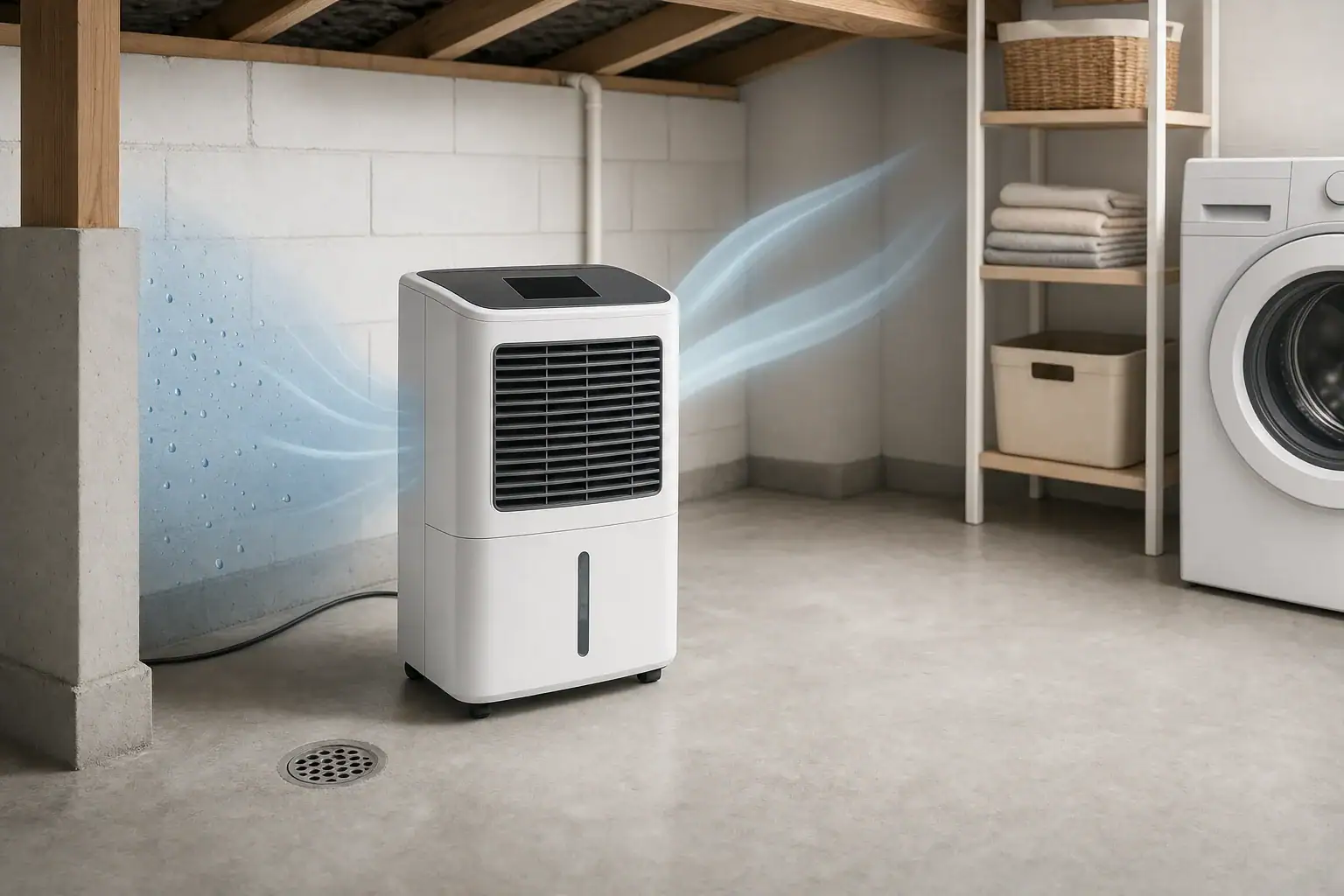
A crawl-space dehumidifier should have enough pint-per-day capacity to hold the space near 45% to 55% relative humidity during typical damp conditions, with sizing based on area, moisture load, temperature, and drainage rather than square footage alone. Many residential crawl spaces fall within a general 50- to 90-pint-per-day range, but small dry spaces may need less and large or persistently wet spaces may require more. Water intrusion and exposed soil should be corrected before relying on equipment capacity.
Quick answer
- Aim for approximately 45% to 55% relative humidity; consistent readings above 60% indicate that moisture control needs attention.
- As broad planning guidance, consider about 30 to 50 pints per day for a small, mildly damp space and 50 to 90 or more pints per day for larger or wetter spaces.
- Compare capacities under the same test standard because published pint ratings can use different temperature and humidity conditions.
- Use continuous gravity drainage or a properly installed condensate pump instead of depending on manual bucket emptying.
- Place the unit centrally when possible, leave the required intake and exhaust clearance, and avoid blocked airflow.
Why Crawl-Space Dehumidifier Size Matters
A dehumidifier removes water vapor from the air and collects it as liquid condensate. Its capacity is commonly stated as pints of water removed in 24 hours under specified test conditions. This rating is a measure of moisture-removal ability, not the size of the collection bucket.
An undersized unit may run continuously without reaching the selected humidity level. An unnecessarily large unit may reach the target quickly, but it can cost more initially and may cycle more often if its controls are not suited to the space. Proper sizing balances moisture removal, airflow, energy use, operating temperature, and expected seasonal conditions.
Crawl spaces differ from ordinary rooms because they may have exposed soil, foundation vents, cool surfaces, plumbing leaks, groundwater seepage, or outdoor air leakage. Correcting those moisture sources often makes a greater difference than adding capacity alone.
How to Estimate Capacity for a Crawl Space
Start with area and volume
Measure crawl-space length and width, then multiply them to find square footage. For irregular layouts, divide the space into rectangles and add their areas. Multiplying area by average height gives approximate volume in cubic feet.
For example, a 1,500-square-foot crawl space with an average height of 3 feet contains about 4,500 cubic feet. Height matters because a tall crawl space contains more air, although moisture entering from soil and walls may still be the dominant load.
Classify the moisture load
A mildly damp space may have elevated humidity during humid weather but no standing water or active leaks. A very damp space may have exposed soil, frequent condensation, wet masonry, or substantial outdoor air entry. These conditions call for source control and potentially greater dehumidification capacity.
As a general starting point, a small, enclosed, mildly damp crawl space may be served by roughly 30 to 50 pints per day. Medium spaces commonly start around 50 to 70 pints per day, while large or persistently damp spaces may need 70 to 90 pints per day or more. These are planning ranges, not guarantees.
Compare ratings carefully
Capacity changes with temperature and relative humidity. A unit tested in warm, very humid air can show a higher removal rate than the same unit tested under cooler, less humid conditions. Compare products using the same rating method and review performance information for the temperatures expected in the crawl space.
Example values for illustration.
| Condition | Planning response | Why it matters |
|---|---|---|
| Under 1,000 square feet and mildly damp | Start around 30 to 50 pints per day | Lower air volume and moisture load may need less capacity |
| 1,000 to 2,000 square feet | Consider roughly 50 to 70 pints per day | Area, height, and leakage can shift the requirement |
| Over 2,000 square feet or very damp | Consider 70 to 90 pints per day or more | Large or wet spaces create a greater removal load |
| Cool operating conditions | Check low-temperature performance | Cold coils may collect frost and reduce removal |
| Open vents or major air leakage | Seal or manage openings before upsizing | Incoming humid air can overwhelm the equipment |
| Standing water or active leakage | Correct drainage or plumbing first | A dehumidifier is not a substitute for water control |
Common Sizing Mistakes and Troubleshooting Cues
Choosing a unit only by square footage is a common mistake. Two equally sized crawl spaces can have very different moisture loads because of climate, soil conditions, foundation drainage, air leakage, and temperature.
- Confusing bucket size with capacity: A small reservoir does not necessarily mean low daily moisture removal. Continuous drainage makes reservoir size less important.
- Comparing unlike ratings: Pint ratings are meaningful only when their test conditions are comparable.
- Ignoring exposed soil: Bare earth can release substantial moisture. A durable, sealed ground vapor barrier can reduce this load.
- Setting humidity too low: A very low setting can increase runtime and energy use without providing a practical benefit. Approximately 45% to 55% is a common general target.
- Overlooking airflow barriers: Foundation walls, stored materials, and narrow compartments can prevent dry air from reaching the entire space.
- Treating bulk water with dehumidification: Roof runoff, plumbing leaks, groundwater, and standing water require direct correction.
If the unit runs continuously and humidity remains above the setting, inspect drainage, filter condition, coil frost, air clearance, and moisture sources. Also compare the dehumidifier’s own sensor with a separate hygrometer placed away from its outlet. Warm, dry discharge air can cause a nearby sensor to report a lower value than the rest of the crawl space.
Drainage and Placement Checklist
Plan for continuous drainage
A crawl-space unit can collect several gallons of water over a damp day, so manual emptying is usually impractical. Gravity drainage is the simplest option when a suitable discharge point is lower than the unit. The hose should slope continuously downward without kinks, loops, or low sections that trap water.
When gravity drainage is unavailable, a condensate pump can move water upward or across a longer distance. It should be rated for the expected lift and installed according to its instructions. Route discharge to an approved location where water will not return to the foundation, create erosion, or freeze in a hazardous area.
Choose a stable location
Place the dehumidifier on a firm, level, elevated support that is suitable for the environment. Keep the intake and exhaust openings clear according to the manufacturer’s specified distances. Do not press the unit against insulation, vapor barriers, stored items, or framing.
A central location often improves distribution. In a divided crawl space, position the unit near an opening between sections or use manufacturer-approved ducting when the equipment is designed for it. A small circulation fan may help with isolated pockets, but it does not add moisture-removal capacity.
- Keep the unit accessible for filter changes, coil inspection, and drain cleaning.
- Protect the cord, hose, and pump tubing from sharp edges and foot traffic.
- Place an independent humidity sensor in a representative area, not directly in the discharge stream.
- Check that doors, vents, and access panels match the intended moisture-control strategy.
Capacity Examples for Typical Crawl Spaces
Small encapsulated space
Consider an 800-square-foot crawl space with a 3-foot average height, a sealed ground liner, closed foundation vents, and no active leaks. If humidity is only moderately elevated in summer, a capacity near 30 to 50 pints per day may be a reasonable starting range. Actual performance still depends on climate and air leakage.
Medium space with seasonal humidity
A 1,500-square-foot crawl space with a 3-foot height and seasonal condensation may justify a starting range around 50 to 70 pints per day. Before selecting equipment, inspect gutters, downspouts, grading, plumbing, and the continuity of the ground vapor barrier. Reducing moisture entry may allow a smaller unit to maintain the target.
Large or compartmentalized space
A 2,500-square-foot crawl space with several foundation sections may need 70 to 90 pints per day or more. One centrally located unit may work if air can circulate freely. Otherwise, approved ducting or multiple independently controlled units may provide more even coverage.
For unusually wet spaces, calculate the load with help from a qualified moisture-control professional rather than adding capacity indefinitely. Persistent water can indicate drainage, plumbing, foundation, or site-grading issues that dehumidification alone cannot resolve.
Electrical, Temperature, and Equipment Safety
Use a properly grounded receptacle and follow applicable electrical codes, including ground-fault protection where required. Avoid extension cords and do not place plugs or connections where they may contact water. Electrical work in a damp or inaccessible area should be handled by a qualified professional.
Confirm the equipment’s listed operating-temperature range. Refrigerant dehumidifiers generally remove less water as temperatures fall, and frost can develop on the coil in cool conditions. Automatic defrost can help manage frost, but it does not make every unit suitable for every temperature.
Look for recognized electrical safety certification and compare energy-efficiency information using a consistent rating method. Dehumidification does not require ionization, ozone generation, or ultraviolet treatment. If a device includes additional air-treatment features, review them separately and avoid intentional ozone production in occupied homes.
Encapsulation or vent changes can affect radon behavior, soil gases, and combustion-air conditions. Homes with fuel-burning equipment in or near the crawl space may need evaluation before the enclosure strategy changes. Follow local requirements and equipment instructions.
Maintenance and Humidity Monitoring
Inspect the unit at least monthly during heavy-use periods. A dirty filter restricts airflow, lowers moisture removal, and can increase operating time. Clean or replace the filter according to its instructions rather than waiting for visible heavy buildup.
Check the drain hose for slime, sediment, kinks, and proper slope. Test a condensate pump and its safety switch periodically if one is used. Inspect the unit after outages because some controls may not automatically resume their previous setting.
Use a separate hygrometer to track conditions over time. Readings can vary by location, so measurements near a cool foundation wall may differ from those near the dehumidifier outlet. Trends over several days are generally more useful than a single reading.
Seasonal changes may require a different setting or inspection schedule. If humidity rises despite normal operation, check for a clogged filter, blocked airflow, drain backup, coil frost, new air leakage, plumbing problems, or exterior water near the foundation.
Example values for illustration.
| Goal or condition | Simple actions | Tools | Note |
|---|---|---|---|
| Maintain routine humidity control | Set approximately 45% to 55% | Dehumidifier and hygrometer | Avoid unnecessarily low settings |
| Readings remain above 60% | Check sizing, airflow, and moisture entry | Independent hygrometer | Review several days of readings |
| Exposed soil | Install or repair a sealed ground barrier | Durable vapor-control materials | Follow local practices |
| Standing water | Correct drainage, grading, or leaks | Drainage assessment | Do not rely on dehumidification alone |
| Uneven humidity | Improve circulation between sections | Multiple sensors | Keep intake and exhaust clear |
| Frequent drain backup | Clean and test the drain path | Drain hose or condensate pump | Keep discharge away from the foundation |
Related guides: How to Size a Dehumidifier (Sq Ft, Pints/Day, and Real-World Tips) • Dehumidifier Capacity Estimator: Room Dampness to Liters/Day • Drain Hose vs Bucket: Which Dehumidifier Setup Is Best? • Dehumidifier Ice Build-Up: Why Coils Freeze and What to Do • Crawl Space Humidity: Signs It Is Affecting Indoor Air
Summary of Crawl-Space Sizing Priorities
Choose crawl-space dehumidifier capacity by combining square footage, ceiling height, dampness, temperature, air leakage, and expected seasonal load. Rough planning ranges of 30 to 50, 50 to 70, and 70 to 90 or more pints per day can help narrow the options, but ratings must be compared under consistent test conditions.
Correct standing water, leaks, exposed soil, and exterior drainage problems before compensating with a larger unit. Provide continuous drainage, clear airflow, safe electrical service, and enough access for maintenance. After installation, verify performance with humidity readings from representative locations and adjust the moisture-control plan if the space consistently remains above 60% relative humidity.
Frequently asked questions
What size dehumidifier is needed for a 1,500-square-foot crawl space?
For a 1,500-square-foot crawl space, a unit rated around 50 to 70 pints per day is often a reasonable starting range. The correct capacity depends on average crawl-space height, outdoor humidity, exposed soil, air leakage, drainage conditions, and whether the space is encapsulated. A persistently damp or compartmentalized space may need more capacity or improved moisture control.
Should I size a crawl-space dehumidifier by square footage or cubic feet?
Square footage is useful for an initial estimate, but it should not be the only sizing factor. Cubic feet accounts for crawl-space height, while moisture sources such as wet soil, foundation leakage, open vents, and plumbing leaks can have an even greater effect on the required capacity. Use both dimensions along with observed humidity and dampness conditions.
What humidity level should a crawl-space dehumidifier be set to?
A setting between approximately 45% and 55% relative humidity is a common general target for crawl spaces. Setting the unit much lower can increase energy use and runtime without necessarily improving moisture control. If readings remain above 60% for several days, inspect the unit, airflow, drainage, and moisture sources.
Can a dehumidifier solve standing water in a crawl space?
No. A dehumidifier removes water vapor from air, but it is not designed to correct bulk water from groundwater, roof runoff, plumbing leaks, or poor grading. Resolve active leaks and drainage problems first, then use dehumidification to manage the remaining humidity load.
Why does my crawl-space dehumidifier run constantly but humidity stays high?
Continuous operation can indicate insufficient capacity, but it can also result from a clogged filter, blocked airflow, frost on the coil, a drain problem, or inaccurate humidity sensing. Check conditions with an independent hygrometer placed away from the unit’s discharge air. Also inspect for new water entry, exposed soil, open vents, and air leaks that may be adding moisture faster than the unit can remove it.
Recommended next:
- How to Size a Dehumidifier (Sq Ft, Pints/Day, and Real-World Tips)
- Desiccant vs Compressor Dehumidifiers: Which Is Better for Cold Rooms?
- Basement Dehumidifier Guide: Targets, Drainage, and Energy Use
- Dehumidifier Running Cost: How Much Electricity Will It Use?
- Dehumidifier Sizing: Liters/Day, Room Type, and Dampness Levels
- Basement Dehumidifier Setup: Drainage, Placement, and RH Targets
- Clear sizing logic (room size → CADR/ACH)
- HEPA vs carbon explained for real use-cases
- Humidity + ventilation basics to reduce mold risk