
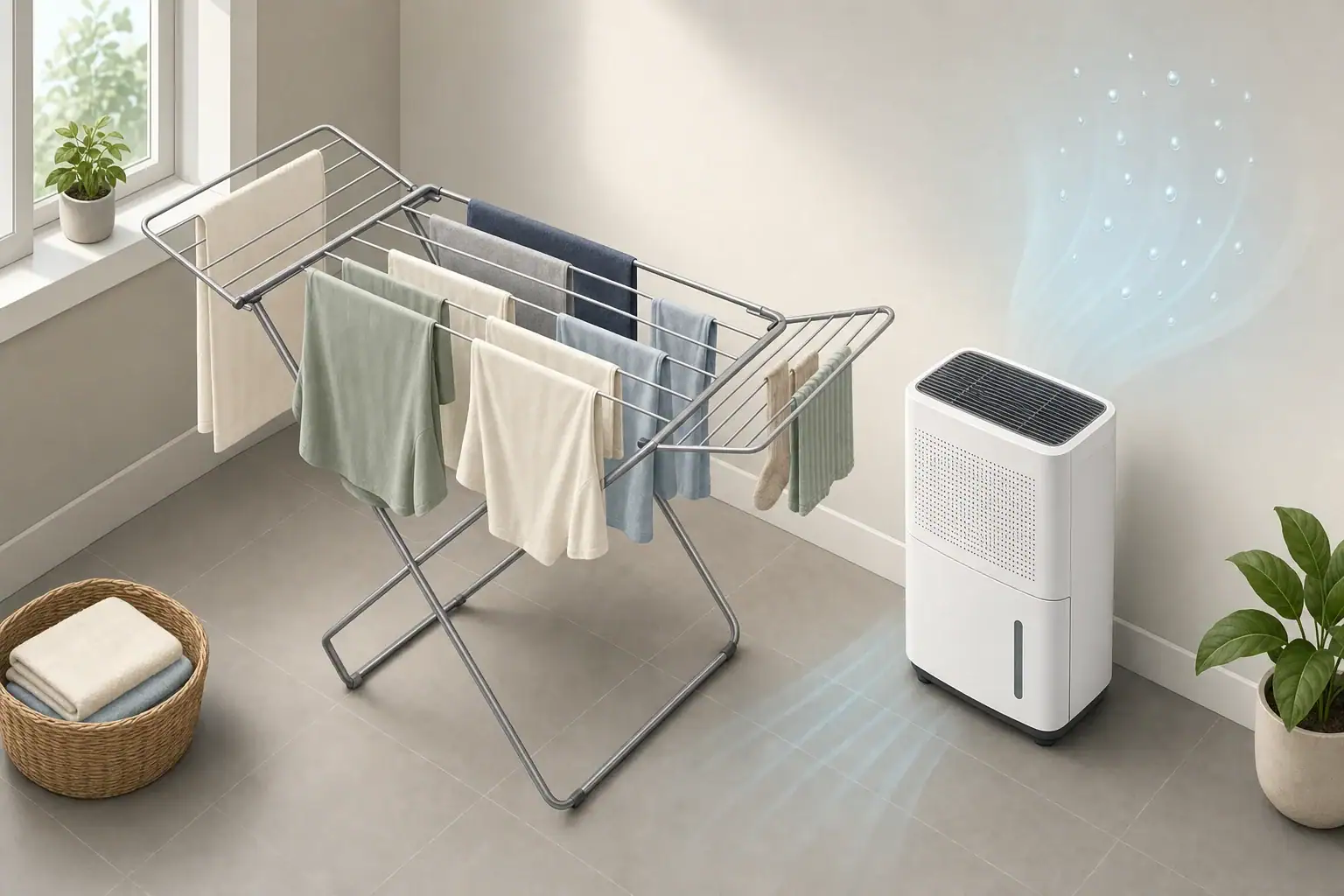
A dehumidifier helps dry laundry indoors when moisture is accumulating faster than ventilation can remove it.
It works by lowering the room’s relative humidity, allowing more water to evaporate from damp fabric. The benefit is usually greatest in a closed or partly closed room with limited ventilation, especially when indoor humidity would otherwise remain above about 60%.
How a dehumidifier helps laundry dry indoors
Wet laundry releases water vapor into the surrounding air. As relative humidity rises, evaporation slows because the air has less capacity to accept additional moisture. A dehumidifier removes some of that water vapor and returns drier air to the room, helping evaporation continue.
Air movement matters as much as humidity. A layer of damp air forms near fabric surfaces, so moving air across and between garments replaces it with drier room air. A dehumidifier provides some circulation, but a separate low-speed fan can improve distribution in larger rooms or around a crowded rack.
The appliance is most useful when line drying causes fogged windows, damp-feeling surfaces, persistent condensation, or room humidity above roughly 60%. It may offer little benefit when outdoor air is dry and an open window or exhaust fan can remove moisture efficiently.
A dehumidifier does not heat fabric as directly as a tumble dryer. Some models release modest waste heat into the room during operation, which can support evaporation, but their primary function is moisture removal.
Humidity targets and sizing logic for indoor laundry
A common general indoor target is about 30% to 50% relative humidity, although climate, season, and building construction affect what is practical. During laundry drying, maintaining approximately 40% to 50% can provide useful drying conditions without making the room unusually dry. Avoid treating a single reading as an absolute limit; monitor trends and look for condensation.
Estimate the moisture load
The water left in a washed load depends on fabric type, load size, and the washer’s final spin. One simple way to estimate it is to weigh the laundry immediately after washing and compare that with its dry weight. Each pound of weight difference represents approximately one pint of water.
For example, a load that is two pounds heavier when wet contains about two pints of water that must go somewhere. The dehumidifier will not necessarily collect all of it because some moisture may leave through ventilation or remain temporarily in room materials.
Interpret capacity ratings carefully
Dehumidifier capacity is commonly expressed in pints removed per day under specified test conditions. Actual removal may be lower in a cool room or once humidity falls. Instead of matching a rating directly to one laundry load, consider room size, starting humidity, temperature, frequency of washing, and whether the unit must also manage existing dampness.
A small laundry area with occasional loads may need less capacity than a basement where several loads dry each week. Compressor-based units also tend to remove less water as temperatures fall, while other dehumidification technologies may behave differently but can use substantial energy.
Example values for illustration.
| Condition | Primary response | Reason |
|---|---|---|
| Room humidity below 50% | Use spacing and airflow first | The air may already have useful drying capacity |
| Humidity repeatedly above 60% | Run a dehumidifier | Active moisture removal can control accumulation |
| Outdoor air is cool and dry | Consider ventilation | Air exchange may remove moisture efficiently |
| Outdoor air is warm and humid | Close windows and dehumidify | Ventilation may add moisture instead of removing it |
| Large or tightly packed load | Add airflow and increase spacing | Moist air can remain trapped between fabrics |
| Cold basement or utility room | Check the unit’s operating range | Low temperatures can reduce performance |
Common mistakes and troubleshooting cues
Running a dehumidifier with windows wide open is a common source of poor results. The unit may continuously process incoming air rather than lowering humidity around the laundry. An exception is when outdoor air is clearly drier than indoor air and ventilation is being used intentionally.
Another mistake is aiming the outlet directly at one garment from very close range. This can leave other parts of the rack in stagnant air. Position the unit far enough away for airflow to spread around the load, while maintaining the clearances specified in its instructions.
Watch for these troubleshooting cues:
- Humidity does not fall: Close unnecessary openings, check whether the reservoir is full, inspect the filter, and confirm that the room is within the appliance’s temperature range.
- Clothes remain damp in folds: Separate layers, turn heavy items, and leave gaps between garments.
- Windows still collect condensation: Move the drying setup away from cold glass, increase moisture removal, or use controlled ventilation when outdoor conditions permit.
- The unit cycles off too early: Check the humidity setting and compare its sensor with a separate monitor placed away from the outlet.
- Ice appears on the coil: Stop and follow the manufacturer’s guidance; the room may be too cold or airflow may be restricted.
Humidity readings also vary by location. A monitor beside the dehumidifier outlet may show drier conditions than the air near the laundry. Place a separate monitor at about breathing height, away from windows, exterior walls, direct airflow, and wet garments.
Practical setup checklist for faster drying
Prepare the laundry and room
- Use the washer’s appropriate high-spin option when suitable for the fabrics. Removing more water mechanically generally uses less room-conditioning energy than evaporating it indoors.
- Shake out garments and hang them in a single layer where possible.
- Leave several inches between bulky items and avoid placing wet fabric against walls.
- Choose a room that can be partly isolated from the rest of the home.
- Keep the rack away from cold windows and surfaces prone to condensation.
Position and operate the dehumidifier
- Set the unit on a level, stable surface and maintain all required clearances.
- Keep air inlets, outlets, curtains, and laundry separate so nothing blocks airflow.
- Use a humidity setting around 45% to 50% as a reasonable starting point.
- Direct general airflow across or around the rack rather than into a wall.
- Use continuous drainage only when the hose can be installed exactly as instructed and routed to an appropriate drain.
- Check the water reservoir before leaving the setup unattended.
Close the room door if doing so does not conflict with combustion-appliance safety or needed ventilation. Recheck humidity after an hour or two. If it is falling steadily and the clothes feel progressively drier, the arrangement is working as intended.
After the load dries, allow the dehumidifier to continue briefly if room humidity remains elevated. There is generally no need to keep it running once the room returns to its normal range.
Real-world indoor laundry drying examples
Small apartment bathroom
A drying rack in a bathroom may produce a sharp humidity increase because the room has little air volume. Closing the door and running a dehumidifier can be effective if the appliance is kept safely away from splashes. An operating exhaust fan may also work, but using both at full output can be inefficient because the fan continually replaces conditioned air.
Cool basement laundry area
A basement may begin with elevated humidity before laundry is added. In this case, the dehumidifier manages both the building’s background moisture and the laundry load. Check the appliance’s minimum operating temperature, and do not assume its rated daily capacity will be achieved in cool conditions.
Open-plan living area
In a large open space, moisture spreads through a much greater air volume. A portable dehumidifier near the rack may still help locally, but it can take longer to change the humidity of the whole area. Creating a safe, partly enclosed drying zone or choosing a smaller room is often more practical.
Dry winter day
If outdoor air has low absolute humidity, brief ventilation may remove moisture faster than active dehumidification. However, very cold outdoor air can cool nearby surfaces and increase heating demand. Use short, controlled ventilation rather than leaving windows open indefinitely.
Safety, ventilation, and energy considerations
Dehumidifiers combine electricity, moving air, collected water, and, in many models, a sealed refrigeration system. Use a properly grounded outlet, keep the cord and plug dry, and avoid extension cords unless the manufacturer explicitly permits one. Never modify the appliance, defeat reservoir switches, or open the refrigerant system.
Keep the unit outside zones where it could be splashed or knocked over. A bathroom or utility-room outlet may require ground-fault protection under applicable electrical rules. Follow local requirements and the appliance instructions.
Do not block combustion-air openings or isolate fuel-burning equipment in a way that changes safe ventilation. A dehumidifier removes water vapor but does not remove carbon dioxide, combustion gases, or general indoor pollutants. Normal ventilation remains necessary.
Ionization, ozone generation, and UV-C are not needed for laundry drying. If an appliance includes optional air-treatment functions, evaluate them separately and avoid features that intentionally produce ozone. Basic filtration may capture lint, but a dehumidifier is not a substitute for a properly sized air purifier.
For energy control, start with water removal in the washer, good garment spacing, and targeted room use. Run the dehumidifier only as long as needed to reach the selected humidity range, and use automatic humidity control when available.
Maintenance and ongoing moisture control
A clogged intake filter reduces airflow and can slow both water removal and laundry drying. Inspect the filter regularly and clean or replace it according to the appliance instructions. Homes with lint, dust, or pets may require more frequent attention.
Empty and rinse the reservoir before residue builds up. Let removable parts dry before reinstalling them. If continuous drainage is used, inspect the hose for kinks, buildup, leaks, and a reliable downward path where gravity drainage is required.
Keep the intake grille, outlet, and humidity sensor free of dust. Do not spray cleaners or water into the appliance. At the end of a season, clean and dry the unit before storage, and protect the cord and drainage components from damage.
Track ordinary operating behavior rather than relying only on drying time. Useful indicators include the room’s starting and ending humidity, the amount of water collected, load size, and how often the unit runs. A gradual decline in collection under similar conditions can point to a dirty filter, colder room, changed settings, or a maintenance issue.
Example values for illustration.
| Goal or condition | Simple action | Tool or cue | Note |
|---|---|---|---|
| Start a drying load | Check room humidity | Humidity monitor | Use the reading as a baseline |
| Maintain useful drying conditions | Target about 40% to 50% | Dehumidistat | Adjust for climate and comfort |
| Avoid prolonged dampness | Keep humidity below about 60% | Monitor trend | Also watch for condensation |
| Improve slow drying | Increase spacing and airflow | Rack and fan | Do not block appliance vents |
| Control operating time | Stop after humidity stabilizes | Automatic control or timer | Follow unattended-use guidance |
| Protect performance | Clean the filter and reservoir | Maintenance schedule | Frequency depends on use and dust |
Related guides: Basement Dehumidifier Guide: Targets, Drainage, and Energy Use • Dehumidifier Running Cost: How Much Electricity Will It Use? • Drain Hose vs Bucket: Which Dehumidifier Setup Is Best? • Dehumidifier in Winter: Does It Work in Cold Basements?
Key takeaways for drying laundry with a dehumidifier
A dehumidifier is most helpful when indoor laundry pushes relative humidity toward or above 60%, ventilation is limited, or outdoor air is too humid to provide effective drying. A target near 40% to 50%, combined with good garment spacing and steady airflow, is a practical starting point.
Choose capacity with the room, temperature, moisture load, and washing frequency in mind rather than relying on floor area alone. Monitor humidity trends, keep the appliance unobstructed, and maintain its filter, reservoir, and drain components. Ventilation is still needed for general indoor air quality, even when a dehumidifier is controlling laundry moisture.
Frequently asked questions
What humidity should I set a dehumidifier to for indoor laundry drying?
A setting around 45% to 50% relative humidity is a practical starting point for most indoor drying setups. The goal is generally to prevent humidity from remaining above about 60%, while allowing for normal variation caused by room temperature, climate, and the size of the load.
Should windows be closed when using a dehumidifier to dry clothes?
In most cases, keep windows and doors mostly closed so the dehumidifier can lower humidity in the drying area. Open-window ventilation can be preferable when outdoor air is genuinely drier than indoor air, but humid outdoor air may slow drying and increase the appliance’s workload.
Where should a dehumidifier be placed near a clothes drying rack?
Place it in the same room as the rack on a level surface, leaving the manufacturer-required clearance around the intake and outlet. Position it far enough from the clothes for airflow to circulate around the full rack rather than concentrating on one item or being blocked by fabric.
Why are clothes still damp after running a dehumidifier?
Slow drying often results from tightly packed garments, poor air circulation, a full water reservoir, or a dirty filter. Separate heavy items and folds, check that the unit is operating within its rated temperature range, and use gentle airflow across the rack if needed.
Can a dehumidifier dry laundry in a cold basement?
It can help, but performance depends on the appliance type and the room temperature. Many compressor-based dehumidifiers remove less moisture in cool conditions, so check the stated operating range and consider improving airflow or using a warmer drying space where practical.
Recommended next:
- How to Size a Dehumidifier (Sq Ft, Pints/Day, and Real-World Tips)
- Desiccant vs Compressor Dehumidifiers: Which Is Better for Cold Rooms?
- Basement Dehumidifier Guide: Targets, Drainage, and Energy Use
- Dehumidifier Running Cost: How Much Electricity Will It Use?
- Dehumidifier Sizing: Liters/Day, Room Type, and Dampness Levels
- Basement Dehumidifier Setup: Drainage, Placement, and RH Targets
- Clear sizing logic (room size → CADR/ACH)
- HEPA vs carbon explained for real use-cases
- Humidity + ventilation basics to reduce mold risk