
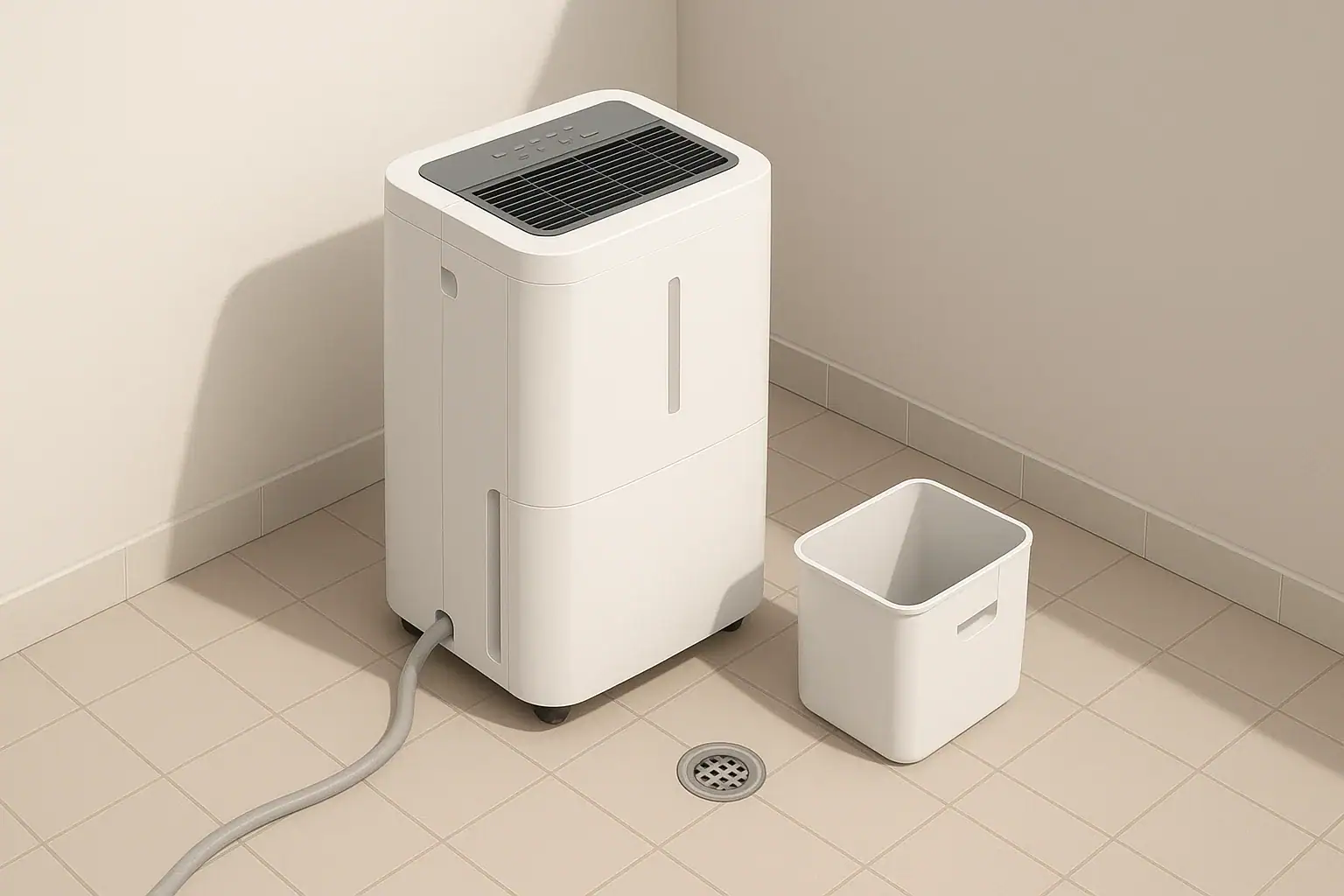
A drain hose is usually better for continuous dehumidifier use, while a bucket is better for flexible, portable use or when no suitable drain is available.
Both setups can keep indoor humidity in a comfortable range if used correctly. The best choice depends on how damp the space is, how often the unit runs, whether you have safe access to a drain, and how often you want to empty a tank. Understanding the tradeoffs helps you avoid leaks, overflows, and unnecessary hassle.
- Use a drain hose for very damp areas or 24/7 operation where a floor drain or nearby sink is available.
- Use the bucket when the dehumidifier moves between rooms or no safe gravity drain is nearby.
- Aim to keep indoor humidity roughly in the 40–60% range for general comfort and mold prevention.
- Expect to empty a bucket anywhere from once every couple of days to multiple times a day in very damp spaces.
- Always keep hoses pitched downward with no kinks, and check for leaks or clogs regularly.
Why the Dehumidifier Drain Setup Matters
Dehumidifiers remove moisture from indoor air and collect it as liquid water (condensate). How that water leaves the machine affects convenience, safety, and performance. If the tank overflows or the drain clogs, the unit may shut off early or spill water onto floors, drywall, or stored items.
In many U.S. homes, a portable dehumidifier handles damp basements, laundry rooms, or bathrooms. Some people only run theirs on humid summer days, while others rely on it nearly all year. With that much variation, there is no single “best” setup: a drain hose or a bucket can both work well when matched to the space and usage.
This comparison focuses on portable residential units, not whole‑home systems tied into HVAC drains. The same basic ideas still apply: water must move away from your living space safely and reliably.
How Drain Hoses and Buckets Work
Before choosing between a drain hose or using the built‑in bucket, it helps to understand how each option operates and its basic requirements.
Bucket (Collection Tank) Basics
Most portable dehumidifiers include an internal tank or bucket that slides out from the front or side. Condensate drips into this container until it reaches a certain level. A float or sensor detects when the tank is full and shuts off the compressor or the whole unit to prevent spilling.
Key points about buckets:
- Capacity: Often ranges from around 0.5 to 2 gallons (roughly 2–8 liters), depending on the size of the dehumidifier.
- Shutoff feature: Automatic shutoff when full prevents overflow but also stops dehumidifying until you empty and reseat the bucket.
- Portability: The unit can run anywhere there is an outlet, with no need to reach a drain.
- Maintenance: The bucket needs periodic cleaning to limit biofilm, slime, and musty odors.
Drain Hose (Continuous) Basics
A drain hose uses gravity (or sometimes a pump) to move water from the dehumidifier to a floor drain, utility sink, condensate pump, or other safe outlet. Many units have a threaded outlet on the back where you attach a short hose or a longer compatible tube.
Key points about drain hoses:
- Gravity dependence: For a passive drain, the hose outlet must be higher than the drain termination so water flows downhill.
- Continuous operation: The tank usually stays empty, so the unit does not stop for bucket emptying and can run as long as needed.
- Placement limits: The dehumidifier’s location is partly dictated by where a drain is available and the necessary downward slope.
- Leak risk: Poor connections, kinks, or clogs can cause water to back up and leak around the machine.
| Aspect | Bucket (Tank) | Drain Hose (Continuous) |
|---|---|---|
| Best use case | Occasional or seasonal use, moving between rooms | Very damp areas, long daily runtimes |
| Water removal limit | Limited by tank size; may fill in a few hours in wet spaces | Limited mainly by dehumidifier capacity and drain availability |
| User effort | Regular lifting and emptying | Initial setup work, then low effort if drain stays clear |
| Placement flexibility | High; only needs a power outlet | Medium; needs access to a drain with downward slope |
| Risk if neglected | Unit stops dehumidifying when full; minimal spill risk | Potential for leaks or unnoticed clogs if not checked |
| Cost and accessories | No extra parts usually needed | May need hose, clamps, or a condensate pump |
| Cleaning needs | Bucket needs periodic scrubbing | Hose interior can build slime; occasional flushing helps |
Example values for illustration.
Common Issues With Each Setup
Both buckets and drain hoses can cause frustration if something goes wrong. Being aware of typical problems helps you spot them early.
Bucket‑Related Problems
- Frequent shutdowns: In a very damp basement, a small bucket may fill quickly, forcing you to empty it multiple times per day. If you forget, humidity creeps up again.
- Spills when carrying: If the bucket is awkward to grip or very full, water can slosh out on the way to the sink or drain.
- Musty smell or slime: Standing water, dust, and biofilm create odors over time. This does not necessarily mean mold in the air, but it can make the area smell unpleasant.
- Improper reseating: If the bucket is not fully pushed in, the unit may not run, or it may leak around the edges.
Drain Hose‑Related Problems
- Backflow from poor slope: If the hose loops upward or lies flat, water can stagnate or back up into the unit.
- Kinks and crushing: Hoses running under doors or furniture can pinch closed, causing leaks at the connection point.
- Clogs from debris: Dust, lint from laundry areas, or scale can slowly narrow the hose, eventually blocking flow.
- Leaking connections: Loose threads or an ill‑fitting hose can drip slowly, sometimes unnoticed behind the unit.
- Improper drain choice: Draining into sinks or tubs that are used frequently can be knocked loose or cause standing water if the sink drain is partially blocked.
How to Choose: Drain Hose vs Bucket
To decide which option fits your situation, consider humidity levels, runtime, room layout, and how often you can attend to the dehumidifier.
1. How Damp Is the Space?
- Lightly damp: Slight musty smell after rain, humidity occasionally above about 60%. A bucket may only fill every few days, making manual emptying reasonable.
- Moderately damp: Humidity often above 60%, noticeable condensation on windows or pipes. Buckets may fill once or more per day, which can be manageable or annoying depending on your schedule.
- Very damp: Visible moisture on walls or floors, frequent musty odor, or humidity often above about 70%. Continuous drains are usually more practical so the unit can run steadily.
2. How Often Will the Dehumidifier Run?
- Occasional use: For short humid spells or specific tasks (like drying laundry indoors), a bucket is often sufficient.
- Daily seasonal use: In many climates, basements need dehumidifying most summer days. If you are emptying the tank more than once a day, a drain hose may be worth the effort.
- Near‑continuous use: In persistently damp spaces, a hose to a reliable drain or pump is usually the most practical choice.
3. What Drains Are Actually Available?
Good candidates for a drain hose connection include:
- Floor drains in basements or utility rooms
- Utility sinks or laundry tubs
- Condensate pumps that discharge to a higher drain line or outdoors, set up according to local codes
Avoid draining directly onto soil near the foundation, into yard drains that can back up toward the house, or into areas where children or pets are likely to disturb the hose.
4. How Much Maintenance Are You Willing to Do?
- Bucket users: Plan to empty and rinse the tank as often as needed to prevent the unit from shutting off and to keep odors down.
- Hose users: Plan occasional checks for clogs, leaks, or accidental disconnections, especially after moving the unit or cleaning the area.
Practical Setup Tips for Buckets and Drain Hoses
Once you decide on a setup, a few practical habits help avoid messes and maintain effective dehumidification.
Better Bucket Use
- Monitor how fast it fills: For the first few days, note how many hours it takes to fill the bucket. This gives you a realistic emptying schedule.
- Do not overfill on purpose: Avoid trying to “stretch” time between empties. Let the automatic shutoff work as intended, then empty promptly.
- Rinse regularly: A quick swish with clean water once or twice a week, plus occasional mild detergent cleaning, helps reduce biofilm buildup.
- Dry before storage: If you put the dehumidifier away for a season, empty and dry the bucket thoroughly so it does not sit with stagnant water.
Better Drain Hose Use
- Maintain a steady downhill slope: Route the hose so every point is lower than the outlet, with no loops that trap water.
- Secure the connection: Use the correct fitting and ensure it is hand‑tightened; avoid cross‑threading.
- Protect the hose: Keep it away from areas where it might be stepped on, pinched by doors, or chewed by pets.
- Check for flow: After setup, run the unit and confirm water is steadily reaching the drain point.
- Flush occasionally: If practical, detach and rinse the hose with clean water to clear sediment or slime.
Real‑World Scenarios: Which Setup Fits?
Scenario 1: Finished Basement Family Room
A mostly finished basement used as a family room is slightly damp in late spring and summer. Humidity is often around 60–65%, and there is a floor drain in an adjacent unfinished storage area.
Good fit: A drain hose routed gently downhill to the floor drain. This allows the dehumidifier to run as needed without constant tank checks, important for a space people use daily.
Scenario 2: Small Apartment Bedroom
A renter in a small apartment notices seasonal humidity and a slight musty smell near an exterior wall. There is no nearby floor drain, and only one shared bathroom sink is available down the hall.
Good fit: Bucket use. The dehumidifier can move between bedroom and living area if needed, and the occupant can empty the tank in the bathroom sink once a day or as required.
Scenario 3: Laundry Room With Frequent Drying
A laundry room in a house has a utility sink and is frequently used for drying clothes indoors on racks. Humidity spikes whenever laundry is drying and takes hours to drop.
Good fit: Drain hose into the utility sink or into a properly installed condensate pump. Continuous drainage keeps up with the frequent moisture load without constant bucket trips.
Scenario 4: Seasonal Cabin
A seasonal cabin is shut for part of the year and used heavily in summer. The owner visits on weekends and wants to limit dampness but cannot check equipment daily.
Possible approaches:
- If there is a reliable floor drain and power is left on, a drain hose may allow the dehumidifier to maintain humidity without manual emptying.
- If no drain is available, the owner may choose to run the unit only when present and use the bucket, accepting that humidity may rise between visits.
Safety and Building Considerations
Moving water around indoors always carries some risk. A few precautions can reduce the chance of damage.
- Use appropriate drains: Ideally, discharge into drains intended for continuous or intermittent water, such as floor drains or utility sinks. Avoid sending water into electrical conduits, wall cavities, or other non‑plumbing openings.
- Mind electrical safety: Keep cords, plugs, and power strips away from any potential leak path, whether from a bucket spill or hose issue.
- Check local rules: In some areas, discharging condensate into certain drains may be restricted or require specific connections. If in doubt, consult local building or plumbing guidance.
- Avoid trip hazards: Route hoses where people are unlikely to trip, especially in hallways or near stairwells.
- Consider surfaces: On wood or laminate floors, even small leaks can cause warping over time. A tray or mat under the unit may help contain minor drips.
Ongoing Maintenance, Cleaning, and Costs
Whichever setup you use, regular maintenance helps keep the dehumidifier effective and limits unwanted odors or leaks.
Shared Maintenance Tasks
- Clean the air filter: Most dehumidifiers have a washable filter to catch dust. Check and clean it according to the manual—often every few weeks during heavy use—to maintain airflow.
- Wipe the exterior: Dust buildup can make vents less effective. A soft cloth or vacuum brush keeps intake and exhaust grills clear.
- Inspect the area: Periodically check nearby walls, floors, and stored items for any signs of dampness or staining that might indicate leaks or insufficient dehumidification.
Bucket‑Specific Maintenance
- Regular cleaning: Use mild detergent and warm water to clean the bucket interior every few weeks, especially in warm weather.
- Check the float mechanism: Ensure any float or sensor is moving freely and not coated with residue that might affect shutoff.
Drain Hose‑Specific Maintenance
- Visual hose inspection: Look for discoloration, bulging, or obvious kinks along the length of the hose.
- Drain outlet check: Confirm that the floor drain or sink remains clear and that water is not pooling or backing up.
- Occasional disconnection: Detach and run clean water through the hose to flush out interior buildup if you notice slow draining.
Humidity Planning and Simple Action Guide
Beyond choosing a drain method, it helps to think about your humidity goals and the steps that support them. Most households find a relative humidity range around 40–60% generally comfortable and less favorable to mold growth than persistently higher levels.
If you use a simple hygrometer or a home air quality monitor with humidity readings, you can adjust how often and how long the dehumidifier runs. Pay attention to how quickly the room returns to that approximate range after showers, laundry, or heavy rain.
| Goal | Simple actions | Tools | Notes |
|---|---|---|---|
| Keep general indoor humidity around 40–60% | Run dehumidifier during humid weather; use exhaust fans when cooking or showering | Dehumidifier, bathroom and kitchen fans | Range is for general comfort and mold prevention tendencies, not a medical target |
| Reduce dampness in basements | Seal obvious water entry points; use continuous drain if space is very damp | Dehumidifier, drain hose or bucket | Address standing water or leaks separately from humidity control |
| Limit bathroom moisture after showers | Run exhaust fan during and after showers; open door when steam clears | Fan, simple humidity gauge if desired | Dehumidifiers can help but do not replace adequate ventilation |
| Manage moisture from indoor laundry drying | Run dehumidifier nearby; improve airflow with a fan | Dehumidifier, small fan | Continuous drain is often more convenient for frequent drying |
| Check if your strategy is working | Monitor humidity before and after running the dehumidifier | Basic hygrometer or air quality monitor | Look for patterns over days rather than single readings |
| Prepare for seasonal changes | Adjust runtime as outdoor humidity changes with the seasons | Same tools, plus simple notes or reminders | Humid months may need more frequent or continuous drainage |
Example values for illustration.
Related guides: Basement Dehumidifier Guide: Targets, Drainage, and Energy Use • How to Size a Dehumidifier (Sq Ft, Pints/Day, and Real-World Tips) • Dehumidifier Running Cost: How Much Electricity Will It Use?
Summary: Picking the Setup That Fits Your Space
A bucket setup works well when you need portability, have no convenient drain, or only run the dehumidifier occasionally. You exchange manual effort—emptying and cleaning the bucket—for flexibility in where you place the unit.
A drain hose setup makes more sense in consistently damp spaces or when you expect long daily runtimes and have a reliable drain with a proper downward slope. You invest a bit more effort in initial routing and periodic checks, but you avoid frequent trips to empty the tank.
In many homes, the most practical approach is to start with the bucket, observe how fast it fills, and switch to a drain hose if emptying becomes a daily chore. Matching the method to your room, schedule, and available drains is usually more important than the specific equipment, as long as you keep humidity roughly in a comfortable range and watch for leaks or clogs.
Frequently asked questions
Should I use a drain hose or a bucket for a basement dehumidifier?
For basements, if the space is very damp or the unit will run near‑continuously and a floor drain or utility sink is available, a drain hose is usually better because it allows continuous operation without frequent emptying. Use the bucket if you need portability, no suitable drain exists, or you can empty the tank regularly.
How should I route a drain hose to avoid backflow and leaks?
Route the hose with a continuous downhill slope from the dehumidifier to the drain with no upward loops, secure the connection with the correct fitting, and protect it from kinks or damage. If the drain point is higher than the unit, use a condensate pump or raise the unit following manufacturer guidance.
How often will I need to empty a dehumidifier bucket?
Emptying frequency depends on tank size, room humidity, and run time; in lightly damp rooms a tank may last several days, while in very damp spaces it might fill multiple times per day. Monitor the first few days to establish a realistic emptying schedule.
Is it safe to leave a dehumidifier running unattended with a bucket attached?
Leaving a dehumidifier unattended with a bucket is acceptable for short periods, but not ideal for long absences because the tank can fill and the unit will shut off, and spills can occur during transport. For extended unattended operation, a properly routed drain hose or condensate pump is safer.
How do I prevent musty smells and slime in buckets and hoses?
Rinse and clean the bucket every few weeks with warm water and mild detergent, dry it before storage, and occasionally flush the hose with clean water to remove sediment and biofilm. Keep the air filter clean and run the unit often enough to avoid stagnant water sitting in the system.
Recommended next:
- How to Size a Dehumidifier (Sq Ft, Pints/Day, and Real-World Tips)
- Desiccant vs Compressor Dehumidifiers: Which Is Better for Cold Rooms?
- Basement Dehumidifier Guide: Targets, Drainage, and Energy Use
- Dehumidifier Running Cost: How Much Electricity Will It Use?
- Dehumidifier Sizing: Liters/Day, Room Type, and Dampness Levels
- Basement Dehumidifier Setup: Drainage, Placement, and RH Targets
- More in Dehumidifiers →
- Clear sizing logic (room size → CADR/ACH)
- HEPA vs carbon explained for real use-cases
- Humidity + ventilation basics to reduce mold risk