
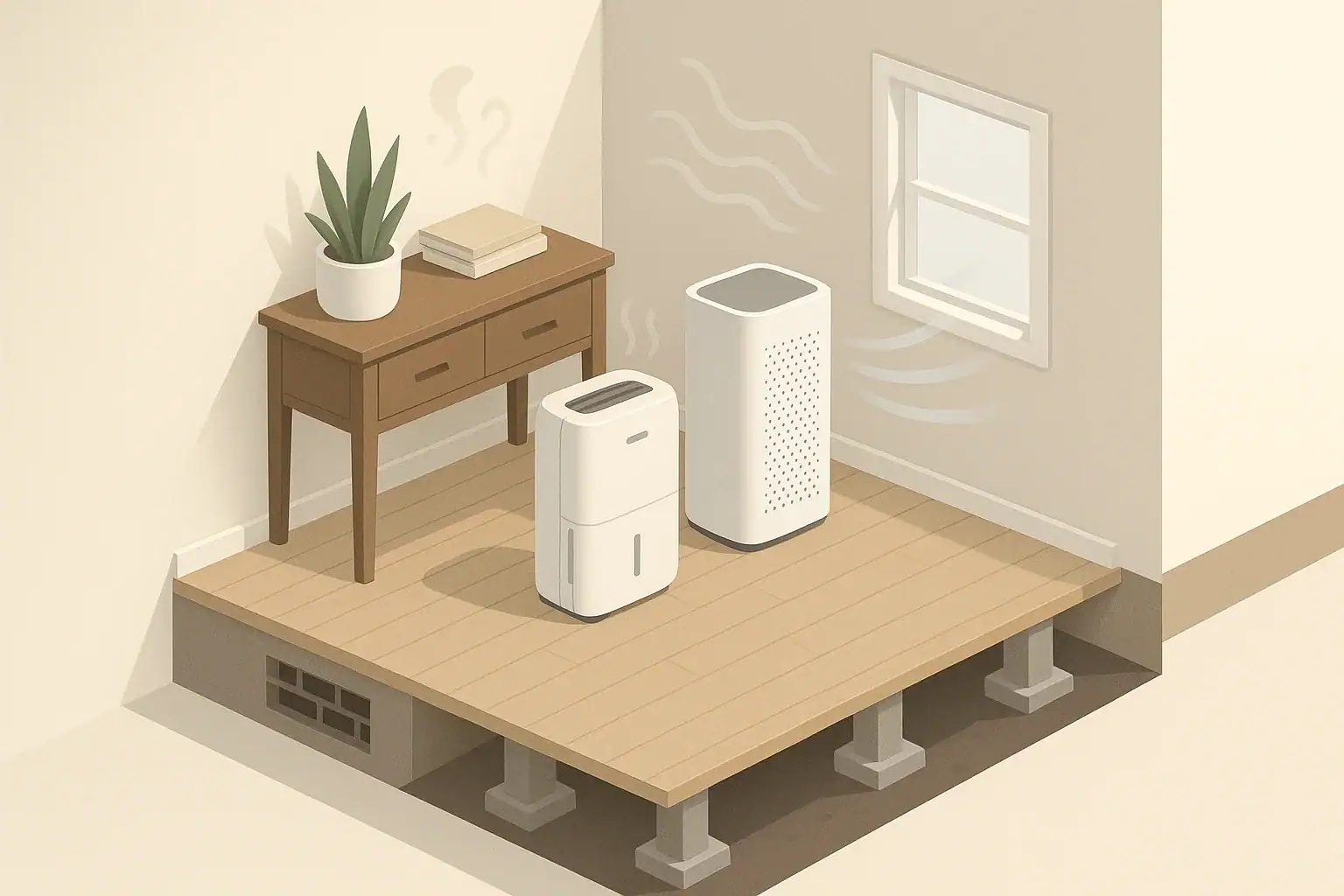
Crawl space humidity can affect indoor air when damp air, odors, particles, or mold-related materials move upward into living spaces through gaps, floor openings, and normal air pressure differences.
A damp crawl space does not automatically mean poor indoor air, but it is a common hidden moisture source in many U.S. homes. The most useful approach is to look for patterns: humidity readings, odors, visible dampness, floor-level changes, and whether symptoms improve when moisture is controlled.
What Crawl Space Humidity Means for Indoor Air
A crawl space is not part of the main living area, but it is often connected to it through small openings. Plumbing holes, wiring penetrations, gaps around ducts, rim joists, and unsealed floor assemblies can allow air to move between the crawl space and rooms above.
Humidity matters because damp materials can support odors, microbial growth on organic surfaces, corrosion, wood movement, and insulation problems. These conditions can change how a home smells and feels, and they may contribute to dustiness or comfort issues. This is different from assuming a medical cause; the practical concern is moisture control and cleaner air movement.
In many homes, air pressure pulls some crawl space air upward. This is often called stack effect. Warm air leaving the top of the house can draw replacement air from lower areas, including basements and crawl spaces. Leaky return ducts, exhaust fans, clothes dryers, and wind can also influence the direction and amount of air movement.
How Moisture Moves from the Crawl Space Into the House
Crawl space moisture usually comes from more than one source. The most common sources include exposed soil, poor exterior drainage, foundation vents during humid weather, plumbing leaks, condensation on cool surfaces, and duct leakage. The fix depends on which of these sources is active.
Relative humidity versus water intrusion
Relative humidity is the amount of moisture in the air compared with what that air can hold at its temperature. A crawl space can have high relative humidity even without visible standing water. Warm outdoor air entering a cooler crawl space can also raise relative humidity and cause condensation.
Water intrusion is different. It includes liquid water from leaks, rain, groundwater, or drainage problems. If there is standing water, wet wood, or repeated puddling, that should be handled as a source problem rather than simply as an air quality issue.
Simple measuring logic
Use at least one hygrometer in the crawl space and one in the living area above it. Check readings at the same time for several days. If the crawl space is consistently above about 60% relative humidity and the rooms above are also elevated, the crawl space may be part of the indoor humidity picture.
Numbers are most useful when paired with observations. A 65% reading after heavy rain means something different from 65% every day during mild weather. Track temperature, humidity, odors, and weather conditions together.
| What you notice | Likely moisture pathway | Practical next step |
|---|---|---|
| Musty odor strongest near floor vents or baseboards | Air leakage from the crawl space | Check duct openings, floor penetrations, and return leaks |
| Indoor humidity stays above 60% | Moisture source plus limited drying | Compare crawl space and indoor readings over several days |
| Visible ground moisture or bare soil | Ground vapor release | Inspect vapor barrier coverage and seams |
| Condensation on pipes or duct surfaces | Warm humid air meeting cool surfaces | Look for ventilation, insulation, and air sealing issues |
| Cupping or slight movement in wood flooring | Moisture imbalance below the floor | Check subfloor and crawl space humidity conditions |
| Damp or sagging insulation | Condensation, leaks, or air movement | Find the moisture source before replacing insulation |
| Puddles after rain | Drainage or groundwater entry | Review grading, gutters, downspouts, and foundation drainage |
Signs Crawl Space Humidity May Be Affecting Indoor Air
The clearest signs are those that appear near the floor, return pathways, or rooms directly above the crawl space. One sign by itself may not prove the crawl space is the source, but several signs together make it worth investigating.
Odors that return after cleaning
A persistent musty or earthy odor can come from damp wood, soil, insulation, or stored materials. If the smell is strongest near floor registers, closets, utility chases, or first-floor rooms, crawl space air movement may be involved.
Humidity that does not match indoor activities
Cooking, bathing, laundry, and humidifiers can raise indoor humidity. If indoor humidity remains high even when those sources are controlled, look below the floor. A crawl space with high humidity can act like a steady moisture reservoir.
Floor and material changes
Wood flooring may cup, crown, or feel slightly different when moisture below the floor is higher than moisture above it. Paint, baseboards, and trim near the floor may also show subtle swelling or staining. These changes deserve careful moisture checks before cosmetic repair.
Dust and particle concerns
Damp crawl spaces can disturb insulation, degrade materials, and allow soil particles to move through leaks. A room air purifier may reduce airborne particles in the living area, but it will not remove the moisture source below the home.
What to Check Before You Choose a Fix
Start outside. Many crawl space humidity problems begin with roof water and surface water. Gutters, downspouts, grading, and splash patterns can move large amounts of moisture toward or away from the foundation.
Next, check the crawl space itself. Look for bare soil, torn vapor barriers, missing coverage at piers, wet insulation, disconnected ducts, plumbing leaks, and signs of pest damage. Do not disturb suspect materials unnecessarily; the goal is to observe and document before deciding what work is needed.
Then look at the air boundary between the crawl space and the house. Common leakage points include plumbing penetrations, tub openings, electrical holes, duct boots, and gaps around framing. Air sealing is often part of crawl space moisture and indoor air planning, especially when odors move upward.
Practical Steps to Lower Crawl Space Humidity
The best moisture plan reduces sources first, then manages air and drying. Equipment can help, but it should not be the only strategy if water is entering from outside or vapor is rising from exposed soil.
Control liquid water first
- Extend downspouts away from the foundation where practical.
- Keep gutters clear enough to prevent overflow near the house.
- Maintain grading so surface water drains away from the foundation.
- Repair plumbing leaks promptly.
- Address standing water before relying on a dehumidifier.
Control ground vapor
A ground vapor barrier helps limit moisture released from soil. In simple terms, more complete coverage generally performs better than partial coverage. Seams, edges, piers, and wall transitions are common weak points, so installation quality matters.
Decide between vented and sealed strategies carefully
Some older crawl spaces rely on foundation vents. In humid climates or seasons, vents can bring outdoor moisture into a cooler crawl space. Sealed or encapsulated crawl spaces may use a dedicated dehumidifier or conditioned air strategy, but details should match local climate, building codes, combustion safety, drainage, and pest inspection needs.
Use dehumidification as moisture management, not a cure-all
A crawl space dehumidifier can help maintain a steadier humidity range after water sources and vapor pathways are addressed. It should drain safely, be accessible for maintenance, and be sized for the conditions. Avoid setting humidity extremely low; overly dry wood can also move and shrink.
Real-World Scenarios and What They Usually Mean
Different homes show crawl space humidity in different ways. These examples are general, but they show how to connect signs with practical next steps.
Scenario 1: Musty first-floor odor after summer rain
This pattern often points to wet soil, surface water near the foundation, or humid outdoor air entering the crawl space. Check gutter discharge, grading, vent behavior, and whether the vapor barrier is intact. Measure crawl space humidity for several days after rain.
Scenario 2: High indoor humidity with no visible crawl space water
High relative humidity without puddles can still be important. Bare soil, open vents, and air leaks can release moisture slowly. Compare indoor and crawl space readings, and look for condensation on ducts, pipes, or framing.
Scenario 3: Wood floor cupping over a crawl space
Floor movement can happen when moisture is higher below the wood than above it. Before sanding or replacing flooring, check subfloor moisture, crawl space humidity, drainage, and whether insulation is trapping dampness against the floor assembly.
Scenario 4: A room air purifier helps dust but not odor
A purifier with a particle filter may reduce suspended dust in a room, and activated carbon may help with some odors for a limited time. However, if crawl space dampness is the source, source control is still needed. Filtration is most useful as a living-area support measure, not a substitute for moisture repair.
Safety, Standards, and Cautions
Moisture work should not create new safety problems. If the crawl space contains fuel-burning equipment, open combustion appliances, or connected ducts, changes to air sealing and ventilation should be evaluated carefully. Pressure changes can affect how appliances draft, so professional guidance may be appropriate.
Avoid ozone-generating devices for crawl space odor control. Ozone can react with materials and is not a routine moisture solution. Ionizers and UV-C systems should also be considered cautiously and only within their intended use; they do not replace drainage, vapor control, drying, or cleaning.
If you find widespread growth, sewage contamination, structural decay, damaged asbestos-containing materials, or electrical hazards, stop and seek qualified help. The calm goal is to correct the source safely, not to disturb materials in a way that spreads debris.
Maintenance and Monitoring Plan
After the crawl space is improved, maintenance keeps it from becoming a hidden problem again. A simple seasonal routine is usually more valuable than one-time attention.
- Check humidity readings during humid weather, after heavy rain, and during heating season.
- Inspect the vapor barrier for tears, gaps, pulled seams, or animal damage.
- Confirm that drains, pumps, or dehumidifier hoses are clear and discharging correctly.
- Look for new plumbing leaks, duct condensation, or wet insulation.
- Replace or clean accessible filters according to the equipment type and conditions.
- Keep stored items off bare soil and away from foundation walls when possible.
For living spaces, continue to manage normal indoor sources. Bathroom exhaust, kitchen ventilation, laundry drying practices, and proper humidifier use all influence indoor humidity. A crawl space may be one part of the picture, not the only one.
| Goal | Simple actions | Tools | Note |
|---|---|---|---|
| Keep living areas comfortable | Track indoor humidity and reduce excess moisture sources | Room hygrometer or air monitor | A general range is about 30% to 50% |
| Limit crawl space dampness | Address drainage, ground vapor, and air leaks | Crawl space hygrometer | Try to stay below 60% when practical |
| Reduce ground vapor | Maintain continuous vapor barrier coverage | Visual inspection and tape-compatible repairs | Edges and seams matter |
| Control water entry | Review grading, gutters, and downspouts | Exterior inspection after rain | Fix water sources before equipment sizing |
| Support drying | Use dehumidification where appropriate | Dedicated crawl space dehumidifier | Setpoints near the mid-range are common |
| Reduce room particles | Use filtration in occupied rooms if needed | Properly sized air purifier | Filtration does not remove moisture sources |
| Catch changes early | Schedule seasonal inspections | Checklist and humidity log | Look for patterns, not one reading |
Related guides: Best Indoor Humidity Level to Prevent Mold (With Seasonal Targets) • Basement Dehumidifier Guide: Targets, Drainage, and Energy Use • Air Purifier vs Dehumidifier: Which One Solves Musty Air?
Frequently asked questions
How do I know if crawl space humidity is affecting indoor air?
Common signs include musty odors near floors, indoor humidity that stays high without an obvious source, and wood floor or trim changes above the crawl space. The clearest check is to compare crawl space and indoor humidity readings over several days while also noting weather and odors.
What humidity level should a crawl space stay below?
A practical goal for many crawl spaces is to stay below about 60% relative humidity. Many professionals try to keep it closer to the mid-40% to mid-50% range when conditions allow, because that reduces the chance of condensation and damp materials.
Can a crawl space have a humidity problem even if there is no standing water?
Yes. Exposed soil, humid outdoor air, air leaks, and condensation can raise relative humidity without visible puddles. High humidity alone can still create odors, moisture damage, and indoor air complaints over time.
Will a dehumidifier fix crawl space humidity indoor air problems by itself?
A dehumidifier can help control moisture, but it does not fix the source of the problem. Drainage issues, ground vapor, plumbing leaks, and air leakage should be addressed first so the equipment is supporting the solution rather than compensating for ongoing water entry.
What should I check first if my house smells musty near the floor?
Start with exterior drainage, gutters, and downspouts, then inspect the crawl space for wet soil, torn vapor barrier, damp insulation, and plumbing leaks. Also check floor penetrations and return leaks, since air can move from the crawl space into rooms above.
Summary: Practical Takeaways
Crawl space humidity can affect indoor air when moisture, odors, or particles move from the crawl space into living areas. The strongest clues are persistent musty odors, elevated indoor humidity, damp crawl space materials, condensation, floor changes, and readings that show the crawl space staying above about 60% relative humidity.
Start with source control: drainage, leaks, ground vapor, and air sealing. Then consider dehumidification, ventilation strategy, and room filtration as supporting tools. Measure over time, keep records, and choose fixes that match the home’s climate, construction, and safety needs.
Recommended next:
- Best Indoor Humidity Level to Prevent Mold (With Seasonal Targets)
- Air Purifier for Mold Spores: What Works and What Doesn’t
- How to Stop Condensation on Windows (And Why It Matters for Mold)
- Basement Dampness 101: RH Targets, Dehumidifiers, and Ventilation
- Condensation on Windows: Causes, Dew Point, and Fixes That Work
- Bathroom Mold Prevention: Exhaust Fan Timing and Humidity Control
- More in Mold & Dampness →
- Clear sizing logic (room size → CADR/ACH)
- HEPA vs carbon explained for real use-cases
- Humidity + ventilation basics to reduce mold risk