
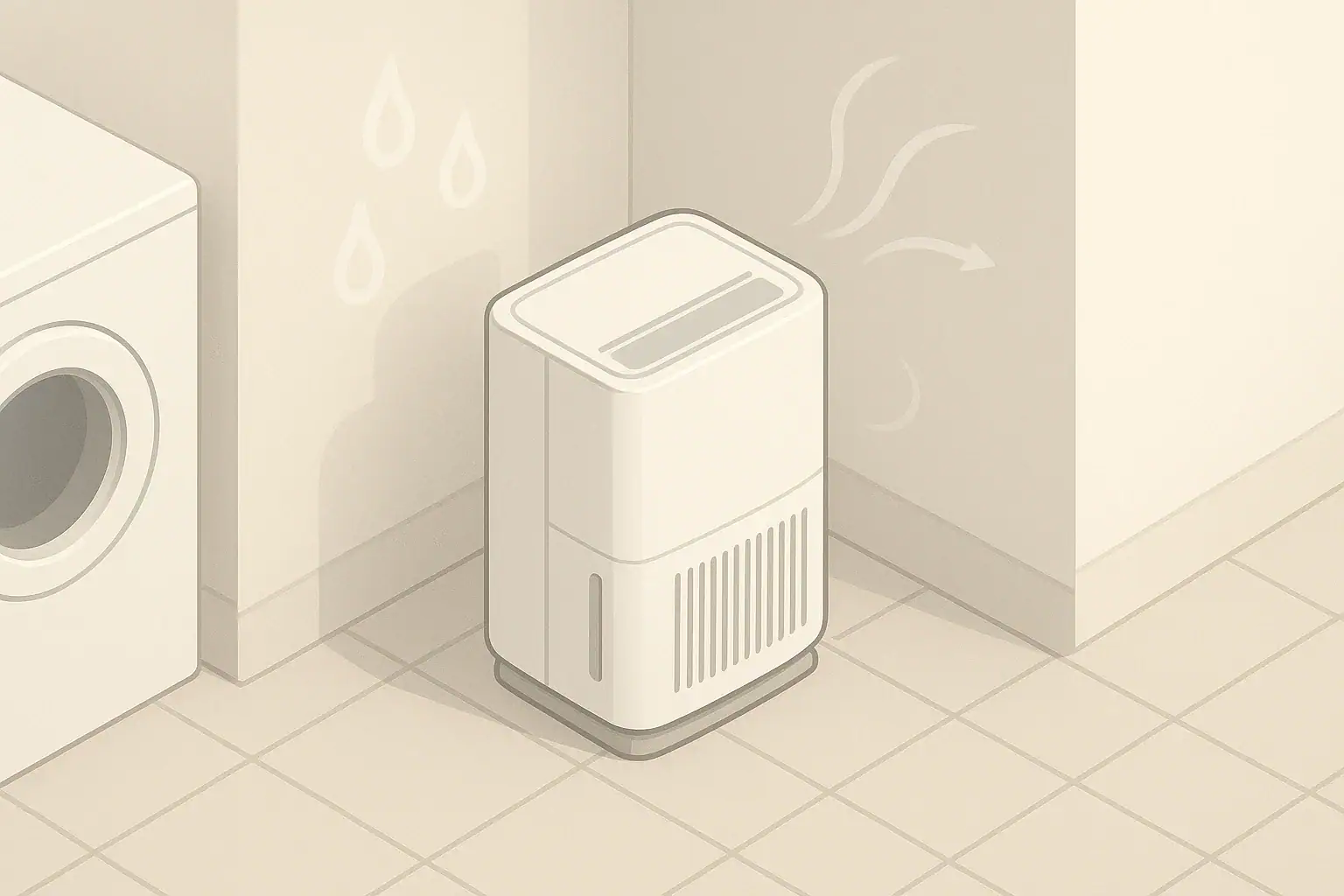
Dehumidifier ice build-up usually happens when the evaporator coils get too cold for the room conditions, often because the room is cool, airflow is restricted, or the unit is not defrosting properly. A dehumidifier needs warm, moist air moving across its coils to remove water efficiently. When that balance is off, moisture can freeze on the coil instead of dripping into the bucket or drain.
Quick answer
- Most portable compressor dehumidifiers work best in rooms above about 65°F, unless the unit is designed for lower-temperature operation.
- A practical indoor humidity target is often about 30% to 50% relative humidity, adjusted for season, comfort, and condensation risk.
- If coils are iced, turn the unit off and let it thaw fully before restarting; do not chip ice with tools.
- Check the air filter, intake clearance, fan operation, bucket position, and room temperature before assuming the unit has failed.
- If ice returns in a warm room with clean airflow, a service issue such as a sensor, fan, or refrigerant problem may be possible.
What dehumidifier ice build-up means
Dehumidifier ice build-up is ice or frost forming on the cold evaporator coil inside the unit. A small amount of frost during certain operating cycles may not be unusual on some models, but heavy ice that blocks airflow, stops water collection, or keeps returning is a sign that something is out of balance.
A compressor-style dehumidifier works somewhat like a small air conditioner. It pulls room air across a cold coil, water vapor condenses on that coil, and the water drains into a bucket or hose. The air then passes across a warmer coil and returns to the room slightly warmer and drier.
If the cold coil drops below freezing and stays there, condensed water can freeze before it drains. As more ice forms, airflow gets weaker, the coil gets even colder, and the machine may collect less water.
Why dehumidifier coils freeze
Frozen coils usually come from one or more of three basic conditions: low room temperature, poor airflow, or a refrigeration and control problem. Understanding these factors helps you troubleshoot without guessing.
Room temperature is too low
Many standard portable compressor dehumidifiers are intended for warmer indoor spaces. In a cool basement, garage-like area, or unheated room, the coil can fall below 32°F more easily. Some units include an automatic defrost function, but defrost performance varies by design and conditions.
As general guidance, if the room is below about 60°F to 65°F, icing becomes more likely for many standard units. Low-temperature or basement-rated models may be designed to operate at lower temperatures, but the dehumidifier in winter cold basement article is the best source for that specific appliance.
Airflow is restricted
Airflow carries heat from the room to the coil. When airflow is blocked, the coil may get colder than intended. A clogged filter, blocked grille, furniture too close to the intake, heavy lint, or a weak fan can all contribute.
Humidity is low or the setting is too aggressive
When a dehumidifier is set very low, it may continue running after the room has already reached a moderate humidity level. In cooler rooms, long run times can increase the chance of frost. Many homes do not need a target below the 30% to 50% relative humidity range for general moisture control.
Controls or components are not working as expected
If the fan is not moving air, a temperature sensor is inaccurate, defrost is not cycling, or the sealed refrigeration system has a fault, ice may keep returning even when the room is warm and the filter is clean. These issues are not usually solved by home adjustment and may require service or replacement.
| What you notice | Likely factor | What to check | Practical next step |
|---|---|---|---|
| Ice in a cool basement | Low room temperature | Room is near or below 60°F to 65°F | Warm the space if practical or use a unit rated for cooler operation |
| Ice plus weak airflow | Restricted intake or outlet | Filter, grille, clearance, dust buildup | Clean filter and allow open space around the unit |
| Ice after long continuous running | Setting may be too low | Humidistat target and actual room humidity | Try a moderate target such as 40% to 50% |
| Bucket stays mostly empty | Coil blocked by ice | Water collection drops while fan runs | Turn off and thaw fully before retesting |
| Fan is noisy or not spinning | Fan or motor issue | Air movement at the outlet | Stop use and seek service guidance |
| Ice returns in a warm room | Control or sealed-system issue | Temperature, filter, clearances all normal | Use warranty or professional repair options |
| Frost appears briefly, then clears | Normal defrost cycle may be occurring | Water collection resumes afterward | Monitor for repeated heavy ice |
Common mistakes that make icing worse
Several everyday habits can make dehumidifier ice build-up more likely. These are usually easy to correct before looking for a mechanical problem.
- Pushing the unit against a wall: Most dehumidifiers need clear intake and exhaust space. Restricted airflow can chill the coil too much.
- Skipping filter cleaning: A dusty filter can reduce airflow even when the grille looks clean from the outside.
- Running in an unheated area: A dehumidifier in a cold crawl space, utility room, or basement may freeze instead of removing much water.
- Setting the humidity target too low: A very low setting increases run time and may not provide a practical benefit for normal home moisture control.
- Ignoring drainage problems: A kinked hose, misaligned bucket, or clogged drain path can confuse troubleshooting because water removal appears poor.
- Restarting before thawing: Running the machine while ice remains can keep airflow blocked and delay normal operation.
What to do when your dehumidifier coils freeze
If you find ice on the coils, use a calm step-by-step approach. The goal is to thaw the unit safely, restore airflow, and test it under reasonable room conditions.
1. Turn the unit off and let it thaw
Switch the dehumidifier off and unplug it before inspecting or cleaning accessible parts. Place towels nearby if melting ice may drip. Let the ice thaw naturally; this may take several hours depending on how much has formed.
Do not use knives, screwdrivers, or sharp tools to remove ice. Damaging the coil can create a leak or make the appliance unsafe to operate.
2. Clean the filter and check the grilles
Remove the washable air filter if your unit has one and clean it according to the manual. Vacuum dust from accessible intake and outlet grilles. Avoid spraying water into electrical areas or disassembling sealed sections of the appliance.
3. Improve placement
Move the dehumidifier to a level surface with open space around the intake and exhaust. As a general practice, allow several inches of clearance on all sides, or follow the owner’s manual if it specifies more. Keep curtains, stored boxes, laundry, and walls from blocking airflow.
4. Check the room conditions
Measure the room temperature with a simple thermometer and compare it with the dehumidifier’s operating range. If the room is cool, consider running the unit during warmer parts of the day, improving room heat, or choosing equipment specifically designed for cool spaces.
5. Use a moderate humidity setting
After the unit is fully thawed, restart it with a moderate target, often around 45% to 50% relative humidity for general dampness control. If the room stabilizes without condensation or musty odors, a lower setting may not be needed.
6. Watch one full operating cycle
Let the unit run long enough to confirm that air is moving, water is collecting, and ice is not reforming quickly. If heavy frost returns despite warm room temperature, clean airflow, and a reasonable humidity setting, stop the test and consider service guidance.
Real-world examples of frozen dehumidifier coils
Freezing looks different depending on the room. These examples are general and meant to help you identify patterns.
Cool finished basement
A basement sits around 60°F in spring, and the dehumidifier is set to 35%. The unit runs for long periods, then water collection slows and frost appears. Raising the target to about 45% and running during warmer periods may reduce icing, but a low-temperature-rated unit may be more suitable if the space remains cool.
Laundry area with lint buildup
A dehumidifier near a laundry area collects lint on the filter and intake grille. The fan still runs, but airflow is weak and the coil begins to freeze. Cleaning the filter more often and keeping lint away from the intake can restore normal operation if no mechanical issue is present.
Warm room with repeated icing
A room is 72°F, the filter is clean, the unit has open clearance, and the humidity target is moderate. Ice still returns after each thaw. In this case, a fan, sensor, defrost, or sealed-system problem becomes more likely, and the practical next step is warranty support, repair evaluation, or replacement planning.
Safety considerations and when to stop using it
A frozen dehumidifier is usually a troubleshooting issue, not an emergency, but electrical appliances and water deserve careful handling. Unplug the unit before cleaning accessible parts, emptying water around the appliance, or checking a drain hose.
Stop using the unit if you notice a burning smell, damaged cord, repeated tripped breaker, unusual loud grinding, water leaking onto electrical parts, or ice that returns immediately after basic checks. Do not bypass bucket switches, defrost controls, sensors, plugs, or other safety features.
Dehumidifiers are designed to remove moisture, not to sanitize air or intentionally generate ozone. Avoid using ozone-generating devices as a response to dampness or odors in occupied home spaces. If a product includes optional ionizing or UV-C features, review the documentation carefully and consider whether the feature is necessary for your goal; moisture control still depends on proper humidity, drainage, airflow, and source control.
Maintenance that helps prevent future ice build-up
Preventing ice is mostly about keeping air moving and matching the unit to the room. A few routine habits can reduce repeat problems and help the appliance work more predictably.
- Clean the air filter regularly: Monthly cleaning is a common starting point, but dusty rooms, laundry areas, and pet areas may need more frequent attention.
- Keep the coils and grilles clear: Dust on accessible surfaces can reduce performance. Follow the manual for what can be cleaned by the user.
- Check the drain path: Make sure the bucket seats correctly, the float moves freely, and any hose slopes properly without kinks.
- Use a realistic humidity target: Many homes aim for roughly 30% to 50% relative humidity, with the higher end often more practical in cooler weather to reduce over-drying.
- Match the unit to the space: Large damp areas, cool basements, and high-moisture rooms may need equipment suited to those conditions.
- Store it clean and dry: Before seasonal storage, empty the bucket, let components dry, and clean the filter to reduce stale odors when restarted.
If maintenance does not stop icing, compare the cost of repair with the age, capacity, and energy use of the unit. Older appliances may be less effective or lack defrost features that are useful in cooler spaces. If you are trying to size a dehumidifier for a colder area, matching capacity to the space can help avoid repeat freeze-ups.
| Goal | Simple actions | Tools | Note |
|---|---|---|---|
| Stay in a practical RH range | Aim around 30% to 50% where comfortable | Hygrometer or monitor | Adjust for season and condensation risk |
| Reduce freezing risk | Avoid running standard units in very cool rooms | Thermometer | Check the appliance operating range |
| Improve airflow | Clear intake and outlet areas | Visual check | Keep stored items and fabric away |
| Limit moisture sources | Use bath fans and cover open sump areas where appropriate | Exhaust fans | Source control reduces runtime |
| Prevent hidden drainage issues | Inspect bucket, hose, and drain slope | Flashlight | Water should move without backing up |
| Track changes | Compare humidity before and after operation | Humidity monitor | Look for trends, not one reading |
Related guides: Dehumidifier Capacity Estimator: Room Dampness to Liters/Day • Desiccant vs Compressor Dehumidifiers: Which Is Better for Cold Rooms? • Basement Dehumidifier Guide: Targets, Drainage, and Energy Use
Frequently asked questions
What room temperature is too cold for a standard dehumidifier?
Many standard portable compressor dehumidifiers start to ice up more often when the room is below about 60°F to 65°F. Some models are designed for lower-temperature use, so the owner’s manual is the best guide for the specific unit. If the space is consistently cool, a low-temperature-rated dehumidifier may perform better.
Can I just scrape the ice off the coils?
No, scraping ice off can damage the coil and create a leak or safety issue. Turn the unit off, unplug it, and let it thaw naturally before restarting. If melting water is likely to overflow, place towels around the appliance while it thaws.
Why does my dehumidifier keep freezing even though the room feels warm?
If ice keeps returning in a warm room, the problem may be restricted airflow, a faulty fan, an inaccurate sensor, a defrost issue, or a sealed-system fault. Start by checking the filter, grilles, and clearances, then watch whether the fan is moving air normally. If the problem continues, service or replacement may be needed.
What humidity setting helps prevent icing?
A moderate setting is usually better than a very low one. For many homes, a target around 45% to 50% relative humidity is a practical starting point, especially in cooler weather. Very low settings can make the unit run longer than necessary and increase frost risk.
How long should I wait before turning it back on after it freezes?
Wait until all visible ice has thawed and the unit is dry enough to restart safely. The thaw time can range from a few hours to longer, depending on how much ice formed and the room temperature. Restarting too early can leave ice in place and cause the coil to freeze again quickly.
When should I stop using the dehumidifier and call for service?
Stop using it if ice returns quickly in a warm room with a clean filter and open airflow, or if you notice burning smells, unusual noises, leaking near electrical parts, or repeated electrical trips. Those signs point to a possible mechanical or safety issue. A qualified repair service or warranty support can help determine whether repair is worthwhile.
Summary: key takeaways for frozen dehumidifier coils
Dehumidifier ice build-up is most often caused by cool room temperatures, restricted airflow, long run times at very low settings, or a fault in the fan, controls, defrost system, or sealed refrigeration system. Start with the simple checks: turn the unit off, let it thaw fully, clean the filter, improve clearance, confirm the room temperature, and use a moderate humidity target.
If ice does not return, the cause was likely operating conditions or maintenance. If ice keeps returning in a warm room with clean airflow and normal settings, stop running repeated tests and consider professional service, warranty support, or replacing the unit with one better matched to the space.
Recommended next:
- How to Size a Dehumidifier (Sq Ft, Pints/Day, and Real-World Tips)
- Desiccant vs Compressor Dehumidifiers: Which Is Better for Cold Rooms?
- Basement Dehumidifier Guide: Targets, Drainage, and Energy Use
- Dehumidifier Running Cost: How Much Electricity Will It Use?
- Dehumidifier Sizing: Liters/Day, Room Type, and Dampness Levels
- Basement Dehumidifier Setup: Drainage, Placement, and RH Targets
- More in Dehumidifiers →
- Clear sizing logic (room size → CADR/ACH)
- HEPA vs carbon explained for real use-cases
- Humidity + ventilation basics to reduce mold risk