
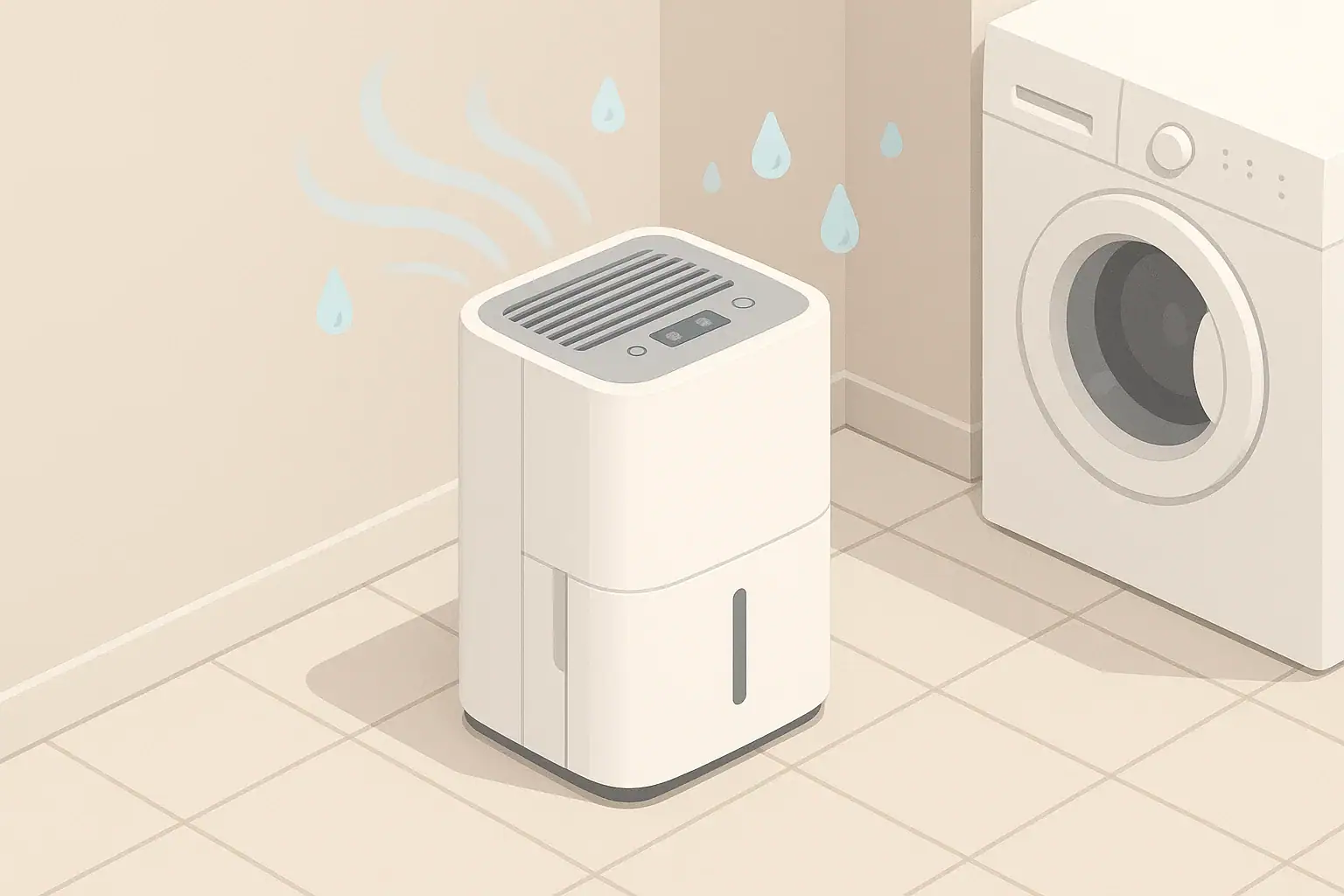
A typical home dehumidifier costs somewhere between a few dollars and several tens of dollars per month to run, depending mainly on wattage, runtime, and your local electricity rate. Once you know these numbers, you can estimate dehumidifier running cost in minutes and decide whether continuous operation, timed use, or seasonal use makes the most sense for your home.
This guide walks step by step through how much electricity a dehumidifier uses, how to calculate cost per day and per month, and how to cut that cost without letting humidity, mold risk, or musty odors get out of control. You will see real-world examples, simple formulas, and practical tips for basements, laundry rooms, and living spaces.
All examples use approximate values so you can plug in your own wattage, hours of use, and utility rate. The goal is to keep indoor humidity in a healthy range while keeping your energy bill predictable and manageable.
What Dehumidifier Running Cost Means And Why It Matters
Dehumidifier running cost is the amount you pay in electricity to remove moisture from indoor air over time. It is usually expressed as cost per hour, per day, per month, or per season. Because dehumidifiers often run for many hours at a stretch, even a moderate power draw can add up.
Understanding this cost matters for several reasons:
- Budgeting: A unit running nearly nonstop in a damp basement can become one of your higher plug-in energy users.
- Right-sizing: An undersized dehumidifier may run constantly and still not reach your humidity target, wasting energy without solving the problem.
- Comfort and health: If you avoid running the dehumidifier because you are worried about cost, humidity can creep high enough to support mold, dust mites, and musty odors.
- Long-term planning: Once you know what humidity control really costs, you can compare it to other improvements such as better drainage, sealing, or ventilation upgrades.
Instead of guessing, you can treat dehumidifier electricity use as a measurable, adjustable part of your overall indoor air quality plan.
Key Factors That Drive Dehumidifier Electricity Use
Dehumidifier running cost is mostly determined by three numbers: power draw in watts, hours of operation, and your price per kilowatt-hour. Several practical details influence each of these.
Power Rating And Capacity
The power rating tells you how much electricity the unit uses while the compressor is running. You will usually find this printed on a label near the cord or in the manual. Typical ranges include:
- Small room units: roughly 200–400 W
- Medium portable units: roughly 400–700 W
- Large or high-capacity units: roughly 600–900 W or more
Higher-wattage models can remove more moisture per hour, so they may reach the target humidity faster and cycle off sooner. That means a 700 W unit does not automatically cost more to run than a 400 W unit; total cost depends on how long each one runs.
Runtime Per Day
Runtime is the number of hours the compressor actually runs in a 24-hour period. It is rarely the same as the number of hours the unit is plugged in or switched on, because the humidistat cycles the compressor on and off.
Runtime depends on:
- Humidity level: Very damp basements or laundry areas can keep the unit running most of the day.
- Setpoint: Aiming for 40% relative humidity instead of 50% can significantly increase runtime.
- Room size and layout: Large, open spaces or connected rooms take longer to dry.
- Moisture sources: Leaks, wet foundations, frequent showers, or indoor drying of clothes all add to the moisture load.
Electricity Rate
Your local electricity rate, expressed in cost per kilowatt-hour (kWh), converts energy use into dollars. It varies by region and sometimes by time of day. In many areas, residential rates fall roughly between $0.10 and $0.25 per kWh.
Even a small change in rate makes a noticeable difference when a dehumidifier runs for hundreds of hours over a season.
Room Conditions And Setup
Two identical dehumidifiers can use very different amounts of electricity in different spaces. Important conditions include:
- Temperature: Refrigerant-based units work more efficiently in warmer air; cool basements can reduce performance and increase runtime.
- Airflow: Blocked intakes, closed doors, and cluttered corners trap moist air and make the compressor work longer.
- Building envelope: Poorly sealed foundations, crawlspaces, and window frames allow a constant stream of humid air that the dehumidifier must handle.
Improving the room conditions often reduces runtime more than changing the dehumidifier itself.
Real-World Cost Examples And Simple Calculations
You can estimate dehumidifier running cost with a straightforward three-step calculation. All you need is the unit’s wattage, estimated runtime, and your electricity price.
Step-By-Step Cost Formula
- Convert watts to kilowatts: kilowatts = watts ÷ 1000
- Estimate daily energy use: daily kWh = kilowatts × hours of runtime per day
- Convert to cost: daily cost = daily kWh × price per kWh
From there, you can multiply by 30 for a rough monthly cost or by the number of days in your typical humid season.
| Scenario | Wattage (W) | Runtime (hours/day) | Daily Use (kWh) | Daily Cost at $0.15/kWh | Approx. Monthly Cost (30 days) |
|---|---|---|---|---|---|
| Mildly damp bedroom, evening use | 300 | 4 | 1.2 | $0.18 | $5.40 |
| Basement, moderate humidity | 500 | 8 | 4.0 | $0.60 | $18.00 |
| Very damp basement, near-continuous | 650 | 20 | 13.0 | $1.95 | $58.50 |
| Seasonal use, laundry area | 450 | 3 | 1.35 | $0.20 | $6.08 |
Example values for illustration.
Example: Mildly Damp Room
Suppose you run a 300 W dehumidifier for 4 hours each evening at an electricity rate of $0.15/kWh:
- Power: 300 W = 0.3 kW
- Daily energy: 0.3 kW × 4 h = 1.2 kWh
- Daily cost: 1.2 kWh × $0.15 = $0.18
- Monthly (30 days): about $5.40
In this case, the cost is modest, and comfort improvement is often worth the added electricity use.
Example: Damp Basement In Humid Weather
Now consider a 500 W unit in a basement that runs about 12 hours per day at the same rate:
- Power: 500 W = 0.5 kW
- Daily energy: 0.5 kW × 12 h = 6 kWh
- Daily cost: 6 kWh × $0.15 = $0.90
- Monthly (30 days): about $27.00
This is a more noticeable cost, but it is also where humidity control can make the biggest difference for mold prevention and protecting stored items.
Comparing To Other Appliances
To put these numbers in context, a dehumidifier running many hours per day may use similar daily energy to a small window air conditioner or a few space heaters used briefly. It usually uses more than a single fan or a compact air purifier, but less than central air conditioning serving an entire home.
Common Mistakes That Increase Running Cost (And How To Fix Them)
Certain habits and setup choices can quietly push dehumidifier running cost much higher than necessary. Watching for these issues can save energy while keeping humidity in a safe range.
Typical Costly Mistakes
- Setting the humidity target unnecessarily low
- Running in continuous mode when the space is only moderately damp
- Ignoring water leaks and moisture sources that overwhelm the unit
- Blocking airflow with furniture or storage boxes
- Letting filters and coils clog with dust
- Using a small unit in a very large or open space
| Symptom | Likely Cause | What To Check | Simple Fix |
|---|---|---|---|
| Runs almost nonstop, humidity barely drops | Undersized unit or heavy moisture source | Room size, leaks, standing water, wet walls | Address leaks, improve drainage, consider higher-capacity unit |
| High electricity bill during humid months | Long runtime and low setpoint | Target humidity setting and timer schedule | Raise setpoint to 45–50% and use timer where possible |
| Unit feels hot and airflow seems weak | Blocked grilles or dirty filter | Intake/exhaust clearance, filter condition | Move clutter away, clean or replace filter |
| Water bucket fills very quickly every day | High moisture load | Sources like showers, laundry, unvented appliances | Use exhaust fans, vent dryer outdoors, limit indoor line-drying |
| Ice on coils in a cool basement | Low air temperature for refrigerant unit | Room temperature and defrost cycle | Raise room temperature if possible or reduce use in cold conditions |
Example values for illustration.
Quick Troubleshooting Routine
- Check the setpoint: If it is below about 40% relative humidity, raise it to 45–50% and monitor comfort and smell for a week.
- Observe runtime: Note approximately how many hours per day the compressor actually runs for a few days in a row.
- Inspect for moisture sources: Look for damp walls, plumbing drips, unvented dryers, or water pooling near the foundation.
- Inspect airflow: Make sure there is at least several inches of space around the intake and exhaust, and that filters are clean.
- Recalculate cost: Use your updated runtime and setpoint to see how much cost changes after adjustments.
Repeating this routine at the start and middle of the humid season helps keep cost and humidity under control.
Safety Basics When Running A Dehumidifier For Long Hours
Dehumidifiers are generally safe household appliances, but long runtimes and damp environments add some risks that are worth managing.
Electrical Safety
- Use a grounded outlet: Plug the dehumidifier directly into a properly grounded wall outlet, not a light-duty extension cord or power strip.
- Keep cords dry: Avoid running the power cord across wet floors or where condensation may pool.
- Inspect the cord: If you notice fraying, discoloration, or heat damage, stop using the unit until it is repaired or replaced.
Water Handling And Spills
- Empty the bucket safely: Turn off or unplug the unit before removing a heavy water bucket, and avoid splashing near the outlet.
- Check drain hoses: If you use a continuous drain, ensure the hose slopes downward and empties into a suitable drain to prevent backflow or leaks.
- Prevent slip hazards: Wipe up spills promptly so damp floors do not become slippery.
Heat And Ventilation Around The Unit
- Allow airflow: Do not drape clothes or fabrics over the dehumidifier; blocked vents can cause overheating and reduced efficiency.
- Avoid confined spaces: Running a unit inside a tightly closed closet or small enclosure can trap heat and moisture.
- Monitor in very hot rooms: In spaces that already get warm, such as small mechanical rooms, check that the dehumidifier does not contribute to uncomfortable or unsafe temperatures.
Safe Operation Over Time
- Follow rated conditions: Many residential dehumidifiers are designed for temperatures above a certain minimum; running below that can cause ice buildup on coils.
- Listen for changes: Unusual noises, burning smells, or repeated tripping of breakers are signs to shut the unit off and investigate.
- Keep away from children and pets: Place the unit where it cannot be easily tipped over or blocked.
Maintenance And Long-Term Use To Control Cost
Regular maintenance keeps a dehumidifier working efficiently, which directly affects electricity use. A neglected unit may run longer, remove less moisture, and cost more to operate.
Routine Maintenance Tasks
- Clean or replace filters: Clogged filters reduce airflow and force the compressor to run longer to achieve the same humidity reduction.
- Check coils and grilles: Dust buildup on coils and vents reduces heat transfer and efficiency.
- Inspect the drain system: Ensure buckets, hoses, and pumps (if present) are clean and draining properly.
Seasonal Start-Up And Shut-Down
- Beginning of humid season: Clean filters, check the cord, test the bucket float or drain hose, and verify that the humidistat responds when you adjust the setpoint.
- End of season: Empty and dry the bucket, run the fan briefly to help dry internal parts, clean filters, and store the unit in a dry location.
Storage Tips
- Store dry: Allow the unit to air out so residual moisture does not sit in the bucket or coils for months.
- Protect from dust: Cover loosely with a breathable material rather than sealing in plastic, which can trap moisture.
- Keep upright: Store the dehumidifier in an upright position to protect the compressor and refrigerant system.
Basic maintenance can noticeably reduce runtime and therefore total running cost over the life of the appliance.
Practical Takeaways And Specs To Look For
When you understand how dehumidifier running cost works, you can make better decisions about when to run it, how hard to run it, and whether your current setup is the best fit for your home. The main levers you control are humidity setpoint, runtime, room conditions, and basic maintenance.
Key Practical Takeaways
- Estimate cost using watts, runtime, and your electricity rate so you are not surprised by seasonal bills.
- Aim for a moderate indoor humidity range, often around 45–50% in most living spaces, to balance comfort, mold prevention, and energy use.
- Address moisture sources such as leaks, poor drainage, and unvented appliances before relying solely on dehumidification.
- Use built-in humidistats and timers instead of continuous mode whenever conditions allow.
- Revisit settings at least once or twice per season as weather and household habits change.
Specs To Look For When Evaluating A Dehumidifier
If you are comparing dehumidifiers with running cost in mind, pay close attention to these specifications and features on labels, manuals, or product descriptions:
- Power draw (watts): Use this to calculate approximate hourly and monthly electricity cost.
- Moisture removal capacity (pints per day or similar): Higher capacity can dry spaces faster, especially in basements or large rooms.
- Recommended coverage area: Match the unit to your room size so it does not run constantly without reaching the setpoint.
- Humidity control range: Look for a clear adjustable range so you can set a realistic target (for example, 40–60% relative humidity).
- Built-in humidistat: Allows the unit to cycle off when the target humidity is reached, reducing unnecessary runtime.
- Timer functions: Let you schedule operation for the most humid parts of the day or when noise is less of a concern.
- Fan speed options: Multiple speeds can help balance noise, comfort, and energy use.
- Drainage options: A hose connection or pump option can support continuous drainage, which is helpful for long runtimes in basements.
- Operating temperature range: Important if you plan to use the unit in cooler basements or shoulder seasons.
- Filter access and maintenance: Easy-to-remove filters and accessible coils make regular cleaning more likely, improving efficiency.
By combining a realistic cost estimate with the right set of features, you can keep indoor humidity under control without overspending on electricity or equipment.
Frequently asked questions
Which specs and features should I prioritize when buying a dehumidifier to minimize running cost?
Prioritize power draw (watts), moisture removal capacity (pints per day), and an accurate built-in humidistat. Look for clear coverage area recommendations, timer functions, and good filter access because proper sizing and control reduce runtime and overall energy use.
What common mistake causes dehumidifier running cost to rise unnecessarily?
Using an undersized unit for a large or very damp space is a frequent mistake, because it runs nearly nonstop without reaching the setpoint. Other common issues include setting the humidity target too low and blocking airflow with storage or dirty filters.
Is it safe to run a dehumidifier continuously, and what precautions should I take?
Continuous operation is generally safe when the unit is installed and maintained correctly, but take basic precautions such as using a grounded outlet, avoiding extension cords, and keeping the unit clear of obstructions. Monitor for unusual noises, overheating, or repeated breaker trips and inspect cords and drains regularly.
How can I quickly estimate my dehumidifier running cost without special tools?
Use the simple formula: convert watts to kilowatts (watts ÷ 1000), multiply by estimated compressor runtime hours per day to get daily kWh, then multiply by your price per kWh. Multiply daily cost by 30 for a rough monthly estimate.
Will a higher-wattage dehumidifier always cost more to operate?
Not necessarily: higher-wattage units often remove moisture faster and may cycle off sooner, so total energy use depends on runtime as well as wattage. Proper sizing for the space and humidity load is more important than wattage alone.
Can simple maintenance tasks really reduce electricity use, and which tasks matter most?
Yes. Cleaning or replacing filters, keeping coils and grilles free of dust, and ensuring proper drainage all improve airflow and heat transfer so the compressor runs less often. Regular checks of hose connections and the humidistat also help maintain efficient operation.
- Clear sizing logic (room size → CADR/ACH)
- HEPA vs carbon explained for real use-cases
- Humidity + ventilation basics to reduce mold risk