
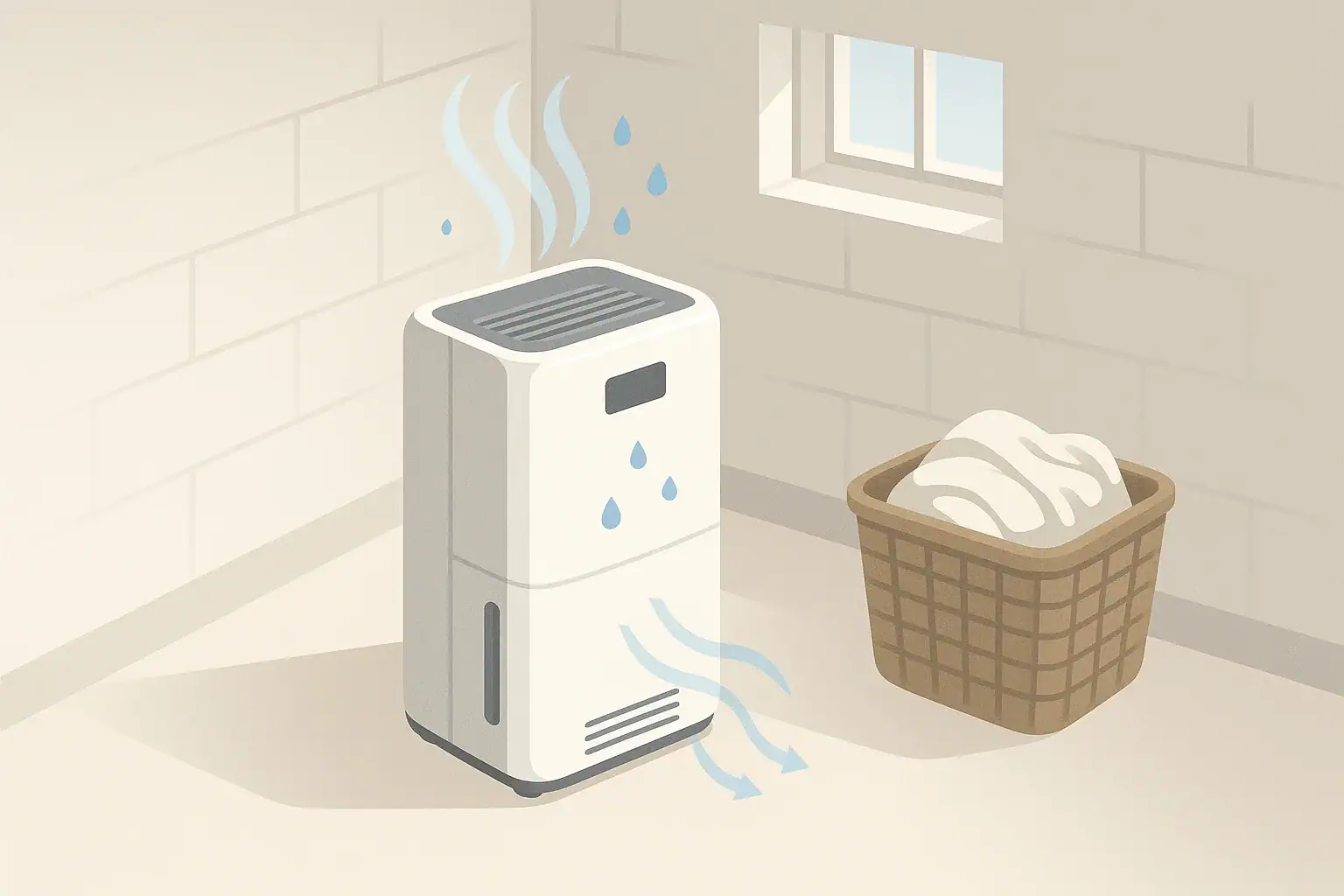
A dehumidifier can work in a winter basement, but its performance drops sharply as the room temperature falls near or below about 60°F.
Cold air holds less moisture than warm air, so winter basements often feel damp without actually having very high relative humidity. Dehumidifiers also have minimum operating temperatures, and below these they may ice up, shut down, or simply remove very little water. Whether it is worth running one in a cold basement depends on the actual humidity level, the temperature, and how the space is used.
- Most standard dehumidifiers work best around 65–80°F; below ~60°F they become less effective.
- Target indoor basement humidity is generally about 40–50% RH in winter, if practical.
- If your winter basement stays below ~55°F and under ~50% RH, a dehumidifier may add cost without much benefit.
- Use a simple hygrometer: run the dehumidifier only when RH is consistently above ~55–60%.
- Address bulk moisture first (leaks, groundwater, condensation) before relying on a dehumidifier.
Why dehumidifiers in winter basements are different
Basements behave differently from above-grade rooms in winter. Soil insulates them somewhat, but they are still cooler, often darker, and can trap moisture from the ground, plumbing, and household activities. This combination can lead to musty odors, visible condensation, or mold on cool surfaces, even when the air’s relative humidity (RH) is not extremely high.
In winter, outdoor air is usually cold and dry. When that air enters your home and warms up, its relative humidity drops. This is why upper floors often feel dry in winter. Basements, however, may stay cooler, so the same air can reach higher RH in the basement than upstairs. At the same time, refrigeration-style dehumidifiers themselves need relatively warm air to work properly. Understanding this balance is key to deciding whether running a dehumidifier in a cold basement is useful or mostly wasted energy.
Key concepts: temperature, humidity, and dehumidifier limits
To judge if a dehumidifier will work in your winter basement, it helps to understand three linked ideas: how cold air holds moisture, what RH really means, and how common dehumidifiers are built to operate.
Cold air and moisture capacity
Relative humidity is a percentage that describes how full of moisture the air is compared with the maximum it can hold at that temperature. Cold air has a much lower moisture capacity than warm air. This means:
- At 75°F, air can hold much more water before reaching 60% RH.
- At 55°F, that same amount of water may drive RH near or above 70%.
This is why a cool basement can reach high RH and see condensation on cold surfaces, even if the total amount of moisture is not especially large.
Typical winter humidity targets
General indoor comfort and moisture guidelines in winter often suggest:
- About 30–50% RH in living spaces.
- Basements often run a bit higher; staying roughly in the 40–50% range is commonly considered helpful for limiting mold growth while avoiding overly dry air.
These are broad ranges, not strict rules. The right target depends on your climate, the age of your home, and how vulnerable your basement is to condensation and leaks.
How common dehumidifiers behave in the cold
Most home dehumidifiers are refrigeration-based: they pull air over cold coils, where moisture condenses and drips into a tank or drain. This design has temperature limits.
- Optimal range: Many residential units are designed for air temperatures roughly in the mid-60s to mid-80s °F.
- Reduced performance: As room temperature drops below about 60°F, the cold coils can start to freeze, and moisture removal slows.
- Auto-defrost or shutoff: Some units will stop or cycle frequently to thaw ice, which means more runtime with less water removed.
There are also desiccant-style dehumidifiers that handle cooler temperatures better, but these use a different technology and can have different energy characteristics. Whatever the type, you should check the stated operating temperature range in the documentation that came with your appliance.
This table summarizes common basement moisture situations and which action is typically most effective.
| Situation (winter) | Main issue | Most helpful first step | Role of dehumidifier |
|---|---|---|---|
| Visible water seepage on walls or floor | Bulk water entry from soil or drainage | Fix grading, gutters, drainage, and sealing | Secondary; manages residual dampness only |
| Cold basement, RH under ~50% | Cool surfaces, but not much moisture | Improve air circulation and insulation where practical | Often unnecessary or low impact |
| Cool basement, RH ~55–65% | Marginally high moisture risking musty odor | Use hygrometer, reduce sources (drying clothes, leaks) | Periodic use can trim RH toward ~45–50% |
| Cool basement, RH consistently above ~65–70% | High moisture plus cold surfaces | Check for hidden leaks, improve ventilation | Useful tool if temp stays near or above low 60s°F |
| Finished basement used as living space | Comfort, odors, potential surface condensation | Seal air leaks, manage humidity sources, monitor RH | Regular use during damp periods may be justified |
| Unfinished storage-only basement | Protecting stored items from dampness | Elevate items, use plastic bins, control leaks | Targeted use when RH is high around storage areas |
Common winter basement dehumidifier mistakes
Many homeowners plug in a dehumidifier in the basement and let it run all winter without checking whether it is doing much. Several typical mistakes reduce effectiveness or waste energy.
Running at very low temperatures
If your basement sits in the low 50s°F or colder for long stretches, a standard dehumidifier may spend more time defrosting than removing moisture. Signs of this include:
- Coils icing over frequently.
- Compressor cycling on and off quickly.
- Very little water in the bucket despite long runtime.
In these conditions, you may get more benefit by slightly warming the space, improving air mixing with the rest of the house, or addressing moisture entry directly.
Ignoring actual humidity readings
Relying on how “damp” a room feels can be misleading, especially in a cold basement. Concrete floors and walls feel clammy at low temperatures even if RH is not especially high. Using a basic hygrometer (standalone or built into some devices) gives more reliable feedback.
- If RH rarely rises above about 50–55%, constant dehumidifier operation is usually not necessary.
- If RH often sits around 60–70%, targeted dehumidification or ventilation changes might be worthwhile.
Blocking airflow and poor placement
Dehumidifiers need a clear flow of air across their coils. In tight corners or behind storage, the machine may mostly reprocess already-dried air or recirculate cold pockets.
- Placing the unit too close to walls or large objects can reduce air circulation.
- Positioning under low-hanging shelves can trap warm, moist air away from the intake.
Using dehumidification instead of fixing leaks
Dehumidifiers are designed to handle moisture in the air, not to compensate for ongoing leaks or standing water. If you see active water intrusion, staining, or repeated puddles, those issues need to be addressed at the source. A dehumidifier alone will not resolve structural moisture problems and may simply run continuously with modest impact.
Practical steps: deciding if a dehumidifier makes sense in your winter basement
Instead of guessing, you can use a simple process to decide how and when to use a dehumidifier in winter.
Step 1: Measure temperature and humidity
- Place a basic hygrometer-thermometer combo in the basement away from exterior walls and drafts.
- Record temperature and RH at a few times during the day, over several days.
- Note the lowest temperature you commonly see and the typical RH range.
If winter temperatures are usually below the mid-50s°F and RH remains under roughly 50–55%, a standard dehumidifier is often not doing much for you.
Step 2: Check for visible moisture and odors
- Look for condensation on windows, metal pipes, or uninsulated ducts.
- Inspect lower walls, corners, and behind stored items for damp spots or surface mold.
- Notice any persistent musty odor, especially after wet weather or laundry days.
These observations help you separate comfort concerns (slightly musty smell) from more serious moisture issues (staining, peeling paint, repeated condensation).
Step 3: Address moisture sources
Before relying on a dehumidifier, make simple fixes where possible:
- Improve exterior drainage with clear gutters and downspouts aimed away from the foundation.
- Seal obvious gaps or cracks that allow liquid water to enter, where appropriate for your structure.
- Vent clothes dryers outdoors and avoid line-drying indoors in the basement when RH is already high.
- Insulate cold water pipes that sweat, and consider insulating bare foundation walls where suitable.
Step 4: Use the dehumidifier selectively
Once you have a baseline:
- Set the dehumidifier to a target RH around 45–50% rather than a constant “on” mode.
- Run it most when RH readings rise above roughly 55–60%, such as during thaws or rainy stretches.
- Monitor whether the bucket fills regularly; if it stays nearly empty, it may not be worth the energy use.
If your basement has multiple rooms, consider whether doors should be open to allow better circulation, or whether you should focus on the dampest area only.
Real-world basement scenarios in winter
Here are some common patterns homeowners see and how a dehumidifier typically fits into each situation.
Unfinished, cool storage basement
Temperature might hover around 50–55°F, with RH readings between 45–55%. The space feels chilly and slightly clammy, but there is no obvious water, and cardboard boxes and stored items look fine.
- A dehumidifier here may run but extract very little water.
- Simple steps like elevating boxes off the floor, using plastic storage bins, and improving airflow may be sufficient.
- Consider using the dehumidifier only during shoulder seasons when the basement is warmer and RH creeps up.
Partly finished basement office or playroom
This space may be conditioned somewhat by the main HVAC system, staying closer to 60–65°F. People spend time here, electronics are present, and the space has soft furnishings or carpet.
- If RH readings are often around 55–65%, modest dehumidifier use can help protect materials and improve comfort.
- Placing the unit centrally with good clearance and continuous drainage can make seasonal operation easier.
- In very cold snaps, if room temperature drops, watch for icing and consider reducing runtime.
Basement laundry area with intermittent moisture
Laundry spaces can spike humidity during washing and drying cycles, especially if the dryer is not well vented or if clothes are air-dried indoors.
- You might see RH peak above 60–70% for several hours, then drop back down.
- A dehumidifier can help smooth these peaks, especially in winter when windows are closed.
- Improving ventilation (for example, short, controlled periods of outdoor air exchange) often works well alongside dehumidification.
Older home with known seepage issues
In some basements, moisture from the ground continues to enter through walls or floor cracks even in winter. RH may sit in the 65–80% range, and there may be a noticeable musty smell.
- A dehumidifier can reduce RH, but it is not a replacement for structural drainage or sealing work.
- Operating temperatures still matter; if it is too cold, performance will be limited.
- Monitoring RH before and after running the unit helps you see how much improvement you are actually getting.
Safety, efficiency, and equipment considerations
Using a dehumidifier in a cold basement involves more than just comfort; safety, energy use, and equipment limits all play a role.
Electrical and placement safety
- Place the unit on a stable, level surface away from standing water or floor drains where it could tip.
- Avoid using long, undersized extension cords that can overheat; plug directly into a properly grounded outlet where possible.
- Maintain clearance around air inlets and outlets, typically at least a few inches on all sides.
Drainage and overflow
In winter, you may be less inclined to empty a bucket daily. If you use continuous drain:
- Route the hose to a floor drain or sump where freezing will not occur.
- Ensure the hose slopes downward all the way to avoid standing water and backups.
Technology types and low-temperature performance
Refrigeration-based units dominate the residential market, but they have limitations in cold spaces. Some devices include features like auto-defrost cycles designed to protect the coils. Desiccant-based units, which use moisture-absorbing materials, can handle lower temperatures better but usually have different power use patterns and capacities.
Whatever the technology, respecting the stated temperature operating range in the product documentation helps avoid damage and inefficient operation.
Maintenance and winter operation tips
Proper maintenance keeps a dehumidifier working as efficiently as possible, which becomes especially important when the temperature already limits performance.
Filter and intake care
- Clean or replace the air filter as recommended; dust buildup reduces airflow and can cause icing.
- Vacuum intake and exhaust grilles gently to keep them clear.
Coil inspection and defrost cycles
- Periodically inspect the coils (when the unit is off and unplugged) for dust accumulation.
- If you notice frequent icing, check that room temperature is within the acceptable range and that airflow is not obstructed.
Energy planning
A dehumidifier can be a significant electrical load if it runs constantly. To avoid unnecessary energy use in winter:
- Use the built-in humidistat or an external reading to limit runtime to periods of higher RH.
- Consider whether slightly improving basement heating or air circulation would reduce humidity without as much dehumidifier use.
- Shut the unit off if RH is consistently at or below your target level.
FAQs: dehumidifiers, winter, and cold basements
Is a dehumidifier necessary in winter if the air feels dry upstairs?
Not necessarily. Upper floors and basements often experience different humidity levels. Measure RH in the basement separately before deciding.
Can a dehumidifier prevent all mold in a basement?
No. Keeping RH in a moderate range can make conditions less favorable for mold growth, but it does not replace fixing leaks, condensation, or building issues. It is one tool in a broader moisture-control strategy.
What RH should I set my basement-dehumidifier-to-in-winter”>What RH should I set my basement dehumidifier to in winter?
Many homeowners aim for around 45–50% RH when practical. If achieving that target requires excessive runtime or causes other issues (like upstairs air becoming too dry), you may choose a slightly higher range and address localized problem spots directly.
Should I run a dehumidifier in an unheated, very cold basement?
In basements that regularly drop below the mid-50s°F, standard dehumidifiers are often inefficient or ineffective. In these cases, controlling liquid water entry, improving drainage, and managing ventilation and insulation usually matter more than running a dehumidifier continuously.
This table outlines simple action ideas for common winter basement humidity goals.
| Humidity / moisture goal | Simple actions | Tools that help | Note |
|---|---|---|---|
| Keep RH roughly 40–50% | Monitor RH, limit indoor clothes drying, seal obvious leaks | Hygrometer, occasional dehumidifier use | Good general comfort and moisture balance in many homes |
| Reduce musty basement odor | Improve airflow, declutter corners, clean dusty surfaces | Fan for circulation, dehumidifier at ~45–50% setpoint | Odors often lessen as RH and surface dust decrease |
| Limit surface condensation on windows and pipes | Insulate cold surfaces, avoid drying laundry nearby | Pipe insulation, hygrometer, dehumidifier if RH high | Even moderate RH can condense on very cold surfaces |
| Protect stored items from dampness | Use sealed bins, elevate items, avoid exterior walls | Hygrometer near storage, spot dehumidification | Local protection can matter more than room-wide RH |
| Handle seasonal wet spells or thaws | Check sump and drainage, watch RH during thaws | Dehumidifier during temporary RH spikes | Short-term use may be more efficient than year-round |
| Manage persistent high RH in a finished basement | Seal air leaks, consider ventilation adjustments | Continuous-drain dehumidifier, RH tracking | Combine moisture control with general HVAC planning |
Related guides: How to Size a Dehumidifier (Sq Ft, Pints/Day, and Real-World Tips) • Basement Dehumidifier Guide: Targets, Drainage, and Energy Use • Dehumidifier Running Cost: How Much Electricity Will It Use?
Key takeaways about dehumidifiers in cold winter basements
Dehumidifiers can help manage winter basement moisture, but only when conditions are within their effective operating range and when humidity is truly high enough to justify running them. Cold basements often feel damp even when RH is not excessive, and standard dehumidifiers lose efficiency as temperatures drop toward the low 60s°F and below.
Using a simple hygrometer, observing temperature, and addressing obvious moisture sources first will guide whether a dehumidifier is worthwhile. In many homes, selective use during damp periods, combined with better drainage, insulation, and airflow, offers a practical balance between comfort, protection of belongings, and energy use.
Frequently asked questions
Can I run a standard refrigeration dehumidifier in a basement that stays below 55°F?
Most refrigeration-type dehumidifiers become much less effective below about 60°F and may ice up or spend excessive time in defrost cycles if used under ~55°F. For consistently cold basements, either slightly warming the space, improving air circulation, or considering a desiccant-style unit (which handles low temps better) is advisable. Always check the unit’s specified operating temperature range before extended use.
How should I decide when to run a dehumidifier in winter versus leaving it off?
Use a hygrometer to track basement RH; run the dehumidifier when RH consistently exceeds roughly 55–60% or during identifiable humidity spikes like laundry or thaws. If RH stays near or below your target (about 45–50%) most of the time and the unit collects little water, it’s usually energy-wasteful to run it continuously.
Will running a dehumidifier stop mold growth on basement walls and stored items?
Lowering ambient RH reduces the likelihood of mold, but a dehumidifier cannot fix liquid water entry, condensation on cold surfaces, or hidden leaks. For persistent mold risk, combine humidity control with repairs (drainage, sealing, insulation) and dry or replace affected materials as needed.
Are desiccant dehumidifiers a better choice for cold basements?
Desiccant dehumidifiers generally perform better at lower temperatures than refrigeration models because they do not rely on cold coils to condense moisture. However, they can have different energy use profiles and capacities, so weigh expected moisture load, operating cost, and maintenance when choosing a unit.
What is the safest way to set up continuous drainage for winter use?
Route the drain hose to an interior floor drain, sump, or laundry drain where it will not be exposed to freezing temperatures, and maintain a continuous downward slope to prevent standing water. If you must route to a higher point, use a condensate pump rated for cold conditions and inspect connections periodically to avoid clogs and backups.
Recommended next:
- How to Size a Dehumidifier (Sq Ft, Pints/Day, and Real-World Tips)
- Desiccant vs Compressor Dehumidifiers: Which Is Better for Cold Rooms?
- Basement Dehumidifier Guide: Targets, Drainage, and Energy Use
- Dehumidifier Running Cost: How Much Electricity Will It Use?
- Dehumidifier Sizing: Liters/Day, Room Type, and Dampness Levels
- Basement Dehumidifier Setup: Drainage, Placement, and RH Targets
- More in Dehumidifiers →
- Clear sizing logic (room size → CADR/ACH)
- HEPA vs carbon explained for real use-cases
- Humidity + ventilation basics to reduce mold risk