
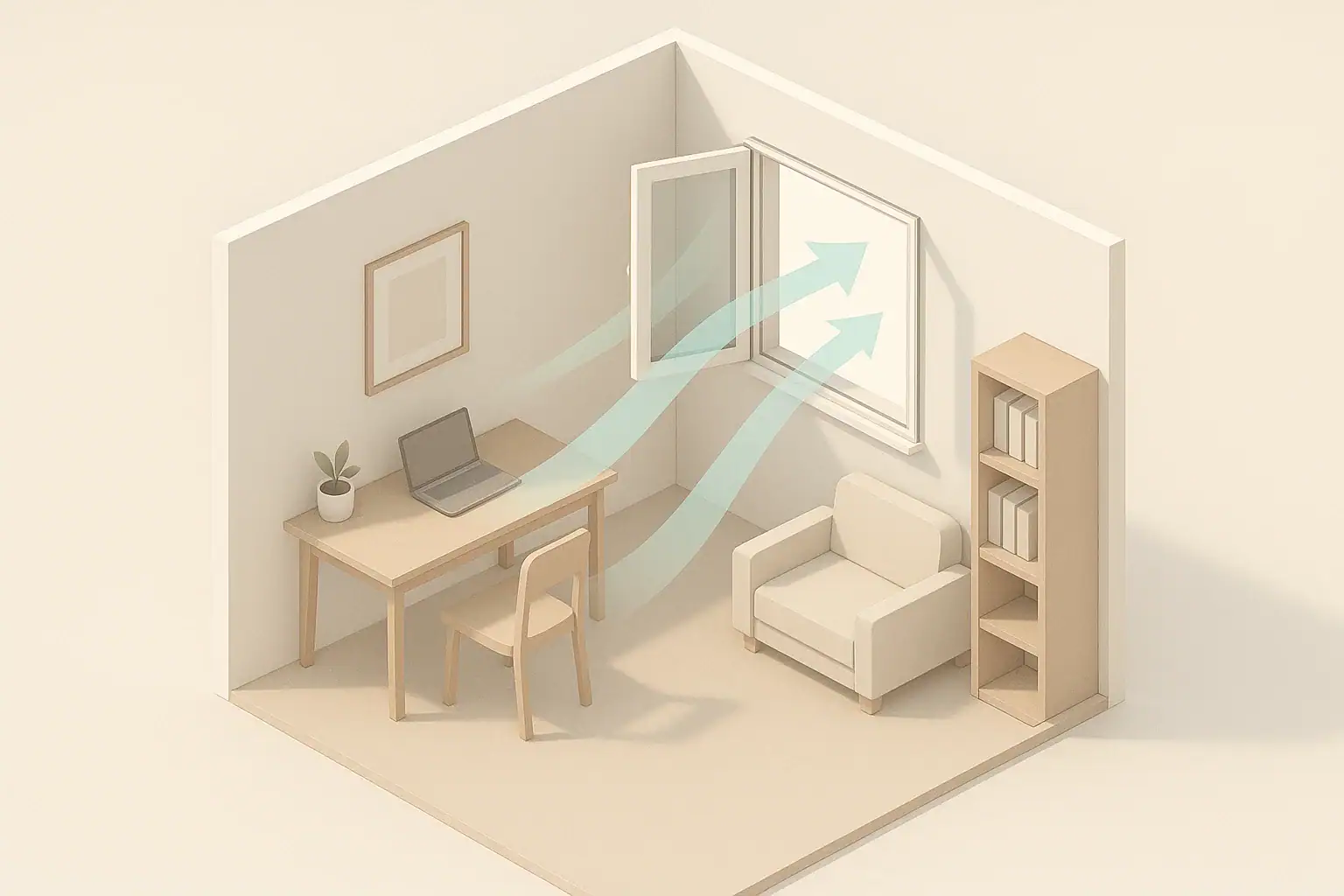
Morning window ventilation is often better for cooler, lower-ozone air, while evening ventilation can work better after heat and indoor buildup, so the best schedule depends on outdoor PM2.5, ozone, pollen, humidity, and temperature.
A useful window ventilation schedule is not simply morning or evening every day. It is a short, intentional air exchange routine that changes with season, weather, outdoor air quality, and what is happening inside the home. The goal is to bring in outdoor air when it is likely to help comfort and dilution without adding avoidable particles, moisture, heat, or odors.
- Use outdoor air quality as the first check: avoid opening windows when local PM2.5, smoke, or ozone levels are elevated.
- For many homes, a 5 to 20 minute window flush is enough to reduce stale air without overcooling or overheating the space.
- Morning often works well in warm seasons because outdoor temperatures are lower and ozone is typically lower than late afternoon.
- Evening can be useful after cooking, cleaning, gatherings, or a warm day, but check humidity, pollen, smoke, and nearby traffic conditions.
- If indoor humidity is already above about 60%, be cautious with window ventilation during damp weather.
- Use CO2, PM2.5, and humidity readings as practical cues when available; no single reading tells the whole story.
What a Window Ventilation Schedule Actually Means
A window ventilation schedule is a planned routine for opening windows to exchange indoor and outdoor air. It can be as simple as opening two windows for 10 minutes after breakfast, or as conditional as opening windows only when outdoor PM2.5 is low and indoor CO2 is rising.
Ventilation matters because indoor air can accumulate moisture, carbon dioxide from occupancy, cooking particles, odors, and gases from normal household activities. Opening windows dilutes these indoor pollutants, but it also brings in outdoor air. That outdoor air may contain pollen, smoke, traffic particles, humidity, or heat.
The practical trade-off is timing. Morning and evening often have different outdoor conditions. Temperature, ozone, pollen release, rush-hour traffic, wind direction, and neighborhood activity can all affect the value of opening a window.
Morning vs Evening Air Quality Trade-Offs
Morning ventilation is often favored when the day will become hot, sunny, or high in ozone. Ground-level ozone generally builds during sunny afternoons, so early hours can be a better time to bring in outdoor air. Morning air may also be cooler, which can help reduce indoor heat before windows are closed for the day.
Evening ventilation can be useful after the home has been occupied all day. It may help clear cooking odors, reduce stuffiness, and release accumulated heat. However, evening conditions can vary. In some areas, traffic emissions, wildfire smoke layers, damp air, or pollen can make evening window opening less useful.
Key factors to compare
- Outdoor PM2.5: Fine particles from smoke, combustion, dust, and traffic can enter through open windows.
- Ozone: Often higher on sunny afternoons and early evenings in many regions, especially during warm months.
- Pollen: Patterns vary by plant type, weather, and location; wind and storms can change conditions quickly.
- Humidity: Damp outdoor air can raise indoor humidity, especially in bathrooms, basements, and poorly ventilated rooms.
- Temperature: Cooler outdoor air can help with comfort, but hot or cold air can increase energy demand.
- Indoor activity: Cooking, cleaning, hobbies, guests, and pets can make a short flush more useful.
| Condition | Morning may work better when | Evening may work better when | Practical note |
|---|---|---|---|
| Warm sunny day | Outdoor air is cool before heat builds | Outdoor air cools after sunset | Check ozone before long evening airing |
| High indoor CO2 | Bedrooms feel stale after sleep | Living areas feel stuffy after occupancy | Use a brief cross-breeze if outdoor air is acceptable |
| Cooking odors | Breakfast cooking needs a quick flush | Dinner cooking creates lingering odors | Use local kitchen exhaust first when available |
| Outdoor smoke or high PM2.5 | Not ideal if levels are elevated | Not ideal if levels are elevated | Keep windows closed and use filtration if available |
| Damp weather | May be acceptable if humidity is moderate | Can raise indoor humidity overnight | Be cautious if indoor humidity is near or above 60% |
| Nearby traffic | Avoid peak commute windows near busy roads | Avoid evening congestion near busy roads | Open windows away from the road if possible |
| Allergy-friendly routine | May be useful after checking local pollen | May be useful if pollen is lower locally | Patterns vary; rely on local readings and comfort cues |
Simple Checks Before Opening Windows
The most practical schedule starts with a quick outdoor and indoor check. This does not require complicated equipment, although a basic indoor monitor can make the decision easier.
Outdoor checks
- Look at local PM2.5 or smoke conditions before opening windows.
- Check ozone forecasts in warm, sunny weather, especially from afternoon into early evening.
- Consider pollen reports if pollen affects household comfort.
- Notice immediate surroundings: traffic, lawn equipment, construction, outdoor grilling, or nearby fires.
- Compare outdoor temperature and humidity with indoor comfort goals.
Indoor checks
- If CO2 is elevated in an occupied room, a short window flush may help dilute stale air.
- If PM2.5 rises during cooking, use kitchen exhaust and consider a brief opening only if outdoor air is clean.
- If indoor humidity is above about 60%, avoid bringing in damp outdoor air unless it is drier outside.
- If the room is already comfortable and outdoor air is poor, keeping windows closed may be the better choice.
Numbers from consumer monitors should be treated as practical signals, not exact laboratory measurements. Trends are often more useful than a single reading.
How to Build a Practical Daily Window Routine
A good schedule is short, repeatable, and adjustable. In many homes, the best approach is a brief morning or evening flush rather than leaving windows open for hours.
Use the short flush method
Open windows for about 5 to 20 minutes when outdoor conditions are favorable. If the home layout allows it, open windows on opposite sides to create cross-ventilation. Interior doors can be opened to improve air movement between rooms.
After the flush, close windows and let filtration, heating, cooling, or dehumidification maintain indoor conditions. This approach limits the time that outdoor particles, moisture, and temperature swings can enter.
Match timing to season
- Spring: Check pollen and wind. Short openings may be better than long airing sessions.
- Summer: Morning is often useful before heat and ozone build. Evening may help if outdoor air has cooled and pollutant levels are acceptable.
- Fall: Watch for wildfire smoke, leaf dust, and temperature swings.
- Winter: Use brief ventilation bursts to reduce stuffiness without major heat loss.
Common Mistakes and Troubleshooting Cues
The most common mistake is assuming fresh air is always better. Outdoor air can be very helpful, but only when its quality and moisture level make sense for the home.
- Leaving windows open during high PM2.5: Smoke and fine particles can enter quickly and may take time to clear.
- Airing during humid evenings: Moist air can raise indoor humidity overnight, especially in bedrooms and basements.
- Opening only one small window: This may provide little air exchange unless there is wind or a pressure difference.
- Ignoring source control: Ventilation helps dilute pollutants, but it does not replace range hoods, bathroom fans, or good storage practices for household chemicals.
- Depending only on smell: Some pollutants and humidity issues may not have a strong odor.
If a room still feels stale after a 10 minute flush, try improving the airflow path. Open a second window, open interior doors, or use an exhaust fan already designed for household ventilation. If outdoor air is poor, keep windows closed and rely on filtration and source control instead.
Real-World Morning and Evening Examples
Different homes need different schedules. The examples below are general planning scenarios, not fixed rules.
Bedroom after sleeping
A bedroom may have higher CO2 in the morning after people have slept with doors or windows closed. If outdoor air is acceptable, opening windows for 10 minutes after waking can be a simple way to refresh the room. In cold weather, even 5 minutes may be enough to noticeably reduce stuffiness.
Open-plan living area after dinner
Cooking can raise particles, odors, and moisture in an open-plan space. Use the kitchen exhaust fan during cooking if available. After cooking, an evening window flush can help if cooking odors, outdoor PM2.5, humidity, and ozone are reasonable.
Apartment near a busy road
Traffic exposure can change by hour and window location. A window facing a courtyard or side street may be more practical than one facing heavy traffic. Avoiding peak commute times can be more important than choosing morning or evening generally.
Home during wildfire smoke season
When smoke is present, window ventilation is usually not the right tool. Keep windows closed, reduce indoor particle sources where practical, and use appropriately sized filtration if available. Resume short ventilation only when outdoor particle levels improve.
Safety, Standards, and Sensible Limits
Window ventilation should be used with basic safety and building considerations in mind. Keep windows secure, use screens where appropriate, and avoid opening windows that create fall or entry risks.
Do not use window ventilation as a substitute for properly installed and maintained combustion appliance venting. If a home has fuel-burning appliances, fireplaces, or attached garages, follow applicable safety guidance and use carbon monoxide alarms as required or recommended by local codes.
Be cautious with devices that intentionally generate ozone. Ozone is a lung irritant and should not be generated indoors as an air cleaning strategy. Ionizers and UV-C features should be evaluated carefully and used only as intended by the manufacturer; they do not replace source control, ventilation, filtration, or moisture management.
For bathroom and kitchen moisture, use exhaust fans that are already installed and intended for that purpose. Do not modify appliances, block vents, or bypass safety controls to change airflow.
Maintenance, Monitoring, and Weekly Upkeep
A window schedule works best when paired with routine upkeep. Clean window tracks and screens periodically so airflow is not blocked by dust or debris. Check that exhaust fans move air and are not clogged with lint or visible buildup.
If using portable air filtration, replace filters based on the device instructions and actual conditions. Homes with pets, smoke events, heavy cooking, or high dust may load filters faster. A clogged filter can reduce airflow and make the system less effective for general particle reduction.
Monitoring can help refine the schedule. CO2 can indicate occupancy-related ventilation needs. PM2.5 helps show when particles rise indoors or enter from outdoors. Relative humidity helps guide whether opening windows will support or undermine moisture control.
| Metric | What it indicates | Common pitfall | Action idea |
|---|---|---|---|
| CO2 | Occupancy and ventilation balance | Treating one number as exact | Use trends to decide when to flush air |
| PM2.5 | Fine particle levels indoors or outdoors | Opening windows when outdoor particles are high | Keep windows closed during smoke or high particle periods |
| Relative humidity | Moisture level in indoor air | Airing during damp weather without checking humidity | Aim for a generally comfortable indoor range, often about 30% to 50% |
| TVOC | Possible gases from products or activities | Assuming readings identify a specific chemical | Ventilate when outdoor air is suitable and reduce sources |
| Temperature | Comfort and energy trade-off | Leaving windows open too long in extreme weather | Use brief openings during very hot or cold periods |
| Outdoor AQI source | Regional pollution conditions | Ignoring very local sources like traffic or grilling | Combine reports with what you observe near the home |
Related guides: Indoor Air Quality Monitors: What to Measure (PM2.5, CO2, VOCs, Humidity) • Ventilation vs Air Purifier: When You Need One, the Other, or Both • How to Ventilate in Winter Without Freezing: Practical Strategies
Summary Takeaways for Morning vs Evening Ventilation
Morning vs evening window ventilation is not a fixed rule. Morning often has advantages for cooler air and lower ozone, while evening can help clear heat, odors, and occupancy-related stuffiness after the day. The better choice is the time when outdoor air is cleaner, drier if needed, and comfortable enough for a short exchange.
Use a simple decision sequence: check outdoor PM2.5, ozone, pollen, humidity, and temperature; consider indoor CO2, odors, particles, and moisture; then open windows briefly if the trade-off is favorable. A 5 to 20 minute cross-ventilation period is often more practical than leaving windows open without a plan.
When outdoor air quality is poor, skip the window flush and focus on source control, exhaust fans, and filtration. When outdoor air is favorable, a consistent morning or evening routine can be a low-cost part of a balanced home air quality plan.
Frequently asked questions
Is morning or evening better for window ventilation in most homes?
Morning is often better in warm weather because outdoor temperatures are usually lower and ozone levels are often lower than later in the day. Evening can be better after a hot day or after indoor activities that created odors, moisture, or stuffiness. The best choice depends on local outdoor air quality and indoor conditions.
How long should I open windows for a quick air exchange?
For many homes, 5 to 20 minutes is enough for a short flush when outdoor air is acceptable. Cross-ventilation with windows on opposite sides of the home can improve airflow and reduce the time needed. Leaving windows open for much longer is not always better if outdoor air quality is poor or the weather is extreme.
Should I avoid window ventilation when ozone is high?
Yes, if local ozone is elevated, it is usually better to keep windows closed and ventilate at another time. Ozone often rises on sunny afternoons and into early evening during warm months. Morning is often the safer time if you want outdoor air and ozone is lower then.
Does evening ventilation increase indoor humidity?
It can, especially in damp weather or in homes that already have humidity issues. Bringing in humid evening air may raise indoor relative humidity overnight, which can make bedrooms, basements, and bathrooms feel less comfortable. If indoor humidity is already near or above 60%, be cautious with evening window opening.
What should I check before deciding between morning vs evening window ventilation?
Check outdoor PM2.5, ozone, pollen, humidity, and temperature first. Then consider indoor CO2, odors, cooking particles, and moisture levels. If outdoor air is clean and conditions are comfortable, either morning or evening may work well depending on whether you want cooler air or want to clear buildup from the day.
Recommended next:
- Ventilation vs Air Purifier: When You Need One, the Other, or Both
- CO2 in Bedrooms: What Levels Mean and How to Improve Air Exchange
- How to Ventilate in Winter Without Freezing: Practical Strategies
- Exhaust Fan Best Practices: Bathrooms and Kitchens That Actually Clear Air
- Air Exchange Basics: ACH, Infiltration, and Why “Stuffy” Happens
- ERV vs HRV: What They Do for Indoor Air Quality
- More in Ventilation & Air Exchange →
- Clear sizing logic (room size → CADR/ACH)
- HEPA vs carbon explained for real use-cases
- Humidity + ventilation basics to reduce mold risk