
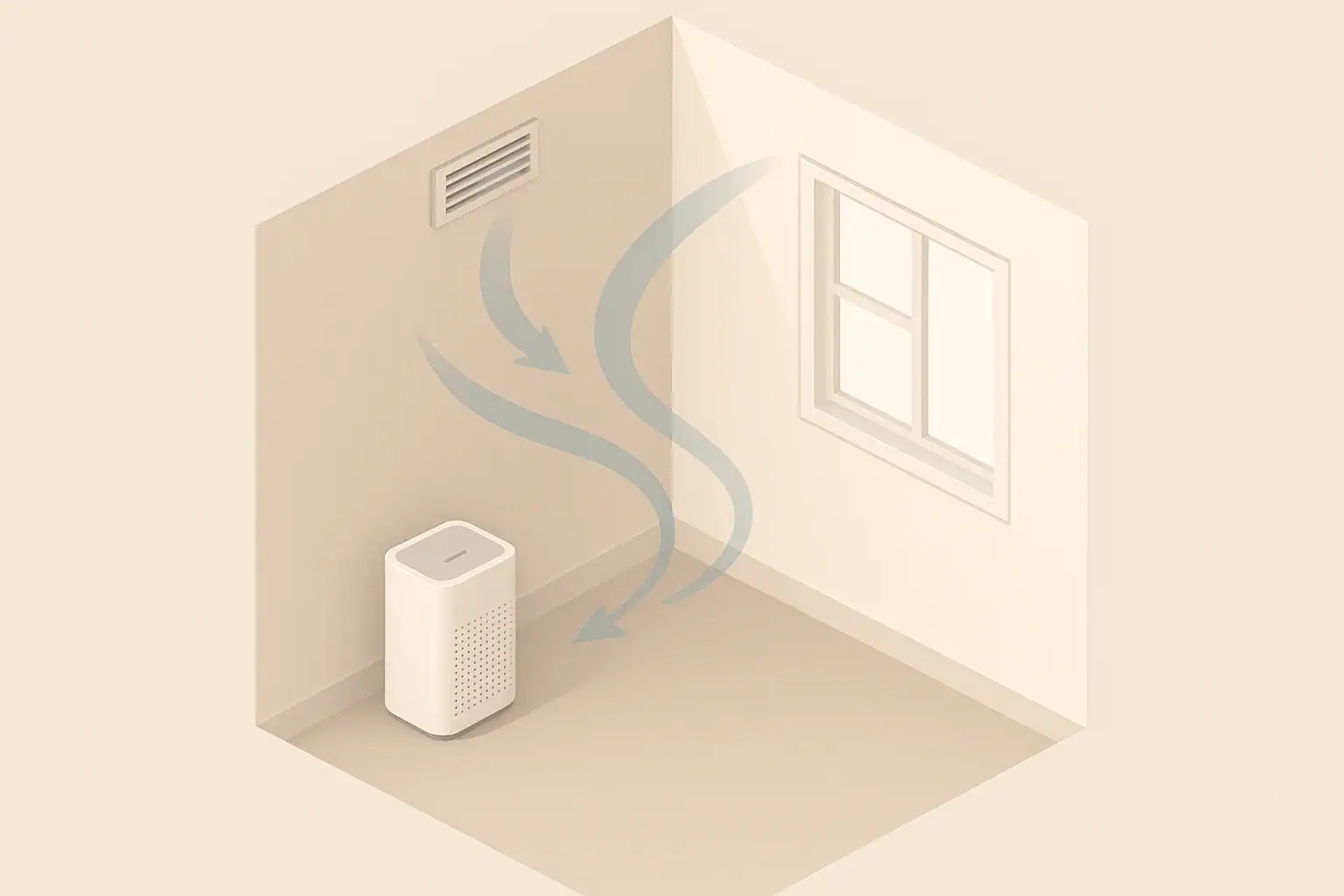
During wildfire smoke, keeping windows and exterior doors closed is usually better when outdoor PM2.5 or visible smoke levels are higher than indoor levels.
Ventilation is normally useful for diluting indoor pollutants, but wildfire smoke changes the balance. The practical goal is to limit smoky outdoor air, reduce indoor particle sources, and use filtration until outdoor air improves.
- Keep windows closed when outdoor smoke is visible, smells strong, or outdoor PM2.5 is higher than indoors.
- Use recirculation where available, and use a high-efficiency HVAC filter such as MERV 13 only if the system can handle it.
- For a cleaner room, portable filtration is commonly planned around about 4 to 6 air changes per hour, with higher airflow if noise and comfort allow.
- Ventilate briefly only when outdoor PM2.5 has dropped and is lower than indoors; start with 10 to 20 minutes and recheck conditions.
- Avoid adding indoor particles from smoking, candles, frying, fireplaces, and unnecessary exhaust fan use during smoke events.
What Ventilating During Wildfire Smoke Means
Ventilation means exchanging indoor air with outdoor air. In routine conditions, this can reduce carbon dioxide, odors, moisture, and pollutants generated indoors. During wildfire smoke, however, outdoor air may contain elevated fine particles that can enter through open windows, doors, vents, and building leaks.
The main concern for home decisions is PM2.5, a category of fine particles small enough to remain suspended in air. Smoke also contains gases and odors, but particle control is usually the first practical target for a home plan.
The decision is not simply open or closed forever. It is a timing question: close up when outdoor air is smoky, filter indoor air while closed, then ventilate when outdoor air becomes cleaner than indoor air.
Key Concepts: PM2.5, Air Exchange, and Filtration
PM2.5 readings from a local air quality source or a home monitor can help guide decisions. Consumer monitors are not laboratory instruments, but they can show trends, such as whether opening a window raises or lowers indoor particle levels.
Outdoor air is not always the cleaning tool
Opening windows works only when outdoor air is cleaner than indoor air for the pollutant you are trying to reduce. During wildfire smoke, outdoor air may be the main source of particles, so open-window ventilation can make the indoor situation worse. For a broader comparison of when to use each approach, see Ventilation vs Air Purifier: When You Need One, the Other, or Both.
Filtration and ventilation do different jobs
Filtration removes particles from air that passes through a filter. Ventilation replaces indoor air with outdoor air. When outdoor air is smoky, filtration usually becomes the preferred tool for particle control, while ventilation is delayed or reduced. If you are planning portable cleanup for smoke, Best Air Purifiers for Wildfire Smoke: What Specs Matter Most covers the main specs to look for.
Simple ACH planning
Air changes per hour, or ACH, estimates how many times a room volume is processed in one hour. For portable air cleaners, a common planning range for a cleaner room is about 4 to 6 ACH, assuming the unit airflow is realistic for the selected fan speed. Large rooms, open floor plans, and high ceilings need more airflow than small bedrooms.
For HVAC systems, the filter rating and system design matter. A higher-rated filter can help capture more fine particles, but using a filter that is too restrictive for the equipment may reduce airflow. If unsure, use the filter rating recommended for the system and prioritize a well-sealed filter fit with no visible bypass gaps. A simple sizing reference like How to Choose the Right Air Purifier for Your Room Size can also help match airflow to the room.
| Situation | Better first step | Why it matters | Notes |
|---|---|---|---|
| Outdoor PM2.5 is higher than indoors | Keep windows closed | Outdoor air is the particle source | Run filtration and monitor trends |
| Outdoor air has improved and is lower than indoors | Ventilate briefly | Cleaner outdoor air can dilute indoor buildup | Try 10 to 20 minutes, then recheck |
| Indoor air feels stale but outdoor air is smoky | Use filtration and reduce sources | Opening windows may raise particle levels | Use filtered mechanical ventilation if already available |
| Cooking or frying is planned | Reduce the activity or use local control | Cooking can add particles indoors | Watch exhaust use because it can pull air in through leaks |
| Leaky apartment or older home | Create one cleaner room | Whole-home control may be harder | Close doors and run a suitable purifier continuously |
| Smoke odor remains after outdoor air clears | Combine ventilation and carbon filtration | Particles and odors behave differently | Carbon helps with some odors but has limited capacity |
Common Mistakes That Let Smoke Indoors
One common mistake is opening windows because the home feels stuffy without checking outdoor conditions. Stale air and smoky air are different problems, and the solution that helps one can worsen the other.
Another mistake is relying on odor alone. Smoke smell can be noticeable even when particle levels are falling, and some people stop smelling smoke after being around it for a while. A PM2.5 monitor, local air quality map, or both can provide a more consistent signal.
Exhaust fans also deserve attention. Bathroom fans, kitchen range hoods, clothes dryers, and whole-house exhaust systems remove indoor air. The replacement air has to come from somewhere, often through cracks, doors, vents, or other leaks. During smoke events, unnecessary exhaust can pull smoky air inside. If you need a refresher on this effect, Exhaust Fan Best Practices: Bathrooms and Kitchens That Actually Clear Air is a useful companion guide.
Filter bypass is another overlooked issue. A good filter helps only if air goes through it rather than around it. Loose-fitting filters, bent frames, dirty filter slots, or missing access covers can reduce practical performance.
Practical Home Checklist for Smoky Days
A calm plan is easier to follow if it is simple. The following steps focus on reducing smoke entry, limiting indoor particle sources, and using the equipment already present in many homes.
Before or early in a smoke event
- Close windows, exterior doors, fireplace dampers, and other intentional openings when smoke arrives.
- Set central air systems to recirculate when that option is available.
- Install a clean HVAC filter with the highest compatible rating recommended for the system.
- Choose one room, often a bedroom or living room, as a cleaner room if whole-home control is difficult.
- Place a portable air cleaner where airflow is not blocked by curtains, furniture, or walls.
While conditions are smoky
- Run filtration continuously at the highest comfortable fan setting.
- Keep interior doors closed for the cleaner room if the purifier is sized for that room only.
- Limit candles, incense, smoking, wood burning, aerosol use, and high-heat cooking.
- Use exhaust fans only when needed for moisture, cooking safety, or odor control.
- Track PM2.5 trends indoors and outdoors when possible.
When outdoor air improves
Ventilation can become useful again when outdoor particle levels are consistently lower than indoors. Open a few windows for a short period, use cross-ventilation if conditions allow, and watch whether indoor PM2.5 falls or rises. If indoor levels rise, close up and return to filtration.
Real-World Examples: Apartment, House, and Cleaner Room
In an apartment, residents may have limited control over shared ventilation, corridor air, or window sealing. A practical approach is to close windows, minimize door opening to smoky corridors, and operate a portable purifier in the room used most often. If hallway odors enter under the door, a simple temporary draft barrier may reduce uncontrolled air movement without modifying building systems.
In a single-family house with central forced air, the main decision is often whether to run the fan. Recirculating air through a clean, compatible filter can help distribute filtration. However, systems that intentionally bring in outdoor air may need to be set according to manufacturer controls or normal operating instructions. The homeowner should not disable safety controls or make unapproved appliance modifications.
In an open-plan home, a small purifier may not effectively cover the combined living, kitchen, and dining area. It may be more practical to create a cleaner sleeping room with the door closed. This reduces the air volume that must be filtered and makes airflow planning easier.
After smoke clears outdoors, a home may still have indoor PM2.5 from infiltration and indoor sources. This is the time when ventilation is most useful. Open windows when outdoor readings are favorable, run filtration at the same time if available, and close the windows again if smoke returns.
Safety and Standards: Avoid Ozone and Use Caution With Add-Ons
For smoke particles, mechanical filtration is the most straightforward home approach. Filters do not intentionally create ozone, and they can be selected and maintained without adding reactive byproducts to indoor air.
Devices marketed with ionizers, plasma, or other electronic air-cleaning features vary in design. Some may produce ozone or other byproducts, especially if misused or poorly maintained. If using a device with optional electronic features, review the documentation and consider leaving those features off when the goal is simple particle filtration. For more on that trade-off, see Air Purifier vs Ozone Generator: Safety, Effectiveness, and Myths.
UV-C systems are generally aimed at biological contaminants on surfaces or inside equipment, not at removing wildfire smoke particles from room air. They require careful design to avoid exposure and material damage. They should not be treated as a substitute for particle filtration during smoke events.
Combustion safety also matters. Do not run generators, grills, camp stoves, or fuel-burning equipment indoors or near open windows and air intakes. Do not block required combustion air openings or alter appliances in an attempt to stop smoke entry.
Maintenance and Upkeep During Smoke Season
Wildfire smoke can load filters faster than ordinary dust. A filter that normally lasts months may need earlier replacement after repeated smoke days. The right interval depends on hours of use, particle levels, airflow, filter size, and the amount of dust and pet hair in the home.
Check filters visually and follow the equipment instructions. A darkened filter is not automatically failed, but noticeable dust loading, reduced airflow, unusual fan noise, or a rising indoor PM2.5 trend can be cues to inspect or replace it.
Prefilters are useful because they catch larger dust and hair before the main filter. If the prefilter is washable, let it dry completely before reinstalling. A damp filter or filter area can create odor and maintenance problems.
Activated carbon can help reduce some smoke odors and gases, but it has limited capacity and is not the same as a particle filter. Once carbon is saturated, it no longer controls odors well. For smoke season planning, carbon is best treated as a useful addition, not a substitute for HEPA or high-efficiency particle filtration. A deeper comparison is available in Activated Carbon Filters Explained: VOCs, Odors, and What They Can’t Do.
| Item | Typical interval range | What can shorten it | Reminder |
|---|---|---|---|
| Portable purifier prefilter | Every 2 to 4 weeks during heavy use | Pet hair, dust, long fan run time | Clean or replace as instructed |
| Main particle filter | About 6 to 12 months | Repeated smoke events and high airflow | Watch airflow and PM2.5 trends |
| HVAC pleated filter | About 1 to 3 months | Continuous fan use and smoky periods | Use only compatible ratings |
| Activated carbon filter | About 3 to 6 months | Persistent odors and gas exposure | Replace when odor control drops |
| Washable mesh screen | Monthly during use | Dusty rooms and pets | Dry fully before reinstalling |
| Air monitor inlet area | Monthly light cleaning | Dust buildup near sensors | Follow the monitor instructions |
Related guides: Wildfire Smoke Indoors: Step-by-Step Plan to Lower PM2.5 Fast • Indoor Air Quality Monitors: What to Measure (PM2.5, CO2, VOCs, Humidity) • Portable Air Purifier vs HVAC Filtration: What Helps More in Homes?
Frequently asked questions
Should I ventilate during wildfire smoke if my house feels hot or stuffy?
Not if outdoor PM2.5 is higher than indoor levels or visible smoke is present. In that case, opening windows may bring in more fine particles than it removes. A better first step is usually to keep the home closed and use filtration until outdoor air improves.
When is it safe to open windows after smoke passes?
Ventilation is most useful when outdoor PM2.5 is consistently lower than indoor PM2.5. A short test of 10 to 20 minutes can help you see whether indoor levels fall or rise. If indoor PM2.5 rises, close the windows and return to filtration.
Is a portable air cleaner enough, or do I still need ventilation?
A portable air cleaner can help reduce particles in a room, but it does not replace ventilation for stale air, moisture, or indoor gases. During smoke events, filtration usually comes first and ventilation is delayed until the outside air is cleaner. In practice, many homes use both at different times.
Does using exhaust fans during wildfire smoke make indoor air worse?
It can, because exhaust fans remove indoor air and replacement air often enters through leaks, cracks, and openings. During smoky periods, use exhaust only when needed for safety, moisture control, or cooking. Avoid unnecessary exhaust if your goal is to keep smoke out.
What indoor sources should I avoid while ventilating during wildfire smoke?
Avoid activities that add particles, such as smoking, candles, incense, frying, and wood burning. These sources can make indoor air dirty even when outdoor air improves. Reducing indoor particle sources makes filtration and later ventilation more effective.
How much airflow does a cleaner room need during smoke?
A common planning target is about 4 to 6 air changes per hour for a cleaner room, assuming the purifier airflow is realistic for the space. Larger rooms, open layouts, and high ceilings need more airflow to achieve the same effect. Noise, placement, and filter bypass can all affect real-world performance.
Summary: When Closed Windows Are the Better Choice
Keeping windows closed is usually the better choice when wildfire smoke makes outdoor PM2.5 higher than indoor PM2.5. In that situation, open-window ventilation can bring in more of the pollutant you are trying to reduce.
The practical approach is to close up during smoky periods, run appropriate filtration, reduce indoor particle sources, and avoid unnecessary exhaust that may pull outdoor air through leaks. A cleaner room can be more realistic than whole-home control in apartments, leaky homes, and open-plan spaces.
Ventilation becomes helpful again when outdoor air is cleaner than indoor air. Use short ventilation periods, check PM2.5 trends when possible, and return to filtration if smoke levels rise. This balanced approach keeps ventilation useful without assuming outdoor air is always the safer option.
Recommended next:
- Ventilation vs Air Purifier: When You Need One, the Other, or Both
- CO2 in Bedrooms: What Levels Mean and How to Improve Air Exchange
- How to Ventilate in Winter Without Freezing: Practical Strategies
- Exhaust Fan Best Practices: Bathrooms and Kitchens That Actually Clear Air
- Air Exchange Basics: ACH, Infiltration, and Why “Stuffy” Happens
- ERV vs HRV: What They Do for Indoor Air Quality
- More in Ventilation & Air Exchange →
- Clear sizing logic (room size → CADR/ACH)
- HEPA vs carbon explained for real use-cases
- Humidity + ventilation basics to reduce mold risk