Air Purifier for Office Desks: Realistic Small-Room Coverage and CADR

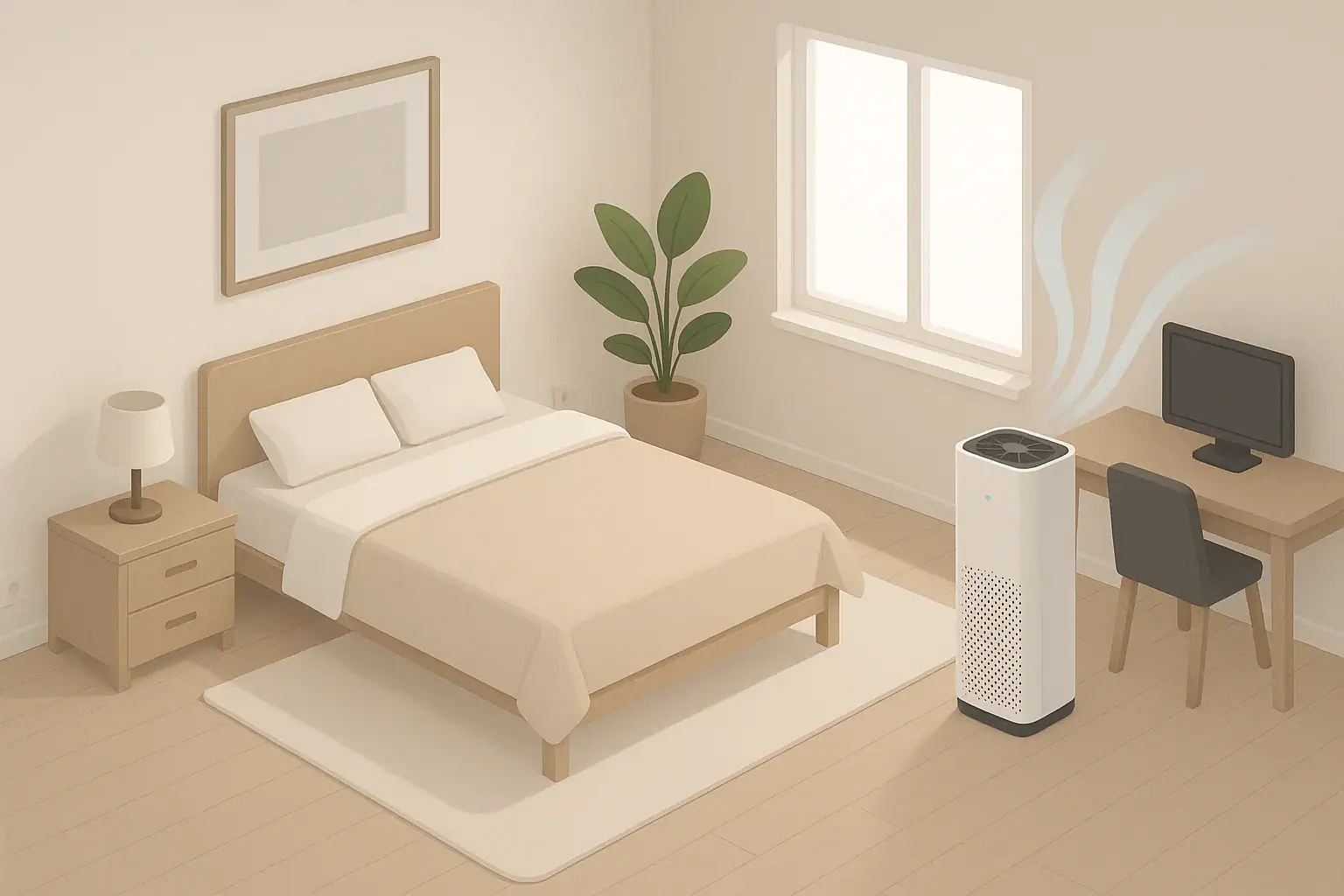
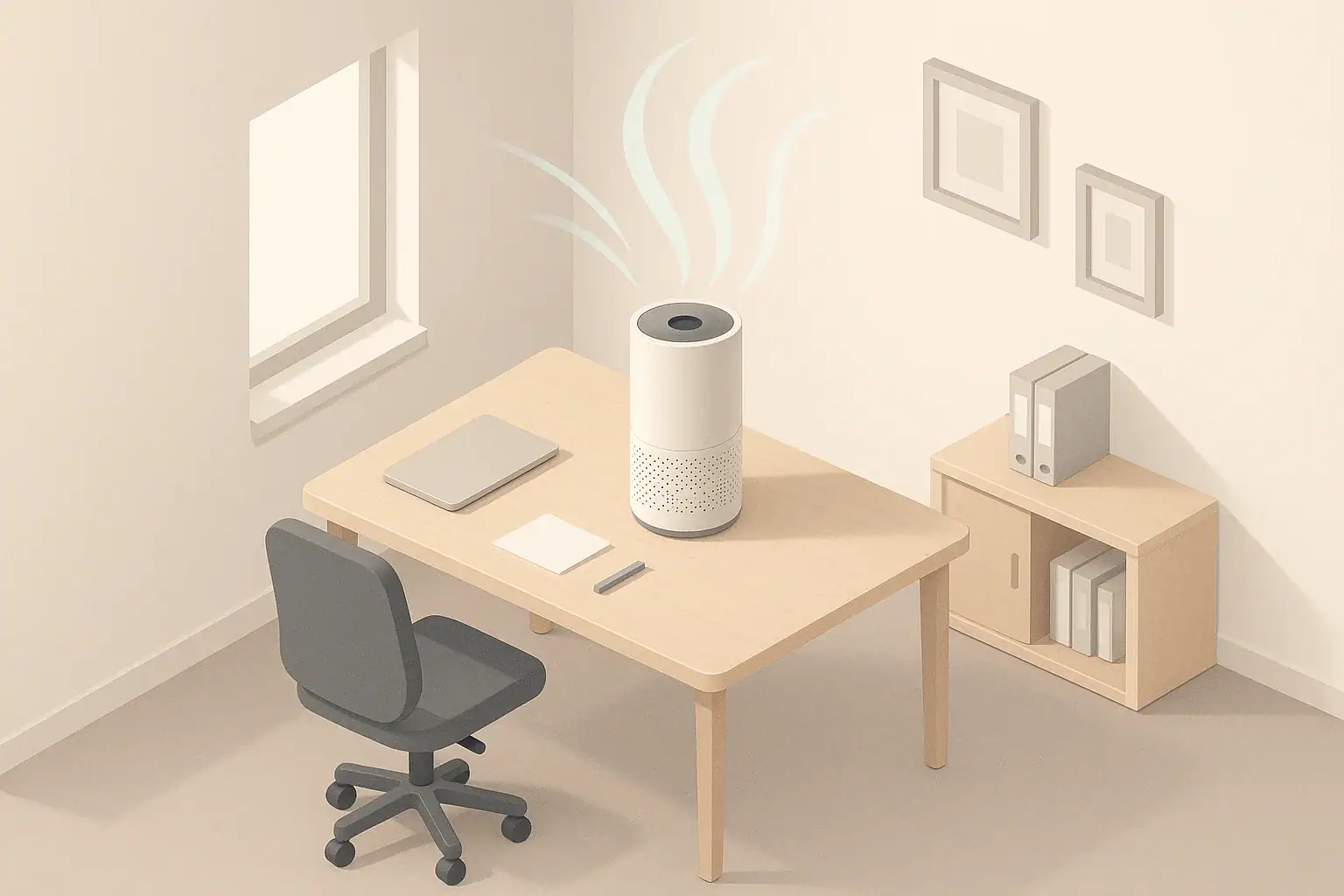
Isometric illustration of a small office desk with air purifier

An air purifier for office desks can improve the air right around where you sit, but it usually cannot clean an entire office by itself. These compact units are best treated as personal or small-room air cleaners that supplement, not replace, a properly sized room purifier or building ventilation.

If you work in a cubicle, shared office, or small home office, a desk air purifier can reduce dust and fine particles in your breathing zone, especially when outdoor smoke or building dust is an issue. To get useful results, you need enough airflow (CADR), sensible placement, and realistic expectations about coverage. This guide explains how desk purifiers work, how to size them for small spaces, and how to avoid common mistakes that waste money or create noise without much benefit.

What Desk Air Purifiers Are and Why They Matter

Desk air purifiers are compact air cleaners designed to sit on a desk, shelf, or small side table near where you work. They use a fan to pull air through filters that capture particles such as dust, pollen, and smoke, and often include a small carbon layer for odors.

Because they are small, these purifiers move less air than full-size room units. That matters for two reasons:

  • Coverage is limited: A small fan can only clean a modest volume of air, especially if you want several air changes per hour.
  • Placement is critical: When the purifier sits close to you, both the benefits (cleaner local air) and the drawbacks (noise, drafts) are more noticeable.

For many people, the real value of a desk purifier is improving the immediate workspace when you cannot control the whole building. It can help with comfort during wildfire smoke, dusty renovation work elsewhere in the building, or in older offices with limited filtration, as long as you understand that it is a local tool, not a whole-building solution.

Key Concepts: CADR, Small-Room Coverage, and Filters

To choose and use an air purifier for office desks effectively, it helps to understand three basic ideas: Clean Air Delivery Rate (CADR), air changes per hour (ACH), and filter types.

CADR and ACH basics

  • CADR (Clean Air Delivery Rate) is a measure of how quickly a purifier removes particles from the air, usually in cubic feet per minute (cfm).
  • ACH (air changes per hour) describes how many times per hour the purifier can theoretically clean the volume of a room.

A simple planning shortcut is:

CADR (cfm) ≈ Room volume (ft³) × Target ACH ÷ 60

Room volume is length × width × ceiling height. For small offices and desk areas, many people aim for a moderate ACH for comfort, recognizing that higher ACH gives faster particle reduction but needs more airflow and more noise.

Example CADR Planning for Small Offices – Example values for illustration.
Room type Approx. size
(ft)
Approx. volume
(ft³, 8 ft ceiling)
Example target ACH Approx. CADR needed
(cfm)
Very small nook 8 × 10 640 3 ACH (light use) 640 × 3 ÷ 60 ≈ 32 cfm
Small home office 10 × 10 800 4 ACH (more coverage) 800 × 4 ÷ 60 ≈ 53 cfm
Private office 10 × 12 960 5 ACH (faster cleanup) 960 × 5 ÷ 60 ≈ 80 cfm
Shared office 12 × 15 1,440 5 ACH (several occupants) 1,440 × 5 ÷ 60 ≈ 120 cfm
Open-plan zone 20 × 20 section 3,200 4 ACH per zone 3,200 × 4 ÷ 60 ≈ 213 cfm

Many desk purifiers have CADR values well below what you would want for a larger shared office, but they can be suitable for a very small office or as a personal supplement.

Filter types in desk purifiers

  • Particle filter (HEPA-style): Captures fine particles such as dust, smoke, and pollen. Wording like “HEPA,” “H13,” or “HEPA-type” may appear, but overall design and sealing matter as much as the label.
  • Pre-filter: A coarse layer that catches hair and larger dust, helping the main filter last longer.
  • Carbon or adsorbent layer: Helps with light odors from food, office materials, or mild cleaning products, but capacity is usually limited in small desk units.

For most office desks, a mechanically filtered unit with a decent particle filter and a basic carbon layer is the main workhorse. Any additional features are secondary to airflow and filter quality.

Real-World Desk and Small-Office Scenarios

Looking at typical office layouts makes it easier to see what a desk air purifier can realistically do.

Scenario 1: Small home office (about 100 ft²)

  • Room: 10 × 10 ft, 8 ft ceiling (about 800 ft³).
  • Use: One person, door often closed, occasional video calls.
  • Goal: Reduce dust and wildfire smoke that seeps indoors.

If you target around 4 ACH for comfort, you would want roughly 50–60 cfm of CADR. A stronger desk unit or a compact floor unit placed near the desk can reasonably handle the whole room, especially if you keep the door mostly closed and run the purifier on a medium or higher speed during the day.

Scenario 2: Cubicle in a large open-plan office

  • Space: Open floor with many desks; your cubicle is only a section of a much larger volume.
  • Use: Multiple coworkers nearby, shared ventilation system, some printer and copier use.
  • Goal: Improve personal breathing zone without changing the whole floor.

In this case, a desk purifier is mainly a local tool. It can help reduce particles in the air directly around your head and torso if positioned so that the clean air stream passes through your breathing zone. It will not noticeably change the air quality across the entire open office because the total volume is far larger than what a small fan can handle.

Scenario 3: Private office (about 120 ft²) with visitors

  • Room: 10 × 12 ft, 8 ft ceiling (about 960 ft³).
  • Use: One main occupant, plus 1–2 visitors for short meetings.
  • Goal: General comfort and faster cleanup of particles after busy periods.

A modest desk or small floor unit may provide some whole-room benefit if CADR is high enough and the door is not constantly open. You might run the purifier on higher speed before and after meetings to help reduce particle buildup, then keep it on a quieter setting while you work. For frequent, longer meetings, a larger room unit will usually be more appropriate.

Scenario 4: Shared office (about 200 ft²) with several desks

  • Room: 10 × 20 ft, 8 ft ceiling (about 1,600 ft³).
  • Use: Three or four people working most of the day.
  • Goal: Better overall air quality plus personal comfort at each desk.

One small desk purifier is unlikely to provide meaningful whole-room air cleaning here. Instead, it can be used as a personal supplement while a larger, higher-CADR purifier serves the room, and the building ventilation handles fresh air exchange.

Common Mistakes and Troubleshooting Desk Purifiers

Even a well-chosen air purifier for office desks can underperform if used incorrectly. Many issues come down to placement, expectations, and maintenance.

Frequent mistakes to avoid

  • Overestimating coverage: Assuming a palm-sized purifier can handle a full open-plan office or large conference room.
  • Blocking airflow: Placing the unit behind monitors, under piles of paper, or against a wall so the intake and outlet are partially covered.
  • Running only on the lowest speed: Using a quiet but weak setting all the time, even during high-pollution events, which keeps effective CADR low.
  • Ignoring filter changes: Letting filters clog until airflow drops and the purifier is mostly just making noise.
  • Using the wrong tool for the job: Expecting a purifier to fix stale air from poor ventilation or to reduce carbon dioxide levels.

Troubleshooting cues

If you suspect your desk purifier is not helping much, look for simple signs:

  • Very little air movement at the outlet, even on higher speeds.
  • Noticeable dust buildup on surfaces despite long run times.
  • Unchanged readings on a basic particle monitor when you turn the unit on and off in a small room.
  • Filters visibly gray or dirty and well past the suggested replacement window.
Desk Purifier Issues and Practical Fixes – Example values for illustration.
Observed issue Likely cause Simple adjustment to try
Little improvement in air over several hours CADR too low for room size or blocked airflow Move unit to a more open spot and run on higher speed; consider a higher-capacity purifier for the room
Noticeable fan noise but weak airflow Clogged filters or obstructed intake Check and clean pre-filter, replace main filter, clear at least a few inches of space around all sides
Draft or cool air blowing directly on face Outlet aimed straight at user at close range Shift purifier to a side table or floor near the desk so air mixes in the room before reaching you
Odors linger despite purifier running Thin carbon layer saturated or odor source not controlled Reduce odor sources, improve ventilation, and replace carbon filter if available
Unit feels too loud to use at work High speed needed for coverage at close distance Run higher speed when away from desk, then use medium or low while working and increase distance from ears

Addressing these basics often restores most of the performance you can reasonably expect from a desk-sized purifier.

Safety Basics for Desk Air Purifiers

Desk purifiers are generally low-risk appliances, but a few safety points are worth keeping in mind, especially when they run for many hours near where you sit.

Ozone and reactive technologies

  • Mechanical filtration (HEPA-style and carbon) is typically preferred for offices and home workspaces.
  • Devices that intentionally generate significant ozone are not appropriate for normal occupied offices, because ozone is a respiratory irritant.
  • Some units include ionizers or similar features; these are often designed to keep ozone production low, but mechanical filters should still be the primary air-cleaning method.

Electrical and placement safety

  • Plug the purifier directly into a suitable outlet rather than overloading power strips with many high-draw devices.
  • Keep the intake and outlet clear of paper, fabric, and other materials that could restrict airflow or overheat the unit.
  • Avoid placing the purifier where it can easily be knocked off a desk or where cords create a tripping hazard.

Use around sensitive occupants

  • For people sensitive to noise, start on lower speeds and increase gradually to find a tolerable balance.
  • If anyone experiences irritation when a new purifier is first used, check for off-gassing odors from new plastics and filters; running the unit in a separate space for a short break-in period can help.

Following the basic instructions that come with the device, combined with common-sense placement and electrical practices, is usually sufficient for safe everyday use at a desk.

Maintenance and Long-Term Use at the Desk

To keep a desk air purifier performing close to its rated CADR, you need simple but consistent maintenance. Over time, dust and particles clog filters and reduce airflow, even if the fan speed setting has not changed.

Filter care and replacement

  • Pre-filter: Check every few weeks in dusty environments. Gently vacuum or wipe as recommended to remove visible dust, which helps protect the main filter.
  • Main particle filter: Replace on the approximate schedule suggested for similar use (often every several months to a year, depending on pollution levels and run time).
  • Carbon layer: Odor control usually fades before airflow drops; if you notice more odors despite the purifier running, the carbon may be saturated and ready for replacement.

Run-time habits

  • For steady benefits, many people leave desk purifiers running whenever they are in the office, and sometimes for a short period before and after work.
  • During high-pollution events (such as wildfire smoke days), running on a higher speed for part of the day can help clear particles more quickly.
  • Between events, a lower continuous speed may be enough for maintenance-level cleaning in a small room.

Storage between seasons

  • If you only use the purifier during certain seasons, store it in a dry, clean area away from moisture and pests.
  • Remove heavily used filters before long-term storage; install new filters at the start of the next season for best performance.
  • Before restarting after storage, check the fan inlet and outlet for dust and gently clean as needed.

These simple habits help maintain airflow, keep noise levels stable, and extend the useful life of both the purifier and its filters.

Practical Takeaways and Specs to Look For

When you put everything together, an air purifier for office desks is most effective when it is sized appropriately, placed intelligently, and maintained regularly. It is a practical tool for improving the air in your immediate workspace, especially in small offices or cubicles, but it should not be expected to fix building-wide ventilation or large open spaces on its own.

Key takeaways for desk and small-office use

  • Match purifier capacity to your actual room volume and desired ACH; tiny units are best for very small spaces or personal zones.
  • Place the purifier where it can draw and exhaust air freely, ideally slightly away from your ears but close enough to influence your breathing zone.
  • Use higher speeds strategically when you are away or during high-pollution periods, and quieter speeds when you are working nearby.
  • Remember that filtration does not replace fresh-air ventilation or humidity control; it is one part of overall indoor air quality.
  • Stay on top of filter maintenance so the purifier does not gradually turn into a low-airflow, high-noise desk accessory.

Specs to look for in a desk air purifier

  • CADR suitable for your space: Use room volume and a reasonable ACH target to estimate the airflow you need; for many small offices, this is often in the tens, not single digits, of cfm.
  • Clear particle filter description: Look for a HEPA-style filter with good sealing and a separate pre-filter for larger dust.
  • Carbon or odor layer: Helpful for light office odors, with the understanding that thin pads have limited capacity.
  • Noise levels at working distance: Consider whether the stated noise on low and medium speeds will be acceptable when the unit sits a few feet from your ears.
  • Multiple fan speeds: Allows you to run higher for quick cleanups and lower for everyday quiet operation.
  • Filter availability and cost: Replacement filters should be easy to obtain and reasonably priced relative to how often you expect to change them.
  • Compact but not cramped design: Small enough to fit your desk or side table, but with visible space for air intake and outlet so airflow is not overly restricted.

Using these criteria, you can choose a desk air purifier that fits your office, set realistic expectations about what it can do, and get consistent benefits from cleaner air in the space where you spend much of your workday.

Frequently asked questions

What specs and features matter most when choosing an air purifier for office desks?

For desk use, prioritize CADR relative to your room volume, a true mechanical particle filter (HEPA-style) with good sealing, noise levels at typical working distance, and multiple fan speeds. Also check filter availability and cost, plus whether a carbon layer is included for odors if you expect them. Compact size and unobstructed intake/outlet space are practical design considerations.

How close should I place a desk air purifier to effectively clean my breathing zone?

Position the purifier a few feet from where you sit so its cleaned air passes through your breathing zone without blasting directly at your face. Avoid placing it behind monitors or blocked by clutter; slightly elevated or on a side table near the desk often gives good local coverage. Good placement helps balance effectiveness with noise and drafts.

Can a desk purifier help during wildfire smoke events in an office?

Yes, a desk purifier with adequate CADR and a HEPA-style filter can reduce fine particles from wildfire smoke in a small, enclosed office or in your immediate breathing zone. For larger rooms, higher CADR or a larger room unit will be more effective; also keep doors and windows closed and consider building ventilation status. Run at higher speeds during heavy smoke and maintain filters to preserve airflow.

What is a common mistake that reduces a desk purifier’s effectiveness?

A frequent mistake is blocking the unit’s intake or outlet (for example, placing it behind monitors or piles of paper) or expecting a small purifier to clean a large open-plan office. Both reduce effective CADR and airflow where you need it. Ensure clear space around the unit and match capacity to the actual room volume.

Are ionizers or ozone-generating purifiers safe to use at a desk?

Mechanical filtration (HEPA-style) and carbon are generally preferred for occupied offices because ozone can irritate the respiratory system. Devices that intentionally generate significant ozone are not appropriate for normal occupied spaces; some ionizers produce little ozone but should not replace mechanical filters. If safety is a concern, choose units that prioritize sealed particle filtration.

How often should I change filters in a desk air purifier?

Filter replacement depends on run time and pollution levels, but many main particle filters are replaced every several months to a year under typical use, while pre-filters may be checked and cleaned every few weeks. Replace or refresh carbon layers when odors persist despite operation. Follow the manufacturer’s guidance and monitor airflow and visible filter loading to decide timing.
Air Purifier for Baby’s Room: Noise, Safety, and Filter Choices

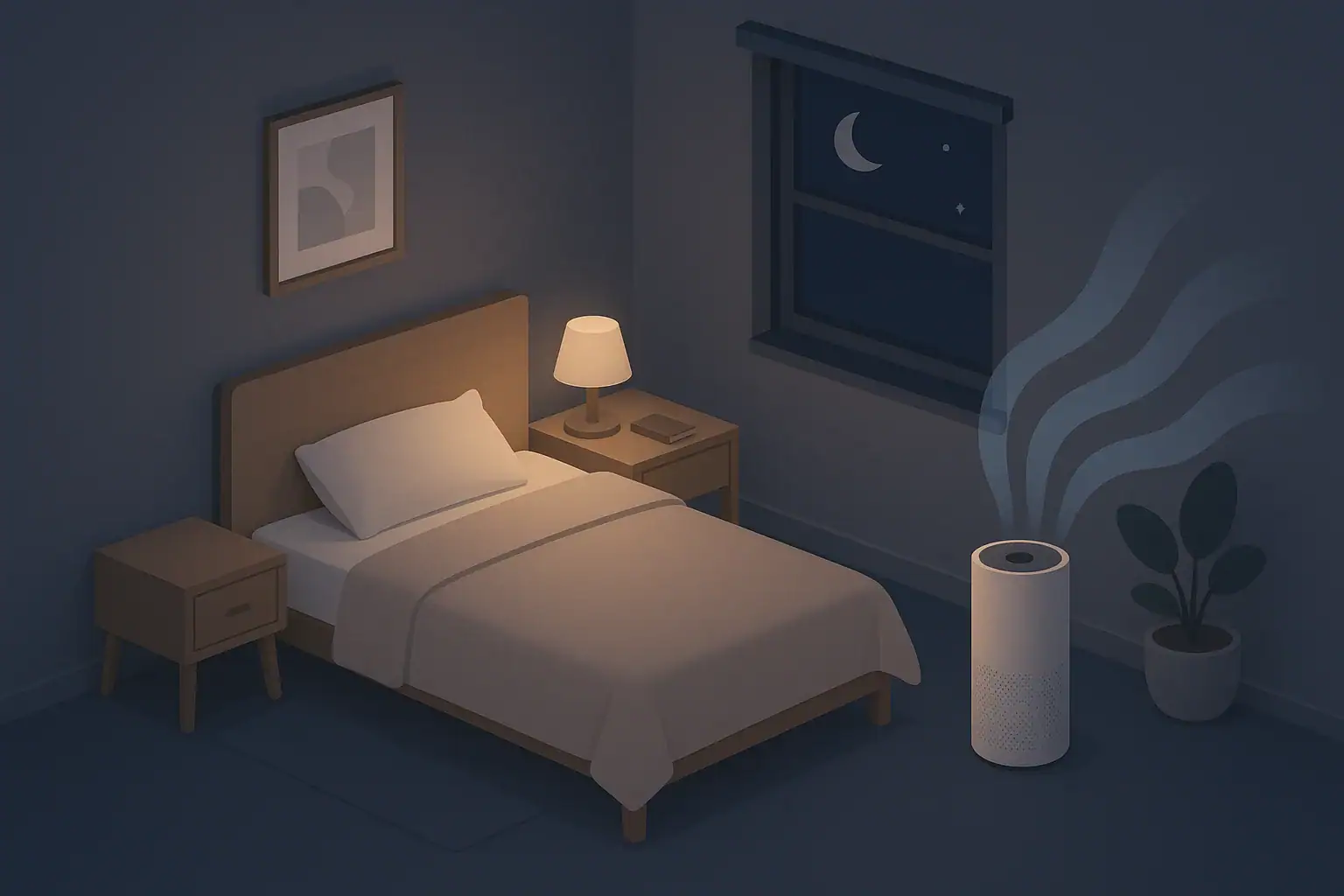
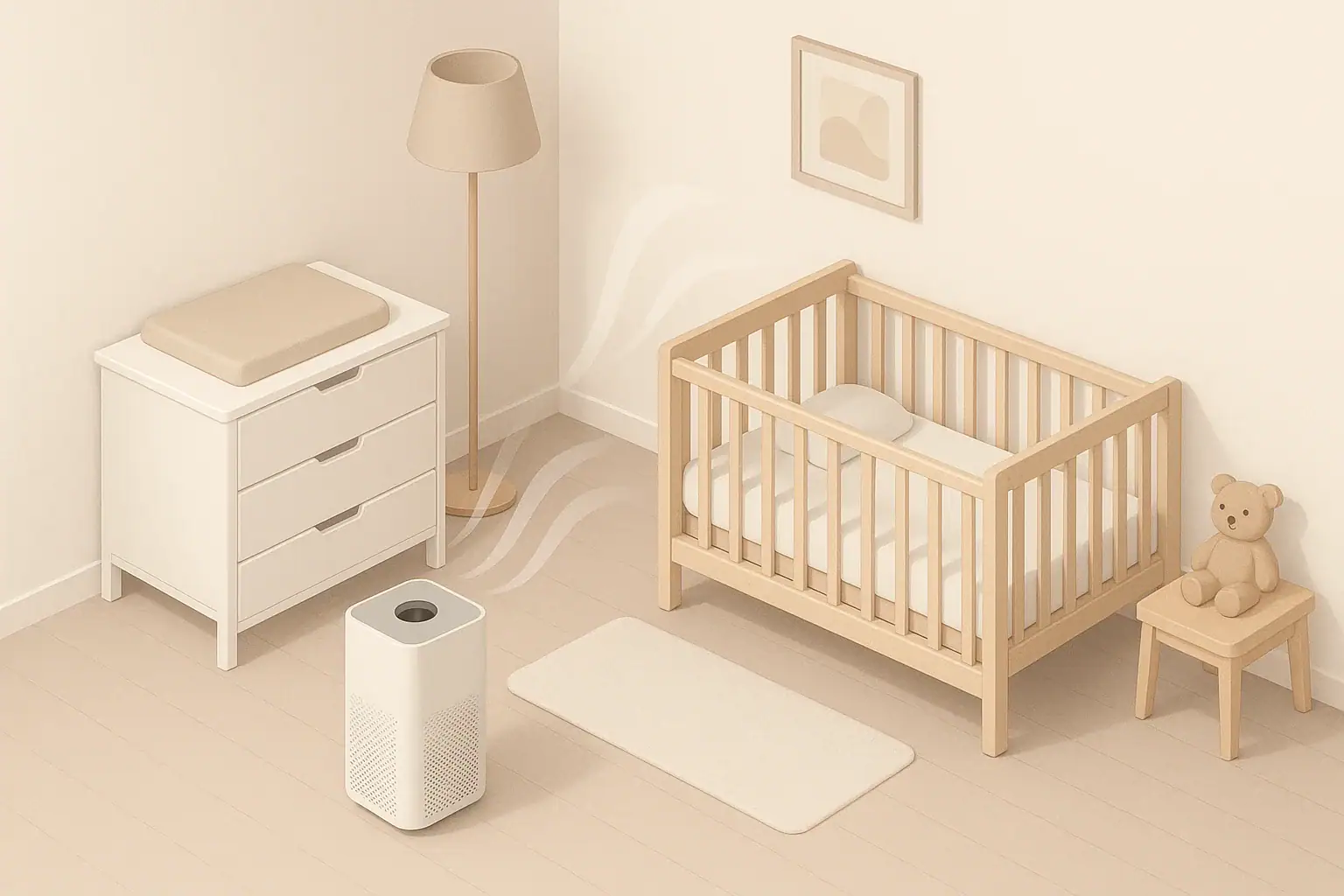
Quiet air purifier running in a tidy baby nursery

An air purifier can be a useful addition to a baby’s room when it is sized correctly, placed safely, and run on a quiet setting with the right filters. In a small nursery, a good air cleaner helps reduce airborne dust, pet dander, fine particles from outdoor pollution, and some odors from diapers or cooking. It does not replace ventilation or humidity control, but it can support a cleaner, more comfortable environment for sleep.

Parents often search for a nursery air purifier, baby air filter, or quiet bedroom air cleaner and are met with long lists of features. To keep things simple, focus on three questions: what kind of particles or smells you want to reduce, how much noise you are comfortable with during naps and nighttime, and whether the unit can run safely and reliably for many hours. The sections below walk through these points in a practical way so you can decide if an air purifier fits your baby’s room and how to use it effectively if you choose one.

What an Air Purifier Does in a Baby’s Room and Why It Matters

In a nursery, an air purifier’s main job is to pull room air through filters and return it with fewer airborne particles and, if equipped, fewer odors. Typical particles include household dust, lint, pet dander, pollen that drifts in from outside, and fine smoke or traffic particles that can enter through windows and doors. A purifier can also help with some of the smells that tend to linger near diaper pails or adjacent kitchens when it includes an odor-reducing filter stage.

This matters because nurseries are often smaller rooms with closed doors, soft furnishings, and many hours of sleep. Air can become stuffy, and particles can stay suspended longer, especially when windows are closed for temperature or noise reasons. A well-chosen air purifier for a baby room can help keep particle levels more stable between regular cleaning and vacuuming, especially if you have pets, live near busy roads, or deal with seasonal smoke.

It is important to remember what an air purifier does not do. It does not add oxygen, control carbon dioxide, or manage humidity. It cannot fix mold on walls or replace safe cleaning and fragrance-free product choices. Instead, it complements other steps: simple ventilation, moderate humidity, and routine dust control.

Key Concepts: How Nursery Air Purifiers Work

Most nursery-friendly air purifiers rely on mechanical filtration: a fan pulls air through one or more filters, and particles or gases are captured as air passes through. Understanding the basic filter stages and sizing concepts makes it easier to compare models without getting lost in marketing terms.

Filter stages for a baby’s room

Common filter stages include:

  • Pre-filter: A coarse mesh or fabric that catches hair, lint, and larger dust. Often washable or vacuumable.
  • Fine particle filter (HEPA or HEPA-type): A dense material designed to capture small particles like dust, pet dander, and fine smoke.
  • Activated carbon filter: A porous carbon layer that helps reduce odors and some gases from diapers, cooking, or nearby traffic.

For a baby’s room, a combination of a pre-filter plus a high-efficiency particle filter is usually the core. Activated carbon is optional but helpful if odors are a recurring complaint.

Room size, airflow, and air changes per hour

Even a strong filter will not help if too little air passes through it. Two practical ideas help here:

  • Airflow (often related to CADR): Indicates how much filtered air the unit can deliver each minute.
  • Air Changes per Hour (ACH): How many times per hour the purifier can theoretically filter the room’s air volume.

For a typical small nursery, many families aim for several air changes per hour when the purifier is on a low or medium setting. That usually means choosing a purifier rated for at least the nursery’s square footage, and often slightly more, so you can keep fan speeds quieter while still moving enough air.

Noise and fan speeds

Noise matters more in a nursery than in many other rooms. Most purifiers offer multiple fan speeds:

  • Low: Quieter, with gentler airflow; suitable for sleeping if the room is not heavily polluted.
  • Medium: A balance between sound and cleaning power; often used when doors and windows are closed for long periods.
  • High or turbo: Loudest; useful briefly when outdoor smoke is high or after opening windows.

A steady, low-pitched hum can double as white noise and help mask household sounds. Sudden changes in fan speed, rattling, or high-pitched tones are more likely to disturb sleep, so testing the unit in the actual nursery is important.

Basic sizing example for a nursery

To get a rough sense of size, measure the nursery length and width in feet, multiply to get square footage, and compare to the purifier’s stated coverage. For example, a 10 ft by 11 ft nursery has 110 square feet of floor area. Choosing a purifier rated for around 150–200 square feet often allows you to run it on a lower speed for similar cleaning power.

Example nursery sizing and airflow planning. Example values for illustration.
Nursery Size (ft²) Approx. Room Volume (8 ft ceiling) Target ACH Range Approx. Airflow Needed (CFM) Practical Notes
80 ft² (small) 640 ft³ 4–6 ACH 45–65 CFM Many compact purifiers can reach this on low or medium speed.
110 ft² (typical) 880 ft³ 4–6 ACH 60–90 CFM Consider a unit rated for ~150–200 ft² so it can run quietly.
140 ft² (larger) 1,120 ft³ 4–6 ACH 75–115 CFM Look for a mid-sized purifier; avoid running tiny units on max all night.
Basement nursery (similar ft²) Varies 4–8 ACH Higher end of range Higher airflow is often helpful where dust and dampness linger.

Real-World Nursery Scenarios and How an Air Purifier Fits In

Thinking through real situations makes it easier to decide how a purifier can help and where other steps matter more. Below are examples based on common nursery setups and concerns.

Scenario 1: Baby’s room with pets in the home

If a dog or cat spends time near the nursery, or fur tends to drift under the door, a purifier with a good pre-filter and fine particle filter can help reduce airborne dander and hair. Practical steps might include:

  • Running the purifier continuously on low or medium when the door is closed.
  • Vacuuming carpets and washable rugs regularly with a high-efficiency vacuum.
  • Cleaning the pre-filter more often, since pet hair clogs it faster.

The purifier will not remove dander already settled in fabrics or bedding, so it works best alongside routine laundry and surface cleaning.

Scenario 2: Nursery near a busy road or seasonal smoke

Homes near traffic or in regions with seasonal smoke may see higher levels of fine outdoor particles indoors. In this case, a nursery air purifier with a tightly sealed high-efficiency particle filter and enough airflow is especially helpful. Useful habits include:

  • Keeping windows closed when outdoor air is visibly hazy or smells smoky.
  • Running the purifier on a higher setting for a short time before bedtime, then lowering it once the baby is asleep.
  • Checking filters more frequently during heavy smoke periods, since they load faster.

When outdoor air improves, brief ventilation (such as opening a window for a short time) helps dilute indoor gases that filters may not capture well.

Scenario 3: Strong diaper or trash odors

In some nurseries, odor is the main complaint. An air purifier with an activated carbon stage can help reduce smells, but it should not be the only solution. Combine it with:

  • Emptying diaper pails frequently rather than relying solely on odor masks or bags.
  • Wiping hard surfaces where spills or leaks have occurred.
  • Ensuring the room is not overly damp, which can make odors linger.

Carbon filters saturate over time and become less effective, so expect to replace them more often than the main particle filter if odor control is a priority.

Scenario 4: Stuffy, closed nursery with no ceiling fan

Some nurseries feel stuffy even when they look clean. In these rooms, a purifier can act as both a filter and a gentle air mover. You might:

  • Place the purifier a few feet from the crib, angled so air circulates around the room rather than directly at the baby.
  • Keep the door slightly open when household noise allows, so air can exchange with the rest of the home.
  • Use the purifier’s low setting as a consistent background sound and airflow source.

If the room still feels stale despite filtration, short ventilation periods and checking for blocked vents or closed supply registers are also important.

Common Mistakes and Troubleshooting Cues

Even a good air purifier can underperform if it is used in ways that limit airflow or safety. Recognizing common mistakes helps you correct issues quickly and decide when the purifier is not the right tool for the problem.

Common setup and use mistakes

  • Purifier too small for the room: A compact unit meant for a desk or very small bedroom may not keep up in a larger nursery, especially with the door closed.
  • Blocked intake or outlet: Placing the unit behind curtains, under shelves packed with items, or next to piles of laundry can restrict airflow and reduce effectiveness.
  • Running on max speed all night: This may create unnecessary noise and make the baby or caregivers less tolerant of the purifier, leading to turning it off entirely.
  • Ignoring filter replacement: Heavily loaded filters reduce airflow and may cause the motor to work harder or change pitch, which can disturb sleep.
  • Expecting it to solve moisture or mold problems: A purifier can remove some airborne spores but will not dry damp walls, carpets, or window frames.

What to check if the nursery still feels dusty or stuffy

If you are already using an air purifier and the room still seems dusty or uncomfortable, walk through these checks:

  • Confirm the purifier is actually on and set to at least a low continuous speed.
  • Inspect the pre-filter and main filter for visible dust buildup and replace or clean as needed.
  • Look for gaps or poor seals around the filter frame where air might bypass the filter media.
  • Reposition the unit so air can circulate around the room rather than immediately hitting a wall or furniture.
  • Check for other sources of dust, such as rarely washed curtains, stuffed toys, or carpets that have not been vacuumed recently.

Noise and vibration troubleshooting

If noise is the main concern, small adjustments often help:

  • Move the purifier onto a solid, level surface; soft or uneven flooring can cause vibration sounds.
  • Ensure all panels, filter doors, and covers are fully latched to avoid rattling.
  • Try a slightly lower fan speed and place the unit farther from the crib while still allowing airflow.
  • Clean dust from the fan intake and outlet grilles, which can sometimes change the sound of airflow.
Typical nursery purifier issues and quick checks. Example values for illustration.
Symptom Likely Cause Quick Check Simple Fix
Room still feels dusty Clogged filter or undersized unit Inspect filters and compare room size to rating Replace filters or choose a unit rated for a larger room.
Strong odors persist Saturated or missing carbon filter Check if carbon stage is installed and dated Replace carbon filter and improve trash/diaper routines.
Fan suddenly louder Heavy dust buildup or blocked vents Look for dust mats on pre-filter and intake grilles Clean pre-filter and clear space around the unit.
Baby seems chilled or drafty Airflow aimed directly at crib Feel airflow direction while purifier runs Angle outlet away and increase distance from crib.
Musty smell remains Moisture or mold source, not just particles Check walls, windows, and closets for dampness Address moisture with ventilation or dehumidification.

Safety Basics for Air Purifiers in a Baby’s Room

Safety should be the first filter you apply before thinking about extra features. A nursery air purifier is a plug-in appliance that may run for many hours unattended, so both electrical safety and child safety matter.

Avoiding ozone and aggressive air treatments

For a baby’s room, mechanical filtration is usually preferred. That means a fan plus filters, without technologies that intentionally create ozone or aggressively alter air chemistry. When comparing options, look for:

  • Purifiers that emphasize mechanical filtration rather than ozone generation.
  • Any ionizing or plasma features that can be turned off if you prefer a simpler mode.
  • Avoiding stand-alone ozone generators for occupied rooms.

Safe placement and cord management

Placement affects both safety and performance:

  • Keep the purifier a few feet from the crib so air does not blow directly on the baby.
  • Route the cord behind furniture when possible and avoid loose loops a crawling baby could pull.
  • Place the unit on the floor or a broad, stable surface rather than on narrow shelves.
  • Leave space around intakes and outlets so fabric, toys, or curtains do not block airflow.

Controls, child locks, and filter access

As babies grow into toddlers, curiosity becomes a factor. Helpful features include:

  • A child lock or button lock that prevents accidental setting changes.
  • A filter compartment that requires some deliberate effort to open, rather than a loose panel.
  • No small detachable pieces within reach that could become choking hazards.

Basic electrical and fire safety

Treat a nursery air purifier like any other long-running electrical appliance:

  • Plug it directly into a wall outlet rather than daisy-chaining multiple extension cords.
  • Do not run the cord under heavy rugs where heat can build up unnoticed.
  • Keep the purifier away from water sources, including humidifiers that might leak or spill.
  • Follow cleaning and filter replacement guidance so the motor does not strain against a severely clogged filter.

Maintenance and Long-Term Use in a Nursery

Once a purifier is in place, light but consistent maintenance keeps it working as intended. In many homes, a modest purifier with clean filters outperforms a high-end unit that rarely has its filters changed.

How often to run the purifier

For a baby’s room, many families choose one of these patterns:

  • Continuous low speed: Run 24/7 on the lowest or second-lowest setting for stable air quality and sound.
  • Boost then settle: Use a higher speed for 30–60 minutes before bedtime, then lower it once the baby is asleep.
  • Event-based: Increase speed during nearby construction, smoke episodes, or heavy pollen days.

Consistency is more important than frequent on-off cycles. A purifier only cleans air that actually passes through it while it is running.

Filter cleaning and replacement habits

Filter care affects both performance and noise. Simple habits include:

  • Checking the pre-filter monthly and cleaning it when visibly dusty.
  • Marking the installation date of new main filters so you can track months in use.
  • Listening for changes in sound that might indicate a clogged filter or blocked intake.
  • Planning a small annual budget for replacement filters when you choose a model.

Seasonal adjustments and storage

In some homes, a purifier is used more heavily in certain seasons:

  • During pollen or wildfire seasons, expect faster filter loading and check filters more often.
  • In very dry winter months, coordinate purifier use with any humidifier in the room, keeping cords separate and water away from the purifier.
  • If you store the purifier between seasons, remove or seal filters in a dry place so they do not absorb odors or moisture while idle.

Putting It All Together and Specs to Look For

Creating a comfortable nursery is less about one perfect device and more about combining simple steps that work together. A well-chosen air purifier for a baby room can reduce airborne particles and some odors, especially in smaller, closed spaces. When paired with moderate humidity, periodic ventilation, and regular cleaning, it becomes one part of a broader indoor air plan as your child grows.

When you compare options, it helps to have a short checklist so you are not distracted by extra features that matter less in daily use.

Practical specs and features to look for

  • Room coverage: Rated for at least your nursery size, ideally with a bit of extra capacity so you can run it on lower speeds.
  • Filter setup: Includes a pre-filter plus a high-efficiency particle filter; add activated carbon if odors are a regular concern.
  • Noise levels: Quiet low and medium fan speeds suitable for sleep; a steady hum rather than rattles or whines.
  • Mechanical filtration focus: Relies primarily on physical filters rather than ozone generation.
  • Child-friendly design: Stable base, secure filter door, and a child lock or simple controls.
  • Filter access and cost: Filters that are easy to replace, with clear guidance on timing and reasonable ongoing cost.
  • Simple indicators: Basic filter change reminder lights or runtime indicators to help you stay on schedule.
  • Energy use: Modest power draw on continuous low-speed operation, since the unit may run many hours a day.

By matching these practical specs to your specific nursery—its size, layout, nearby pollution sources, and your baby’s sleep patterns—you can choose an air purifier that quietly supports cleaner air without becoming a source of noise, clutter, or extra worry.

Frequently asked questions

Which technical specs and features most affect an air purifier’s performance in a nursery?

Key specs are room coverage or CADR/airflow to achieve several air changes per hour for your nursery size, a high-efficiency particle filter (true HEPA or equivalent), and low-noise fan settings for overnight use. An activated carbon stage helps with odors, and child-safety features plus easy filter access improve practicality for long-term use.

What’s the most common setup mistake that makes a nursery air purifier underperform?

Common mistakes are choosing a unit that is undersized for the room or placing the purifier so its intake or outlet is blocked by furniture, curtains, or laundry. Neglecting regular filter cleaning or replacement and only running the unit for short periods instead of continuous low-speed operation also reduce effectiveness.

Is it safe to run an air purifier overnight in a baby’s room?

Running a mechanical-filter air purifier overnight is generally safe when the unit is placed securely, cords are managed, and ozone-generating technologies are avoided. Ensure stable placement, keep the unit a few feet from the crib, and use child locks as the child becomes mobile.

How often should I check or replace filters in a baby’s room?

Check washable or pre-filters monthly and clean as needed; main HEPA-type filters typically last around 6–12 months depending on use and pollution levels, while activated carbon filters may require more frequent replacement if odors are common. Mark installation dates and follow the manufacturer’s guidance for best results.

Can an air purifier remove diaper and trash odors in a nursery?

Activated carbon filters can reduce many organic odors, but they saturate over time and are not a substitute for frequent emptying of diaper pails and regular cleaning. Combining odor-capable filtration with better waste-handling and ventilation is the most reliable approach.

Will an air purifier protect my baby from outdoor smoke or pollen?

A properly sized purifier with a high-efficiency particle filter and sufficient airflow can substantially lower indoor smoke and pollen levels when windows are closed. During heavy smoke or high pollen days, run the purifier at higher settings and check filters more often; brief ventilation is useful when outdoor air quality improves.

Do Air Purifiers Help With Cooking Smoke and Grease Particles?

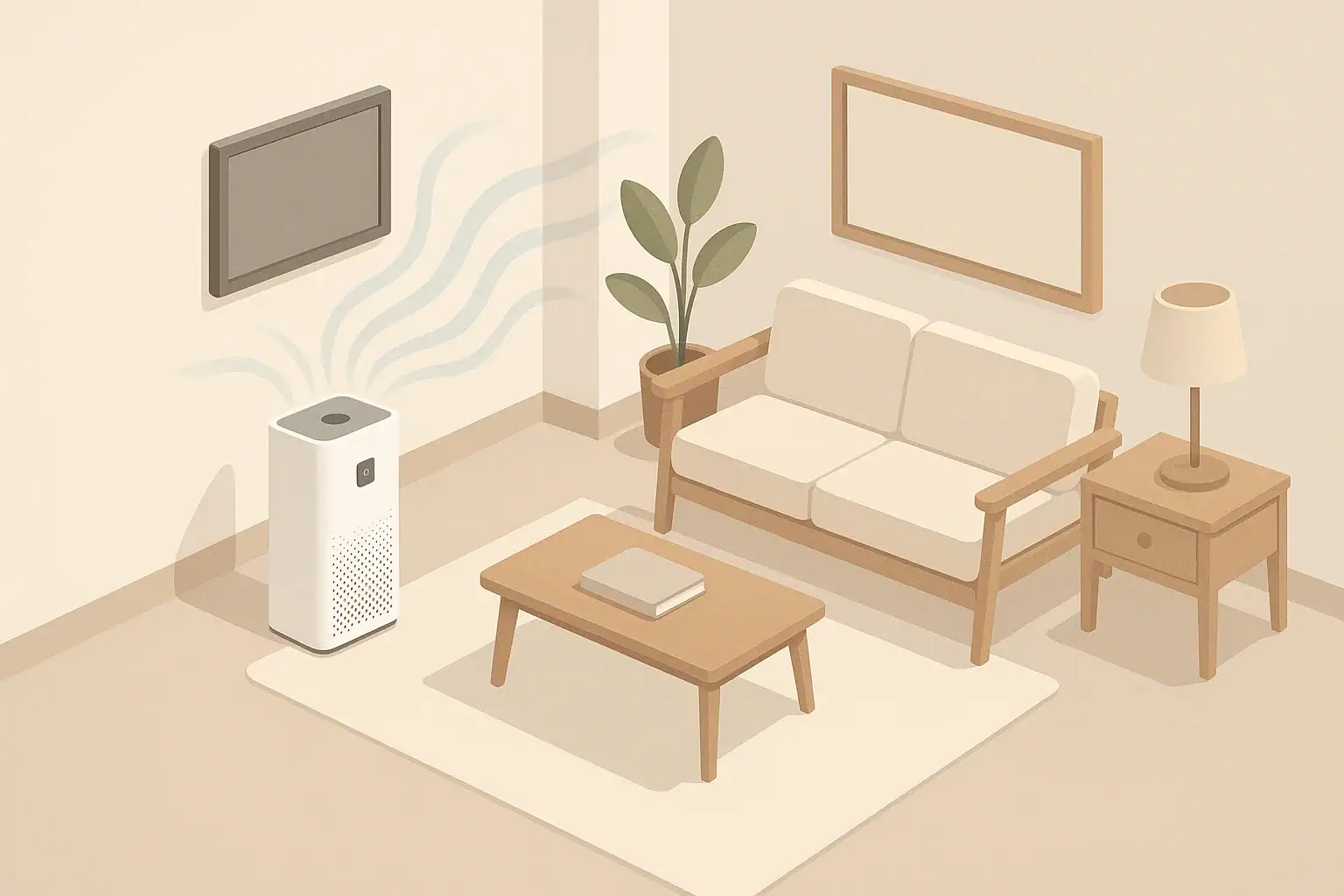
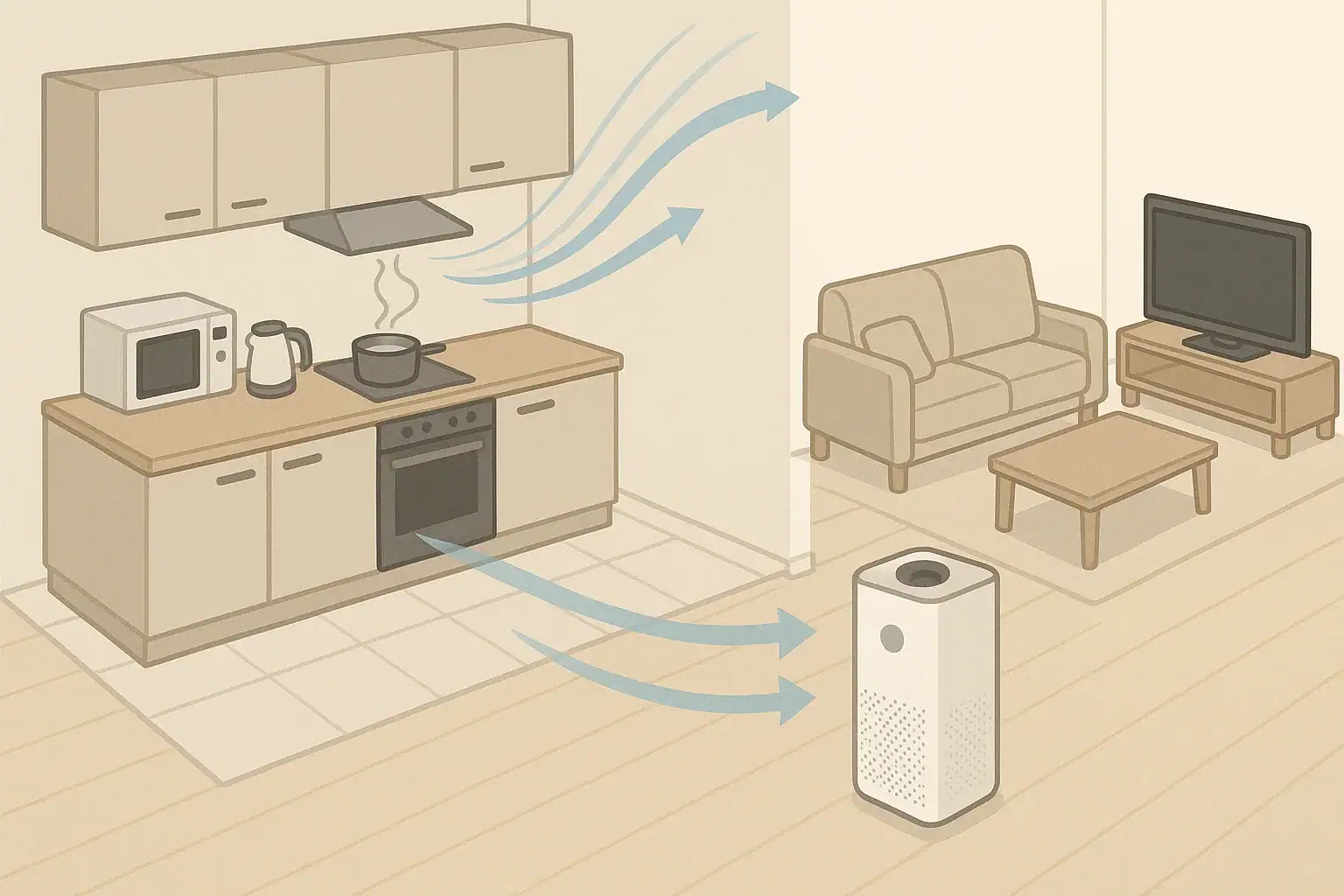
Air purifier running near an open kitchen to capture cooking smoke

Air purifiers can significantly reduce cooking smoke and airborne grease particles, but they cannot replace a good range hood or regular cleaning. Used correctly, a purifier helps clear smoky air faster, limits how far particles spread through an open-plan home, and can soften lingering food odors when it has the right filters. Used poorly, it may make little difference while clogging filters faster than expected.

This guide explains how air purifiers interact with cooking smoke, oil mist, and kitchen odors so you can decide when and how to use one. We will look at particle filtration, grease buildup, odor control, and how to size and place a purifier near the kitchen without damaging it.

Whether you cook in a small apartment, a gas range kitchen, or a large open living area, the same principles apply: control emissions at the stove first, then use a purifier to clean the rest of the room air efficiently and safely.

How Cooking Smoke and Grease Affect Indoor Air

Cooking is one of the largest sources of indoor air pollution in many homes. Frying, broiling, searing, and even toasting bread can release a mix of fine particles, ultrafine particles, grease droplets, and gases into the air. These pollutants can stay suspended for minutes to hours and travel well beyond the stove.

When you cook on high heat or for long periods, three main types of byproducts typically enter your indoor air:

  • Fine and ultrafine particles from browning, charring, and smoke when food or crumbs overheat.
  • Grease aerosols – microscopic droplets of oil and fat that ride air currents and can later deposit on cabinets, walls, and fabrics.
  • Gaseous byproducts and odors from hot oil, spices, and, with gas stoves, combustion products like nitrogen dioxide.

In open layouts, these byproducts do not stay in the kitchen. Air currents carry them into living rooms, hallways, and nearby bedrooms. In small apartments or homes without strong exhaust ventilation, you may notice:

  • Visible haze after frying or searing.
  • Persistent smell of last night’s dinner in soft furnishings.
  • Greasy film gradually building up on nearby surfaces.

Because many cooking particles are extremely small, they can bypass simple mesh filters and contribute heavily to overall indoor particle counts. This is where air purifiers can help: they do not stop emissions at the source, but they can reduce how long those particles remain in the air and how far they spread.

How Air Purifiers Handle Cooking Smoke, Grease, and Odors

Air purifiers work by pulling room air through one or more filters, then returning cleaner air to the room. For cooking emissions, performance depends on the type of filters used and how quickly the purifier can move air.

What air purifiers do well for cooking emissions

  • Capture fine particles from smoke, browning, and toasting as air passes through a high-efficiency particle filter.
  • Trap some airborne grease droplets in pre-filters and main filters before they settle on distant surfaces.
  • Reduce overall particle levels in adjacent rooms, especially in open-plan spaces where kitchen air mixes with living areas.
  • Speed up cleanup after a smoky event, such as accidentally overcooking food or burning crumbs in a toaster.

Most of this benefit comes from mechanical particle filters (often labeled as HEPA or similar). These are designed to capture very small particles efficiently when enough air is pushed through them.

Where air purifiers are limited

  • They cannot remove settled grease from cabinets, walls, or countertops. Once oil lands on a surface, it must be cleaned manually.
  • They only partially address odors and gases unless the purifier includes a dedicated gas/odor filter such as activated carbon. Even then, odor control is limited by the amount of media and how often it is replaced.
  • They do not protect you at the stove from intense smoke or fumes while you stand over a hot pan. Source control and exhaust ventilation are more important in that moment.
  • They do not remove steam or humidity from boiling water or dishwashing. That requires ventilation or dehumidification, not filtration.

Because of these limits, the best strategy is layered: use a range hood or exhaust fan to remove as much pollution as possible at the stove, then use an air purifier to clean the remaining air in the surrounding rooms.

Table 1. When an air purifier helps most vs. when ventilation matters more. Example values for illustration.
Cooking situation Main goal Most effective tool How a purifier fits in
Light sautéing or simmering Keep background air clean Basic range hood or window Runs on low to keep particles from drifting into other rooms.
Frequent pan-frying on high heat Control heavy smoke and grease Strong exhaust to outdoors Helps reduce residual smoke and grease in open-plan areas.
Small apartment with weak or no hood Limit buildup of smoke and odor Window + portable fan Placed in main room, clears particles that are not vented outside.
Burned food incident Clear visible haze quickly Open windows if possible High fan speed shortens how long the smoky smell lingers.
Lingering food smell in bedroom Reduce odor and fine particles Door closed, basic ventilation Unit with odor filter scrubs air while you sleep.

Key filter types for cooking smoke

  • Mechanical particle filters: Capture smoke particles and some ultrafine particles. Performance depends on filter efficiency, airflow, and sealing.
  • Pre-filters: Often a mesh or fabric layer that traps larger dust and some grease droplets before they hit the main filter. These usually need more frequent cleaning near kitchens.
  • Odor/gas filters: Typically activated carbon or similar media that can adsorb some cooking odors and gases. Capacity is limited and declines as the media saturates.

For cooking smoke, a purifier with both a high-efficiency particle filter and a meaningful amount of odor media will generally perform better than a particle-only unit, especially in small or poorly ventilated homes.

Real-World Examples: How to Use a Purifier Around the Kitchen

How you cook and how your home is laid out will determine where a purifier makes the most difference. These scenarios illustrate typical setups and what you can realistically expect.

Small apartment kitchen open to living room

In a studio or one-bedroom apartment where the stove is only a few steps from the sofa, cooking smoke and odors often spread quickly. In this case, common strategies include:

  • Placing a purifier in the main living area, several feet away from the stove but in the natural airflow path.
  • Running the purifier on medium or high during cooking and for 30–60 minutes afterward.
  • Using a window or bathroom fan to help remove humid, smoky air while the purifier handles remaining particles.

You may still smell food while cooking, but the air usually clears faster, and fabrics retain less odor over time.

Open-plan kitchen, dining, and family room

In larger open spaces, cooking emissions mix with the air in the entire shared area. Here, the purifier is not just a “kitchen” device; it becomes part of the overall air quality plan for the main living zone.

  • Size the purifier for the combined area, not just the kitchen footprint.
  • Place it where air circulates freely, such as near the center of the living area or along the main airflow path from kitchen to seating area.
  • Consider higher fan speeds during heavy cooking days, then lower speeds for background cleaning.

This setup is especially helpful for households that cook daily, use high-heat methods, or have sensitive family members who react to smoke.

Bedroom near the kitchen

In some homes, the kitchen shares a wall or hallway with bedrooms. Cooking smells and particles can drift into sleeping areas, especially in the evening. In this case:

  • Use a purifier in the bedroom to keep the air cleaner where you sleep.
  • Close the bedroom door during heavy cooking and run the purifier on a moderate setting.
  • After cooking, keep the purifier running for at least an hour to reduce any drifting particles or odors.

This does not stop all smells from entering, but it can noticeably reduce intensity and duration, especially when combined with closing doors and using exhaust fans.

Handling a smoky or greasy event

When something burns or oil starts to smoke heavily, the priority is to stop the smoke and ventilate quickly. A purifier is most useful immediately afterward:

  • Turn off the heat and safely remove or cover the pan.
  • Open windows and run exhaust fans if available.
  • Set the purifier to a high fan speed in the main affected room to help pull down lingering fine particles.

Expect filters to load faster after such events. If you frequently have very smoky cooking sessions, be prepared for more frequent filter maintenance.

Common Mistakes and Troubleshooting When Using Purifiers for Cooking Smoke

Even a capable air purifier can underperform if it is used or placed poorly. Recognizing common mistakes and their signs can help you adjust your setup for better results.

Common setup and usage mistakes

  • Placing the purifier right next to the stove, where it is exposed to hot steam and splattering grease, which can clog filters and stress the motor.
  • Undersizing the purifier for a large open-plan area, so it never cycles enough air to noticeably reduce particle levels.
  • Relying on a purifier alone while never using the range hood or opening windows, especially during high-heat cooking.
  • Running on the lowest fan speed only during heavy cooking, which may be too gentle to keep up with emissions.
  • Ignoring filter changes so long that airflow drops and odor filters become saturated and ineffective.

Troubleshooting cues: what the symptoms often mean

Table 2. Troubleshooting purifier performance near kitchens. Example values for illustration.
Symptom Likely cause Practical fix
Room still looks hazy 30–60 minutes after cooking Airflow too low or purifier too small for the space Increase fan speed, move unit to a more central location, or use a higher-capacity purifier.
Strong food smells linger for many hours No odor filter or saturated odor media Add or replace odor/gas filter and use ventilation during and after cooking.
Purifier sounds louder and moves less air over time Filters clogged with dust, smoke, and grease Clean pre-filter and replace main filter according to use, not just calendar time.
Visible grease film forms on purifier housing Unit placed too close to stove or in direct splatter path Move it several feet away and wipe housing regularly with a damp cloth.
Bedroom still smells like dinner the next morning Door left open, weak airflow through purifier, or low run time Close door during cooking, run purifier longer on moderate speed, and check filter condition.

Simple performance checks

You do not need specialized instruments to get a basic sense of whether your purifier is helping with cooking smoke:

  • Visual check: After a smoky cooking session, note how long it takes for any visible haze to clear with the purifier on high versus off.
  • Odor check: Pay attention to how long strong cooking smells persist in adjacent rooms when you use the purifier consistently.
  • Filter inspection: If the pre-filter or main filter near the kitchen darkens noticeably faster than in other rooms, it is likely capturing cooking-related pollution.

If you do use a consumer air quality monitor, you will often see a sharp rise in particle readings during cooking and a faster decline when a properly sized purifier runs on a higher setting.

Safety Basics When Running Air Purifiers Near Kitchens

Most home air purifiers are safe to use around kitchens when placed and operated sensibly. However, cooking areas introduce heat, moisture, and grease that require a bit of extra caution.

Placement and electrical safety

  • Keep the purifier away from direct heat such as burners, oven vents, or hot cookware. Excessive heat can warp plastics and damage internal components.
  • Avoid active splatter zones where oil could spray directly onto the intake or outlet.
  • Route power cords carefully so they do not cross main walkways or create a trip hazard in a busy kitchen.
  • Do not block vents on the purifier with cabinets, curtains, or furniture, which can overheat the motor or reduce performance.

Features that may affect indoor air

Some purifiers include optional features such as ionizers, plasma generators, or UV-C lamps. These are intended to supplement filtration but may also introduce byproducts or change how the unit behaves.

  • If you are primarily concerned about cooking smoke and grease, mechanical filtration alone is usually sufficient.
  • Review the manual to understand how to enable or disable optional features if you prefer a simpler filtration-only mode.
  • Follow all manufacturer safety instructions regarding filter replacement, cleaning, and safe distances from heat sources.

Fire and emergency considerations

  • In the event of a kitchen fire or heavy flare-up, focus first on safety, evacuation, and calling emergency services. The purifier is not a fire-control device.
  • After any significant smoke event, inspect the purifier housing and cord for heat damage before continued use.

Used with these precautions, an air purifier can operate safely for years in kitchen-adjacent spaces while helping to manage everyday cooking emissions.

Maintenance and Long-Term Use Near Kitchens

Cooking environments are harsher on air purifiers than bedrooms or home offices. Grease, fine smoke, and higher particle loads mean filters and housings need more attention.

Filter cleaning and replacement

  • Pre-filters: Often washable or vacuumable. Near kitchens, they may darken or feel slightly tacky more quickly. Cleaning them regularly helps protect the main filter.
  • Main particle filters: These load faster when used near cooking. Expect replacement intervals to be shorter than the maximum time suggested for low-use rooms.
  • Odor/gas filters: These have a finite capacity. If cooking smells start to linger again despite good ventilation, it may be a sign that the odor filter is saturated.

If your purifier includes a filter-change indicator, treat it as a starting point, not an absolute rule. Heavy frying, frequent high-heat cooking, or repeated smoky events may require earlier changes.

Cleaning the purifier housing

Over time, a thin film of grease and dust can build up on the exterior surfaces of a purifier placed near a kitchen. To keep it operating well:

  • Wipe the housing periodically with a soft cloth lightly dampened with water and a mild detergent if needed.
  • Avoid spraying cleaners directly into the intake or outlet.
  • Check vents and grills for visible dust buildup and gently remove it according to the manual.

Seasonal and long-term operation

Many households use different purifier schedules across the year:

  • Daily cooking households: Run the purifier on a low or medium setting most of the day, with higher speeds during and after cooking.
  • Occasional heavy cooking: Keep the purifier in the main living area and use higher speeds on cooking days, then lower speeds or off on lighter days.
  • Vacation or extended time away: Turn the purifier off and store it in a dry, cool place. Check filters for age and condition before restarting after a long break.

Whatever pattern you choose, monitor performance over time. If you notice declining airflow, more noise, or reduced odor control, it is likely time to inspect and service the filters.

Practical Takeaways and Specs to Look For

For cooking smoke and grease, an air purifier is most effective when it is properly sized, placed thoughtfully, and paired with good kitchen ventilation. It will not erase all cooking smells or replace a vented range hood, but it can meaningfully reduce airborne particles and help your home feel fresher after meals.

When you are comparing air purifiers for use near a kitchen or in an open-plan living area, use this checklist to guide your decision.

Specs to look for in an air purifier for cooking smoke

  • Room size rating that matches the combined kitchen and living area, not just the footprint of the stove zone.
  • High-efficiency particle filter (often labeled as HEPA or similar) to capture fine smoke particles and some ultrafine particles.
  • Meaningful smoke-oriented performance rating (such as a smoke-focused clean air delivery rating) to indicate how quickly it can reduce fine particles.
  • Dedicated odor/gas filter with a reasonable amount of media if you want help with cooking smells in addition to smoke.
  • Removable or washable pre-filter to catch larger particles and some grease before they reach the main filter.
  • Multiple fan speeds, including a high setting for smoky events and a quiet setting for background use.
  • Clear filter-change indicators or easy access for visual inspection, so you can adjust replacement timing based on your cooking habits.
  • Compact footprint and stable design that fits safely in your intended location without blocking walkways.

Once you have a suitable purifier, focus on how you use it: run your range hood or exhaust fan during cooking, place the purifier several feet away from the stove along the airflow path, and use higher speeds during and after meals. Combined, these steps can noticeably improve indoor air quality in homes where cooking is a daily activity.

Frequently asked questions

What specifications and features should I prioritize when buying a purifier for kitchen smoke?

Prioritize a high-efficiency particle filter plus sufficient airflow for the combined kitchen and living area, a washable pre-filter, and a meaningful amount of activated carbon or other odor media for smells. Multiple fan speeds and a clear room-size or CADR rating for smoke performance are also useful so you can run higher speeds during cooking and quieter modes afterward.

Can placing a purifier too close to the stove reduce its effectiveness?

Yes. Placing a unit right next to the stove exposes it to heat, steam, and splattering oil that can clog filters and stress the fan, reducing long-term performance. Position the purifier several feet away in the natural airflow path instead of directly in the splatter zone.

Are air purifiers safe to run near a stove or oven?

Most are safe when kept away from direct heat and active splatter zones, with cords routed safely and vents unobstructed. After any major smoke event or heat exposure, inspect the housing and cord for damage before continued use.

How long should I run a purifier after cooking to clear smoke and odors?

Run the purifier on a high setting during cooking and for at least 30–60 minutes afterward for typical smoky events; run times should be longer for heavy smoke or large open spaces. Combining purification with ventilation (windows or exhaust fans) speeds clearing and reduces strain on filters.

Will an air purifier remove greasy residue from kitchen surfaces?

No—air purifiers can reduce airborne grease droplets before they settle, but they cannot remove grease that has already deposited on cabinets or countertops. Surface grease must be cleaned manually with appropriate cleaners.

How often will filters need replacing if I cook daily?

Filter life depends on cooking frequency and methods: heavy frying and frequent smoky events shorten intervals. Clean pre-filters often, watch for visible darkening or reduced airflow, and use any change indicators as a guide to replace main and odor filters sooner than the maximum interval recommended for low-use rooms.

Air Purifier Placement Mistakes: Corners, Walls, and Blocked Airflow (And How to Fix Them)

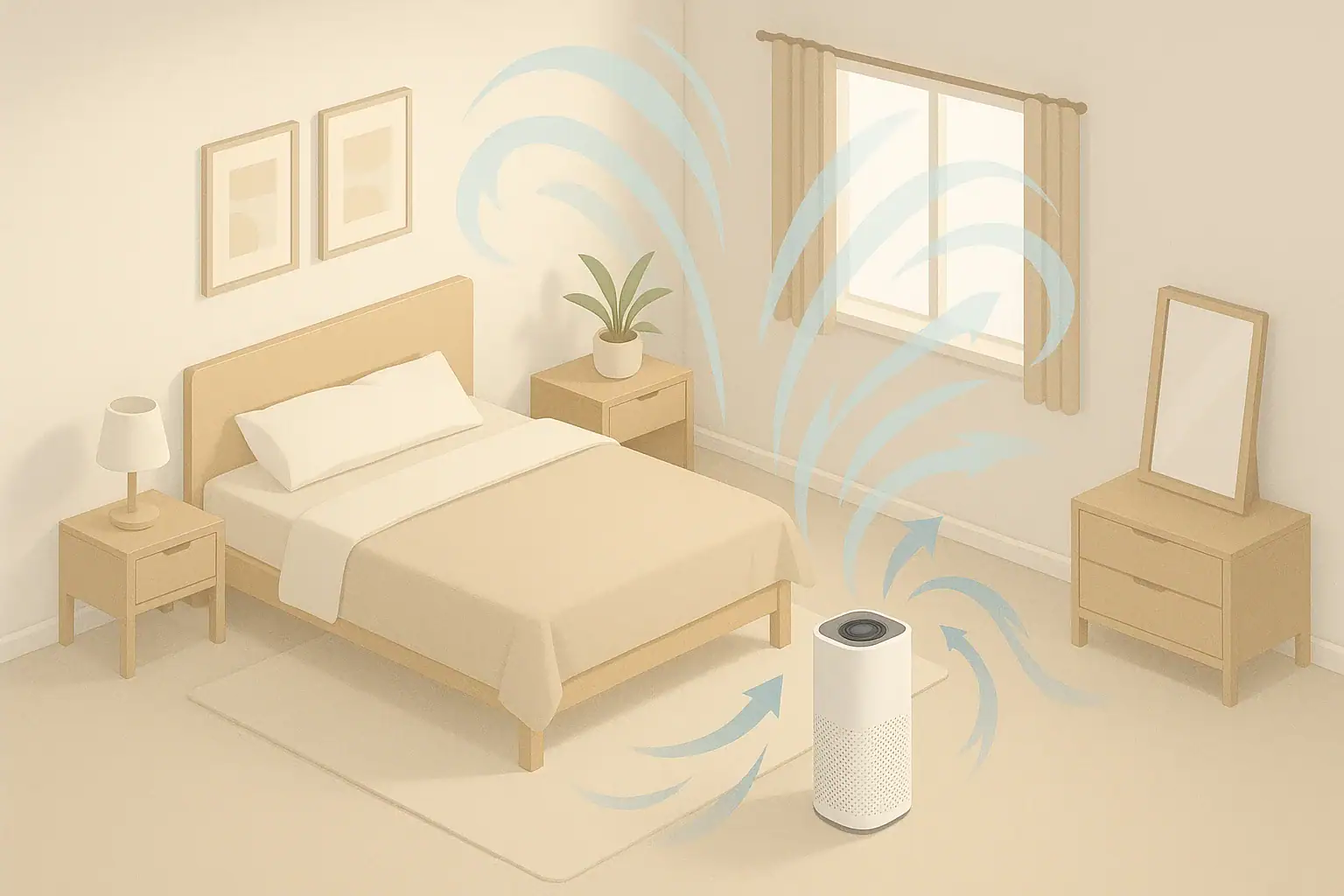
Bedroom scene showing proper placement of a home air purifier

The biggest air purifier placement mistake is putting the unit where air cannot move freely around it, such as tight corners, against walls, or hidden behind furniture. When intake or outlet vents are blocked, the purifier mostly recycles the same small pocket of air instead of cleaning the whole room.

Good placement is just as important as filter quality or Clean Air Delivery Rate. Simple changes like pulling the purifier away from walls, aiming the outlet toward the part of the room you use most, and keeping clutter away from vents can noticeably improve real-world performance.

This guide explains how air purifiers interact with room airflow, shows practical examples of good and bad locations, and walks through common problems, safety basics, and long-term habits. The goal is to help your purifier work closer to its rated capacity without special tools, renovations, or guesswork.

Why Placement Matters for Real-World Air Cleaning

On paper, many air purifiers look powerful: high CADR numbers, multiple filters, and strong fans. In practice, those benefits only show up if the unit can pull in dirty air from the room and push clean air back out into the breathing zone. Placement is what connects the machine’s capabilities to the space you live in.

Most portable air purifiers work on a simple loop:

  • Air is drawn in through intake grilles.
  • Air passes through one or more filters.
  • Clean air is discharged through an outlet, usually on the top, front, or side.

When that loop is squeezed into a corner, pressed against a wall, or buried in clutter, the purifier ends up re-cleaning the same air over and over. The rest of the room, especially the center and occupied areas, may see only slow improvements in dust, pollen, smoke, or odors.

Good placement helps you:

  • Reach your target air changes per hour (ACH) more reliably.
  • Get better coverage in the areas where you actually sit, sleep, and work.
  • Run the purifier on lower, quieter speeds because airflow is less restricted.

In short, you can think of placement as “free performance.” You already paid for the purifier; positioning it well lets you use more of the cleaning power you bought.

Key Airflow Concepts: How Purifiers Interact With Rooms

Placement mistakes are easier to spot if you understand basic airflow behavior in rooms, which lets you steer clear of common blocking and recirculation problems.

Intake, Outlet, and Clearance

Every purifier has at least one intake and one outlet. Some pull air from a single side, others from multiple sides, and many use a 360-degree intake around the body. Regardless of design, all of them need clear space around these areas.

  • Intake clearance: Enough open space so room air can flow toward the unit without squeezing through a narrow gap.
  • Outlet clearance: Enough open space so clean air can spread into the room before looping back to the intake.
  • Side and top clearance: Avoiding shelves, curtains, or tabletops that cap or block the outlet.

A practical rule of thumb is to imagine a small “air bubble” around the purifier that you keep free of large objects on all sides.

Room Zones and Mixing

Rooms are not perfectly mixed boxes. Air tends to form zones:

  • Busy zones: Where people move, doors open, and fans run. Air changes faster here.
  • Quiet zones: Corners, behind large furniture, and along some walls. Air can sit longer and collect particles.

Placing a purifier in a quiet, blocked zone often means it mostly cleans that zone. Placing it where clean air can sweep through the main occupied area improves the air you actually breathe.

Height and Breathing Zone

The “breathing zone” is the height where you inhale most of your air: roughly from a seated person’s chest to head level, or around pillow height when lying down. While floor placement is common and often fine, raising a purifier 1–3 feet can help move more clean air through this breathing zone in bedrooms and home offices.

Typical Placement Options and Tradeoffs
Placement option Main benefit Common drawback Best use case
Floor, near center-side wall Good whole-room mixing, easy power access Can be in walking path if not planned General living rooms and medium bedrooms
Floor, pulled out from corner Improves coverage vs tight corner placement Still less ideal than mid-room locations Small rooms where outlets are in corners
Low table or sturdy shelf (1–3 ft high) Targets breathing zone more directly Needs stable surface to avoid tipping Bedrooms and home offices
Near HVAC supply (not directly in front) Uses existing circulation to spread clean air Too close can disrupt vent airflow Large or open-plan spaces
Near door inside enclosed room Helps clean air entering or leaving room Door drafts can cause uneven mixing Bedrooms with closed doors at night

Example values for illustration.

Real-World Examples of Good and Bad Locations

Seeing typical room layouts makes it easier to recognize air purifier placement mistakes in your own home. The examples below use common U.S. room sizes and furniture arrangements.

Small Bedroom Example

Imagine a 120-square-foot bedroom with a bed against one wall, a nightstand, and a dresser.

  • Poor placement: Purifier jammed between the dresser and wall in a back corner, with the intake only a few inches from both surfaces.
  • Better placement: Purifier on the floor or a low stand near the side of the bed, pulled 12–18 inches from the wall, outlet aimed toward the center of the room.

In the better placement, air can move around the bed and across the room, so the air near your pillow is refreshed more consistently.

Living Room With Sectional Sofa

Consider a 300-square-foot living room with a sectional sofa, coffee table, TV stand, and a rug.

  • Poor placement: Purifier hidden completely behind the sectional, with the outlet blowing into the back of the couch.
  • Better placement: Purifier beside the sofa’s end, with a clear path from the outlet toward the main seating area and at least several inches of clearance on all sides.

This small shift moves the purifier from a dead zone to a position where clean air can flow around people sitting on the couch.

Home Office With Desk and Shelving

In a compact home office, it is tempting to slide the purifier under the desk to keep it out of sight.

  • Poor placement: Purifier under the desk surrounded by storage boxes and tangled cords, with the intake facing the wall.
  • Better placement: Purifier to the side of the desk, intake facing open space, outlet directed toward your chair and monitor area.

With the better placement, the purifier treats air where you sit instead of mainly cleaning the space under the desk.

Open-Plan Living and Kitchen Area

Open-plan spaces often exceed the ideal coverage area of a single purifier, so placement should focus on the zone you care about most.

  • Poor placement: Purifier in a far kitchen corner behind a trash can and stool, far from where people sit.
  • Better placement: Purifier near the boundary of the living area and kitchen, with the outlet aimed toward the seating zone and enough space to avoid bumping into it.

Here, you accept that the purifier will not fully control the entire open-plan area, but you help it focus on the part of the room where you spend the most time.

Common Layout Issues and Simple Fixes
Room type Typical bad placement Why it underperforms Practical adjustment
Bedroom Behind tall dresser in corner Air recirculates in small pocket behind furniture Move beside bed with outlet aimed toward center of room
Living room Buried behind TV stand and speakers Blocked intake, clean air trapped behind electronics Place next to TV stand with at least 12 in of open space
Home office Under desk between storage bins Restricted airflow, uneven cleaning at breathing height Place to side of desk, slightly raised if possible
Kids’ room In toy corner surrounded by bins Clutter blocks vents and collects dust Create a clear “no toys” zone around the purifier
Pet area Right next to litter box or pet bed Hair and dust overload pre-filters quickly Keep nearby but offset by several feet with clear airflow

Example values for illustration.

Common Placement Mistakes and Simple Troubleshooting

Even when a purifier is technically in the “right” room, small details can keep it from working well. The issues below are among the most frequent air purifier placement mistakes and include quick ways to spot and fix them.

Mistake 1: Tight Corners and Flush Walls

What it looks like: The unit is pressed directly into a corner or flush against a wall, especially if the intake is on the back or sides.

Why it is a problem: Airflow is squeezed into a narrow wedge, and the purifier mostly pulls in air it has just cleaned.

How to troubleshoot:

  • Pull the purifier 6–18 inches away from each wall, if space allows.
  • Rotate the unit so the intake faces the open part of the room.
  • Stand a few feet away and feel for a noticeable stream of air in the room’s center.

Mistake 2: Obstructed by Furniture, Curtains, or Clutter

What it looks like: The purifier is behind a couch, under a table, or directly behind long curtains that move when the fan runs.

Why it is a problem: Large surfaces act as barriers, and soft fabrics can be pulled into grilles, increasing noise and reducing airflow.

How to troubleshoot:

  • Clear at least a small ring around the purifier where you do not store boxes, laundry, or toys.
  • Check that curtains do not touch the intake or outlet when the fan is on high.
  • Listen for whistling or rattling sounds that may indicate turbulence from obstructions.

Mistake 3: Wrong Height for How You Use the Room

What it looks like: The purifier is on the floor in a room where people mostly stand or sit at a high counter, or it is on a tall, wobbly shelf.

Why it is a problem: Clean air may stay low or high instead of passing through the breathing zone, and unstable surfaces add tip-over risk.

How to troubleshoot:

  • In bedrooms and offices, consider a low, sturdy table or stand about 1–3 feet high.
  • Avoid very tall, narrow shelves that can shake or vibrate.
  • Check that all vents are still fully exposed after raising the unit.

Mistake 4: Fighting With Fans, Vents, or Open Windows

What it looks like: The purifier sits directly in front of a supply vent, under a strong ceiling fan, or right next to an open window.

Why it is a problem: Strong air streams can blow clean air away from the room or send unfiltered air past the intake.

How to troubleshoot:

  • Move the purifier slightly to the side of vents rather than directly in front.
  • Use gentle fan settings that mix air without overpowering the purifier’s outlet.
  • Expect reduced relative impact while windows are wide open; use the purifier more when windows are closed.

Mistake 5: Ignoring Room Size Limits

What it looks like: A small purifier is expected to clean a large open-plan space or multiple rooms at once, even with good placement.

Why it is a problem: The fan and filters cannot move enough air volume to achieve meaningful ACH across the entire area.

How to troubleshoot:

  • Focus the purifier on a single main room or zone instead of the entire floor.
  • Close doors when practical to keep the treated volume manageable.
  • Consider adding a second unit in distant areas if needed.

Safety Basics for Air Purifier Placement

Good placement is not only about performance; it also affects safety and day-to-day comfort. Keeping a few safety principles in mind helps prevent avoidable issues.

Tip-Over and Tripping Hazards

Purifiers are often tall enough to be knocked over but heavy enough to cause minor injury or damage if they fall.

  • Place the unit on a flat, stable surface that does not rock or flex.
  • Avoid narrow walkways or doorways where people or pets regularly pass.
  • Route power cords along walls, under cord covers, or behind furniture to reduce tripping.

Heat Sources and Electrical Safety

Although most purifiers run relatively cool, they still use electricity and move air through motors.

  • Keep the unit away from open flames, heaters, and stove areas.
  • Do not cover the purifier with blankets, clothing, or other fabrics.
  • Avoid plugging the purifier into overloaded power strips or daisy-chained extension cords.

Children, Pets, and Sensitive Occupants

In homes with children or pets, placement needs to balance performance with access control.

  • Avoid locations where children can easily climb on or pull the unit over.
  • Keep the purifier a short distance from pet beds and litter areas to reduce fur buildup on grilles.
  • In nurseries or bedrooms for sensitive occupants, choose a spot that keeps noise acceptable while still allowing clear airflow.

Vent Clearance and Overheating Risk

Blocked vents can cause the motor to work harder and, in extreme cases, overheat.

  • Regularly check that dust, pet hair, or fabric has not built up against the intake.
  • Do not push the purifier into enclosed cabinets or tight cubbies.
  • If the housing feels unusually hot or airflow drops sharply, turn the unit off and inspect for blockages.

Long-Term Use, Maintenance, and Storage Habits

Even with good placement, long-term performance depends on how you run, maintain, and store your air purifier. Maintenance and placement work together: poor airflow can load filters faster, and neglected filters can reduce the benefit of careful positioning.

Daily and Weekly Habits

Small, regular checks help keep the purifier working close to its rated capacity.

  • Run the purifier consistently on an appropriate speed for the room size and pollution level.
  • Glance at the area around the unit once or twice a week to make sure clutter has not crept into the “no storage” zone.
  • Dust or vacuum around the purifier to reduce the amount of loose debris reaching the intake.

Filter Checks and Placement Clues

Filter condition can reveal whether your current placement is overloading the purifier or missing problem areas.

  • If pre-filters clog extremely fast, the unit may be too close to a concentrated source like a litter box, cooking area, or heavy traffic zone.
  • If filters stay unusually clean despite high dust elsewhere in the room, the purifier may be working mostly in a low-traffic corner.
  • Use filter inspections to decide whether to shift the unit closer to where pollutants are generated or where people spend time.

Seasonal Adjustments

Room layouts often change with seasons, and placement should adjust with them.

  • When adding fans in summer, recheck that the purifier is not directly under a strong downdraft.
  • When rearranging furniture for holidays, verify the purifier is not suddenly blocked by a new piece.
  • During wildfire season or heavy pollen times, consider moving the purifier closer to bedrooms or main living areas you use most.

Short-Term Storage

If you store the purifier for a time, how you do it affects performance when you bring it back into service.

  • Clean the exterior and pre-filter before storage so dust does not cake onto surfaces.
  • Store the unit in a dry, indoor area away from moisture and extreme temperatures.
  • When you bring it back out, inspect for dust, insects, or damage before choosing a new placement.

Practical Takeaways and Specs to Look For

Good placement does not have to be complicated. A few repeatable habits can prevent most air purifier placement mistakes and help any model perform closer to its design limits.

  • Keep intake and outlet areas clear of walls, furniture, and fabrics.
  • Place the purifier in the same zone where you spend the most time, not just near the nearest outlet.
  • Adjust height and orientation so clean air flows through the breathing zone.
  • Watch for signs of poor placement, such as uneven dust buildup, strong noise changes, or very fast filter clogging.

Specs to Look For When Planning Placement

When you read product information or consider adding another purifier, certain specifications and features can make placement easier and more forgiving.

  • CADR ratings by pollutant type: Look for clearly stated CADR values for smoke, dust, and pollen so you can match the unit to your room size and pollution concerns.
  • Recommended room size: Use the suggested coverage as a starting point, then place the unit in a single room or zone within that limit.
  • Intake and outlet design: Note whether the unit pulls air from one side, multiple sides, or all around; this tells you which directions need the most clearance.
  • Height and footprint: A stable base and moderate height make it easier to place the purifier near furniture without tipping.
  • Noise levels at different speeds: Quieter operation at medium settings gives you more flexibility to place the unit closer to beds or desks.
  • Cord length and controls: A longer cord and accessible controls reduce the temptation to use unsafe extension setups or awkward, blocked locations.
  • Filter access: Easy-to-reach filter doors encourage regular maintenance, which supports long-term performance in whatever spot you choose.

Combining these specs with thoughtful placement, clear airflow paths, and regular filter care will help your air purifier clean more of the room’s air, more consistently, over the long term.

Frequently asked questions

Which specifications and features should I check to make placement easier?

Look at CADR ratings and the manufacturer’s recommended room size to confirm the unit can handle the volume you want to treat. Also note intake/outlet design, noise levels at usable fan speeds, cord length, and how easy it is to access filters for maintenance—those details affect where you can safely and effectively place the unit.

Why is placing an air purifier in a corner a common mistake?

Corners and flush walls restrict airflow so the purifier tends to recirculate the same small pocket of air instead of cleaning the whole room. Pulling the unit several inches into open space and orienting the intake toward the room lets it mix air more effectively.

Are there safety concerns I should consider when positioning a purifier?

Yes—improper placement can increase tip-over or tripping risk, expose the unit to heat sources, or block vents and cause overheating. Choose a flat, stable surface, keep cords tidy, avoid covering vents, and keep the unit away from open flames and heaters.

How high should I place an air purifier for the best effect on breathing air?

For bedrooms and home offices, placing the purifier on a low table or stand about 1–3 feet high often moves more clean air through the breathing zone. Floor placement can be fine in larger rooms, but ensure intakes and outlets remain unobstructed.

Can one purifier clean an open-plan living area effectively?

Many single units are undersized for large open-plan spaces; they may improve the zone where they’re placed but won’t deliver the same ACH across the whole area. Focus the purifier on the area you use most, close doors when possible, or add another unit for distant zones.

What signs indicate my current placement is underperforming?

Watch for uneven dust buildup, filters that clog unusually fast, noticeably reduced airflow in the room center, or odd noise changes when the fan runs. These clues suggest restricted intake/outlet paths or that the unit is working mostly in a low-traffic pocket.

How Long Should You Run an Air Purifier Each Day? Schedules That Actually Work

Isometric bedroom with running air purifier and gentle airflow

Most homes get the best results by running an air purifier 8–16 hours per day in main rooms, and up to 24/7 during allergy or smoke seasons. The exact schedule depends on room size, purifier capacity, and how much dust, pollen, smoke, or pet dander you are dealing with.

Instead of guessing how long to run an air cleaner, you can build a simple routine that fits your rooms and daily habits. That means using lower speeds for long stretches, boosting power during cooking or cleaning, and focusing on the spaces where you actually spend time.

This guide walks through how air purifiers work over time, how to set realistic daily schedules, what to avoid, and how to keep things safe and efficient. By the end, you will have a practical plan for run time, noise, energy use, and filter care that you can adjust season to season.

Why Daily Air Purifier Run Time Matters

Run time is what turns a good air purifier into consistently cleaner indoor air. The device only improves air quality when it is actually moving air through its filters, so the number of hours per day is just as important as the type of filter you buy.

Daily run time affects three main things:

  • How clean the air stays: Longer, steady operation keeps dust, pet dander, pollen, and smoke particles from building back up.
  • Comfort and noise: The more hours you run it, the more you may need to rely on lower fan speeds and smart placement to keep sound acceptable.
  • Cost and filter wear: More hours mean more electricity use and faster filter loading, especially during dusty or smoky periods.

There is no single perfect number of hours that fits every home. A small bedroom with a right-sized unit might only need 8–10 hours per day, while a large open-plan living space or a home near busy roads may benefit from near-continuous use.

Thinking about run time as a daily “air hygiene” habit, rather than an occasional cleanup, is the key mindset shift. The goal is not to blast the room once, but to quietly keep particle levels low throughout the day and night.

How Air Purifiers Work Over Time: CADR, ACH, and Room Size

To decide how long to run an air purifier, it helps to understand how quickly it can clean a given room. Two ideas are especially useful: CADR and ACH.

  • CADR (Clean Air Delivery Rate) is the volume of filtered air the purifier delivers each minute. It is usually given in cubic feet per minute (CFM) for smoke, dust, or pollen.
  • ACH (Air Changes per Hour) is how many times per hour the purifier can theoretically move a room’s entire air volume through its filters.

In simple terms, higher CADR in a smaller room gives you higher ACH, which means the purifier can pull particle levels down faster and keep them low with fewer hours or lower fan speeds.

You can estimate ACH with a basic calculation:

  1. Measure room size (length × width × height) to get room volume.
  2. Look up the purifier’s CADR in CFM.
  3. Use this formula: ACH ≈ (CADR × 60) ÷ room volume.
Example ACH and run time planning for typical rooms. Example values for illustration.
Room type Approx. size (sq ft) Example CADR (CFM) Approx. ACH Suggested daily run pattern
Small bedroom 120 120 ~6 ACH 1–2 hours pre-bed on medium, then 7–9 hours overnight on low
Medium living room 250 200 ~4–5 ACH Low all day when occupied, medium during cooking or cleaning
Large open-plan area 450 250 ~3 ACH Near-continuous low to medium; consider extra unit or zoning
Home office 100 100 ~5–6 ACH Low to medium during work hours, short high-speed boosts as needed
Nursery or child’s room 110 120 ~6 ACH Continuous low when occupied, especially during naps and night

These example values show that a well-sized purifier can reach several air changes per hour in a bedroom but may struggle to keep up in a large combined space. In that larger room, you either need more hours, higher speeds, or more than one unit.

Because indoor sources (people, pets, textiles, cooking, and outdoor air leakage) steadily add new particles, air cleaning is not a one-time event. Even after an initial “cleanup” period, the purifier must run often enough to keep up with what is constantly entering the air.

Real-World Daily Schedules and Special Situations

There is a wide range of reasonable schedules, but most households end up in one of three patterns:

  • Continuous low-speed operation in key rooms.
  • Long daily blocks (for example, daytime plus overnight) with targeted boosts.
  • Event-based use focused on cooking, cleaning, and high-pollen or smoke days.

Bedroom schedule

Because you spend several uninterrupted hours in the bedroom, it is often the top priority.

  • Evening pre-clean: 1–2 hours on medium with the door mostly closed to pull particle levels down before sleep.
  • Overnight: 7–9 hours on low or sleep mode to maintain cleaner air with minimal noise.
  • Daytime: If the room is unused and the door is closed, you can reduce speed or turn it off. If the door stays open to a hallway or living space, keep it on low to avoid recontamination.

Result: roughly 8–12 hours of run time per day focused on when you are in the room.

Living room or open-plan area schedule

Main living spaces usually have more activity, soft furnishings, and traffic from outdoors.

  • Occupied daytime: Low to medium whenever people are using the space, often 6–12 hours.
  • Cooking periods: Medium to high 30–60 minutes before, during, and after cooking to help with grease, smoke, and odors.
  • Evening relaxation: Low or a quiet setting while watching TV or reading.
  • Empty home: Off or very low if the home is unoccupied for long stretches and outdoor air is generally clean.

Result: 8–16 hours per day, with higher speeds tied to known pollution spikes.

Home office schedule

For a home office used during workdays:

  • Work hours: Low to medium whenever you are in the room.
  • Short boost: 20–30 minutes on high if the room has been closed up or you notice visible dust in sunbeams.
  • Off hours: Low or off when the room is empty, unless it shares a lot of air with the rest of the home.

Result: 6–9 hours per weekday, with more flexible use on weekends.

High-pollution or special cases

Some situations temporarily increase the need for both run time and fan speed:

  • Wildfire smoke or heavy outdoor pollution: Often 24/7 use in bedrooms and main living areas, with higher speeds during the day and lower at night.
  • Indoor projects that create dust: Run on high during sanding, drilling, or sweeping, and keep it on medium to high for several hours afterward.
  • Deep cleaning days: Medium to high during vacuuming, bed changing, and dusting, then low for several hours to capture stirred-up particles.

In these cases, it is usually better to err on the side of more hours and stronger airflow until conditions improve.

Common Run-Time Mistakes and How to Fix Them

Even with a good purifier, a few common habits can quietly undo your efforts. Recognizing these patterns helps you decide not just how long to run the unit, but how to run it more intelligently.

Frequent run-time and setup mistakes and better alternatives. Example values for illustration.
Common mistake What you might notice Simple fix
Running on high for 1 hour, then off all day Air feels fresher right after, but dust and odors return quickly Use low or medium for many hours instead of short blasts on max
Placing unit in a corner or behind furniture Clean air seems localized; far side of room stays dusty Move purifier to a more central spot with several inches of clearance
Using a small purifier in a large open-plan space Little change in allergy or smoke symptoms despite long run times Reserve that unit for a smaller room or add another purifier for the larger area
Ignoring clogged filters Fan sounds louder, but airflow feels weak at the outlet Clean pre-filters regularly and replace main filters on schedule
Relying only on auto mode in a very dusty or smoky home Sensor rarely triggers high speed, yet surfaces collect dust quickly Set a constant low or medium baseline, then let auto handle spikes
Turning purifier off at night due to noise Morning congestion or allergy symptoms despite daytime use Switch to sleep mode, move unit farther from the bed, or lower speed instead of shutting it off

Quick troubleshooting cues

Use these simple checks to decide whether your current schedule is working:

  • Visual dust check: If you still see dust floating in sunlight beams after several hours of operation, you may need more ACH (higher speed or a larger unit) or more hours.
  • Surface dust buildup: If surfaces get dusty within a day or two, consider running the purifier longer in the rooms you use most.
  • Odor persistence: If cooking or pet odors linger even after long run times, check carbon or odor filters and increase run time around odor events.
  • Symptom tracking: Note allergy or asthma symptoms morning and evening. If they improve on days you run the purifier longer, that is a sign your baseline schedule was too short.

Adjust your daily hours in small steps, such as adding 2–4 hours per day in a key room for a week, then reassessing comfort, noise, and results.

Safety Basics When Running an Air Purifier for Many Hours

Most modern air purifiers are designed for long, continuous operation, but it is still important to use them safely when they run for many hours each day.

Electrical and placement safety

  • Use a proper outlet: Plug the purifier directly into a wall outlet, not a damaged extension cord or overloaded power strip.
  • Keep vents clear: Do not drape curtains, bedding, or clothing over the unit. Blocked intakes or outlets can overheat components and reduce performance.
  • Stable surface: Place on a flat, stable floor or platform where it will not be knocked over by children or pets.
  • Away from moisture: Avoid placing it in very damp areas or directly next to humidifiers where mist can saturate filters.

Filter and air quality safety

  • Replace filters on time: Severely overloaded filters can restrict airflow and may stress the fan motor.
  • Avoid covering air inlets: Stacking items on top of a purifier with top exhaust can trap heat and reduce air circulation.
  • Be cautious with ozone-producing technologies: If your unit has a setting that intentionally produces ozone or “ionization” modes, use them only according to the manual and disable them if you are sensitive.

Run-time safety with children, pets, and sleep

  • Child and pet access: Position units so that cords are not tripping hazards and controls are not easily tampered with.
  • Night use: For overnight operation, confirm that noise levels and airflow do not cause discomfort or dry throat. Adjust speed or distance from the bed if needed.
  • Ventilation balance: Purifiers do not add fresh oxygen. If you are sealing a room tightly for smoke control, periodically ventilate when outdoor conditions allow.

Used correctly, running an air purifier many hours per day is generally safe and is often recommended during high-pollution periods or for sensitive individuals.

Filter Life, Maintenance, and Long-Term Use

The more hours per day you run your air purifier, the more important routine maintenance becomes. A clogged or saturated filter can quietly undo the benefits of long run times.

How run time affects different filters

  • Pre-filters: Mesh or foam layers catch hair and larger dust. They load quickly in homes with pets and should be cleaned or replaced regularly to protect the main filter.
  • HEPA or high-efficiency particle filters: These capture fine particles like pollen, smoke, and fine dust. Heavy daily use or smoke exposure shortens their effective life.
  • Carbon or gas filters: These absorb odors and some gases. They gradually lose capacity, especially with frequent cooking or smoke, even if they still look clean.

Practical maintenance rhythm

A simple way to keep long-term performance consistent is to link maintenance to your run-time habits:

  • Every 2–4 weeks: Check and clean pre-filters if washable, or replace disposable ones as needed.
  • Every 3–6 months: Inspect main filters for darkening, dust buildup, or reduced airflow at your usual fan speed.
  • Seasonally: Reassess run time during pollen season, heating season, or wildfire season and note any changes in filter wear.

If you only use a purifier heavily during certain months, you can store it during cleaner seasons. Before storage, clean or replace filters, allow any washable parts to dry completely, and cover the unit to keep dust out. When bringing it back into service, check filters again and run on low at first to confirm normal operation.

Maintenance timing based on daily run hours. Example values for illustration.
Daily run pattern Typical pre-filter care Typical main filter check What to watch for
4–6 hours per day, light use Inspect every 4–6 weeks Inspect every 9–12 months Gradual dust buildup; mild darkening on filter surface
8–12 hours per day, average home Clean every 3–4 weeks Inspect every 6–9 months Noticeable dust on pre-filter; reduced airflow at same fan setting
16–24 hours per day, high pollution Clean every 2–3 weeks Inspect every 3–6 months Darkened filters, more frequent odor breakthrough, fan working harder
Seasonal heavy use (smoke or pollen) Before and after each season Inspect at end of season Filters may need replacement even if calendar time is short

These intervals are starting points. If your home has multiple pets, indoor smoking, or frequent cooking, expect to shorten them. If your home is very clean and you run the unit fewer hours, you may stretch them slightly, but do not skip inspections.

Putting It All Together: Schedules, Specs, and Simple Rules

To decide how long to run an air purifier each day, combine what you know about your rooms, your pollution sources, and your comfort level with noise and cost.

Simple rule-of-thumb schedules

  • Bedrooms: 8–12 hours daily, focusing on 1–2 hours before bed plus overnight on low.
  • Main living areas: 8–16 hours daily, low to medium when occupied, higher during cooking or cleaning.
  • Home office: Run during work hours, with extra boosts after long closures or dusty tasks.
  • Smoke or heavy outdoor pollution days: Up to 24/7 in key rooms, with higher speeds when you are awake and lower when sleeping.

From there, adjust weekly based on visible dust, odors, and how you feel. If you notice better sleep or fewer morning symptoms on days you run the purifier longer, that is a sign your baseline schedule was too short.

Specs to look for when planning run time

If you are choosing or upgrading an air purifier with daily run time in mind, these specifications and features make scheduling easier and more effective:

  • CADR ratings: Look for a CADR that gives you at least 4–5 air changes per hour in the room where you will use it most, based on your room volume.
  • Multiple fan speeds: At least three speeds (low, medium, high) so you can balance noise and cleaning power at different times of day.
  • Quiet low or sleep mode: A low setting that is comfortable to run overnight in bedrooms or nurseries.
  • Clear filter indicators: Lights or reminders that help you track filter life when running the unit many hours per day.
  • Washable pre-filter: Captures hair and large dust to extend the life of more expensive main filters.
  • Timer or scheduling options: Built-in timers or compatibility with simple external timers so you can automate on/off periods.
  • Energy use information: Published wattage at different fan speeds so you can estimate monthly operating cost for your chosen run time.
  • Solid build and stable design: A sturdy housing and stable base for safe, long-term operation in high-traffic areas.

When you match these specs to your room size and daily routine, “how long to run an air purifier” becomes much easier to answer. You can run it enough hours, at the right speeds, to keep air consistently cleaner without constant manual adjustments.

Over time, a steady, well-planned schedule usually works better than occasional high-speed bursts. Focus on the rooms you use most, adjust with the seasons, and let your eyes, nose, and symptoms guide small tweaks to your daily run time.

Frequently asked questions

Which air purifier specs and features should I check when planning how long to run it each day?

Key specs are CADR and the implied ACH for your room volume, which tell you how quickly the unit can clean the air. Also look for multiple fan speeds and a quiet or sleep mode for long overnight runs, clear filter indicators or timers to support scheduled use, and published energy use so you can estimate operating cost. A washable pre-filter and a carbon stage are useful if you run the unit frequently and need odor or large-particle control.

Is it better to run an air purifier on high for a short time or keep it on low for many hours?

For maintaining low particle levels, continuous low-to-medium operation is usually more effective than short high-speed bursts because it keeps re-entrainment and new sources in check. Short high-speed runs are helpful for event-based spikes like cooking or dust-generating projects, but they use more energy and can load filters faster. A mixed strategy — a steady baseline with targeted boosts — combines the advantages of both approaches.

Is it safe to run an air purifier 24/7?

Most modern air purifiers are designed for continuous operation and are safe to run around the clock when used per the manufacturer’s instructions. Ensure the unit is plugged into a proper outlet, vents are unobstructed, filters are maintained, and any ozone-producing settings are disabled if you are sensitive. If you seal a room tightly to control smoke, remember to ventilate periodically when outdoor conditions allow.

How can I tell if my air purifier is too small for the room?

Signs that a unit is undersized include persistent visible dust, slow clearing of odors or smoke, and poor symptom improvement despite long run times. Calculate the unit’s CADR versus your room volume to estimate ACH; aim for at least 4–5 ACH for routine cleaning. If ACH is low, consider a larger unit or adding a second purifier for the space.

How often should I check or replace filters if I run the unit many hours per day?

For heavy daily use, inspect and clean washable pre-filters every 2–4 weeks, check main HEPA filters every 3–6 months, and monitor carbon filters more frequently if you have strong odors or smoke exposure. Use any onboard filter indicators as a guide and shorten intervals in homes with pets, smoking, or frequent cooking. Regular checks prevent reduced airflow and protect the fan motor from stress.

Will an air purifier remove cooking odors or gases?

HEPA filters remove particles but do not capture most gases or volatile organic compounds; activated carbon or other gas-phase media are required to reduce odors and many cooking-related gases. Run the purifier on medium to high during and after cooking and ensure the unit includes a carbon stage if odor removal is a priority. For best results combine source control (venting) with the purifier.

Air Purifier Energy Cost Calculator: From Watts to Monthly Bill

Isometric illustration of a living room with an air purifier

An air purifier that runs 24/7 typically costs only a few dollars per month in electricity, and you can estimate that cost by converting its watts and run time into kilowatt-hours (kWh) and multiplying by your power rate. In other words, the basic air purifier energy cost calculator formula is: watts ÷ 1000 × hours × electricity price.

Knowing this number helps you decide whether you can afford to run your purifier continuously, which fan speed to use most of the time, and whether multiple smaller units or one larger unit makes more sense. Instead of guessing, you can plug in your purifier’s wattage, your daily hours of use, and your local price per kWh to see the impact on your monthly electric bill.

This guide walks through the math step-by-step, shows real-world examples, highlights common mistakes, and gives practical tips to balance clean air, noise, and energy use. You do not need special tools—just the watt rating on the label, your schedule, and a recent utility bill.

What Air Purifier Energy Cost Means and Why It Matters

When people talk about air purifier energy cost, they are usually asking how much it will add to their monthly electricity bill if they run it on low, medium, or high for a certain number of hours. The same purifier can be very cheap to run at low speed and several times more expensive at high speed, even though the device itself never changes.

Understanding this cost matters because air purifiers are often used for long stretches—overnight, during allergy season, or continuously during wildfire smoke. Over a full month, small differences in wattage and run time can add up. A 30-watt purifier running 10 hours a day costs far less than a 90-watt model running 24/7, even if both look similar on the outside.

Energy cost also ties directly into comfort and performance. Higher fan speeds move more air through the filter, which can improve air changes per hour (ACH) and clean air delivery rate (CADR), but they also use more power and make more noise. Knowing the cost of each setting lets you choose a schedule that keeps indoor air quality high without creating bill shock.

Key Concepts: Watts, kWh, Runtime, and Electricity Rates

You can treat an air purifier like any other appliance when you calculate operating cost. Four basic pieces of information drive the math: watts, kilowatts (kW), kilowatt-hours (kWh), and your electricity rate.

Watts and kilowatts

Every air cleaner has a power rating in watts (W). This is the rate at which it uses electricity at a given moment.

  • Watts (W) measure instantaneous power use.
  • Kilowatts (kW) are thousands of watts: 1 kW = 1000 W.

To convert watts to kilowatts, divide by 1000:

kW = W ÷ 1000

Examples:

  • 30 W purifier → 0.03 kW
  • 60 W purifier → 0.06 kW
  • 100 W purifier → 0.10 kW

What is a kilowatt-hour?

A kilowatt-hour (kWh) combines power and time. Utilities bill you for the total kWh you use over a billing period.

  • Energy (kWh) = power (kW) × time (hours)
  • Cost = energy (kWh) × electricity rate (dollars per kWh)

If a purifier uses 0.06 kW and runs for 10 hours, it uses:

0.06 kW × 10 hours = 0.6 kWh

Runtime patterns

Energy use depends strongly on how long you run the purifier each day. Common patterns include:

  • Night-only use: 8–10 hours per day.
  • Daytime and evening: 12–16 hours per day.
  • Continuous filtration: 24 hours per day.

For planning, choose the pattern that best matches your household. You can always refine the numbers later.

Electricity price per kWh

Your electricity bill lists a price per kWh, sometimes with different rates for peak and off-peak hours. For a quick estimate, most people use a single blended rate, such as $0.12–$0.20 per kWh. The exact value depends on your region and utility plan.

Step-by-step cost formula

You can think of an air purifier energy cost calculator as four simple steps:

  1. Convert watts to kW: W ÷ 1000.
  2. Multiply by hours per day to get daily kWh.
  3. Multiply by 30 to approximate monthly kWh.
  4. Multiply by your rate per kWh to get monthly cost.

Written as a single formula:

Monthly cost ≈ (W ÷ 1000) × hours per day × 30 × rate per kWh

Table 1. Quick planning inputs for an air purifier energy cost calculator – Example values for illustration.
Input What it is Typical range How to find it
Purifier wattage (W) Power draw at a given fan speed 10–30 W (small), 30–80 W (medium), 80–150 W (large) Check rating label or manual; note low/medium/high if listed
Hours per day Average daily runtime on that speed 8, 12, 16, or 24 hours Estimate based on your routine and air quality needs
Days per month Number of days you expect to use it 30 (simple average) Use 30 for planning; adjust for shorter or longer months if desired
Electricity rate Price per kWh from your utility About $0.10–$0.25 per kWh in many U.S. areas Look at the line item on your latest bill
Number of purifiers How many units you run regularly 1–4 in many homes Repeat calculations per unit, then add costs together

Real-World Air Purifier Cost Examples

Seeing the math with realistic numbers makes it easier to judge what is affordable for your home. The following examples assume an electricity rate of $0.15 per kWh. If your rate is higher or lower, you can scale the results up or down.

Example 1: Small bedroom purifier at night

  • Power: 30 W (0.03 kW) on low.
  • Runtime: 10 hours per night.
  • Daily energy: 0.03 kW × 10 h = 0.3 kWh.
  • Monthly energy: 0.3 × 30 = 9 kWh.
  • Monthly cost: 9 kWh × $0.15 ≈ $1.35.

This level of use adds only a little more than a dollar per month to your bill.

Example 2: Medium living room purifier most of the day

  • Power: 60 W (0.06 kW) on medium.
  • Runtime: 16 hours per day (daytime and evening).
  • Daily energy: 0.06 kW × 16 h = 0.96 kWh.
  • Monthly energy: 0.96 × 30 ≈ 28.8 kWh.
  • Monthly cost: 28.8 × $0.15 ≈ $4.32.

This is a common scenario for homes that want cleaner air in shared spaces while people are awake.

Example 3: Large purifier running 24/7 for high ACH

  • Power: 90 W (0.09 kW) on high.
  • Runtime: 24 hours per day.
  • Daily energy: 0.09 kW × 24 h = 2.16 kWh.
  • Monthly energy: 2.16 × 30 = 64.8 kWh.
  • Monthly cost: 64.8 × $0.15 ≈ $9.72.

This kind of use is more typical during short-term events, such as wildfire smoke or major renovation dust, when maximum filtration is a priority.

Example 4: Mixed-speed schedule on one purifier

Many people use a higher speed for a short “cleanup” period, then a lower speed the rest of the time. You can handle this by calculating each segment separately and adding them together.

  • High speed: 80 W (0.08 kW) for 4 hours per day.
  • Low speed: 30 W (0.03 kW) for 12 hours per day.

Daily energy:

  • High: 0.08 × 4 = 0.32 kWh.
  • Low: 0.03 × 12 = 0.36 kWh.
  • Total: 0.32 + 0.36 = 0.68 kWh per day.

Monthly energy and cost:

  • 0.68 × 30 = 20.4 kWh per month.
  • 20.4 × $0.15 ≈ $3.06 per month.

This approach gives you the benefit of strong filtration when needed while keeping overall cost moderate.

Example 5: Multiple purifiers in one home

To estimate the cost of several units, calculate each one separately and then add the totals.

  • Bedroom purifier: 25 W, 10 hours per day → about $1.13/month at $0.15/kWh.
  • Living room purifier: 70 W, 12 hours per day → about $3.78/month.
  • Home office purifier: 40 W, 8 hours per day → about $1.44/month.

Combined, these three units cost roughly $6–$7 per month to run with these assumptions. If you want to reduce that number, you can shorten run times, lower fan speeds, or concentrate use in the rooms you occupy most.

Table 2. Sample monthly energy costs for different air purifier setups – Example values for illustration.
Scenario Wattage (W) Hours per day Monthly kWh (30 days) Monthly cost at $0.15/kWh
Small bedroom, night-only 30 10 9.0 ≈ $1.35
Medium living room, long daytime use 60 16 28.8 ≈ $4.32
Large purifier, continuous high speed 90 24 64.8 ≈ $9.72
Mixed-speed schedule (one unit) 80 high / 30 low 4 high / 12 low 20.4 ≈ $3.06
Three purifiers in one home 25 / 70 / 40 10 / 12 / 8 ~44.4 total ≈ $6.66 combined

Common Mistakes and Troubleshooting Your Cost Estimates

Air purifier energy calculations are straightforward, but a few recurring mistakes can make your estimates misleading. Recognizing these issues helps you troubleshoot when the math does not match your utility bill.

Mistake 1: Using maximum wattage for all speeds

Many labels show a single wattage, often the maximum draw at the highest fan speed. If you run the purifier mostly on low or medium, using the max wattage will overstate your actual cost.

  • What to do: If you cannot find per-speed wattage, assume lower speeds use roughly half to two-thirds of the listed maximum and run separate estimates for each speed you use often.

Mistake 2: Forgetting how many hours it actually runs

It is easy to underestimate runtime. A purifier that quietly runs in the background can be on far more than you realize.

  • Symptom: Your bill increase is higher than your calculation.
  • Check: Count how many hours per day it truly operates, especially if you use built-in timers or sleep modes.

Mistake 3: Ignoring multiple units

Running several low-wattage purifiers can add up to the same or higher total wattage as one large unit.

  • Symptom: Cost seems high even though each purifier is “efficient.”
  • Check: Add up the wattage and runtime for all units, not just the one you notice the most.

Mistake 4: Not accounting for seasonal changes

During wildfire smoke, pollen peaks, or illness in the home, many people run purifiers longer and at higher speeds. Your average month may look different from these peak periods.

  • Symptom: Some months are much more expensive than your annual average.
  • Check: Make separate estimates for “normal” and “heavy-use” periods.

Mistake 5: Comparing wattage without considering ACH and CADR

Lower wattage does not always mean better or cheaper in practice. A small, low-watt unit may need to run on high all day to achieve the same air changes per hour as a larger purifier running on a moderate setting.

  • What to do: Consider both wattage and the clean air delivery rate you need for your room size. Sometimes a slightly higher-wattage unit on a lower speed can be more comfortable and similarly efficient overall.

Quick troubleshooting cues

  • If your estimate is far below the actual cost, review runtime, number of devices, and electricity rate.
  • If your estimate is far above the actual cost, check whether you assumed high speed all the time when you mostly use lower settings.
  • If you want exact numbers, a plug-in energy monitor can measure real kWh over a week; you can then project that to a month.

Basic Safety Considerations When Running Air Purifiers

While air purifiers are generally low-risk appliances, running them for many hours a day means they should be treated with the same basic electrical and indoor air safety care as other plug-in devices.

Electrical safety and placement

  • Plug purifiers directly into a wall outlet that matches the voltage specified on the label.
  • Avoid daisy-chaining multiple high-draw devices on the same power strip or extension cord.
  • Position the purifier on a stable, flat surface where it cannot be easily tipped over.
  • Keep cords out of walkways to reduce tripping hazards and prevent the unit from being pulled over.

Airflow safety and comfort

  • Keep intake and outlet areas clear of curtains, bedding, and soft furnishings that could block airflow.
  • Maintain enough clearance around the purifier for air to circulate (often a foot or more on all sides, depending on the design).
  • Do not place the outlet so it blows directly into faces at close range for long periods, especially for people with dry eyes or sensitive airways.

Filter and emissions considerations

  • Use filter types that match your goals (for example, particle filters for dust and pollen, gas-adsorbing media for some odors).
  • Follow manufacturer guidance on any features that generate ions or other byproducts, and use them only as recommended.
  • Replace filters on schedule to maintain performance; severely loaded filters can reduce airflow and effectiveness even if the energy draw stays similar.

Safe long-duration operation

  • If you plan to run a purifier 24/7, make sure vents are not gradually blocked by clutter or dust buildup.
  • Periodically check that the motor and housing do not feel excessively hot during extended use.
  • Turn the unit off and unplug it before moving, cleaning, or inspecting internal components.

Maintenance, Long-Term Use, and Cost Over Time

Energy cost is only one part of long-term ownership. Filter replacements and basic maintenance also affect both performance and your overall budget. A well-maintained purifier can often run effectively on lower fan speeds, which may reduce electricity use over time.

Filter replacement and energy

As filters load with dust and particles, airflow can drop. The fan may compensate by working harder, but more often the result is reduced clean air delivery for the same wattage.

  • Follow the recommended replacement interval or change filters sooner if they look heavily loaded.
  • Clean reusable pre-filters on schedule to capture larger particles before they reach the main filter.
  • Expect filter costs to be larger than electricity costs over the life of the purifier in many cases.

Keeping intakes and surroundings clean

Dust buildup near the purifier can slowly restrict airflow and reduce efficiency.

  • Vacuum or wipe the intake grille and nearby floor area periodically.
  • Check that air paths are not blocked by furniture that has been moved over time.
  • Inspect the power cord for damage during regular cleaning.

Seasonal adjustments and storage

Many households vary purifier use by season. You can adjust both runtime and fan speed without losing track of cost.

  • During high-pollen or smoke seasons, expect higher runtime and energy use; plan this into your budget.
  • In lower-pollution months, you may be able to reduce hours per day or use a lower speed while still maintaining comfort.
  • If you store a purifier for a season, remove or seal filters according to the manual and store in a dry, clean area to avoid moisture damage or odors.

Estimating total cost of ownership

To understand the long-term impact of an air purifier, combine annual energy and filter costs:

  • Estimate yearly kWh from your monthly calculation and multiply by your rate.
  • Add the cost of all filters you expect to replace in a year.
  • Compare this combined number to the improvement in indoor air quality, comfort, and health benefits for your household.

Practical Takeaways and Specs to Look For

By now, you can turn any purifier’s wattage and runtime into a realistic monthly cost. The final step is to use that knowledge when you choose settings, decide where to place units, and evaluate new models.

Key takeaways for everyday use

  • Use the simple formula (W ÷ 1000 × hours × 30 × rate) to estimate monthly cost for each purifier and fan speed.
  • Expect many common setups to cost only a few dollars per month in electricity, especially at low or medium speeds.
  • Consider higher speeds for short periods when you need rapid cleanup, then switch back to quieter, lower-wattage settings.
  • Size purifiers to your rooms so you can run them at moderate speeds instead of relying on maximum power all the time.
  • Revisit your estimates during seasons when you use purifiers more heavily, such as wildfire smoke or peak allergy months.

Specs to look for when comparing air purifiers

To balance clean air performance with energy use and long-term cost, pay attention to these specifications and features:

  • Wattage at different fan speeds: Look for clear power ratings for low, medium, and high so you can estimate separate costs.
  • Clean air delivery rate (CADR): Higher CADR at a given wattage generally means more efficient filtration.
  • Recommended room size and ACH targets: Match the purifier to your room volume so it can reach your desired air changes per hour without running constantly on high.
  • Filter type and replacement interval: Note how often filters need to be replaced and the expected cost; this often outweighs electricity over time.
  • Noise level by speed: Quieter operation at moderate speeds makes it easier to keep the purifier running for more hours when needed.
  • Timer and scheduling options: Built-in timers, sleep modes, or external plug timers can help you avoid unnecessary runtime.
  • Auto or sensor-based modes: Particle or air quality sensors can adjust fan speed automatically, increasing power only when air quality worsens.
  • Energy-conscious design: Features such as low standby power and efficient fans contribute to lower overall consumption.

When you combine these specs with a simple cost calculator, you can choose air purifiers and operating schedules that support healthy indoor air while keeping electricity use predictable and manageable.

Frequently asked questions

Which specifications and features most affect an air purifier’s energy use and cleaning efficiency?

Wattage at each fan speed, the clean air delivery rate (CADR) for the particles you care about, and the recommended room size are the primary specs. Features like timers, auto/sensor modes, and low standby power also influence overall energy use and usability.

Why do my energy cost estimates sometimes overstate actual usage?

Estimating using the maximum listed wattage for all speeds or forgetting to account for actual runtime can overstate costs. Check per-speed power ratings when available and verify typical daily hours or use an energy monitor to measure real consumption.

Is it safe to operate an air purifier 24/7, and what precautions should I take?

Running a purifier continuously is generally safe if you follow manufacturer guidance: use the correct electrical outlet, keep intake and outlet areas clear, and replace filters on schedule. Periodically check for excessive heating, damaged cords, and ensure stable placement.

How should I calculate monthly cost if I change fan speeds during the day?

Calculate kWh for each speed segment separately (kW × hours), sum the daily kWh, and then multiply by days per month and your rate. This segmented approach yields a more accurate monthly estimate than assuming a single speed.

Will running several small purifiers use more electricity than one larger unit?

Multiple small units can consume more total power if their combined wattage and runtime exceed a single larger unit’s usage, but a properly sized larger purifier may achieve the same air changes at lower speeds. Compare combined wattages, CADR, and room coverage to decide which option is more efficient for your needs.

What’s the easiest way to get an exact measurement of my purifier’s energy use?

A plug-in energy monitor or a smart plug with energy reporting will measure real kWh over days or weeks so you can project monthly costs. This direct measurement avoids assumptions about wattage and runtime and captures standby and variable-speed behavior.

Quiet Air Purifiers for Bedrooms: What Sleep Mode Really Does (And What It Doesn’t)

Quiet bedroom scene with air purifier beside bed

Sleep mode on a bedroom air purifier usually means the fan runs at its lowest speed with dimmed lights, so the unit is quieter but also cleans the air more slowly. For most people, the best approach is to use higher speeds to clean the room before bed, then switch to a quiet setting overnight so you get both cleaner air and less noise.

Quiet air purifiers for bedrooms, night mode, and whisper-quiet filtration all describe the same goal: enough air changes to keep dust, pet dander, and smoke under control without a fan that keeps you awake. Because there is no universal standard for “sleep mode,” you need to understand how your purifier behaves and how to set up the room around it.

This guide explains what sleep mode really does, how it affects noise and air cleaning, and how to use modes, placement, and simple routines to keep your bedroom comfortable, quiet, and less stuffy by morning.

What Sleep Mode Means on Quiet Bedroom Air Purifiers

Sleep mode is a preset designed to make an air purifier less noticeable in a dark, quiet bedroom. It prioritizes comfort over maximum cleaning speed, mainly by reducing airflow and light output.

While details vary, most bedroom air purifiers in sleep or night mode do some combination of the following:

  • Drop fan speed to the lowest or near-lowest setting.
  • Reduce noise level so the fan sounds more like a soft background hum.
  • Dim or shut off display lights so the room stays dark.
  • Limit auto mode jumps, so the fan speed does not ramp up suddenly at night.

This matters because air cleaning performance depends on how much air the fan can push through the filters each hour. Lower fan speed means fewer air changes per hour, which can be fine in a reasonably clean room but slow during smoke events, heavy dust, or strong odors.

To use sleep mode effectively, think of it as a maintenance setting: it helps keep already-improved air cleaner and more comfortable overnight, but it is rarely the fastest way to clear a polluted bedroom.

Key Concepts: Noise, Airflow, and Bedroom Sizing

To balance quiet operation with effective bedroom filtration, it helps to understand three basic ideas: noise level, airflow, and room size.

Noise ranges that feel quiet in bedrooms

Manufacturers often list noise in decibels (dB). People perceive sound differently, but many sleepers find these broad ranges useful when comparing quiet air purifiers for bedrooms:

  • Low 20s–mid 30s dB: Often perceived as very quiet or whisper-like in a still room.
  • Mid 30s–mid 40s dB: Noticeable fan noise; for some people this is pleasant white noise.
  • Above mid 40s dB: Can feel loud in a silent bedroom, especially for light sleepers.

Sleep mode is typically designed to land in the lowest of these ranges, but the exact number depends on the model and room acoustics.

Airflow, CADR, and air changes per hour

Two related ideas describe how quickly a purifier can clean bedroom air:

  • Clean Air Delivery Rate (CADR): How much filtered air the unit can provide per minute under test conditions.
  • Air Changes per Hour (ACH): How many times per hour the purifier can theoretically filter a room’s air volume.

As fan speed drops in sleep mode, effective CADR and ACH drop too. That is why a purifier that is correctly sized for your bedroom can often stay on low or sleep mode at night and still keep up, while a very small unit in a large room may fall behind when pollutants are entering continuously.

Comparing purifier modes for bedroom use

Most purifiers offer several modes that trade off noise and cleaning speed. The table below shows how they typically relate for bedroom use.

Table 1. Common air purifier modes and typical bedroom use – Example values for illustration.
Mode Relative airflow Approximate noise perception Best use in a bedroom
High / Turbo 100% of rated airflow Loudest; may require raised voices Pre-cleaning the room before bed or during smoke/odor spikes
Medium 50–70% of rated airflow Moderate fan sound Evening use while awake in the bedroom
Low 25–40% of rated airflow Soft but noticeable hum Overnight in moderately sized rooms for most sleepers
Sleep / Night 15–30% of rated airflow Very quiet; often blends with background Overnight for light sleepers or very quiet homes
Auto Varies with sensor readings Can jump from quiet to loud suddenly Daytime use; manual low or sleep is often better at night

Real-World Bedroom Setups and Sleep Mode Examples

Because every bedroom and household is different, it helps to look at concrete examples of how quiet air purifiers can be used overnight.

Example 1: Small bedroom, allergy focus

Imagine a 120-square-foot bedroom with one person who has dust and pet dander allergies. The purifier is correctly sized for the room and located a few feet from the foot of the bed.

  • Evening routine: Run on medium for 1–2 hours before bed with the door mostly closed.
  • Overnight: Switch to low or sleep mode; noise becomes a soft background sound.
  • Result: Fewer overnight allergy symptoms, and the room does not feel stuffy by morning.

Example 2: Larger bedroom, wildfire smoke nearby

Now consider a 220-square-foot bedroom in an area affected by seasonal wildfire smoke. The purifier is near the center of the room, away from curtains and corners.

  • During smoke events: Run the purifier on high for several hours in the afternoon and evening, with windows closed.
  • At bedtime: If outdoor smoke is still heavy, keep the unit on medium; if levels have dropped, switch to low or sleep mode.
  • Result: Faster reduction of fine smoke particles before sleep, then quieter maintenance overnight.

Example 3: Very light sleeper sharing a room

In a shared bedroom, one person sleeps lightly and notices every sound. The purifier is placed on the far side of the room, angled so the outlet does not blow directly on either sleeper.

  • Evening: Run on medium while reading or watching a show; noise is acceptable while awake.
  • Overnight: Use sleep mode only, and disable audible beeps if possible.
  • Result: The light sleeper is less disturbed, while the other person still benefits from filtered air.

Example 4: Bedroom with multiple devices

Some bedrooms also have a humidifier, dehumidifier, or fan running. Each device adds sound and airflow.

  • Noise layering: A ceiling fan plus purifier on low can create a steady, blended white noise that masks outdoor sounds.
  • Staggered operation: Run the loudest device (often a dehumidifier) during the day, and rely more on the quieter purifier at night.
  • Placement: Keep devices in different corners to avoid resonance or rattling against each other.

Common Mistakes and Troubleshooting for Bedroom Purifiers

Even a good quiet air purifier can seem ineffective or too loud if it is used in a suboptimal way. Many issues come down to placement, mode choices, or filter condition.

Frequent mistakes with sleep mode and bedroom use

  • Relying on sleep mode only even during heavy pollution, which can leave the room feeling hazy or stale.
  • Putting the purifier in a corner or tight gap, which restricts airflow and can increase noise from turbulence.
  • Placing it directly next to the bed, so any small sound or vibration feels louder than it really is.
  • Leaving filters in too long, leading to reduced airflow, more fan strain, and sometimes higher noise.
  • Using auto mode overnight, which can jump to high speed suddenly if a sensor detects a spike.

Noise and performance troubleshooting cues

The table below links common symptoms to likely causes and simple steps you can take.

Table 2. Troubleshooting common bedroom purifier issues – Example values for illustration.
Symptom Likely cause What to check or adjust
Still smells smoky or stale in the morning Fan speed too low for room size or pollution level Use high or medium for 1–3 hours before bed; confirm room is within the purifier’s coverage
Fan sounds louder than expected on low Unit too close to wall, corner, or hard surface Move it at least several inches away from walls and off tight shelves; place on a stable, level surface
Rattling or buzzing at night Loose panel, filter not seated, or objects on top Remove items from the top, reseat filters, and ensure access panels are fully latched
Sudden loud bursts of fan noise Auto mode reacting to sensor changes Switch to manual low or sleep mode before bed to keep fan speed constant
Bright display disturbs sleep Display light settings not adjusted Enable display dimming or light-off option; if not available, reposition unit so light faces away from the bed
Dust buildup on furniture despite running purifier Insufficient run time or clogged filters Run the unit more hours per day, check and replace filters as needed, and keep intakes free of visible dust

When sleep mode may not be enough

Sleep mode alone is usually not sufficient when:

  • Outdoor air quality is very poor (for example, strong wildfire smoke).
  • There are strong ongoing indoor sources, such as heavy indoor smoking or frequent high-heat cooking nearby.
  • The purifier is undersized for the bedroom’s square footage and ceiling height.

In these cases, use higher speeds to reduce pollutant levels first, then step down to the quietest setting you can tolerate once the room feels and smells cleaner.

Safety Basics for Bedroom Air Purifier Use

Most modern air purifiers are designed for safe, continuous operation, including overnight use in bedrooms. Still, a few basic precautions help keep them safe and reliable.

Electrical and placement safety

  • Use a proper outlet: Plug the purifier directly into a wall outlet rather than a heavily loaded power strip.
  • Keep cords tidy: Route the power cord where it will not be tripped over or pinched by furniture.
  • Allow ventilation space: Do not drape blankets, clothing, or curtains over the unit or block the intake or outlet.
  • Stable surface: Place the purifier on a flat, stable surface so it cannot tip over easily.

Filter and airflow safety

  • Use compatible filters: Only use filters designed for your model so the fan is not overworked by excessive resistance.
  • Avoid improvised coverings: Do not tape cloths, paper, or improvised pre-filters over vents; these can restrict airflow and strain the motor.
  • Keep away from open flames: Do not place the purifier next to candles or other open flames where airflow might disturb them.

Bedroom comfort and health considerations

  • Ozone-producing technologies: For bedroom use, many people prefer purifiers that rely on mechanical filtration rather than technologies that intentionally generate reactive gases.
  • Children and pets: In rooms with children or pets, ensure the unit is placed where it cannot easily be knocked over or used as a step.
  • Humidity balance: If you also run a humidifier or dehumidifier, avoid directing strong moist or very dry air streams straight into the purifier’s intake.

Long-Term Use, Maintenance, and Seasonal Storage

Quiet performance and effective filtration both depend on consistent maintenance. Over time, filters load with particles, and dust can accumulate on grilles and sensors.

Filter replacement habits

  • Follow time or indicator guidance: Many purifiers use a filter timer or indicator light; treat this as a reminder to inspect, not as an absolute rule.
  • Adjust for heavy use: If you run the purifier on higher speeds frequently (for example, during wildfire season), filters may need replacement sooner than the default schedule.
  • Check visually: Dark, heavily loaded filters, or a noticeable drop in airflow at the same fan speed, can signal that it is time to replace them.

Keeping noise low over time

  • Dust the intake and outlet: Gently vacuum or wipe grilles to keep airflow smooth and reduce whistling sounds.
  • Reseat filters after cleaning: When you open the unit, ensure filters and panels are firmly back in place to prevent rattling.
  • Listen for changes: A new hum, buzz, or vibration often means something has shifted or a filter is overdue for replacement.

Seasonal or temporary storage

  • Clean before storage: Remove used filters if they are near the end of life, and gently clean dust from the housing.
  • Store in a dry place: Keep the purifier and spare filters in a cool, dry area away from moisture and direct sunlight.
  • Inspect before reuse: When bringing the unit back into service, check for odors, visible mold on filters, or damage before running it in a bedroom.

Putting It All Together: Quiet Bedroom Setup and Specs to Look For

Using sleep mode well is less about a single button and more about a simple routine: clean the air more aggressively before bed, then maintain it quietly overnight with a right-sized, well-placed purifier.

  • Use higher fan speeds when noise is less of a concern, especially after cooking, cleaning, or during smoke events.
  • Switch to low or sleep mode at bedtime if the room already feels and smells clean.
  • Place the purifier a few feet from the bed, away from corners and obstructions, with clear space around the intake and outlet.
  • Keep filters fresh and grilles clean so the fan does not have to work harder (and louder) than necessary.

Specs to look for in a quiet bedroom air purifier

When you compare quiet air purifiers for bedrooms, these specifications and features help you predict both noise and performance:

  • Room size rating that comfortably covers your bedroom’s square footage at a moderate to high ACH.
  • Published noise levels for low and sleep modes, ideally in the low 20s to mid 30s dB range.
  • Multiple manual fan speeds, including a true low or sleep setting you can lock in overnight.
  • Display dimming or lights-off option so the room stays dark while you sleep.
  • High-efficiency particle filter (often described as HEPA-type or similar) for fine dust, pollen, and smoke particles.
  • Optional gas/odor filter stage (commonly activated carbon) if you are concerned about smells or certain indoor gases.
  • Timer or scheduling function so you can automate pre-cleaning on higher speeds before bedtime.
  • Filter indicator to remind you when it is time to inspect and replace filters.
  • Compact footprint and stable design that fits safely in your bedroom layout without blocking walkways.

With these points in mind, you can choose and use a quiet bedroom air purifier in a way that supports both cleaner air and better sleep, instead of relying only on the label “sleep mode.”

Frequently asked questions

Which technical specs most affect how quiet and effective a bedroom air purifier is?

Look for the unit’s CADR or ACH rating relative to your room size, published noise levels for low/sleep settings, and the number of manual fan speeds. Filter type and resistance (for example, a true HEPA or equivalent) also affect performance and how hard the fan must work. Together these specs predict how well the unit can clean while staying quiet.

Can I rely on sleep mode alone to keep my bedroom air clean overnight?

Sleep mode reduces airflow to lower noise, so it often maintains already-low pollutant levels but is not ideal for rapid cleanup during heavy pollution events. For best results, run higher speeds to reduce spikes in particles or odors before switching to sleep mode overnight. If pollutants are continuous or outdoor air is very poor, keep the fan at a higher setting.

What safety precautions should I take when running an air purifier in a bedroom overnight?

Plug the purifier directly into a properly rated wall outlet, keep the intake and outlet unobstructed, and place the unit on a stable surface where it cannot be knocked over. Use compatible filters and avoid covering vents or using improvised coverings that restrict airflow. Also keep the unit away from open flames and excessive moisture.

How should I position a quiet air purifier in my bedroom for best results?

Position the purifier a few feet from the bed, away from corners, walls, curtains, and other obstructions so intake and outlet airflow are clear. Avoid placing it directly next to the head of the bed if small sounds bother you, and keep it on a stable, level surface for minimal vibration. Good placement improves both airflow and perceived noise.

How often should I change filters if I run the purifier overnight?

Filter replacement depends on runtime and pollution levels; follow the unit’s indicator or recommended schedule as a baseline and inspect filters visually for heavy loading. Units used heavily during events such as wildfire season or in dusty homes will need new filters sooner than those running lightly. Replacing filters when recommended keeps airflow and quiet performance consistent.

Will sleep mode reduce allergy symptoms and dust exposure enough for allergy sufferers?

Sleep mode can help maintain lower particle levels overnight if the purifier is correctly sized and the room was cleaned on higher speeds beforehand. However, allergy sufferers often need a unit that provides adequate ACH even at low settings and a high-efficiency particle filter to see consistent symptom improvement. Combining pre-cleaning, correct sizing, and regular filter changes gives the best results.

Best Air Purifiers for Large Rooms: Sizing, Setup, and Avoiding Underpowered Units

isometric illustration of a large living room with air purifier

The best air purifiers for large rooms are the ones that can actually move enough air (CADR) to reach your target air changes per hour (ACH) without being too loud to live with. In practice, that usually means choosing a higher-capacity model than the box suggests, or using two moderate units instead of one small “large-room” purifier. Getting this right is what separates a barely noticeable upgrade from a clearly cleaner, fresher-feeling space.

This guide focuses on big living rooms, open-plan layouts, basements, and high-ceiling spaces. You will learn how to translate room size into a realistic CADR target, how to spot when a purifier is underpowered, and how to fix it with better sizing and placement. You will also see concrete examples and simple rules of thumb you can reuse for any room in your home.

Whether you are dealing with wildfire smoke, traffic pollution, pet dander, or cooking fumes, the goal is the same: pick and set up a purifier that can quietly keep up with the full volume of air in your large room.

What “Large Room” Really Means and Why It Matters

When manufacturers say “air purifier for large rooms,” they often mean something different from what people picture. A box might claim coverage for 500 square feet, but that number can assume low ceilings, low pollution, and a relatively low ACH target. In real homes, open concepts, tall ceilings, and frequent cooking or smoke can easily overwhelm an underpowered unit.

For air purifiers, room size is about volume, not just floor area. A 400-square-foot room with 10-foot ceilings holds 25% more air than the same room with 8-foot ceilings. That extra volume must be filtered over and over for the purifier to keep particle levels down.

Two key ideas drive performance in big spaces:

  • Clean Air Delivery Rate (CADR): How many cubic feet of filtered air per minute the purifier can deliver.
  • Air Changes per Hour (ACH): How many times per hour the purifier could theoretically process the full volume of the room.

In large rooms, you usually want several air changes per hour, not just one or two. If the purifier’s CADR is too low for the room volume, it has to run on high constantly, yet the air can still feel dusty, smoky, or stale. Correctly matching CADR and ACH to your room volume is the foundation of avoiding underpowered models.

Key Concepts: CADR, ACH, and How They Work Together

You do not need advanced math to size an air purifier for a large room, but understanding CADR and ACH will help you see through vague “coverage” claims.

Clean Air Delivery Rate (CADR)

CADR is a combined measure of filter efficiency and airflow, usually given in cubic feet per minute (CFM). A higher CADR means the purifier can clean more air in the same amount of time. Many products list separate CADR values for smoke, dust, and pollen; for general planning, the smoke or overall particle CADR is often the most useful number.

For large rooms, CADR matters because:

  • A low-CADR purifier might work in a bedroom but be overwhelmed in a great room.
  • Running a low-CADR unit on maximum speed can be noisy while still not reaching your desired ACH.
  • Two moderate-CADR units can combine to provide a higher effective CADR with less noise.

Air Changes per Hour (ACH)

ACH tells you how many times per hour the purifier could theoretically process the full room volume. It does not mean the air is completely replaced each time, but higher ACH generally means faster reduction of particle levels.

Typical targets in large rooms:

  • About 2–3 ACH: Light everyday use when pollution sources are modest.
  • About 4–5 ACH: More active control for homes with frequent cooking, pets, or nearby traffic.
  • 6+ ACH: More intensive control for wildfire smoke, sensitive occupants, or very busy kitchens.

Connecting Room Volume, ACH, and CADR

Once you know your room volume (length × width × height), you can estimate the CADR needed to reach a chosen ACH. A common approach is to calculate a target CADR and then round up to account for imperfect mixing and real-world conditions.

Because many large rooms are irregular (L-shaped, partial walls, stair openings), it often makes sense to treat them as one connected air volume. If the resulting CADR number looks very high, that is a sign that one small “large-room” purifier is likely to be underpowered, and you may want to plan on two units or accept a lower ACH target.

Real-World Examples: How to Size Purifiers for Large Rooms

Walking through real spaces makes it easier to see how CADR and ACH play out. Below are simple examples that you can adapt to your own home by plugging in your own dimensions.

Step 1: Estimate Room Volume

Start by measuring the main length and width of the space you want to treat, then multiply to get square footage. Multiply that by ceiling height to get volume.

Example 1: Medium open living-dining area

  • Length: 22 ft
  • Width: 16 ft
  • Ceiling height: 9 ft
  • Floor area: 22 × 16 = 352 sq ft
  • Volume: 352 × 9 = 3,168 cubic ft

Example 2: Large family room with partial vaulted ceiling

  • Length: 26 ft
  • Width: 18 ft
  • Average ceiling height (mix of 8 and 12 ft): about 10 ft
  • Floor area: 26 × 18 = 468 sq ft
  • Volume: 468 × 10 = 4,680 cubic ft

Step 2: Choose an ACH Target

For the examples above, you might choose:

  • 3–4 ACH for the 352 sq ft living-dining area.
  • 4–5 ACH for the 468 sq ft family room, especially if it is a central gathering space.

Step 3: Use a CADR Planning Table

The following table shows how different large-room scenarios translate into rough CADR planning ideas. Use it as a starting point, then adjust for your own room volume and ACH target.

Planning CADR for Typical Large Rooms – Example values for illustration.
Room description Approx. volume (cubic ft) ACH goal (range) CADR planning idea Practical notes
300 sq ft living room, 8 ft ceiling 2,400 3–4 ACH Moderate CADR unit may be enough Often fine with one mid-sized purifier on medium speed
350 sq ft open living-dining, 9 ft ceiling 3,150 3–5 ACH One strong or two moderate units Two units can improve coverage across both zones
450 sq ft family room, 9 ft ceiling 4,050 4–5 ACH Higher total CADR needed Commonly easier with two units run at comfortable speeds
500 sq ft great room with 10 ft ceiling 5,000 3–5 ACH Substantial CADR required Plan on multiple purifiers or accept a lower ACH target
400 sq ft basement rec room, 8 ft ceiling 3,200 3–5 ACH Moderate to high CADR Combine filtration with moisture control for comfort
L-shaped 450 sq ft great room, mixed heights Varies (often 4,000+) 3–5 ACH Two units in different zones Helps reduce stagnant corners and dead zones

Step 4: Placement and Multiple Units

Even a correctly sized purifier can feel weak if it is tucked into a corner or blocked by furniture. In large or open-concept rooms, consider:

  • Placing a unit closer to where people spend time, such as near seating areas.
  • Using a second unit near pollutant sources, like the kitchen side of an open-plan space.
  • Leaving a few feet of open space around air inlets and outlets so air can circulate freely.

Many households find that two moderate units running on medium speed provide better overall comfort than a single high-powered unit running loudly on its maximum setting.

Common Mistakes and How to Spot an Underpowered Setup

Large rooms are where weak or generic air purifier claims show up fastest. Recognizing early warning signs helps you correct course before you decide the purifier “does not work.”

Typical Sizing and Setup Mistakes

Some of the most common issues with air purifiers for large rooms include:

  • Relying on marketing square-foot numbers without checking your actual room volume or ceiling height.
  • Using a single small unit in a great room that really needs two purifiers or a much higher CADR.
  • Placing the unit in a corner or behind furniture where airflow is blocked.
  • Running only on the lowest fan speed even during heavy pollution events like wildfire smoke or long cooking sessions.
  • Ignoring filter condition, so clogged filters quietly reduce airflow and effective CADR.

Troubleshooting Cues in Large Rooms

If you suspect your large-room purifier is underperforming, look for these practical signals and possible fixes.

Common Large-Room Problems and Practical Fixes – Example values for illustration.
What you notice Likely cause Simple checks Practical adjustments
Air still smells smoky after hours of running Too low ACH or exhausted gas filter Check fan speed and filter age Increase speed, add a second unit, or replace carbon filter
Dust settles quickly on surfaces Insufficient particle filtration or poor circulation Look for blocked inlets/outlets Reposition unit, run at higher speed, or upsize CADR
One side of the room feels fresher than the other Uneven coverage in large or L-shaped room Compare conditions in different zones Use two units in separate zones or move unit closer to occupied areas
Purifier is very loud but results seem modest Unit too small for room volume Estimate room volume vs. product claims Keep current unit but add another purifier or upgrade to higher CADR
Visible dust streaks inside purifier housing Bypass around filters or poor seals Inspect filter fit and gaskets Refit filters carefully and replace if warped or damaged
Odors return quickly after cooking Undersized or saturated carbon filter Smell near outlet vs. rest of room Use higher capacity gas filter and ventilate during and after cooking

When to Consider a Second Purifier

Adding a second purifier is often the most straightforward way to rescue an underpowered setup in a large room. It tends to help when:

  • Your estimated room volume is well above what a single unit can realistically handle at comfortable noise levels.
  • The room has an L-shape, alcoves, or stair openings that create dead zones.
  • You want to keep both units on low or medium speeds for quieter operation.

Place the second unit in a different part of the room, ideally between a main pollutant source (like the kitchen or entry door) and where people spend time.

Safety Basics for Large-Room Air Purifiers

Air purifiers are generally safe household appliances, but large-room models often run longer hours and at higher fan speeds. A few simple precautions help keep operation safe and predictable over the long term.

Ozone and Add-On Technologies

Some air cleaning technologies can intentionally or unintentionally generate ozone or other byproducts. Many households prefer to rely primarily on mechanical filtration (particle filters plus optional gas/odor filters) to minimize added chemicals in the air.

When reviewing product options, look for clear statements about ozone generation and avoid using any mode or accessory that conflicts with the manufacturer’s safety instructions. If you are especially sensitive to odors or respiratory irritants, focusing on straightforward filtration and good ventilation is often the most conservative approach.

Placement and Fire Safety

Large-room purifiers are often placed in high-traffic areas, so safe placement matters:

  • Keep the purifier on a stable, level surface where it cannot be easily knocked over.
  • Do not drape fabrics over the unit or block the intake or outlet with furniture.
  • Avoid running power cords under rugs or where they can be pinched by furniture.
  • Keep units away from obvious sources of moisture and heat, such as showers, stovetops, or space heaters.

Sensor and “Smart” Features

Many large-room purifiers include built-in sensors and automatic modes that change fan speed based on detected particle levels. These can be useful, but keep their limitations in mind:

  • Sensors located on the purifier may not reflect conditions across the entire large room.
  • Automatic modes may keep the fan at low speed even when you would prefer more aggressive cleaning.
  • For events like wildfire smoke or heavy cooking, it is often better to manually select a higher fan speed for a few hours.

Used thoughtfully, smart features can reduce energy use and noise, but they should support—not replace—your own judgment about when the room needs more filtration.

Maintenance and Long-Term Use in Large Spaces

In large rooms, purifiers typically process more total air and run for longer hours. That accelerates filter loading and makes routine maintenance more important for keeping CADR and ACH where you expect them to be.

Filter Replacement in High-Use Rooms

Manufacturers usually base filter replacement intervals on moderate daily use. In a big, busy space, you may approach those hour counts much faster. Pay attention to:

  • Operating hours: Running 24/7 will shorten intervals compared with only evenings and weekends.
  • Fan speed: Higher speeds push more air (and more particles) through the filter.
  • Local conditions: Wildfire smoke season, nearby construction, or heavy indoor dust can all load filters quickly.

If your purifier has a filter indicator, treat it as a helpful reminder rather than a strict rule. In large rooms with heavy use, replacing filters a bit earlier often preserves performance and avoids long stretches of underpowered operation.

Pre-Filters, Grilles, and Housing

Most large-room purifiers use a pre-filter to capture hair, lint, and larger dust before it reaches the main filter. Keeping this layer clean helps maintain airflow and can extend the life of the primary filter.

  • Vacuum or wash (if allowed) the pre-filter on a regular schedule, such as monthly in busy rooms.
  • Wipe dust from intake grilles and outlet vents so air can move freely.
  • When reinstalling filters after cleaning, check that they sit flat and snug to reduce bypass.

Off-Season or Occasional Use

Some people run air purifiers heavily during specific seasons, such as wildfire periods or allergy peaks, and less at other times. For large rooms in this situation:

  • Store the purifier in a dry indoor area if you will not use it for several months.
  • Seal or bag replacement filters to keep them clean and dry until needed.
  • When restarting after storage, inspect filters and gaskets for visible damage or odor before running at high speed.

Thoughtful maintenance keeps your purifier closer to its rated CADR, which is especially important when you rely on it to handle the larger air volume of a great room or open-concept space.

Practical Takeaways and Specs to Look For

Choosing an effective air purifier for a large room comes down to matching capacity to room volume, using sensible placement, and maintaining filters so the unit can deliver its rated performance over time.

Key Takeaways for Large-Room Air Purifiers

  • Treat “large-room” marketing claims as rough hints, not guarantees. Base your decision on room volume, ACH goals, and CADR.
  • In many great rooms, two moderate purifiers placed well outperform one small unit in a corner.
  • Expect to run purifiers for many hours per day at low or medium speeds, with higher speeds during cooking or smoke events.
  • Filter upkeep has a bigger impact in large rooms because any drop in CADR affects a larger air volume.

Specs to Look For When Comparing Models

When you compare air purifiers for large rooms, focus on the specifications and features that most directly affect real-world performance and usability.

  • CADR suitable for your room volume: Look for a particle CADR that, combined with your room volume, can reach your target ACH at a fan speed you can tolerate.
  • Clear filter information: Particle filter type, gas/odor filter presence, and estimated replacement intervals should be clearly described.
  • Multiple fan speeds: At least three fan settings (low, medium, high) help balance noise and cleaning power.
  • Noise levels by speed: Check approximate sound levels so you know whether medium or high speed will be acceptable in your main living area.
  • Energy use: Power draw at different fan speeds matters when running a purifier many hours per day in a large space.
  • Filter seal and construction quality: Well-fitting filters and solid housings reduce bypass and help the purifier deliver its rated CADR.
  • Simple access for maintenance: Tool-free filter changes and easy access to pre-filters make it more likely you will keep up with cleaning and replacements.
  • Optional sensors and timers: Auto modes, timers, and basic air quality indicators can help manage noise and energy, especially in high-use rooms.

By focusing on these specs and matching them to your actual room size and usage patterns, you can avoid underpowered models and choose air purifiers that genuinely improve air quality in your large rooms.

Frequently asked questions

What specifications and features should I prioritize when choosing an air purifier for a large room?

Prioritize particle CADR relative to your room volume so the unit can reach your ACH target at a tolerable fan speed. Also check filter type (true HEPA for particles plus carbon for odors), number of fan speeds, noise levels at each speed, and clear filter replacement guidance.

Why might an air purifier be ineffective in a great room even if it’s rated for a large area?

Ratings often assume lower ceilings and ideal mixing; in practice an insufficient CADR for the room volume, poor placement, blocked inlets, or clogged filters can reduce effectiveness. Large or irregular spaces also create dead zones where a single unit can’t circulate air well.

Are there safety concerns to consider when running air purifiers continuously in large rooms?

Basic safety precautions include placing the unit on a stable surface, avoiding blocked intakes or draped fabrics, and not running power cords where they can be damaged. Be cautious with technologies that produce ozone or byproducts, and follow the manufacturer’s instructions for continuous operation.

Is it better to use one very powerful purifier or two medium units in an open-plan living area?

Two medium units often provide better coverage, quieter operation, and fewer dead zones than a single high-speed unit, especially in L-shaped or open-plan spaces. Placing units to cover different zones or pollutant sources usually improves real-world performance.

How often should I replace or clean filters when running purifiers in busy large spaces?

Expect to replace primary filters more frequently than the manufacturer’s moderate-use estimate if the purifier runs many hours daily or during smoke/construction events. Clean pre-filters monthly in heavy-use rooms and watch for reduced airflow or visible loading as signs to replace main filters sooner.

Can built-in sensors and automatic modes be relied on to manage air quality across a large room?

Built-in sensors can be useful but may not represent conditions across a large or segmented room, so automatic modes can sometimes under-react. For events like wildfire smoke or heavy cooking, manually increasing fan speed for a period usually achieves faster, more consistent cleaning.

Best Air Purifiers for Wildfire Smoke: Specs That Actually Matter

Isometric illustration of home air purifier running in living room

The best air purifiers for wildfire smoke have a strong smoke CADR, a sealed HEPA filter, and enough capacity for the room you actually use them in. During wildfire season, a properly sized purifier can cut indoor smoke particles (PM2.5) dramatically, especially in bedrooms and main living areas where you spend the most time. Odor and gas filters help with smell, but particle removal is the first priority for health protection.

This guide explains which specifications really matter for wildfire smoke, how to match an air purifier to your room size, and how to run it when outdoor air quality is poor. You will see concrete examples, simple sizing steps, and maintenance tips so you can get the most out of any purifier you already own or plan to buy. The goal is not perfection, but a practical setup that keeps indoor air noticeably cleaner and easier to breathe when the air outside turns hazy.

Why Wildfire Smoke Needs Special Attention Indoors

Wildfire smoke is not the same as everyday household dust or pollen. It is dominated by very fine particles (often in the PM2.5 range and smaller) plus a mix of gases and volatile organic compounds. These tiny particles stay suspended in the air for hours, leak through small gaps in buildings, and can travel deep into the lungs when inhaled.

When outdoor air is smoky, indoor air often becomes your main refuge. But unless you actively manage it, smoke can quickly infiltrate through open windows, bathroom and kitchen vents, and even small cracks around doors. An air purifier designed for fine particle removal can significantly lower indoor PM2.5 levels, especially in closed rooms, creating cleaner “safe zones” in your home.

For wildfire smoke, the performance of an air purifier depends on three main ideas:

  • How efficiently it captures tiny particles (filter type and quality)
  • How much clean air it can move per minute (Clean Air Delivery Rate, or CADR)
  • How well it is matched to your room size and layout (air changes per hour, or ACH)

Understanding these basics helps you avoid paying for features that sound impressive but do little to reduce smoke exposure when you really need it.

Key Specs and How Air Purifiers Work Against Wildfire Smoke

Most room air purifiers for wildfire smoke use mechanical filtration: a fan pulls dirty air through filters, and cleaner air is pushed back into the room. For smoke, two specifications matter far more than marketing language or extra features.

Fine Particle Filtration (HEPA or Equivalent)

The core job is to capture the fine particles that make up wildfire smoke haze. For this, you want a high-efficiency particle filter:

  • HEPA or equivalent filter: Designed to capture a very high percentage of small particles, including smoke, dust, and pollen.
  • Higher-grade HEPA (often labeled H13 or similar): Can capture an even larger fraction of ultrafine particles, which may be useful for priority rooms or sensitive occupants.
  • Pre-filter: A coarse first layer that catches hair, lint, and larger dust so the main HEPA filter does not clog as quickly.

Filter integrity matters as much as filter media. If air can leak around the edges of the filter, smoke bypasses the media and cleaning efficiency drops. A well-designed purifier will have gaskets, tight-fitting frames, or other sealing features to reduce this bypass.

Be cautious with vague labels such as “HEPA-type” or “HEPA-style” without clear performance claims. For wildfire smoke, a genuinely high-efficiency fine particle filter with good sealing is worth prioritizing.

Clean Air Delivery Rate (CADR) and Room Sizing

CADR (Clean Air Delivery Rate) combines filter efficiency and airflow into a single number, usually given in cubic feet per minute (CFM). For wildfire smoke, the smoke CADR is the most relevant value.

A higher smoke CADR means the purifier can process more air per minute and reduce indoor smoke levels faster. This is especially important when outdoor air quality index (AQI) readings are very high and you want to bring indoor PM2.5 down quickly.

To make CADR more intuitive, it helps to relate it to air changes per hour (ACH)—how many times per hour the purifier can theoretically move a room’s entire air volume through the filters. For wildfire smoke, many people aim for several air changes per hour in bedrooms and main living areas during bad smoke days.

Example CADR and Room Size Planning for Wildfire Smoke – Example values for illustration.
Approx. Room Size (ft²) Ceiling Height (ft) Target ACH Range Approx. Smoke CADR Needed (CFM) Typical Setup
120 (small bedroom) 8 5–8 ACH 80–130 One compact purifier on medium–high
200 (large bedroom / office) 8 5–8 ACH 130–210 One mid-size purifier; close door during smoke
350 (small living room) 8 4–7 ACH 190–330 Larger purifier or two smaller units
500 (open-plan area) 9 4–6 ACH 300–450 One high-CADR unit plus partial room zoning
700+ (large open-plan) 9 4–6 ACH 450–650+ Multiple units and strategic door closing

These values are planning ranges, not strict rules. Real homes have leaks, open doors, and furniture that reduce ideal performance, so it is common to choose a purifier with more CADR than the bare minimum.

Particles vs Odors and Gases

Wildfire smoke contains both solid particles and gases. HEPA filters target the particles; they do not remove gases or smells. To reduce smoke odor, you need a gas-phase filter such as activated carbon or similar sorbent media.

  • Thin carbon pads can help, but often saturate quickly during multi-day smoke events.
  • Thicker carbon beds or cartridges generally have more capacity and may hold odor longer before breakthrough.
  • Even with carbon, some smoke smell may remain when outdoor levels are extremely high or the building is leaky.

For most households, a purifier with both a high-efficiency particle filter and a meaningful amount of activated carbon offers a balanced approach: particle protection plus some odor relief.

Real-World Examples of Using Air Purifiers for Wildfire Smoke

Seeing how these specs play out in everyday situations can make them easier to apply. Below are common scenarios and how an air purifier can be used effectively in each.

Scenario 1: Small Bedroom “Clean Room”

A 10 × 12 foot bedroom with an 8-foot ceiling has a volume of about 960 cubic feet. During a smoke event, you want this room to be a cleaner retreat, especially for sleep.

  • Choose a purifier with a smoke CADR in the 100–150 CFM range or higher.
  • Keep the bedroom door and windows closed during the worst smoke periods.
  • Run the purifier on medium or high for the first hour, then reduce to a quieter setting if needed for sleep.
  • Place the unit a couple of feet from the wall, with a clear path to the bed’s breathing zone.

In this setup, many people notice a visible reduction in haze in the room and a drop in PM2.5 readings on basic monitors compared with the rest of the home.

Scenario 2: Main Living Room in an Open-Plan Space

Consider a 15 × 20 foot living area that opens into a hallway and kitchen. Even if the labeled coverage on a purifier box seems large, open layouts effectively increase the volume the unit must handle.

  • Target a higher smoke CADR, for example 250–350 CFM or more, depending on how open the space is.
  • When smoke is heavy, close off side rooms and unused areas to reduce the total volume connected to the space.
  • Position the purifier where air can circulate across the main seating area, not hidden behind furniture.
  • Use the higher fan settings when you first close windows or when AQI spikes, then step down to medium once levels stabilize.

Because open spaces are harder to control, some households use two units: one focused on the living room and another in a hallway or adjacent room to help pull smoke-laden air through filters more evenly.

Scenario 3: Combining Central HVAC with Room Purifiers

Many homes rely on a central heating and cooling system. During wildfire smoke events, you can often improve performance by combining it with room air purifiers:

  • Use a higher-efficiency furnace filter rated for fine particles, within the limits recommended for your system.
  • Set the HVAC fan to run continuously or on a recirculation mode during the worst smoke hours so indoor air passes through the filter more often.
  • Place room purifiers in bedrooms and main living areas to add extra cleaning where people spend the most time.

This combined approach can provide more even whole-home coverage, while room purifiers help achieve higher effective ACH in priority rooms.

Scenario 4: Temporary Shelter or Rental During a Fire

If you are staying in a temporary space or rental during a wildfire event, you may not be able to alter the building. A portable room purifier is often the most practical tool you can bring with you.

  • Choose at least one room (often a bedroom) to act as a primary clean-air zone.
  • Block obvious gaps under doors with towels and close windows as much as possible.
  • Run the purifier on a higher setting when you first arrive and after any time the room has been open to smoky air.

Even in less-than-ideal buildings, this approach can create a noticeably cleaner microenvironment for rest and recovery.

Common Mistakes and Troubleshooting Wildfire Smoke Control

Even with a good purifier, a few common missteps can limit how much protection you actually get. Recognizing them early can save both frustration and filter life.

Frequent Mistakes When Choosing or Using a Purifier

  • Undersizing for the room: Buying a small unit based on price or compact size, then expecting it to handle a large open-plan space.
  • Relying only on low fan speed: Running the purifier on its quietest setting even when AQI is very high, which may not provide enough air changes per hour.
  • Ignoring leaks and open windows: Leaving windows cracked or bathroom vents running on outside air, which constantly pulls in new smoke.
  • Waiting too long to clean pre-filters: Letting the pre-filter clog with dust and pet hair, which reduces airflow and makes the HEPA filter work harder.
  • Expecting HEPA to remove all odors: Assuming that if particles are low, smell will disappear, even though gases require carbon or other sorbent media.

Simple Troubleshooting Cues

If your home still feels smoky even with a purifier running, these questions can help you diagnose what to adjust:

  • Is the purifier large enough for the room, based on its smoke CADR and your room size?
  • Are doors and windows fully closed in the rooms you are trying to protect?
  • Is the purifier running on a high enough fan speed during peak smoke hours?
  • Are the filters clean and properly seated, with no visible gaps or misalignment?
  • Is the purifier blocked by furniture, curtains, or walls that limit airflow?
Common Wildfire Smoke Issues and Practical Adjustments – Example values for illustration.
Observed Problem Likely Cause Practical Adjustment
Room still hazy after hours of use Purifier undersized or fan too low Increase fan speed; move unit closer; consider higher-CADR unit or second purifier
Strong smoke smell despite low visible haze Carbon filter saturated or too thin Replace or upgrade carbon filter; reduce infiltration by sealing gaps
Purifier loud but little improvement Severe leaks or open windows/vents Close windows, fireplace dampers, and outside-air vents; use door sweeps or towels
Dust buildup on surfaces near purifier outlet Pre-filter clogged, diverting airflow paths Clean pre-filter; check HEPA for loading; reposition outlet away from walls
Allergy or irritation indoors even on clear days after fires Old filters saturated from past smoke events Replace HEPA and carbon filters before next smoke season

Monitoring tools, such as basic PM2.5 displays on some purifiers or standalone monitors, can help confirm whether changes in placement, fan speed, or sealing actions are making a measurable difference.

Safety Basics When Using Air Purifiers for Wildfire Smoke

Most mechanical air purifiers are straightforward to use, but a few safety and health considerations are worth keeping in mind, especially when running them for many hours or days at a time.

Avoid Ozone-Producing Devices

For wildfire smoke, you do not need ozone to clean the air. Devices marketed primarily as ozone generators or that intentionally produce significant ozone should be avoided for occupied spaces. Ozone is a respiratory irritant and can react with indoor chemicals to form additional byproducts.

Some air purifiers include optional ionizers or similar features. If you are unsure how much ozone they may produce, many users choose to disable these modes and rely on HEPA and carbon filtration, which are well-established for smoke particles and many odors.

Electrical and Placement Safety

  • Plug purifiers directly into a wall outlet rather than into overloaded power strips.
  • Keep the intake and outlet clear of curtains, bedding, and paper to avoid blocking airflow or creating a fire hazard.
  • Do not place purifiers where they can easily tip into water sources such as bathtubs or sinks.
  • Maintain adequate space around the unit for cooling and airflow, as specified in the manual.

Health Expectations and Limits

Air purifiers can significantly reduce indoor particle levels but cannot guarantee a particular health outcome. People with asthma, heart disease, or other conditions sensitive to smoke should follow medical guidance and emergency information during wildfire events.

Purifiers also do not replace evacuation orders or other safety directives. Think of them as one layer in a broader smoke protection plan that also includes staying informed about outdoor conditions, limiting strenuous activity during severe smoke, and creating at least one cleaner indoor room.

Maintenance and Long-Term Use Through Multiple Smoke Seasons

Wildfire seasons can last weeks or months, and some regions experience them every year. Planning for long-term use helps keep performance consistent and avoids surprises when smoke arrives suddenly.

Filter Care During Active Smoke Events

  • Pre-filters: Check and clean every few weeks during heavy use. A quick vacuum or rinse (if allowed) keeps airflow strong.
  • HEPA filters: Expect shorter lifespans when running the purifier many hours per day. If airflow drops or indicator lights signal replacement, do not postpone during smoke season.
  • Carbon filters: Odor control often fades before the HEPA looks dirty. If smoke smell returns quickly after turning the purifier on, the carbon stage may be saturated.

Off-Season Storage

When smoke season ends, you may not need to run purifiers as intensively. How you store them affects how ready they will be next year:

  • Wipe dust from the housing and ensure filters are dry before storage.
  • Store units in a dry, indoor space to avoid moisture damage or mold on filters.
  • If filters are near the end of their life, consider replacing them before the next smoke season so you are prepared.

Planning Ahead for Filter Availability

During large wildfire events, replacement filters can become harder to find. It is often practical to keep at least one spare set of HEPA and carbon filters on hand for each purifier you rely on for smoke control.

Over several seasons, consider how filter costs, noise level at higher fan speeds, and ease of maintenance fit your household. The best long-term purifier is one you are willing to run whenever outdoor air quality worsens and that you can keep supplied with filters without difficulty.

Putting It All Together: Practical Takeaways and Specs Checklist

Choosing the best air purifiers for wildfire smoke is less about chasing every new feature and more about getting the basics right: strong smoke CADR, high-efficiency filtration, good placement, and consistent use during bad air days.

For most homes, a realistic strategy is to prioritize one or two key rooms—often bedrooms and a main living area—and ensure those spaces can reach reasonable air changes per hour when smoke is heavy. Combined with sealing obvious leaks, managing windows, and following local health guidance, this can substantially reduce your overall smoke exposure indoors.

Specs to Look For in an Air Purifier for Wildfire Smoke

  • Filter Type: True HEPA or equivalent fine particle filter, plus a washable or replaceable pre-filter.
  • Smoke CADR: High enough for your room size to reach several air changes per hour; larger or open rooms may need 250+ CFM or multiple units.
  • Gas/Odor Control: Activated carbon or similar sorbent media, with enough mass to handle multi-day smoke events.
  • Sealing and Build: Tight filter fit, gaskets, or similar features to minimize air bypass around filters.
  • Noise at Useful Speeds: A fan setting that delivers strong cleaning while still tolerable for sleep or conversation.
  • Energy Use: Reasonable power draw for continuous operation on low or medium during smoke season.
  • Filter Availability: Replacement HEPA and carbon filters that are easy to source and simple to change.
  • Safety Features: No intentional ozone generation, stable base, and clear ventilation around the unit.

If you already own a purifier, compare it against this checklist and the room size guidance above. Small changes—such as moving it to a better location, running it on a higher setting during peaks, or refreshing filters before smoke season—can make a noticeable difference in how clean your indoor air feels when wildfires affect your area.

Frequently asked questions

What specifications should I prioritize when choosing an air purifier for wildfire smoke?

Prioritize a high smoke CADR, a true HEPA or equivalent fine-particle filter with tight sealing, and enough capacity for the room to achieve several air changes per hour. For odors and gases, look for a meaningful amount of activated carbon, but particle removal should be your primary concern for health protection.

How do I determine the right purifier size or CADR for my room?

Calculate your room volume (floor area × ceiling height) and decide how many air changes per hour (ACH) you want; then choose a purifier whose smoke CADR provides that ACH (roughly: CFM = volume × ACH / 60). Aim for higher CADR than the bare minimum to allow for home leaks and open layouts.

Is it a mistake to run an air purifier on its quietest setting during heavy smoke?

Yes — the quietest setting often provides too few air changes during high smoke periods. Run the purifier on medium or high when AQI is poor until levels stabilize, then reduce speed for sleep or comfort.

Will a HEPA filter remove smoke odors and gases?

No — HEPA removes particles but not most gases or volatile compounds that cause odors. To reduce smell, use a purifier with activated carbon or another gas sorbent; thicker carbon beds perform better and last longer than thin pads.

Are ozone-generating or ionizing purifiers safe to use during wildfire smoke?

Avoid ozone-generating devices for occupied spaces because ozone is a respiratory irritant and can form harmful byproducts indoors. If a purifier includes an ionizer or ozone mode, disable it and rely on mechanical HEPA and carbon filtration for smoke events.

How often should I replace HEPA and carbon filters during prolonged smoke events?

Check pre-filters every few weeks and clean as recommended; HEPA filters may need replacement sooner if airflow drops or indicator lights come on, and carbon filters often saturate faster and lose odor control first. Keep spare filters available during extended smoke periods to maintain performance.

Best Air Purifiers for Pets: Dander, Odors, and Filter Costs Explained

Isometric living room with air purifier and pet bed

The best air purifiers for pets use a strong particle filter plus a real odor filter, sized correctly for your room and budgeted for long-term filter costs. If you live with cats, dogs, birds, or small animals, a well-chosen purifier can noticeably cut pet dander, fur fragments, and smells, especially in smaller or closed-up spaces.

This guide walks through what actually matters for pet households: how HEPA and carbon filters work, how big a unit you need, what ongoing filter expenses look like, and how to avoid common mistakes that make a purifier seem useless. You will also find concrete examples, simple sizing steps, and a checklist of specs to look for before you buy.

Used alongside cleaning, grooming, and ventilation, a pet-focused air cleaner can make rooms feel fresher, reduce visible dust, and help sensitive people breathe more comfortably around animals without relying on fragrance cover-ups.

What “Best Air Purifier for Pets” Really Means and Why It Matters

For pet homes, “best” does not mean the most expensive or the one with the most features. It means a purifier that reliably removes fine pet dander, handles litter box or wet dog odors, runs quietly enough to leave on, and has filter replacements you can realistically afford for years.

Pets add several types of pollutants to indoor air:

  • Fine pet dander (microscopic skin flakes) that can stay airborne and trigger symptoms for sensitive people.
  • Hair and fur fragments that carry dander and dust, and quickly clog weak filters.
  • Odors and gases from litter boxes, cages, bedding, and pet accidents.
  • Extra dust and tracked-in particles from paws, fur, and outdoor time.

An effective pet air purifier targets these specific issues instead of just moving air around. That means:

  • A high-efficiency particle filter for dander and fine dust.
  • Meaningful odor media for litter and animal smells.
  • Enough airflow (Clean Air Delivery Rate, or CADR) to keep up with shedding and activity.
  • Safe operation around animals and people for many hours a day.

When those pieces line up, you are more likely to notice less dust on surfaces, fewer lingering smells, and more stable air quality between cleanings.

How Pet Air Purifiers Work: Filters, Airflow, and Room Size

Most pet-friendly air purifiers use mechanical filtration: a fan pulls air through layers of filters that trap particles and odors. Understanding these layers helps you compare models beyond marketing claims.

Filter Layers for Dander and Odors

Typical stages in a pet-focused air purifier include:

  • Pre-filter: A coarse mesh or fabric that catches hair, fur, and large dust before it reaches the finer media.
  • Fine particle filter (HEPA or similar): Captures small airborne particles, including pet dander and fine dust.
  • Activated carbon or other gas media: Adsorbs odor molecules from litter, bedding, urine, and general pet smells.

Some units combine these into one cartridge; others use separate pieces. Separate filters can be helpful in pet homes because you may need to change the odor filter more often than the particle filter.

Filter Types and Their Roles in Pet Homes
Filter layer Main job Helps with Limitations
Pre-filter (washable mesh or fabric) Stops large debris before it reaches finer filters Fur, hair clumps, large dust Does not remove fine dander or odors
HEPA or similar fine filter Traps small airborne particles Pet dander, fine dust, some smoke Does not target gases or smells
High-efficiency HEPA-style media Higher capture efficiency for tiny particles Very fine dander in bedrooms or small rooms Too much resistance can reduce airflow if undersized
Activated carbon filter Adsorbs odor molecules and some VOCs Litter box odors, wet dog smell, cage smells Saturates over time; must be replaced
Special gas media blends Targets a broader range of gases Strong, persistent or chemical-like odors Higher cost; not needed in every home

Example values for illustration.

Air Changes per Hour and CADR

To actually reduce dander and odors, the purifier must move enough air through those filters. Two ideas matter most:

  • Room size: Measured in square feet (length × width). High ceilings increase the volume that must be cleaned.
  • Air changes per hour (ACH): How many times per hour the purifier can theoretically filter the room’s air.

Many pet owners aim for roughly 4–8 ACH in the rooms where pets spend the most time. Higher ACH helps in heavy-shedding or multi-pet homes.

A simple way to size a purifier is to look for manufacturer guidance on maximum room size at a given ACH, then choose a model that can handle your room on a medium fan speed. That way, you can run higher speeds during shedding season or cleaning, and drop to quieter settings the rest of the time.

Placement and Airflow Paths

Even a strong purifier underperforms if air cannot reach it. For pet households:

  • Place the unit where air can flow freely on at least two sides, not jammed against a wall or under a table.
  • Avoid placing the intake right on the floor in the heaviest fur zones; slightly elevated placement can reduce rapid clogging.
  • Keep it a short distance from litter boxes, cages, or pet beds so odors are captured early, without blowing directly on animals.

Real-World Pet Scenarios and How to Size a Purifier

Translating specs into everyday use is easier with concrete examples. The scenarios below illustrate how room size, number of pets, and odor level shape what you need from an air purifier.

Example Pet Setups

Use these examples as rough reference points when comparing units and deciding where to place them.

Example Pet Rooms and Purifier Needs
Home situation Approx. room size Pet factors Practical purifier approach
Small apartment with one cat Living room ~200 sq ft, open to kitchen Litter box in corner, moderate shedding One medium-capacity purifier near living/litter area; prioritize carbon filter for odors and washable pre-filter for fur.
Two dogs in a single-story home Open living area ~350 sq ft, separate bedrooms Heavy shedding, wet dog smell after walks One higher-capacity unit in main living area plus smaller unit in the primary bedroom; run higher speed after outdoor play or baths.
Multiple cats with covered litter boxes Dedicated litter room ~100 sq ft Strong, persistent litter odors Compact purifier in the litter room placed a few feet from boxes with substantial carbon media; second unit in main living area if needed.
Birds or small animals in cages Shared living room or office ~150 sq ft Fine dust from feathers or bedding, cage odors Purifier placed near but not blowing on cages; focus on fine particle filtration and odor control, with quiet operation for nervous animals.
Basement rec room with dog bed Large finished basement ~400 sq ft Cooler, sometimes damp, dog spends evenings there Larger-capacity purifier plus humidity control if needed; avoid placing unit directly on concrete if floors are damp.

Example values for illustration.

Quick Sizing Walkthrough

Here is a simple way to sanity-check purifier size for a pet room:

  1. Measure the room (length × width) to get square footage.
  2. Decide how intense the pet load is:
    • Light: one short-haired pet, good cleaning habits.
    • Moderate: one or two pets, some odors, visible fur.
    • Heavy: multiple pets, strong odors, frequent shedding.
  3. Aim for higher ACH in heavier situations (closer to 6–8 ACH for heavy, 4–6 for moderate, 3–4 for light).
  4. Choose a purifier rated for at least your room size at a medium setting so you have headroom for high-speed bursts.

If you consistently smell litter or see dust quickly resettle even with regular cleaning, that is a sign your current purifier is undersized or poorly placed.

Common Mistakes and Troubleshooting Pet Air Purifiers

Many people buy a purifier, turn it on, and feel disappointed. Often, the problem is not the basic technology but how it is sized, placed, or maintained in a pet-heavy home.

Frequent Buying and Setup Mistakes

  • Choosing by room label only: Marketing coverage numbers may assume low ACH. For active, shedding pets, those estimates are often too optimistic.
  • Ignoring odor filter details: A thin, perfumed “deodorizing” pad is not the same as a substantial activated carbon filter.
  • Relying on the highest fan speed only: If a unit only feels effective on max and is too loud to leave on, it will not be used consistently.
  • Placing the purifier in a blocked corner: Furniture, curtains, and walls can short-circuit airflow and reduce effective coverage.
  • Never cleaning the pre-filter: In pet homes, a clogged pre-filter can drastically cut airflow and make the purifier seem weak.

Troubleshooting: When Results Are Disappointing

If your purifier is running but the air still feels dusty or smells like pets, work through these cues:

  • Problem: Odors return quickly after scooping litter or cleaning cages.
    Check whether the carbon filter is old, very thin, or combined with the HEPA in a way that forces full cartridge replacement. In heavy-odor rooms, odor filters may need more frequent changes than the manual suggests.
  • Problem: Visible fur collects on the grille, and airflow feels weak.
    Remove and clean the pre-filter on the schedule recommended for high-shedding homes (often every few weeks). If airflow improves afterward, set a recurring reminder.
  • Problem: Dust resettles on surfaces within a day even with the purifier on.
    Confirm that the unit is sized for the room and that you are using at least a medium fan speed for several hours a day. Adding a second unit or moving the existing one closer to the activity area may help.
  • Problem: Pets avoid a room when the purifier runs.
    Start on the quietest setting, and avoid aiming strong airflow directly at beds or cages. Gradually increase speed as animals adjust.

Maintenance Planning for Pet Homes

Pet households typically need more frequent filter attention than non-pet homes. The table below summarizes typical intervals in heavier-use situations.

Example Filter Care Intervals in Pet Households
Filter or part Typical interval range What shortens lifespan Practical reminder
Pre-filter (washable) Clean every 2–6 weeks Multiple shedding pets, high fan speeds Align cleaning with regular vacuuming days.
HEPA or fine particle filter Replace every 6–12 months Heavy dust, infrequent housecleaning Inspect for darkening, musty smell, or reduced airflow.
Activated carbon or odor filter Replace every 3–9 months Strong litter or cage odors, frequent cooking fumes If odors return sooner than before, plan a change.
Combined HEPA + carbon cartridge Replace every 6–12 months 24/7 use on medium or high, multiple animals Track purchase dates so you do not exceed rated life by more than a few months.

Example values for illustration.

Safety Basics for Using Air Purifiers Around Pets

Most mechanical filtration purifiers are generally safe for pets when used as directed, but a few design choices and habits can improve safety and comfort.

Avoiding Ozone and Unnecessary Add-ons

  • Skip ozone-generating modes for everyday use. Ozone is a lung irritant; pet lungs are at least as sensitive as human lungs.
  • Treat ionizers and UV as optional. These add-ons typically contribute less than strong HEPA and carbon filters. If a purifier includes them, using a mode that lets you turn them off is often preferable.

Physical Safety Around Animals

  • Secure power cords so they do not become chew toys or tripping hazards. Cord covers or routing behind furniture can help.
  • Ensure stable placement so a curious cat or energetic dog cannot easily knock the unit over.
  • Avoid direct airflow on cages or beds. Constant strong air on small animals or resting pets can be uncomfortable or chilling.
  • Keep intakes clear of bedding and toys to prevent blockages or overheating.

Room Conditions and Humidity

Air purifiers do not control humidity, but humidity still affects pets and indoor air quality:

  • If the room is very humid, consider separate moisture control so pet bedding does not stay damp and musty.
  • Use exhaust fans when bathing pets to remove moist air and odors at the source.
  • Avoid placing purifiers directly on damp floors in basements or laundry rooms.

Long-Term Use, Filter Costs, and Everyday Routines

Running an air purifier for pets is a long-term habit, not a one-time fix. Planning for filter costs and integrating the unit into your daily routine makes it easier to stick with.

Estimating Annual Filter Costs

To avoid surprises, estimate yearly expenses before you commit to a model:

  • List each filter type (pre-filter, HEPA, carbon, combined cartridge).
  • Note the manufacturer’s replacement interval, then shorten it slightly for multi-pet homes.
  • Multiply the number of expected replacements per year by the approximate filter price.

Sometimes a purifier with a higher upfront price but affordable filters is less expensive over three to five years than a cheaper unit with costly cartridges.

Noise, Energy Use, and Comfort

  • Noise: Most people run purifiers on low or medium most of the day. Look for a noise level that you and your pets can comfortably ignore at those speeds.
  • Energy: Mechanical purifiers are often similar to a small fan in power draw on low. Running continuously on low or medium is usually more efficient and effective than short bursts on maximum.
  • Routine: Many pet owners run higher speeds during cleaning, grooming, or litter changes, then switch back to quieter settings for background control.

Cleaning and Off-Season Storage

If you ever pause use for a season (for example, when pets spend more time outdoors):

  • Clean or replace filters before storage so dust and odors are not sealed in for months.
  • Store the purifier in a dry, temperature-stable area.
  • When restarting, inspect filters for any musty smell or visible deterioration and replace if needed.

Putting It All Together: Practical Takeaways and Specs to Look For

Choosing the best air purifiers for pets comes down to matching strong basic filtration with realistic room coverage and filter costs you can maintain. Combine that with good placement, cleaning habits, and safe operation, and you will get far more value from any unit you buy.

Key Takeaways for Pet Households

  • Use mechanical filtration (pre-filter + HEPA-style + carbon) as your core strategy for dander and odors.
  • Size purifiers for the actual rooms your pets use most, not the whole house at once.
  • Expect to clean pre-filters regularly and replace odor filters more often in heavy-odor rooms.
  • Place units where air can circulate freely and where they can intercept odors early.
  • Plan for multi-year filter costs before buying so you can afford to keep the purifier running.

Specs to Look For in a Pet-Focused Air Purifier

When comparing models, look for these practical features and numbers:

  • Filter system
    • Dedicated pre-filter that is washable or vacuumable.
    • Fine particle filter described as HEPA or equivalent, with clear particle capture claims.
    • Substantial activated carbon or gas media for odors, not just a thin scented pad.
  • Room coverage and airflow
    • Coverage rating that matches or exceeds the size of your main pet room at a medium setting.
    • Clear airflow or CADR information so you can estimate air changes per hour.
  • Noise and controls
    • Multiple fan speeds, including a quiet low setting for continuous use.
    • Simple controls or auto modes that do not constantly startle pets with sudden speed changes.
  • Safety and build
    • No reliance on ozone for cleaning; mechanical filtration as the primary method.
    • Stable base and protected intake/outlet grilles.
    • Cord routing options to reduce chewing and tripping risks.
  • Filter availability and cost
    • Replacement filters that are easy to source.
    • Clear guidance on expected filter life so you can estimate yearly costs.

With these criteria in mind, you can narrow down the many options on the market to a few air purifiers that genuinely fit your pets, your rooms, and your long-term budget.

Frequently asked questions

What specs and features should I prioritize when choosing an air purifier for a home with pets?

Prioritize a washable pre-filter for hair, a HEPA or equivalent fine particle filter for dander, and substantial activated carbon or gas media for odors. Also check CADR or airflow and coverage at a medium fan speed, noise levels for continuous use, and the availability and cost of replacement filters.

How often will I need to replace filters in a multi-pet household?

Pre-filters typically need cleaning every 2–6 weeks in shedding homes, HEPA filters generally last 6–12 months, and carbon/odor filters often need replacement every 3–9 months depending on odor load. Heavy shedding or strong litter/cage odors will shorten these intervals, so inspect filters more often and plan replacement based on performance, not just the calendar.

What is a common mistake that prevents an air purifier from working well around pets?

A frequent mistake is poor placement or neglecting the pre-filter: placing a unit in a blocked corner, too low on the floor, or never cleaning the pre-filter can drastically reduce airflow and effectiveness. Choosing a unit only by its room label without considering ACH, CADR, or odor media also leads to disappointment in pet-heavy homes.

Are air purifiers safe to use around pets?

Mechanical filtration systems (HEPA + carbon) are generally safe for pets when used as directed; avoid ozone-generating devices because ozone irritates lungs. Also secure cords, ensure stable placement, and avoid directing strong airflow onto small or resting animals to keep them comfortable and safe.

Where should I place an air purifier to best capture pet dander and odors?

Place the purifier where air can flow freely on multiple sides and a short distance from litter boxes, cages, or pet beds so odors are intercepted early without blowing directly on animals. Slightly elevated placement can reduce rapid pre-filter clogging, and avoid tucking the unit tightly against furniture or curtains.

How can I estimate the annual cost of running an air purifier for pets?

List each filter type, shorten the manufacturer replacement intervals for multi-pet use, and multiply the expected number of replacements per year by current filter prices. Factor in occasional higher-speed operation during shedding or cleaning and compare multi-year filter costs to upfront price when choosing a model.