
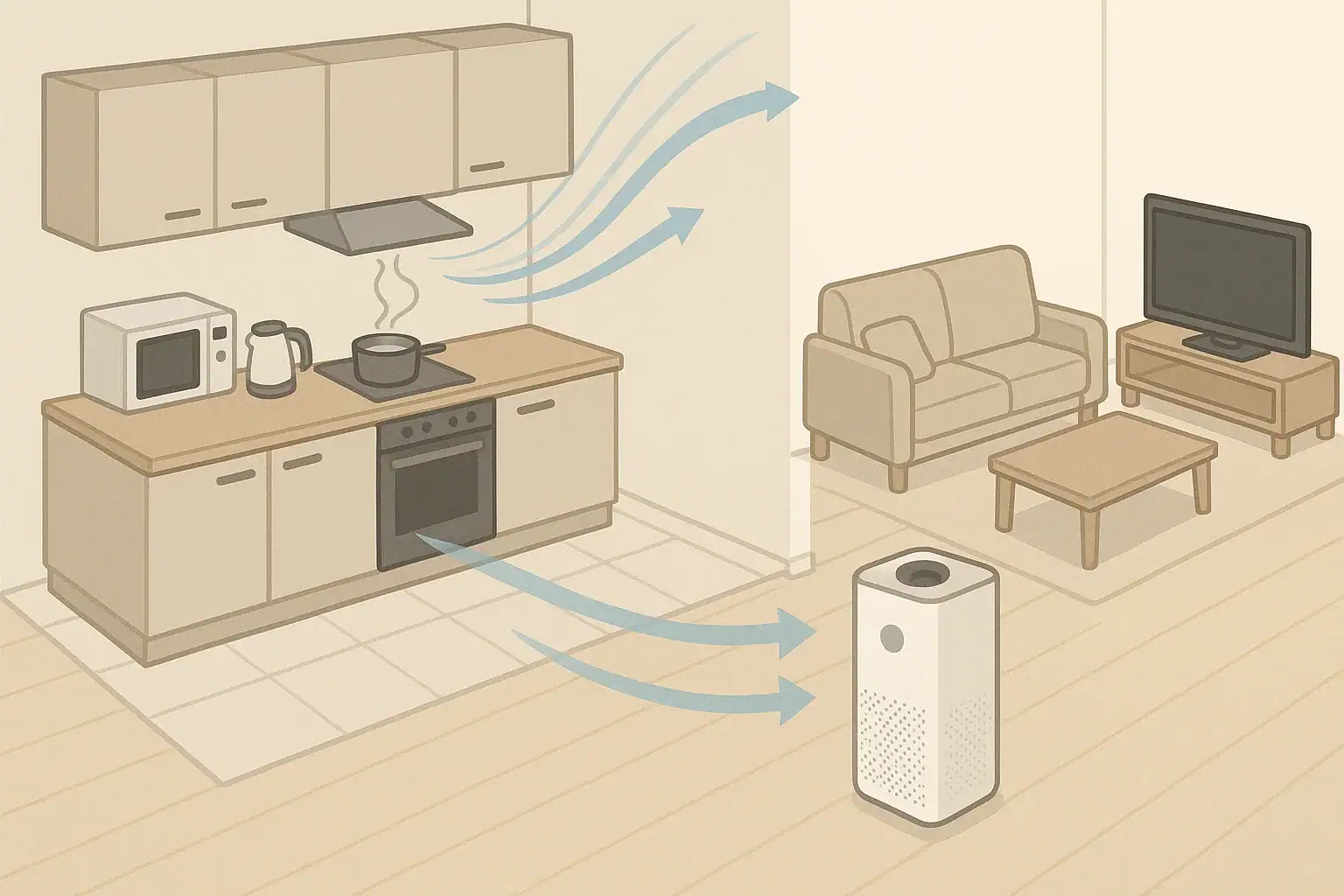
Air purifiers can significantly reduce cooking smoke and airborne grease particles, but they cannot replace a good range hood or regular cleaning. Used correctly, a purifier helps clear smoky air faster, limits how far particles spread through an open-plan home, and can soften lingering food odors when it has the right filters. Used poorly, it may make little difference while clogging filters faster than expected.
This guide explains how air purifiers interact with cooking smoke, oil mist, and kitchen odors so you can decide when and how to use one. We will look at particle filtration, grease buildup, odor control, and how to size and place a purifier near the kitchen without damaging it.
Whether you cook in a small apartment, a gas range kitchen, or a large open living area, the same principles apply: control emissions at the stove first, then use a purifier to clean the rest of the room air efficiently and safely.
How Cooking Smoke and Grease Affect Indoor Air
Cooking is one of the largest sources of indoor air pollution in many homes. Frying, broiling, searing, and even toasting bread can release a mix of fine particles, ultrafine particles, grease droplets, and gases into the air. These pollutants can stay suspended for minutes to hours and travel well beyond the stove.
When you cook on high heat or for long periods, three main types of byproducts typically enter your indoor air:
- Fine and ultrafine particles from browning, charring, and smoke when food or crumbs overheat.
- Grease aerosols – microscopic droplets of oil and fat that ride air currents and can later deposit on cabinets, walls, and fabrics.
- Gaseous byproducts and odors from hot oil, spices, and, with gas stoves, combustion products like nitrogen dioxide.
In open layouts, these byproducts do not stay in the kitchen. Air currents carry them into living rooms, hallways, and nearby bedrooms. In small apartments or homes without strong exhaust ventilation, you may notice:
- Visible haze after frying or searing.
- Persistent smell of last night’s dinner in soft furnishings.
- Greasy film gradually building up on nearby surfaces.
Because many cooking particles are extremely small, they can bypass simple mesh filters and contribute heavily to overall indoor particle counts. This is where air purifiers can help: they do not stop emissions at the source, but they can reduce how long those particles remain in the air and how far they spread.
How Air Purifiers Handle Cooking Smoke, Grease, and Odors
Air purifiers work by pulling room air through one or more filters, then returning cleaner air to the room. For cooking emissions, performance depends on the type of filters used and how quickly the purifier can move air.
What air purifiers do well for cooking emissions
- Capture fine particles from smoke, browning, and toasting as air passes through a high-efficiency particle filter.
- Trap some airborne grease droplets in pre-filters and main filters before they settle on distant surfaces.
- Reduce overall particle levels in adjacent rooms, especially in open-plan spaces where kitchen air mixes with living areas.
- Speed up cleanup after a smoky event, such as accidentally overcooking food or burning crumbs in a toaster.
Most of this benefit comes from mechanical particle filters (often labeled as HEPA or similar). These are designed to capture very small particles efficiently when enough air is pushed through them.
Where air purifiers are limited
- They cannot remove settled grease from cabinets, walls, or countertops. Once oil lands on a surface, it must be cleaned manually.
- They only partially address odors and gases unless the purifier includes a dedicated gas/odor filter such as activated carbon. Even then, odor control is limited by the amount of media and how often it is replaced.
- They do not protect you at the stove from intense smoke or fumes while you stand over a hot pan. Source control and exhaust ventilation are more important in that moment.
- They do not remove steam or humidity from boiling water or dishwashing. That requires ventilation or dehumidification, not filtration.
Because of these limits, the best strategy is layered: use a range hood or exhaust fan to remove as much pollution as possible at the stove, then use an air purifier to clean the remaining air in the surrounding rooms.
| Cooking situation | Main goal | Most effective tool | How a purifier fits in |
|---|---|---|---|
| Light sautéing or simmering | Keep background air clean | Basic range hood or window | Runs on low to keep particles from drifting into other rooms. |
| Frequent pan-frying on high heat | Control heavy smoke and grease | Strong exhaust to outdoors | Helps reduce residual smoke and grease in open-plan areas. |
| Small apartment with weak or no hood | Limit buildup of smoke and odor | Window + portable fan | Placed in main room, clears particles that are not vented outside. |
| Burned food incident | Clear visible haze quickly | Open windows if possible | High fan speed shortens how long the smoky smell lingers. |
| Lingering food smell in bedroom | Reduce odor and fine particles | Door closed, basic ventilation | Unit with odor filter scrubs air while you sleep. |
Key filter types for cooking smoke
- Mechanical particle filters: Capture smoke particles and some ultrafine particles. Performance depends on filter efficiency, airflow, and sealing.
- Pre-filters: Often a mesh or fabric layer that traps larger dust and some grease droplets before they hit the main filter. These usually need more frequent cleaning near kitchens.
- Odor/gas filters: Typically activated carbon or similar media that can adsorb some cooking odors and gases. Capacity is limited and declines as the media saturates.
For cooking smoke, a purifier with both a high-efficiency particle filter and a meaningful amount of odor media will generally perform better than a particle-only unit, especially in small or poorly ventilated homes.
Real-World Examples: How to Use a Purifier Around the Kitchen
How you cook and how your home is laid out will determine where a purifier makes the most difference. These scenarios illustrate typical setups and what you can realistically expect.
Small apartment kitchen open to living room
In a studio or one-bedroom apartment where the stove is only a few steps from the sofa, cooking smoke and odors often spread quickly. In this case, common strategies include:
- Placing a purifier in the main living area, several feet away from the stove but in the natural airflow path.
- Running the purifier on medium or high during cooking and for 30–60 minutes afterward.
- Using a window or bathroom fan to help remove humid, smoky air while the purifier handles remaining particles.
You may still smell food while cooking, but the air usually clears faster, and fabrics retain less odor over time.
Open-plan kitchen, dining, and family room
In larger open spaces, cooking emissions mix with the air in the entire shared area. Here, the purifier is not just a “kitchen” device; it becomes part of the overall air quality plan for the main living zone.
- Size the purifier for the combined area, not just the kitchen footprint.
- Place it where air circulates freely, such as near the center of the living area or along the main airflow path from kitchen to seating area.
- Consider higher fan speeds during heavy cooking days, then lower speeds for background cleaning.
This setup is especially helpful for households that cook daily, use high-heat methods, or have sensitive family members who react to smoke.
Bedroom near the kitchen
In some homes, the kitchen shares a wall or hallway with bedrooms. Cooking smells and particles can drift into sleeping areas, especially in the evening. In this case:
- Use a purifier in the bedroom to keep the air cleaner where you sleep.
- Close the bedroom door during heavy cooking and run the purifier on a moderate setting.
- After cooking, keep the purifier running for at least an hour to reduce any drifting particles or odors.
This does not stop all smells from entering, but it can noticeably reduce intensity and duration, especially when combined with closing doors and using exhaust fans.
Handling a smoky or greasy event
When something burns or oil starts to smoke heavily, the priority is to stop the smoke and ventilate quickly. A purifier is most useful immediately afterward:
- Turn off the heat and safely remove or cover the pan.
- Open windows and run exhaust fans if available.
- Set the purifier to a high fan speed in the main affected room to help pull down lingering fine particles.
Expect filters to load faster after such events. If you frequently have very smoky cooking sessions, be prepared for more frequent filter maintenance.
Common Mistakes and Troubleshooting When Using Purifiers for Cooking Smoke
Even a capable air purifier can underperform if it is used or placed poorly. Recognizing common mistakes and their signs can help you adjust your setup for better results.
Common setup and usage mistakes
- Placing the purifier right next to the stove, where it is exposed to hot steam and splattering grease, which can clog filters and stress the motor.
- Undersizing the purifier for a large open-plan area, so it never cycles enough air to noticeably reduce particle levels.
- Relying on a purifier alone while never using the range hood or opening windows, especially during high-heat cooking.
- Running on the lowest fan speed only during heavy cooking, which may be too gentle to keep up with emissions.
- Ignoring filter changes so long that airflow drops and odor filters become saturated and ineffective.
Troubleshooting cues: what the symptoms often mean
| Symptom | Likely cause | Practical fix |
|---|---|---|
| Room still looks hazy 30–60 minutes after cooking | Airflow too low or purifier too small for the space | Increase fan speed, move unit to a more central location, or use a higher-capacity purifier. |
| Strong food smells linger for many hours | No odor filter or saturated odor media | Add or replace odor/gas filter and use ventilation during and after cooking. |
| Purifier sounds louder and moves less air over time | Filters clogged with dust, smoke, and grease | Clean pre-filter and replace main filter according to use, not just calendar time. |
| Visible grease film forms on purifier housing | Unit placed too close to stove or in direct splatter path | Move it several feet away and wipe housing regularly with a damp cloth. |
| Bedroom still smells like dinner the next morning | Door left open, weak airflow through purifier, or low run time | Close door during cooking, run purifier longer on moderate speed, and check filter condition. |
Simple performance checks
You do not need specialized instruments to get a basic sense of whether your purifier is helping with cooking smoke:
- Visual check: After a smoky cooking session, note how long it takes for any visible haze to clear with the purifier on high versus off.
- Odor check: Pay attention to how long strong cooking smells persist in adjacent rooms when you use the purifier consistently.
- Filter inspection: If the pre-filter or main filter near the kitchen darkens noticeably faster than in other rooms, it is likely capturing cooking-related pollution.
If you do use a consumer air quality monitor, you will often see a sharp rise in particle readings during cooking and a faster decline when a properly sized purifier runs on a higher setting.
Safety Basics When Running Air Purifiers Near Kitchens
Most home air purifiers are safe to use around kitchens when placed and operated sensibly. However, cooking areas introduce heat, moisture, and grease that require a bit of extra caution.
Placement and electrical safety
- Keep the purifier away from direct heat such as burners, oven vents, or hot cookware. Excessive heat can warp plastics and damage internal components.
- Avoid active splatter zones where oil could spray directly onto the intake or outlet.
- Route power cords carefully so they do not cross main walkways or create a trip hazard in a busy kitchen.
- Do not block vents on the purifier with cabinets, curtains, or furniture, which can overheat the motor or reduce performance.
Features that may affect indoor air
Some purifiers include optional features such as ionizers, plasma generators, or UV-C lamps. These are intended to supplement filtration but may also introduce byproducts or change how the unit behaves.
- If you are primarily concerned about cooking smoke and grease, mechanical filtration alone is usually sufficient.
- Review the manual to understand how to enable or disable optional features if you prefer a simpler filtration-only mode.
- Follow all manufacturer safety instructions regarding filter replacement, cleaning, and safe distances from heat sources.
Fire and emergency considerations
- In the event of a kitchen fire or heavy flare-up, focus first on safety, evacuation, and calling emergency services. The purifier is not a fire-control device.
- After any significant smoke event, inspect the purifier housing and cord for heat damage before continued use.
Used with these precautions, an air purifier can operate safely for years in kitchen-adjacent spaces while helping to manage everyday cooking emissions.
Maintenance and Long-Term Use Near Kitchens
Cooking environments are harsher on air purifiers than bedrooms or home offices. Grease, fine smoke, and higher particle loads mean filters and housings need more attention.
Filter cleaning and replacement
- Pre-filters: Often washable or vacuumable. Near kitchens, they may darken or feel slightly tacky more quickly. Cleaning them regularly helps protect the main filter.
- Main particle filters: These load faster when used near cooking. Expect replacement intervals to be shorter than the maximum time suggested for low-use rooms.
- Odor/gas filters: These have a finite capacity. If cooking smells start to linger again despite good ventilation, it may be a sign that the odor filter is saturated.
If your purifier includes a filter-change indicator, treat it as a starting point, not an absolute rule. Heavy frying, frequent high-heat cooking, or repeated smoky events may require earlier changes.
Cleaning the purifier housing
Over time, a thin film of grease and dust can build up on the exterior surfaces of a purifier placed near a kitchen. To keep it operating well:
- Wipe the housing periodically with a soft cloth lightly dampened with water and a mild detergent if needed.
- Avoid spraying cleaners directly into the intake or outlet.
- Check vents and grills for visible dust buildup and gently remove it according to the manual.
Seasonal and long-term operation
Many households use different purifier schedules across the year:
- Daily cooking households: Run the purifier on a low or medium setting most of the day, with higher speeds during and after cooking.
- Occasional heavy cooking: Keep the purifier in the main living area and use higher speeds on cooking days, then lower speeds or off on lighter days.
- Vacation or extended time away: Turn the purifier off and store it in a dry, cool place. Check filters for age and condition before restarting after a long break.
Whatever pattern you choose, monitor performance over time. If you notice declining airflow, more noise, or reduced odor control, it is likely time to inspect and service the filters.
Practical Takeaways and Specs to Look For
For cooking smoke and grease, an air purifier is most effective when it is properly sized, placed thoughtfully, and paired with good kitchen ventilation. It will not erase all cooking smells or replace a vented range hood, but it can meaningfully reduce airborne particles and help your home feel fresher after meals.
When you are comparing air purifiers for use near a kitchen or in an open-plan living area, use this checklist to guide your decision.
Specs to look for in an air purifier for cooking smoke
- Room size rating that matches the combined kitchen and living area, not just the footprint of the stove zone.
- High-efficiency particle filter (often labeled as HEPA or similar) to capture fine smoke particles and some ultrafine particles.
- Meaningful smoke-oriented performance rating (such as a smoke-focused clean air delivery rating) to indicate how quickly it can reduce fine particles.
- Dedicated odor/gas filter with a reasonable amount of media if you want help with cooking smells in addition to smoke.
- Removable or washable pre-filter to catch larger particles and some grease before they reach the main filter.
- Multiple fan speeds, including a high setting for smoky events and a quiet setting for background use.
- Clear filter-change indicators or easy access for visual inspection, so you can adjust replacement timing based on your cooking habits.
- Compact footprint and stable design that fits safely in your intended location without blocking walkways.
Once you have a suitable purifier, focus on how you use it: run your range hood or exhaust fan during cooking, place the purifier several feet away from the stove along the airflow path, and use higher speeds during and after meals. Combined, these steps can noticeably improve indoor air quality in homes where cooking is a daily activity.
Frequently asked questions
What specifications and features should I prioritize when buying a purifier for kitchen smoke?
Prioritize a high-efficiency particle filter plus sufficient airflow for the combined kitchen and living area, a washable pre-filter, and a meaningful amount of activated carbon or other odor media for smells. Multiple fan speeds and a clear room-size or CADR rating for smoke performance are also useful so you can run higher speeds during cooking and quieter modes afterward.
Can placing a purifier too close to the stove reduce its effectiveness?
Yes. Placing a unit right next to the stove exposes it to heat, steam, and splattering oil that can clog filters and stress the fan, reducing long-term performance. Position the purifier several feet away in the natural airflow path instead of directly in the splatter zone.
Are air purifiers safe to run near a stove or oven?
Most are safe when kept away from direct heat and active splatter zones, with cords routed safely and vents unobstructed. After any major smoke event or heat exposure, inspect the housing and cord for damage before continued use.
How long should I run a purifier after cooking to clear smoke and odors?
Run the purifier on a high setting during cooking and for at least 30–60 minutes afterward for typical smoky events; run times should be longer for heavy smoke or large open spaces. Combining purification with ventilation (windows or exhaust fans) speeds clearing and reduces strain on filters.
Will an air purifier remove greasy residue from kitchen surfaces?
No—air purifiers can reduce airborne grease droplets before they settle, but they cannot remove grease that has already deposited on cabinets or countertops. Surface grease must be cleaned manually with appropriate cleaners.
How often will filters need replacing if I cook daily?
Filter life depends on cooking frequency and methods: heavy frying and frequent smoky events shorten intervals. Clean pre-filters often, watch for visible darkening or reduced airflow, and use any change indicators as a guide to replace main and odor filters sooner than the maximum interval recommended for low-use rooms.
- Clear sizing logic (room size → CADR/ACH)
- HEPA vs carbon explained for real use-cases
- Humidity + ventilation basics to reduce mold risk