
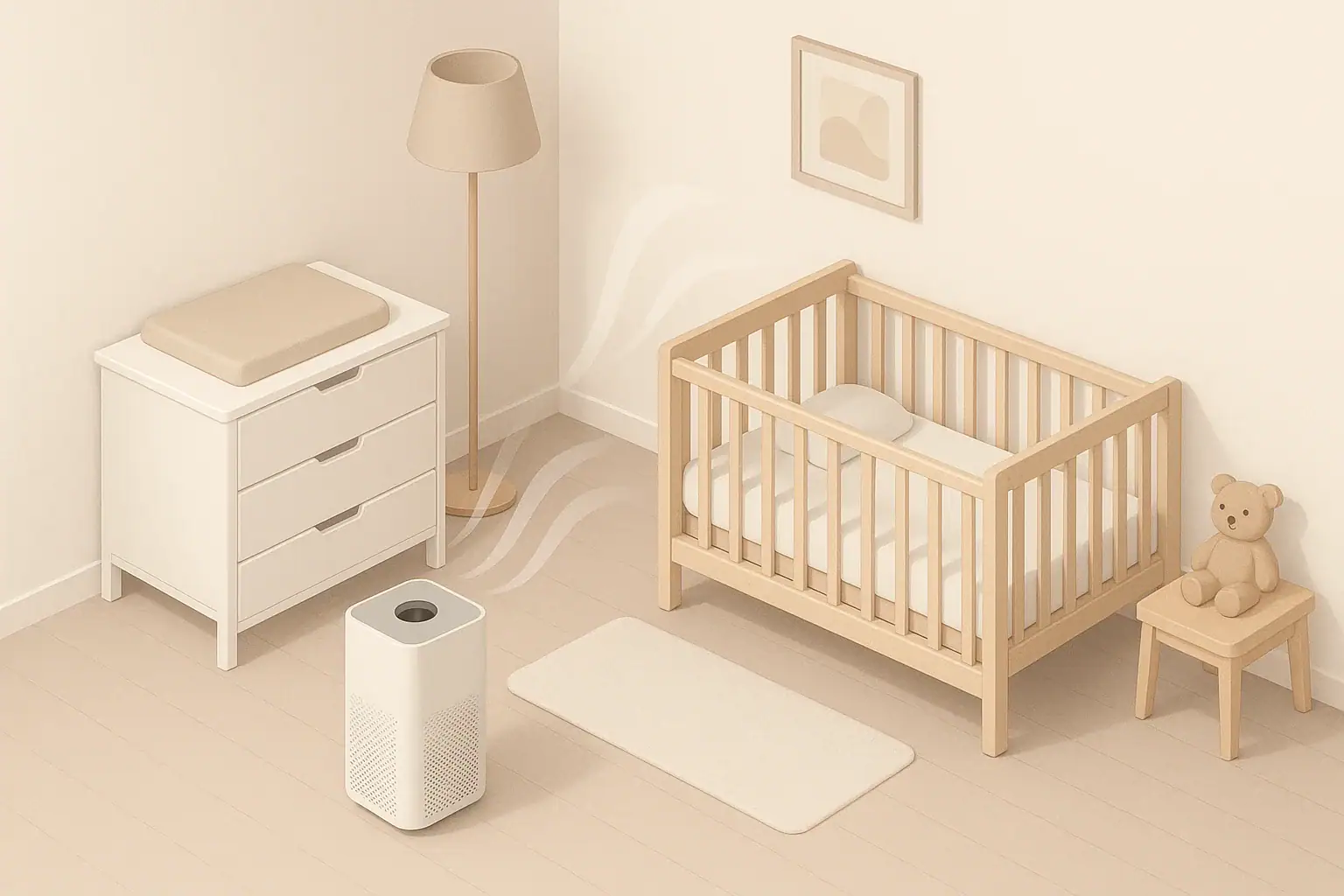
An air purifier can be a useful addition to a baby’s room when it is sized correctly, placed safely, and run on a quiet setting with the right filters. In a small nursery, a good air cleaner helps reduce airborne dust, pet dander, fine particles from outdoor pollution, and some odors from diapers or cooking. It does not replace ventilation or humidity control, but it can support a cleaner, more comfortable environment for sleep.
Parents often search for a nursery air purifier, baby air filter, or quiet bedroom air cleaner and are met with long lists of features. To keep things simple, focus on three questions: what kind of particles or smells you want to reduce, how much noise you are comfortable with during naps and nighttime, and whether the unit can run safely and reliably for many hours. The sections below walk through these points in a practical way so you can decide if an air purifier fits your baby’s room and how to use it effectively if you choose one.
What an Air Purifier Does in a Baby’s Room and Why It Matters
In a nursery, an air purifier’s main job is to pull room air through filters and return it with fewer airborne particles and, if equipped, fewer odors. Typical particles include household dust, lint, pet dander, pollen that drifts in from outside, and fine smoke or traffic particles that can enter through windows and doors. A purifier can also help with some of the smells that tend to linger near diaper pails or adjacent kitchens when it includes an odor-reducing filter stage.
This matters because nurseries are often smaller rooms with closed doors, soft furnishings, and many hours of sleep. Air can become stuffy, and particles can stay suspended longer, especially when windows are closed for temperature or noise reasons. A well-chosen air purifier for a baby room can help keep particle levels more stable between regular cleaning and vacuuming, especially if you have pets, live near busy roads, or deal with seasonal smoke.
It is important to remember what an air purifier does not do. It does not add oxygen, control carbon dioxide, or manage humidity. It cannot fix mold on walls or replace safe cleaning and fragrance-free product choices. Instead, it complements other steps: simple ventilation, moderate humidity, and routine dust control.
Key Concepts: How Nursery Air Purifiers Work
Most nursery-friendly air purifiers rely on mechanical filtration: a fan pulls air through one or more filters, and particles or gases are captured as air passes through. Understanding the basic filter stages and sizing concepts makes it easier to compare models without getting lost in marketing terms.
Filter stages for a baby’s room
Common filter stages include:
- Pre-filter: A coarse mesh or fabric that catches hair, lint, and larger dust. Often washable or vacuumable.
- Fine particle filter (HEPA or HEPA-type): A dense material designed to capture small particles like dust, pet dander, and fine smoke.
- Activated carbon filter: A porous carbon layer that helps reduce odors and some gases from diapers, cooking, or nearby traffic.
For a baby’s room, a combination of a pre-filter plus a high-efficiency particle filter is usually the core. Activated carbon is optional but helpful if odors are a recurring complaint.
Room size, airflow, and air changes per hour
Even a strong filter will not help if too little air passes through it. Two practical ideas help here:
- Airflow (often related to CADR): Indicates how much filtered air the unit can deliver each minute.
- Air Changes per Hour (ACH): How many times per hour the purifier can theoretically filter the room’s air volume.
For a typical small nursery, many families aim for several air changes per hour when the purifier is on a low or medium setting. That usually means choosing a purifier rated for at least the nursery’s square footage, and often slightly more, so you can keep fan speeds quieter while still moving enough air.
Noise and fan speeds
Noise matters more in a nursery than in many other rooms. Most purifiers offer multiple fan speeds:
- Low: Quieter, with gentler airflow; suitable for sleeping if the room is not heavily polluted.
- Medium: A balance between sound and cleaning power; often used when doors and windows are closed for long periods.
- High or turbo: Loudest; useful briefly when outdoor smoke is high or after opening windows.
A steady, low-pitched hum can double as white noise and help mask household sounds. Sudden changes in fan speed, rattling, or high-pitched tones are more likely to disturb sleep, so testing the unit in the actual nursery is important.
Basic sizing example for a nursery
To get a rough sense of size, measure the nursery length and width in feet, multiply to get square footage, and compare to the purifier’s stated coverage. For example, a 10 ft by 11 ft nursery has 110 square feet of floor area. Choosing a purifier rated for around 150–200 square feet often allows you to run it on a lower speed for similar cleaning power.
| Nursery Size (ft²) | Approx. Room Volume (8 ft ceiling) | Target ACH Range | Approx. Airflow Needed (CFM) | Practical Notes |
|---|---|---|---|---|
| 80 ft² (small) | 640 ft³ | 4–6 ACH | 45–65 CFM | Many compact purifiers can reach this on low or medium speed. |
| 110 ft² (typical) | 880 ft³ | 4–6 ACH | 60–90 CFM | Consider a unit rated for ~150–200 ft² so it can run quietly. |
| 140 ft² (larger) | 1,120 ft³ | 4–6 ACH | 75–115 CFM | Look for a mid-sized purifier; avoid running tiny units on max all night. |
| Basement nursery (similar ft²) | Varies | 4–8 ACH | Higher end of range | Higher airflow is often helpful where dust and dampness linger. |
Real-World Nursery Scenarios and How an Air Purifier Fits In
Thinking through real situations makes it easier to decide how a purifier can help and where other steps matter more. Below are examples based on common nursery setups and concerns.
Scenario 1: Baby’s room with pets in the home
If a dog or cat spends time near the nursery, or fur tends to drift under the door, a purifier with a good pre-filter and fine particle filter can help reduce airborne dander and hair. Practical steps might include:
- Running the purifier continuously on low or medium when the door is closed.
- Vacuuming carpets and washable rugs regularly with a high-efficiency vacuum.
- Cleaning the pre-filter more often, since pet hair clogs it faster.
The purifier will not remove dander already settled in fabrics or bedding, so it works best alongside routine laundry and surface cleaning.
Scenario 2: Nursery near a busy road or seasonal smoke
Homes near traffic or in regions with seasonal smoke may see higher levels of fine outdoor particles indoors. In this case, a nursery air purifier with a tightly sealed high-efficiency particle filter and enough airflow is especially helpful. Useful habits include:
- Keeping windows closed when outdoor air is visibly hazy or smells smoky.
- Running the purifier on a higher setting for a short time before bedtime, then lowering it once the baby is asleep.
- Checking filters more frequently during heavy smoke periods, since they load faster.
When outdoor air improves, brief ventilation (such as opening a window for a short time) helps dilute indoor gases that filters may not capture well.
Scenario 3: Strong diaper or trash odors
In some nurseries, odor is the main complaint. An air purifier with an activated carbon stage can help reduce smells, but it should not be the only solution. Combine it with:
- Emptying diaper pails frequently rather than relying solely on odor masks or bags.
- Wiping hard surfaces where spills or leaks have occurred.
- Ensuring the room is not overly damp, which can make odors linger.
Carbon filters saturate over time and become less effective, so expect to replace them more often than the main particle filter if odor control is a priority.
Scenario 4: Stuffy, closed nursery with no ceiling fan
Some nurseries feel stuffy even when they look clean. In these rooms, a purifier can act as both a filter and a gentle air mover. You might:
- Place the purifier a few feet from the crib, angled so air circulates around the room rather than directly at the baby.
- Keep the door slightly open when household noise allows, so air can exchange with the rest of the home.
- Use the purifier’s low setting as a consistent background sound and airflow source.
If the room still feels stale despite filtration, short ventilation periods and checking for blocked vents or closed supply registers are also important.
Common Mistakes and Troubleshooting Cues
Even a good air purifier can underperform if it is used in ways that limit airflow or safety. Recognizing common mistakes helps you correct issues quickly and decide when the purifier is not the right tool for the problem.
Common setup and use mistakes
- Purifier too small for the room: A compact unit meant for a desk or very small bedroom may not keep up in a larger nursery, especially with the door closed.
- Blocked intake or outlet: Placing the unit behind curtains, under shelves packed with items, or next to piles of laundry can restrict airflow and reduce effectiveness.
- Running on max speed all night: This may create unnecessary noise and make the baby or caregivers less tolerant of the purifier, leading to turning it off entirely.
- Ignoring filter replacement: Heavily loaded filters reduce airflow and may cause the motor to work harder or change pitch, which can disturb sleep.
- Expecting it to solve moisture or mold problems: A purifier can remove some airborne spores but will not dry damp walls, carpets, or window frames.
What to check if the nursery still feels dusty or stuffy
If you are already using an air purifier and the room still seems dusty or uncomfortable, walk through these checks:
- Confirm the purifier is actually on and set to at least a low continuous speed.
- Inspect the pre-filter and main filter for visible dust buildup and replace or clean as needed.
- Look for gaps or poor seals around the filter frame where air might bypass the filter media.
- Reposition the unit so air can circulate around the room rather than immediately hitting a wall or furniture.
- Check for other sources of dust, such as rarely washed curtains, stuffed toys, or carpets that have not been vacuumed recently.
Noise and vibration troubleshooting
If noise is the main concern, small adjustments often help:
- Move the purifier onto a solid, level surface; soft or uneven flooring can cause vibration sounds.
- Ensure all panels, filter doors, and covers are fully latched to avoid rattling.
- Try a slightly lower fan speed and place the unit farther from the crib while still allowing airflow.
- Clean dust from the fan intake and outlet grilles, which can sometimes change the sound of airflow.
| Symptom | Likely Cause | Quick Check | Simple Fix |
|---|---|---|---|
| Room still feels dusty | Clogged filter or undersized unit | Inspect filters and compare room size to rating | Replace filters or choose a unit rated for a larger room. |
| Strong odors persist | Saturated or missing carbon filter | Check if carbon stage is installed and dated | Replace carbon filter and improve trash/diaper routines. |
| Fan suddenly louder | Heavy dust buildup or blocked vents | Look for dust mats on pre-filter and intake grilles | Clean pre-filter and clear space around the unit. |
| Baby seems chilled or drafty | Airflow aimed directly at crib | Feel airflow direction while purifier runs | Angle outlet away and increase distance from crib. |
| Musty smell remains | Moisture or mold source, not just particles | Check walls, windows, and closets for dampness | Address moisture with ventilation or dehumidification. |
Safety Basics for Air Purifiers in a Baby’s Room
Safety should be the first filter you apply before thinking about extra features. A nursery air purifier is a plug-in appliance that may run for many hours unattended, so both electrical safety and child safety matter.
Avoiding ozone and aggressive air treatments
For a baby’s room, mechanical filtration is usually preferred. That means a fan plus filters, without technologies that intentionally create ozone or aggressively alter air chemistry. When comparing options, look for:
- Purifiers that emphasize mechanical filtration rather than ozone generation.
- Any ionizing or plasma features that can be turned off if you prefer a simpler mode.
- Avoiding stand-alone ozone generators for occupied rooms.
Safe placement and cord management
Placement affects both safety and performance:
- Keep the purifier a few feet from the crib so air does not blow directly on the baby.
- Route the cord behind furniture when possible and avoid loose loops a crawling baby could pull.
- Place the unit on the floor or a broad, stable surface rather than on narrow shelves.
- Leave space around intakes and outlets so fabric, toys, or curtains do not block airflow.
Controls, child locks, and filter access
As babies grow into toddlers, curiosity becomes a factor. Helpful features include:
- A child lock or button lock that prevents accidental setting changes.
- A filter compartment that requires some deliberate effort to open, rather than a loose panel.
- No small detachable pieces within reach that could become choking hazards.
Basic electrical and fire safety
Treat a nursery air purifier like any other long-running electrical appliance:
- Plug it directly into a wall outlet rather than daisy-chaining multiple extension cords.
- Do not run the cord under heavy rugs where heat can build up unnoticed.
- Keep the purifier away from water sources, including humidifiers that might leak or spill.
- Follow cleaning and filter replacement guidance so the motor does not strain against a severely clogged filter.
Maintenance and Long-Term Use in a Nursery
Once a purifier is in place, light but consistent maintenance keeps it working as intended. In many homes, a modest purifier with clean filters outperforms a high-end unit that rarely has its filters changed.
How often to run the purifier
For a baby’s room, many families choose one of these patterns:
- Continuous low speed: Run 24/7 on the lowest or second-lowest setting for stable air quality and sound.
- Boost then settle: Use a higher speed for 30–60 minutes before bedtime, then lower it once the baby is asleep.
- Event-based: Increase speed during nearby construction, smoke episodes, or heavy pollen days.
Consistency is more important than frequent on-off cycles. A purifier only cleans air that actually passes through it while it is running.
Filter cleaning and replacement habits
Filter care affects both performance and noise. Simple habits include:
- Checking the pre-filter monthly and cleaning it when visibly dusty.
- Marking the installation date of new main filters so you can track months in use.
- Listening for changes in sound that might indicate a clogged filter or blocked intake.
- Planning a small annual budget for replacement filters when you choose a model.
Seasonal adjustments and storage
In some homes, a purifier is used more heavily in certain seasons:
- During pollen or wildfire seasons, expect faster filter loading and check filters more often.
- In very dry winter months, coordinate purifier use with any humidifier in the room, keeping cords separate and water away from the purifier.
- If you store the purifier between seasons, remove or seal filters in a dry place so they do not absorb odors or moisture while idle.
Putting It All Together and Specs to Look For
Creating a comfortable nursery is less about one perfect device and more about combining simple steps that work together. A well-chosen air purifier for a baby room can reduce airborne particles and some odors, especially in smaller, closed spaces. When paired with moderate humidity, periodic ventilation, and regular cleaning, it becomes one part of a broader indoor air plan as your child grows.
When you compare options, it helps to have a short checklist so you are not distracted by extra features that matter less in daily use.
Practical specs and features to look for
- Room coverage: Rated for at least your nursery size, ideally with a bit of extra capacity so you can run it on lower speeds.
- Filter setup: Includes a pre-filter plus a high-efficiency particle filter; add activated carbon if odors are a regular concern.
- Noise levels: Quiet low and medium fan speeds suitable for sleep; a steady hum rather than rattles or whines.
- Mechanical filtration focus: Relies primarily on physical filters rather than ozone generation.
- Child-friendly design: Stable base, secure filter door, and a child lock or simple controls.
- Filter access and cost: Filters that are easy to replace, with clear guidance on timing and reasonable ongoing cost.
- Simple indicators: Basic filter change reminder lights or runtime indicators to help you stay on schedule.
- Energy use: Modest power draw on continuous low-speed operation, since the unit may run many hours a day.
By matching these practical specs to your specific nursery—its size, layout, nearby pollution sources, and your baby’s sleep patterns—you can choose an air purifier that quietly supports cleaner air without becoming a source of noise, clutter, or extra worry.
Frequently asked questions
Which technical specs and features most affect an air purifier’s performance in a nursery?
Key specs are room coverage or CADR/airflow to achieve several air changes per hour for your nursery size, a high-efficiency particle filter (true HEPA or equivalent), and low-noise fan settings for overnight use. An activated carbon stage helps with odors, and child-safety features plus easy filter access improve practicality for long-term use.
What’s the most common setup mistake that makes a nursery air purifier underperform?
Common mistakes are choosing a unit that is undersized for the room or placing the purifier so its intake or outlet is blocked by furniture, curtains, or laundry. Neglecting regular filter cleaning or replacement and only running the unit for short periods instead of continuous low-speed operation also reduce effectiveness.
Is it safe to run an air purifier overnight in a baby’s room?
Running a mechanical-filter air purifier overnight is generally safe when the unit is placed securely, cords are managed, and ozone-generating technologies are avoided. Ensure stable placement, keep the unit a few feet from the crib, and use child locks as the child becomes mobile.
How often should I check or replace filters in a baby’s room?
Check washable or pre-filters monthly and clean as needed; main HEPA-type filters typically last around 6–12 months depending on use and pollution levels, while activated carbon filters may require more frequent replacement if odors are common. Mark installation dates and follow the manufacturer’s guidance for best results.
Can an air purifier remove diaper and trash odors in a nursery?
Activated carbon filters can reduce many organic odors, but they saturate over time and are not a substitute for frequent emptying of diaper pails and regular cleaning. Combining odor-capable filtration with better waste-handling and ventilation is the most reliable approach.
Will an air purifier protect my baby from outdoor smoke or pollen?
A properly sized purifier with a high-efficiency particle filter and sufficient airflow can substantially lower indoor smoke and pollen levels when windows are closed. During heavy smoke or high pollen days, run the purifier at higher settings and check filters more often; brief ventilation is useful when outdoor air quality improves.
- Clear sizing logic (room size → CADR/ACH)
- HEPA vs carbon explained for real use-cases
- Humidity + ventilation basics to reduce mold risk