
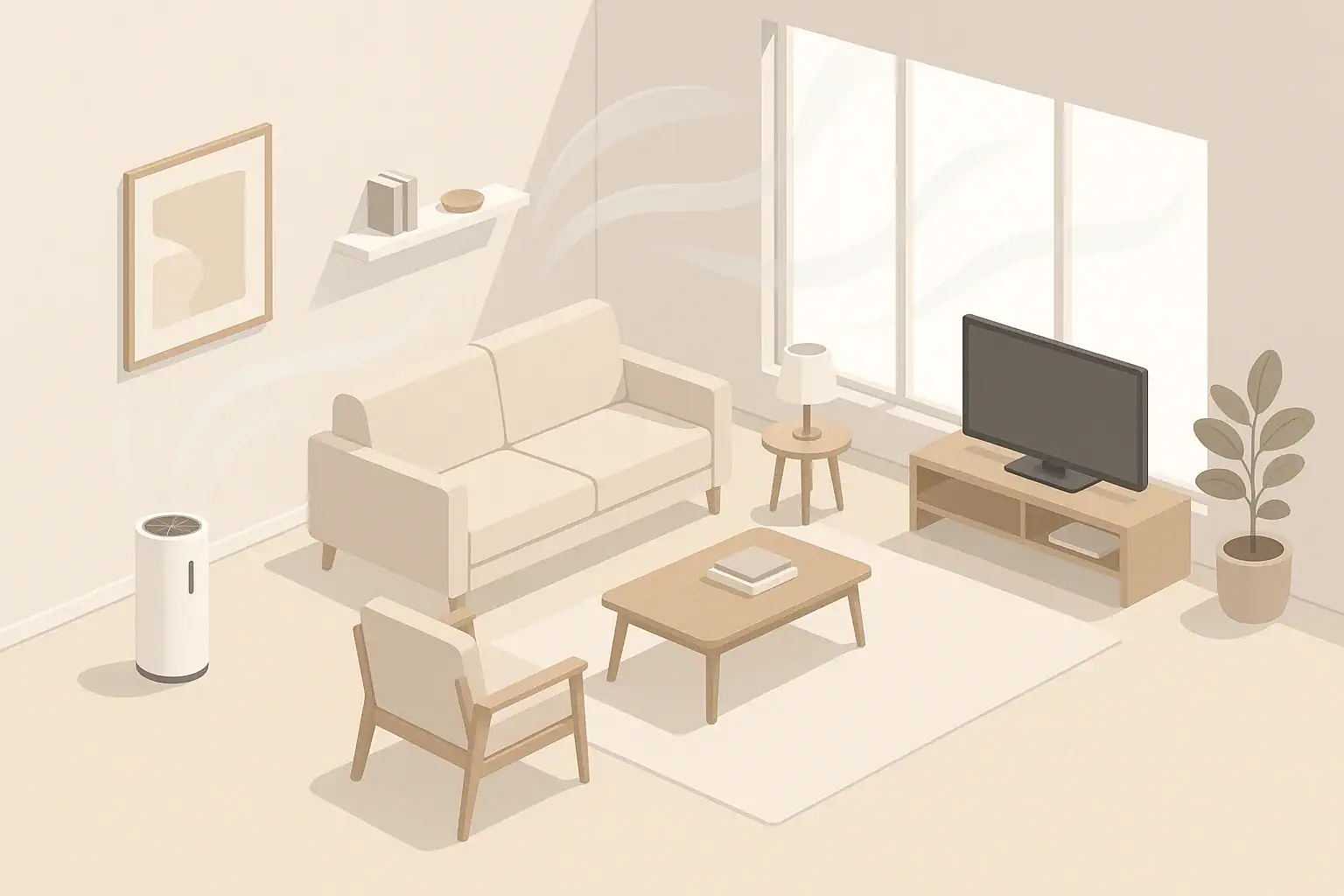
The best air purifiers for large rooms are the ones that can actually move enough air (CADR) to reach your target air changes per hour (ACH) without being too loud to live with. In practice, that usually means choosing a higher-capacity model than the box suggests, or using two moderate units instead of one small “large-room” purifier. Getting this right is what separates a barely noticeable upgrade from a clearly cleaner, fresher-feeling space.
This guide focuses on big living rooms, open-plan layouts, basements, and high-ceiling spaces. You will learn how to translate room size into a realistic CADR target, how to spot when a purifier is underpowered, and how to fix it with better sizing and placement. You will also see concrete examples and simple rules of thumb you can reuse for any room in your home.
Whether you are dealing with wildfire smoke, traffic pollution, pet dander, or cooking fumes, the goal is the same: pick and set up a purifier that can quietly keep up with the full volume of air in your large room.
What “Large Room” Really Means and Why It Matters
When manufacturers say “air purifier for large rooms,” they often mean something different from what people picture. A box might claim coverage for 500 square feet, but that number can assume low ceilings, low pollution, and a relatively low ACH target. In real homes, open concepts, tall ceilings, and frequent cooking or smoke can easily overwhelm an underpowered unit.
For air purifiers, room size is about volume, not just floor area. A 400-square-foot room with 10-foot ceilings holds 25% more air than the same room with 8-foot ceilings. That extra volume must be filtered over and over for the purifier to keep particle levels down.
Two key ideas drive performance in big spaces:
- Clean Air Delivery Rate (CADR): How many cubic feet of filtered air per minute the purifier can deliver.
- Air Changes per Hour (ACH): How many times per hour the purifier could theoretically process the full volume of the room.
In large rooms, you usually want several air changes per hour, not just one or two. If the purifier’s CADR is too low for the room volume, it has to run on high constantly, yet the air can still feel dusty, smoky, or stale. Correctly matching CADR and ACH to your room volume is the foundation of avoiding underpowered models.
Key Concepts: CADR, ACH, and How They Work Together
You do not need advanced math to size an air purifier for a large room, but understanding CADR and ACH will help you see through vague “coverage” claims.
Clean Air Delivery Rate (CADR)
CADR is a combined measure of filter efficiency and airflow, usually given in cubic feet per minute (CFM). A higher CADR means the purifier can clean more air in the same amount of time. Many products list separate CADR values for smoke, dust, and pollen; for general planning, the smoke or overall particle CADR is often the most useful number.
For large rooms, CADR matters because:
- A low-CADR purifier might work in a bedroom but be overwhelmed in a great room.
- Running a low-CADR unit on maximum speed can be noisy while still not reaching your desired ACH.
- Two moderate-CADR units can combine to provide a higher effective CADR with less noise.
Air Changes per Hour (ACH)
ACH tells you how many times per hour the purifier could theoretically process the full room volume. It does not mean the air is completely replaced each time, but higher ACH generally means faster reduction of particle levels.
Typical targets in large rooms:
- About 2–3 ACH: Light everyday use when pollution sources are modest.
- About 4–5 ACH: More active control for homes with frequent cooking, pets, or nearby traffic.
- 6+ ACH: More intensive control for wildfire smoke, sensitive occupants, or very busy kitchens.
Connecting Room Volume, ACH, and CADR
Once you know your room volume (length × width × height), you can estimate the CADR needed to reach a chosen ACH. A common approach is to calculate a target CADR and then round up to account for imperfect mixing and real-world conditions.
Because many large rooms are irregular (L-shaped, partial walls, stair openings), it often makes sense to treat them as one connected air volume. If the resulting CADR number looks very high, that is a sign that one small “large-room” purifier is likely to be underpowered, and you may want to plan on two units or accept a lower ACH target.
Real-World Examples: How to Size Purifiers for Large Rooms
Walking through real spaces makes it easier to see how CADR and ACH play out. Below are simple examples that you can adapt to your own home by plugging in your own dimensions.
Step 1: Estimate Room Volume
Start by measuring the main length and width of the space you want to treat, then multiply to get square footage. Multiply that by ceiling height to get volume.
Example 1: Medium open living-dining area
- Length: 22 ft
- Width: 16 ft
- Ceiling height: 9 ft
- Floor area: 22 × 16 = 352 sq ft
- Volume: 352 × 9 = 3,168 cubic ft
Example 2: Large family room with partial vaulted ceiling
- Length: 26 ft
- Width: 18 ft
- Average ceiling height (mix of 8 and 12 ft): about 10 ft
- Floor area: 26 × 18 = 468 sq ft
- Volume: 468 × 10 = 4,680 cubic ft
Step 2: Choose an ACH Target
For the examples above, you might choose:
- 3–4 ACH for the 352 sq ft living-dining area.
- 4–5 ACH for the 468 sq ft family room, especially if it is a central gathering space.
Step 3: Use a CADR Planning Table
The following table shows how different large-room scenarios translate into rough CADR planning ideas. Use it as a starting point, then adjust for your own room volume and ACH target.
| Room description | Approx. volume (cubic ft) | ACH goal (range) | CADR planning idea | Practical notes |
|---|---|---|---|---|
| 300 sq ft living room, 8 ft ceiling | 2,400 | 3–4 ACH | Moderate CADR unit may be enough | Often fine with one mid-sized purifier on medium speed |
| 350 sq ft open living-dining, 9 ft ceiling | 3,150 | 3–5 ACH | One strong or two moderate units | Two units can improve coverage across both zones |
| 450 sq ft family room, 9 ft ceiling | 4,050 | 4–5 ACH | Higher total CADR needed | Commonly easier with two units run at comfortable speeds |
| 500 sq ft great room with 10 ft ceiling | 5,000 | 3–5 ACH | Substantial CADR required | Plan on multiple purifiers or accept a lower ACH target |
| 400 sq ft basement rec room, 8 ft ceiling | 3,200 | 3–5 ACH | Moderate to high CADR | Combine filtration with moisture control for comfort |
| L-shaped 450 sq ft great room, mixed heights | Varies (often 4,000+) | 3–5 ACH | Two units in different zones | Helps reduce stagnant corners and dead zones |
Step 4: Placement and Multiple Units
Even a correctly sized purifier can feel weak if it is tucked into a corner or blocked by furniture. In large or open-concept rooms, consider:
- Placing a unit closer to where people spend time, such as near seating areas.
- Using a second unit near pollutant sources, like the kitchen side of an open-plan space.
- Leaving a few feet of open space around air inlets and outlets so air can circulate freely.
Many households find that two moderate units running on medium speed provide better overall comfort than a single high-powered unit running loudly on its maximum setting.
Common Mistakes and How to Spot an Underpowered Setup
Large rooms are where weak or generic air purifier claims show up fastest. Recognizing early warning signs helps you correct course before you decide the purifier “does not work.”
Typical Sizing and Setup Mistakes
Some of the most common issues with air purifiers for large rooms include:
- Relying on marketing square-foot numbers without checking your actual room volume or ceiling height.
- Using a single small unit in a great room that really needs two purifiers or a much higher CADR.
- Placing the unit in a corner or behind furniture where airflow is blocked.
- Running only on the lowest fan speed even during heavy pollution events like wildfire smoke or long cooking sessions.
- Ignoring filter condition, so clogged filters quietly reduce airflow and effective CADR.
Troubleshooting Cues in Large Rooms
If you suspect your large-room purifier is underperforming, look for these practical signals and possible fixes.
| What you notice | Likely cause | Simple checks | Practical adjustments |
|---|---|---|---|
| Air still smells smoky after hours of running | Too low ACH or exhausted gas filter | Check fan speed and filter age | Increase speed, add a second unit, or replace carbon filter |
| Dust settles quickly on surfaces | Insufficient particle filtration or poor circulation | Look for blocked inlets/outlets | Reposition unit, run at higher speed, or upsize CADR |
| One side of the room feels fresher than the other | Uneven coverage in large or L-shaped room | Compare conditions in different zones | Use two units in separate zones or move unit closer to occupied areas |
| Purifier is very loud but results seem modest | Unit too small for room volume | Estimate room volume vs. product claims | Keep current unit but add another purifier or upgrade to higher CADR |
| Visible dust streaks inside purifier housing | Bypass around filters or poor seals | Inspect filter fit and gaskets | Refit filters carefully and replace if warped or damaged |
| Odors return quickly after cooking | Undersized or saturated carbon filter | Smell near outlet vs. rest of room | Use higher capacity gas filter and ventilate during and after cooking |
When to Consider a Second Purifier
Adding a second purifier is often the most straightforward way to rescue an underpowered setup in a large room. It tends to help when:
- Your estimated room volume is well above what a single unit can realistically handle at comfortable noise levels.
- The room has an L-shape, alcoves, or stair openings that create dead zones.
- You want to keep both units on low or medium speeds for quieter operation.
Place the second unit in a different part of the room, ideally between a main pollutant source (like the kitchen or entry door) and where people spend time.
Safety Basics for Large-Room Air Purifiers
Air purifiers are generally safe household appliances, but large-room models often run longer hours and at higher fan speeds. A few simple precautions help keep operation safe and predictable over the long term.
Ozone and Add-On Technologies
Some air cleaning technologies can intentionally or unintentionally generate ozone or other byproducts. Many households prefer to rely primarily on mechanical filtration (particle filters plus optional gas/odor filters) to minimize added chemicals in the air.
When reviewing product options, look for clear statements about ozone generation and avoid using any mode or accessory that conflicts with the manufacturer’s safety instructions. If you are especially sensitive to odors or respiratory irritants, focusing on straightforward filtration and good ventilation is often the most conservative approach.
Placement and Fire Safety
Large-room purifiers are often placed in high-traffic areas, so safe placement matters:
- Keep the purifier on a stable, level surface where it cannot be easily knocked over.
- Do not drape fabrics over the unit or block the intake or outlet with furniture.
- Avoid running power cords under rugs or where they can be pinched by furniture.
- Keep units away from obvious sources of moisture and heat, such as showers, stovetops, or space heaters.
Sensor and “Smart” Features
Many large-room purifiers include built-in sensors and automatic modes that change fan speed based on detected particle levels. These can be useful, but keep their limitations in mind:
- Sensors located on the purifier may not reflect conditions across the entire large room.
- Automatic modes may keep the fan at low speed even when you would prefer more aggressive cleaning.
- For events like wildfire smoke or heavy cooking, it is often better to manually select a higher fan speed for a few hours.
Used thoughtfully, smart features can reduce energy use and noise, but they should support—not replace—your own judgment about when the room needs more filtration.
Maintenance and Long-Term Use in Large Spaces
In large rooms, purifiers typically process more total air and run for longer hours. That accelerates filter loading and makes routine maintenance more important for keeping CADR and ACH where you expect them to be.
Filter Replacement in High-Use Rooms
Manufacturers usually base filter replacement intervals on moderate daily use. In a big, busy space, you may approach those hour counts much faster. Pay attention to:
- Operating hours: Running 24/7 will shorten intervals compared with only evenings and weekends.
- Fan speed: Higher speeds push more air (and more particles) through the filter.
- Local conditions: Wildfire smoke season, nearby construction, or heavy indoor dust can all load filters quickly.
If your purifier has a filter indicator, treat it as a helpful reminder rather than a strict rule. In large rooms with heavy use, replacing filters a bit earlier often preserves performance and avoids long stretches of underpowered operation.
Pre-Filters, Grilles, and Housing
Most large-room purifiers use a pre-filter to capture hair, lint, and larger dust before it reaches the main filter. Keeping this layer clean helps maintain airflow and can extend the life of the primary filter.
- Vacuum or wash (if allowed) the pre-filter on a regular schedule, such as monthly in busy rooms.
- Wipe dust from intake grilles and outlet vents so air can move freely.
- When reinstalling filters after cleaning, check that they sit flat and snug to reduce bypass.
Off-Season or Occasional Use
Some people run air purifiers heavily during specific seasons, such as wildfire periods or allergy peaks, and less at other times. For large rooms in this situation:
- Store the purifier in a dry indoor area if you will not use it for several months.
- Seal or bag replacement filters to keep them clean and dry until needed.
- When restarting after storage, inspect filters and gaskets for visible damage or odor before running at high speed.
Thoughtful maintenance keeps your purifier closer to its rated CADR, which is especially important when you rely on it to handle the larger air volume of a great room or open-concept space.
Practical Takeaways and Specs to Look For
Choosing an effective air purifier for a large room comes down to matching capacity to room volume, using sensible placement, and maintaining filters so the unit can deliver its rated performance over time.
Key Takeaways for Large-Room Air Purifiers
- Treat “large-room” marketing claims as rough hints, not guarantees. Base your decision on room volume, ACH goals, and CADR.
- In many great rooms, two moderate purifiers placed well outperform one small unit in a corner.
- Expect to run purifiers for many hours per day at low or medium speeds, with higher speeds during cooking or smoke events.
- Filter upkeep has a bigger impact in large rooms because any drop in CADR affects a larger air volume.
Specs to Look For When Comparing Models
When you compare air purifiers for large rooms, focus on the specifications and features that most directly affect real-world performance and usability.
- CADR suitable for your room volume: Look for a particle CADR that, combined with your room volume, can reach your target ACH at a fan speed you can tolerate.
- Clear filter information: Particle filter type, gas/odor filter presence, and estimated replacement intervals should be clearly described.
- Multiple fan speeds: At least three fan settings (low, medium, high) help balance noise and cleaning power.
- Noise levels by speed: Check approximate sound levels so you know whether medium or high speed will be acceptable in your main living area.
- Energy use: Power draw at different fan speeds matters when running a purifier many hours per day in a large space.
- Filter seal and construction quality: Well-fitting filters and solid housings reduce bypass and help the purifier deliver its rated CADR.
- Simple access for maintenance: Tool-free filter changes and easy access to pre-filters make it more likely you will keep up with cleaning and replacements.
- Optional sensors and timers: Auto modes, timers, and basic air quality indicators can help manage noise and energy, especially in high-use rooms.
By focusing on these specs and matching them to your actual room size and usage patterns, you can avoid underpowered models and choose air purifiers that genuinely improve air quality in your large rooms.
Frequently asked questions
What specifications and features should I prioritize when choosing an air purifier for a large room?
Prioritize particle CADR relative to your room volume so the unit can reach your ACH target at a tolerable fan speed. Also check filter type (true HEPA for particles plus carbon for odors), number of fan speeds, noise levels at each speed, and clear filter replacement guidance.
Why might an air purifier be ineffective in a great room even if it’s rated for a large area?
Ratings often assume lower ceilings and ideal mixing; in practice an insufficient CADR for the room volume, poor placement, blocked inlets, or clogged filters can reduce effectiveness. Large or irregular spaces also create dead zones where a single unit can’t circulate air well.
Are there safety concerns to consider when running air purifiers continuously in large rooms?
Basic safety precautions include placing the unit on a stable surface, avoiding blocked intakes or draped fabrics, and not running power cords where they can be damaged. Be cautious with technologies that produce ozone or byproducts, and follow the manufacturer’s instructions for continuous operation.
Is it better to use one very powerful purifier or two medium units in an open-plan living area?
Two medium units often provide better coverage, quieter operation, and fewer dead zones than a single high-speed unit, especially in L-shaped or open-plan spaces. Placing units to cover different zones or pollutant sources usually improves real-world performance.
How often should I replace or clean filters when running purifiers in busy large spaces?
Expect to replace primary filters more frequently than the manufacturer’s moderate-use estimate if the purifier runs many hours daily or during smoke/construction events. Clean pre-filters monthly in heavy-use rooms and watch for reduced airflow or visible loading as signs to replace main filters sooner.
Can built-in sensors and automatic modes be relied on to manage air quality across a large room?
Built-in sensors can be useful but may not represent conditions across a large or segmented room, so automatic modes can sometimes under-react. For events like wildfire smoke or heavy cooking, manually increasing fan speed for a period usually achieves faster, more consistent cleaning.
- Clear sizing logic (room size → CADR/ACH)
- HEPA vs carbon explained for real use-cases
- Humidity + ventilation basics to reduce mold risk