
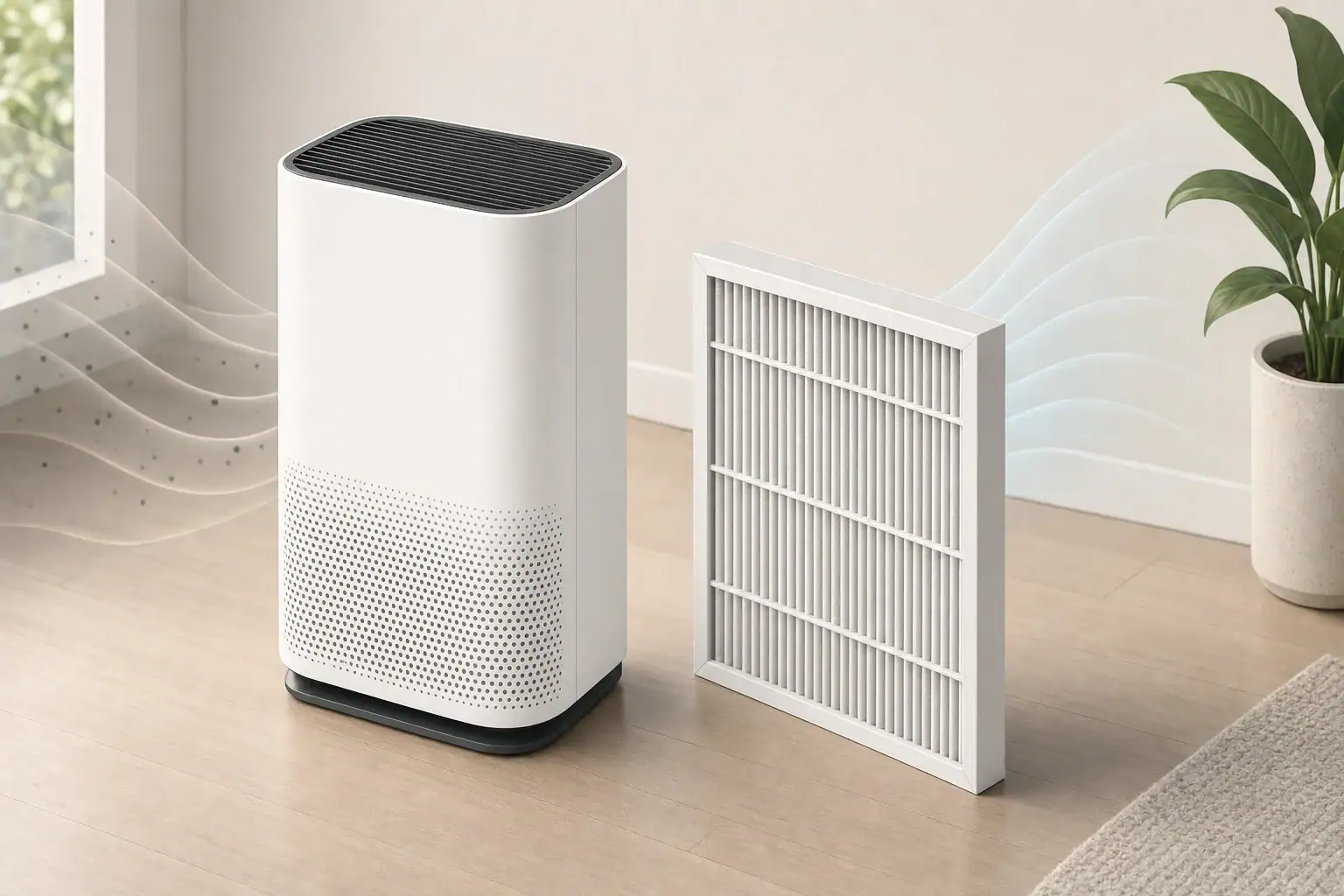
An air purifier cleans air in a specific room, while an HVAC filter cleans recirculated air across a ducted home whenever the system blower is running. They can complement each other, but they differ in coverage, filtration efficiency, airflow, placement, and operating schedule. The better choice depends on whether the goal is room-level particle removal, whole-home baseline filtration, or both.
Quick answer
- A portable air purifier is designed for a room or defined open area and can operate independently of heating or cooling.
- An HVAC filter serves connected rooms, but it filters only the air that reaches a return duct while the blower runs.
- For portable units, roughly 4–5 air changes per hour is a practical planning range for regular particle control; higher rates may be useful for temporary smoke conditions.
- For central systems, MERV 13 is a common efficiency target when the equipment and ductwork can handle it; always follow system guidance.
- Neither standard particle filter is a substitute for ventilation, moisture control, or meaningful amounts of activated carbon when gases and odors are the concern.
What an Air Purifier and HVAC Filter Actually Do
A portable air purifier pulls room air through one or more filters and returns the cleaned air to the same space. A well-sized unit can run continuously or on a schedule, making it useful in bedrooms, home offices, living rooms, and other high-use areas.
Most particle-focused purifiers use a mechanical filter, often a HEPA-type filter. HEPA filtration is intended to capture particles passing through the filter media, including fine dust, pollen, smoke particles, and some airborne debris. Actual room performance also depends on fan speed, operating time, filter condition, and how well the filter is sealed inside the housing.
An HVAC filter sits in a central forced-air system, usually at a return grille or near the air handler. Its original role includes keeping dust and debris from accumulating on system components. Higher-efficiency filters can also reduce particles in recirculated indoor air.
However, an HVAC filter does not pull air evenly from every location. Closed doors, limited returns, duct leakage, system cycling, and low blower runtime can reduce how much room air reaches it. It also does not bring in outdoor air unless the system has a dedicated ventilation component.
How Filtration Ratings, Airflow, CADR, and MERV Compare
CADR and room air changes
Portable purifier sizing is commonly based on clean air delivery rate, or CADR. CADR combines filter efficiency and airflow into an estimate of how much particle-cleaned air the unit supplies, generally expressed in cubic feet per minute.
A useful sizing formula is:
Required CADR in cfm = room volume in cubic feet × target ACH ÷ 60
For example, a 300-square-foot room with an 8-foot ceiling has a volume of 2,400 cubic feet. A target of 5 air changes per hour, or ACH, would require approximately 200 cfm of clean air delivery. This is an illustrative planning calculation, not a guarantee of uniform performance.
Open doors, high ceilings, adjoining spaces, and irregular layouts increase the effective volume. Published CADR values may also differ by particle category, so compare the rating relevant to the intended use rather than relying only on a general room-size claim.
MERV and central filtration
HVAC filters are commonly rated using MERV, or minimum efficiency reporting value. A higher MERV rating generally indicates improved capture of smaller particles, but it may also create more airflow resistance than a lower-efficiency filter.
MERV 13 is often used as a practical target for improved residential particle filtration when the system supports it. Installing a filter with more resistance than the equipment can accommodate may reduce airflow, affect comfort, increase blower energy use, or contribute to equipment problems. The system manual or a qualified HVAC professional should determine compatibility.
Example values for illustration.
| Feature | Portable air purifier | HVAC filter |
|---|---|---|
| Primary coverage | One room or defined open area | Rooms connected to central ductwork |
| Operating time | Independent; can run continuously | Filters while the blower runs |
| Common rating | CADR and sometimes HEPA classification | MERV |
| Typical sizing basis | Room volume and target ACH | System dimensions, airflow, and compatibility |
| Fine-particle control | Can be strong when properly sized and sealed | Depends on MERV, runtime, ducts, and airflow |
| Gas and odor control | Requires substantial activated carbon or other gas media | Limited with standard particle filters |
| Main constraint | Room coverage, noise, and placement | Blower runtime and allowable filter resistance |
Common Mistakes and Performance Problems
A frequent mistake is treating a high-efficiency filter rating as a complete measure of real-world performance. Filter media can be efficient in a laboratory test while the overall device delivers too little airflow for the room. Air can also bypass the media through gaps around a poorly fitted filter.
Watch for these common problems:
- Undersizing a portable purifier: A low CADR may produce too few air changes in a large room.
- Running only on the quietest setting: Low speed may be comfortable for sleep but may not deliver the CADR used for room-size claims.
- Blocking airflow: Curtains, furniture, walls, or recessed corners can obstruct intake and exhaust paths.
- Using an incompatible HVAC filter: A filter that is too restrictive for the system can reduce airflow.
- Ignoring blower runtime: A capable central filter has limited effect while the blower is off.
- Expecting particle filters to remove gases: HEPA and MERV ratings describe particle performance, not removal of carbon dioxide, most VOCs, or persistent odors.
- Neglecting the source: Filtration cannot replace kitchen exhaust, smoke prevention, dampness correction, or removal of a continuing pollutant source.
Visible dust is not a perfect performance test. Some household dust settles quickly and may not reach either filter, while fine particles can remain suspended without being visible. A basic PM2.5 monitor can show trends, but readings are affected by sensor quality, placement, humidity, and cooking aerosols.
Practical Checklist for Choosing Between Them
Start by identifying the area and pollutant type rather than choosing only by filter label.
Choose or prioritize a portable air purifier when
- You need stronger filtration in one occupied room.
- The home lacks central forced-air ductwork.
- Bedrooms are separated from the main HVAC return by closed doors.
- You want filtration that can continue when heating or cooling is off.
- You can size the unit from CADR and room volume.
Improve central HVAC filtration when
- You want a baseline level of particle filtration across connected rooms.
- The system can support a more efficient filter without unacceptable airflow loss.
- The filter fits correctly without crushed edges or gaps.
- The blower runs often enough to circulate air through the return system.
Use both when
A combined approach is useful when central filtration provides broad coverage but one room needs a higher clean-air rate. For example, the HVAC filter can serve common areas while a portable purifier provides additional air changes in a bedroom or office.
Before buying or replacing equipment, measure the room, note ceiling height, identify door and window patterns, confirm the HVAC filter dimensions, and check central-system compatibility. Also consider acceptable noise at the fan speed needed to meet the target CADR.
Real-World Examples for Different Homes
Apartment without central forced air
A portable purifier is usually the direct filtration option because a window or wall air conditioner may not have a whole-home return system. Size the purifier for the room where it will operate. If a living area opens into a kitchen or hallway, include the connected volume or use multiple units.
House with central heating and cooling
A compatible higher-efficiency HVAC filter can provide whole-home baseline particle reduction. A portable purifier may still be helpful in a frequently occupied room, especially when doors are closed or the central blower has limited runtime.
Temporary outdoor smoke
Closing windows when outdoor air is poor, reducing indoor particle sources, and running appropriately sized filtration can help limit indoor particle buildup. A higher ACH target or multiple portable units may provide more clean air in a large open plan. Outdoor-air ventilation should be adjusted according to current conditions rather than stopped permanently.
Cooking odors and fine particles
A vented range hood is the primary control when available. Particle filtration can reduce airborne cooking particles, but odor and gas reduction requires suitable gas-phase media and enough contact time. Thin carbon sheets generally have limited capacity compared with deeper beds of activated carbon.
Damp room with musty odors
Neither an air purifier nor an HVAC filter fixes excess moisture. Correct leaks, improve exhaust, and use moisture control as needed. A general indoor relative humidity range of about 30%–50% is often practical, although climate and building conditions matter.
Safety, Ozone, Ionizers, and UV-C
Mechanical filtration is the most straightforward approach for household particle removal. Some air-cleaning products add ionization, electrostatic collection, plasma, or ultraviolet components, but these features should be evaluated separately from filter ratings and airflow.
Ozone is a lung irritant and should not be intentionally generated in occupied spaces. Look for products designed and verified to avoid harmful ozone emissions. Turning off an optional ionizing feature may be reasonable when conventional filtration is the goal, provided this follows the device instructions.
UV-C performance depends on wavelength, intensity, exposure time, placement, and shielding. A small light inside a fast-moving portable unit does not automatically provide meaningful treatment. UV-C can also damage some materials, and direct exposure can harm eyes and skin, so enclosed designs and manufacturer safety instructions matter.
Do not modify an air purifier, HVAC cabinet, blower, or electrical component to add filtration or ultraviolet equipment. HVAC changes should preserve fire safety, airflow, condensate management, and access for servicing.
Maintenance, Filter Replacement, and Operating Costs
Filter loading gradually increases resistance and can reduce airflow. Replacement timing depends on operating hours, particle levels, pets, renovations, smoke events, filter depth, and the amount of filter media. Visual appearance alone is not always a reliable indicator.
Portable purifier prefilters may be vacuumed or washed only when the instructions allow it. HEPA filters generally should not be washed unless specifically designed for washing, because water or aggressive cleaning can damage the media. Clean air intakes and outlets gently so dust does not restrict airflow.
Check an HVAC filter monthly at first to learn how quickly it loads in the home. Insert the correct size and orientation, close the access panel fully, and do not stack filters unless the system was designed for that arrangement.
Ownership cost includes replacement filters and electricity. Portable purifier energy use rises with fan speed, while central filtration cost is influenced by blower runtime and filter resistance. A larger purifier running at a moderate setting may sometimes be quieter than a smaller unit operating continuously at maximum speed.
Example values for illustration.
| Filter or task | Planning range | What may shorten the interval |
|---|---|---|
| Portable prefilter inspection | Every 2–4 weeks | Pets, heavy dust, or high fan runtime |
| Washable prefilter cleaning | About monthly if instructions permit | Visible buildup or reduced airflow |
| Portable particle filter | About 6–12 months | Smoke, renovations, continuous operation, or small filter area |
| Portable carbon filter | About 3–6 months | Frequent odors, gases, humidity, or low carbon mass |
| One-inch HVAC filter | Inspect monthly; often replace in 1–3 months | High blower runtime, pets, dust, or smoke |
| Deeper HVAC media filter | Often 6–12 months | System design, loading, airflow, and manufacturer guidance |
Related guides: MERV 13 vs HEPA: What the Numbers Mean for Indoor Air • How to Choose the Right Air Purifier for Your Room Size • Ventilation vs Air Purifier: When You Need One, the Other, or Both • Air Purifier Maintenance Checklist: Filters, Sensors, and Cleaning
Summary: Which Filtration Approach Fits the Goal?
A portable air purifier is usually the more controllable option for delivering a measurable amount of cleaned air to one room. Choose it by CADR, room volume, target ACH, noise at the intended speed, and filter replacement cost.
An HVAC filter provides broader filtration through a compatible forced-air system. Its effectiveness depends on MERV rating, fit, blower runtime, return-air pathways, duct condition, and the airflow resistance the equipment can safely handle.
For many homes, the practical answer is not one or the other. A compatible HVAC filter can provide whole-home baseline filtration, while one or more correctly sized portable purifiers can add clean-air capacity where people spend the most time. Ventilation, source control, kitchen and bathroom exhaust, and moisture management remain separate parts of a balanced indoor air quality plan.
Frequently asked questions
Is an air purifier better than an HVAC filter for allergies?
A properly sized portable air purifier can provide stronger particle filtration in the room where a person sleeps or spends the most time, especially when doors are closed or the HVAC blower does not run continuously. A compatible higher-MERV HVAC filter can still reduce allergens throughout connected areas of a ducted home. Using both may provide the most consistent coverage.
Can I use a MERV 13 HVAC filter instead of buying an air purifier?
A MERV 13 filter may improve whole-home baseline particle filtration if the HVAC system is designed to handle its resistance and the blower runs often enough. It may not provide the same clean-air rate in a specific bedroom or closed room as a correctly sized portable purifier. Check equipment guidance or consult an HVAC professional before increasing filter efficiency.
What CADR should an air purifier have for a bedroom?
Calculate the room volume by multiplying floor area by ceiling height, then multiply that volume by the desired air changes per hour and divide by 60. For example, a 2,400-cubic-foot room targeting 5 air changes per hour needs about 200 cfm of CADR. Consider connected spaces, open doors, and the unit’s CADR at the fan speed you expect to use.
Does running the HVAC fan continuously make the filter more effective?
Running the blower longer generally sends more recirculated air through the HVAC filter, which can improve particle removal in rooms connected to the return system. It can also increase electricity use, noise, and filter loading. The benefits depend on filter efficiency, system airflow, return-air pathways, and whether the system is suitable for extended fan operation.
Do air purifiers or HVAC filters remove cooking odors and smoke smells?
Particle filters can help reduce fine smoke and cooking particles, but standard HEPA and MERV filters do not reliably remove odors or most gases. Meaningful odor reduction usually requires a substantial amount of activated carbon or other gas-phase media, along with source control such as a vented range hood. During smoke events, reducing outdoor-air entry when conditions are poor can also help limit indoor particles.
Recommended next:
- HEPA vs Activated Carbon: Best Setup for Allergies, Odors, and Smoke
- Air Purifier vs Dehumidifier: Which One Solves Musty Air?
- Humidifier vs Dehumidifier: When to Add Moisture vs Remove It
- Air Purifier vs Ozone Generator: Safety, Effectiveness, and Myths
- HEPA vs Carbon Filters: When Each One Matters Most
- Air Purifier vs Ventilation: Which Fixes Stuffy Bedrooms Better?
- Clear sizing logic (room size → CADR/ACH)
- HEPA vs carbon explained for real use-cases
- Humidity + ventilation basics to reduce mold risk