
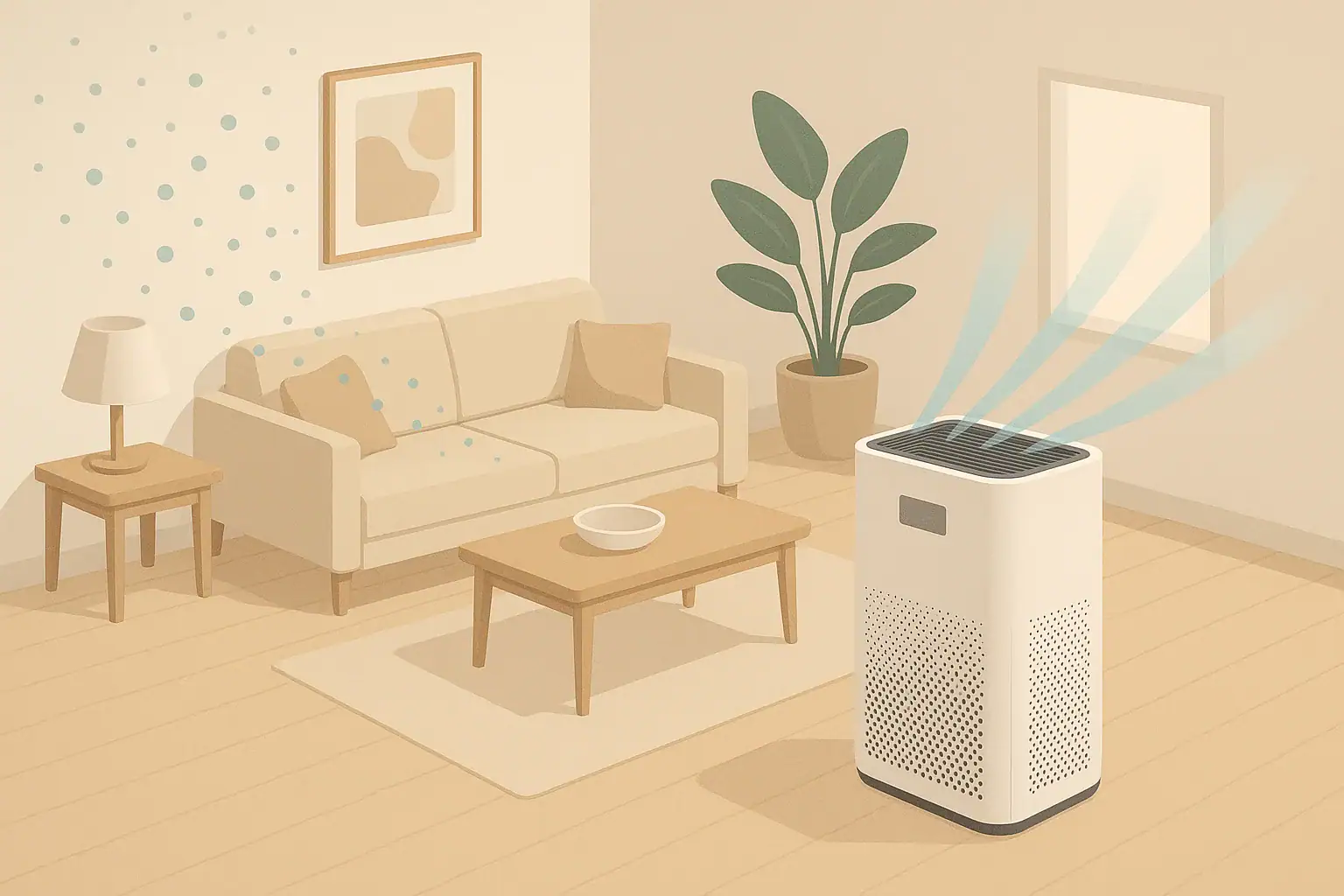
A practical target for a safe PM2.5 level indoors is to keep everyday background levels in the single digits to low teens in µg/m³ and to limit how high and how long short-term spikes last. Lower is generally better, especially for children, older adults, and anyone with asthma or heart or lung disease.
Indoor PM2.5 (fine particulate matter) is one of the most important indicators of air quality at home. These tiny particles come from cooking, smoke, outdoor pollution, and everyday activities, and they are small enough to reach deep into the lungs. Understanding what the numbers on your air quality monitor mean helps you decide when to ventilate, when to filter, and when to change habits.
This guide explains PM2.5 in plain language, shows typical indoor ranges, and walks through real-world examples from cooking, wildfire smoke, and cleaning. You will also see common mistakes that keep indoor particle levels higher than they need to be, basic safety considerations, and a simple checklist of specs to look for when you buy monitors, filters, or other gear in the future.
What PM2.5 Means Indoors and Why It Matters
PM2.5 stands for particulate matter with a diameter of 2.5 micrometers or smaller. For comparison, a human hair is roughly 70 micrometers thick, so these particles are about 30 times smaller than a hair and invisible to the naked eye.
Because they are so small, PM2.5 particles can stay suspended in the air for long periods. When you breathe, they can travel deep into the lungs and, for the smallest particles, even enter the bloodstream. This is why PM2.5 is often used as a shorthand for “fine particle pollution” or “fine dust” in indoor air quality discussions.
Health agencies link both short-term and long-term exposure to elevated PM2.5 with a range of problems, including irritation of the eyes and throat, worsening asthma, increased respiratory infections, and added strain on the heart and circulatory system. The risk is higher for sensitive groups such as children, older adults, pregnant individuals, and people with existing heart or lung disease.
Indoors, PM2.5 is especially important because you spend many hours each day at home, and many common activities—like frying food or burning candles—can temporarily push levels much higher than your background baseline. Knowing this helps you focus on what you can control: sources, ventilation, and filtration.
Key Concepts: How PM2.5 Is Measured and Interpreted
Most home air quality monitors use a small optical sensor. Air is drawn through a chamber and a laser or LED shines light across the airflow. The sensor estimates the amount of fine particulate matter by measuring how much light bounces off the particles.
There are two main ways these readings are shown:
- Micrograms per cubic meter (µg/m³) – how many micrograms of PM2.5 are present in one cubic meter of air. This is the most straightforward unit for indoor use.
- Index or color scale (often based on an Air Quality Index) – a simplified number and color band (green, yellow, orange, red, purple) that groups ranges of PM2.5 into categories from “good” to “unhealthy.”
Most home devices show near real-time values, sometimes averaged over a short internal period (for example, 10–60 seconds). Health guidelines, however, often refer to averages over 24 hours or longer. This is why a quick spike while you sear food in a hot pan may look dramatic on your monitor but is less concerning if it drops quickly and your daily average stays low.
To make sense of the numbers, it helps to distinguish between background levels (what your home settles to when nothing obvious is happening) and activity-related spikes (short bursts from cooking, cleaning, or smoke).
| PM2.5 level (µg/m³) | Typical indoor situation | General interpretation for most homes |
|---|---|---|
| 1–5 | Well-sealed home with good filtration and clean outdoor air | Very low background; desirable for sensitive groups if sustainable |
| 5–12 | Typical home with occasional cooking and basic filtration | Generally good; reasonable target for everyday indoor air |
| 12–35 | Frequent cooking, nearby traffic, or mild outdoor pollution | Elevated; aim to reduce duration and frequency of these levels |
| 35–55 | Heavy frying, indoor smoke, or nearby wood burning | High; minimize exposure time, especially for sensitive people |
| >55 | Wildfire smoke intrusion or strong indoor combustion sources | Very high; take active steps to lower levels as quickly as possible |
These bands are not strict safety cutoffs. They are practical guideposts to help you decide when to open windows, turn on filtration, or change habits. For long-term health, keeping your usual background in the lower bands and shortening higher spikes is a sensible strategy.
Real-World PM2.5 Examples at Home
Seeing how PM2.5 behaves in everyday situations makes the numbers on a monitor much easier to understand. Below are common household scenarios and how particle levels often respond.
Cooking and kitchen activities
Cooking is usually the largest controllable indoor source of PM2.5 in non-smoking homes. High-heat methods such as frying, broiling, or searing can cause rapid spikes that sometimes exceed 100 µg/m³ near the stove, especially if there is no effective exhaust.
- Boiling or steaming: small, brief increases; often remains under 15–20 µg/m³ if ventilation is reasonable.
- Oven baking at moderate temperatures: modest rises, especially when opening the oven door.
- Pan frying or stir-frying: sharp spikes; readings may jump from 8 µg/m³ background to 60 µg/m³ or more in minutes.
- Toasting bread: noticeable but short-lived spikes, especially if crumbs are burning.
With good ventilation (such as an effective exhaust hood vented outdoors or open windows when outdoor air is clean), these spikes usually fall back toward background within 30–60 minutes.
Wildfire smoke and outdoor pollution
During wildfire events or periods of heavy outdoor pollution, indoor PM2.5 can climb even if you do nothing differently indoors. Leaky windows, frequently opened doors, and running fans that pull air from outside can all raise indoor levels.
- Closed windows, no filtration: indoor PM2.5 often tracks at roughly half to three-quarters of outdoor levels, depending on how tight the building is.
- Closed windows, active filtration: indoor levels can be much lower than outdoors, sometimes by a factor of three or more.
- Open windows during smoky periods: indoor readings may quickly approach outdoor levels.
In these situations, a monitor helps you confirm whether your mitigation steps—closing gaps, running filters, limiting outdoor air intake—are working.
Cleaning, dusting, and hobbies
Many dust-generating activities produce PM2.5 even if you do not see visible dust clouds.
- Dry sweeping or vigorous dusting: can create short-lived spikes as dust is stirred up and then resettles.
- Vacuuming with a low-efficiency or leaking vacuum: may increase PM2.5, especially in smaller rooms.
- Hobbies such as sanding, soldering, or 3D printing: can produce fine particles that linger without good local exhaust or filtration.
Switching to damp cleaning methods, using vacuums with better filtration, and isolating hobby areas can noticeably lower the peaks you see on your monitor.
| Activity | Typical PM2.5 pattern | Simple adjustment to reduce levels |
|---|---|---|
| Pan frying dinner | Background 8 µg/m³, spike to 70 µg/m³ for 15–30 minutes | Start exhaust before cooking, use lids, run filtration on high during and after |
| Weekend house cleaning | Repeated bumps from 5 to 25–35 µg/m³ while sweeping and vacuuming | Use damp mopping, higher-efficiency vacuum, and ventilate during cleaning |
| Wildfire smoke day | Outdoor 150 µg/m³, indoor drifting from 15 to 60 µg/m³ without action | Seal windows, close vents drawing outdoor air, and run room filtration continuously |
| Burning scented candles | Slow rise from 6 to 30–40 µg/m³ over an evening | Limit use, choose fewer open flames, and ventilate after extinguishing |
Common Mistakes and Troubleshooting High PM2.5 Readings
When you first start using a PM2.5 monitor, it is easy to misinterpret the numbers or overlook simple fixes. Recognizing common mistakes helps you troubleshoot quickly.
Mistake 1: Reacting to every short spike
Brief spikes during cooking or cleaning are normal in most homes. The more important question is how long levels stay elevated after the activity stops.
- Sign of a problem: PM2.5 remains above about 25–35 µg/m³ for hours after cooking or cleaning ends.
- What to check: Are you using kitchen exhaust or opening windows during and after cooking when outdoor air is clean? Is there any smoldering source, such as a candle or incense, left burning?
Mistake 2: Ignoring background levels
Some people focus only on peak readings and overlook their everyday baseline. A background that never drops below the mid-teens or higher suggests ongoing sources or poor filtration.
- Sign of a problem: Lowest readings during quiet times stay above roughly 12–15 µg/m³ even on days with clean outdoor air.
- What to check: Indoor smoking, frequent candle use, nearby busy roads, leaky windows, or clogged filters.
Mistake 3: Placing the monitor in misleading locations
Monitor placement can easily skew your understanding of indoor PM2.5.
- Avoid: placing the device directly above a stove, next to a window crack, on the floor, or in direct sunlight.
- Better: position it at breathing height (about 3–5 feet from the floor), away from walls and direct drafts, in a room where you spend a lot of time.
Mistake 4: Forgetting about humidity and sensor limits
Low-cost optical sensors can be influenced by high humidity and the type of particles in the air. On very humid days, some monitors may overestimate PM2.5.
- Sign of a problem: Numbers jump when humidity rises sharply, even without a clear particle source.
- What to check: Compare readings before and after using dehumidification or ventilation. Focus on trends and averages, not single readings.
Mistake 5: Overlooking hidden sources
Sometimes elevated PM2.5 is caused by less obvious sources.
- Unvented gas appliances or space heaters.
- Attached garages where vehicle exhaust or hobby activities leak into the home.
- Regular burning of incense or scented products.
If PM2.5 stays elevated and you cannot see an obvious cause, walk through your home while watching the monitor, moving it room to room. Sudden jumps in one area can help you pinpoint hidden sources.
PM2.5 Safety Basics Indoors
There is no single PM2.5 number that guarantees safety for every person, but there are widely used guideline ranges and practical targets that help reduce risk. The general principle is straightforward: the lower your long-term average and the shorter your high spikes, the better.
Everyday targets for most households
- Background level: Aim for single-digit to low-teens µg/m³ when no obvious sources are active.
- Short-term peaks: Expect spikes during cooking or cleaning, but try to keep them as low as reasonably possible and bring levels back down within about an hour.
- Long-term exposure: Pay attention to the patterns you see over weeks, not just one busy evening in the kitchen.
Extra caution for sensitive groups
Some people feel symptoms—such as coughing, tightness in the chest, wheezing, or headaches—at levels that others tolerate without noticing. Extra caution is sensible if your household includes:
- People with asthma or other chronic lung conditions.
- Individuals with heart disease or circulation problems.
- Older adults.
- Infants, young children, or pregnant individuals.
In these homes, it can be helpful to aim for especially low PM2.5 in bedrooms and main living areas. That may mean running filtration more often, using gentler cooking methods, and avoiding routine indoor smoke from any source.
When to take immediate action
While exact thresholds vary by guideline, the following situations usually call for prompt steps to reduce PM2.5:
- Readings above roughly 35–55 µg/m³ that last more than an hour or two indoors.
- Any time sensitive individuals are experiencing breathing difficulty, chest pain, or unusual fatigue in conjunction with elevated readings.
- Periods when outdoor air is visibly smoky or hazy and indoor levels are climbing.
In these cases, focus on stopping the source (for example, turning off a smoky appliance), improving filtration, and using cleaner outdoor air if and when it is available.
Long-Term Management, Habits, and Monitoring
Keeping PM2.5 low indoors is not a one-time project. It is an ongoing balance of habits, building characteristics, and equipment. The goal is to build routines that naturally keep your long-term averages low without constant effort.
Daily and weekly habits
- Cooking: Use lids when practical, pre-start kitchen exhaust, and avoid charring or burning food.
- Cleaning: Favor damp dusting and mopping over dry sweeping; use vacuums with effective filtration.
- Open flames: Limit candles and incense to occasional use, and ventilate afterward.
- Smoking: Avoid smoking indoors; even occasional indoor smoking can dominate your PM2.5 profile.
Ventilation and filtration routines
Ventilation and filtration work together, but the balance shifts depending on outdoor air quality.
- When outdoor air is clean: Open windows periodically to dilute indoor sources, especially after cooking or cleaning.
- When outdoor air is polluted or smoky: Keep windows closed as much as practical and rely more on filtration and sealing leaks.
- Whole-home systems: If your heating or cooling system uses replaceable filters, change them on schedule and consider higher-efficiency options compatible with your equipment.
Using a monitor over months and seasons
Over the long term, a PM2.5 monitor is most useful for spotting patterns and confirming that your strategies are working.
- Note your typical background in different seasons; it may rise in winter if windows stay closed or during local pollen or dust seasons.
- Watch how quickly levels fall after cooking or smoky events; if it takes longer over time, filters may be clogged or ventilation paths may be blocked.
- Use logs or simple notes to connect activities (such as a new hobby or a change in cleaning products) with changes in your PM2.5 patterns.
Storage and care of monitors and filters
- Monitors: Keep vents and inlets free of dust; avoid storing devices in very humid areas or where they can collect grease (such as directly above a stove).
- Filters: Store spare filters in dry locations, sealed in their packaging, and label them with the date you plan to install them.
- Seasonal homes: If you leave a home unoccupied for long periods, consider how you will ventilate and filter the air before regular use resumes.
Practical Takeaways and Specs to Look For
Bringing all of this together, managing PM2.5 at home comes down to three main actions: limit what you generate, dilute or remove what you cannot avoid, and use your monitor as a guide rather than a source of anxiety.
- Use the monitor to learn how cooking, cleaning, and outdoor conditions affect your PM2.5, then adjust habits accordingly.
- Aim for low background levels and shorter, lower peaks rather than chasing a perfect zero reading.
- Give extra protection to sensitive individuals by keeping bedrooms and main living areas especially clean and well-filtered.
Specs to look for when choosing PM2.5 gear
If you plan to improve your setup over time—whether by upgrading your monitor, filtration, or ventilation—these specifications and features are worth paying attention to:
- For PM2.5 monitors:
- Clear display of PM2.5 in µg/m³ (not only a color or generic index).
- Ability to show short-term trends or graphs over at least several hours.
- Documented operating humidity and temperature range.
- Option to log data or view historical averages (daily or weekly) if you like to track patterns.
- For filtration devices:
- Filters rated to capture fine particles in the PM2.5 size range.
- Clean air delivery rate (CADR) or similar performance information appropriate for the room size.
- Multiple fan speeds so you can run quietly at low speed most of the time and higher during spikes.
- Filter replacement indicators or clear guidance on replacement intervals.
- For whole-home systems:
- Filters with efficiency ratings suitable for fine particle removal while still compatible with your equipment.
- Fan settings that allow extended or continuous circulation when needed.
- Access for regular inspection and replacement of filters without tools or with minimal effort.
By combining a basic understanding of PM2.5 numbers with thoughtful equipment choices and everyday habits, you can create a home environment with cleaner air, fewer particle spikes, and better comfort for everyone who lives there.
Frequently asked questions
Which monitor and filter features most affect how well indoor PM2.5 is measured and reduced?
For monitors, look for a clear numeric PM2.5 readout in µg/m³, the ability to view short-term trends or logged data, and documented operating ranges for humidity and temperature. For filters, important features include a rating that captures fine particles (PM2.5), an appropriate clean air delivery rate (CADR) for the room size, and multiple fan speeds to balance noise and performance.
How can I tell if a PM2.5 spike is a short event or a persistent problem?
Watch how long elevated readings remain after the source stops—short cooking spikes typically fall within 30–60 minutes with good ventilation, while persistent problems keep background levels in the mid-teens or higher for long periods. Use trend or average views on your monitor and compare quiet-period baselines across days to identify ongoing sources.
At what indoor PM2.5 levels should I take immediate safety measures?
There is no single absolute cutoff for everyone, but readings sustained above roughly 35–55 µg/m³ indoors generally warrant prompt action to reduce exposure, especially if sensitive people are present. Any time occupants experience breathing difficulty, chest pain, or other concerning symptoms in combination with elevated levels, stop the source and improve filtration or ventilation immediately.
How quickly can ventilation and filtration bring PM2.5 down after cooking or a smoky event?
Reduction speed depends on room size, airflow, and filtration capacity; with a good exhaust hood or a high-CADR air cleaner running on high, levels often return near background within 30–60 minutes. In poorly ventilated spaces or without adequate filtration, elevated levels can linger for hours.
Should I open windows or run filters when outdoor air looks smoky?
If outdoor air is visibly smoky, keep windows and doors closed and rely on filtration and sealing leaks to limit indoor infiltration. When outdoor air is clean, periodic window opening can help dilute indoor sources, but rely on your monitor to confirm whether outdoor air is beneficial at a given time.
Where should I place a PM2.5 monitor to get readings that represent typical exposure?
Position a monitor at breathing height (about 3–5 feet above the floor) in a frequently used room, away from direct drafts, windows, the stove, and floors to avoid misleading readings. For larger homes, consider additional monitors in bedrooms and main living areas to capture typical exposure patterns.
- Clear sizing logic (room size → CADR/ACH)
- HEPA vs carbon explained for real use-cases
- Humidity + ventilation basics to reduce mold risk