
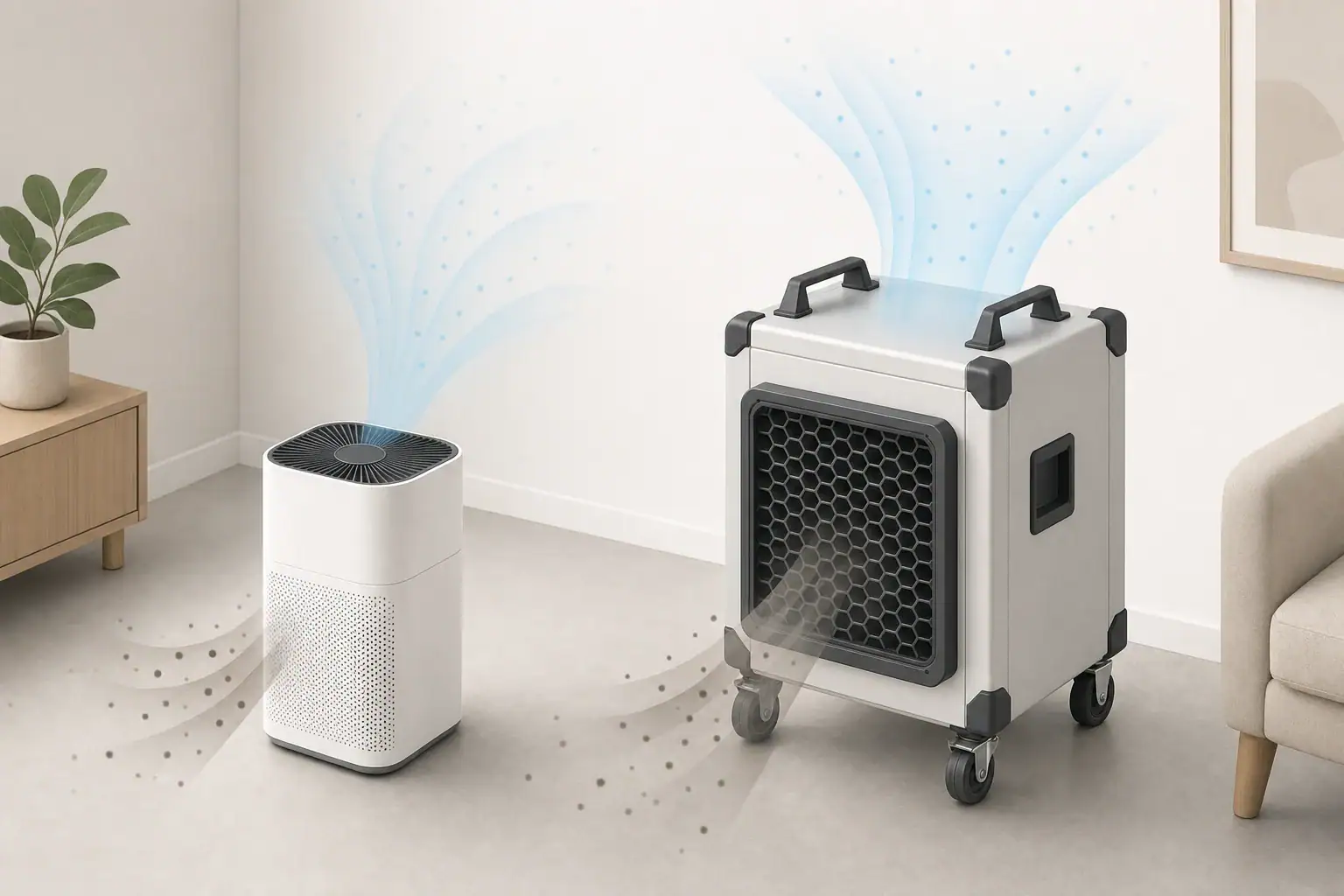
A residential air purifier is usually the practical choice for routine room air cleaning, while an air scrubber is generally intended for construction, remediation, or other temporary high-particle conditions. The terms sometimes overlap, so the filter, airflow rate, sealing, and operating method matter more than the product label. Neither option replaces source control, moisture correction, or appropriate ventilation.
- For everyday particle control, plan around roughly 4–5 air changes per hour, or ACH, when noise and energy use allow.
- Choose a purifier by smoke CADR when available; as a simple example, a 300-square-foot room with an 8-foot ceiling needs about 200 cubic feet per minute of clean air for 5 ACH.
- Use a true air scrubber mainly for contained renovation, restoration, or unusually dusty work, following its operating and exhaust requirements.
- Mechanical filters address particles. Activated carbon may help with some gases and odors, but thin carbon sheets have limited capacity.
- Avoid devices that intentionally produce ozone in occupied residential spaces.
What Air Scrubber and Air Purifier Mean
An air purifier is typically a portable residential appliance that pulls room air through one or more filters and returns the filtered air to the same space. Common components include a prefilter, a high-efficiency particle filter, and sometimes activated carbon.
An air scrubber is less consistently defined. In construction and restoration work, it usually means a durable, high-airflow filtration machine designed to capture airborne material during demolition, sanding, water-damage cleanup, or similar projects. Some models can discharge filtered air outside a contained work area to create negative pressure.
The term is also used for add-on HVAC devices that use ionization, ultraviolet light, catalysts, or other active processes. These installed products do not necessarily perform the same function as a portable remediation air scrubber. Their performance and byproducts must be evaluated technology by technology.
The main residential distinction
A purifier is designed for repeated use in occupied rooms, often with lower sound levels and multiple fan settings. A remediation scrubber emphasizes rugged construction, high airflow, containment compatibility, and short-term operation around a specific project.
How Filtration and Room Sizing Differ
Both devices may use HEPA filtration. A HEPA filter is commonly rated to capture at least 99.97% of particles at 0.3 micrometers under specified test conditions. That filter-media rating is not the same as whole-device performance because air can bypass a poorly sealed filter or leak through the cabinet.
For residential purifiers, clean air delivery rate, or CADR, combines airflow and particle-removal efficiency. A higher CADR means more filtered air is delivered each minute. Smoke CADR is often the most useful conservative value for planning around fine particles.
ACH describes how many room volumes pass through the cleaner per hour. The basic planning formula is:
ACH = CADR × 60 ÷ room volume in cubic feet
For example, a 300-square-foot room with an 8-foot ceiling has a volume of 2,400 cubic feet. A device delivering 200 cubic feet per minute provides about 5 ACH in that closed room. This is an illustrative estimate; open doors, tall ceilings, connected rooms, furniture, and airflow obstructions affect real performance.
About 4–5 ACH is a useful general planning range for routine particle reduction. A higher target, such as 5–6 ACH, may be practical during intermittent smoke or dusty conditions, but only if the device can operate at an acceptable sound level. These are planning targets rather than universal regulatory requirements.
| Feature | Residential air purifier | Remediation air scrubber |
|---|---|---|
| Primary role | Routine recirculating air cleaning | Temporary dust or project containment |
| Typical setting | Bedroom, living room, or home office | Renovation or restoration work area |
| Airflow approach | Returns cleaned air to the room | Recirculates or exhausts filtered air |
| Sizing method | CADR and desired ACH | Work-zone volume, containment, and project plan |
| Noise priority | Often designed for continuous occupied use | High airflow may take priority over quiet operation |
| Portability | Usually light enough for room-to-room use | Often larger, heavier, and built for job sites |
| Best fit | Everyday particles, dust, and smoke management | Short-term generation of heavy airborne debris |
Limits and Common Selection Mistakes
Air cleaning is only one part of indoor air quality management. A purifier or scrubber cannot correct an active water leak, remove settled contamination from surfaces, or provide fresh outdoor air. It also cannot make unsafe renovation practices acceptable.
Expecting particle filters to remove gases
HEPA filters capture particles, including dust, pollen, and many smoke particles. They do not meaningfully capture most gases. Activated carbon can adsorb some odors and volatile organic compounds, but capacity depends on the carbon type, mass, contact time, and specific gas. A thin carbon pad may become saturated quickly under a substantial gas load.
Using floor area without ceiling height
Room-size claims often assume a particular ceiling height and ACH. A 400-square-foot room with a 12-foot ceiling contains 50% more air than the same floor area with an 8-foot ceiling. Calculate volume when ceilings are unusually high.
Sizing for the highest setting only
The published CADR generally corresponds to a high fan speed. If that setting is too loud for sleeping or conversation, actual daily cleaning may be lower. Choosing enough capacity to meet the target at a comfortable medium setting can be more practical.
Treating an open floor plan as one small room
Clean air does not distribute evenly around walls, corridors, stairways, or large furniture. Multiple appropriately placed purifiers may produce more consistent coverage than one device at a distant end of a connected space.
Ignoring filter bypass
A high-grade filter cannot deliver its expected performance if air moves around it. Look for a close-fitting filter, intact gaskets, a well-sealed cabinet, and no visible gaps caused by incorrect installation.
Practical Home Decision Checklist
Start by identifying the pollutant, its source, and whether the condition is routine or temporary. This prevents using a filtration device where ventilation, cleaning, or moisture control would be more effective.
- For ordinary airborne particles: Use a residential purifier with a documented CADR and an appropriately sealed particle filter.
- For renovation dust: Isolate the work area, control dust at the source, and consider a remediation air scrubber sized for the contained zone.
- For outdoor smoke: Close obvious air leaks when conditions warrant, use mechanical filtration, and size for roughly 5 ACH if practical.
- For cooking emissions: Use a range hood exhausted outdoors when available. A purifier can supplement source ventilation but should not replace it.
- For dampness or mold growth: Correct the moisture source and clean or remove affected material appropriately. Filtration does not solve the underlying water problem.
- For odors or VOC concerns: Remove or isolate the source and ventilate when outdoor conditions permit. Carbon filtration is supplementary and has finite capacity.
Place a recirculating purifier where its intake and outlet have open space. Avoid pushing it tightly against curtains, furniture, or a wall unless its airflow design specifically allows that placement. Closing the room door generally improves predictable room-level ACH.
Real-World Residential Examples
Bedroom used every night
A 180-square-foot bedroom with an 8-foot ceiling contains 1,440 cubic feet. Approximately 120 cubic feet per minute of clean air would provide 5 ACH. Because nighttime noise matters, a larger purifier running below its maximum setting may be more usable than a smaller unit operating at full speed.
Open living and dining area
A connected 600-square-foot area with a 9-foot ceiling contains 5,400 cubic feet. Reaching 5 ACH would require about 450 cubic feet per minute of effective clean air. Two devices placed in separate airflow zones may distribute filtration more evenly than one unit, especially where a partial wall or furniture interrupts circulation.
Short remodeling project
During drywall sanding or floor work, source capture, barriers, careful cleanup, and appropriate work practices come first. A remediation air scrubber can supplement those measures by filtering the isolated work-zone air. If it is configured for negative pressure, exhaust routing and replacement air must be planned so combustion appliances and other building systems are not adversely affected.
Recurring basement mustiness
A purifier may capture airborne particles but will not lower humidity or repair seepage. Check for leaks, drainage problems, condensation, and elevated relative humidity. A dehumidifier is generally the relevant appliance when excess moisture is the main issue; a purifier may be used separately for particles.
Ozone, Ionizers, UV-C, and Safe Operation
Mechanical filtration is the straightforward default for occupied residential spaces because it captures particles without intentionally adding reactive substances to the air. Devices marketed with ionization, plasma, electrostatic, photocatalytic, or similar active features require additional evaluation.
Some electronic air-cleaning processes can produce ozone as a byproduct. Ozone is a respiratory irritant and should not be intentionally generated in occupied rooms. A regulatory certification related to ozone emissions does not establish particle-removal performance, and a CADR rating does not by itself evaluate all possible chemical byproducts.
UV-C can inactivate some microorganisms when the dose, exposure time, wavelength, and equipment design are appropriate. A small lamp inside a fast-moving residential air cleaner may have limited contact time. UV-C also does not remove dust, smoke particles, gases, or moisture, so it is not a substitute for filtration or source control.
Do not look directly at exposed UV-C lamps or operate equipment with damaged safety enclosures. Follow the listed installation, electrical, clearance, and filter requirements. Portable job-site scrubbers should use grounded outlets and should not be placed where they can draw in liquid, combustible vapor, or hot debris.
Creating negative pressure can affect fireplaces, furnaces, water heaters, and other combustion equipment. Professional planning is appropriate when exhausting substantial airflow from a home or when the project involves asbestos, lead, extensive contamination, or structural water damage.
Filter Maintenance, Noise, and Ownership Costs
Filters load with captured material, increasing airflow resistance and sometimes reducing CADR. Replacement schedules are estimates rather than fixed rules. Smoke, pets, construction dust, continuous operation, and high fan speeds can shorten service life.
Inspect washable prefilters regularly and clean them only as directed. A damp filter should not be returned to the device unless the instructions specifically permit it and it is fully dry. Do not vacuum or wash a non-washable HEPA filter unless its documentation explicitly allows that method.
Carbon filters may need replacement when odors return, but odor alone is not a reliable indicator for every gas. Saturated carbon cannot usually be restored through ordinary household cleaning. Keep spare-filter availability and annual replacement cost in mind when comparing devices.
Noise and energy use rise with fan speed. For continuous operation, compare performance at the speed you are likely to tolerate rather than relying only on the maximum setting. Clean intakes, unobstructed outlets, and timely filter changes help maintain airflow without unnecessary fan strain.
| Component | Planning interval | What may shorten it | Practical reminder |
|---|---|---|---|
| Washable prefilter | Inspect every 2–4 weeks | Pets, lint, or heavy dust | Clean and dry as directed |
| Disposable prefilter | About 1–3 months | Construction dust or smoke | Replace if loaded or damaged |
| Portable purifier particle filter | About 6–18 months | Long runtime or high particle levels | Check airflow and filter indicator |
| Thin activated carbon pad | About 1–6 months | Frequent cooking or odor sources | Capacity may be limited |
| Deep carbon filter | About 6–24 months | High gas concentration or humidity | Follow weight and replacement guidance |
| Central HVAC filter | About 1–3 months | High system use or dusty conditions | Use only approved resistance ratings |
Related guides: How to Choose the Right Air Purifier for Your Room Size • Air Purifier Placement: Where to Put It for Best Results • Air Purifier vs Dehumidifier: Which One Solves Musty Air? • Air Purifier vs Ozone Generator: Safety, Effectiveness, and Myths
Air Scrubber vs Air Purifier Takeaways
For routine home use, a residential air purifier is generally the appropriate option. Size it with CADR, room volume, and a realistic fan setting, aiming for roughly 4–5 ACH for general particle management when practical.
A remediation air scrubber is better suited to contained projects that generate substantial airborne dust or require controlled exhaust. Its use should be part of a broader plan that includes source control, isolation, safe work practices, and cleanup.
Neither device corrects excess humidity, removes a pollution source, or supplies outdoor air. Match the tool to the problem: filtration for particles, activated carbon as limited support for some gases, ventilation for suitable source removal, and moisture control for dampness. Favor sealed mechanical filtration and avoid intentional ozone generation in occupied areas.
Frequently asked questions
Is an air scrubber better than an air purifier for wildfire smoke?
For routine wildfire smoke in an occupied room, a residential air purifier with a documented smoke CADR is usually the better fit. Choose enough clean-air capacity for the room volume and a fan speed you can use for extended periods. A job-site air scrubber may be useful for temporary high-dust work, but it is often louder and less practical for daily home use.
Can an air scrubber remove mold from the air in a house?
An air scrubber with effective particle filtration may capture some airborne mold spores, but it does not remove mold growing on building materials or correct the moisture problem that supports growth. Leaks, condensation, drainage, and elevated humidity need to be addressed first. Significant or widespread contamination may require a professional remediation plan.
How do I size an air purifier for a bedroom?
Calculate room volume by multiplying floor area by ceiling height, then compare that volume with the purifier’s CADR. For a planning target of about 5 ACH, divide the room volume by 12 to estimate the needed CADR in cubic feet per minute. Select a unit that can provide useful airflow at a tolerable nighttime noise level, not only at its highest setting.
Do HEPA filters remove odors and volatile organic compounds?
HEPA filters are designed for particles and do not meaningfully remove most odors, gases, or volatile organic compounds. Activated carbon can reduce some gases and odors, but effectiveness depends on the amount and type of carbon, contact time, and pollutant concentration. Source removal and appropriate ventilation remain important for persistent chemical odors.
Is it safe to run an air scrubber with negative pressure inside a home?
Negative-pressure operation can be appropriate for a properly contained renovation or remediation area, but exhaust routing and replacement air must be planned carefully. Removing substantial indoor air can interfere with fireplaces, furnaces, water heaters, and other combustion appliances. Professional guidance is advisable for major projects, hazardous materials, or homes with combustion equipment.
Recommended next:
- HEPA vs Activated Carbon: Best Setup for Allergies, Odors, and Smoke
- Air Purifier vs Dehumidifier: Which One Solves Musty Air?
- Humidifier vs Dehumidifier: When to Add Moisture vs Remove It
- Air Purifier vs Ozone Generator: Safety, Effectiveness, and Myths
- HEPA vs Carbon Filters: When Each One Matters Most
- Air Purifier vs Ventilation: Which Fixes Stuffy Bedrooms Better?
- Clear sizing logic (room size → CADR/ACH)
- HEPA vs carbon explained for real use-cases
- Humidity + ventilation basics to reduce mold risk