
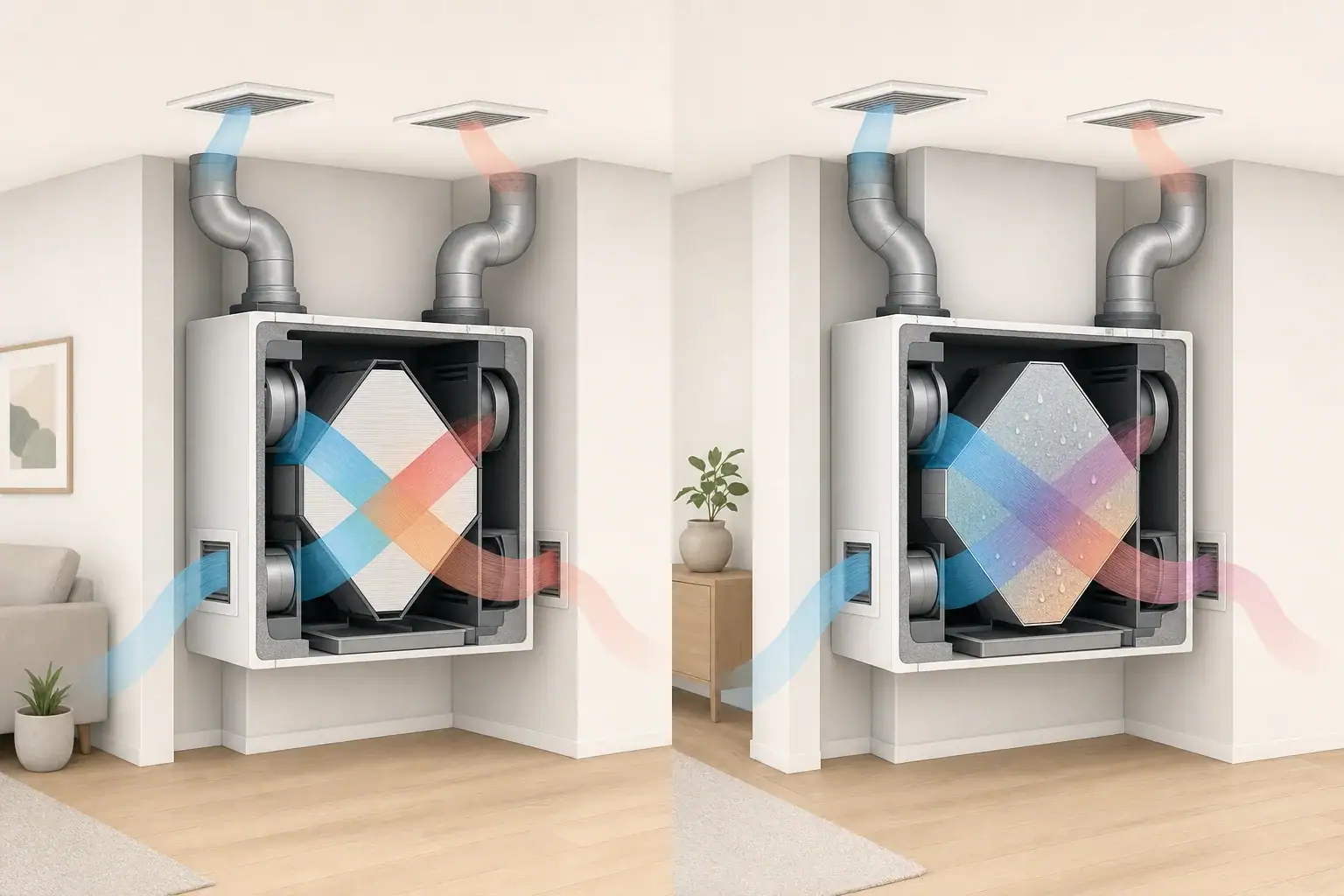
An ERV transfers both heat and some moisture between outgoing and incoming air, while an HRV primarily transfers heat.
Both systems provide controlled ventilation by exhausting stale indoor air and bringing in filtered outdoor air. The better choice depends mainly on climate, indoor humidity, home airtightness, occupancy, and how the system will be installed and maintained.
Quick answer
- Choose based on moisture conditions as well as temperature: an ERV moderates moisture transfer, while an HRV removes more indoor moisture during cold, dry weather.
- A general indoor relative humidity range of about 30% to 50% is practical for many homes, although season, climate, and building conditions matter.
- Run balanced ventilation continuously at a low setting when possible, with temporary higher airflow during cooking, bathing, or gatherings.
- Inspect filters about every 1 to 3 months and clean or replace them according to system instructions and actual dust loading.
- Use a qualified design calculation rather than selecting equipment only by square footage; airflow needs also depend on bedrooms, occupants, layout, and local code.
What ERVs and HRVs Do for Home Air Quality
Energy recovery ventilators and heat recovery ventilators are types of balanced mechanical ventilation. They usually have two separate air streams: one carries stale indoor air outside, and the other brings outdoor air inside. The streams pass through a recovery core without intentionally mixing.
During winter, heat from outgoing indoor air warms the colder incoming air. During summer, the process works in reverse, reducing some of the heat entering with outdoor air. This recovery lowers the heating or cooling penalty compared with opening windows or operating a basic exhaust fan continuously.
The main indoor air quality benefit is predictable air exchange. Ventilation can dilute carbon dioxide, cooking byproducts, odors, moisture, and pollutants released by furnishings or household activities. Filters in the unit also capture some outdoor particles before supply air reaches living areas.
However, neither an ERV nor an HRV is a complete air-cleaning system. Standard ventilation filters may not provide the same particle removal as a properly sized portable or central air cleaner. Ventilation can also bring in outdoor smoke or pollution, so operation may need to be adjusted during poor outdoor air conditions.
How Heat and Moisture Transfer Differ
An HRV uses a heat-exchange core that transfers sensible heat while allowing most moisture to leave with the exhaust air. In a cold climate, this can help remove excess humidity created by showers, cooking, plants, and occupants. It can also make an already dry home feel drier during winter.
An ERV transfers sensible heat and a portion of the moisture, sometimes called latent energy. In winter, it can return some outgoing moisture to the incoming air. In hot, humid weather, it can transfer some moisture from incoming air to the cooler, drier exhaust stream before that air enters the home.
Moisture transfer does not mean an ERV actively humidifies or dehumidifies the house. It only moderates the moisture difference between the two air streams. A home with a wet basement, plumbing leak, oversized cooling system, or heavy indoor moisture production may still need source correction or dedicated dehumidification.
Example values for illustration.
| Consideration | ERV | HRV |
|---|---|---|
| Heat transfer | Transfers heat | Transfers heat |
| Moisture transfer | Transfers a portion of moisture | Transfers little moisture through the core |
| Cold, dry winter | May limit excessive indoor drying | Can remove more indoor moisture |
| Hot, humid summer | Reduces part of the incoming moisture load | Does not recover meaningful moisture |
| Persistently damp home | Not a substitute for dehumidification or repairs | May remove moisture when outdoor air is drier |
| Filtration role | Filters incoming air within system limits | Filters incoming air within system limits |
| Primary selection factor | Climate and moisture balance | Climate and moisture balance |
Ventilation Sizing and Airflow Planning
ERV and HRV sizing is normally expressed in cubic feet per minute, or cfm. The correct design airflow is not simply the maximum airflow listed for a unit. Residential ventilation calculations commonly consider conditioned floor area, number of bedrooms, expected occupancy, exhaust locations, and applicable building codes or standards.
A system should be able to provide the required continuous airflow without operating at its loudest setting all the time. Some extra capacity is useful for temporary boosts, but a substantially oversized unit may cost more, create unnecessary noise, or operate inefficiently if controls and ducts are not designed correctly.
Distribution matters as much as rated airflow
Supply air is often directed to bedrooms and main living spaces. Exhaust air is commonly drawn from bathrooms, laundry areas, or other locations where moisture and odors originate. Kitchen range hoods generally remain separate because grease and high cooking loads require purpose-built exhaust equipment.
Airflow should be measured and balanced after installation. If the exhaust side moves much more air than the supply side, the home may become depressurized. If supply is much higher, the home may become positively pressurized. Either condition can move moisture through building assemblies or affect combustion appliances.
Local codes and commonly used residential ventilation standards provide calculation methods, but requirements vary. A qualified HVAC professional can account for duct resistance, climate, equipment controls, and interactions with other mechanical systems.
Common ERV and HRV Mistakes and Troubleshooting Cues
A frequent mistake is selecting an ERV automatically for every humid climate or an HRV automatically for every cold climate. Climate is important, but indoor moisture patterns also matter. A cold-climate home that is consistently too dry may benefit from moisture recovery, while a crowded or damp home may need stronger moisture removal.
Other common problems include:
- Blocked or dirty filters: Reduced airflow, increasing fan noise, or weak air at grilles can indicate a maintenance issue.
- Unbalanced airflow: Doors that move unexpectedly, drafts near exterior openings, or combustion concerns warrant professional airflow testing.
- Poor duct placement: Supply and exhaust grilles located too close together may short-circuit airflow instead of ventilating the room.
- Condensation or frost: Cold-weather operation may require a built-in defrost strategy and correctly installed condensate drainage.
- Excessive noise: Undersized ducts, high fan speed, restrictive filters, or vibration transfer can make normal operation disruptive.
- Unrealistic humidity expectations: An ERV cannot correct water intrusion, and an HRV cannot safely dry a home when outdoor air is warm and humid.
Condensation around ducts, water near the cabinet, persistent frost, unusual odors, or sudden airflow changes should be evaluated rather than ignored. Do not bypass defrost controls, alter safety components, or install filters that exceed the system’s approved resistance without professional guidance.
How to Choose Between an ERV and an HRV
Start by reviewing actual indoor conditions through more than one season. A basic humidity monitor can show whether the home tends to become dry, comfortable, or damp. Outdoor climate data and observations of window condensation, static electricity, basement dampness, or long bathroom drying times add useful context.
Use this homeowner checklist
- Identify whether winters are mainly cold and dry, mild and wet, or mixed.
- Consider whether summers are humid and whether air conditioning already controls moisture effectively.
- Measure indoor relative humidity in several rooms over time rather than relying on one reading.
- Count bedrooms and review floor area for a code-based ventilation calculation.
- Confirm that supply and exhaust ducts can reach appropriate rooms.
- Ask how the installer will measure and balance airflow.
- Check access space for filters, the core, drain components, and exterior hoods.
- Compare sound ratings at the airflow setting likely to be used continuously.
- Plan for filter costs, cleaning, electricity, and periodic service.
If indoor humidity regularly exceeds about 50% to 60%, first investigate moisture sources and outdoor conditions. If winter humidity remains below roughly 30%, increasing outdoor ventilation may make dryness more noticeable. These ranges are general planning cues, not universal limits.
Real-World Climate and Home Examples
A newer home in a cold, dry region
A tightly built house may retain moisture from occupants but become dry during long heating seasons. An HRV can be appropriate if winter condensation is a recurring concern. An ERV may be considered when humidity is already low and additional drying would reduce comfort. Airflow control remains important with either option.
A home in a hot, humid region
An ERV can reduce part of the moisture entering with required outdoor air, easing the latent load on the cooling system. It does not replace air conditioning or a dehumidifier. Ducts located in hot attics or other unconditioned spaces also need careful sealing and insulation to avoid condensation and energy loss.
A mixed-climate home
In a location with humid summers and cool winters, either system may be workable. An ERV often provides balanced seasonal moisture moderation, while an HRV may suit a home that produces substantial winter moisture. Controls that allow low continuous airflow and event-based boosts can help across seasons.
An apartment or older, leaky house
Installation may be constrained by exterior-wall access, shared ventilation, limited duct routes, or building rules. A leaky house still may have rooms with poor air exchange, but uncontrolled leakage is not the same as balanced ventilation. Before adding equipment, determine whether a central building system already supplies or exhausts air.
In all scenarios, source control remains the first step. Use local exhaust for cooking and bathing, repair leaks, keep combustion equipment vented correctly, and avoid introducing unnecessary indoor pollutants.
Safety, Controls, and Ongoing Maintenance
ERVs and HRVs generally rely on mechanical filtration and heat or energy exchange; they do not need ozone generation. If a ventilation product includes ionization, ultraviolet equipment, or another electronic air-treatment feature, evaluate it separately. Look for clear safety documentation and avoid equipment intended to produce ozone in occupied spaces.
Homes with fireplaces, fuel-burning furnaces, water heaters, or other combustion appliances require particular attention to pressure balance. Carbon monoxide alarms should be installed and maintained according to local requirements and alarm instructions. Ventilation equipment does not replace combustion inspection or carbon monoxide detection.
Maintenance intervals depend on outdoor debris, indoor dust, pets, construction activity, wildfire smoke, and operating time. A practical routine includes checking filters every one to three months, cleaning exterior intake and exhaust hoods, inspecting the recovery core, and confirming that condensate drains remain open where applicable.
Core cleaning methods vary. Some HRV cores may be washable, while some ERV cores require dry cleaning or another specific procedure. Follow the equipment documentation rather than soaking, vacuuming, or applying chemicals without confirmation.
A monitor can help evaluate patterns, but it cannot prove that ventilation is correctly sized or balanced. Readings are most useful as trends alongside humidity observations, outdoor conditions, and professional airflow measurements.
Example values for illustration.
| Metric | What it indicates | Common pitfall | Practical response |
|---|---|---|---|
| Relative humidity | Indoor moisture level | Sensor affected by nearby vents | Compare several rooms and seasons |
| Carbon dioxide | Occupancy and ventilation trend | Treating one reading as a safety limit | Watch for repeated rises during occupancy |
| PM2.5 | Fine-particle trend | Ignoring outdoor smoke | Compare indoor and outdoor conditions |
| TVOC | Broad response to some gases | Assuming it identifies a specific chemical | Use trends to investigate sources |
| Temperature | Comfort and system context | Measuring beside a supply grille | Place the sensor in a representative area |
| Outdoor air quality | Whether ventilation may import pollutants | Assuming outdoor air is always cleaner | Adjust operation during unusual events |
Related guides: ERV vs HRV: What They Do for Indoor Air Quality • Best Indoor Humidity Level to Prevent Mold (With Seasonal Targets) • Exhaust Fan Best Practices: Bathrooms and Kitchens That Actually Clear Air • Ventilating During Wildfire Smoke: When Keeping Windows Closed Is Better
Key Takeaways for Homeowners
The basic ERV versus HRV decision centers on moisture transfer. Both recover heat and provide balanced outdoor air, but an ERV moderates moisture exchange while an HRV allows more indoor moisture to be exhausted.
An ERV often fits homes where limiting winter dryness or summer moisture entry is useful. An HRV often fits homes where winter moisture removal is a priority. Neither choice should be based on climate labels alone.
For reliable results, combine a code-appropriate airflow calculation with good duct design, measured balancing, accessible maintenance, and realistic humidity expectations. Continue using source control, kitchen and bathroom exhaust, particle filtration when needed, and outdoor air quality awareness as parts of a broader home air quality plan.
Frequently asked questions
Is an ERV or HRV better for a cold climate?
Either system may work in a cold climate, but winter indoor humidity is an important deciding factor. An HRV generally exhausts more indoor moisture and may help when window condensation or excess winter humidity is recurring. An ERV may be preferable when the home becomes uncomfortably dry during the heating season.
Should I choose an ERV for a hot and humid climate?
An ERV is often useful in hot, humid climates because it transfers part of the incoming moisture to the exhaust air stream. This can reduce the moisture load added by required ventilation. It does not replace properly sized air conditioning, dehumidification, or moisture-source repairs.
Can an ERV or HRV improve indoor air quality during wildfire smoke?
Both systems can provide filtered outdoor air, but their standard filters may not be sufficient for heavy smoke conditions. During poor outdoor air events, follow local public-health guidance and consider reducing outdoor-air intake if the system and building conditions allow. A properly sized air cleaner can provide additional particle control indoors.
How often should ERV or HRV filters be checked?
Checking filters every one to three months is a practical starting point, although actual replacement needs depend on dust, pets, outdoor debris, construction, and smoke exposure. Dirty filters can reduce airflow, increase noise, and affect system balance. Use only filter types and maintenance procedures approved for the equipment.
Does an ERV or HRV need to run all the time?
Many homes benefit from low continuous balanced ventilation because it provides predictable air exchange. Higher temporary airflow can be used for bathing, cooking, entertaining, or other periods of higher moisture and pollutant production. The final operating schedule should match the ventilation design, local requirements, noise limits, and outdoor air conditions.
Recommended next:
- HEPA vs Activated Carbon: Best Setup for Allergies, Odors, and Smoke
- Air Purifier vs Dehumidifier: Which One Solves Musty Air?
- Humidifier vs Dehumidifier: When to Add Moisture vs Remove It
- Air Purifier vs Ozone Generator: Safety, Effectiveness, and Myths
- HEPA vs Carbon Filters: When Each One Matters Most
- Air Purifier vs Ventilation: Which Fixes Stuffy Bedrooms Better?
- Clear sizing logic (room size → CADR/ACH)
- HEPA vs carbon explained for real use-cases
- Humidity + ventilation basics to reduce mold risk