
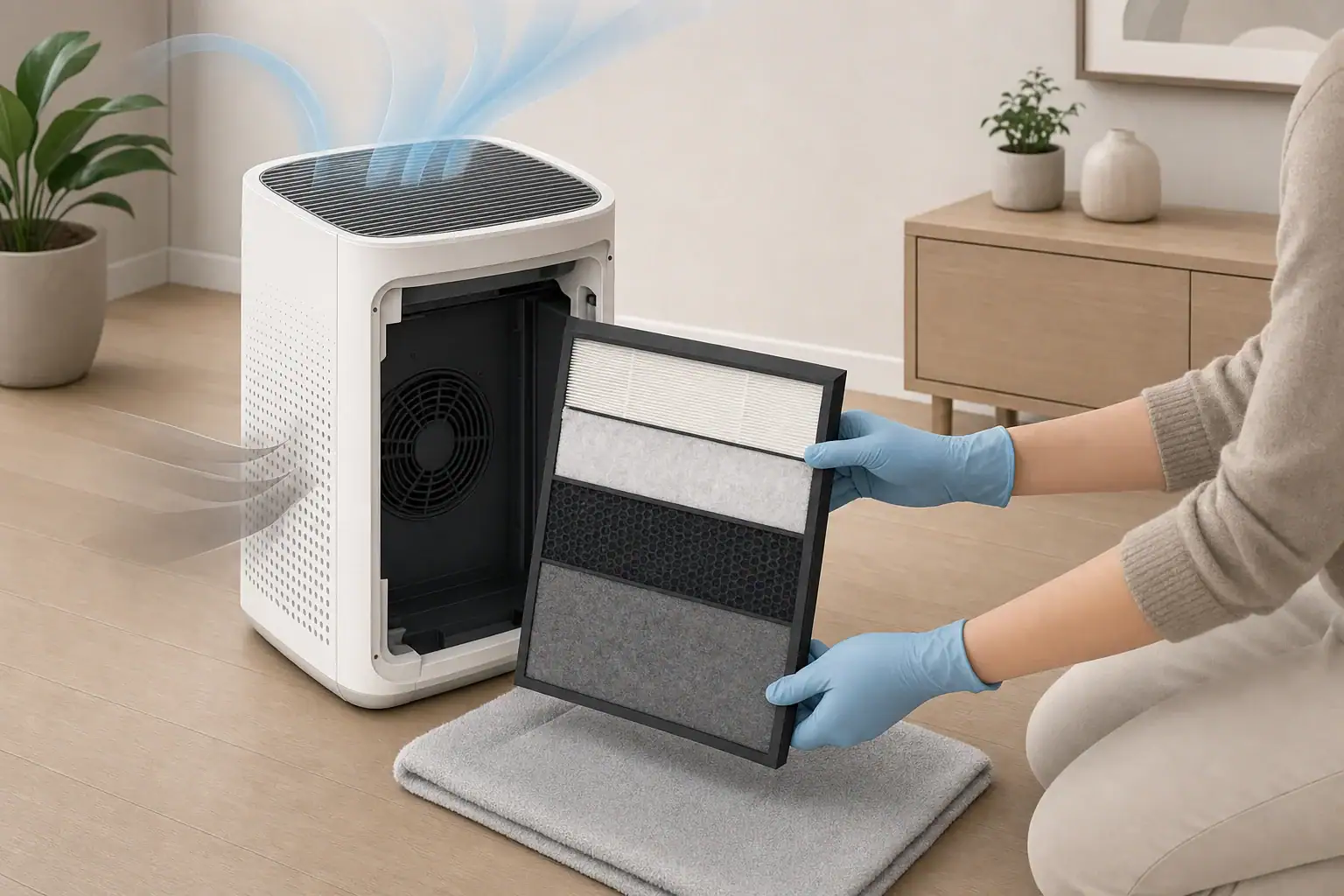
An air purifier can reduce airborne particles and some odors after water damage, but it cannot dry materials, remove established mold, or replace physical cleanup. Its useful role begins alongside moisture control: stop the water, remove damaged material as appropriate, dry the area, and keep indoor humidity under control. If contaminated water, extensive damage, or unsafe electrical conditions are involved, professional assessment may be appropriate.
- Use dehumidification and ventilation when outdoor conditions allow; aim to keep relative humidity below 60%, with roughly 30% to 50% serving as a common indoor target.
- Start drying wet materials promptly. A 24- to 48-hour window is commonly used as practical guidance, although actual drying time depends on the material and conditions.
- Choose a purifier with an effective particle filter, adequate airflow, and a well-sealed filter path. HEPA filtration can capture airborne mold spores but cannot remove mold growing on a surface.
- For planning, 4 to 6 air changes per hour can be a reasonable example range during cleanup, provided the purifier can run at that setting without excessive noise.
- Replace any purifier filter that becomes wet, visibly contaminated, or persistently musty rather than trying to dry and reuse it.
What an Air Purifier Can and Cannot Do After Water Damage
Water damage creates two separate indoor air quality tasks: controlling moisture at the source and managing material released into the air. An air purifier addresses only the second task. It circulates room air through filters that can collect particles such as dust, fragments from damaged materials, and airborne mold spores.
A purifier does not pull meaningful amounts of water from walls, carpet, wood, or insulation. That requires water extraction, removal of unsalvageable materials, ventilation when suitable, and often a dehumidifier. A purifier also cannot clean mold hidden behind drywall or under flooring.
Odor reduction has similar limits. Activated carbon may reduce some airborne odor compounds, but a continuing musty smell often indicates damp or contaminated material that still needs attention. Masking or filtering the odor without correcting the source is not a complete solution.
Think of the purifier as a supporting device. It can help control particles while the room is being dried and cleaned, then continue filtering residual airborne dust after the source has been resolved.
Filters, CADR, and Airflow for a Damp Room
A particle filter is the main feature to consider after water damage. A properly installed HEPA filter is designed to capture very small particles, including airborne spores. Labels such as H13 or H14 describe filter-media classifications, but the complete purifier also needs adequate airflow and a sealed air path. Air that leaks around the filter reduces real-world performance.
Activated carbon serves a different purpose. It can adsorb some gases and odors, but a thin carbon sheet may have limited capacity. Carbon does not capture moisture and should not be treated as a substitute for removing odor-producing materials.
Room sizing can be estimated with air changes per hour, or ACH. Multiply room volume in cubic feet by the desired ACH, then divide by 60 to estimate the required clean air delivery rate in cubic feet per minute. For example, a 200-square-foot room with an 8-foot ceiling contains 1,600 cubic feet. At 5 ACH, the illustrative requirement is about 133 cubic feet per minute.
Select based on the speed the purifier will actually use. A unit capable of the desired airflow only at an uncomfortably loud maximum setting may deliver less practical filtration if it is routinely turned down.
Example values for illustration.
| Condition | Primary response | Purifier role |
|---|---|---|
| Standing water | Stop the source and extract water safely | Secondary; do not place equipment in an electrically unsafe area |
| Wet walls, carpet, or wood | Dry, inspect, or remove material | Captures some airborne particles during work |
| Indoor humidity above 60% | Use dehumidification or suitable ventilation | Does not lower humidity |
| Airborne cleanup dust | Contain dust and clean with appropriate methods | Particle filtration may reduce suspended dust |
| Musty odor | Find and correct the moisture or material source | Carbon may provide limited supplemental odor control |
| Visible mold growth | Assess the affected materials and cleanup scope | Does not remove growth from surfaces or cavities |
Mold Risk, Warning Signs, and Common Mistakes
Mold growth becomes more likely when moisture remains in porous materials. Temperature, material type, airflow, and the original water source all affect the outcome, so no purifier setting can guarantee prevention. Prompt drying and removal of materials that cannot be dried are more important than filter grade.
Useful warning signs include continuing dampness, condensation, discoloration, swelling, soft drywall, peeling finishes, or a musty odor that returns after ventilation. A moisture meter can help compare damp and dry areas, but readings must be interpreted for the material being tested.
Common mistakes include:
- Running only an air purifier while leaving carpet padding, drywall cavities, or insulation wet.
- Pointing a high-velocity fan directly at visible suspected mold, which may spread material before containment or cleaning is planned.
- Using indoor humidity readings from only one location, especially next to a dehumidifier or open window.
- Assuming a low PM2.5 reading proves that a wall cavity is dry or mold-free. Particle monitors do not identify mold or hidden moisture.
- Keeping a filter that became wet because it still looks clean.
- Using fragrances or ozone-generating devices to cover odors instead of addressing their source.
Cleanup scope also matters. A small, clean-water spill on a hard surface is different from widespread flooding, sewage-contaminated water, or damage involving HVAC ducts and concealed cavities. The latter situations generally warrant more cautious assessment.
Post-Water-Damage Cleanup Checklist
Control water and electrical hazards first
Stop the leak if it is safe to do so. Avoid using plug-in equipment in standing water or where outlets, cords, or appliances may have become wet. Electrical conditions should be evaluated before purifiers, fans, or dehumidifiers are operated in the affected space.
Remove water and evaluate materials
Extract standing water and inspect nearby flooring, baseboards, wallboard, cabinets, furnishings, and insulation. Nonporous surfaces are generally easier to clean and dry than absorbent materials. Porous items that remain wet, cannot be accessed, or are contaminated may require removal rather than surface drying.
Dry the space and track humidity
Use a dehumidifier, appropriate ventilation, and controlled air movement. Outdoor ventilation is most useful when outside air is drier and does not introduce smoke, heavy pollution, or excessive humidity. Check relative humidity in several parts of the room rather than directly beside the drying equipment.
Add particle filtration
Place the purifier on a stable, dry surface with clearance around its intake and outlet. Keep it close enough to the work area to capture particles, but outside containment barriers unless the cleanup plan specifies otherwise. Closing doors can improve filtration in a single room, while open-plan areas may require more airflow or multiple units.
Clean without redistributing debris
A purifier is not a construction vacuum. Use cleanup methods suited to the material and contamination involved. Avoid sweeping fine debris aggressively into the air. After work is complete, clean settled dust and continue filtration while checking that humidity and odors remain stable.
Examples of Air Purifier Use in Common Water-Damage Scenarios
Small clean-water leak in a bedroom
After the leak is stopped, wet bedding and movable items can be removed, and the floor and wall area can be dried. A particle-filter purifier may run in the room to manage disturbed dust. A dehumidifier, not the purifier, handles excess moisture.
Wet carpet and padding
Surface drying may not reveal water held in padding or the subfloor. The key decision is whether all layers can be fully accessed and dried. A purifier can collect airborne particles during removal, but it does not draw water from the carpet assembly.
Musty basement after seepage
First address seepage, drainage, wet contents, and humidity. Carbon filtration may temporarily reduce some odor, while particle filtration handles airborne debris. If the odor returns when the purifier is off, continue looking for damp material rather than simply increasing purifier speed.
Large or contaminated water event
Floodwater, sewage, extensive hidden damage, and affected HVAC components require controls beyond ordinary room filtration. Isolation, protective equipment, material removal, and professional procedures may be needed. A portable purifier should not be considered a substitute for a defined remediation plan.
Safety Considerations for Ionizers, Ozone, and UV-C
A conventional mechanical purifier using particle and carbon filters is usually the simplest approach for occupied home spaces. Avoid equipment designed to generate ozone intentionally. Ozone is a reactive gas and is not needed for routine post-water-damage particle filtration.
Some purifiers include ionization or other electronic air-cleaning functions. Performance and emissions vary, so review independent safety certification and determine whether the electronic feature can be disabled. An ozone-related certification addresses emissions; it does not establish that wet materials have been dried or cleaned.
UV-C may inactivate some microorganisms under sufficient exposure, but effectiveness depends on dose, distance, shielding, and air speed. A small lamp inside a portable device does not remediate mold on walls, flooring, furniture, or concealed building materials. UV-C also does not remove particles unless the device includes effective filtration.
Filters loaded with cleanup dust should be handled gently. Follow the equipment instructions, avoid striking or shaking filters indoors, and use protective measures appropriate to the cleanup conditions.
Filter Inspection, Replacement, and Ongoing Maintenance
Inspect the purifier before using it after a water event. Confirm that the housing, plug, and cord remained dry and that the unit has no visible contamination. If water entered the electrical components, stop using the device until it has been evaluated according to its safety instructions.
Check the prefilter frequently during demolition or dusty cleanup. A clogged prefilter restricts airflow and lowers the amount of filtered air delivered to the room. Clean it only by the method allowed by the manufacturer, and let washable components dry completely before reinstallation.
Do not wash a HEPA or carbon filter unless it is explicitly designed for washing. Water can damage filter fibers, adhesives, carbon media, and seals. Any filter that becomes wet, develops visible growth, or retains a musty odor should generally be replaced.
Calendar reminders are useful, but condition and operating hours matter more than a fixed date. Heavy dust, continuous high-speed use, smoke, and elevated humidity can shorten service life. Keep a dry replacement filter stored in its protective packaging outside the affected area.
Example values for illustration.
| Filter or component | Example planning interval | Replace or service sooner when |
|---|---|---|
| Washable prefilter | Inspect weekly during active cleanup | Dust visibly covers the surface or airflow falls |
| Disposable prefilter | Inspect every 1 to 2 weeks during cleanup | It is wet, damaged, heavily loaded, or odorous |
| HEPA filter | Often checked at 6 to 12 months in routine use | It becomes wet, contaminated, damaged, or airflow declines |
| Activated carbon filter | Often checked at 3 to 6 months | Odors return quickly or the media becomes damp |
| Combination filter | Follow the shortest applicable media interval | Either particle or odor performance declines |
| Intake and outlet grilles | Inspect monthly and after dusty work | Debris blocks openings or settles inside accessible areas |
Related guides: Air Purifier for Mold Spores: What Works and What Doesn’t • Air Purifier vs Dehumidifier: Which One Solves Musty Air? • Air Purifier vs Ozone Generator: Safety, Effectiveness, and Myths
Summary: Where an Air Purifier Fits in Water-Damage Cleanup
An air purifier is a supplemental particle-control tool after water damage, not a drying or mold-removal device. Moisture correction, water extraction, material assessment, and humidity control come first.
Use effective particle filtration with adequate CADR, a sealed filter path, and unobstructed airflow. Carbon can help with some residual odors, but continuing odor calls for source investigation. Keep relative humidity below 60%, inspect filters more frequently during cleanup, and replace any media that becomes wet or contaminated.
For extensive, hidden, or contaminated damage, ordinary portable filtration has clear limits. A defined cleanup plan and appropriate professional assessment are more important than increasing purifier speed or selecting a higher filter classification.
Frequently asked questions
Should I run an air purifier immediately after water damage?
Run an air purifier only after electrical safety has been addressed and the unit can be placed on a dry, stable surface. It can help capture airborne dust and spores disturbed during cleanup, but water extraction and drying should begin first.
Can an air purifier remove a musty smell after a leak?
An activated-carbon filter may reduce some airborne odor compounds temporarily. A persistent or returning musty odor usually means damp, contaminated, or mold-affected material remains and should be investigated rather than masked.
What size air purifier is needed after water damage?
Size the purifier by its clean air delivery rate and the room volume, not only the room’s square footage. During cleanup, an example target of 4 to 6 air changes per hour can be useful, provided the unit can operate at the required airflow in practical conditions.
Will a HEPA air purifier prevent mold after flooding?
HEPA filtration can capture airborne particles, including mold spores, but it cannot prevent mold if building materials remain wet. Prompt extraction, drying, humidity control, and removal of unsalvageable materials are the primary mold-control measures.
Should I replace an air purifier filter if it got wet?
Yes, a filter that becomes wet, visibly contaminated, or persistently musty should generally be replaced. Do not wash or dry a HEPA or carbon filter unless the manufacturer specifically states that the filter is washable.
Recommended next:
- Air Purifier Maintenance Checklist: Filters, Sensors, and Cleaning
- When to Replace Carbon Filters (And How to Tell They’re Spent)
- How to Clean and Calibrate an Air Quality Monitor
- Air Purifier Maintenance Checklist: Monthly and Seasonal Tasks
- Filter Replacement Schedules: HEPA, Carbon, and Pre-Filters
- Cleaning Air Purifier Sensors and Intakes: What Not to Do
- Clear sizing logic (room size → CADR/ACH)
- HEPA vs carbon explained for real use-cases
- Humidity + ventilation basics to reduce mold risk