
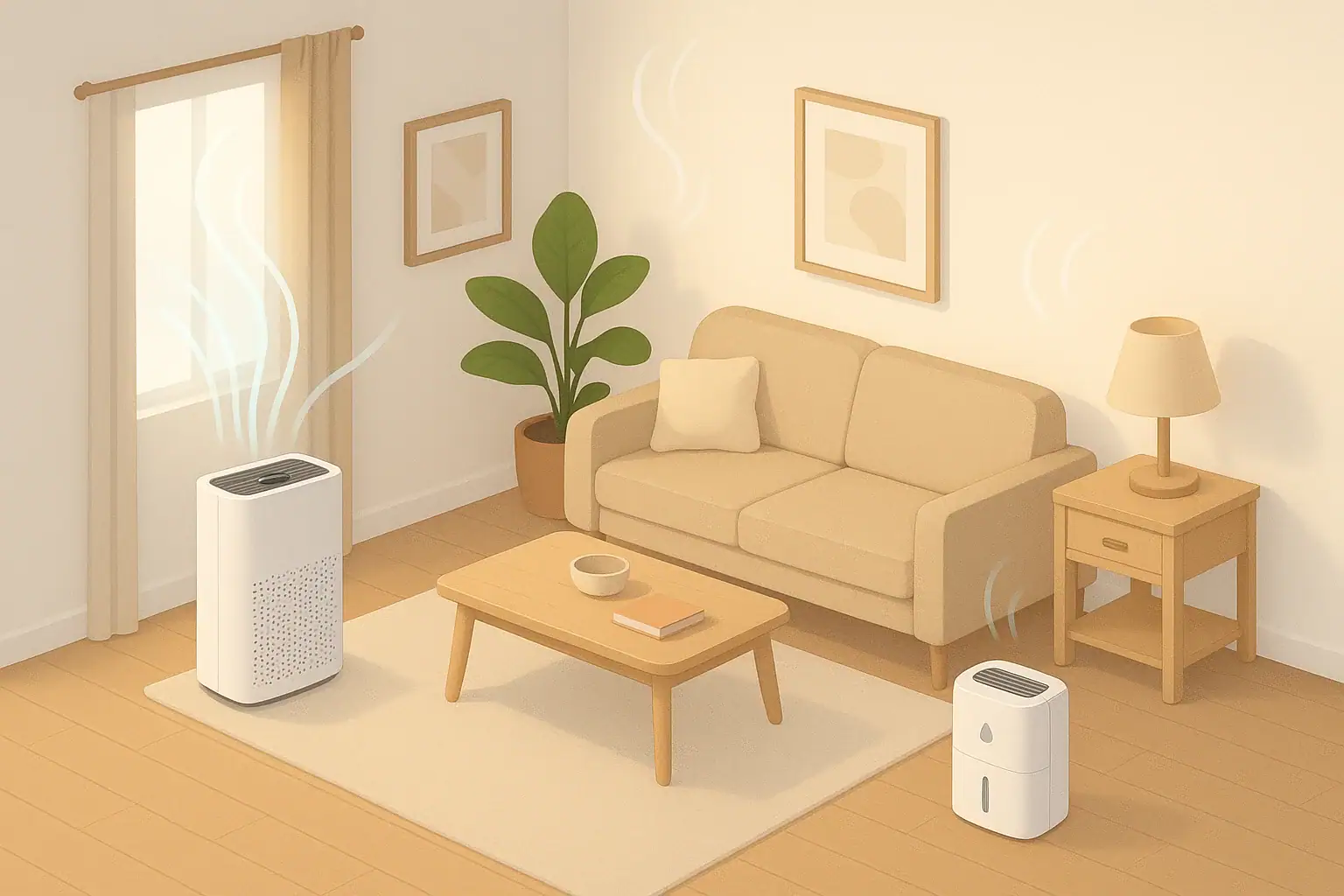
An air purifier with a high-efficiency particle filter can reduce airborne mold spores in a room, but it cannot remove mold growth or fix moisture problems. Used correctly, a room air cleaner is best seen as a support tool alongside humidity control, leak repair, and proper cleaning to keep indoor air healthier and help limit mold exposure.
Many people search for an air purifier for mold spores after noticing musty smells, visible mold, or allergy-like symptoms. Mold remediation can feel overwhelming, and it is tempting to hope that a single machine will solve everything. This guide explains what air purifiers can realistically do for mold, which features matter, and how to size, place, and maintain a unit so you get meaningful results instead of just moving air and noise.
By the end, you will understand how mold spores behave, how filtration and airflow interact, where air purifiers fit in a whole-home moisture strategy, and which specifications to look for when you are ready to choose or upgrade a purifier.
What an Air Purifier for Mold Spores Really Does (and Why It Matters)
An air purifier for mold spores is simply a particle filter with enough airflow to pull room air through it several times per hour. Mold spores are microscopic, but they are still large enough for high-efficiency mechanical filters to capture. That makes filtration a practical way to lower airborne spore levels in a specific space.
Understanding what this does and does not mean is critical:
- What it does: Reduces the number of spores and spore-laden dust particles floating in the air while the unit is running.
- What it does not do: Remove mold growing on drywall, carpets, or framing, or correct the damp conditions that allowed mold to grow.
This distinction matters for health and comfort. People sensitive to mold may notice fewer symptoms in a room where airborne spores are reduced, especially bedrooms and living areas where they spend many hours. At the same time, if moisture problems continue, new spores will keep entering the air, and the purifier will only be managing part of the issue.
Thinking of the purifier as “respiratory protection for the room” rather than “mold removal for the building” helps set realistic expectations and encourages a broader plan that also addresses humidity, leaks, and cleaning.
Key Concepts: How Mold Spores and Air Purifiers Interact
To use an air purifier effectively for mold spores, it helps to understand how spores behave indoors and how filtration, airflow, and room size work together.
How mold spores behave in indoor air
- Size range: Many common mold spores fall in a size range that high-efficiency mechanical filters are designed to capture.
- Movement: Spores ride on air currents from HVAC systems, fans, and simple temperature differences, spreading from damp basements or bathrooms into other areas.
- Settling and re-suspension: Spores settle into dust on floors, fabrics, and shelves, then become airborne again when people walk, sit on furniture, vacuum, or move boxes.
- Moisture dependence: Mold needs persistent moisture to grow, but once spores are produced they can remain dry and dormant in dust until they find a new damp surface.
Air purifiers target the airborne phase of this cycle: they remove spores and dust from the air stream before those particles can be inhaled or re-settle elsewhere.
Why filter type matters
For mold spores, the most important component is the mechanical particle filter:
- High-efficiency mechanical or HEPA-type filters: Designed to capture a high percentage of fine particles, including mold spores and the dust they cling to.
- Pre-filters: Coarser filters that catch hair and large dust, protecting the main filter from clogging too quickly.
- Gas/odor filters: Activated carbon or similar media that can help with musty smells but do not directly remove spores.
Extra features such as ionizers or UV lights are secondary for mold control. The combination of a well-sealed, high-efficiency particle filter and enough airflow is what drives most of the benefit.
CADR, ACH, and room coverage
Two related ideas describe how effectively a purifier can clean a room:
- Clean Air Delivery Rate (CADR): A rating that combines filter efficiency and airflow into a single number. Higher CADR means more clean air per minute.
- Air Changes per Hour (ACH): How many times per hour the purifier can move a volume of air equal to the room volume through its filter.
In practice, this means that a small purifier with an excellent filter can still underperform in a large room because it simply cannot move enough air. For mold spore reduction, many people aim for several air changes per hour in the rooms that matter most, such as bedrooms, basements, or home offices.
| Room type | Approx. floor area (ft²) | Typical ceiling height (ft) | Illustrative target ACH | Approx. clean air volume needed (ft³/hour) |
|---|---|---|---|---|
| Small bedroom | 100–150 | 8 | 4–5 | 3,200–6,000 |
| Medium bedroom or office | 150–250 | 8–9 | 4–6 | 4,800–13,500 |
| Living room | 250–400 | 9 | 4–6 | 9,000–21,600 |
| Basement zone | 300–500 | 7–8 | 5–8 | 10,500–32,000 |
| Studio apartment | 400–600 | 8–9 | 4–6 | 12,800–32,400 |
To use this kind of planning, estimate your room’s floor area and ceiling height, choose a target ACH, and look for a purifier whose airflow and CADR can reasonably approach the needed clean air volume.
Real-World Use Cases and Practical Examples
Seeing how an air purifier for mold spores behaves in common situations makes it easier to plan where and how to use one.
Example 1: Musty basement with limited visible mold
A partially finished basement smells musty after rainy weeks. Humidity is often high, and there are some darkened areas on joists but no large patches of visible mold on walls. In this case:
- A dehumidifier and drainage improvements handle the moisture source.
- A medium-to-high capacity purifier runs continuously in the main sitting area to reduce airborne spores and dust that migrate upstairs.
- The purifier is placed away from walls and large furniture to encourage circulation through the occupied zone.
The purifier does not dry the basement, but once humidity is controlled it helps reduce the background level of spores and fine particles in the air people breathe.
Example 2: Bedroom above a previously damp area
A first-floor bedroom sits above a crawlspace that had moisture problems. The crawlspace has been sealed and dried, but the occupant is mold-sensitive and wants extra protection in the sleeping area:
- A compact purifier with a high-efficiency filter runs on low all night and higher for a few hours before bedtime.
- The unit is positioned so that cleaned air flows across the bed area rather than against a wall.
- Door is kept mostly closed at night to keep the treated air concentrated in the bedroom.
Even if some spores still migrate from the crawlspace, the purifier helps keep airborne levels lower where the occupant spends 7–9 hours each night.
Example 3: Renovation or small mold cleanup
During a small-scale mold cleanup or renovation in a bathroom or closet, dust and spores can be stirred up as materials are removed:
- A portable purifier is placed in or just outside the work area, running on a higher fan setting.
- Doors are kept closed as much as practical, and plastic sheeting may be used to limit spread.
- After work stops, the purifier continues running for several hours to capture remaining airborne particles.
This does not replace containment or professional remediation when needed, but it can help reduce the spread of disturbed spores into adjacent rooms.
Example 4: Apartment with limited control over building moisture
In a rental unit where there is occasional mustiness from neighboring spaces or common areas, the tenant may have limited ability to alter the building itself:
- A purifier is used in the main living area and another in the bedroom to reduce spores and dust that drift in from hallways or shared ventilation.
- Portable dehumidification is used when indoor humidity rises for long periods.
- Exhaust fans are run consistently during cooking and showering to avoid adding extra moisture.
Here, the purifier serves as a controllable, room-level tool to improve air quality even when building-wide issues are still being addressed.
Common Mistakes and Troubleshooting Mold Spore Control
Many people invest in an air purifier for mold spores but see little improvement because of avoidable mistakes. Recognizing these patterns can help you troubleshoot performance problems.
Frequent mistakes when using air purifiers for mold
- Relying on a purifier instead of fixing moisture: Running a purifier in a room with an active leak or chronically wet materials allows mold growth and spore production to continue.
- Undersizing the purifier: Choosing a small unit for a large space leads to low air changes per hour and only modest reductions in airborne spores.
- Blocking airflow: Placing the purifier behind furniture, heavy curtains, or in a corner with only a few inches of clearance restricts circulation and reduces effective coverage.
- Running it only occasionally: Turning the purifier on for an hour here and there does little to manage ongoing spore release in a space that is regularly occupied.
- Neglecting filter replacement: Overloaded filters choke airflow and reduce both CADR and spore capture, even if the filter media is still technically intact.
- Relying on add-on technologies: Prioritizing ionizers or UV lights over a robust mechanical filter can lead to higher cost without clear mold-related benefit.
Simple troubleshooting cues
If you already own an air purifier and are not seeing the mold-related improvement you expected, consider the following checkpoints:
- Room coverage: Compare the purifier’s rated room size or airflow to your actual room dimensions; if your space is much larger, performance will be limited.
- Runtime: Confirm how many hours per day the unit actually runs. For mold spores, continuous or near-continuous operation in problem rooms is often needed.
- Fan speed: Check whether you are using only the quietest, lowest setting. Higher speeds may be necessary for a few hours after cleaning or during peak mold seasons.
- Filter condition: Inspect the pre-filter and main filter. Heavy dust loading, discoloration, or odors are signs it may be time to replace.
- Placement: Stand near the unit and feel for strong airflow at both the intake and outlet. If airflow is weak or blocked, reposition the purifier or check for obstructions.
| Observed issue | Likely cause | Practical adjustment |
|---|---|---|
| Musty odor persists despite purifier use | Ongoing moisture or active mold growth | Inspect for leaks, use dehumidification, and address visible mold on surfaces |
| Little change in symptoms in a large room | Purifier undersized for space | Add a second unit or upgrade to a higher-capacity model for that area |
| Good performance at first, then decline | Filters clogged with dust | Clean pre-filter if allowed and replace main filter according to use conditions |
| Clean air felt only in one corner | Blocked airflow or poor placement | Move purifier away from walls and large furniture; aim outlet toward occupied zone |
| Air feels stuffy when purifier is off | Intermittent operation | Run purifier continuously on low–medium and increase speed during activities that stir up dust |
Safety Basics When Using Air Purifiers Around Mold
Air purifiers are generally straightforward to use, but mold-related concerns and certain technologies call for some extra safety awareness.
Avoiding ozone and unnecessary byproducts
- Ozone generators: Devices that intentionally produce ozone for “mold removal” are not the same as standard mechanical purifiers. Ozone is a respiratory irritant and does not fix moisture problems or remove settled mold from surfaces.
- Ionizers and electrostatic options: Some ionizing features can produce small amounts of byproducts. When the goal is mold spore reduction, a well-designed mechanical filter is usually sufficient without relying on ionization.
Safe operation in occupied rooms
- Airflow comfort: Avoid aiming the outlet directly at faces or bedding at very high speeds if the draft is uncomfortable, especially for children or older adults.
- Noise levels: Higher fan speeds can be loud. Use stronger settings when rooms are unoccupied or during the day, and quieter settings at night if needed.
- Trip hazards: Place the unit so that cords do not cross walkways, especially in small rooms or shared spaces.
Working safely around mold sources
When using an air purifier during mold cleanup or in areas with known mold growth:
- Follow local guidance on protective equipment and cleaning methods, especially for larger or hidden mold problems.
- Avoid disturbing large areas of mold without a plan for containment, drying, and safe material removal.
- Use the purifier as a supplement to, not a replacement for, appropriate remediation steps.
For typical household situations, combining moisture control, basic cleaning, and a well-chosen air purifier provides a safer and more comfortable environment without relying on aggressive chemicals or high-ozone devices.
Long-Term Use, Maintenance, and Storage
Because mold and moisture issues can be seasonal or intermittent, it is useful to think about how you will use and care for an air purifier over months and years.
Routine maintenance for mold-focused use
- Pre-filter care: If the unit has a washable or vacuumable pre-filter, clean it on a regular schedule to keep airflow strong and protect the main filter.
- Main filter replacement: Use the manufacturer’s schedule as a starting point, then adjust based on dust load, runtime, and any noticeable decline in performance.
- Exterior cleaning: Wipe the housing and intake grilles with a damp cloth to remove dust that might otherwise be pulled inside.
- Odor monitoring: If filters develop a persistent musty or stale odor, they may be saturated and ready for replacement, especially in damp environments.
Seasonal operation patterns
Mold spore levels and moisture conditions vary by season and climate. Common patterns include:
- Humid seasons: Run purifiers more consistently in basements, bathrooms, and bedrooms when outdoor humidity and indoor dampness increase.
- Shoulder seasons: When windows are open more often, you may rely partly on natural ventilation and adjust purifier runtime accordingly.
- Dry seasons: In very dry weather, mold activity indoors may decrease, but purifiers can still help with dust and other particles.
Storing a purifier when not in use
- Dry location: Store the purifier and spare filters in a dry, clean area away from obvious moisture sources.
- Filter protection: If you remove filters for storage, keep them in sealed bags or containers to limit dust and odor absorption.
- Restart checks: When bringing a stored purifier back into service, inspect filters for dust, damage, or odors and run the unit briefly on higher speed to confirm smooth operation.
Consistent but simple maintenance keeps airflow high and filtration effective, which is especially important when you are using the purifier as part of a mold and moisture management plan.
Practical Takeaways and Specs to Look For
When you step back, an air purifier for mold spores is most effective when it is correctly sized, well placed, and paired with moisture control. The goal is not perfection, but a noticeable reduction in airborne spores and dust where you spend the most time.
Key takeaways include:
- Use the purifier as a support tool, not a substitute for fixing leaks, drying damp materials, and addressing visible mold.
- Prioritize a strong mechanical filter and adequate airflow over extra features that add cost without clear mold benefits.
- Run the purifier consistently in priority rooms, especially sleeping areas and damp-prone spaces, and keep filters maintained.
Specs to look for when choosing an air purifier for mold spores
When you are ready to select or upgrade a unit, this checklist can help focus on the features that matter most for mold-related air cleaning:
- Filter type: High-efficiency mechanical or HEPA-type main filter, plus a pre-filter for larger dust and hair.
- Room coverage and airflow: Stated capacity that matches or slightly exceeds your room size, with enough airflow to provide several air changes per hour.
- Sealed design: Filters that fit snugly with gaskets or seals so air is forced through the media rather than leaking around it.
- Fan speed options: Multiple settings so you can use higher speeds when needed and quieter settings at night.
- Simple maintenance: Easy access to filters, clear replacement intervals, and availability of replacement filter sets.
- Low-emission operation: Mechanical filtration as the primary technology, without reliance on ozone-generating features.
- Practical size and placement: A form factor that fits where you need it while allowing several inches of clearance around the intake and outlet.
By combining these specifications with good humidity management, ventilation, and mold source control, you can use an air purifier as an effective part of a broader strategy to reduce mold spore exposure and improve indoor air quality over the long term.
Frequently asked questions
Which specifications and features are most important when choosing an air purifier to reduce mold spores?
Prioritize a high-efficiency mechanical (HEPA-type) main filter, adequate airflow to achieve several air changes per hour for the room, and a sealed filter housing to prevent bypass. A washable pre-filter helps extend the life of the main filter, and multiple fan speeds let you run higher cleaning rates when needed and quieter settings at night.
How long should I run an air purifier to effectively lower airborne mold spores?
For mold-prone or occupied rooms, run the purifier continuously or near-continuously to maintain lower airborne spore levels, aiming for the ACH you targeted when sizing the unit. Increase fan speed during activities that stir up dust or after cleaning, and run for several hours afterwards to clear remaining particles.
Is it a mistake to rely only on an air purifier instead of fixing moisture or mold growth?
Yes — using a purifier alone is a common error. Air cleaners reduce airborne spores but do not remove mold growing on surfaces or stop the moisture that allows growth; address leaks, drying, and remediation alongside filtration for a complete solution.
Where should I place my purifier for the best reduction of mold spores?
Place the unit in the occupied zone with several inches of clearance around intakes and outlets, and aim the outlet toward the area you want cleaned (for example, across a bed or seating area). Avoid placing it tucked behind furniture or in corners where airflow is restricted, and keep doors closed when possible to concentrate cleaned air.
Are ozone generators, ionizers, or UV devices safe and effective for mold control?
Devices that intentionally produce ozone are not recommended because ozone is a respiratory irritant and does not address moisture or settled mold. Ionizers can create byproducts and typically add little beyond a good mechanical filter; UV may help with microorganisms on the lamp surface but is secondary to filtration for airborne spore reduction. Mechanical filtration is the safest and most consistently effective primary approach.
How can I tell if my purifier is actually reducing mold-related symptoms or spore levels?
Improved symptoms, fewer musty odors, and a noticeable reduction in dust are practical signs it is helping, but they are subjective. For objective checks, monitor filter loading and odors, increase runtime to see if symptoms fall, or use particle monitors or professional testing if precise airborne spore measurements are needed.
- Clear sizing logic (room size → CADR/ACH)
- HEPA vs carbon explained for real use-cases
- Humidity + ventilation basics to reduce mold risk