
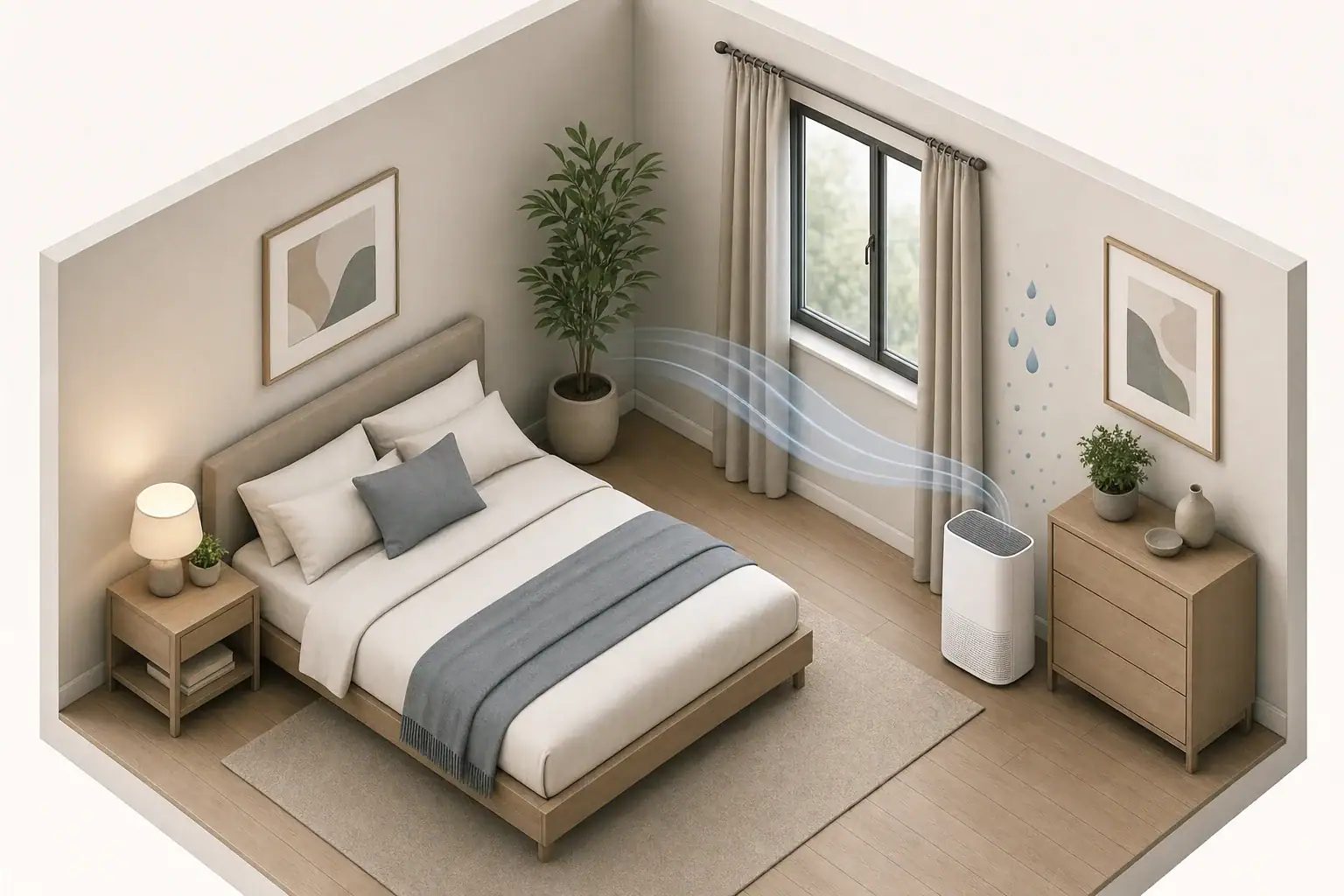
A dehumidifier can run in a bedroom at night if it maintains a comfortable humidity level without producing disruptive noise, drafts, heat, or light. For many rooms, automatic humidity control and a low fan setting provide a practical balance. Placement, capacity, and compressor cycling can matter as much as the published sound rating.
Quick answer
- Aim for roughly 30% to 50% relative humidity, with 40% to 50% often serving as a practical bedroom target.
- Use an automatic humidity setting rather than continuous operation unless the room has an ongoing moisture problem.
- Sound around 40 dBA or lower may be easier for many people to tolerate, but personal sensitivity and sound character vary.
- Keep the unit away from the bed and hard surfaces that can amplify vibration while maintaining the clearances required by its manual.
- Empty and clean the water container regularly, or use an approved drain arrangement where appropriate.
Why bedroom humidity and dehumidifier noise matter
Relative humidity describes how much moisture the air holds compared with the maximum it could hold at the same temperature. Because warmer air can hold more moisture, the relative humidity reading may change when bedroom temperature changes overnight.
Humidity that remains above approximately 50% to 60% can contribute to condensation, musty odors, and conditions that support mold growth. Excessively dry air can also feel uncomfortable, so running a dehumidifier as low as possible is not the goal. A general indoor range of 30% to 50% is widely used for practical moisture management, although seasonal conditions and the building may influence the achievable level.
Noise affects bedroom suitability in several ways. A steady fan sound may be less noticeable than repeated compressor starts, beeps, rattles, or abrupt fan-speed changes. Bright control lights and warm exhaust air can also affect nighttime comfort even when average noise is modest.
How to choose capacity and understand night settings
Dehumidifier capacity is commonly expressed as the amount of water the appliance can remove in 24 hours under specified test conditions. Actual removal in a bedroom may be lower because temperature and humidity are usually less demanding than laboratory conditions.
Room area is only one sizing factor. Also consider ceiling height, dampness severity, outdoor humidity, air leakage, attached bathrooms, laundry drying, and whether the bedroom door stays open. A very small unit may run almost continuously, while a substantially oversized unit may create more noticeable on-and-off cycling.
Useful controls for overnight operation
- Humidistat or target setting: Cycles the unit in response to measured relative humidity.
- Low fan: Usually reduces airflow noise, although water removal may take longer.
- Sleep or night mode: May dim lights, reduce fan speed, or limit control sounds. Functions vary, so check the manual.
- Timer: Allows operation before bedtime or during a selected part of the night.
- Continuous mode: Runs without maintaining a normal target and is generally better reserved for active dampness or supervised drying.
A separate humidity monitor can provide a useful comparison, but it may not match the dehumidifier exactly. Sensors in different parts of a room can differ by several percentage points because of airflow, temperature, and distance from the appliance.
Bedroom dehumidifier decision matrix. Example values for illustration.
| Bedroom condition | Practical approach | What to watch |
|---|---|---|
| Humidity around 40% to 50% | Leave the unit off or use automatic control | Confirm that humidity remains stable |
| Humidity repeatedly above 50% to 60% | Set a moderate target and keep doors and windows closed | Look for moisture sources or condensation |
| Brief humidity rise after bathing | Use bathroom exhaust first, then reassess | A bedroom unit may not address the source efficiently |
| Noise interrupts sleep | Run the unit before bed or use low fan | Check whether humidity rises again overnight |
| Unit runs continuously | Check the target, room conditions, and capacity | Open windows or air leakage may add moisture |
| Frequent short cycling | Improve placement and compare sensor readings | The unit may be oversized or sensing its own exhaust |
| Cold bedroom | Check the appliance temperature rating | Some compressor units lose effectiveness or frost in cool air |
Common bedroom mistakes and troubleshooting cues
Placing a dehumidifier directly beside the bed can make ordinary fan and compressor sounds seem much louder. It may also direct warm, dry exhaust across the sleeper. Increase the distance where possible without blocking airflow or ignoring the manufacturer’s clearance requirements.
A corner is not automatically a quiet location. Lightweight furniture, hollow floors, walls, and hard surfaces can transmit or reflect vibration. Place the appliance upright on a stable, level floor rather than on a bed, thick rug, or unstable stand.
If the unit runs all night
Continuous operation does not always mean the appliance is defective. The target may be set too low, the room may exchange humid air with other spaces, or the capacity may be limited for the conditions. Check humidity with a separate monitor and inspect for open windows, an attached damp bathroom, wet clothing, or building moisture.
If the room feels warmer
Dehumidifiers release heat during normal operation. The temperature increase may be more noticeable in a small closed bedroom. Running the unit before bedtime, lowering the moisture load through ventilation when outdoor conditions permit, or placing the unit outside an open bedroom door may improve comfort, though the last option can reduce direct control of bedroom humidity.
If water removal suddenly falls
Lower humidity may simply mean less water is available to collect. Reduced airflow from a dirty filter, a blocked intake, cool room conditions, or a full container can also limit operation. Use the troubleshooting steps in the appliance manual rather than opening or modifying the refrigeration system.
How to set up a dehumidifier for quieter nights
Start by measuring humidity for several days, including overnight. This establishes whether moisture is persistent, seasonal, or limited to activities such as showering and indoor laundry drying.
- Choose a moderate target. Begin near 45% to 50% relative humidity rather than selecting the lowest available setting.
- Run the unit before bedtime. Operating it for a few hours before sleep may allow a lower fan setting or shorter overnight runtime.
- Position it carefully. Keep it several feet from the bed when space allows, with unobstructed intake and exhaust paths.
- Reduce vibration. Use a solid, level floor and confirm that the container, filter, and removable panels are seated correctly.
- Manage light and sounds safely. Use built-in display dimming or sleep functions. Do not cover controls or ventilation openings.
- Close unnecessary openings. A closed window prevents the unit from continually processing humid outdoor air. Whether to close the bedroom door depends on the intended treatment area and appliance sizing.
Published sound levels are useful for comparison only when test conditions are similar. A rating may reflect a particular fan speed and measurement distance. Tonal hum, vibration, compressor starts, and the acoustics of the room can make two units with similar ratings seem different.
Nighttime settings in real-world bedroom scenarios
Small bedroom with mildly elevated humidity
Suppose humidity reaches about 55% in the evening but falls after several hours of operation. A moderate target near 45% to 50%, low fan, and a pre-bedtime start may be sufficient. Continuous mode would usually remove more moisture than necessary for this example.
Bedroom connected to a frequently used bathroom
Moisture control should begin at the source. Run the bathroom exhaust fan during bathing and for an appropriate period afterward, keep the bedroom separated from the steam when practical, and then check bedroom humidity. A dehumidifier can manage remaining moisture but should not substitute for effective source ventilation.
Basement bedroom with persistent dampness
A basement room may receive moisture through air leakage, foundation materials, or adjacent spaces. The dehumidifier may need to serve a larger connected area rather than the bedroom alone. Persistent water entry, visible leaks, or recurring condensation calls for correction of the moisture source, not simply a lower humidity setting.
Noise-sensitive sleeper
Pre-dry the room in the evening and use a timer or automatic setting overnight. Moving the appliance farther away may help more than changing fan speed. If the unit must operate outside the bedroom, verify with a humidity monitor that airflow through the doorway is adequate.
Safety and indoor air quality considerations
Connect the appliance according to its manual, typically to a suitable grounded wall outlet. Avoid overloaded circuits, damaged cords, wet plugs, and extension arrangements not permitted by the manufacturer. Keep the appliance upright and allow the recommended settling time after transport before operation.
For continuous drainage, use only the supported hose or pump configuration. Route tubing so it cannot kink, leak onto flooring, or create a trip hazard. A gravity drain requires a continuous downward path. Collected condensate is not intended for drinking or food preparation.
Keep the unit where children and pets cannot tip it, pull on drainage tubing, or interfere with controls. Maintain clear airflow around curtains, bedding, and furniture. Do not cover the appliance to hide lights or reduce sound because covering it can obstruct cooling and airflow.
A dehumidifier controls moisture; it is not a substitute for particle filtration or ventilation. Optional ionization, ultraviolet, or other air-treatment features are separate from dehumidification and should be evaluated cautiously. Avoid devices designed to generate ozone in occupied bedrooms, and do not intentionally modify an appliance to create ozone or bypass safety controls.
Maintenance, cleaning, and operating cost planning
Routine maintenance supports airflow and limits odors. Check the washable air filter on the schedule in the manual and clean it more often in dusty rooms or homes with shedding pets. Let washable parts dry fully before reinstalling them.
Empty the bucket before it reaches the shutoff point if overnight interruption would be inconvenient. Wash the container periodically with the method recommended by the manufacturer, paying attention to corners and float mechanisms. Do not mix cleaning chemicals.
Inspect drainage hoses, connections, and nearby flooring for leaks. Dust intake and exhaust grilles gently without pushing debris into the appliance. Unplug the unit before cleaning unless its instructions specify a different safe procedure.
Energy use depends on wattage, runtime, fan setting, room conditions, and local electricity rates. An illustrative estimate uses wattage multiplied by operating hours and divided by 1,000 to find kilowatt-hours. For example, a 400-watt unit running six hours uses about 2.4 kilowatt-hours before cycling is considered; actual consumption may be lower or higher.
Night operation planning reference. Example values for illustration.
| Setting or condition | Noise consideration | Placement or use tip | Note |
|---|---|---|---|
| Low fan | Usually reduces airflow sound | Start earlier in the evening | Moisture removal may take longer |
| High fan | More airflow may mask compressor changes | Use before bedtime if disruptive | Can lower humidity faster |
| Automatic humidity | Produces occasional starts and stops | Set a moderate target | Cycling frequency varies by moisture load |
| Continuous operation | Creates sustained fan and compressor sound | Reserve for active dampness when appropriate | Monitor humidity to avoid over-drying |
| Timer operation | Limits noise to selected hours | Schedule operation before sleep | Check overnight humidity afterward |
| Hard floor near a wall | May amplify vibration or reflections | Use a stable location with required clearance | Do not block vents or place on bedding |
Related guides: Dehumidifier Auto Mode vs Continuous Mode: Which Setting to Use • Drain Hose vs Bucket: Which Dehumidifier Setup Is Best? • Dehumidifier Short Cycling: Causes and How to Fix It • Dehumidifier Energy Cost: What It Adds to Your Monthly Bill
Bedroom dehumidifier takeaways
A bedroom dehumidifier works most comfortably when it maintains a moderate humidity target without running harder or longer than necessary. Start near 45% to 50% relative humidity, confirm conditions with a separate monitor, and adjust based on seasonal moisture and personal comfort.
For quieter nights, prioritize automatic control, low fan speed, pre-bedtime operation, stable placement, and adequate distance from the bed. Address bathroom steam, leaks, condensation, and other moisture sources directly. Regular filter, bucket, and drain maintenance helps preserve airflow while reducing unexpected shutdowns, rattles, and odors.
Frequently asked questions
What humidity setting should I use for a dehumidifier in a bedroom at night?
A target of about 45% to 50% relative humidity is a practical starting point for many bedrooms. Adjust the setting based on a separate humidity monitor, comfort, condensation, and seasonal conditions rather than choosing the lowest setting available.
Is it safe to leave a dehumidifier running overnight in a bedroom?
It can be safe when the appliance is used according to its manual, connected to an appropriate grounded outlet, and kept clear of bedding, curtains, and furniture. Empty the bucket or use a manufacturer-approved drainage setup, and do not use damaged cords or unsupported extension arrangements.
How can I make a bedroom dehumidifier quieter while sleeping?
Use low fan speed or sleep mode if available, and run the unit for a few hours before bedtime to reduce the need for overnight operation. Place it on a stable, level floor several feet from the bed when possible, while preserving the clearances specified in the manual.
Why does my dehumidifier make the bedroom feel warmer?
Dehumidifiers release heat as part of normal operation, and the temperature rise can be more noticeable in a small closed room. Running it earlier in the evening, using automatic humidity control, or reducing moisture sources may limit the amount of overnight heat and runtime.
Should I run a dehumidifier continuously in a bedroom?
Continuous mode is usually unnecessary when the bedroom humidity is already within a moderate range. Automatic control is generally better for routine use because it cycles the unit based on the selected humidity target; continuous operation may be appropriate for persistent dampness or supervised drying.
Recommended next:
- How to Size a Dehumidifier (Sq Ft, Pints/Day, and Real-World Tips)
- Desiccant vs Compressor Dehumidifiers: Which Is Better for Cold Rooms?
- Basement Dehumidifier Guide: Targets, Drainage, and Energy Use
- Dehumidifier Running Cost: How Much Electricity Will It Use?
- Dehumidifier Sizing: Liters/Day, Room Type, and Dampness Levels
- Basement Dehumidifier Setup: Drainage, Placement, and RH Targets
- Clear sizing logic (room size → CADR/ACH)
- HEPA vs carbon explained for real use-cases
- Humidity + ventilation basics to reduce mold risk