
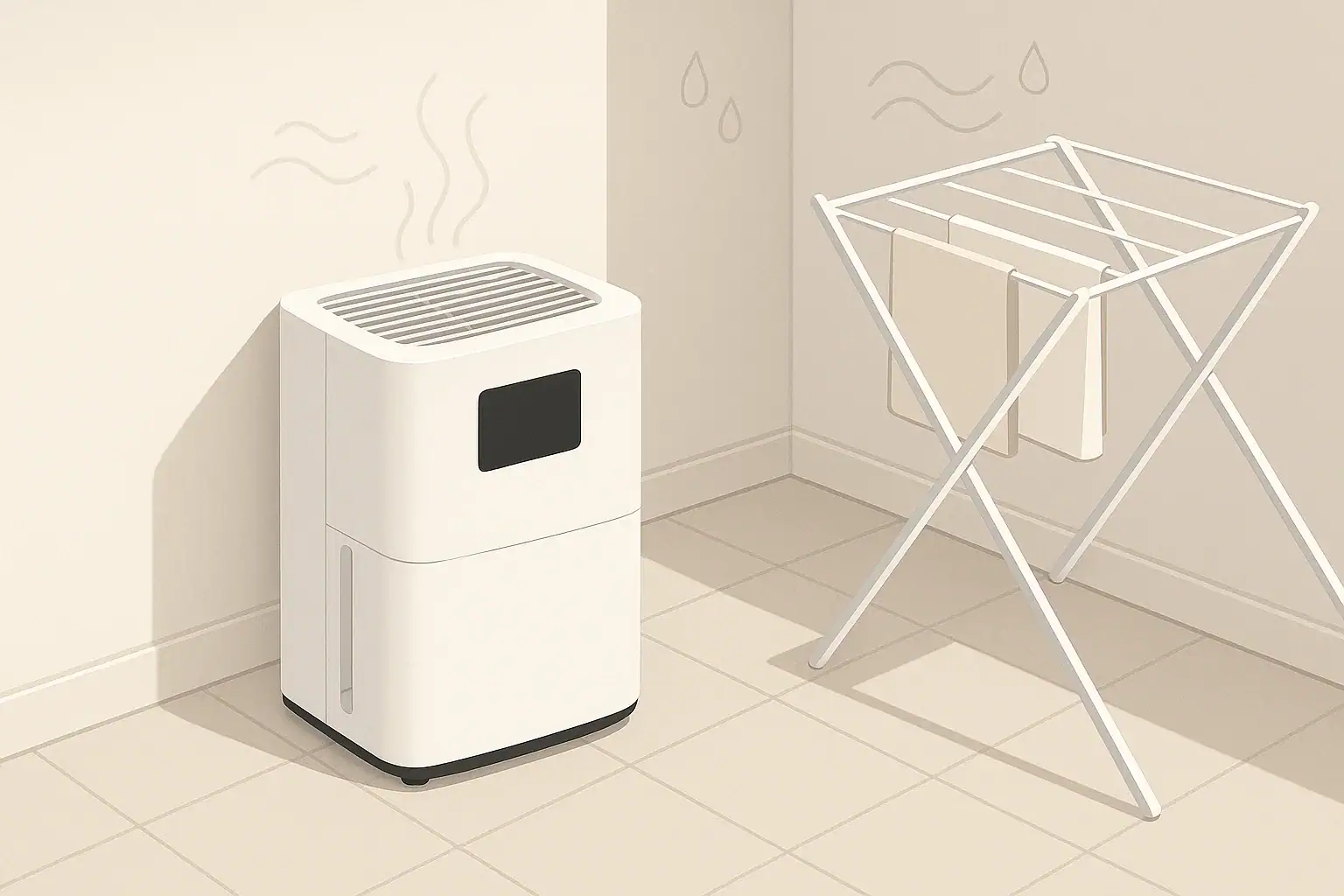
Most home dehumidifiers make a steady fan and compressor hum in the 40–60 dB range, similar to quiet conversation or background TV, and there are several practical ways to reduce how loud they sound in your space.
Dehumidifier noise matters because these units often run for many hours in bedrooms, basements, and living areas. Understanding what causes the sound, what is typical, and how placement and settings affect noise can help you get the moisture control you need without constant distraction. This article explains what to expect and offers realistic ways to make your dehumidifier seem quieter.
- Many portable dehumidifiers operate around 40–60 dB at low–medium fan speeds (example range).
- Noise mainly comes from the fan and compressor; higher fan speed and heavy moisture loads are usually louder.
- Placing the unit on a stable, level, vibration-damping surface often cuts rattles and hum.
- Keeping at least a few feet of open space around the intake and exhaust can reduce turbulent airflow noise.
- Using lower fan modes or timers at night helps limit disturbance in bedrooms and living spaces.
What dehumidifier noise is and why it matters
Dehumidifiers pull humid air across cold coils to condense water, then blow the drier air back into the room. This process relies on a compressor and a fan, both of which generate sound. The goal is not silence but a stable noise level that fades into the background of daily life.
The overall noise you perceive is a mix of:
- Fan noise – the sound of air moving through grilles and ductwork inside the unit.
- Compressor noise – a mechanical hum or buzz while the refrigeration system is running.
- Vibration and rattles – from loose panels, wheels, or the unit touching hollow floors or furniture.
- Room acoustics – hard surfaces, corners, and small rooms can reflect and amplify sound.
This matters for comfort and usability. A slightly louder unit may be perfectly acceptable in a basement but distracting in a bedroom. Understanding what is normal helps you decide if you are hearing typical operating noise, avoidable vibration, or a sign of a problem.
Key concepts: noise levels, distance, and operating modes
Noise is usually measured in decibels (dB). Because the dB scale is logarithmic, small number changes can feel significant. For everyday reference, quiet conversation is often around 50–60 dB, and a typical kitchen refrigerator hum is often in the 40 dB range (example comparisons).
Dehumidifier noise depends on several practical factors:
Distance from the unit
Noise levels fall as you move away from the source. Sound measurements are often taken at a set point, such as around 3 feet in front of the unit. A dehumidifier that sounds noticeable at close range may blend into background noise a room away.
Fan speed and operating mode
- High fan or turbo modes move more air, remove moisture faster, and usually sound louder.
- Low or sleep modes reduce airflow and noise at the cost of slower dehumidification.
- Compressor cycling may cause the sound to rise and fall as humidity reaches and drops below the target.
Moisture load and duty cycle
In very damp spaces, the compressor may stay on for longer periods (a higher duty cycle), so you hear the louder operating sound more of the time. As humidity drops closer to your setpoint, the unit may cycle off more often, lowering average noise over the day.
Type and size of dehumidifier
- Portable refrigerant dehumidifiers (common in homes) typically have a noticeable but steady hum.
- Desiccant dehumidifiers can have different noise profiles, sometimes more fan-dominated.
- Larger-capacity units often have bigger fans and compressors, which can be louder but may run less often if correctly sized.
Noise expectations should match room use. A basement or garage may tolerate more sound than a nursery or home office where people value quiet.
| Noise factor | What happens | What you can try |
|---|---|---|
| High fan speed | More airflow whoosh, higher overall sound level | Use medium/low speed once humidity is under control |
| Hard floor contact | Vibration transferred to floor, possible droning sound | Add a thin rubber mat or anti-vibration pads |
| Corner placement | Sound reflects off walls, can seem amplified | Pull unit slightly away from walls and corners |
| Clogged air filter | Restricted airflow can cause turbulence and higher fan effort | Clean or replace intake filter per manual |
| Loose panels or bucket | Rattling, intermittent buzzing or clicking | Ensure bucket and panels are seated; adjust or pad contact points |
| Room acoustics | Hard, bare rooms reflect and sharpen noise | Add soft furnishings or relocate unit if possible |
Example values for illustration.
Common dehumidifier noise issues and troubleshooting
Most dehumidifiers will produce a consistent hum plus fan noise, but some sounds suggest maintenance needs or setup problems. Here are frequent complaints and what they often indicate.
Rattling or vibrating sounds
Rattles usually come from loose parts or resonance with the floor.
- Check the surface: Uneven or hollow floors can amplify vibration.
- Inspect wheels and feet: Ensure casters fully touch the floor and are not stuck in one direction.
- Confirm bucket fit: A slightly loose water bucket can chatter against its housing.
If a light press on the unit changes or stops the rattle, it is often surface- or panel-related rather than an internal failure.
Buzzing, clicking, or metal-on-metal sounds
Short, sharp sounds may point to contact between parts or expansion and contraction of metal components as the unit cycles.
- Look for loose grilles or panels that can be gently tightened per the manual.
- Check that cords, hoses, or nearby objects are not touching the unit and vibrating.
Persistent harsh or grinding noises can be a sign of a failing fan motor or other internal issues, which usually requires professional servicing or replacement rather than a do-it-yourself fix.
Gurgling or water sounds
Some gurgling or trickling is normal as condensate drains into the bucket or through a hose. Sudden changes in these sounds could indicate a partially blocked drain hose or an incorrectly sloped hose causing water to pool. Ensuring the hose has a gentle downward path and is not kinked can help.
Noise spikes when the compressor starts
A brief increase in sound when the compressor starts or stops is common. However, repeated loud bangs, clanks, or electrical noises are not typical and may be a reason to stop using the unit and consider inspection or replacement for safety reasons.
Practical ways to make your dehumidifier quieter
You cannot remove all sound from a dehumidifier, but you can often reduce the loudness and how noticeable it feels.
Optimize placement
- Use a stable, level surface: This reduces vibration and rattling. A simple test is to gently rock the unit; it should not wobble.
- Add soft isolation: Thin rubber pads or a dense foam mat under the feet can absorb vibration energy that would otherwise travel into the floor.
- Avoid tight corners: Pulling the unit 6–12 inches away from walls and corners can reduce reflected sound and allow smoother airflow.
- Aim airflow away from listening areas: Direct exhaust air away from beds, desks, and seating areas where the noise might feel more intrusive.
Adjust settings and schedule
- Lower fan speed once humidity is under control, especially at night.
- Use timers so the unit runs more in the daytime and less during sleep or quiet hours, if your moisture situation allows.
- Choose a realistic humidity setpoint: Aiming for a moderate level (often around 45–50% relative humidity in many homes, as a general comfort-oriented example) can reduce how often the compressor runs compared to trying to keep it much lower.
Separate the unit from sleeping and working areas
If possible, locate the dehumidifier in an adjacent hallway, closet with louvered doors, or nearby room where it can still treat much of the air without being right next to sleeping or working spaces. Leave doors open or partially open to allow airflow, and ensure there is enough clearance around the unit as specified in the manual.
Real-world noise scenarios in different rooms
How loud a dehumidifier feels depends as much on the room as on the device itself. These example situations illustrate how to balance noise and moisture control.
Basement or crawlspace
Basements typically tolerate more noise, and sound often stays isolated from living areas. In these spaces, a higher-capacity unit on a moderate or high setting can be acceptable, especially if it keeps upstairs areas drier and more comfortable.
Practical ideas:
- Place the unit on a rubber mat to control vibration on concrete.
- Keep it away from stairs that open directly to quiet living areas, if possible.
- Use a continuous drain with a hose, if the layout allows, to avoid frequent bucket emptying noise.
Bedroom or nursery
For sleeping spaces, consistent, low-level fan noise can act as a form of neutral background sound, but sudden changes or higher pitched tones are more disturbing.
- Prioritize low fan or sleep modes with a modest humidity target.
- Place the unit several feet away from the bed and ideally not directly facing it.
- Consider running the dehumidifier more intensely during the day, then scaling back at night if your climate and building conditions allow.
Living room or open-plan area
In larger, open rooms, sound spreads out and is often less concentrated. However, reflective surfaces like bare floors and large windows can keep the noise noticeable.
- Position the unit near a supporting wall but not tightly wedged into a corner.
- Use area rugs, curtains, and upholstered furniture to absorb sound.
- Experiment with different locations within the same room; moving a few feet can make a surprising difference.
Noise, safety, and indoor air quality considerations
Noise is only one aspect of using a dehumidifier safely and effectively. When adjusting for quieter operation, it is important not to compromise basic safety or indoor air quality goals.
- Do not cover the unit or block vents in an attempt to muffle sound; this can cause overheating or reduced performance.
- Keep clearances as recommended by the manufacturer so air can move freely.
- Use grounded outlets and avoid overloading extension cords; electrical safety is more important than small noise gains.
- Manage humidity within a reasonable range to help discourage mold growth and damp odors, instead of turning the unit off completely due to noise if moisture is significant.
Some air cleaning devices use ionizers or ozone-generating technologies that can have their own acoustic and air quality considerations. Standard home dehumidifiers generally rely on refrigeration or desiccant processes rather than ozone, and for indoor air quality, it is usually preferable to avoid adding ozone intentionally to occupied spaces.
Maintenance steps that can reduce noise over time
Regular maintenance keeps a dehumidifier working efficiently and can also prevent new noises from developing as parts wear or get dirty.
Clean or replace intake filters
Many portable dehumidifiers have a washable or replaceable intake filter that captures dust and lint. When this filter clogs:
- The fan may work harder, which can increase noise.
- Airflow becomes more turbulent, sometimes causing whistling or whooshing sounds.
Cleaning or replacing the filter on the schedule suggested in the manual (or more often in dusty areas) helps both sound and performance.
Empty and seat the water bucket correctly
Removing and replacing the water bucket multiple times a week can gradually wear or shift alignment points. Make sure the bucket:
- Slides fully into place and engages any float switches correctly.
- Does not wobble front-to-back or side-to-side when the unit is moved gently.
If you use a drain hose, ensure connections are snug but not overtightened, and that the hose routing does not press or pull on the unit, which can create extra vibration.
Dust and coil cleanliness
Over time, dust buildup on grills and coils can affect airflow paths. With the unit unplugged, lightly vacuuming accessible grills and wiping exterior surfaces can help air move more smoothly, sometimes reducing noise associated with uneven airflow. Internal coil cleaning beyond what the manual allows for users is generally a job for a qualified technician.
Monitor for changes over time
A gradual increase in noise over months or years may reflect:
- Wear in fan bearings.
- Extra vibration as parts loosen.
- Reduced efficiency due to internal dust or aging components.
At some point, a significantly louder or harsher-sounding unit may be nearing the end of its practical life span, especially if performance has also declined.
Frequently asked questions about dehumidifier noise
Is it normal for a dehumidifier to run constantly and make noise all day?
In very humid conditions or in a space with ongoing moisture sources, a dehumidifier may run for long periods, especially at first. As humidity approaches your setpoint, it should cycle off or drop into lower fan modes. If it never seems to shut off and remains loud, you may need to reassess sizing, humidity targets, or underlying moisture issues.
Can a dehumidifier be used as white noise?
Some people find the steady hum of a dehumidifier similar to white noise and even helpful for sleep. Others are sensitive to compressor cycling or particular tones. If used as background sound, choose a stable setting and location that keeps the noise consistent, and ensure the unit is safe to operate unattended in that space.
Are quieter units always better for indoor air quality?
Quieter does not automatically mean better moisture control. The key is matching capacity and noise tolerance to the room. A slightly louder, correctly sized unit that runs efficiently can often maintain a healthier humidity range more reliably than a very quiet device that is too small for the space.
Should I put my dehumidifier in a closet to muffle the noise?
Placing a dehumidifier in an enclosed closet can restrict airflow, trap heat, and reduce effectiveness unless the closet is specifically designed with ventilation. A better approach is usually to move it to a nearby open area, adjust placement, and use soft furnishings to absorb sound while keeping clearances and ventilation adequate.
| Situation | Noise consideration | Placement tip | Note |
|---|---|---|---|
| Light sleeper in bedroom | Prefer steady, low noise | Place across room, low fan, away from bed | Run more aggressively in daytime if possible |
| Basement moisture control | Higher noise usually acceptable | Central placement on rubber mat | Keep doors open to upper levels as needed |
| Home office nearby | Fan noise may interfere with calls | Place in adjacent hall or room, door ajar | Use medium fan during work hours |
| Open-plan living area | Sound spreads but can reflect off hard surfaces | Near wall, not in corner, away from seating | Rugs and curtains help soften acoustics |
| Nighttime cooling and drying | Combined HVAC and dehumidifier noise | Coordinate with HVAC fan settings | Balance comfort, humidity, and sound |
| Children’s room | Sudden noise changes may disturb sleep | Use steady mode, slightly outside doorway | Check cord and trip safety around kids |
Example values for illustration.
Related guides: How to Size a Dehumidifier (Sq Ft, Pints/Day, and Real-World Tips) • Dehumidifier Running Cost: How Much Electricity Will It Use? • Dehumidifier Capacity Estimator: Room Dampness to Liters/Day
Summary: what to expect and what you can do
Typical home dehumidifiers produce a constant mix of fan and compressor noise that many people describe as similar to a refrigerator or quiet conversation at close range. This sound level is usually normal, especially when the unit is working hard to pull moisture out of the air.
You can often make a dehumidifier seem quieter by focusing on placement, vibration control, realistic humidity targets, and regular maintenance rather than relying on settings alone. Paying attention to sudden changes in noise helps distinguish ordinary operation from signs of wear or potential problems. With a practical approach, it is usually possible to keep indoor humidity in a comfortable range while limiting how much the dehumidifier disrupts daily life.
Frequently asked questions
What decibel level should I expect from a home dehumidifier at typical distances?
Most portable home dehumidifiers produce roughly 40–60 dB when measured a few feet away, similar to a quiet conversation or background television. Measured levels drop with distance, so a unit that is noticeable at 3 feet may be much quieter across a room.
Why does my dehumidifier get louder when the compressor starts?
A brief increase in volume when the compressor starts is normal because the motor and refrigerant flow create transient mechanical and airflow sounds. Repeated loud bangs, clanks, or electrical noises are not typical and should prompt you to stop use and have the unit inspected.
How far should I place a dehumidifier from walls and furniture to reduce noise?
Pull the unit about 6–12 inches (15–30 cm) from walls and corners to reduce reflections and allow smoother airflow; increasing that distance further reduces perceived noise. Also avoid direct contact with hollow floors and consider placing a rubber or foam mat under the feet to cut vibration transfer.
Can I run a dehumidifier in sleep or low fan mode overnight without compromising moisture control?
Using low or sleep modes overnight is common and will reduce noise, but dehumidification will be slower and the unit may run longer to reach the same setpoint. If persistent high humidity is a concern, run the unit more aggressively during the day and scale back at night if conditions allow.
What noises mean I should perform maintenance or seek repairs?
Persistent rattling, grinding, harsh metallic noises, or a steady increase in volume over time often indicate loose panels, worn bearings, or other mechanical problems that need attention. Normal sounds include steady hums and occasional gurgling from condensate drainage; irregular water noises, electrical pops, or very loud mechanical sounds warrant inspection.
Recommended next:
- How to Size a Dehumidifier (Sq Ft, Pints/Day, and Real-World Tips)
- Desiccant vs Compressor Dehumidifiers: Which Is Better for Cold Rooms?
- Basement Dehumidifier Guide: Targets, Drainage, and Energy Use
- Dehumidifier Running Cost: How Much Electricity Will It Use?
- Dehumidifier Sizing: Liters/Day, Room Type, and Dampness Levels
- Basement Dehumidifier Setup: Drainage, Placement, and RH Targets
- More in Dehumidifiers →
- Clear sizing logic (room size → CADR/ACH)
- HEPA vs carbon explained for real use-cases
- Humidity + ventilation basics to reduce mold risk