
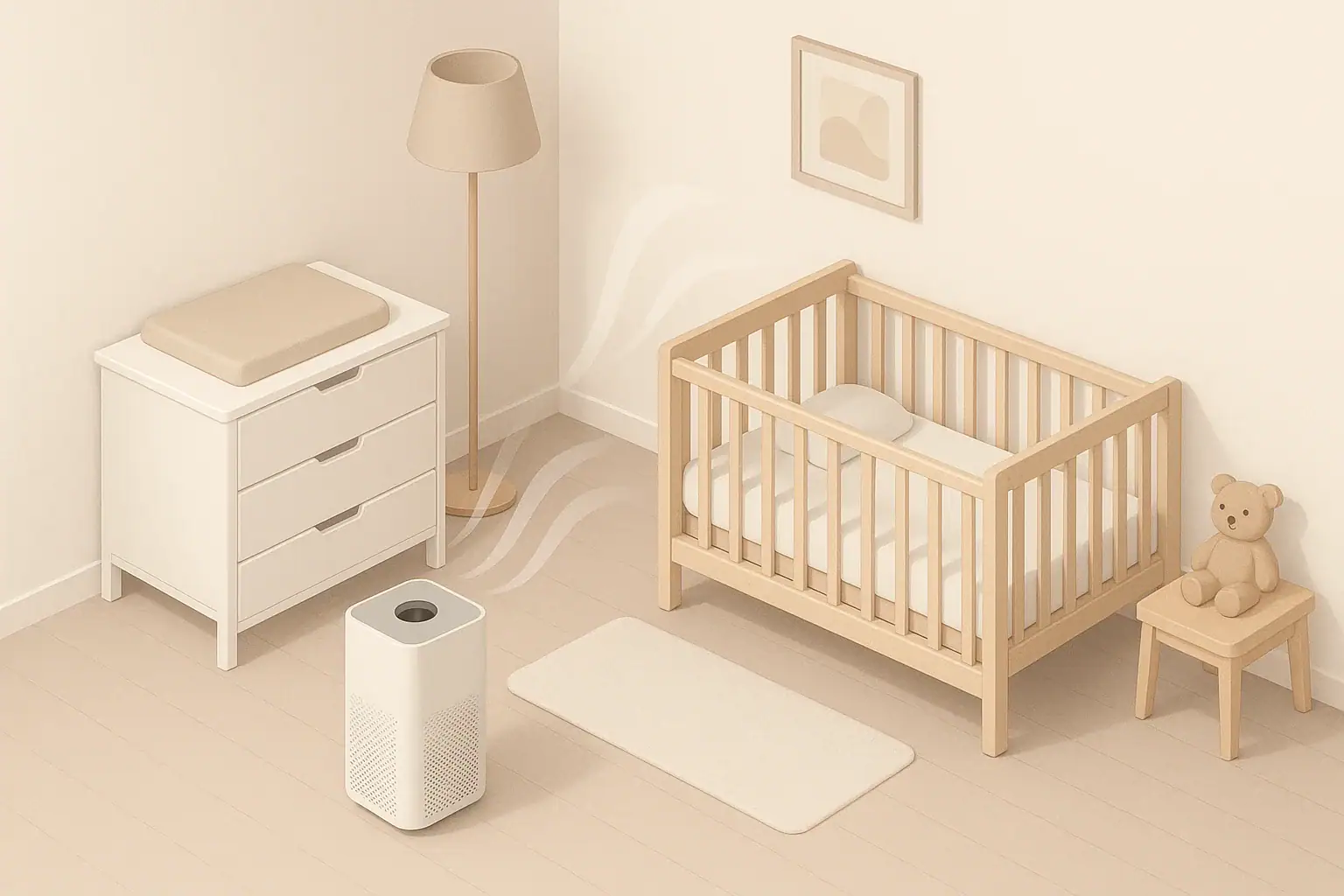
A carefully chosen air purifier can be a helpful part of an overall plan to keep a baby’s room comfortable. This page covers practical considerations families often weigh when deciding whether to add a purifier to a nursery and how to use one safely and effectively. The focus is on straightforward, actionable points: safety features and placement to avoid hazards, the trade-offs between noise and airflow during naps and at night, and which filter types address particles versus odors. It also touches on how to size a unit for a small room, how filters and pre-filters should be maintained, and how purifiers fit alongside ventilation and humidity control. If you are simply exploring options, the sections below are arranged so you can jump to the topics most relevant to your home and routine.
Why Consider an Air Purifier in a Baby’s Room?
Many parents think about adding an air purifier to the nursery to keep the environment as comfortable as possible. Indoor air often contains a mix of dust, pet dander, outdoor pollution that has drifted inside, and odors from cooking or nearby traffic. An air purifier can help reduce some of these airborne particles and smells, especially in smaller enclosed spaces like a baby’s room.
At the same time, an air purifier is only one part of overall indoor air quality. Good ventilation, reasonable humidity, regular cleaning, and avoiding strong fumes indoors all contribute to a more comfortable space for a baby. When you do choose an air purifier, it helps to focus on three core questions:
- Is it quiet enough for naps and overnight sleep?
- Is it designed and used in a way that is safe around infants?
- Does it use filters that match your goals (particles, odors, or both)?
The sections below walk through these topics with a calm, practical approach, without assuming that every family must use an air purifier. Instead, the goal is to help you choose and use one wisely if you decide it fits your home.
Key Safety Considerations for Nursery Air Purifiers
Safety is the first priority in any baby’s room, and air purifiers are no exception. Most are simple plug-in appliances, but details like where you place the unit, what technologies it uses, and how you manage cords and filters all matter.
Avoiding Ozone and High-Output Ionizers
Many families prefer purifiers that clean air using mechanical filtration (such as HEPA-type filters and activated carbon) rather than devices that intentionally generate ozone. Ozone is a reactive gas, and high levels are generally undesirable indoors.
When choosing a purifier for a baby’s room, consider:
- Preferring models marketed as “ozone-free” or that rely on a fan plus filters only.
- Being cautious with ionizers or plasma features that actively change air chemistry. If included, confirm they meet current safety standards and can be turned off.
- Avoiding stand-alone ozone generators entirely for occupied spaces.
Placement, Cord Safety, and Tip-Over Concerns
Where you place an air purifier has a big impact on both safety and performance.
- Distance from crib: Keep the purifier a few feet away from the crib so airflow is not blowing directly on the baby. This gives space for gentle mixing of the air.
- Cord management: Route cords behind furniture when possible. Use outlet covers and avoid leaving loops of cable where a crawling baby or toddler could pull or chew.
- Stable surface: Place the unit on the floor or a sturdy surface where it cannot easily tip if bumped. Avoid perching it on wobbly furniture.
- Vent clearance: Leave space around intake and outlet vents so airflow is not blocked by curtains, bedding, or toys.
Child Locks and Filter Access
For nurseries, it is helpful if the air purifier has some basic protections against curious hands:
- Child lock or button lock: Prevents accidental changes to settings when a toddler presses the control panel.
- Secure filter door: Ideally, the filter compartment should not be easy to open without deliberate effort, reducing the chance of a child accessing the filter material or sharp plastic edges.
- No small loose parts: Check that there are no detachable small pieces within reach that could become a choking hazard.
Electrical and Fire Safety Basics
Air purifiers are usually low-risk, but treating them like any other plug-in appliance is sensible:
- Plug directly into a wall outlet rather than extension cords when practical.
- Do not run the power cord under thick rugs where heat can build up.
- Keep the purifier away from water sources like humidifiers that might spill.
- Follow the manufacturer’s cleaning and filter replacement schedule to avoid overly clogged filters that may strain the motor.
Example values for illustration.
| Situation | Main Tool to Consider | Why It May Help | Extra Notes |
|---|---|---|---|
| Visible dust and pet dander in nursery | HEPA-type air purifier | Reduces airborne particles while fan is running | Still combine with vacuuming and dusting |
| Stuffy room, air feels “used” | Ventilation (open window if outdoor air is acceptable) | Brings in fresher air and removes buildup of indoor pollutants | Use window screens and consider outdoor conditions |
| Lingering odors from diapers or cooking | Purifier with activated carbon filter | Helps reduce some smells and certain gases | Empty diaper pails and clean surfaces regularly |
| Damp nursery or musty smell | Dehumidifier plus ventilation | Lowers moisture that can support mold growth | Maintain moderate humidity, often around mid-range |
| Seasonal smoke from outside (e.g., regional events) | HEPA-type purifier with good seal | Reduces fine particles that enter from outdoors | Close windows when outdoor smoke is high |
| General long-term indoor air planning | Combination of filtration, ventilation, and cleaning | Addresses both particles and gases over time | Adjust approach as child grows and home changes |
How Quiet Should a Nursery Air Purifier Be?
Babies sleep many hours a day, both at night and during naps. Noise level is one of the most practical considerations when choosing a purifier for the nursery. A constant gentle sound can be soothing like white noise, but loud fan noise or high-pitched tones may be disruptive.
Understanding Fan Speeds and Sound Levels
Most air purifiers have several fan speeds. Higher speeds move more air but also create more noise. For a baby’s room, many parents aim to run the purifier on a low or medium setting for most of the night, only using higher speeds briefly when needed (such as when outdoor air quality is worse or the room has been closed up for a long time).
Manufacturers often list noise in decibels (dB), but these numbers can be hard to interpret. As a simple guide:
- Lower fan settings tend to sound similar to a quiet fan or soft white noise.
- Highest settings may sound like a bathroom fan or louder household appliance.
- The pitch matters: a low, steady hum is generally easier to sleep through than a whine or rattling sound.
Testing Noise in the Actual Room
Noise ratings on a box do not always reflect how a purifier will sound in your specific nursery. Room size, hard floors vs. carpet, and wall surfaces all shape the sound.
To assess noise in practice:
- Run the purifier in the nursery at night on each speed while you or another adult is present.
- Check for rattles, vibrations, or whistling sounds that might be bothersome.
- If needed, place the purifier farther from the crib (while still allowing circulation) to reduce perceived loudness.
Balancing Noise, Airflow, and Sleep
Effective filtration requires moving enough air through the filters, which naturally creates some sound. The goal is not total silence but a balance between:
- A fan speed that keeps air circulating through the filters at a reasonable rate.
- A noise level that fits your baby’s and your own tolerance for background sound.
- Placement that avoids blowing air directly at the crib while still mixing air in the room.
Some families find that the gentle hum of a purifier doubles as a white noise source, which can mask sudden sounds from other parts of the home.
Filter Types: HEPA, Carbon, and Nursery Priorities
Filter choice determines what an air purifier focuses on. For baby rooms, the main goals are usually reducing airborne particles and, sometimes, reducing odors from diapers, pets, or cooking.
HEPA and HEPA-Type Filters for Particles
High efficiency particle filters are designed to capture fine particles in the air. Many residential purifiers use filters described as “HEPA” or “HEPA-type.” Industry standards for true HEPA filters generally involve testing at specific particle sizes and efficiencies, but marketing terms can vary.
In practical terms for a nursery:
- True HEPA: Refers to filters tested to a recognized standard for high efficiency at small particle sizes.
- H13 or H14 labels: These labels are sometimes used to describe filters with higher efficiency ranges under certain European classifications. For a small bedroom, both can offer strong particle removal when the purifier is well designed and sealed.
- HEPA-type: A broader term that may indicate improved filtration over basic mesh filters, but the exact performance depends on the design and testing.
For babies, reducing airborne dust, pet dander, and fine particles from outdoor air can be especially relevant for comfort. A purifier with a tightly sealed particle filter and a fan that can recirculate the room’s air several times per hour is generally more important than the specific marketing label alone.
Activated Carbon Filters for Odors and Gases
Activated carbon filters are commonly added to air purifiers to help with odors and some gases. They do this by adsorbing molecules onto the large surface area within the carbon material. In a nursery, this can be useful for:
- Diaper and trash odors.
- Residual cooking smells that drift into the bedroom.
- Certain indoor fumes from household products, if other sources are minimized.
Activated carbon filters do eventually saturate and become less effective, so they typically require more frequent replacement than HEPA filters. If odor reduction is important in your baby’s room, check that carbon filters are easy to access and available at a reasonable ongoing cost.
Combined Filter Cartridges vs. Separate Stages
Some purifiers use a single cartridge containing both HEPA-type media and activated carbon. Others separate these into distinct stages (for example, a pre-filter, a HEPA-stage filter, and a separate carbon stage).
- Combined filters: Simple to replace but may require full cartridge changes even if only one component is saturated.
- Separate filters: Allow targeted changes (e.g., carbon more often, HEPA less often) but may be slightly more complex to manage.
Either design can work in a baby’s room as long as filters fit tightly and are changed on schedule. Poor seals or gaps around the filter can allow air to bypass the filter media, reducing overall effectiveness.
Pre-Filters and Large Particle Reduction
Many purifiers include a pre-filter (sometimes washable) that catches fluff, hair, and larger particles before they reach the main HEPA filter. For nurseries, pre-filters can be helpful because:
- They reduce how quickly the main filter clogs.
- They’re often easy to rinse or vacuum, lowering ongoing costs.
- They can handle visible dust, lint, and pet hair, especially in homes with animals.
Checking and cleaning the pre-filter on a regular schedule keeps airflow strong and fan noise more consistent.
Choosing the Right Size Purifier for a Baby’s Room
Even a high-quality filter will not work well if the purifier is too small for the room. Sizing is typically based on how much clean air the device can deliver and how many times per hour the room’s air passes through the filter.
Room Size, CADR, and Air Changes per Hour (ACH)
Two common concepts used to describe sizing are Clean Air Delivery Rate (CADR) and Air Changes per Hour (ACH).
- CADR: A laboratory measurement combining filter efficiency and airflow. It is usually given in cubic feet per minute (CFM) for particles like dust, smoke, or pollen. Higher CADR means more filtered air per minute.
- ACH: An estimate of how many times per hour the purifier can theoretically filter a room’s volume of air. It depends on both the purifier’s airflow and the room’s size and height.
For a typical small nursery, many families aim for several air changes per hour when the purifier is on a moderate setting. This means the entire room’s air volume may pass through the filters multiple times each hour, keeping particle levels more stable over time.
Measuring the Nursery and Matching Capacity
To estimate the room size:
- Measure the room’s length and width in feet and multiply them to find the floor area.
- Multiply by the ceiling height to estimate the volume.
- Compare your room size to example CADR and ACH planning guides from independent sources or product documentation.
Oversizing slightly (choosing a purifier rated for a somewhat larger room) can allow you to run it on a lower, quieter fan speed while still maintaining reasonable filtration rates.
Placement for Best Airflow in a Nursery
Good placement helps maximize performance without creating drafts on the baby.
- Away from corners: Avoid pushing the purifier tightly into a corner, which can limit airflow. A small gap from walls is usually helpful.
- Clear intake and outlet: Keep soft items like curtains, blankets, and plush toys away from the intake and outlet grilles.
- Not under shelves packed with items: Shelves directly above the outlet may deflect the air and reduce circulation.
- Consider door position: If the door is often closed, size and placement matter more because there is less natural exchange with the rest of the home.
Operation, Maintenance, and Long-Term Use
Once the purifier is in place, simple habits help keep it working as intended. A well-maintained but modest purifier often performs better than a high-end device that is neglected.
How Often to Run the Air Purifier
Many families choose to run a nursery purifier for long stretches at a low or medium speed instead of cycling it on and off frequently. Options include:
- Continuous low speed: Maintains more stable air quality and sound level, often suitable for both day and night.
- Higher speed before bedtime: Running the purifier on a higher setting for a short period before sleep, then lowering it when the baby is in the room.
- Adjusting for outdoor events: Increasing runtime or speed during local smoke events or heavy pollen days if indoor particle levels seem elevated.
Whatever schedule you choose, consistency matters more than frequent on-off changes. A purifier can only improve air while it is operating and air is passing through the filters.
Filter Replacement, Cleaning, and Costs
Filters gradually clog with particles and, in the case of carbon filters, fill up with adsorbed gases. Over time, airflow may drop and odor removal can weaken. To keep performance reasonable:
- Follow the recommended replacement intervals as a starting point.
- Check filters visually for heavy dust buildup.
- Clean or replace pre-filters more often if you have pets or live in a dusty area.
- Plan an annual or semiannual budget for replacement filters when considering a new purifier.
Timely filter maintenance supports stable airflow, predictable noise, and more consistent particle capture in the nursery.
Example values for illustration.
| Filter Type | Typical Interval Range (Example) | What Changes the Interval | Reminder |
|---|---|---|---|
| Washable pre-filter | Every 1–3 months | Pet hair, visible dust, nearby traffic roads | Rinse or vacuum when visibly dusty |
| Standard HEPA or HEPA-type filter | About 6–12 months | Daily runtime, fan speed, local pollution | Replace sooner if airflow or noise changes noticeably |
| High-grade H13/H14-style filters | About 6–18 months | Usage hours, pre-filter effectiveness | Check for dust loading and follow maker guidance |
| Activated carbon panel or cartridge | About 3–6 months | Strength of odors, smoke events, chemicals used indoors | Replace if odors linger despite cleaning |
| All-in-one combined filter | About 6–12 months | Pollution levels, total hours of operation | Set a calendar reminder when you install a new filter |
| Sensors or indicator-based systems | When filter light or notice appears | Internal estimates of airflow and runtime | Use indicator as a guide, not the only signal |
Coordinating Purifiers with Ventilation and Humidity
An air purifier cannot do everything on its own. It does not add fresh oxygen, control carbon dioxide, or fully manage moisture. For a comfortable nursery, it helps to consider the purifier as one tool among several.
Ventilation: Bringing in Fresh Air Safely
Fresh-air ventilation dilutes indoor pollutants that purifiers cannot filter well, such as some gases that are not significantly adsorbed by carbon. Options include:
- Opening windows when outdoor air quality and noise are acceptable.
- Using whole-house or bathroom exhaust fans at appropriate times to remove stale air.
- Keeping doors slightly open so the nursery is not isolated from the rest of the home’s air exchange.
When outside air quality is poor, many families keep windows closed and rely more on filtration in the short term, then ventilate when conditions improve.
Humidity and Mold Prevention Basics
Humidity levels that are too high or too low can be uncomfortable. Extremely damp conditions can support mold growth on surfaces, while very dry conditions may contribute to irritation for some people. Many sources suggest a moderate indoor humidity range as a practical target, often somewhere in the middle between very dry and very damp.
For nurseries, consider:
- Using a simple hygrometer to monitor humidity.
- Running a dehumidifier if the room stays damp for long periods, especially in basements.
- Using a humidifier carefully in very dry seasons, cleaning and maintaining it to avoid buildup.
- Ventilating after steamy showers or indoor drying of laundry that might raise moisture near the nursery.
Balanced humidity, cleanable surfaces, and appropriate ventilation complement what an air purifier can do, helping keep the baby’s room more consistently comfortable throughout the year.
Putting It All Together for a Baby’s Room
Creating a comfortable nursery environment is an ongoing process rather than a single purchase. A well-chosen air purifier can support this by reducing airborne particles and some odors, particularly in smaller closed rooms. When combined with reasonable ventilation, moderate humidity, and simple cleaning habits, it becomes one part of a broader indoor air strategy as your child grows.
Frequently asked questions
Is it safe to run an air purifier in a baby’s room all night?
Running an air purifier overnight is generally safe if the unit uses mechanical filtration (HEPA or similar) and does not intentionally generate ozone. Make sure the purifier is placed on a stable surface, cords are secured out of reach, and the airflow isn’t directed straight at the baby. Follow the manufacturer’s safety guidance and avoid models that produce ozone or high-output ionization unless they can be disabled.
What filter types should I choose for an air purifier for a baby room?
For particle removal, choose a true HEPA or high-efficiency H13/H14-style filter; these capture dust, pet dander, and many fine particles. If odors or some gases are a concern, add an activated carbon stage or cartridge; a washable pre-filter helps trap hair and large debris and extends main filter life. Ensure filters seat tightly and follow replacement schedules.
How quiet should an air purifier be in a nursery and how can I test it?
Aim for a low or medium fan setting that produces a steady, low-pitched hum rather than a high whine; many parents prefer a sound level similar to soft white noise. Check manufacturer dB ratings as a guide, but run the unit in the actual room at night to listen for rattles or bothersome tones and to confirm tolerance. Placing the purifier a few feet from the crib can reduce perceived loudness while maintaining circulation.
How do I size an air purifier for a baby’s room?
Measure the room’s floor area and ceiling height to estimate volume, then compare that to the purifier’s CADR or stated room-size rating to target multiple air changes per hour. Choosing a unit rated for a slightly larger room lets you run it at lower, quieter speeds while maintaining filtration. Use ACH and CADR guidance from independent sources or product documentation to match capacity to your space.
Can an air purifier prevent mold or control humidity in a nursery?
An air purifier can remove some airborne mold spores but it does not control humidity or eliminate surface mold caused by excess moisture. Preventing mold requires managing humidity with ventilation, dehumidifiers if needed, and addressing leaks or damp areas. Use a purifier as a complementary tool while focusing on moisture control and cleaning to reduce mold risk.
Recommended next:
- Best Air Purifiers for Allergies: What to Look For (CADR, HEPA, Carbon)
- How to Choose the Right Air Purifier for Your Room Size
- Air Purifier Placement: Where to Put It for Best Results
- Do Air Purifiers Help With Smoke and Odors?
- Air Purifier Noise: What dB Levels Are Quiet Enough for Sleep?
- Best Air Purifiers for Pets: Dander, Odors, and Filter Costs
- More in Air Purifiers →
- Clear sizing logic (room size → CADR/ACH)
- HEPA vs carbon explained for real use-cases
- Humidity + ventilation basics to reduce mold risk



About this site
Home Air Quality Lab publishes practical, independent guides about indoor air quality—clear sizing, safer use, and real-world expectations.
Affiliate disclosure
Some links on this site may be affiliate links. If you buy through these links, we may earn a small commission at no extra cost to you. This helps support our content. Learn more.