
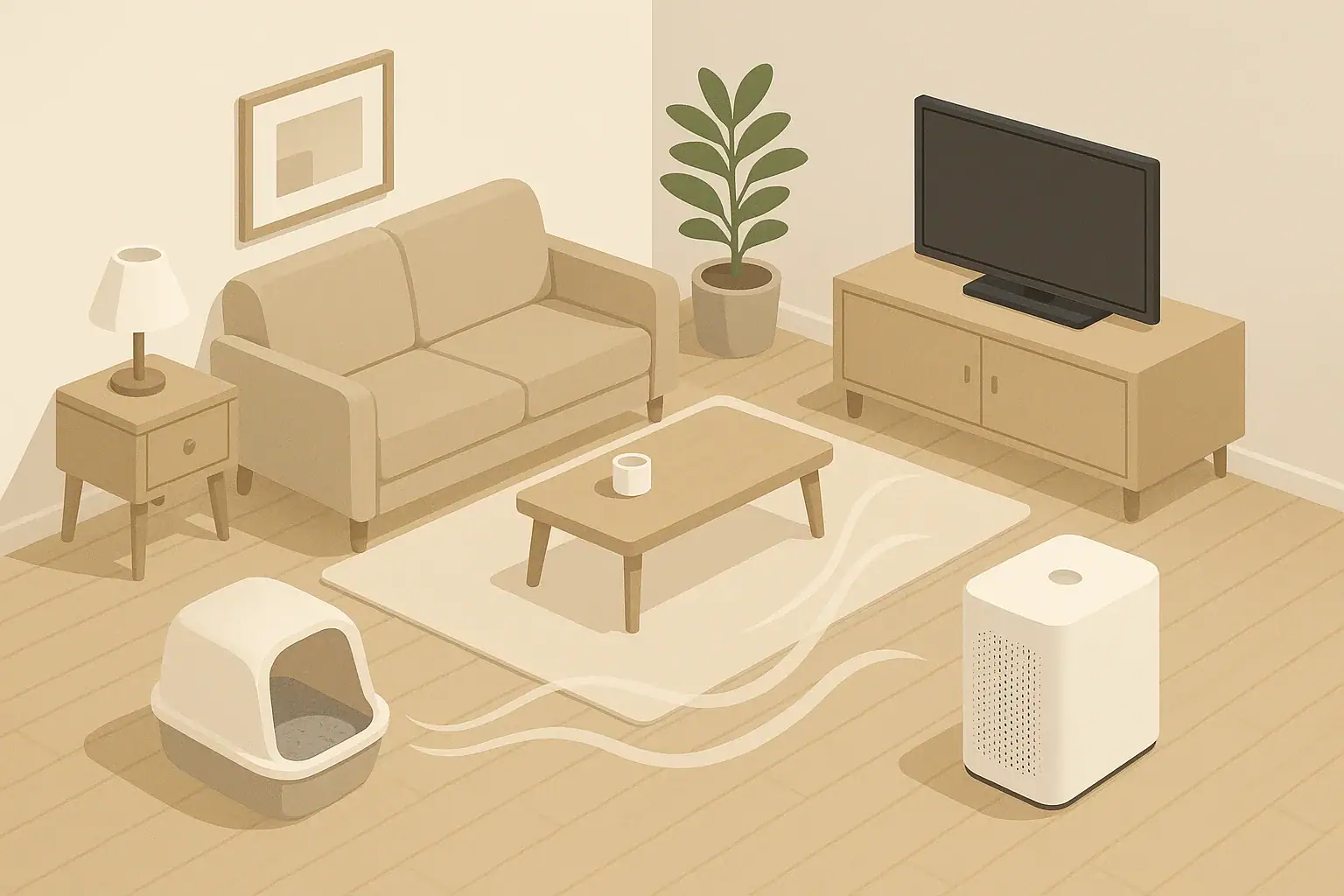
An air purifier for cat litter odor can noticeably reduce urine and feces smells, but only if it has an effective carbon filter, is sized correctly, and is placed well. Litter boxes constantly release odor gases and litter dust, so you are asking the purifier to handle a continuous source, not just the occasional whiff. When you combine a good carbon filter with basic litter box hygiene and some ventilation, you can usually keep the litter area from smelling up the rest of the home.
This guide explains how carbon filters work for cat litter smells, what to look for in an odor-focused air purifier, and how to use it day to day. You will see how factors like room size, airflow, humidity, and filter maintenance all change how well a purifier can control cat box odor. Whether your litter box is in a small bathroom, a laundry room, or a bedroom corner, the same principles apply.
What “Air Purifier for Cat Litter Odor” Really Means and Why It Matters
When people search for an air purifier for cat litter odor, they are usually dealing with a room that smells like urine or a musty litter box even when it looks clean. From an indoor air quality perspective, those smells are mostly gases and very fine particles, not just ordinary dust.
Cat litter smells are largely caused by:
- Ammonia and other nitrogen compounds released as urine breaks down in the box
- Sulfur-containing compounds and VOCs from feces and decomposing organic matter
- Fine litter dust and cat dander stirred up when cats dig or when you pour new litter
Standard particle-only filtration cannot remove most odor molecules. That is why a purifier aimed at litter box odor must include a gas-adsorbing stage, typically an activated carbon filter, in addition to a particle filter such as HEPA.
This matters because it sets expectations. A small, HEPA-only unit might help with visible dust near the litter box but still leave the room smelling like a cat bathroom. To actually reduce odor, you need the right filter media, enough carbon to matter, and enough airflow to pass room air through that carbon many times per hour.
Key Concepts: How Carbon Filters and HEPA Work on Litter Odor
An air purifier for cat litter odor usually combines two main filter types: a particle filter (often HEPA or HEPA-style) and a gas filter (usually activated carbon). Each plays a different role.
HEPA or HEPA-style filters are designed to capture solid particles such as:
- Litter dust kicked up during digging or pouring
- Cat dander and hair fragments
- General household dust circulating through the room
Activated carbon filters are porous materials that adsorb gases onto their internal surface area. For litter odor, they help by:
- Reducing ammonia and related urine gases that cause sharp, eye-watering smells
- Adsorbing sulfur compounds and VOCs from feces and decomposing waste
- Tempering strong scents from scented litters or cleaning products used near the box
Not all carbon filters are equally effective. Thin, lightly coated sheets may provide only short-term improvement near a litter box before they saturate. Thicker beds of pellets or granules usually offer more odor-holding capacity, but they also increase resistance to airflow. The purifier’s fan has to be strong enough to move air through the carbon without losing too much flow.
Airflow concepts also matter:
- Clean Air Delivery Rate (CADR) is a measure of how much filtered air a purifier can deliver. Higher CADR generally means more room air passes through the carbon each hour.
- Air Changes per Hour (ACH) describes how many times per hour the purifier can theoretically filter a room’s entire volume. Litter rooms often benefit from higher ACH than general living spaces.
| Feature | HEPA-style filter | Activated carbon filter |
|---|---|---|
| Main target | Particles: litter dust, dander, hair, fine dust | Gases and VOCs: ammonia, sulfur compounds, scents |
| Visible dust near litter box | Highly effective at capturing fine dust | Minimal impact on visible dust |
| Strong urine or feces odor | Limited; most odor molecules pass through | Effective when carbon amount and contact time are adequate |
| What happens when overloaded | Clogs; airflow drops, noise may increase | Saturates; odor starts passing straight through |
| Typical life in odor-heavy room (illustrative) | 6–18 months depending on dust load | 3–12 months depending on odor intensity and runtime |
| Best role in a litter-area purifier | Core filter for dust and dander reduction | Dedicated odor layer for gas and smell control |
Understanding these roles helps you choose a purifier that does more than just blow air around the litter box. For odor, the carbon stage is non‑negotiable; for overall cleanliness and allergies, the HEPA stage is just as important.
Real-World Setups: How to Use a Purifier Around the Litter Box
How you set up the purifier matters almost as much as which model you buy. The same unit can perform very differently in a cramped bathroom versus an open-plan living room.
Matching purifier size to room and odor level
Think about the room where the litter box lives:
- Small bathroom or closet (under about 60–80 square feet): A compact purifier with modest CADR can work if it runs most of the time and has a decent carbon layer.
- Bedroom or office (around 100–200 square feet): You generally want a mid-size purifier with a stronger fan, since the odor can spread to sleeping or working areas.
- Open living room or combined space: A single purifier right next to the litter box may improve the immediate area but will not completely control odor across the whole zone. In that case, treat the litter corner as a “local problem” and focus on that area first.
In most homes, people aim for several air changes per hour in the litter room. That usually means running the purifier continuously on a low or medium speed instead of only turning it on when the smell is noticeable.
Placement relative to the litter box
Placement can make the difference between a purifier that quietly works in the background and one that barely affects odor.
- Keep the purifier a few feet from the litter box, close enough to intercept the odor plume but not so close that litter dust blows straight into the intake.
- Leave several inches of clearance around the intake and outlet so air can move freely.
- Avoid tucking the purifier behind furniture, under shelves, or in tight corners where airflow is blocked.
- Do not aim a strong outlet stream directly at the litter box; gentle draw across the area is better than a blast of air that disturbs the litter.
Example scenarios
- Litter box in a guest bathroom: Place a small purifier on the floor or a low shelf opposite the toilet, about 3–5 feet from the box. Run it on low all day and briefly on higher speed right after scooping.
- Litter box in a bedroom corner: Put the purifier between the box and the bedroom door so air flows from the box toward the unit instead of toward the bed. Use a quiet or night mode overnight.
- Litter box in a laundry room: Position the purifier so its intake faces the box, with the outlet pointed toward the door. If there is an exhaust fan, let the purifier help clean air before it mixes with the rest of the house.
In all setups, remember that the purifier supplements, but does not replace, basic litter box hygiene and periodic ventilation when outdoor air quality allows.
Common Mistakes and Troubleshooting Cat Litter Odor
If you bought an air cleaner for cat litter smell and the room still seems unpleasant, the problem is often how the purifier is chosen or used, not just the product itself. Recognizing common mistakes can help you troubleshoot.
Frequent mistakes that limit odor control
- Using a HEPA-only purifier: It removes dust and dander but leaves most odor gases untouched.
- Relying on a thin carbon sheet: Very light carbon coatings saturate quickly near a litter box, especially with multiple cats.
- Undersizing the purifier: A small fan in a large or open room cannot move enough air through the carbon to keep up with odor production.
- Placing the purifier too far away: If it sits across the room or in a different area entirely, odor can spread long before air reaches the filter.
- Running it only when you smell something: By the time odor is strong, the room air is already saturated with gases; continuous operation works better.
- Neglecting the litter box itself: Infrequent scooping and rare full litter changes can overwhelm even a well-sized purifier.
Simple troubleshooting cues
Use the symptoms you notice to narrow down what to adjust:
- Odor is strong right at the box but fades a few feet away: Improve scooping frequency and consider a thicker carbon filter. The purifier may be helping the room but not keeping up at the source.
- Odor fills adjacent rooms even with the purifier running: The unit may be undersized or poorly placed. Move it closer to the box and consider a higher CADR or an additional purifier for nearby living spaces.
- Odor used to be controlled but has slowly returned: Carbon is likely saturated. Replace the odor filter stage, and clean pre-filters so airflow stays strong.
- Room feels dusty even though odor is better: Check the HEPA filter and pre-filter for buildup. They may need cleaning or replacement to restore particle control.
| What you notice | Likely cause | Practical next step |
|---|---|---|
| Room smells the same with purifier on or off | No carbon filter or carbon fully saturated | Confirm there is a carbon stage; replace or upgrade to thicker carbon |
| Odor returns quickly after scooping | Continuous odor source overwhelming small purifier | Increase runtime and fan speed; consider higher-CADR unit for that room |
| Purifier exhaust smells like litter box | Carbon bed is loaded with odor molecules | Replace carbon filter; check for clogged pre-filter reducing airflow |
| Cat avoids using the box after purifier is added | Noise or airflow disturbing the cat | Move purifier a bit farther away; use lower fan speed or quiet mode |
| Dusty surfaces near litter box despite purifier | HEPA or pre-filter clogged, or airflow blocked | Clean or replace filters; ensure intake and outlet are unobstructed |
Using these cues, you can usually decide whether you need a stronger purifier, better placement, more frequent filter changes, or simply improved litter box maintenance.
Safety Basics for Using Purifiers Near Litter Boxes
Most portable air purifiers are designed for continuous use in homes, but litter areas introduce extra considerations such as pet behavior, moisture, and cleaning habits.
Filtration technologies and byproducts
Many odor-focused devices advertise extra technologies beyond basic filters. Some of these can create byproducts or add complexity:
- Ozone-generating modes: Ozone can irritate lungs and is not recommended as a primary tool for household odor control, especially in small, enclosed litter rooms.
- Ionizers and similar add-ons: These can change how particles behave in the air. Some users prefer to leave these modes off and rely on mechanical filters and carbon alone.
- UV or other internal lights: These are usually aimed at microorganisms, not odor gases. They do not replace the need for carbon.
When in doubt, treat add-on features as optional. For many homes, simple mechanical filtration plus carbon provides a predictable, low-complexity approach to litter odor.
Placement, cords, and tipping risks
Cats can be curious about new appliances, especially those that hum or move air.
- Route power cords along walls or behind furniture so they are harder to snag during play or zoomies.
- Choose a stable, flat surface for the purifier. Avoid wobbly stands or narrow shelves where a jumping cat could knock it over.
- Keep vents free of litter bags, toys, and storage bins so air can move and the motor does not overheat.
- Unplug the purifier before any internal cleaning or filter changes to avoid electrical hazards.
Interaction with humidity and cleaning products
Humidity and cleaning choices around the litter box can influence both odor and purifier performance.
- Excess humidity can make air feel heavier and odors more noticeable. It can also affect how some carbon filters age over time.
- Very dry air can increase dustiness and static, making litter dust more noticeable even if odor is reduced.
- Strong cleaning chemicals or heavy fragrances near the box add VOCs that the carbon filter must also adsorb, using up capacity that could be spent on litter odor.
Moderate humidity and mild, cat-safe cleaners usually pair best with an odor-focused purifier.
Maintenance and Long-Term Use Around Cat Litter
Because a litter box is a constant odor source, filters near it usually wear out faster than in a typical bedroom or office. Planning for more frequent checks and replacements helps keep performance consistent.
Carbon filter care
Activated carbon has a finite capacity. Once its pores are filled with gases, it stops adsorbing and begins letting odors pass through again.
- Expect shorter replacement intervals in a litter room than the generic schedule printed in the manual for normal use.
- Use your nose as a guide. If odor returns quickly after scooping or you smell litter at the purifier’s exhaust, the carbon stage is likely saturated.
- Whenever possible, replace the carbon component alone rather than discarding the entire filter stack, if the purifier is designed that way.
Pre-filter and HEPA maintenance
Pre-filters trap hair and large dust before it reaches the finer media. In a litter area, they collect cat hair, tracked litter, and general debris quickly.
- Clean washable pre-filters on the schedule suggested by the manufacturer, or more often if visibly dusty.
- Vacuum non-washable pre-filters gently using a brush attachment to remove built-up hair and dust.
- Inspect HEPA filters during each carbon change. If they look heavily gray or clogged, replacement may be due even if the calendar interval is not up.
Keeping upstream filters clean protects the carbon stage by maintaining airflow. Poor airflow means fewer passes of room air through the carbon, which reduces odor control even if the carbon is not yet saturated.
Operating patterns for odor-heavy rooms
Because the litter box never really “turns off,” the purifier strategy should reflect that.
- Run the purifier continuously on a low or medium speed in the litter room to maintain stable odor levels.
- Temporarily increase fan speed right after scooping or when multiple cats have just used the box to handle short-term odor spikes.
- Keep doors either mostly open or mostly closed on a consistent basis so you can better predict how much air the purifier is actually treating.
Over time, you can fine-tune runtime, fan speed, and filter replacement intervals based on how the room smells and how quickly filters load with dust.
Putting It All Together: Practical Takeaways and Specs to Look For
For most homes, the most effective approach to cat litter odor is layered: good litter box hygiene, some ventilation when possible, and a properly chosen air purifier with a meaningful carbon filter close to the box.
In summary, a purifier can:
- Reduce how far and how strongly cat urine and feces odors spread from the litter room
- Cut down on litter dust and dander in the surrounding area
- Make bedrooms, offices, and living rooms with litter boxes more comfortable to spend time in
It cannot completely compensate for a rarely scooped or heavily soiled box, but it can significantly improve baseline air quality when used correctly.
Specs to look for in an air purifier for cat litter odor
When you are comparing options for a litter-area purifier, focus on these practical specifications and features:
- Carbon filter type and amount: Look for a clearly defined odor or gas stage with a substantial layer of carbon (pellets, granules, or a thick block), not just a thin dusting.
- Replaceable carbon stage: Check that the odor filter can be replaced regularly without discarding the entire unit.
- HEPA or high-efficiency particle filter: Essential for capturing litter dust, dander, and general indoor particles.
- Appropriate CADR for your room size: Choose a unit that can provide several air changes per hour in the specific room where the litter box sits.
- Multiple fan speeds: Helpful for running quietly most of the time and boosting airflow after scooping or during heavy use.
- Low to moderate noise levels on working speeds: Especially important if the litter box is in a bedroom or if your cat is noise-sensitive.
- Good airflow design: Intakes and outlets should not be easy to block, and the unit should not require tight corners for placement.
- Simple filter access: Filters should be easy to reach and change so you actually keep up with maintenance.
- No reliance on ozone-generating modes for odor control: Mechanical filtration plus carbon is usually the safer, more predictable choice.
If you match these specs to your room size, number of cats, and litter box location, an air purifier with a solid carbon filter can become a reliable part of your long-term strategy for managing cat litter odor and improving indoor air quality.
Frequently asked questions
Which features make an air purifier effective against cat litter odor?
An effective unit couples a meaningful activated carbon stage (pellets, granules, or a thick block) with a true HEPA particle filter and enough CADR or airflow for the room size. Replaceable carbon stages, multiple fan speeds, and straightforward filter access help maintain long-term odor control.
Why doesn’t my HEPA-only purifier remove the litter box smell?
HEPA filters capture particles like dust and dander but do not remove most odor-causing gas molecules such as ammonia or sulfur compounds. For smells you need a carbon or other gas-adsorbing stage with sufficient capacity and contact time.
Is it safe to use ozone-generating or ionizer modes near a litter box?
Ozone-generating modes are not recommended for occupied indoor spaces because ozone can irritate the respiratory system; they are especially inappropriate in small, enclosed litter rooms. Many users prefer to rely on mechanical filtration and carbon rather than ionizers or ozone-producing features.
How often should carbon and HEPA filters be replaced when the purifier is near a litter box?
Replacement intervals are typically shorter than manufacturer estimates for normal use: carbon filters in odor-heavy areas may need replacing every few months, and pre-filters or HEPA elements should be inspected regularly and replaced when visibly loaded. Use smell and airflow (and the purifier’s indicators, if available) as practical cues.
Can an air purifier completely eliminate odor from a rarely cleaned litter box?
No. An air purifier can reduce how far and how strongly odors spread but cannot substitute for regular scooping and litter changes; a heavily soiled box will overwhelm any realistic purifier. Treat filtration as part of a layered strategy including hygiene and ventilation.
- Clear sizing logic (room size → CADR/ACH)
- HEPA vs carbon explained for real use-cases
- Humidity + ventilation basics to reduce mold risk