
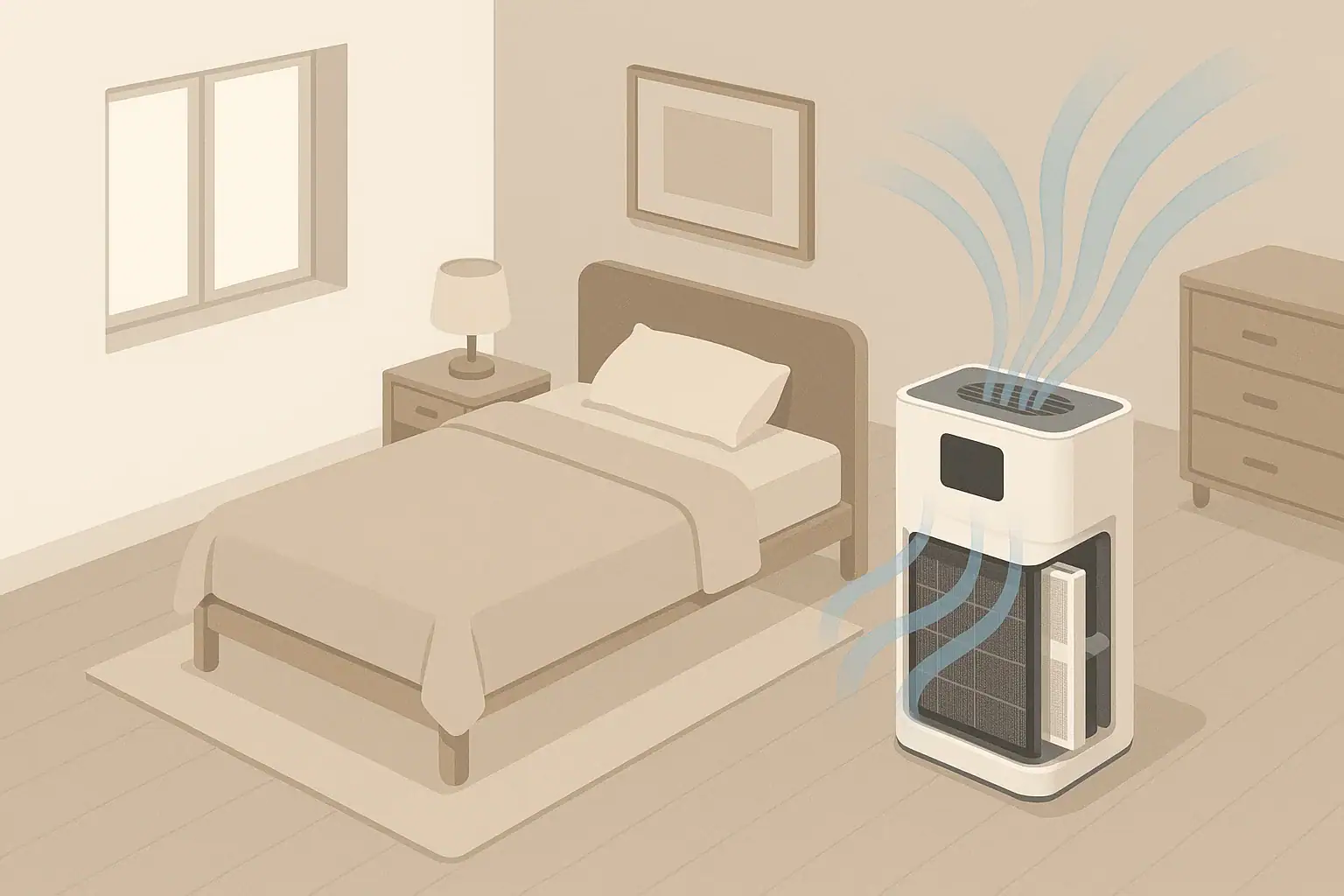
The best air purifiers for allergies are units with a high enough CADR for your room, a true HEPA filter, and at least a basic activated carbon layer for odors and gases. When these three pieces are sized and used correctly, an air cleaner can noticeably lower airborne pollen, dust, pet dander, and mold spores in the spaces where you spend the most time.
This guide explains how to read CADR ratings, what “true HEPA” really means, and when carbon filters matter so you can match a purifier to your allergy triggers and room size. Instead of generic advice, you will see concrete room examples, simple calculations, and common mistakes to avoid.
Use this as a practical buying and setup checklist for allergy air purifiers in bedrooms, nurseries, home offices, and open living areas, whether you are dealing with seasonal allergies, pet allergies, or allergic asthma.
What Allergy Air Purifiers Do and Why CADR, HEPA, and Carbon Matter
An allergy-focused air purifier is a portable appliance that pulls room air through filters to remove airborne particles and some gases. For allergies, the main goal is to reduce your exposure to inhaled triggers while you are indoors, especially during sleep and long periods in one room.
Indoor air regularly contains a mix of allergens and irritants:
- Pollen that drifts indoors through doors, windows, or on clothing
- Pet dander and saliva proteins from cats, dogs, and other animals
- Dust mite debris and fragments from insect pests
- Mold spores from damp areas or outdoor air
- Fine particles from cooking, candles, or outdoor pollution (PM2.5)
Three core specs determine how well an air purifier can handle this mix:
- CADR (Clean Air Delivery Rate) – how quickly the purifier can reduce particle levels in a given room size.
- True HEPA filtration – how efficiently it captures very small allergen particles and fine dust.
- Activated carbon – how effectively it reduces odors and some gases that can irritate sensitive airways.
When CADR is matched to room size, the HEPA filter is genuinely high efficiency, and carbon capacity fits your odor and gas concerns, an air purifier becomes a strong support tool alongside cleaning, humidity control, and medical treatment.
Key Concepts: CADR, HEPA Filtration, and Activated Carbon
Understanding a few technical terms makes it much easier to compare air purifiers for allergies without relying on marketing language.
CADR: How Much Clean Air You Actually Get
CADR is a standardized measure of how quickly an air purifier reduces three types of particles in a test room: smoke (very fine), dust, and pollen (larger). Each CADR value is expressed in cubic feet per minute (CFM). Higher numbers mean more filtered air per minute and faster cleanup after a spike in allergens.
For allergies, CADR connects directly to how many air changes per hour (ACH) you get in a room. ACH tells you how many times per hour the purifier can process a volume of air equal to the room volume. A useful target for allergy relief is:
- 4–5 ACH for typical seasonal or dust allergies
- 5–8 ACH for more severe allergies or allergic asthma in bedrooms
To estimate the CADR you need, you can use a simple formula:
- Room volume (cubic feet) = length × width × ceiling height
- Required CADR (CFM) ≈ room volume × desired ACH ÷ 60
| Room type | Approx. size (ft²) | Ceiling height (ft) | Target ACH for allergies | Estimated CADR needed (CFM) |
|---|---|---|---|---|
| Small bedroom | 120 | 8 | 5 ACH | ≈ 80 CFM |
| Medium bedroom | 180 | 8 | 5 ACH | ≈ 120 CFM |
| Large living room | 300 | 9 | 4 ACH | ≈ 180 CFM |
| Open studio space | 450 | 9 | 4 ACH | ≈ 270 CFM |
For allergies, the smoke CADR is usually the most useful single number because it reflects performance on small, hard-to-capture particles similar in size to many allergen fragments and pollution.
True HEPA Filtration: The Core of Allergy Performance
HEPA (High Efficiency Particulate Air) filters are dense mats of fibers designed to capture tiny particles as air passes through. For allergy relief, look for:
- True HEPA or equivalent high-efficiency rating – designed to capture a very high percentage of fine particles at a specified small size.
- Clear efficiency data – published filtration efficiency at small particle sizes, not just vague “HEPA-type” or “HEPA-style” claims.
HEPA filters trap allergens using three main mechanisms:
- Interception – particles follow the airflow and brush against fibers, sticking to them.
- Impaction – larger particles (like pollen) cannot follow the air stream around fibers and collide with them.
- Diffusion – very small particles move randomly and are more likely to hit and stick to fibers.
The combination allows a good HEPA filter to capture pollen grains, pet dander, mold spores, and fine dust mite debris that remain suspended in air.
Filter Seals and Housing: Preventing Bypass Leaks
Even a high-grade HEPA filter can underperform if air leaks around it instead of being forced through it. For allergies, system design matters almost as much as the filter media itself. Helpful design cues include:
- Gaskets or foam seals around the filter edges
- Rigid frames and secure latches that keep filters seated tightly
- Consistent CADR ratings that confirm the fan, housing, and filter work well together
Activated Carbon: Comfort and Odor Control
Activated carbon is a porous material that adsorbs certain gases and odors. It does not remove solid allergens like pollen or dust, but it can improve comfort for people whose symptoms are triggered or worsened by smells or chemical irritants.
Common uses of carbon filters include:
- Reducing pet, cooking, or musty odors
- Lowering some volatile organic compounds (VOCs) from paints, cleaning products, or new furnishings
Carbon filters come in different forms:
- Thin coated sheets – lightweight, basic odor control.
- Thicker granular or pellet carbon – more capacity for persistent odors and gases.
If your main issue is sneezing and congestion from pollen or dust, a simple carbon layer is usually enough. If you also react strongly to smells or fumes, a thicker carbon stage can be more useful.
Real-World Allergy Scenarios and How to Size a Purifier
Translating specs into everyday use makes it easier to choose the right purifier for allergies in your home.
Example 1: Seasonal Allergies in a Small Bedroom
Room: 10 ft × 12 ft bedroom with an 8 ft ceiling (960 cubic feet). The sleeper has strong spring pollen allergies and wakes up congested.
- Target ACH: 5–6 (because the bedroom is used 7–9 hours per night).
- CADR calculation: 960 × 5 ÷ 60 ≈ 80 CFM minimum.
- Practical choice: a purifier with a smoke CADR in the 100–150 CFM range so it can run on a medium or low setting overnight and still hit the target ACH.
- Other factors: quiet operation on medium speed, true HEPA filter, basic carbon layer for musty or outdoor odors.
Example 2: Pet Allergies in an Open Living Area
Room: Combined living and dining area of 18 ft × 20 ft with a 9 ft ceiling (3,240 cubic feet). A dog or cat spends most of the day here.
- Target ACH: at least 4 to keep dander and hair fragments under control.
- CADR calculation: 3,240 × 4 ÷ 60 ≈ 216 CFM.
- Practical choice: a purifier with a smoke CADR around 250–300 CFM to compensate for open doorways and occasional high shedding.
- Other factors: large true HEPA filter, stronger pre-filter to catch hair and larger dust, more substantial carbon if pet odor is a concern.
Example 3: Dust and Mold Sensitivity in a Home Office
Room: 11 ft × 14 ft office with a 9 ft ceiling (1,386 cubic feet), located near a bathroom with occasional humidity issues. The user has dust mite and mold sensitivities and spends most of the workday here.
- Target ACH: 5–6 because of long daily exposure.
- CADR calculation: 1,386 × 5 ÷ 60 ≈ 116 CFM.
- Practical choice: a purifier with smoke CADR around 150–200 CFM to allow quieter operation and handle occasional spikes when doors are opened.
- Other factors: continuous operation on low or medium, attention to humidity control in the adjacent bathroom, and regular cleaning to manage settled dust.
Placement Tips in Real Rooms
Across these examples, placement makes a noticeable difference:
- In bedrooms, position the purifier within a few feet of the bed, not buried in a corner behind furniture.
- In living rooms, place it where airflow is not blocked by sofas or cabinets, ideally near the center of activity.
- Keep a few inches of clearance on all sides of the intake and outlet so the fan can circulate air effectively.
- Run the unit continuously on a comfortable speed instead of only turning it on when symptoms flare.
| Situation | Key allergy trigger | Helpful purifier settings | Notes |
|---|---|---|---|
| Spring pollen in bedroom | Pollen, outdoor dust | Medium during day, low at night | Close windows; start purifier 1–2 hours before bedtime. |
| Pet dander in living room | Pet dander, hair | Medium or high when pets are active | Use brush or vacuum on furniture to reduce settled dander. |
| Dusty home office | Dust mite debris | Continuous low or medium | Combine with weekly dusting and HEPA vacuuming. |
| Musty basement room | Mold spores, odors | Medium, 24/7 | Address moisture source; purifier cannot fix dampness alone. |
Common Mistakes That Reduce Allergy Relief
Even a high-quality air purifier can give disappointing results if it is used incorrectly. Watching for these issues can help you troubleshoot weak performance.
Using a Purifier That Is Too Small for the Room
Symptom: Allergy symptoms improve only slightly, or only when you sit very close to the purifier.
Likely cause: CADR is too low for the room volume, especially in open floor plans or rooms with high ceilings.
Fix: Recalculate room volume, check the purifier’s smoke CADR, and aim for at least 4–5 ACH. In some cases, it is more effective to move an undersized unit into a smaller room (like a bedroom) and add a second unit for larger spaces.
Running on the Quietest Setting Only
Symptom: Air still feels dusty after cooking, cleaning, or opening windows; allergy flares after these activities.
Likely cause: The fan stays on the lowest speed, which may not provide enough airflow to handle spikes in allergens.
Fix: Use medium or high speed for 30–60 minutes after high-particle activities, then drop back to a quieter setting. If noise is still an issue, consider a purifier with a higher CADR so it can deliver more clean air at lower noise levels.
Blocking Airflow with Furniture or Clutter
Symptom: The purifier runs, but dust seems to settle nearby and air in the rest of the room does not feel cleaner.
Likely cause: The intake or outlet is blocked by a wall, curtain, or furniture, creating a small pocket of cleaned air instead of circulating through the whole room.
Fix: Move the unit so air can flow freely around it, and avoid pushing it directly against walls or into tight corners unless the design specifically allows it.
Ignoring Filter Replacement and Pre-Filter Cleaning
Symptom: Airflow feels weaker over time, noise increases, or odors linger even when the purifier is on.
Likely cause: Clogged pre-filters or HEPA filters restricting airflow and reducing effective CADR.
Fix: Follow the recommended replacement schedule, clean washable pre-filters on time, and pay attention to filter indicator lights or noticeable discoloration.
Expecting the Purifier to Handle All Allergens
Symptom: Allergy symptoms persist despite good purifier specs and continuous operation.
Likely cause: Large amounts of allergens remain in carpets, bedding, and soft furnishings, or there are ongoing moisture problems feeding mold growth.
Fix: Combine air purification with regular vacuuming (ideally with a HEPA vacuum), washing bedding in hot water, using dust mite covers, and controlling indoor humidity.
Safety Basics When Using Air Purifiers for Allergies
Most mechanical HEPA and carbon-based air purifiers are straightforward to use safely, but a few details matter for people with respiratory conditions.
Be Cautious with Ozone and Certain Add-On Technologies
Some devices incorporate ionizers, plasma, or other technologies that can produce small amounts of ozone or byproducts. For people with asthma or sensitive lungs, even low-level ozone can be irritating.
- Prefer units that focus on mechanical filtration (pre-filter, HEPA, carbon) as the primary cleaning method.
- If a purifier has an ionizing or similar mode, check whether it can be turned off and rely on the HEPA and carbon stages instead.
Placement and Electrical Safety
Basic electrical safety helps avoid accidents:
- Place the purifier on a stable, level surface where it cannot be easily knocked over.
- Avoid running the cord under rugs or where it can be pinched by furniture.
- Keep the unit and cord away from standing water, humidifiers that can spill, and very wet areas.
Filter Handling and Dust Exposure
When you change filters, you are handling material that has captured a lot of dust and allergens.
- Turn the purifier off and unplug it before opening the housing.
- Remove filters slowly to avoid shaking loose dust back into the room.
- Consider wearing a simple mask or positioning yourself upwind if you are highly sensitive.
- Place used filters directly into a trash bag, seal it, and dispose of it promptly.
Children, Pets, and Air Outlets
For homes with children or pets:
- Choose locations where curious hands or paws cannot easily block vents.
- Ensure outlet grilles are secure and small enough that fingers cannot reach moving fan blades.
- Do not place the purifier where pets are likely to chew the cord or knock the unit over.
Maintenance and Long-Term Use for Allergy Control
Consistent, low-effort maintenance keeps an allergy air purifier working at close to its rated CADR for years.
Typical Filter Lifespans
Actual lifespans depend on dust levels, smoking, pets, and fan speed, but general ranges look like this:
- Pre-filters: clean or replace every 1–3 months.
- Carbon filters: replace every 3–12 months, depending on thickness and odor load.
- HEPA filters: replace every 6–24 months, depending on usage hours and dust levels.
Simple Maintenance Routine
A basic schedule for an allergy-focused purifier might include:
- Monthly: vacuum or wash pre-filter (if washable), wipe dust from the housing and vents.
- Every 3–6 months: check carbon filter for odor breakthrough or discoloration.
- Annually or as indicated: replace HEPA filter when airflow drops or indicator lights signal.
Recognizing When Performance Is Dropping
You do not need instruments to spot many performance issues. Common signs include:
- Airflow from the outlet feels weaker at the same fan speed.
- The unit sounds strained or louder than usual.
- Odors linger longer than they used to with the purifier running.
- Allergy symptoms worsen even though your routine has not changed.
Storage and Seasonal Use
Some people run purifiers mainly during peak allergy seasons and store them the rest of the year. If you do this:
- Clean or replace filters before storage so the unit does not sit full of damp dust.
- Store in a dry, indoor space to avoid moisture damage or mold growth in the filter media.
- When you bring it back out, inspect filters for any musty smell or visible mold spots and replace if needed.
| Maintenance task | Suggested frequency | What to look for | Action if there is a problem |
|---|---|---|---|
| Clean pre-filter | Every 1–3 months | Visible dust layer, reduced airflow | Vacuum or wash (if allowed) and let dry completely. |
| Check carbon filter | Every 3–6 months | Persistent odors, dark discoloration | Replace if odors break through quickly. |
| Replace HEPA filter | Every 6–24 months | Clogged appearance, weak airflow, indicator light | Install a new HEPA filter; do not wash unless explicitly allowed. |
| Clean housing and vents | Monthly | Dust buildup on grilles | Wipe with a dry or slightly damp cloth; avoid getting water inside. |
Putting It All Together: Practical Takeaways and Specs to Look For
When you line up CADR, true HEPA filtration, carbon capacity, and room size, an air purifier can be a strong part of your allergy management plan. The goal is not perfection, but noticeably lower airborne allergen levels in the rooms where you sleep and spend the most time.
Use the points below as a quick reference when comparing models or checking whether your current purifier is set up effectively.
Quick Specs to Look For in an Allergy Air Purifier
- Room match: Calculate your room volume and target at least 4–5 air changes per hour based on the purifier’s smoke CADR.
- True HEPA filter: Look for clearly stated high-efficiency filtration, not just “HEPA-type” wording.
- Sealed design: Filters that seat firmly with gaskets or tight frames to minimize air leaks around the filter.
- Carbon stage: At least a basic carbon layer for general odors; thicker carbon if you are sensitive to smells or VOCs.
- Noise levels: A fan speed that delivers your target ACH at a noise level you can tolerate overnight (often in the low-to-mid 30 dB range for bedrooms).
- Multiple speeds or auto mode: Ability to run higher during the day or during spikes, then lower at night.
- Filter access and cost: Easy-to-access filters with clear replacement intervals and reasonable long-term cost.
- Physical size and placement: Footprint that fits the room while allowing several inches of clearance for airflow.
Combined with regular cleaning, humidity control, and medical guidance, a well-chosen and properly sized allergy air purifier can significantly reduce airborne triggers such as pollen, dust, pet dander, and mold spores, helping you breathe more comfortably indoors throughout the year.
Frequently asked questions
Which specs and features matter most when choosing an air purifier for allergies?
Focus on a high enough smoke CADR for the room to achieve 4–8 ACH, a true HEPA filter with published efficiency, and a sealed housing to prevent bypass. Noise levels, multiple fan speeds, and at least a basic carbon layer for odors are also useful practical features.
Can running an air purifier only on its quietest setting reduce its effectiveness?
Yes. The lowest fan speed may not move enough air to reach your target ACH, especially after activities that spike particles (cooking, cleaning). Run a higher speed for 30–60 minutes after spikes, then reduce to a quieter setting for continuous use.
Are ozone-producing air cleaners safe for people with respiratory conditions?
Ozone and some ionizing technologies can irritate lungs and worsen asthma or allergies, so mechanical filtration (pre-filter, HEPA, carbon) is generally safer. If a unit has an ionizer or ozone mode, use the HEPA/carbon stages without that mode for sensitive individuals.
How often should I replace filters to keep allergy protection effective?
Typical schedules are: clean pre-filters every 1–3 months, replace carbon filters every 3–12 months depending on odor load, and replace HEPA filters every 6–24 months based on use and dust levels. Watch airflow, odor breakthrough, and indicator lights to adjust timing for your environment.
Where is the best place to put an air purifier for allergy relief?
Place it near where you spend most time (for bedrooms, within a few feet of the bed; for living rooms, near the central activity area), keep intake and outlet clear of obstructions, and allow several inches of clearance on all sides. Continuous operation on an appropriate setting improves steady protection.
Do I need a carbon filter if my main issue is pollen or dust?
Carbon filters do not remove pollen or dust but can help with odors and some gases that worsen symptoms for sensitive people. If your primary triggers are pollen and dust, prioritize HEPA and CADR; add carbon if odors or VOCs are also a concern.
- Clear sizing logic (room size → CADR/ACH)
- HEPA vs carbon explained for real use-cases
- Humidity + ventilation basics to reduce mold risk